How To Follow Up On A Quote Without Sounding Desperate
Most quotes die in silence, not rejection. Here is the exact follow-up cadence, timing, and templates that get a buyer to answer yes or no instead of ghosting you.
TL;DR
- Most quotes do not get rejected — they get ignored. Silence is a process failure, not a verdict.
- Send the first follow-up 48-72 hours after the quote lands, then space touches at day 5, day 10, day 17, and a final breakup at day 30.
- Every follow-up must add something: a case study, a clarified line item, a deadline, a risk removed. "Just checking in" is why you get ghosted.
- Multi-thread. Quotes stall because the person you emailed is not the person who signs, and you never found the other three.
- Before you blame your copy, verify the email actually lands. A bounced quote follow-up looks identical to a rejection from your side of the inbox.
You sent the quote. You felt good about the call. Then nothing — for eleven days.
This is the most expensive stretch of the entire sales cycle, because you have already paid every cost: discovery time, scoping, pricing approval, the proposal doc. The only thing standing between that work and revenue is a follow-up sequence most reps improvise badly.
Here is what actually works, with timing, templates, and the operational stuff nobody mentions.
Why do quotes go silent instead of getting a "no"?#
Buyers rarely say no. Saying no requires a decision, and a decision requires internal alignment they have not built yet.
Four real reasons your quote is sitting in limbo:
- The champion lost the internal argument — or has not started it. Your quote is one line in a budget conversation happening without you.
- Priorities shifted. A reorg, a hiring freeze, a competitor's outage. The project that mattered in March is invisible in April.
- Your quote raised a question they cannot answer alone. An implementation line item, a term in the MSA, a per-seat cost that scales worse than they expected.
- They never received it. Spam filter, wrong address, a person who left the company two weeks earlier.
Reason four is more common than reps believe. According to HubSpot's sales research, a large share of deals classified as "no response" involve contact-data problems rather than genuine disinterest. If you built your contact list from a scraped export or a stale CRM record, some percentage of your "ghosting" is a delivery problem wearing a psychology costume.
What is the right follow-up cadence after sending a quote?#
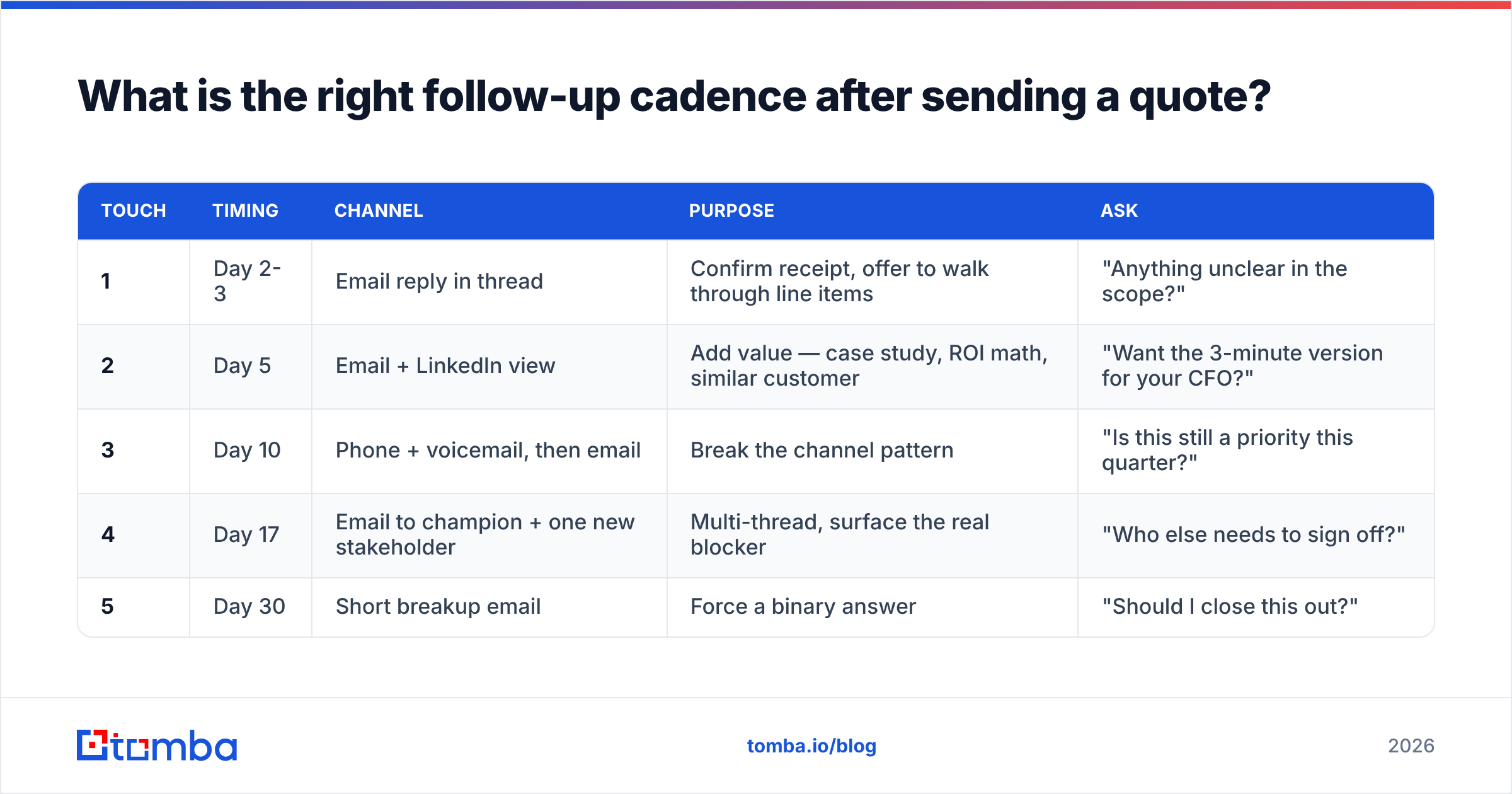
Five touches over 30 days. Not three, not fifteen.
The logic: B2B buying committees average six to ten people, and the quote has to physically travel through several of them. Too few touches and you fall off the list before it circulates. Too many and you train them to ignore your name.
| Touch | Timing | Channel | Purpose | Ask |
|---|---|---|---|---|
| 1 | Day 2-3 | Email reply in thread | Confirm receipt, offer to walk through line items | "Anything unclear in the scope?" |
| 2 | Day 5 | Email + LinkedIn view | Add value — case study, ROI math, similar customer | "Want the 3-minute version for your CFO?" |
| 3 | Day 10 | Phone + voicemail, then email | Break the channel pattern | "Is this still a priority this quarter?" |
| 4 | Day 17 | Email to champion + one new stakeholder | Multi-thread, surface the real blocker | "Who else needs to sign off?" |
| 5 | Day 30 | Short breakup email | Force a binary answer | "Should I close this out?" |
Two rules that matter more than the grid:
- Reply in the original thread for touches 1 and 2. The quote is attached there. Making them dig for it adds friction at the exact moment you are trying to remove it.
- Change channel by touch 3. If four emails have failed, a fifth email is not the answer. Pick up the phone. Reps who add a call to their follow-up sequence consistently outperform email-only reps on response rate — largely because a voicemail plus an email in the same hour reads as a real human, not an automation.
How do you write a quote follow-up that gets a reply?#
Every follow-up needs a reason to exist that is not "I want money."
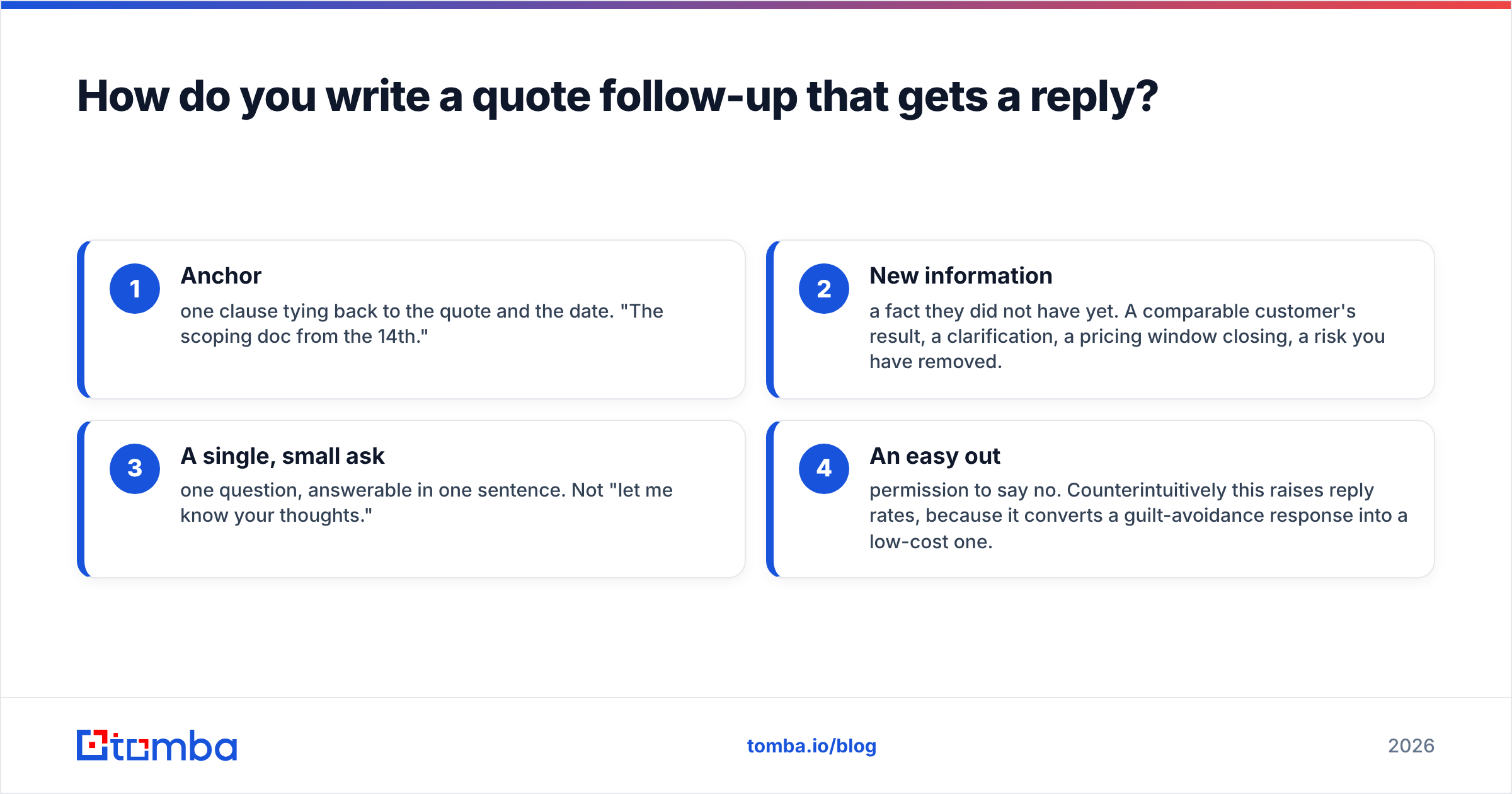
Structure each message in four lines:
- Anchor — one clause tying back to the quote and the date. "The scoping doc from the 14th."
- New information — a fact they did not have yet. A comparable customer's result, a clarification, a pricing window closing, a risk you have removed.
- A single, small ask — one question, answerable in one sentence. Not "let me know your thoughts."
- An easy out — permission to say no. Counterintuitively this raises reply rates, because it converts a guilt-avoidance response into a low-cost one.
Template: Touch 1 (Day 2-3)#
Subject: (reply in original thread)
Hi Dana — sending the quote back to the top of your inbox.
The one line people usually have questions about is the onboarding fee. It covers data migration and the two admin training sessions; it drops to zero if your team handles migration in-house. Happy to re-issue either version.
Which way do you want it?
Template: Touch 3 (Day 10, after a voicemail)#
Subject: Quick one on the Q3 rollout
Hi Dana — left you a voicemail. Short version: a company about your size ran the same rollout last quarter and hit break-even in seven weeks. Happy to send the two-page write-up if that's useful for the internal case.
Is this still on the roadmap for Q3, or has it slipped? Either answer is fine — it just changes what I send you next.
Template: Touch 5 (Day 30, the breakup)#
Subject: Closing this out?
Hi Dana — I haven't heard back, which usually means the timing isn't right. Totally fine.
I'm going to close this out on my end unless you tell me otherwise. If it resurfaces next quarter, the pricing in the quote holds through December.
Should I close it?
The breakup email is the single highest-reply-rate message in most sequences. Loss aversion does the work. Do not weaponize it — do not fake-close a deal you will keep chasing, because you only get to use it once per relationship.
If you want a starting library rather than writing from scratch, Tomba's cold email templates cover the adjacent patterns, and the subject line tester is worth 30 seconds before touch 3 — quote follow-ups die on subject lines that read like invoices.
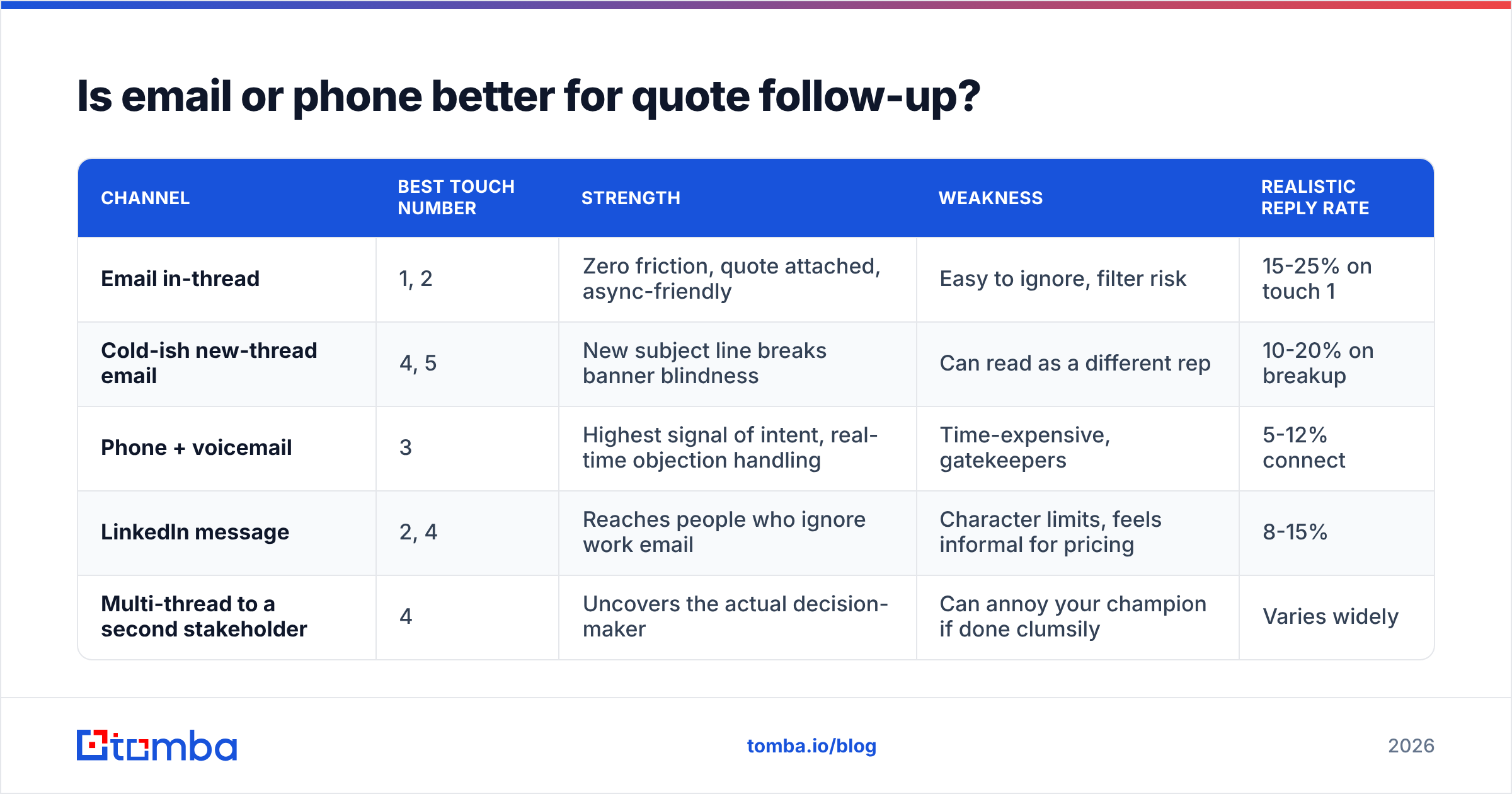
Is email or phone better for quote follow-up?#
Neither alone. The combination beats both.
| Channel | Best touch number | Strength | Weakness | Realistic reply rate |
|---|---|---|---|---|
| Email in-thread | 1, 2 | Zero friction, quote attached, async-friendly | Easy to ignore, filter risk | 15-25% on touch 1 |
| Cold-ish new-thread email | 4, 5 | New subject line breaks banner blindness | Can read as a different rep | 10-20% on breakup |
| Phone + voicemail | 3 | Highest signal of intent, real-time objection handling | Time-expensive, gatekeepers | 5-12% connect |
| LinkedIn message | 2, 4 | Reaches people who ignore work email | Character limits, feels informal for pricing | 8-15% |
| Multi-thread to a second stakeholder | 4 | Uncovers the actual decision-maker | Can annoy your champion if done clumsily | Varies widely |
The multi-thread row deserves a caveat. Going around your champion without telling them is how you lose a deal permanently. The clean version: tell the champion first. "Would it help if I sent the ROI summary directly to your finance lead, or would you rather forward it?" That single question either gets you the name or tells you your champion has no internal traction — both useful.
When you do need that second contact and your champion will not hand it over, a domain search on the company will surface the other people on the team and their email pattern, which beats guessing at firstname@ and hoping.
What should you do when the contact has gone completely dark?#
Assume a data problem before you assume disinterest. Run through this in order:
- Check the bounce. Soft bounces and quarantined mail often do not surface in a CRM. If your last three emails to that address produced zero opens and zero bounces, that pattern itself is suspicious.
- Verify the address is still live. People change jobs constantly; B2B contact data decays roughly 25-30% per year. Running the address through an email verifier takes seconds and tells you whether you are talking to a mailbox or a void.
- Check whether they left the company. A quick LinkedIn check plus a reverse email lookup tells you if your champion moved on — in which case the deal is not dead, it is orphaned, and someone inherited their projects.
- Find the successor. Whoever took over the function is now your buyer, and they have no idea a quote exists.
- Re-enter the account, not the thread. New contact, new context, reference the prior work: "Your predecessor and I scoped this in March — here's the two-line summary."
That third step catches a genuinely surprising number of "lost" deals. A quote sent to someone in their notice period never had a chance, and no amount of follow-up copy fixes it.
How do you follow up without sounding desperate?#
Desperation is a structural tell, not a tonal one. Buyers detect it from four signals:
- Frequency without new information. Three emails in five days that each say "circling back" reads as pressure. Three emails over three weeks that each add a fact reads as diligence.
- Escalating apology. "Sorry to bother you again" stacked across messages signals you believe you are an imposition. Drop it entirely after touch 1.
- Unprompted discounting. Offering 15% off in touch 3 tells the buyer your first price was fiction and teaches them that waiting is profitable. Hold price; change scope instead if you need movement.
- Open-ended asks. "Let me know your thoughts" puts the work on them. One specific question puts the work on you.
The tonal fix is simple: write like the deal happening or not happening does not change your quarter. Whether or not that is true, it is the register that gets replies. Confidence in follow-up correlates with a higher win rate for exactly this reason — it signals that other customers exist.
One more thing on cadence discipline: log every touch. If you cannot see, at a glance, that touch 3 went out on the 14th, you will either double-send or drop the thread entirely. Gartner's research on B2B buying consistently finds that buyers spend the majority of the purchase cycle not talking to any vendor — which means the vendor who is still present, calmly, at week four wins by attrition more often than by persuasion.
What tools make quote follow-up less manual?#
Three categories, in order of impact.
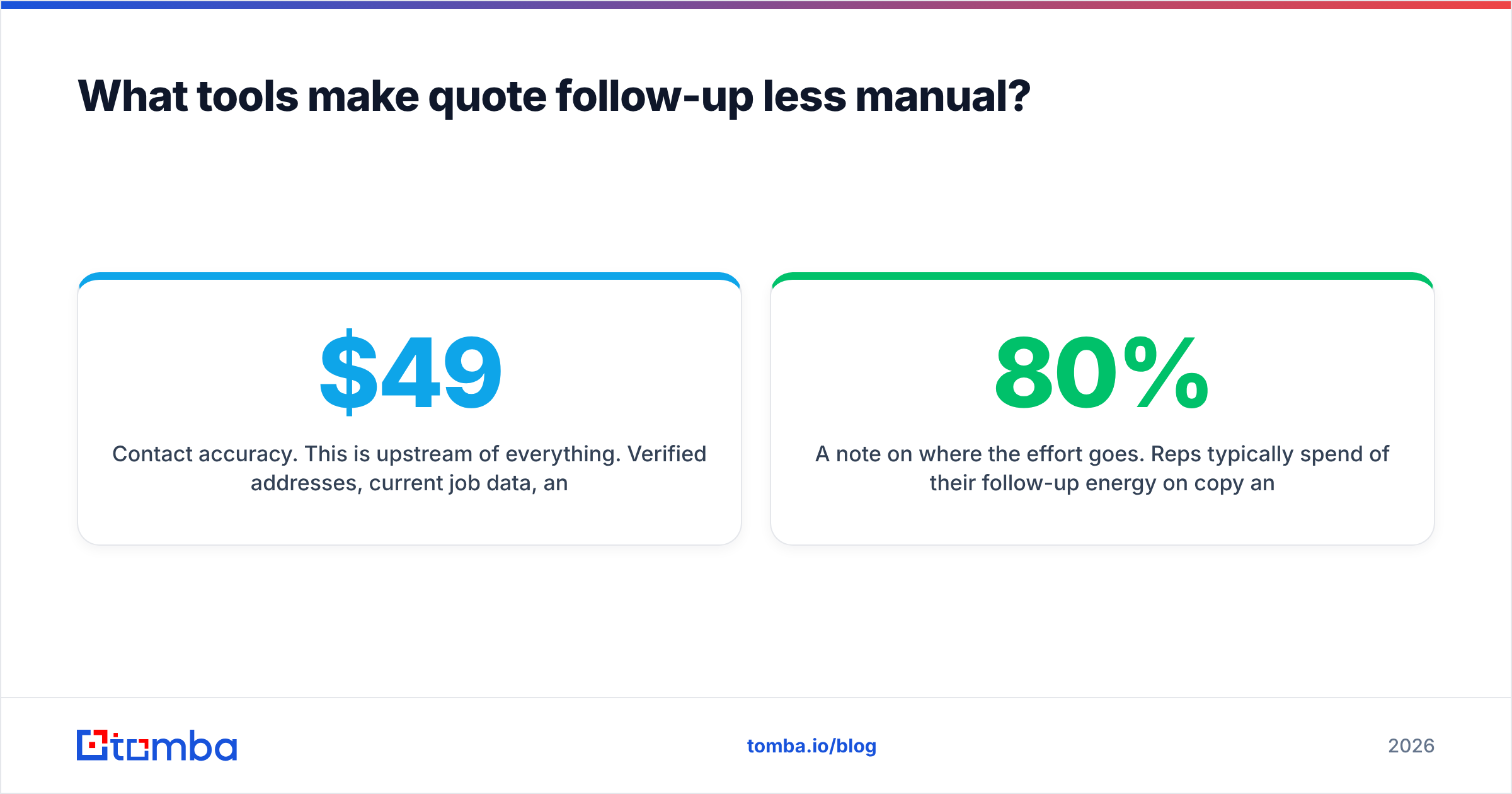
Contact accuracy. This is upstream of everything. Verified addresses, current job data, and a second stakeholder on every account. Tomba's data enrichment fills in the fields your CRM left blank, and the email finder gets you the finance or ops contact your champion has not introduced you to. Tomba's plans run Free (25 searches/month), Starter at $49/mo, Growth at $99/mo, and Pro at $249/mo — see Tomba pricing for the full breakdown.
Sequence execution. Any of the mainstream sales engagement platforms will schedule and log your five touches. The feature that matters is auto-pause on reply — nothing kills a warm deal faster than an automated touch 4 landing the morning after they wrote back.
CRM hygiene. Whichever CRM you run, the follow-up cadence has to live in it as tasks, not in your head. Salesforce and HubSpot both support quote-stage task automation natively; use it.
A note on where the effort goes. Reps typically spend 80% of their follow-up energy on copy and 20% on contact data. Invert it. A mediocre follow-up to the right verified person outperforms a brilliant one to a dead mailbox every single time — and the second scenario is invisible to you, which is what makes it dangerous.
What does a good quote follow-up process look like end to end?#
Six steps, repeatable per deal:
- Verify before you quote. Confirm the recipient's address is live and that they are still at the company. Two seconds now, weeks saved later.
- Send the quote with a next step baked in. "I'll follow up Thursday unless I hear from you first" makes touch 1 expected rather than intrusive.
- Run the 5-touch cadence over 30 days, each touch carrying new information.
- Multi-thread at touch 4 — with your champion's knowledge, ideally with their blessing.
- Break up at day 30 and mean it. Move the deal to closed-lost with a re-engage date.
- Re-engage at 90 days with a genuine trigger: a new feature, a case study in their vertical, a pricing change, a funding announcement on their side.
Step six is where most pipelines leak value. A closed-lost quote is a warm lead with full context attached. Most reps never touch it again.
Where should you start?#
Start with the boring half: make sure your follow-ups are reaching a real, current human. Fix the data problem and a meaningful chunk of your "ghosting" turns out to have been a routing problem all along.
Run your open quotes through the Tomba Email Finder to confirm each contact is live, pull a second stakeholder on every account over your average deal size, and enrich the records with current titles so touch 4 goes to someone who can actually approve the spend. The free tier gives you 25 searches a month to test the workflow on your stalled deals before committing to a plan — which is exactly enough to find out how many of your dead quotes were never dead.
Related guides#
// get started
Find, verify and enrich your first contacts today
Start on the free plan with 25 searches a month, then scale when your team is ready.
Free plan · No credit card required · GDPR & CCPA
Get the Tomba newsletter
Product and data updates
// about the author