How To Follow Up With A Client Without Being Annoying
Most deals die in the follow-up gap, not the pitch. Here is a 7-touch follow-up sequence, timing data, and copy templates that get replies from busy clients in 2026.
TL;DR
- Most client deals stall in the follow-up gap, not the pitch. Roughly half of sellers stop after one attempt; the replies cluster between touch three and touch seven.
- Use a fixed cadence — Day 2, 5, 10, 17, 24, 38, then a breakup — so you never have to decide "is it too soon?" again.
- Every follow-up must carry new information. "Just checking in" is the single most ignored sentence in B2B email.
- Mix channels. Email → LinkedIn → phone → email beats five emails to the same inbox, especially when the inbox is filtering you.
- Before you blame your copy, verify the address. A bounced follow-up looks identical to a silent client from your side of the screen.
Why do most client follow-ups fail?#
Because they contain no new information. That is the whole diagnosis.
Think of follow-up like knocking on a neighbor's door. The first knock is reasonable. The second knock, thirty seconds later, with the same expression on your face, is the reason they stop answering. What works is coming back later with something in your hands — their package that got delivered to you by mistake.
Applied to sales: the follow-up that gets replies is the one that adds a case study, a price change, a competitor's move, a new integration, or a deadline. The follow-up that gets deleted is the one that adds pressure.
There is a second, less glamorous failure mode: the email never arrived. Sales teams routinely attribute silence to disinterest when the real cause is a stale address, a role account that was retired, or a spam filter that ate the thread. If your follow-up open rate collapses across a whole account list, the problem is infrastructure, not persuasion.
Wait — corrected form:
How many times should you follow up with a client?#
Seven touches over roughly five weeks, then a clean exit.
That number is not arbitrary. Aggregated outbound data from vendors and analyst notes has converged on the same shape for a decade: reply rates keep climbing until touch five or six, plateau around seven, and turn negative after nine or ten. HubSpot's sales research has repeatedly found that a large share of reps stop at one or two attempts, which means touches three through seven are the least competitive real estate in your prospect's inbox.
Here is the cadence that holds up across deal sizes:
- Day 0 — Initial contact or meeting. The proposal, demo, or first email. Set the follow-up expectation out loud: "I'll send a recap tomorrow and check back Friday if I haven't heard from you."
- Day 2 — Recap and confirm. Short. Restate what they said their problem was, in their words, and attach one artifact (proposal, scope, pricing).
- Day 5 — Add value. A relevant case study, benchmark, or a link to something a peer company published. No ask.
- Day 10 — Change the channel. LinkedIn message or phone. Same thread of thought, different pipe.
- Day 17 — Introduce urgency honestly. A real deadline: contract cycle, pricing change, implementation calendar filling up. Never invent one.
- Day 24 — Go sideways. Loop in a second stakeholder, or offer a smaller commitment (15-minute call instead of a full demo).
- Day 38 — The breakup. "I'll assume the timing isn't right and stop reaching out. If that changes, reply to this email and I'll pick it back up."
The breakup email is consistently one of the highest-reply messages in any sequence, precisely because it removes the obligation to say yes.
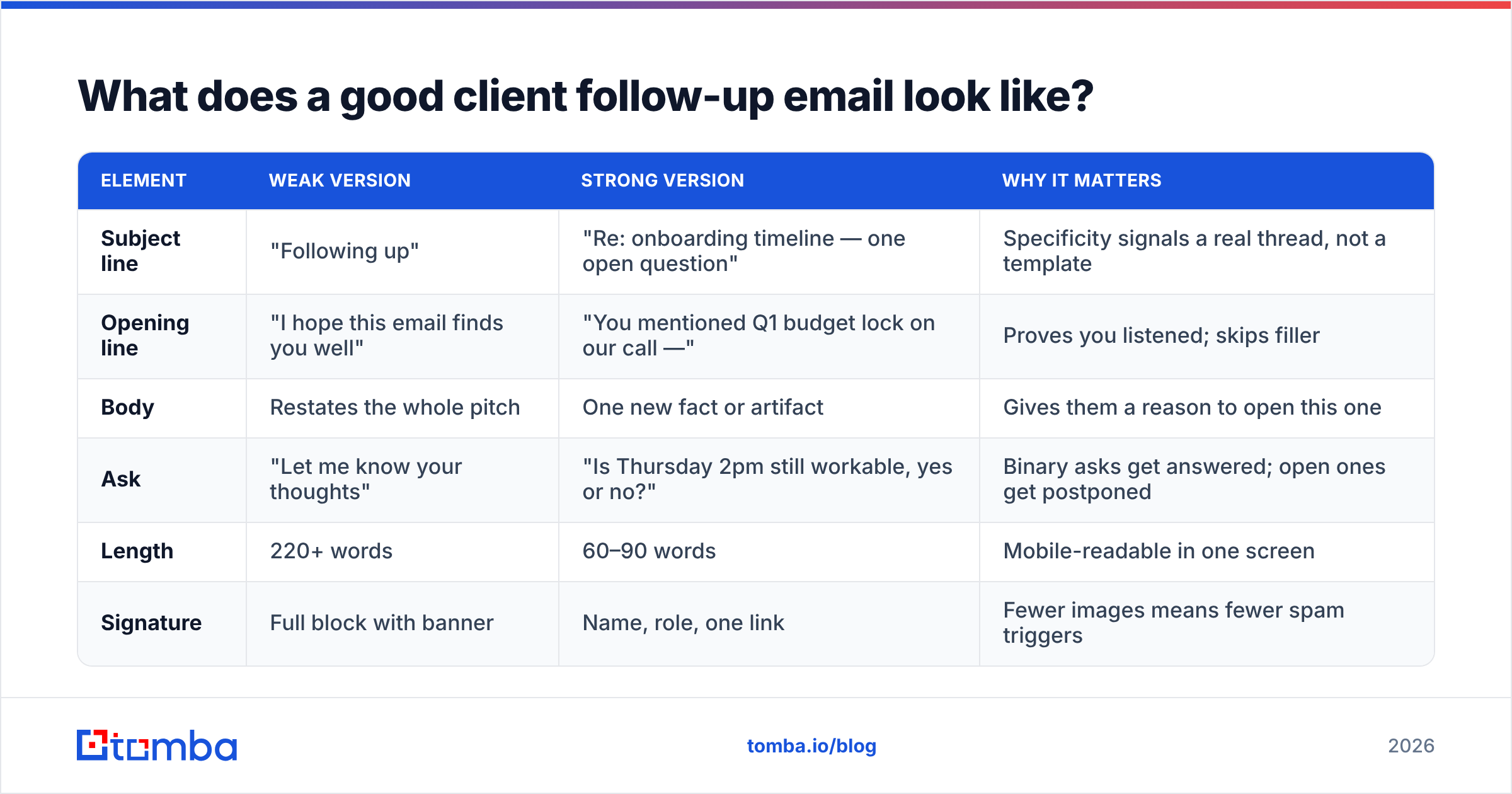
What does a good client follow-up email look like?#
Four lines, one ask, zero throat-clearing. Structure beats cleverness.
| Element | Weak version | Strong version | Why it matters |
|---|---|---|---|
| Subject line | "Following up" | "Re: onboarding timeline — one open question" | Specificity signals a real thread, not a template |
| Opening line | "I hope this email finds you well" | "You mentioned Q1 budget lock on our call —" | Proves you listened; skips filler |
| Body | Restates the whole pitch | One new fact or artifact | Gives them a reason to open this one |
| Ask | "Let me know your thoughts" | "Is Thursday 2pm still workable, yes or no?" | Binary asks get answered; open ones get postponed |
| Length | 220+ words | 60–90 words | Mobile-readable in one screen |
| Signature | Full block with banner | Name, role, one link | Fewer images means fewer spam triggers |
The single highest-leverage change most teams can make is the ask. "Let me know your thoughts" outsources the work of deciding what happens next to the busiest person in the conversation. "Should I hold the Thursday slot or release it?" takes four seconds to answer.
Two working templates:
Touch 3 — value add
Subject: The onboarding number you asked about
Hi Dana — you asked how long migration usually takes for a team your size. Two comparable accounts finished in 11 and 14 days respectively; I've pasted their sequence below.
No action needed. If it's useful, I can walk your ops lead through it in 15 minutes.
Touch 7 — breakup
Subject: Closing the loop
Hi Dana — I haven't heard back, which usually means this isn't a priority right now. That's a completely fine answer.
I'll stop reaching out. If the migration question comes back in Q3, reply to this email and I'll pick up exactly where we left off.
Should you follow up by email, phone, or LinkedIn?#
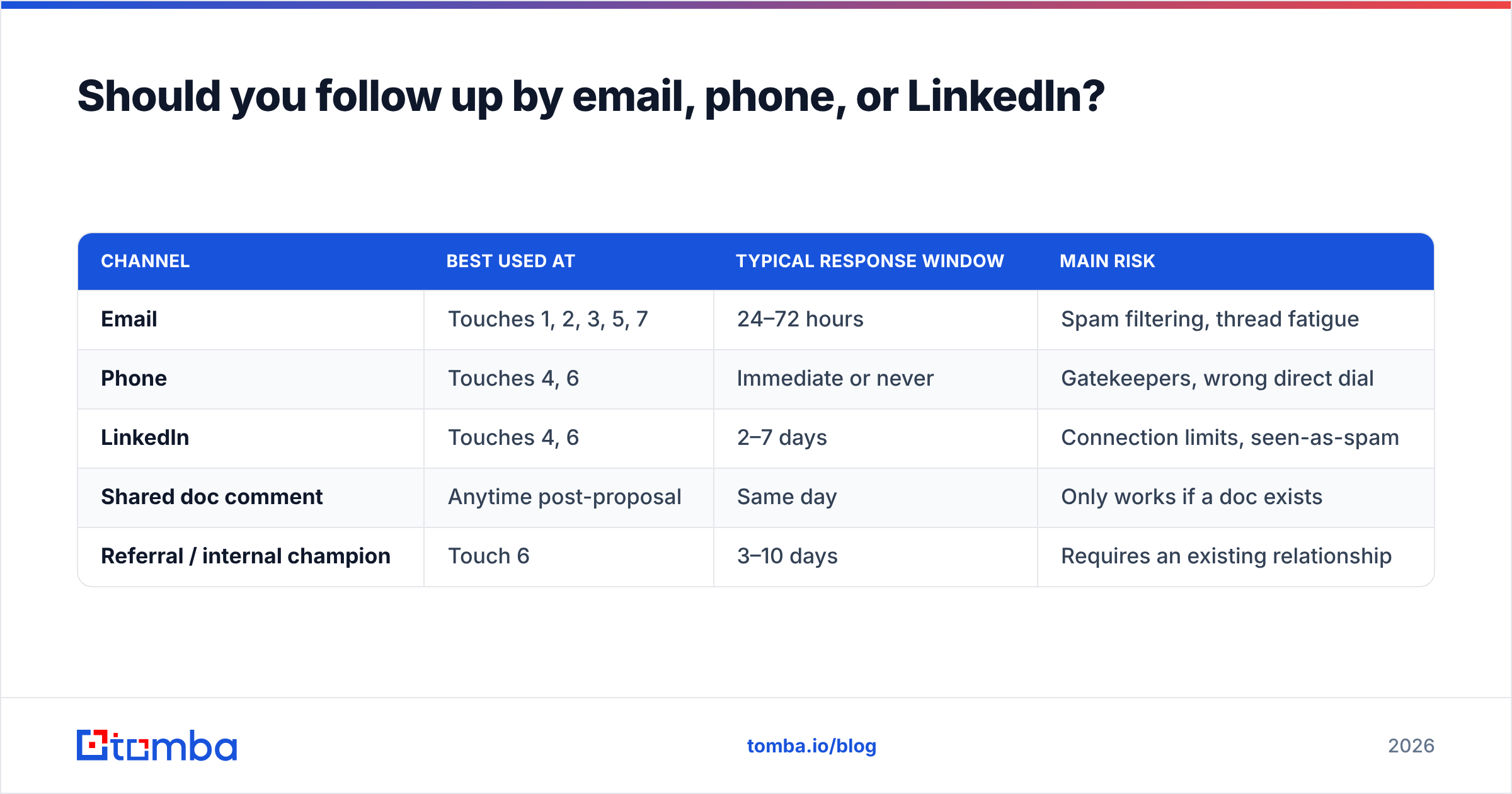
All three, in rotation — because channel fatigue is real and inbox placement is unpredictable.
| Channel | Best used at | Typical response window | Main risk |
|---|---|---|---|
| Touches 1, 2, 3, 5, 7 | 24–72 hours | Spam filtering, thread fatigue | |
| Phone | Touches 4, 6 | Immediate or never | Gatekeepers, wrong direct dial |
| Touches 4, 6 | 2–7 days | Connection limits, seen-as-spam | |
| Shared doc comment | Anytime post-proposal | Same day | Only works if a doc exists |
| Referral / internal champion | Touch 6 | 3–10 days | Requires an existing relationship |
A practical rule: never send two consecutive touches on the same channel after touch three. If email two and email three both went unanswered, the fourth attempt should be a call or a LinkedIn outreach message. Silence on one channel is ambiguous; silence on three is an answer.
For phone touches you need a direct line, not a switchboard. A phone finder that returns verified mobile numbers turns touch four from a voicemail lottery into an actual conversation. And if you are working named accounts rather than a bought list, data enrichment fills in the title, seniority, and company context that make the message worth opening in the first place.
How do you follow up after a proposal or quote?#
Differently from a cold follow-up — the stakes are higher and the silence means something specific.
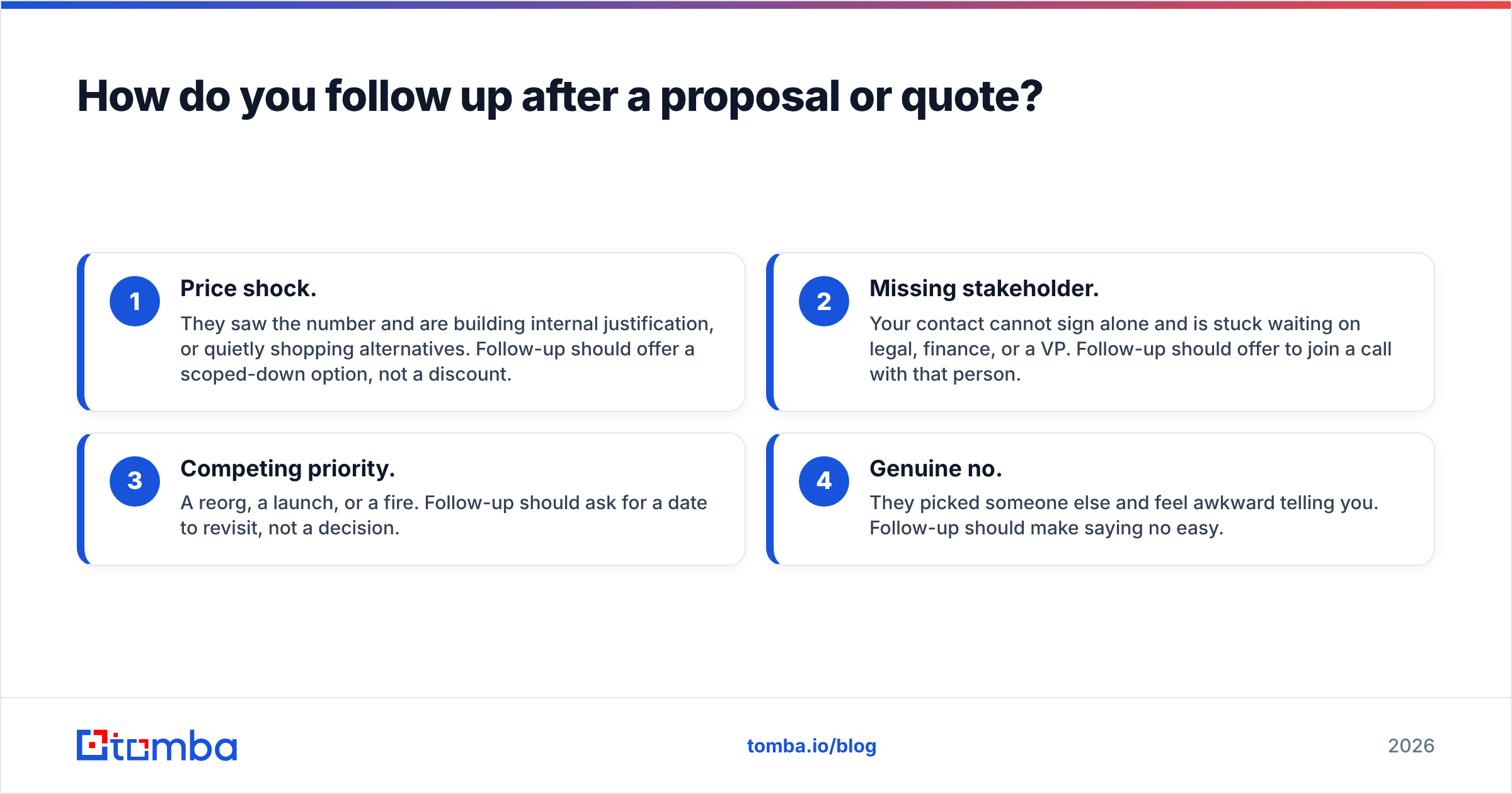
Post-proposal silence almost always maps to one of four causes:
- Price shock. They saw the number and are building internal justification, or quietly shopping alternatives. Follow-up should offer a scoped-down option, not a discount.
- Missing stakeholder. Your contact cannot sign alone and is stuck waiting on legal, finance, or a VP. Follow-up should offer to join a call with that person.
- Competing priority. A reorg, a launch, or a fire. Follow-up should ask for a date to revisit, not a decision.
- Genuine no. They picked someone else and feel awkward telling you. Follow-up should make saying no easy.
Ask directly which one it is. A message that says "Usually when I don't hear back after a proposal it's one of three things — price, timing, or a stakeholder I haven't met yet. Which is closest?" reliably outperforms a fourth polite nudge, because it lets the client pick a low-effort answer instead of composing an explanation.
Track this in your pipeline. If you tag every stalled deal with one of those four reasons, within a quarter you will know whether your problem is pricing, discovery, or multithreading — and that changes what you fix. Reviewing your win rate split by stall reason is more useful than reviewing it in aggregate.
What should you never do in a follow-up?#
Six habits that reliably cost replies:
- Fake urgency. "Prices go up Friday" when they don't. Clients talk to each other, and the credibility hit outlasts the deal.
- Guilt. "I've reached out three times now" reframes you as the aggrieved party. Nobody buys from someone they feel they owe an apology to.
- The blank bump. Forwarding your own email with "^" or "any update?" adds zero information and reads as low effort.
- Volume as strategy. Nine emails in nine days does not demonstrate persistence; it demonstrates that you are not reading the room, and it damages your sender reputation when recipients start marking you as spam.
- Ignoring a soft no. "Not right now" means put a calendar reminder 90 days out, not send another email tomorrow.
- Following up to an unverified address. You will conclude the client is ignoring you when the mail server rejected you before delivery.
That last one is worth dwelling on. Bounce data is invisible in most CRMs unless someone wires it in deliberately. Running your contact list through an email verifier before a sequence starts removes the most expensive false signal in follow-up: silence that was never silence.
How do you automate follow-up without sounding automated?#
Automate the timing and the tracking. Never automate the reasoning.
The parts worth automating:
- Cadence triggers. Tasks that fire on Day 2, 5, 10, 17, 24, 38 so you are not relying on memory.
- Data hygiene. Verification and enrichment on list import, not after the bounces roll in.
- Logging. Every touch written to the CRM automatically, so the next rep who inherits the account can see the history.
- Stall detection. An alert when a deal has had no inbound activity for 14 days.
The parts you should keep manual:
- What new information each touch carries. This is the entire value of the follow-up.
- The decision to switch channels. Depends on signals a tool cannot see.
- When to stop. A relationship worth $200k gets more patience than one worth $2k.
Teams that automate the reasoning end up with sequences where touch four references a case study the client already told you was irrelevant. Compare notes with an established playbook — Salesforce's guidance on follow-up cadence and peer reviews on G2 are both useful sanity checks — but the content of each touch should still be written by someone who was on the call.
Where tooling genuinely helps is at the top of the funnel. If you are following up with clients whose contact details you inherited from a spreadsheet, a domain search that maps current employees at the account will tell you whether your champion still works there — which is, more often than anyone admits, the actual reason nobody replied.
What does a healthy follow-up system look like in 2026?#
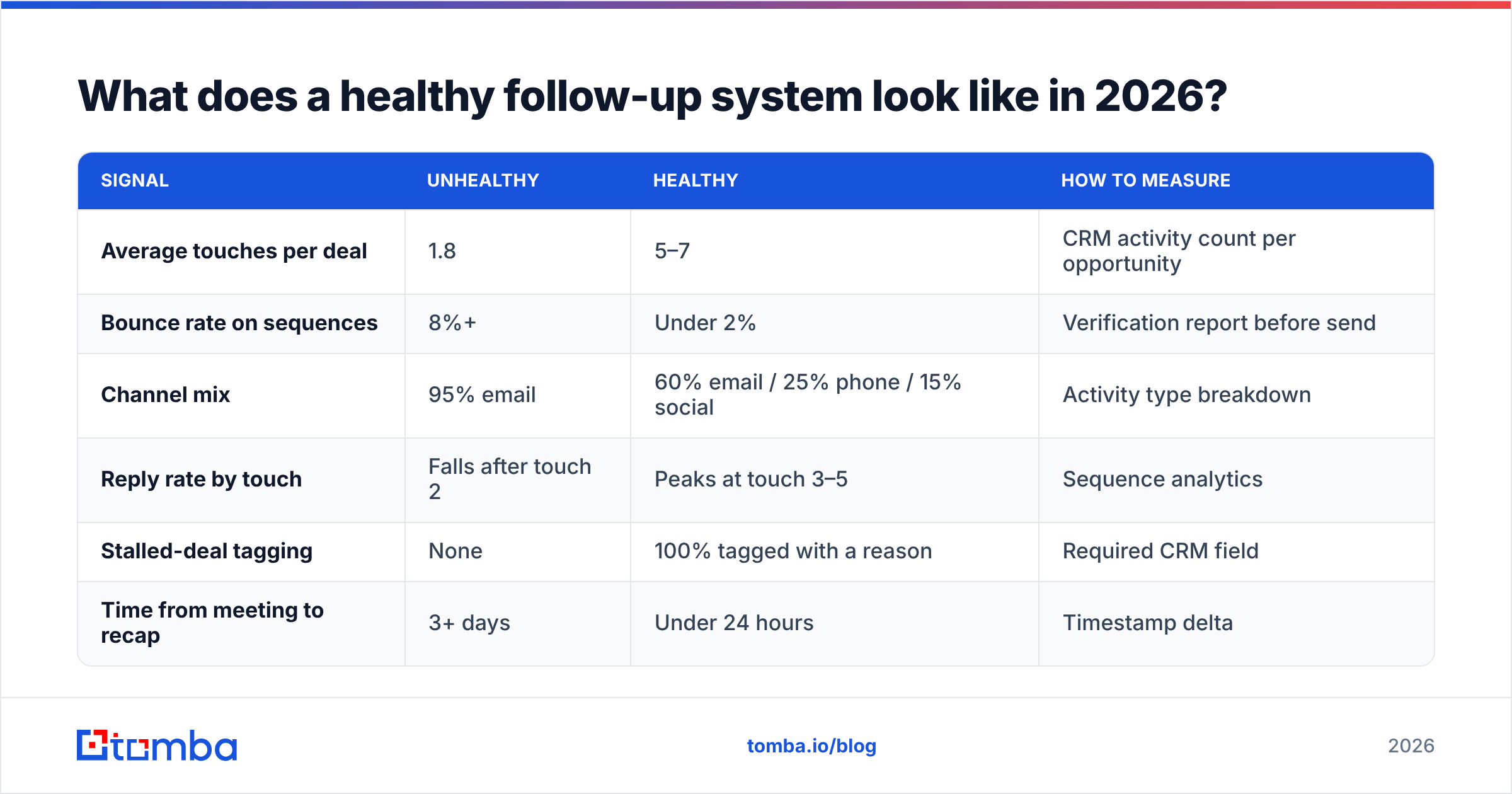
| Signal | Unhealthy | Healthy | How to measure |
|---|---|---|---|
| Average touches per deal | 1.8 | 5–7 | CRM activity count per opportunity |
| Bounce rate on sequences | 8%+ | Under 2% | Verification report before send |
| Channel mix | 95% email | 60% email / 25% phone / 15% social | Activity type breakdown |
| Reply rate by touch | Falls after touch 2 | Peaks at touch 3–5 | Sequence analytics |
| Stalled-deal tagging | None | 100% tagged with a reason | Required CRM field |
| Time from meeting to recap | 3+ days | Under 24 hours | Timestamp delta |
If you only fix one row, fix bounce rate. Everything downstream — reply rate, touch count, channel mix — is measured against a denominator that is wrong when a chunk of your list was never deliverable.
Start with contacts that actually exist#
Follow-up discipline is worth very little if the address is dead. Before your next sequence, run the account list through the Tomba Email Finder to confirm the person still holds the role and the address still resolves. The free tier covers 25 searches a month, Starter is $49/mo, and Growth is $99/mo if you are working at list scale — full Tomba pricing is on the site. Get the contact right first; then the seven touches have somewhere to land.
Related guides#
// get started
Find, verify and enrich your first contacts today
Start on the free plan with 25 searches a month, then scale when your team is ready.
Free plan · No credit card required · GDPR & CCPA
// about the author