How To Follow Up With A Lead: The 2026 Playbook
Most deals die in the gap between first contact and second touch. Here is the cadence, channel mix, and timing data that decides whether your follow-up gets a reply or a delete.
TL;DR
- Roughly 80% of closed deals need five or more touches, yet most reps stop after one or two. The gap between those two numbers is your pipeline.
- Speed beats polish on the first response: reply inside five minutes and your qualification odds jump by an order of magnitude versus a 30-minute reply.
- A working cadence is 7-9 touches over 21-28 days, mixing email, phone, and LinkedIn — not seven copies of the same email.
- Every follow-up must add something new: a resource, a data point, a specific question. "Just checking in" is the single lowest-reply message in B2B.
- Bad data kills good cadences. If 15% of your addresses bounce, your sequence is training inbox providers to filter you.
Why do most leads die after the first touch?#
Because nobody follows up enough, and the ones who do follow up badly.
Think of follow-up like watering a plant. One heavy soak on day one does nothing if you then ignore it for three weeks. Small, consistent, well-timed touches are what actually keep the thing alive. Sales works the same way — a buyer's attention is not a single moment you either capture or lose, it is a window that opens and closes repeatedly over weeks.
The structural problem is that the first touch almost never lands at the right time. Your prospect was in a meeting, mid-quarter, on PTO, or simply not thinking about the problem you solve. Nothing about your pitch was wrong. The timing was. Follow-up is how you buy more chances at correct timing without spending more money on lead acquisition.
There is a second, uglier reason: reps interpret silence as rejection. It usually isn't. Silence in B2B means "not important enough to reply to right now," which is a very different signal from "no." A structured cadence removes the emotional judgment call and replaces it with a schedule.
How fast should you respond to a new inbound lead?#
Inside five minutes, if you can. The classic lead response management research that Harvard Business Review popularized found firms responding within an hour were nearly seven times more likely to have a meaningful conversation with a decision-maker than those responding an hour later — and 60 times more likely than firms waiting 24 hours.
Practical rules that follow from that:
- Route inbound instantly. Any manual triage step between form fill and first reply is costing you conversions. Use routing rules in your CRM so leads never sit in a queue overnight.
- Call first, email second, for high-intent forms. Demo requests and pricing-page fills deserve a phone attempt within minutes, then an email that references the call attempt.
- Have a five-minute template ready. It does not need to be brilliant. It needs to exist and to reference exactly what they downloaded or clicked.
- Set expectations in the first reply. "I'll try you again Thursday morning if we don't connect" makes touch two expected instead of intrusive.
- Log the source. A lead from a pricing page and a lead from an ebook download need completely different second touches.
Outbound is the opposite problem. There is no inbound trigger, so your job is to manufacture relevance — a funding round, a job posting, a new tool in their stack, a competitor they just lost to.
What does a working follow-up cadence look like?#
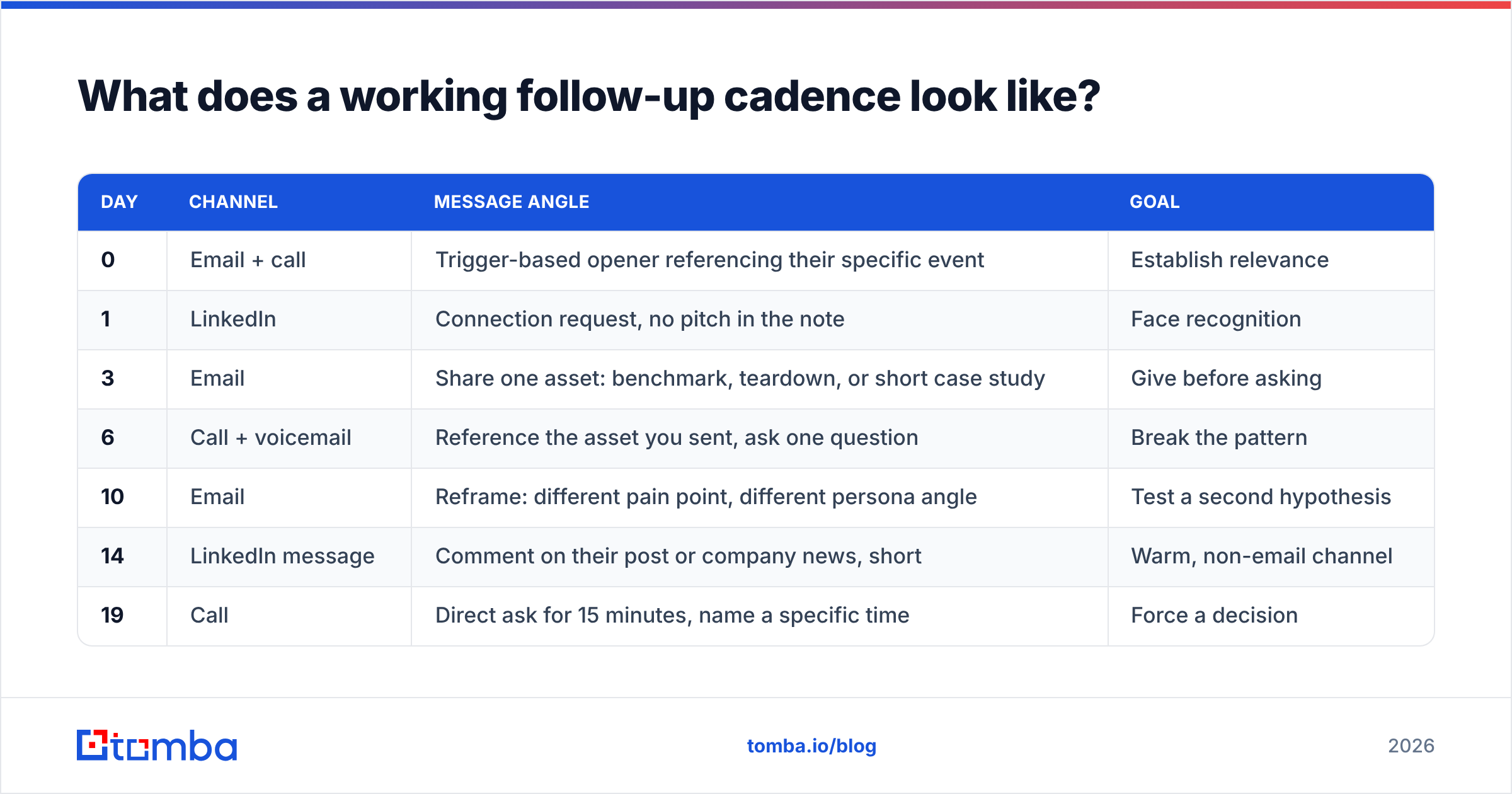
Seven to nine touches across three to four weeks, alternating channels. Here is a cadence that holds up across most B2B segments with deal sizes between $5k and $75k ACV.
| Day | Channel | Message angle | Goal |
|---|---|---|---|
| 0 | Email + call | Trigger-based opener referencing their specific event | Establish relevance |
| 1 | Connection request, no pitch in the note | Face recognition | |
| 3 | Share one asset: benchmark, teardown, or short case study | Give before asking | |
| 6 | Call + voicemail | Reference the asset you sent, ask one question | Break the pattern |
| 10 | Reframe: different pain point, different persona angle | Test a second hypothesis | |
| 14 | LinkedIn message | Comment on their post or company news, short | Warm, non-email channel |
| 19 | Call | Direct ask for 15 minutes, name a specific time | Force a decision |
| 24 | "Closing the loop" — permission to stop, easy re-open | Clean exit, high reply rate | |
| 45+ | Nurture restart on a new trigger | Recycle, don't discard |
Three things make this cadence work rather than annoy.
Channel rotation. Email fatigue is real; the same message on LinkedIn or by voice reads as persistence rather than spam. Rotating channels also means a broken email address does not silently kill the entire sequence.
Angle rotation. Touches 1, 3, and 5 should test different value propositions, not restate one. If your day-0 email led with cost savings and got nothing, day-10 should lead with risk or speed instead.
Declining intensity, not declining quality. Gaps widen from one day to five days. Your last touch should be as well-written as your first — the breakup email consistently outperforms touches 3 through 6 on reply rate precisely because it is short, honest, and asks for a low-cost answer.
Which follow-up channels actually get replies in 2026?#
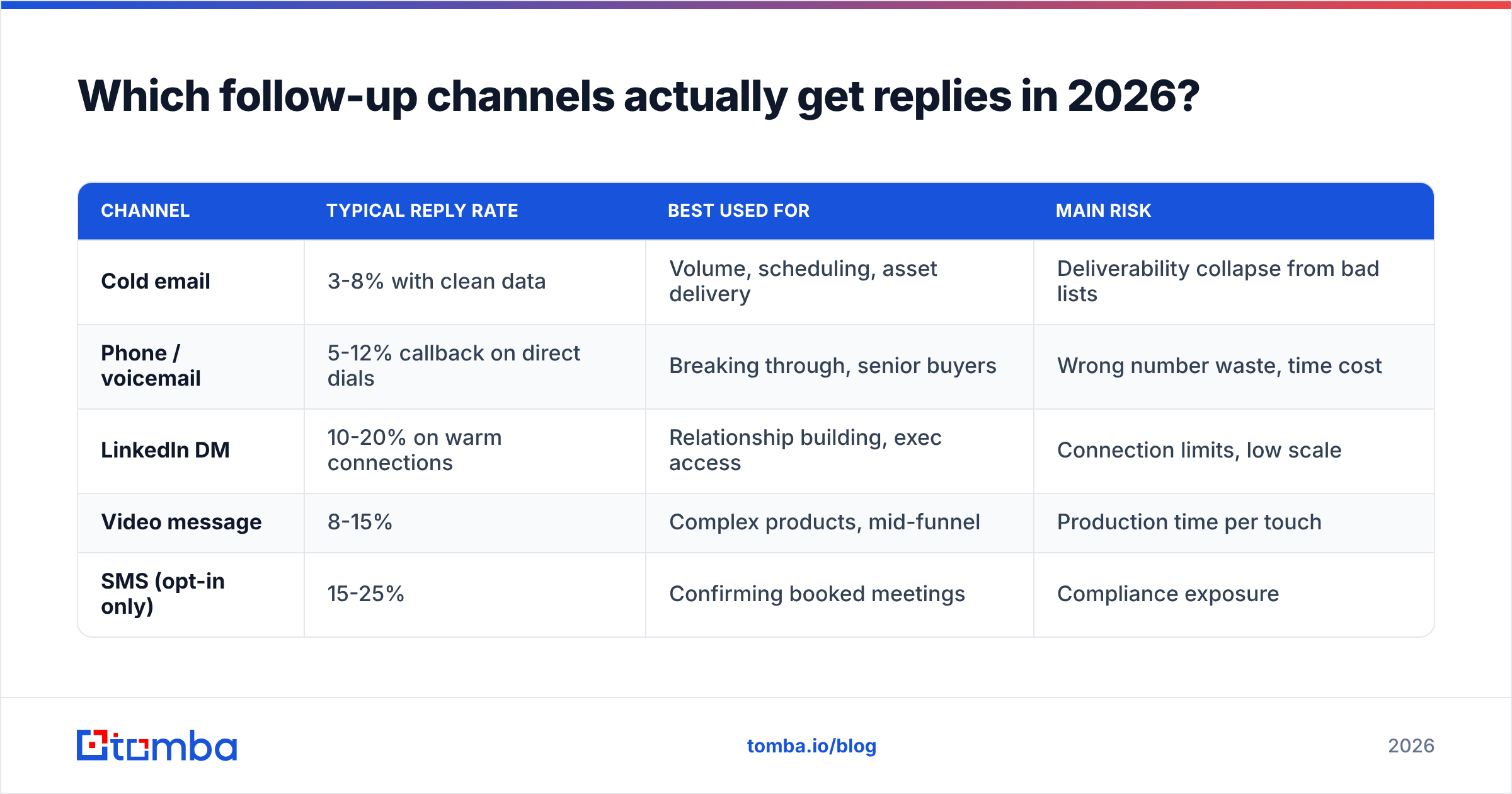
Depends on persona, but the ranking has shifted. Email is still the volume workhorse; phone has quietly recovered as inbox volume exploded; LinkedIn is the best warm-up layer but a poor primary channel at scale.
| Channel | Typical reply rate | Best used for | Main risk |
|---|---|---|---|
| Cold email | 3-8% with clean data | Volume, scheduling, asset delivery | Deliverability collapse from bad lists |
| Phone / voicemail | 5-12% callback on direct dials | Breaking through, senior buyers | Wrong number waste, time cost |
| LinkedIn DM | 10-20% on warm connections | Relationship building, exec access | Connection limits, low scale |
| Video message | 8-15% | Complex products, mid-funnel | Production time per touch |
| SMS (opt-in only) | 15-25% | Confirming booked meetings | Compliance exposure |
The reason phone works again is arithmetic: everyone moved to email, so inboxes got crowded and phones got quiet. Direct dials are the constraint — switchboard numbers waste your time. Pulling verified B2B phone numbers alongside email at the enrichment step is what makes a phone-inclusive cadence viable rather than a coin flip.
For LinkedIn, treat it as an amplifier. A connection request sent the day after your first email raises the odds that the second email gets read, because the name is now familiar. That is a cheap compounding effect most teams skip. If you want the broader mechanics, our take on LinkedIn outreach covers the sequencing.
What should each follow-up message actually say?#
New information or a new question. Nothing else qualifies.
The failure mode is the content-free bump: "Just following up on my last email," "Bumping this to the top of your inbox," "Any thoughts?" These messages ask the prospect to do all the cognitive work of remembering who you are and deciding what to do — for zero reward. They train people to ignore your name.
Replace each bump with one of these five patterns:
- The asset drop. "Here's the benchmark I mentioned — page 4 has the number for your segment." Gives value, requires no reply, keeps you visible.
- The single question. "Is reducing onboarding time actually a priority this half, or is that a 2027 problem?" One question, binary-ish answer, easy to reply to in ten seconds.
- The reframe. Switch the pain point entirely. "Different angle: most teams your size hit this at the data layer, not the tooling layer."
- The social proof with specifics. Name a comparable company, name the number, keep it to two sentences. Vague "companies like yours saw great results" is worse than nothing.
- The permission-to-close. "Sounds like this isn't a fit right now — okay if I close the file and check back in Q2?" This gets replies from people who have ignored six prior emails, because it costs them nothing to say yes.
Keep every follow-up under 90 words. Follow-ups are read on phones, in gaps between meetings, with low attention. If your day-10 email is longer than your day-0 email, you have the ratio backwards. Running drafts through a spam checker before a sequence goes live catches the trigger words and link-heavy formatting that push follow-ups into promotions tabs.
How does data quality change your follow-up results?#
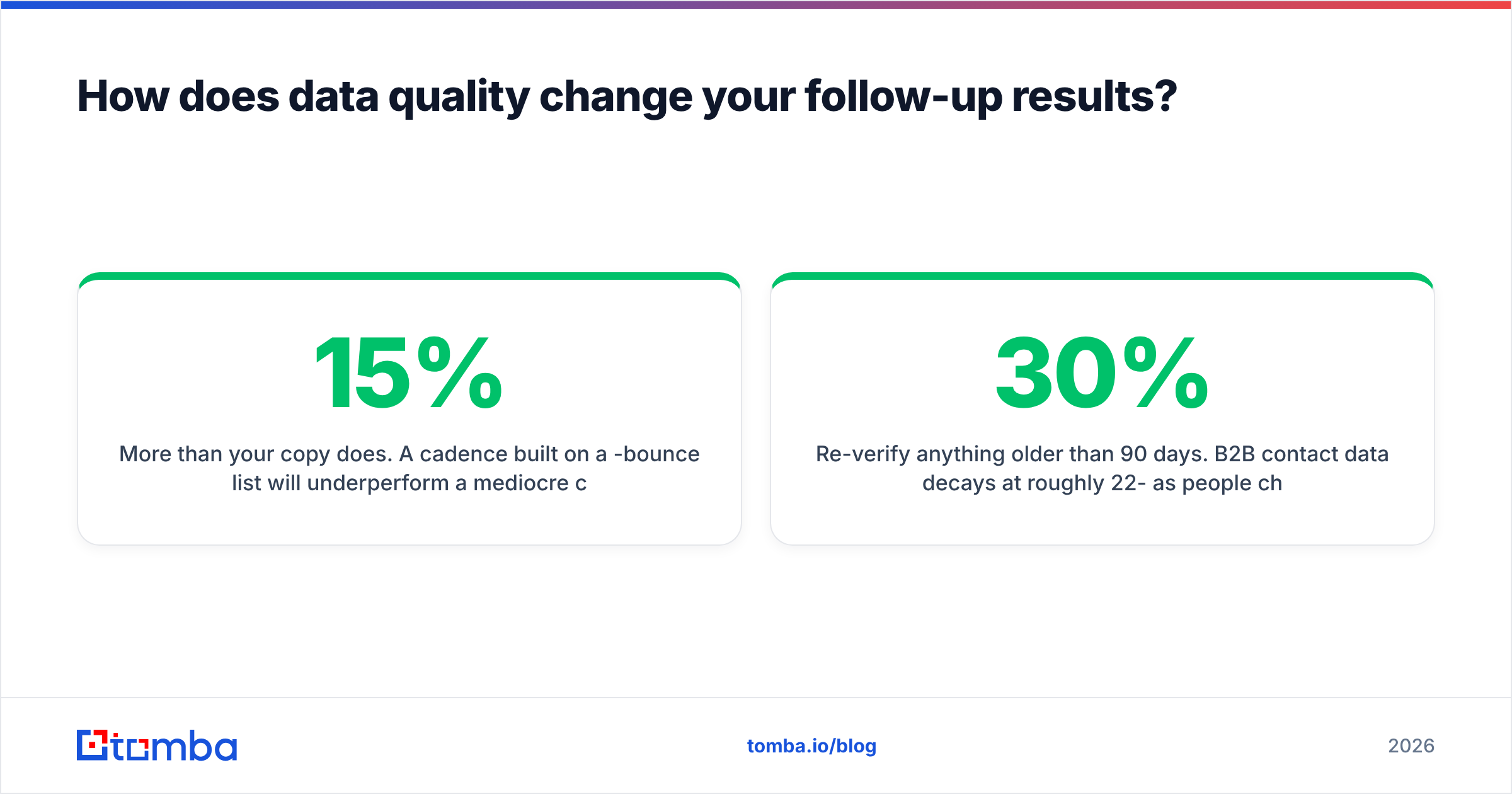
More than your copy does. A cadence built on a 15%-bounce list will underperform a mediocre cadence on a 2%-bounce list, every time.
Here is why the effect compounds. Mailbox providers score your sending domain on engagement and bounce signals. High bounces from touch one degrade that score, which means touches three through seven from the same domain land in spam even for valid addresses. You are not just losing the bad contacts — you are losing the good ones behind them. That is the mechanism behind most "our reply rates fell off a cliff and we didn't change anything" stories.
The fix is boring and it works:
- Verify before the first send, not after the bounce. Run every list through an email verifier and drop anything not marked deliverable.
- Handle catch-all domains separately. Catch-alls accept everything at the SMTP layer, so they look valid and bounce later. A dedicated catch-all verifier sorts real mailboxes from accept-all noise.
- Re-verify anything older than 90 days. B2B contact data decays at roughly 22-30% per year as people change jobs; a list you built in January is measurably worse by April.
- Cap volume per sending domain. Even clean lists suffer if one domain sends 500 cold emails a day. Split across domains and monitor sender reputation weekly.
Which tools support a multi-touch follow-up motion?#
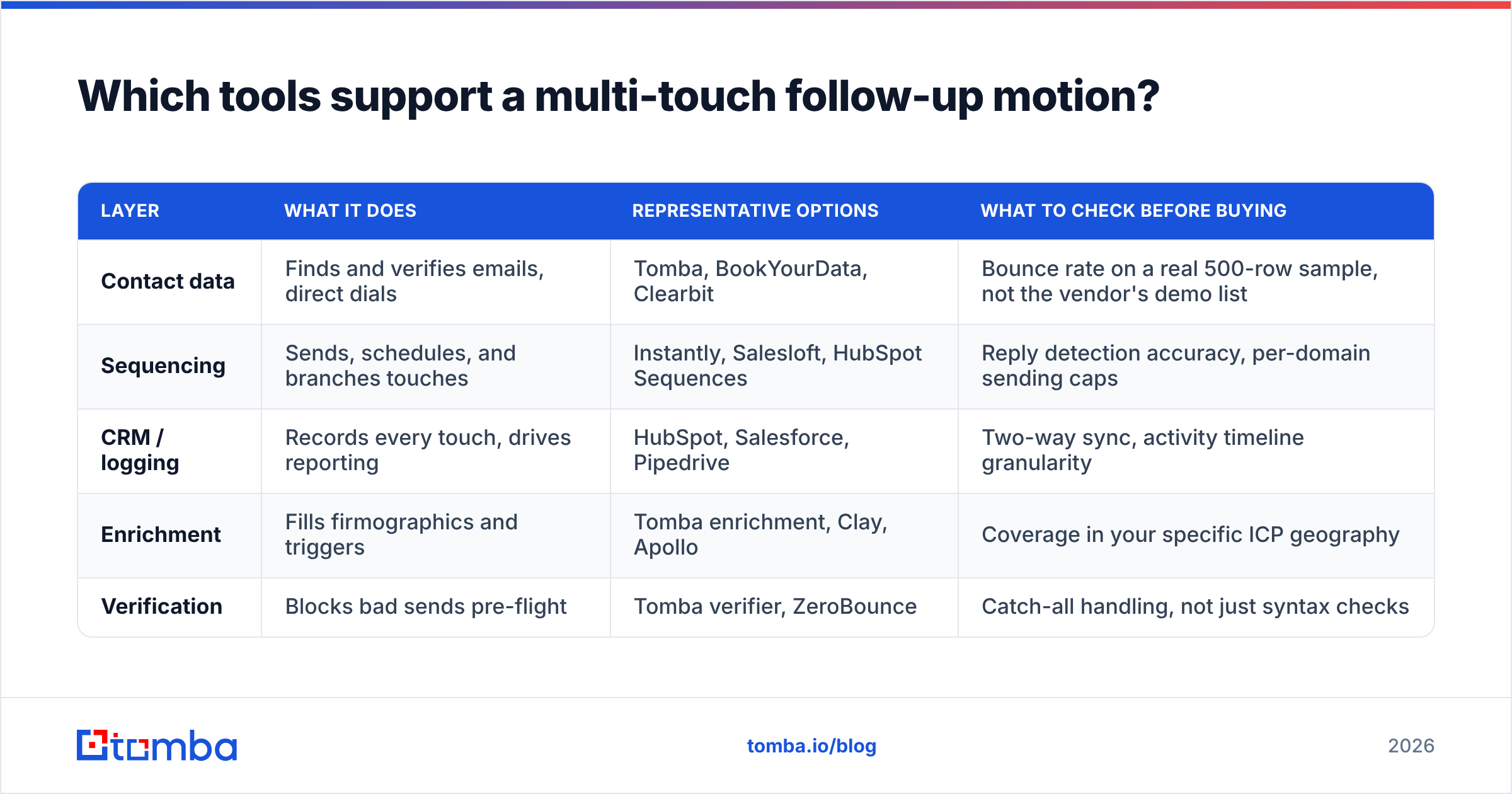
You need three layers: contact data, sequencing, and CRM logging. Some vendors bundle all three; specialists usually beat bundles on the data layer.
| Layer | What it does | Representative options | What to check before buying |
|---|---|---|---|
| Contact data | Finds and verifies emails, direct dials | Tomba, BookYourData, Clearbit | Bounce rate on a real 500-row sample, not the vendor's demo list |
| Sequencing | Sends, schedules, and branches touches | Instantly, Salesloft, HubSpot Sequences | Reply detection accuracy, per-domain sending caps |
| CRM / logging | Records every touch, drives reporting | HubSpot, Salesforce, Pipedrive | Two-way sync, activity timeline granularity |
| Enrichment | Fills firmographics and triggers | Tomba enrichment, Clay, Apollo | Coverage in your specific ICP geography |
| Verification | Blocks bad sends pre-flight | Tomba verifier, ZeroBounce | Catch-all handling, not just syntax checks |
On the data layer, the honest evaluation method is a bake-off. Take 500 real target accounts, run them through two providers, send to both, and compare bounce rate and connect rate. Vendor-published accuracy numbers are measured on their own favorable samples. BookYourData, for instance, is strong when you want pre-built lists by industry filter; Tomba fits better when you are resolving specific named people at specific domains and want an API in the loop. Different jobs.
Cost matters at cadence scale because multi-touch means more lookups. Tomba pricing starts with a free tier at 25 searches per month, then $49/mo Starter, $99/mo Growth, and $249/mo Pro, with Enterprise custom — worth modeling against your monthly prospect volume before you commit to a seat-based bundle. If you are checking vendor reputation more broadly, G2's sales intelligence category is the least-biased public source for review volume.
How do you know your follow-up is working?#
Measure per-touch, not per-sequence. A blended "8% reply rate" hides the fact that touch 1 did 2% and the breakup email did 11%.
Track four things:
- Reply rate by touch number. Tells you where to cut and where to invest. If touch 6 produces nothing across 2,000 sends, delete it.
- Positive reply rate, separately. Total replies include "unsubscribe" and "wrong person." Only positive replies predict pipeline.
- Bounce rate by list source. Isolates the data problem from the copy problem. Anything above 3% means fix the list before touching the copy.
- Meeting-to-touch ratio. How many total touches does one booked meeting cost you? This is your real efficiency number and the one to benchmark quarter over quarter.
Change one variable at a time. Teams that rewrite all seven emails and swap data vendors in the same week learn nothing from the result. Run a two-week hold on your control cadence, change the day-3 email only, and read the difference.
One more discipline: define a clear exit. Every lead should either convert, explicitly decline, or move to nurture after the final touch. Leads that live forever in "following up" status are the reason forecast accuracy dies. A clean response rate baseline is impossible when half your list is in limbo.
What is the fastest way to fix your follow-up this quarter?#
Do these four things, in order, before you rewrite a single email.
- Verify your existing list and remove everything that is not deliverable.
- Add direct dials to your top 200 accounts so the phone touches in your cadence are real.
- Extend your cadence from wherever it stops today to at least seven touches with a proper breakup email.
- Instrument reply rate by touch number so next quarter's changes are evidence-based.
That sequence works because it fixes the deliverability floor first, then adds channels, then adds volume, then adds measurement. Doing it in the reverse order — new copy on a dirty list — is how teams conclude "cold outreach doesn't work anymore."
Follow-up is not persistence for its own sake. It is a structured way of being present at the moment your prospect's priority changes, without burning your domain reputation or your reps' time getting there.
Start with the data layer. If your cadence is landing on stale or unverified addresses, no amount of rewriting saves it. The Tomba Email Finder resolves verified work emails by name and domain, with a free tier at 25 searches a month so you can bake it off against your current provider on a real list before you pay anything. Add the email verifier as a pre-send gate and your seven-touch cadence gets seven real chances instead of two.
Related guides#
// get started
Find, verify and enrich your first contacts today
Start on the free plan with 25 searches a month, then scale when your team is ready.
Free plan · No credit card required · GDPR & CCPA
// about the author