How to Follow Up With a Potential Client: The 2026 Playbook
Most deals die in the gap between the first meeting and the second. Here is the exact cadence, channel mix, and message angles that turn a silent prospect into a booked call — without nagging.
TL;DR
- Most deals do not die from rejection. They die from silence after touch one or two — the average buying committee needs 6 to 8 contacts before it responds, and most reps stop at two.
- A working follow-up sequence is a cadence (when), a channel mix (where), and a message angle (why they should care this time). Change the angle every touch, not just the wording.
- Never follow up more than once on an unverified address. A bounce is not silence — it is a data problem, and it quietly torches your sender reputation.
- Multi-channel beats email-only: email plus LinkedIn plus one phone attempt lifts contact rates materially versus email alone.
- Close the loop explicitly. A polite "I'll stop here unless you tell me otherwise" breakup message pulls more replies than any of the four messages before it.
Why do most follow-ups with potential clients fail?#
Because they are the same message, resent.
You met a prospect at a conference or on a discovery call. You sent a recap. Nothing came back. Three days later you sent "Just checking in — any thoughts?" and then, a week after that, "Bumping this to the top of your inbox." Neither message contained a single new piece of information. From the buyer's side, you sent one email three times.
There are three failure modes worth separating, because they need different fixes:
- The data problem. Your message never arrived. The address was a guess, the contact left the company, or a catch-all domain swallowed it silently. No amount of clever copy fixes this.
- The timing problem. Your message arrived at the wrong moment. The buyer had a quarter-close, a reorg, or a vacation. This one is fixed purely by persistence and spacing.
- The value problem. Your message arrived, was read, and gave the buyer no reason to spend two minutes replying. This is fixed by changing the angle, not the frequency.
Most reps treat every silence as a timing problem and respond with volume. Knowing how to follow up with a potential client starts with diagnosing which of the three you actually have — and the first one is the easiest to eliminate before you ever hit send.

How many follow-ups should you send before giving up?#
Five to eight touches over roughly three weeks, then a clean exit. That range holds up across most B2B sales research, and the reason it works is arithmetic rather than psychology: each touch has an independent chance of landing on a day when the buyer has bandwidth. Stack enough independent chances and you compound your odds.
The counterargument — "I don't want to be annoying" — is worth taking seriously, but it usually misidentifies what annoys people. Buyers rarely complain about the number of messages. They complain about messages with no content. Seven useful touches feel like diligence. Three empty ones feel like harassment.
Two guardrails keep persistence from tipping into pestering:
- Never send two consecutive touches on the same channel with the same ask. If email touch three asked for a call, LinkedIn touch four should offer something instead.
- Always give an exit. Every sequence needs a final message that releases the prospect. It costs you nothing and it consistently produces replies from people who were interested but buried.
What does a real follow-up cadence look like?#
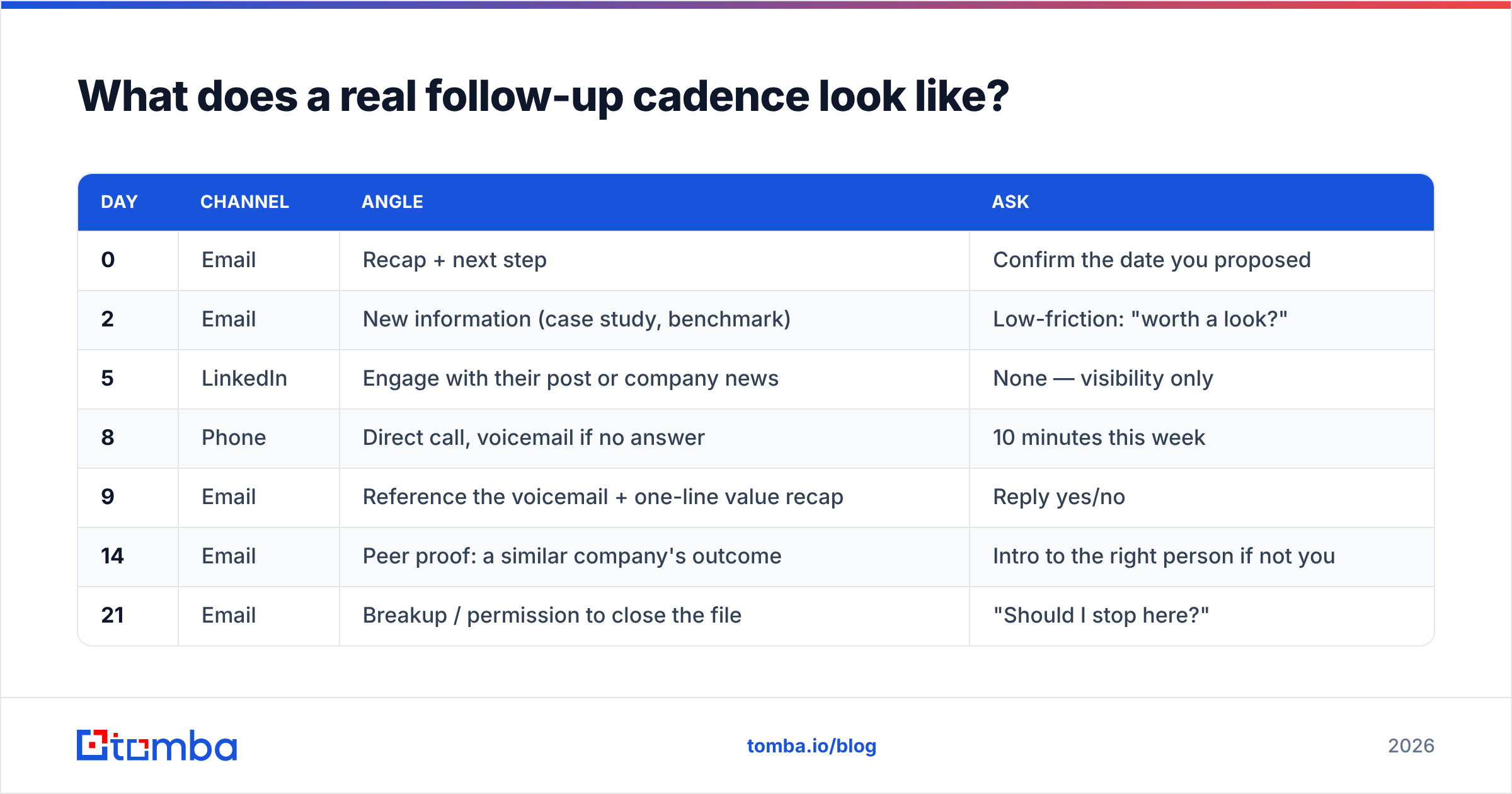
Here is a cadence that works for a warm prospect — someone who took a meeting, downloaded something substantial, or replied once and then went quiet. Adjust the spacing outward for enterprise deals and inward for transactional ones.
| Day | Channel | Angle | Ask |
|---|---|---|---|
| 0 | Recap + next step | Confirm the date you proposed | |
| 2 | New information (case study, benchmark) | Low-friction: "worth a look?" | |
| 5 | Engage with their post or company news | None — visibility only | |
| 8 | Phone | Direct call, voicemail if no answer | 10 minutes this week |
| 9 | Reference the voicemail + one-line value recap | Reply yes/no | |
| 14 | Peer proof: a similar company's outcome | Intro to the right person if not you | |
| 21 | Breakup / permission to close the file | "Should I stop here?" |
Three things about this table matter more than the exact days.
The channel changes. Email-only sequences hit a ceiling fast. Adding a LinkedIn touch and a single call attempt roughly doubles the surface area of the sequence — the same prospect who ignores four emails will often reply to a comment on their own post.
The ask shrinks and then reverses. Early touches ask for a meeting. Middle touches ask for a yes/no. The final touch asks for permission to leave. Descending commitment is what makes the sequence feel respectful.
Day 5 asks for nothing. A pure-value touch resets the relationship. It signals you are paying attention to their business, not just your pipeline.
What should each follow-up message actually say?#
Rotate through angles. If you cannot name the angle of the email you are about to send, you are sending a bump, and bumps do not convert.
- The recap. Restate what they said their problem was, in their words, and what you agreed the next step would be. This is the only follow-up that should ever start with "As discussed."
- The new artifact. Send something that did not exist in the last conversation: a benchmark, a teardown of their competitor's approach, a one-page ROI sketch. New information is the only honest reason to reappear in someone's inbox.
- The trigger event. They raised funding, launched a product, hired a VP of Sales, or changed their pricing page. Reference it specifically. Generic "congrats on the round" gets ignored; "congrats on the round — the Series B usually means the SDR team doubles, which is exactly when list quality starts breaking" does not.
- The peer proof. One sentence on a company that looks like theirs, one sentence on the measurable outcome, one question about whether the same pattern applies to them.
- The objection pre-empt. Name the thing you suspect is blocking them: budget cycle, an incumbent contract, an internal champion who went quiet. Buyers reply to accurate guesses because it saves them the awkwardness of typing it themselves.
- The redirect. "If this isn't your call anymore, who owns it now?" This is the highest-yield message in most sequences and almost nobody sends it.
- The breakup. "I'll assume the timing's wrong and close the file — happy to circle back next quarter if that's better." Short, no guilt, no passive aggression.
A structural note on all seven: keep them under 90 words, put the ask in its own line, and never attach a deck to a follow-up. The deck is the meeting, not the bait.
How do you make sure your follow-up actually lands?#
You verify before you persist. This is the least glamorous part of learning how to follow up with a potential client and it is where the largest number of "unresponsive" prospects actually live.
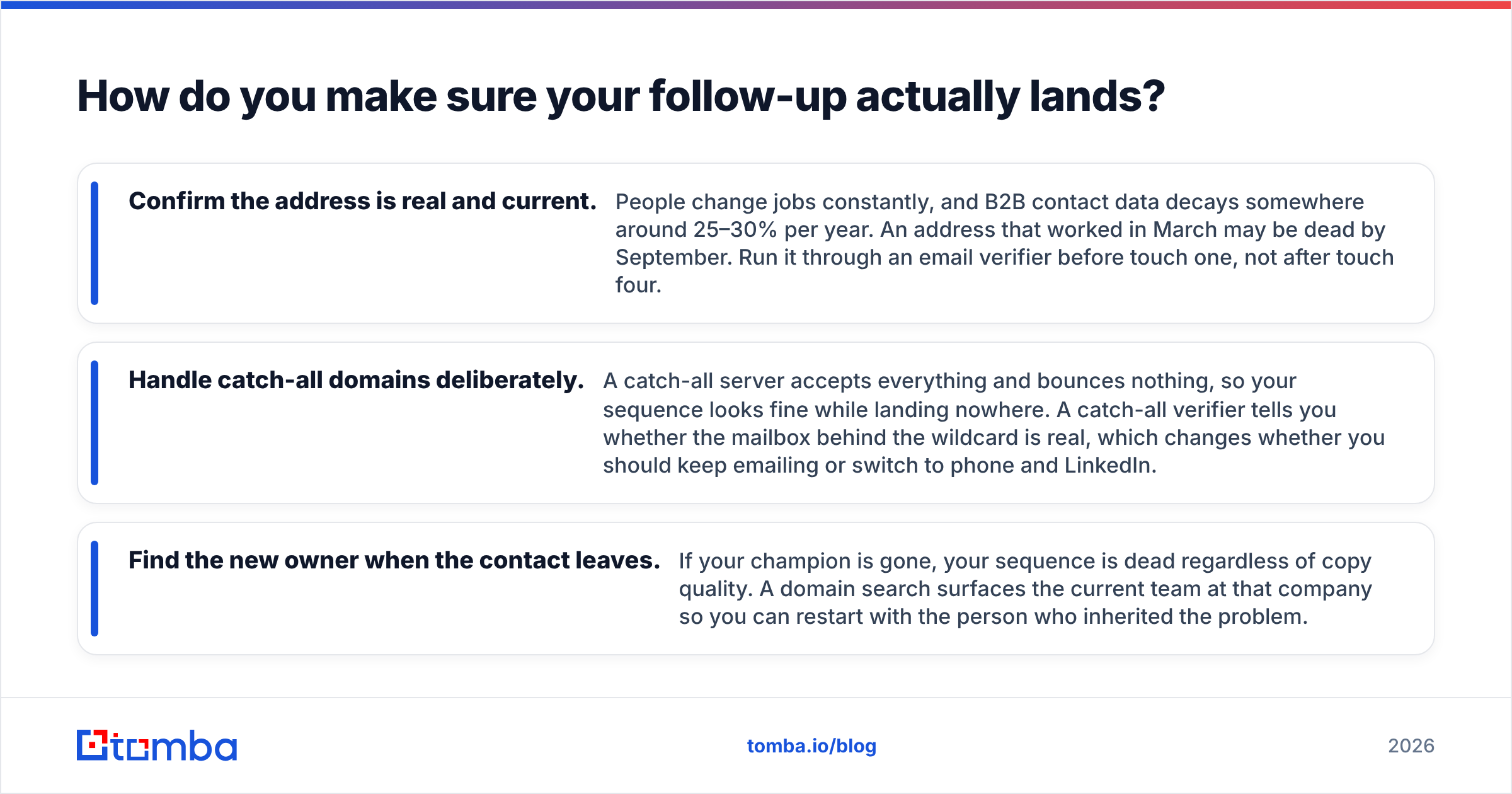
Three checks, in order:
- Confirm the address is real and current. People change jobs constantly, and B2B contact data decays somewhere around 25–30% per year. An address that worked in March may be dead by September. Run it through an email verifier before touch one, not after touch four.
- Handle catch-all domains deliberately. A catch-all server accepts everything and bounces nothing, so your sequence looks fine while landing nowhere. A catch-all verifier tells you whether the mailbox behind the wildcard is real, which changes whether you should keep emailing or switch to phone and LinkedIn.
- Find the new owner when the contact leaves. If your champion is gone, your sequence is dead regardless of copy quality. A domain search surfaces the current team at that company so you can restart with the person who inherited the problem.
Deliverability compounds here. Every hard bounce chips at sender reputation, and a damaged reputation means your next twenty follow-ups — to perfectly good addresses — start landing in spam. Reps usually blame their copy for the drop-off. It is often the list.

Which channel should you use at each stage?#
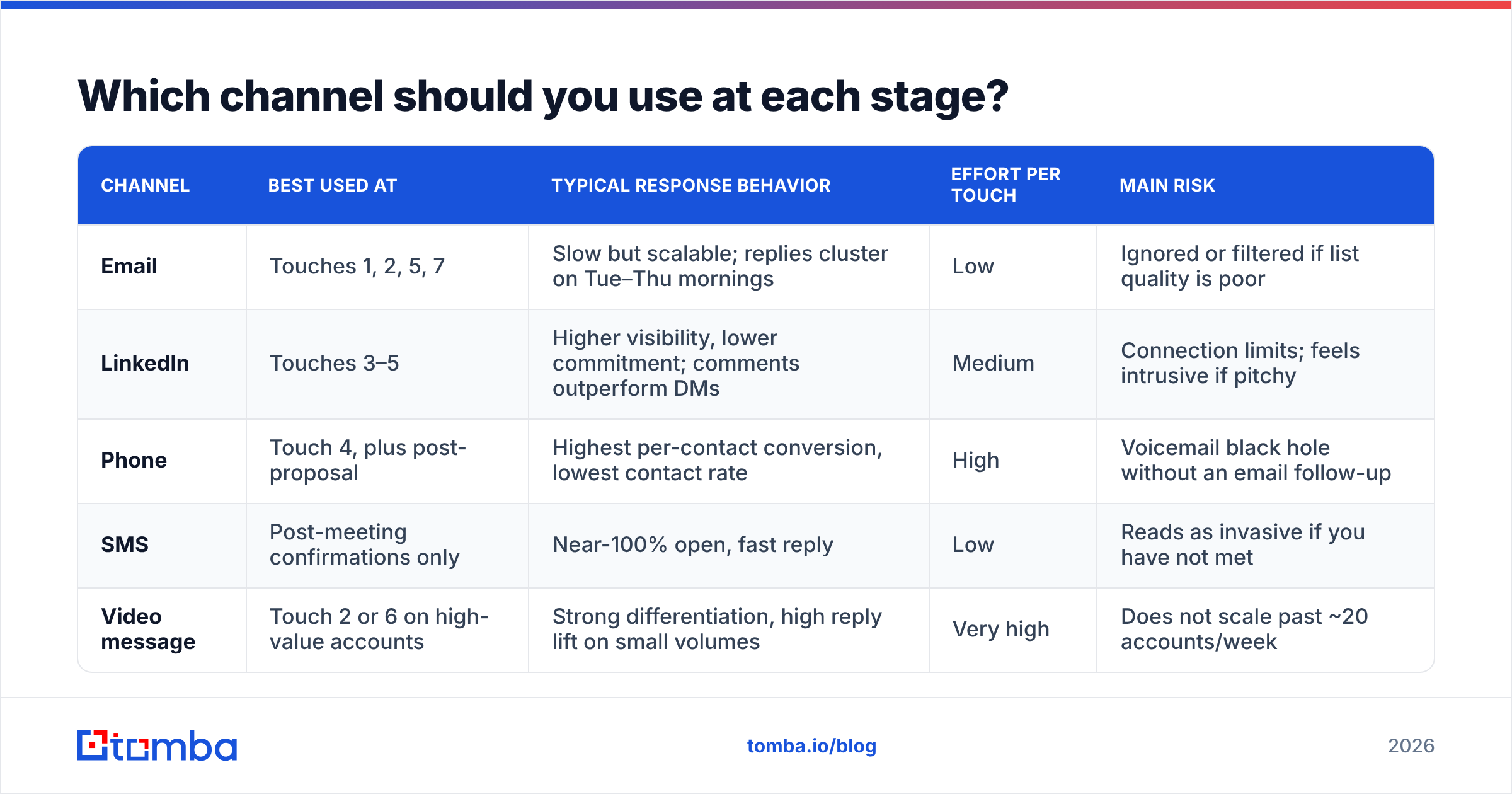
There is no single best channel, only a best channel for a given stage and buyer persona. This is roughly how the options compare in practice:
| Channel | Best used at | Typical response behavior | Effort per touch | Main risk |
|---|---|---|---|---|
| Touches 1, 2, 5, 7 | Slow but scalable; replies cluster on Tue–Thu mornings | Low | Ignored or filtered if list quality is poor | |
| Touches 3–5 | Higher visibility, lower commitment; comments outperform DMs | Medium | Connection limits; feels intrusive if pitchy | |
| Phone | Touch 4, plus post-proposal | Highest per-contact conversion, lowest contact rate | High | Voicemail black hole without an email follow-up |
| SMS | Post-meeting confirmations only | Near-100% open, fast reply | Low | Reads as invasive if you have not met |
| Video message | Touch 2 or 6 on high-value accounts | Strong differentiation, high reply lift on small volumes | Very high | Does not scale past ~20 accounts/week |
The practical takeaway: use email for volume, LinkedIn for warmth, phone for the accounts that justify the minutes, and SMS only after a real conversation. Sequences that mix at least two channels consistently outperform single-channel ones — a pattern echoed across the sales engagement category on G2 and in most of HubSpot's published sales benchmarks over on the HubSpot sales blog.
How do you follow up after a meeting or proposal?#
Post-meeting follow-up is a different discipline from cold follow-up, and it is where more revenue leaks than anywhere else in the pipeline.
Send the recap within four hours. Not the next morning. The recap should contain: the problem in their words, what you proposed, what happens next, and who owns each next step with a date. If you cannot write those four things, you did not run a good meeting — and that is useful to learn immediately rather than three weeks later.
Put the next meeting on the calendar before you leave the current one. A booked date beats any follow-up sequence ever written. Everything in this article is a recovery mechanism for when this step fails.
After a proposal, follow up on the decision process, not the document. "Did you get a chance to review the proposal?" invites a "not yet." "Who else needs to sign off before this can move, and what would they need to see?" invites information. Ask about the process and you get a map of the deal; ask about the PDF and you get a stall.
Log everything in the CRM the same day. A follow-up sequence that lives in one rep's memory is a sequence that dies during PTO.
When should you stop following up?#
Stop when you have sent the breakup and gotten nothing, or when you have credible evidence the deal is not real — no budget cycle for three quarters, an incumbent with 18 months left on contract, or your champion has stopped responding to internal messages too.
But "stop" should mean "move to nurture," not "delete." The correct end state for a non-responsive prospect is a re-engagement date 90 days out, tied to a trigger you can watch for: funding, a leadership hire, a product launch, a competitor announcement. Roughly a fifth of closed-won deals in a typical B2B pipeline started as a revived dead lead. The rep who files the record cleanly beats the rep who marks it lost and forgets.
One more discipline worth building: track your own numbers. Log how many touches it took on the deals you won. Almost every team that measures this discovers the answer is higher than their sequences allow — and then fixes the cadence instead of the copy.
Get the contact data right before you build the cadence#
Every tactic here assumes one thing: the message reaches a real person at a real address who still works there. That assumption fails more often than most teams measure, and it fails silently.
Tomba Email Finder finds and confirms professional email addresses by name, domain, or company, so your sequence starts against live contacts instead of guesses. Verification runs alongside it, catch-all domains get flagged rather than silently swallowed, and you can pull the current team at an account when your original champion moves on. Start free with 25 searches a month, or move to Starter at $49/mo when your outbound volume outgrows it — full Tomba pricing is public, no sales call required.
Build the cadence second. Get the data right first.
Related guides#
Ready to find emails that actually work?
Join 150,000+ professionals who stopped guessing and started sending. Free credits on signup — no credit card required.
Get the Tomba newsletter
Practical outbound tactics and product updates — once every two weeks.
About the author