How To Follow Up With Prospects: A 2026 Sales Playbook
Most B2B deals die in the silence between touch one and touch two. Here is the cadence, timing, channel mix, and message structure that turns ignored first emails into booked meetings.
TL;DR
- Most replies do not come from your first email. Plan a 5-8 touch sequence over 3-4 weeks before you write a single word.
- Every follow-up must add something new — a proof point, a resource, a different angle. "Just bumping this" is why prospects mute you.
- Mix channels. Email carries the sequence, LinkedIn warms it, and one well-timed call at touch 4 or 5 lifts reply rates more than three extra emails.
- Bad data looks exactly like bad follow-up. If 15% of your addresses bounce, your cadence never ran in the first place.
- Set an explicit exit: a breakup message, then a 90-day nurture list. Following up forever costs more than it earns.
Why do most prospects go quiet after the first touch?#
Because your first touch arrived at the wrong moment, not because your offer was wrong.
A buyer opens your email while walking into a standup, thinks "maybe later," and later never happens. Nothing about that decision was about your product. It was about attention. Sales leaders keep treating silence as rejection when it is almost always just deprioritization — the inbox equivalent of putting a flyer on the passenger seat and forgetting it.
Think of follow-up like watering a plant. One heavy soak on day one does nothing if you never come back. Consistent, spaced contact is what actually gets something to grow. The reps who complain that "outbound doesn't work anymore" are almost always the reps sending one email and moving on.
There is a second, less flattering reason for silence: the message never arrived. Between role changes, catch-all domains, and stale scraped lists, a meaningful share of B2B sending goes nowhere. Before you rebuild your messaging, confirm your list is real — a quick pass through an email verifier separates "they ignored me" from "they never got it." Those two problems have completely different fixes.

What is a follow-up cadence, and how many touches does it take?#
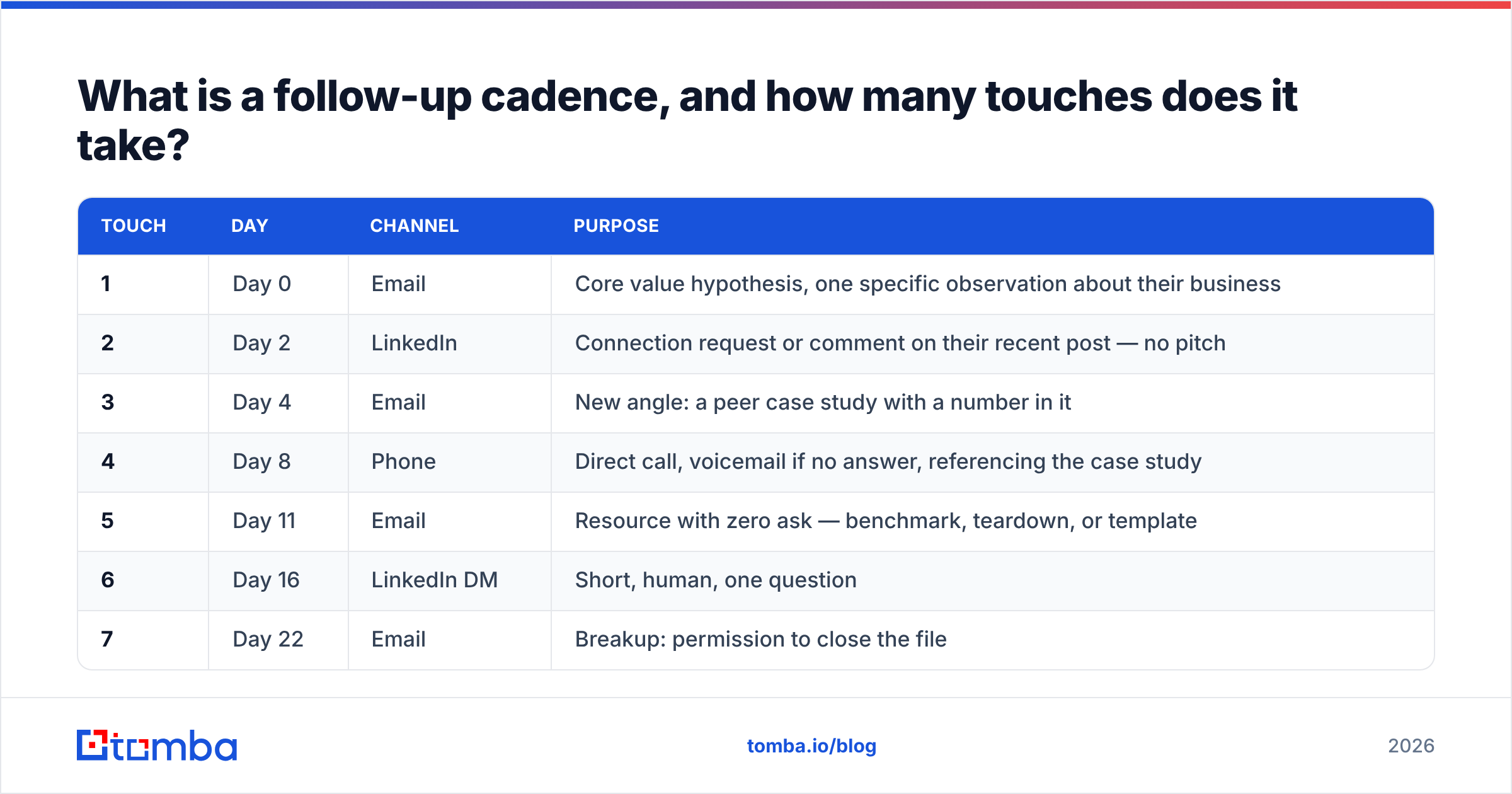
A cadence is a pre-planned sequence of contact attempts across channels, with fixed intervals and a defined end point. It is written before the campaign starts, not improvised after each non-reply.
The number that matters: most B2B deals need 5 to 8 touches before a first meaningful response, and a large share of positive replies land on touch three or later. Yet a majority of reps stop after two. That gap is the entire opportunity — the meetings are sitting in the touches your competitors never send.
Here is the shape of a cadence that works for mid-market B2B without burning the relationship:
| Touch | Day | Channel | Purpose |
|---|---|---|---|
| 1 | Day 0 | Core value hypothesis, one specific observation about their business | |
| 2 | Day 2 | Connection request or comment on their recent post — no pitch | |
| 3 | Day 4 | New angle: a peer case study with a number in it | |
| 4 | Day 8 | Phone | Direct call, voicemail if no answer, referencing the case study |
| 5 | Day 11 | Resource with zero ask — benchmark, teardown, or template | |
| 6 | Day 16 | LinkedIn DM | Short, human, one question |
| 7 | Day 22 | Breakup: permission to close the file | |
| 8 | Day 90+ | Re-entry with a trigger event (funding, hire, launch) |
Notice what is missing: there is no touch whose only content is "circling back." Every row has a job.
Spacing matters as much as count. Two days between touch one and two feels attentive. Two days between touch six and seven feels like harassment. Widen the gaps as the sequence progresses — the pattern below is deliberate: 2, 2, 4, 3, 5, 6 days.
How do you follow up with prospects step by step?#
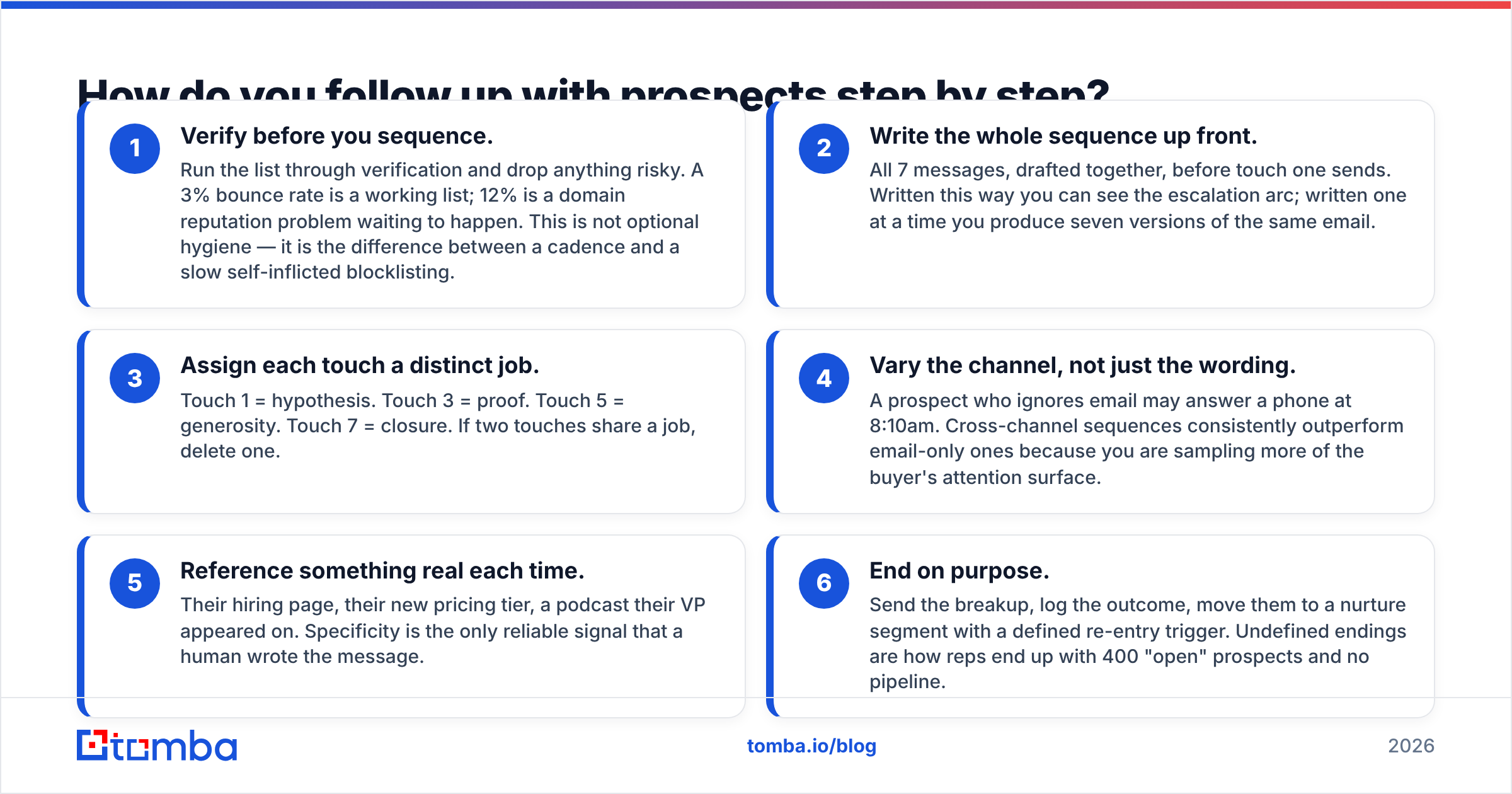
Six steps, in order. Skipping any one of them is where cadences fall apart.
- Verify before you sequence. Run the list through verification and drop anything risky. A 3% bounce rate is a working list; 12% is a domain reputation problem waiting to happen. This is not optional hygiene — it is the difference between a cadence and a slow self-inflicted blocklisting.
- Write the whole sequence up front. All 7 messages, drafted together, before touch one sends. Written this way you can see the escalation arc; written one at a time you produce seven versions of the same email.
- Assign each touch a distinct job. Touch 1 = hypothesis. Touch 3 = proof. Touch 5 = generosity. Touch 7 = closure. If two touches share a job, delete one.
- Vary the channel, not just the wording. A prospect who ignores email may answer a phone at 8:10am. Cross-channel sequences consistently outperform email-only ones because you are sampling more of the buyer's attention surface.
- Reference something real each time. Their hiring page, their new pricing tier, a podcast their VP appeared on. Specificity is the only reliable signal that a human wrote the message.
- End on purpose. Send the breakup, log the outcome, move them to a nurture segment with a defined re-entry trigger. Undefined endings are how reps end up with 400 "open" prospects and no pipeline.
Which follow-up channel actually performs best?#
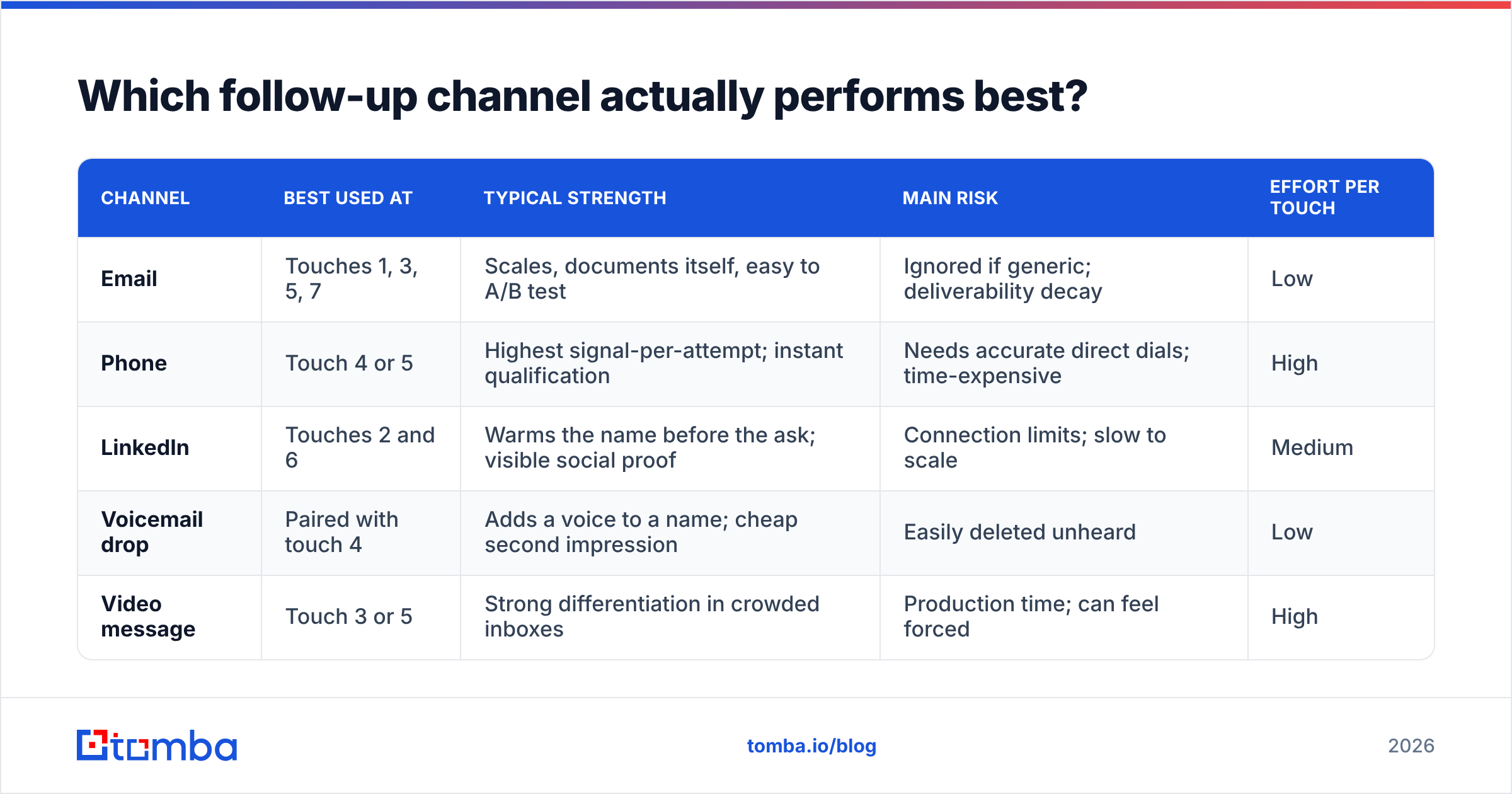
None of them alone. The right question is which channel does which job.
| Channel | Best used at | Typical strength | Main risk | Effort per touch |
|---|---|---|---|---|
| Touches 1, 3, 5, 7 | Scales, documents itself, easy to A/B test | Ignored if generic; deliverability decay | Low | |
| Phone | Touch 4 or 5 | Highest signal-per-attempt; instant qualification | Needs accurate direct dials; time-expensive | High |
| Touches 2 and 6 | Warms the name before the ask; visible social proof | Connection limits; slow to scale | Medium | |
| Voicemail drop | Paired with touch 4 | Adds a voice to a name; cheap second impression | Easily deleted unheard | Low |
| Video message | Touch 3 or 5 | Strong differentiation in crowded inboxes | Production time; can feel forced | High |
Two practical notes. First, the phone touch only works if the number is a direct dial — switchboard numbers waste the highest-effort touch you have, which is why a phone finder belongs in the same workflow as your email tooling. Second, LinkedIn touches should not pitch. Their entire job is making your name familiar so touch 3 reads as "that person again" instead of "another stranger." HubSpot's sales blog has consistent data on this pattern across thousands of sequences, and it holds up in practice: familiarity precedes response.
What should each follow-up message actually say?#
Each message needs a reason to exist that the prospect can perceive in the first line.
Touch 3 — the proof follow-up. Lead with the outcome, not the apology.
Subject: the 9-day onboarding number
Hi Dana — following my note Tuesday. A team roughly your size at [Peer Co] cut onboarding from 31 days to 9 after moving verification upstream of their sequences. Their bottleneck looked a lot like the one your careers page implies you're hiring around.
Worth 15 minutes to see whether the same lever applies?
Touch 5 — the generosity follow-up. No ask at all. Send the benchmark, the teardown, the checklist. This is the touch that converts skeptics, because it is the only one that costs them nothing.
Touch 7 — the breakup. Short, warm, genuinely final.
Subject: closing the loop
Dana — I'll stop here so I'm not clogging your inbox. If deliverability moves up the list next quarter, reply to this and I'll pick it back up with fresh numbers. Either way, good luck with the Q1 launch.
Breakups get replies at a surprisingly high rate, and a meaningful fraction of them are positive. The mechanism is not guilt — it is that a deadline forces a decision that was being deferred indefinitely.
If you are building a library rather than a one-off, start from proven structures instead of a blank page; a set of cold email templates will get you to a testable first draft faster than staring at the compose window.

How long should you wait between follow-ups?#
Long enough that you are not annoying, short enough that they still remember the last message. Practically, that means 2-3 days early in the sequence and 5-7 days late in it.
Two adjustments worth making:
- Deal size scales the interval. A $2k self-serve deal tolerates a compressed 12-day cadence. A $180k enterprise deal with six stakeholders needs 6-8 weeks and wider gaps, because the internal decision cycle is the actual constraint.
- Engagement compresses the interval. If someone opened your deck three times yesterday, follow up today. Behavior beats the calendar every time — this is where sequencing tools earn their cost.
Timing of day matters less than most people claim, with one exception: the phone touch. Direct dials connect meaningfully more often before 9am and after 4pm, when gatekeeping and meeting density both drop.
How do you know when to stop following up?#
When you have sent the breakup and gotten nothing. Not before, not after.
Reps err in both directions. Some stop at touch two and leave most of their pipeline unworked. Others run a prospect for nine months, which is worse — it burns domain reputation, poisons the account for future reps, and produces a CRM full of zombie opportunities that distort forecasting.
Set the rule at the team level so it is not a judgment call:
- 7 touches over ~22 days, then exit.
- Exit means: mark closed-lost with a reason, move to nurture, set a re-entry trigger.
- Re-entry triggers are events, not dates: a funding round, a relevant new hire, a competitor switch, a product launch.
- One re-entry attempt per trigger. Never restart the full cadence cold.
Gartner's research on B2B buying behavior makes the underlying point well: buyers spend the overwhelming majority of the cycle not talking to any vendor. Your job at exit is to be the vendor they remember when the cycle restarts — which is a nurture problem, not a follow-up problem.
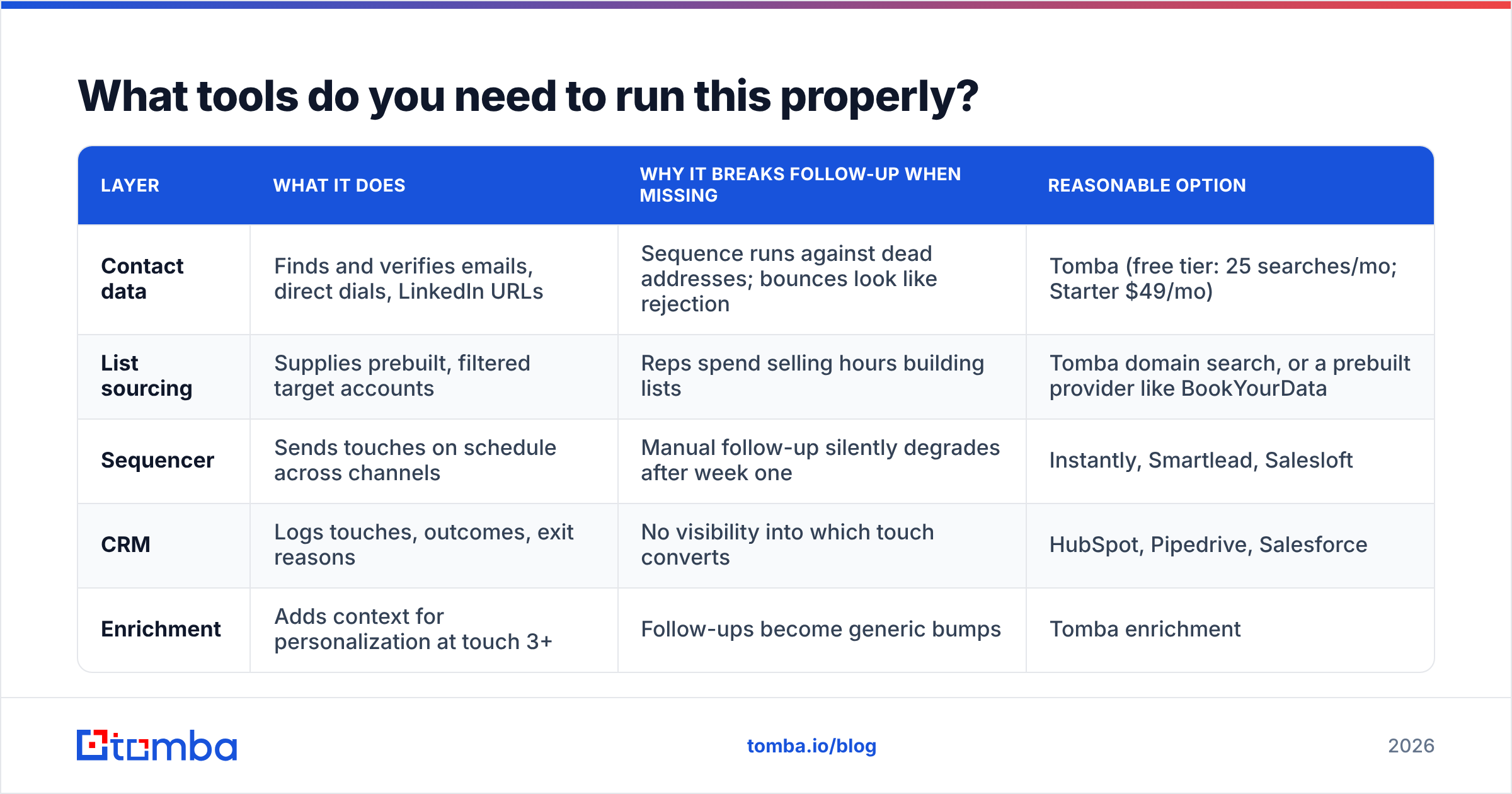
What tools do you need to run this properly?#
Less than most stacks contain. You need three capabilities: accurate contact data, a sequencing engine, and a place to log outcomes.
| Layer | What it does | Why it breaks follow-up when missing | Reasonable option |
|---|---|---|---|
| Contact data | Finds and verifies emails, direct dials, LinkedIn URLs | Sequence runs against dead addresses; bounces look like rejection | Tomba (free tier: 25 searches/mo; Starter $49/mo) |
| List sourcing | Supplies prebuilt, filtered target accounts | Reps spend selling hours building lists | Tomba domain search, or a prebuilt provider like BookYourData |
| Sequencer | Sends touches on schedule across channels | Manual follow-up silently degrades after week one | Instantly, Smartlead, Salesloft |
| CRM | Logs touches, outcomes, exit reasons | No visibility into which touch converts | HubSpot, Pipedrive, Salesforce |
| Enrichment | Adds context for personalization at touch 3+ | Follow-ups become generic bumps | Tomba enrichment |
On the data layer specifically: the cheapest way to double your effective reply rate is usually not better copy, it is fewer wasted touches. Use domain search to map every relevant contact at a target account so you are not sequencing a single champion who left in March, and enrich before the sequence starts rather than mid-flight. G2's sales intelligence category is a reasonable place to sanity-check vendor claims against user reviews before you commit budget.
How do you measure whether your follow-up is working?#
Track four numbers per sequence, not per email:
- Touch-to-reply distribution. Which touch produces replies? If everything comes from touch 1, your later touches are filler. If nothing comes before touch 4, your opener needs work.
- Bounce rate. Above 5% and you have a data problem masquerading as a messaging problem.
- Positive reply rate per 100 contacts. The only number tied to pipeline. Open rates are increasingly meaningless with privacy proxies inflating them.
- Meetings per 1,000 touches. Your efficiency ceiling. Improving this beats simply sending more.
Review these monthly and change exactly one variable at a time — cadence length, channel mix, or copy. Changing all three at once tells you nothing about which change worked. Understanding what a healthy response rate looks like for your segment keeps the review honest; expectations for a 12-person SaaS team and a 400-person enterprise motion are not the same.
Where should you start this week?#
Pick one segment of 100 accounts. Verify the contacts, write all seven touches before sending any, and run it to completion with no improvisation. You will learn more from one disciplined sequence than from six months of ad-hoc bumping.
The part most teams get wrong is the foundation, not the follow-up. If your addresses are stale, every improvement you make to cadence and copy is measured against noise. Start with the Tomba Email Finder to build a verified, current contact list — free tier covers 25 searches a month if you just want to test the workflow, and Starter runs $49/mo when you're ready to scale it across a real territory. Get the data right first; then the follow-up sequence you just designed has something solid to run on.
Related guides#
// get started
Find, verify and enrich your first contacts today
Start on the free plan with 25 searches a month, then scale when your team is ready.
Free plan · No credit card required · GDPR & CCPA
// about the author