How To Follow Up Without Saying Follow Up: 9 Better Openers
"Just following up" tells a prospect you have nothing new to say. Here are nine reply-worthy alternatives, a decision table for picking one, and the cadence math behind them.
TL;DR
- "Just following up" is a status update about you. Prospects reply to messages that are about them, so every follow-up needs a new unit of value — not a nudge.
- The nine openers below each carry their own payload: a trigger event, a resource, a benchmark, a teardown, a referral pivot, a permission close, and three more.
- Follow-ups drive roughly half of all cold-email replies, so the sequence matters more than the first send. Most teams stop at two touches; four to six spaced over 14–21 days is the sweet spot.
- Pick your opener with the decision table below: it maps prospect signal (opened, clicked, silent, bounced-back) to the right message type.
- None of this works on bad data. Verify addresses before you build a six-touch cadence on top of them, or you're just spamming a typo.
Why does "just following up" kill your reply rate?#
Because it asks the recipient to do work you didn't do.
Think of it like knocking on a neighbor's door twice with nothing in your hands. The first knock, they might answer out of curiosity. The second knock — same empty hands — trains them to ignore the sound. "Just following up," "bumping this to the top of your inbox," and "circling back" all say the same thing: I have no new information, but I want something from you.
Three specific failures happen when you open that way:
- It surfaces the ask before the value. The first eight words of a follow-up are what shows in the preview pane. If those words are administrative, the message reads as a chore.
- It admits the previous email failed. You're drawing attention to your own ignored message rather than starting a new conversation.
- It's pattern-matched to spam. Filters and humans both learn phrases. When 40 other vendors use the same opener that quarter, yours gets grouped with them.
The fix is not a cleverer synonym for "checking in." It's replacing the purpose of the message. A good follow-up is a standalone email that happens to be the second one you sent — it would still make sense to someone who never received the first.
What should replace "following up" in the first line?#
Nine openers, each tied to a different situation. Copy the structure, not the words.
1. The trigger-event open
"Saw the Series B announcement — congrats. That usually means hiring pressure on the RevOps side within a quarter."
Works when something verifiable changed: funding, a new exec, a product launch, a job posting, an acquisition. The trigger justifies the timing, which is the hardest part of any follow-up to defend.
2. The resource drop (no ask)
"Pulled the three onboarding flows I mentioned into a two-page doc. Attached — no reply needed."
You give something and explicitly remove the obligation. Counterintuitively, "no reply needed" earns replies because it removes the pressure that makes people defer.
3. The benchmark open
"Ran the numbers across 40 mid-market SaaS teams last quarter: median SDR set 8.2 meetings/month. You mentioned you're around 5."
Data specific to their peer group. This is the highest-performing opener for analytical buyers because it hands them an argument they can take into their own internal meeting.
4. The teardown
"Spent 10 minutes in your signup flow. Three things slowed me down — screenshot of the second one below."
High effort, high return. Only send when you've actually done the work; a fake teardown burns the account permanently.
5. The permission close (the "should I close your file?" line)
"I'll assume the timing isn't right and stop here unless you tell me otherwise."
Best used as touch five or six. It converts silence into a decision. Expect a mix of "yes, close it" and "no, sorry — next month," and both outcomes are better than an open loop.
6. The referral pivot
"This may not be your area — is Priya the right person for outbound tooling, or someone else?"
Lets them help you without buying anything. Low-cost yes.
7. The one-question email
"Quick one: are you still running enrichment through a manual list build, or did that move in-house?"
A single question, answerable in under six words. Reply friction near zero.
8. The reframe
"I think I pitched this wrong. The reason teams your size use this isn't lead volume — it's that their CRM data goes stale in 90 days."
Admitting a mis-pitch is disarming and gives you a legitimate reason to write again.
9. The deadline that's actually real
"Our Q1 onboarding cohort closes March 14. After that the next slot is May."
Only if true. Fabricated urgency is the fastest way to lose a deal you hadn't won yet.
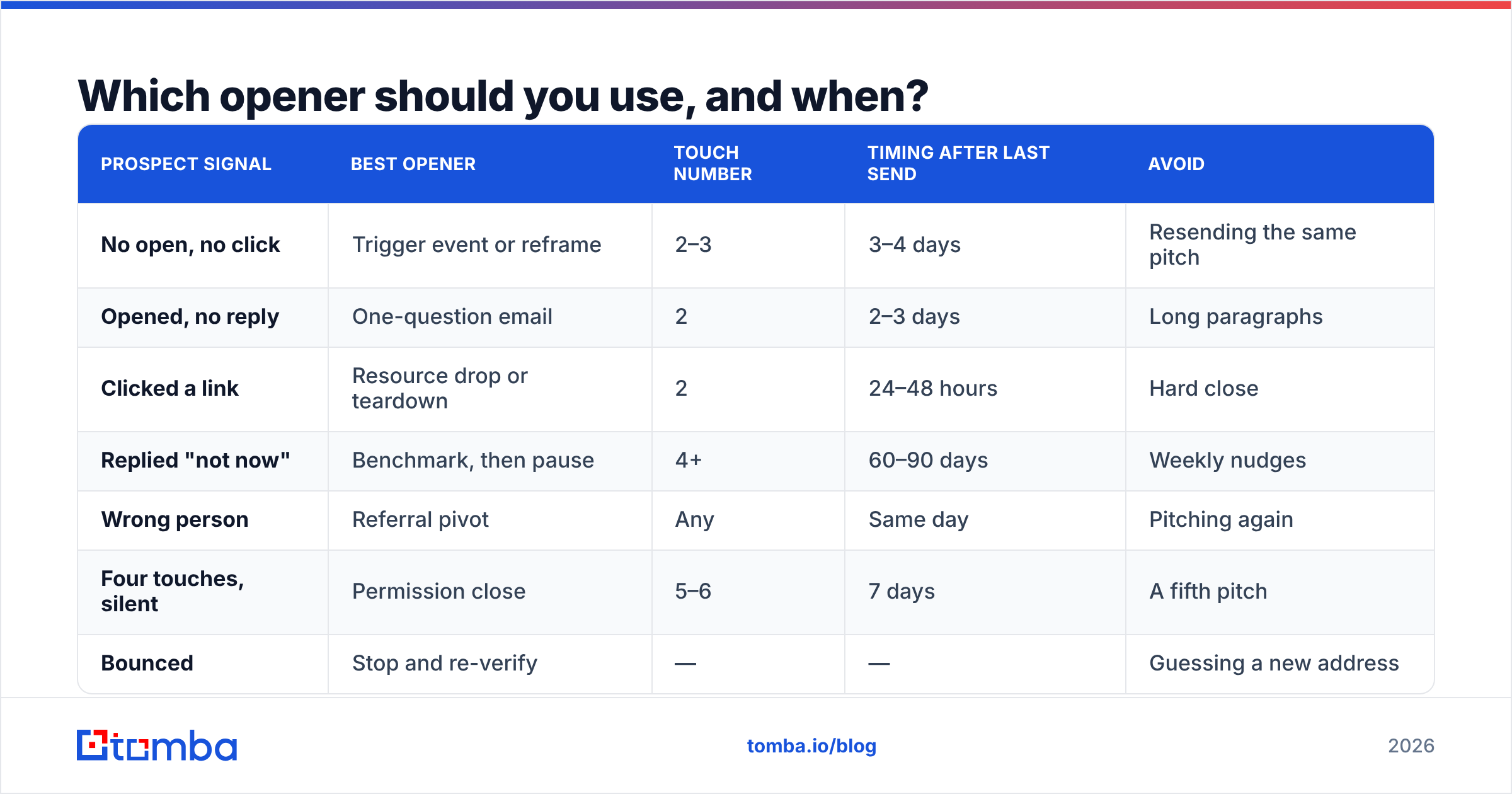
Which opener should you use, and when?#
Match the message to the signal you have. This is the table to keep next to your sequence builder.
| Prospect signal | Best opener | Touch number | Timing after last send | Avoid |
|---|---|---|---|---|
| No open, no click | Trigger event or reframe | 2–3 | 3–4 days | Resending the same pitch |
| Opened, no reply | One-question email | 2 | 2–3 days | Long paragraphs |
| Clicked a link | Resource drop or teardown | 2 | 24–48 hours | Hard close |
| Replied "not now" | Benchmark, then pause | 4+ | 60–90 days | Weekly nudges |
| Wrong person | Referral pivot | Any | Same day | Pitching again |
| Four touches, silent | Permission close | 5–6 | 7 days | A fifth pitch |
| Bounced | Stop and re-verify | — | — | Guessing a new address |
Two rules govern the whole table. First, escalate value, not frequency — each touch should be worth more than the last, not louder. Second, never send two consecutive emails of the same type; a question followed by a question reads as nagging, while a question followed by a resource reads as a relationship.
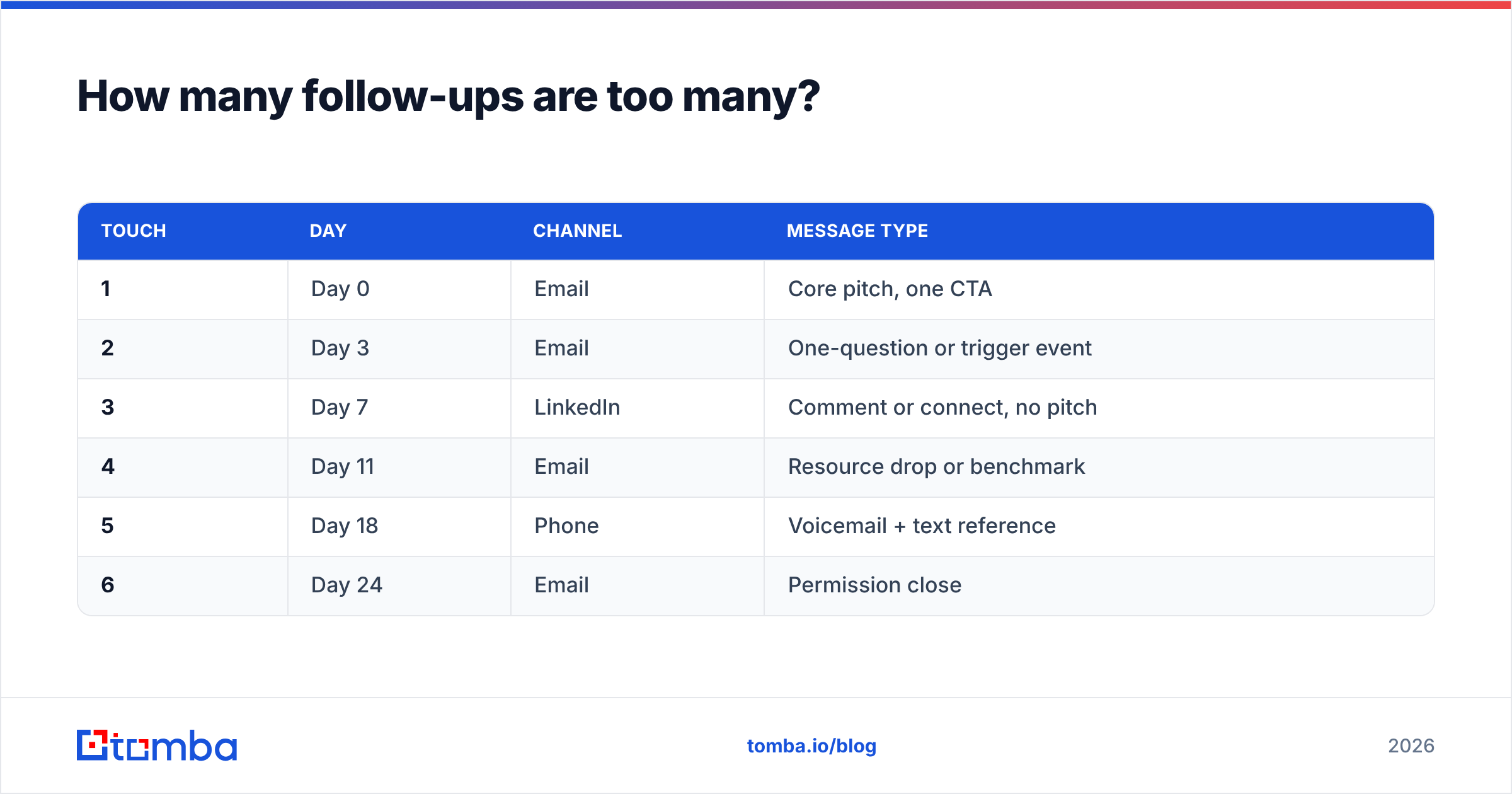
How many follow-ups are too many?#
The honest answer: it depends on deal size, but the data points in a consistent direction.
Follow-ups account for a large share of total replies in cold outbound — most teams see the majority of positive responses arrive on touch two through five, not touch one. Yet a persistent share of reps send exactly one email and move on. That gap is where most pipeline is left on the table.
A defensible default cadence:
| Touch | Day | Channel | Message type |
|---|---|---|---|
| 1 | Day 0 | Core pitch, one CTA | |
| 2 | Day 3 | One-question or trigger event | |
| 3 | Day 7 | Comment or connect, no pitch | |
| 4 | Day 11 | Resource drop or benchmark | |
| 5 | Day 18 | Phone | Voicemail + text reference |
| 6 | Day 24 | Permission close |
Then stop. Reopen in 90 days with a trigger event, not a "circling back on my email from March." Nobody remembers your email from March, and reminding them is a status update about you again.
For enterprise deals with 9+ stakeholders, extend the window rather than adding touches — 8 emails over 60 days outperforms 8 emails over 20. HubSpot's sales research and buyer-behavior work from Gartner both point the same way: B2B buying groups move on their own clock, and pressure compresses nothing.
What does a rewritten follow-up actually look like?#
Before and after, same prospect, same offer.
Before (the bump):
Subject: Following up
Hi Marcus,
Just following up on my email from last week about our email-finding platform. Did you get a chance to look? Let me know if you'd like to set up 15 minutes.
Best, Dana
After (trigger + one question):
Subject: Your two new SDR reqs
Marcus — saw you posted two SDR roles on Tuesday.
When teams double SDR headcount, list-building usually eats the first month before anyone dials. The teams that avoid that pre-build a verified contact set before the reps start.
Are you building those lists in-house right now, or buying them?
Dana
The second version is shorter, has a subject line that describes the recipient's world rather than the sender's calendar, and asks one question with a six-word answer. It also never references the first email — which is the point. If it lands cold, it still works.
A note on the subject line: never reply-thread a follow-up with "Re: Re:" unless the prospect actually replied. Fake threading is a trust cost you pay once and can't refund. If you want to genuinely test what lands, run candidates through a subject line tester before the sequence goes live rather than after.
Does any of this matter if your data is wrong?#
No. And this is the part most "follow-up tips" posts skip.
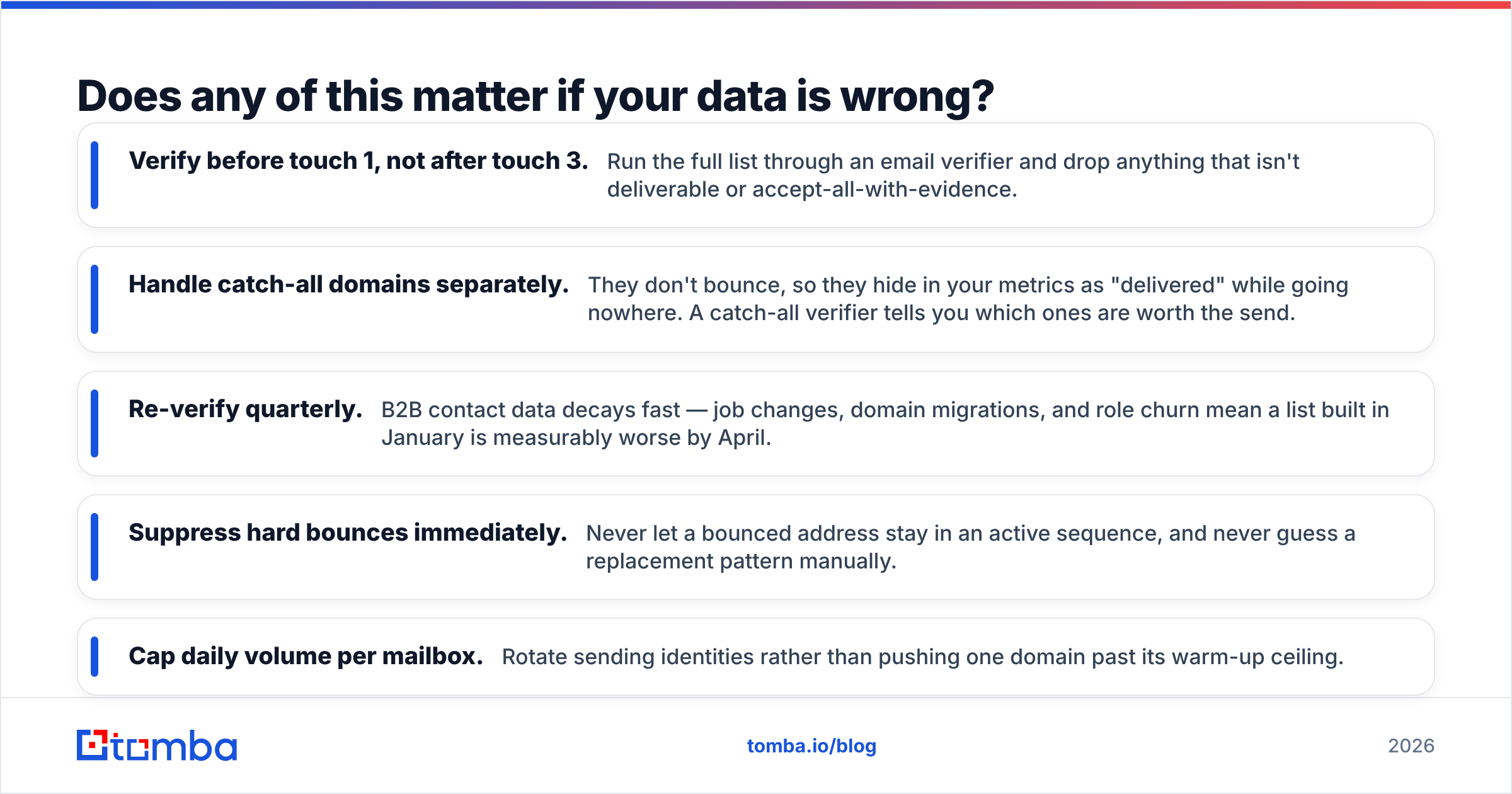
Every extra touch multiplies the cost of a bad address. If your list has a 12% invalid rate and you're running a six-touch cadence, you're generating six times the bounce volume — and bounce rate is one of the strongest negative signals mailbox providers use to score a sender. Push past roughly 2–3% and your email deliverability starts degrading for the valid contacts too. You end up punishing the prospects who were reachable because of the ones who weren't.
A workable pre-sequence checklist:
- Verify before touch 1, not after touch 3. Run the full list through an email verifier and drop anything that isn't deliverable or accept-all-with-evidence.
- Handle catch-all domains separately. They don't bounce, so they hide in your metrics as "delivered" while going nowhere. A catch-all verifier tells you which ones are worth the send.
- Re-verify quarterly. B2B contact data decays fast — job changes, domain migrations, and role churn mean a list built in January is measurably worse by April.
- Suppress hard bounces immediately. Never let a bounced address stay in an active sequence, and never guess a replacement pattern manually.
- Cap daily volume per mailbox. Rotate sending identities rather than pushing one domain past its warm-up ceiling.
If the contact record itself is thin — you have a name and a company but no address — that's a sourcing problem, not a copy problem. A domain search against the company gives you the pattern and the reachable people on the team, which also tells you whether your original contact is even the right one to keep chasing.
How do you compare follow-up approaches side by side?#
Three common philosophies, honestly assessed:
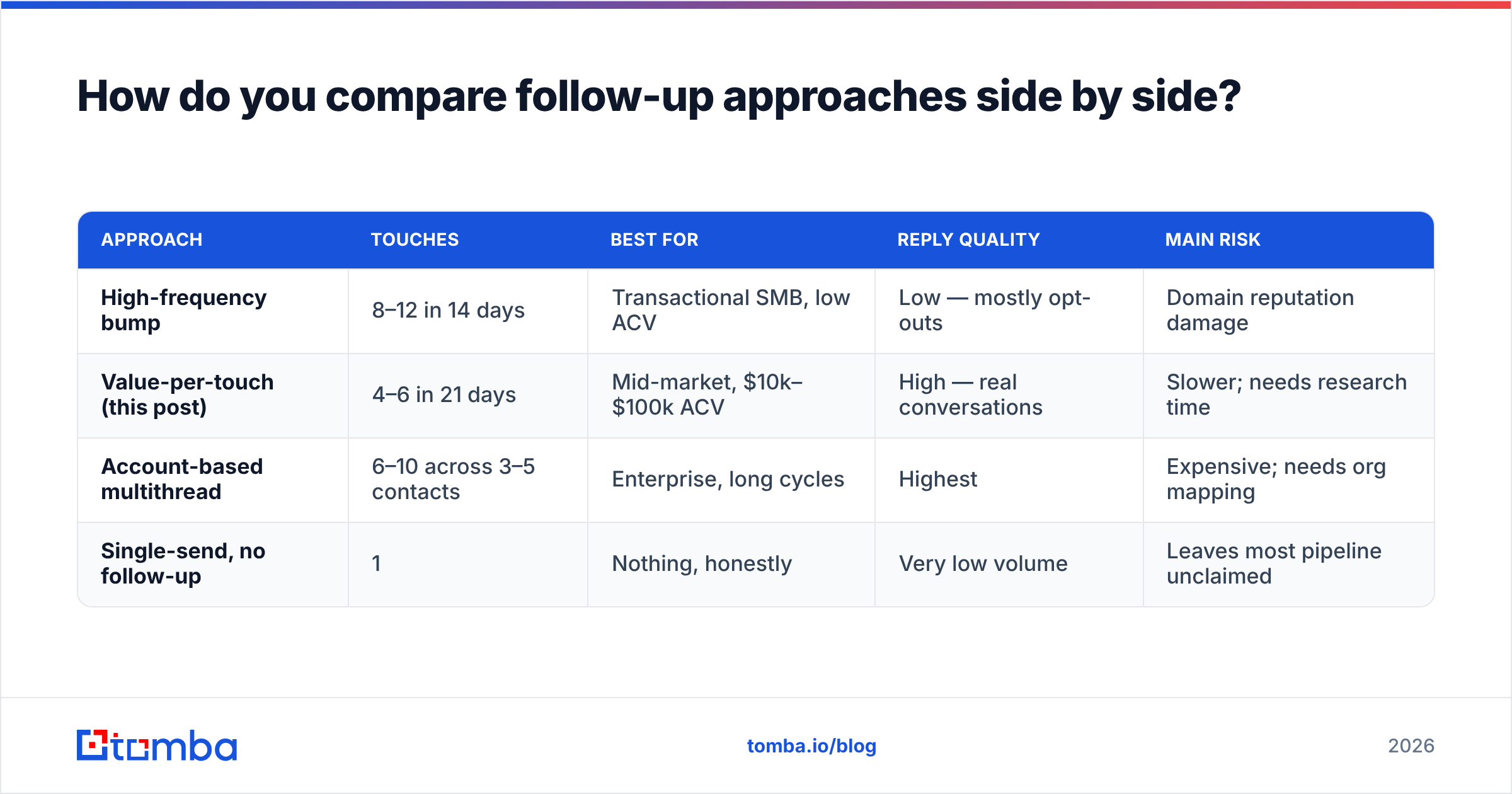
| Approach | Touches | Best for | Reply quality | Main risk |
|---|---|---|---|---|
| High-frequency bump | 8–12 in 14 days | Transactional SMB, low ACV | Low — mostly opt-outs | Domain reputation damage |
| Value-per-touch (this post) | 4–6 in 21 days | Mid-market, $10k–$100k ACV | High — real conversations | Slower; needs research time |
| Account-based multithread | 6–10 across 3–5 contacts | Enterprise, long cycles | Highest | Expensive; needs org mapping |
| Single-send, no follow-up | 1 | Nothing, honestly | Very low volume | Leaves most pipeline unclaimed |
The value-per-touch model wins for most B2B teams because it's the only one where the marginal email is cheap to produce and still respected by the recipient. High-frequency works arithmetically until your domain gets flagged, at which point the math inverts hard. If you want to see how peers rate these tools and cadences before committing, vendor review data on G2 is more useful than vendor case studies.
One caveat worth stating plainly: the account-based approach genuinely outperforms everything else on large deals, but it requires accurate org charts and multiple verified contacts per account. That's a data investment before it's a messaging one.
What should you stop writing today?#
A short kill list. Every one of these phrases signals "no new information":
- "Just following up"
- "Circling back"
- "Bumping this to the top of your inbox"
- "Checking in to see if you saw my last email"
- "Did you get a chance to review?"
- "Any thoughts on the below?"
- "Wanted to make sure this didn't fall through the cracks"
- "Per my last email"
Replace each with a sentence that contains a noun the prospect cares about: their headcount, their funding, their competitor, their metric, their deadline. If the first sentence of your follow-up doesn't contain one of those, you haven't written a follow-up — you've written a reminder, and nobody has ever bought anything from a reminder.
Test it with a simple question before you hit send: if this email arrived first, would it still make sense? If yes, send it. If it only makes sense as a sequel, rewrite it.
Where do you go from here?#
Start with the data, then fix the copy. A perfect nine-opener sequence sent to unverified addresses produces bounces, not meetings — and the reputation damage outlasts the campaign by months.
Build your list with the Tomba Email Finder, verify every address before touch one, and run your cadence knowing the only variable left is your message. Tomba's free tier gives you 25 searches a month to test the workflow, with Starter at $49/mo and Growth at $99/mo when you're ready to scale — see the full Tomba pricing breakdown. Then go rewrite that "just following up" draft sitting in your outbox.
Related guides#
Ready to find emails that actually work?
Join 150,000+ professionals who stopped guessing and started sending. Free credits on signup — no credit card required.
Get the Tomba newsletter
Practical outbound tactics and product updates — once every two weeks.
About the author