How to Gather Competitive Intelligence: A 7-Step 2026 Playbook
Most competitive intel dies in a Google Doc nobody opens. Here's a repeatable 7-step system for collecting, verifying, and shipping competitor signals your reps actually use in live deals.
TL;DR
- Competitive intelligence is not a competitor spreadsheet. It is a repeatable loop: collect signals, verify them, distill them into a decision, ship it to the people in live deals.
- Roughly 80% of what you need is public and free — job postings, pricing pages, changelogs, review sites, SEC/Companies House filings, hiring patterns, and win/loss calls with your own buyers.
- The bottleneck is almost never access to data. It is verification and distribution: unverified intel is a rumor, and undistributed intel is a rounding error.
- Build a weekly 90-minute cadence instead of a quarterly 40-page deck. Cadence beats depth every single time.
- Pair public signals with contact-level data so intel turns into outreach — knowing a competitor lost a champion is only useful if you can email their replacement.
What is competitive intelligence, and what is it not?#
Competitive intelligence (CI) is the systematic collection and analysis of public information about your market, competitors, and buyers, turned into decisions your team can act on this week.
Think of it like weather forecasting for revenue. A meteorologist does not own a crystal ball — they read pressure systems, satellite images, and historical patterns, then say "bring a jacket." CI works the same way. You are not stealing anyone's roadmap. You are reading enough public pressure systems to tell your VP of Sales which jacket to bring into next quarter's deals.
Here is what CI is not:
- Not a competitor feature matrix. A matrix is an artifact. CI is a process that produces artifacts.
- Not corporate espionage. Everything in this playbook is public, published, or volunteered by your own customers. The Strategy and Competitive Intelligence Professionals ethics code draws the line clearly: no misrepresentation of who you are, ever.
- Not a one-time project. A CI deck built in March is fiction by June. Pricing pages change, positioning shifts, and the competitor who was "enterprise only" quietly launched a $29 self-serve tier.
- Not the same as market research. Market research tells you the size of the pond. CI tells you which fish are eating your bait.
Why does competitive intelligence fail at most B2B companies?#
It fails for four boring, fixable reasons.
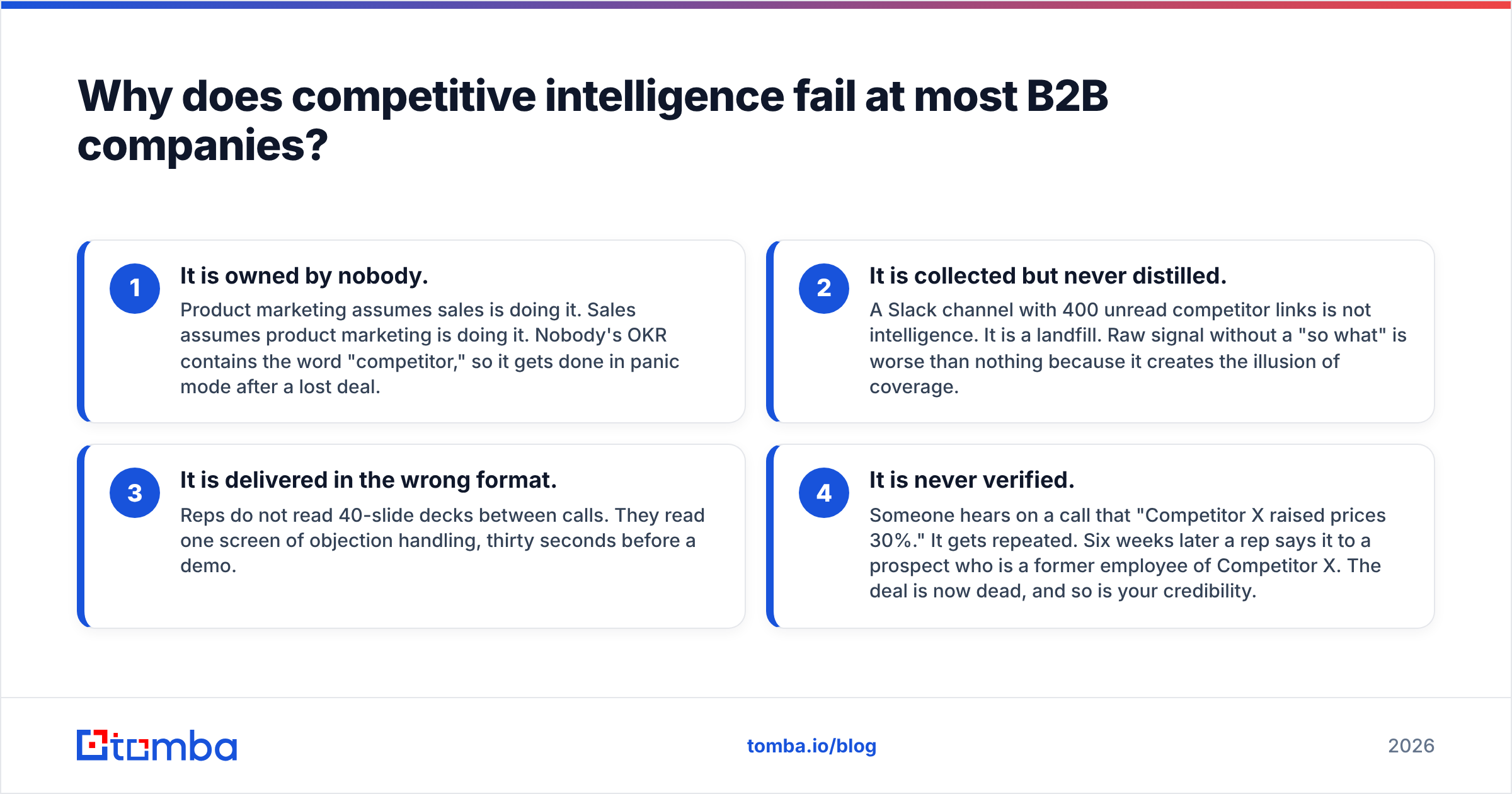
- It is owned by nobody. Product marketing assumes sales is doing it. Sales assumes product marketing is doing it. Nobody's OKR contains the word "competitor," so it gets done in panic mode after a lost deal.
- It is collected but never distilled. A Slack channel with 400 unread competitor links is not intelligence. It is a landfill. Raw signal without a "so what" is worse than nothing because it creates the illusion of coverage.
- It is delivered in the wrong format. Reps do not read 40-slide decks between calls. They read one screen of objection handling, thirty seconds before a demo.
- It is never verified. Someone hears on a call that "Competitor X raised prices 30%." It gets repeated. Six weeks later a rep says it to a prospect who is a former employee of Competitor X. The deal is now dead, and so is your credibility.
Fix ownership, distillation, format, and verification, and CI stops being theater.
What are the four types of competitive intelligence you should collect?#
Not all intel is equally useful. Sort everything you gather into these four buckets, because each one feeds a different decision-maker.
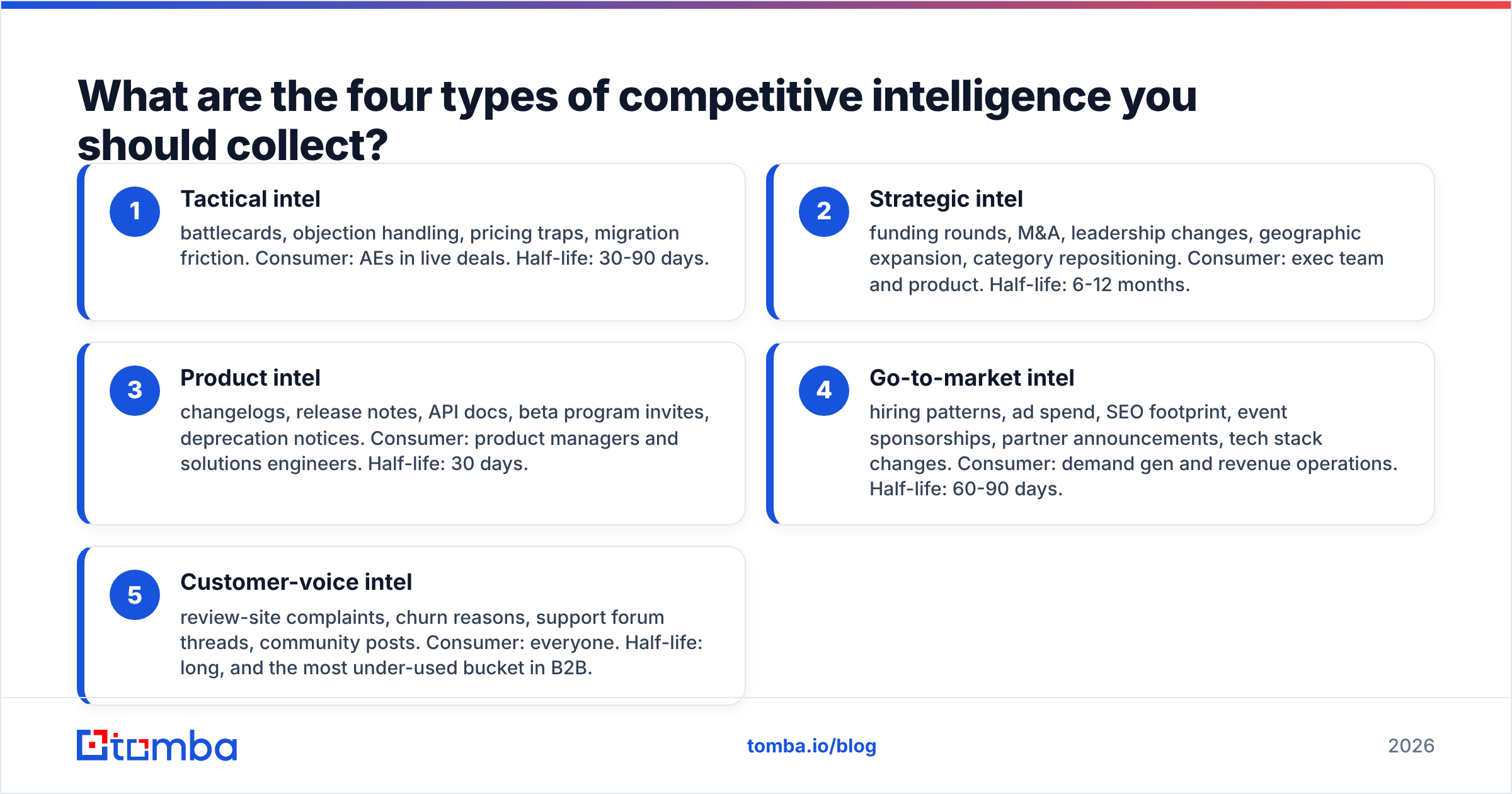
- Tactical intel — battlecards, objection handling, pricing traps, migration friction. Consumer: AEs in live deals. Half-life: 30-90 days.
- Strategic intel — funding rounds, M&A, leadership changes, geographic expansion, category repositioning. Consumer: exec team and product. Half-life: 6-12 months.
- Product intel — changelogs, release notes, API docs, beta program invites, deprecation notices. Consumer: product managers and solutions engineers. Half-life: 30 days.
- Go-to-market intel — hiring patterns, ad spend, SEO footprint, event sponsorships, partner announcements, tech stack changes. Consumer: demand gen and revenue operations. Half-life: 60-90 days.
- Customer-voice intel — review-site complaints, churn reasons, support forum threads, community posts. Consumer: everyone. Half-life: long, and the most under-used bucket in B2B.
If a signal does not fit one of these buckets, it is trivia. Do not file it.
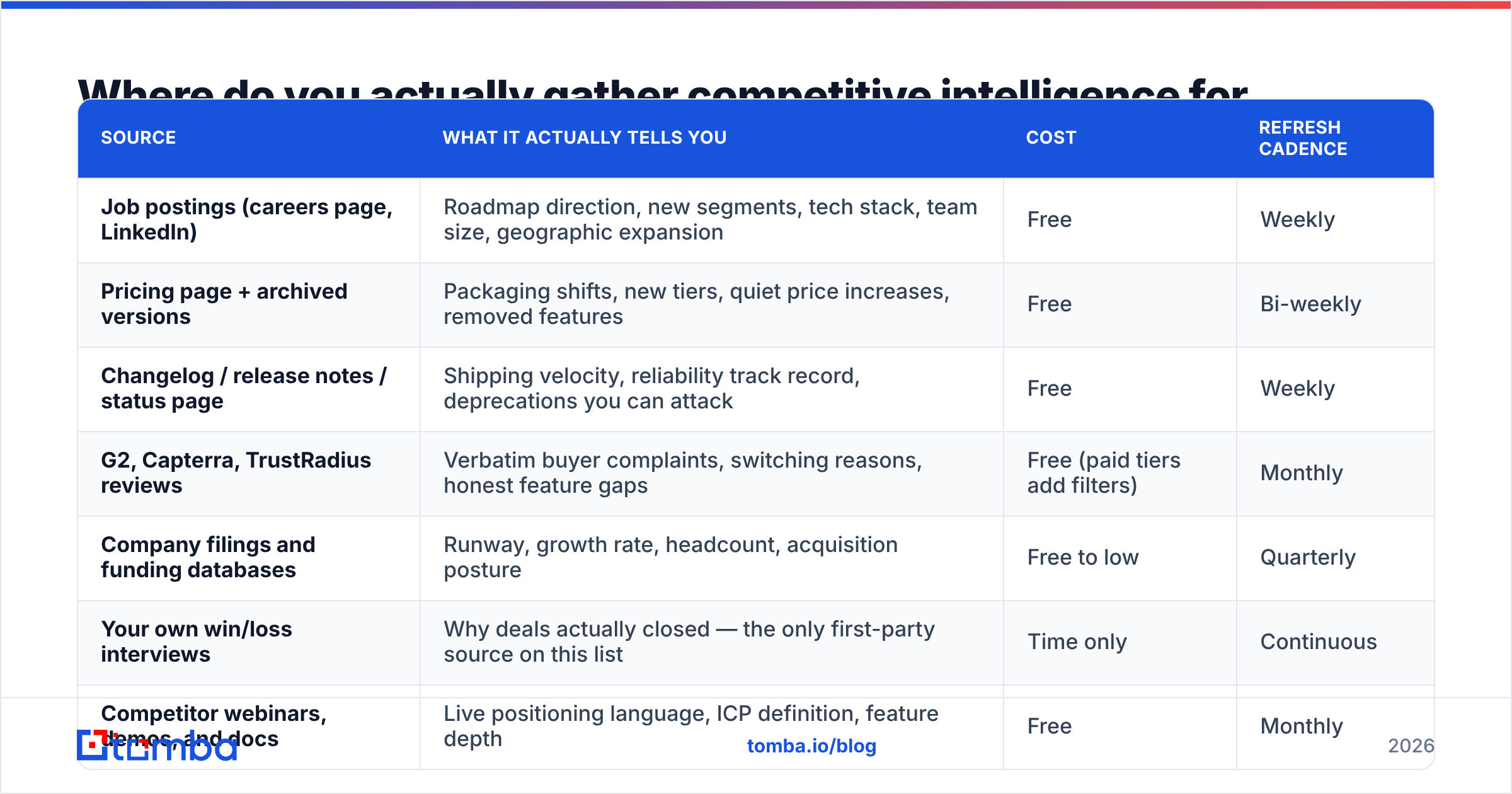
Where do you actually gather competitive intelligence for free?#
Start here before you buy a single tool. This table covers the sources that produce the highest signal-to-noise ratio for a B2B software or services company.
| Source | What it actually tells you | Cost | Refresh cadence |
|---|---|---|---|
| Job postings (careers page, LinkedIn) | Roadmap direction, new segments, tech stack, team size, geographic expansion | Free | Weekly |
| Pricing page + archived versions | Packaging shifts, new tiers, quiet price increases, removed features | Free | Bi-weekly |
| Changelog / release notes / status page | Shipping velocity, reliability track record, deprecations you can attack | Free | Weekly |
| G2, Capterra, TrustRadius reviews | Verbatim buyer complaints, switching reasons, honest feature gaps | Free (paid tiers add filters) | Monthly |
| Company filings and funding databases | Runway, growth rate, headcount, acquisition posture | Free to low | Quarterly |
| Your own win/loss interviews | Why deals actually closed — the only first-party source on this list | Time only | Continuous |
| Competitor webinars, demos, and docs | Live positioning language, ICP definition, feature depth | Free | Monthly |
| Website tech stack and ad footprint | Vendor switches, analytics changes, paid channel bets | Free tools available | Monthly |
Three of these deserve extra attention.
Job postings are the cheapest roadmap leak in existence. When a competitor posts three FedRAMP compliance roles, they are telling you they are chasing public sector in the next 12 months. When they post a "Partnerships Manager, EMEA," you know where the expansion budget went. Nobody is hiding this — it is on their careers page, indexed by Google.
Review sites are the only place your competitor's customers speak without a marketing edit. Filter G2 reviews to 2- and 3-star ratings and read the "What do you dislike?" field. That is your objection-handling script, written by people who paid money and got frustrated.
Win/loss interviews outperform every third-party source combined. Ten fifteen-minute calls with recently closed-lost buyers will teach you more than a $30,000 analyst subscription. The catch is you need current contact data for buyers who have already stopped answering your rep's emails — which is where an email verifier and a decent B2B database stop being nice-to-haves.
How do you build a repeatable CI workflow in 7 steps?#
Ninety minutes a week, one owner, one output. That is the whole system.
Step 1 — Pick five competitors, not fifteen. Two head-to-head rivals you meet in deals, two adjacent players who could enter your lane, one "do nothing / spreadsheet" incumbent. Anything beyond five gets skipped in practice.
Step 2 — Set up passive collection. Google Alerts on brand + "pricing" + "acquires" + "raises". RSS on their blog and changelog. A saved LinkedIn search for their job postings. A monitored inbox that subscribes to their newsletter using a role address you control. Fifteen minutes of setup, permanent yield.
Step 3 — Create a single intake channel. One Slack channel, one form, one rule: every submission must include a link and one sentence of "so what." No link, no entry. This kills the landfill problem at the source.
Step 4 — Verify before you file. Two-source rule for anything that will appear on a battlecard. A screenshot of the pricing page beats a rep's recollection. A dated archive link beats a screenshot. If you cannot verify it, file it as "unconfirmed" and never let it leave the internal doc.
Step 5 — Distill weekly. Ninety minutes, same slot every week. Read the intake, kill 80% of it, and write at most three findings. Each finding is: what changed, why it matters, what we do about it, who owns it.
Step 6 — Ship to the point of use. Battlecards live inside the CRM next to the opportunity, not in a wiki. Pricing changes go to the deal desk. Roadmap signals go to product in their planning ritual. Distribution is the job, not an afterthought.
Step 7 — Close the loop with sales. Once a month, ask three AEs one question: "What did you need last month that you didn't have?" Their answer is your collection priority for the following month. CI that does not take requests becomes CI nobody requests.
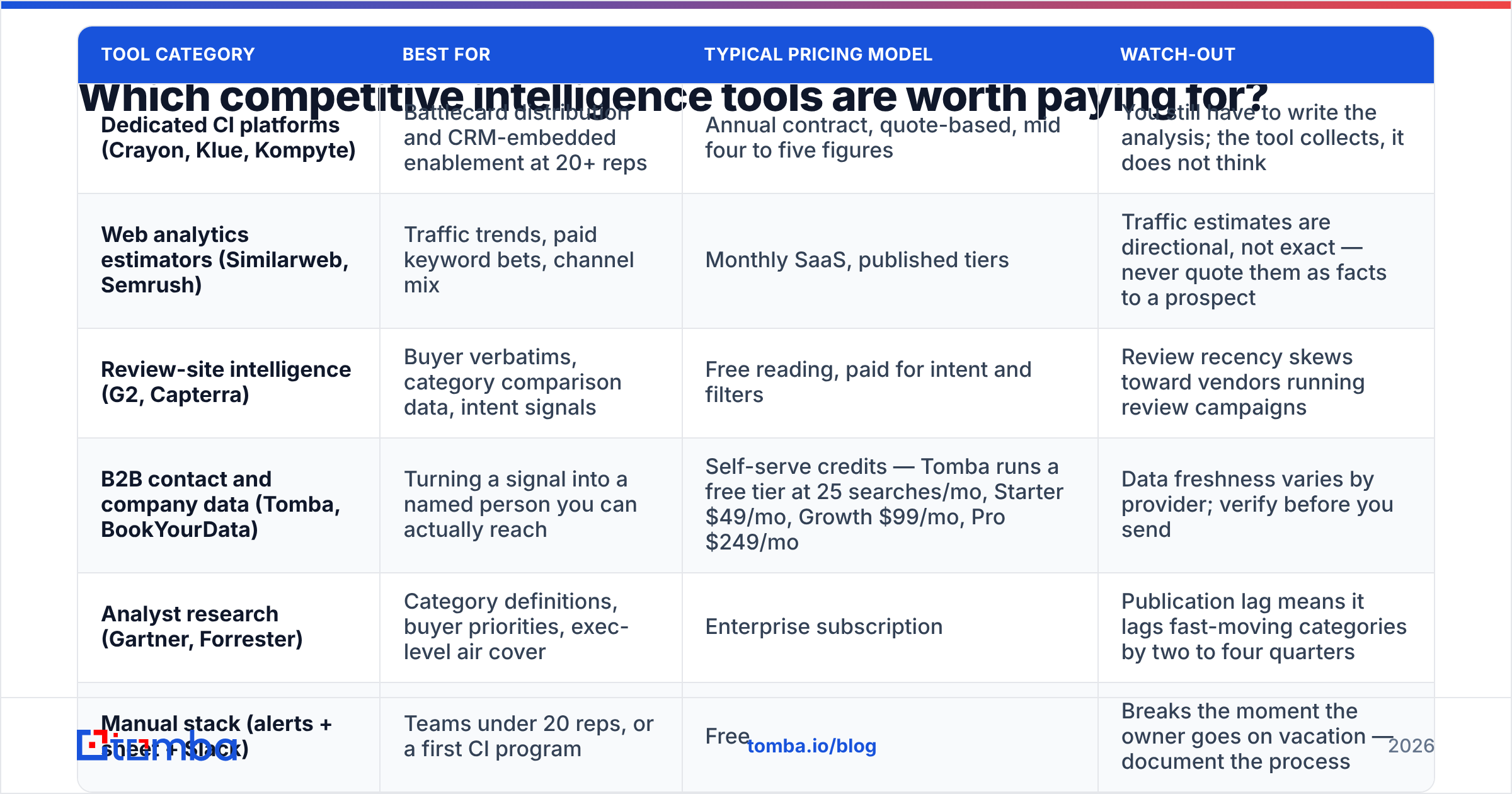
Which competitive intelligence tools are worth paying for?#
You can run steps 1 through 7 with free tools for a long time. Buy software when manual collection is costing more than an hour a day, or when you need audit trails across a large sales team.
| Tool category | Best for | Typical pricing model | Watch-out |
|---|---|---|---|
| Dedicated CI platforms (Crayon, Klue, Kompyte) | Battlecard distribution and CRM-embedded enablement at 20+ reps | Annual contract, quote-based, mid four to five figures | You still have to write the analysis; the tool collects, it does not think |
| Web analytics estimators (Similarweb, Semrush) | Traffic trends, paid keyword bets, channel mix | Monthly SaaS, published tiers | Traffic estimates are directional, not exact — never quote them as facts to a prospect |
| Review-site intelligence (G2, Capterra) | Buyer verbatims, category comparison data, intent signals | Free reading, paid for intent and filters | Review recency skews toward vendors running review campaigns |
| B2B contact and company data (Tomba, BookYourData) | Turning a signal into a named person you can actually reach | Self-serve credits — Tomba runs a free tier at 25 searches/mo, Starter $49/mo, Growth $99/mo, Pro $249/mo | Data freshness varies by provider; verify before you send |
| Analyst research (Gartner, Forrester) | Category definitions, buyer priorities, exec-level air cover | Enterprise subscription | Publication lag means it lags fast-moving categories by two to four quarters |
| Manual stack (alerts + sheet + Slack) | Teams under 20 reps, or a first CI program | Free | Breaks the moment the owner goes on vacation — document the process |
The honest recommendation: run the manual stack for one full quarter first. You will learn what you actually need, and you will negotiate a far better contract when you can tell a vendor exactly which three workflows you are buying.
How do you turn a competitor signal into pipeline?#
This is where most CI programs stop, and it is the step with the clearest revenue attribution.
A signal is only worth money if it ends in a conversation. Three patterns that work:
- Layoff or restructure signal → champion outreach. When a competitor cuts staff, their customers get reassigned CSMs and slower support. That is a switching window. Identify the accounts, find the current owner of the problem, and reach out with a migration angle rather than a feature pitch.
- Deprecation or price-increase signal → targeted campaign. A removed feature is a list of newly unhappy users. Build the account list, then use domain search to map the buying committee at each one before your competitor's renewal cycle closes.
- Hiring signal → timing play. A company hiring its first RevOps leader is about to buy tooling. A company hiring five SDRs is about to buy data. Both are budget events you can be early to.
In each case the intel gives you the why now, and contact data gives you the who. Missing either half leaves you with a nicely formatted observation and zero meetings.
How do you measure whether competitive intelligence is working?#
Track four numbers. Ignore the rest.
- Competitive win rate — win rate on deals where a named competitor was present, tracked before and after your program launched. This is the headline metric.
- Battlecard usage — opens or views per rep per month. If usage is near zero, your format is wrong, not your reps.
- Time-to-answer — how long between a rep asking "how do we beat X on Y" and getting a verified answer. Target under four hours.
- Loss-reason quality — the percentage of closed-lost deals with a specific, verified reason rather than "price" or "no decision." Vague loss reasons mean your intake is broken.
If competitive win rate has not moved after two quarters, the problem is almost always distribution, not collection.
What are the ethical and legal lines you should not cross?#
Simple test: if you would be uncomfortable seeing your collection method described in a competitor's press release about you, do not do it.
Clearly acceptable: reading public pages, buying a competitor's product openly as a company, interviewing your own lost prospects, reading published filings, subscribing to public newsletters, analyzing job ads.
Clearly not acceptable: misrepresenting your identity to get a demo, posing as a customer or journalist, inducing a competitor's employee to breach an NDA, accessing anything behind an authentication wall you are not authorized to use, scraping in violation of terms you agreed to.
The grey middle — anonymous free-trial signups, secret shopping through a partner — is a legal and brand-risk question. Get a written policy from your legal team once, and stop relitigating it every quarter.
Where should you start this week?#
Pick two competitors. Set six Google Alerts. Read every 2- and 3-star review of both on G2 and paste the ten most repeated complaints into one document. Book three win/loss calls. Block ninety minutes on Friday to distill it into a single page. That is a functioning CI program, and it cost you nothing but attention.
The step that trips most teams is contact reachability. You will identify the right accounts and the right people, then discover half your emails bounce because the data is eighteen months stale. Run those names through Tomba's Email Finder to get verified, deliverable addresses by name and domain — free tier included, Starter at $49/mo when you scale it. Intelligence that reaches a real inbox is the only kind that shows up in your pipeline report.
Related guides#
// get started
Find, verify and enrich your first contacts today
Start on the free plan with 25 searches a month, then scale when your team is ready.
Free plan · No credit card required · GDPR & CCPA
// about the author