How To Generate Business Leads: The 2026 Playbook
Seven lead generation channels, ranked by cost per lead, time to first meeting, and how well they scale. Includes the list-building workflow, the metrics that matter, and the mistakes that quietly kill pipeline.
TL;DR
- Lead generation is not one channel. It is a portfolio: outbound email, LinkedIn, content/SEO, paid, referrals, events, and website visitor identification each have different cost per lead and different time to first meeting.
- The cheapest reliable pipeline for most B2B teams under $10M ARR is still targeted outbound built on clean, verified contact data — not volume-first spray.
- Your list quality determines everything downstream. A 12% bounce rate does not just waste sends, it damages sender reputation and suppresses the good emails too.
- Track cost per qualified lead and lead-to-meeting rate, not raw lead counts. Raw counts reward the wrong behavior.
- Pick two channels, run them for 90 days with consistent volume, then add a third. Teams that run six half-built channels generate less pipeline than teams that run two well.
What actually counts as a business lead in 2026?#
A business lead is a person at a company who fits your ideal customer profile and has a reachable, verified contact point. That last clause is where most "lead lists" fall apart.
Here is the hierarchy most B2B teams should use internally, from weakest to strongest:
- Raw contact — a name and a company, no verified email or phone. Effectively worthless until enriched. Do not let anyone count these in a pipeline report.
- Verified contact — an ICP-fit person with a deliverable email address or a valid direct dial. This is your minimum viable lead.
- Engaged lead — that person opened, clicked, replied, visited your pricing page, or accepted a connection request. Intent is now non-zero.
- Marketing qualified lead (MQL) — engagement crosses a scoring threshold you defined in advance. See the definition of a marketing qualified lead if your team argues about this weekly, which most do.
- Sales qualified lead (SQL) — a rep has confirmed budget, need, timing, or at least two of the three, and booked a next step.
- Opportunity — a real deal with a close date. Lead gen's job ends here.
The practical takeaway: when someone asks "how many leads did we generate," ask which tier they mean. Teams that skip this conversation end up celebrating 4,000 raw contacts that produce two meetings.
Which lead generation channels actually produce pipeline?#
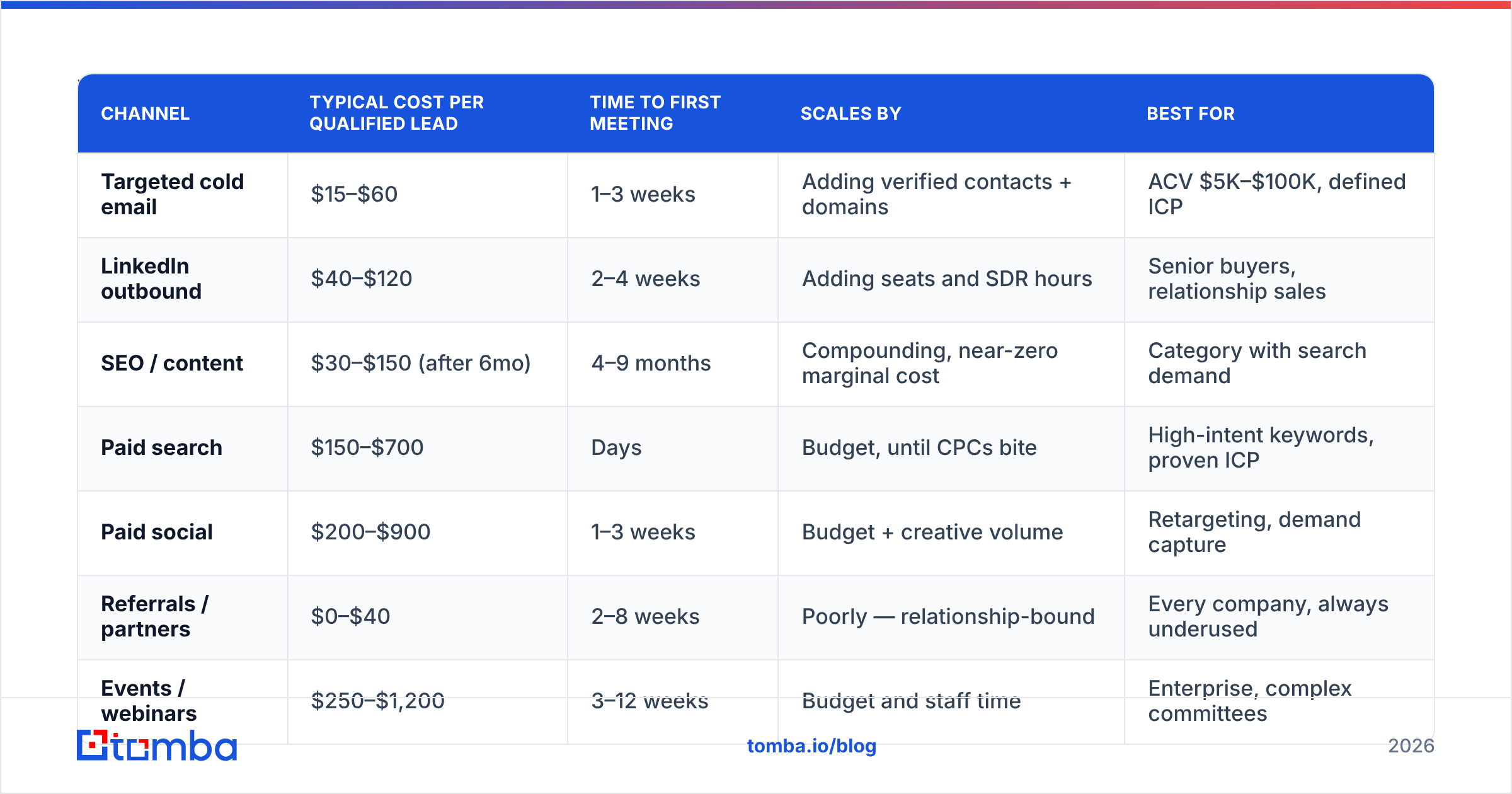
Every channel works for someone. The question is what it costs you in money and calendar weeks. These ranges reflect common B2B SaaS and services benchmarks — your numbers will vary by ACV and market, but the relative ordering holds up remarkably well.
| Channel | Typical cost per qualified lead | Time to first meeting | Scales by | Best for |
|---|---|---|---|---|
| Targeted cold email | $15–$60 | 1–3 weeks | Adding verified contacts + domains | ACV $5K–$100K, defined ICP |
| LinkedIn outbound | $40–$120 | 2–4 weeks | Adding seats and SDR hours | Senior buyers, relationship sales |
| SEO / content | $30–$150 (after 6mo) | 4–9 months | Compounding, near-zero marginal cost | Category with search demand |
| Paid search | $150–$700 | Days | Budget, until CPCs bite | High-intent keywords, proven ICP |
| Paid social | $200–$900 | 1–3 weeks | Budget + creative volume | Retargeting, demand capture |
| Referrals / partners | $0–$40 | 2–8 weeks | Poorly — relationship-bound | Every company, always underused |
| Events / webinars | $250–$1,200 | 3–12 weeks | Budget and staff time | Enterprise, complex committees |
| Website visitor ID | $20–$80 | Days | Existing traffic volume | Sites with 3K+ monthly visits |
Two things jump out of that table. First, outbound email has the lowest cost per qualified lead and the shortest ramp, which is why it remains the default first channel for small teams. Second, SEO has the best long-run economics and the worst short-run ones — it is a channel you start now so it pays in month nine, not a channel you start when the pipeline is empty.
Referrals deserve special mention. They cost almost nothing, close at 2–4x the rate of cold channels, and almost nobody runs them systematically. If you have not asked your last ten happy customers for one introduction each, do that before you buy anything.
How do you build a lead list that does not bounce?#
This is the step people rush, and it is the step that determines whether the other steps work at all.
Step 1 — Write the ICP as filters, not adjectives. "Mid-market SaaS companies that care about security" is not a filter. "Software companies, 50–500 employees, US or UK, with a job posting for a security engineer in the last 90 days" is. If you cannot express your ICP as filters, you cannot build a list against it.
Step 2 — Source companies before people. Build the account list first: 200–500 target domains. Pull them from your CRM's closed-won patterns, from G2 category pages, from funding announcements, from conference attendee lists, from your competitors' public customer logos.
Step 3 — Find the people at those accounts. Once you have domains, a domain search returns the people and email patterns at each company far faster than hunting profile by profile. For named prospects you already identified on LinkedIn, an email finder resolves first name + last name + domain into a deliverable address.
Step 4 — Verify before you send. Non-negotiable. Run the full list through an email verifier and drop anything that comes back invalid. Catch-all domains need a separate judgment call — they are not automatically bad, but they should be sent to in a smaller, separate batch so they do not poison your main sending stats.
Step 5 — Enrich for personalization hooks. A verified email gets you delivered. A relevant first line gets you a reply. Pull job title, recent funding, tech stack, or headcount growth into the row so your copy has something real to reference.
Step 6 — Deduplicate against the CRM. Nothing kills credibility like emailing an existing customer a cold intro. Check every new list against closed-won, open opportunities, and active sequences.

Should you build lists or buy them?#
Both are legitimate. Bought lists get you volume immediately and are useful for testing whether a segment responds at all. Vendors like BookYourData sell prebuilt, filterable B2B contact data that many teams use effectively as a starting layer. Built lists — where you define the accounts and resolve contacts yourself — cost more time but stay tighter to your ICP and stay current.
The pragmatic answer for most teams: buy or pull a broad segment to test the hypothesis, then build narrow lists against whichever segment replies. Whichever path you take, verify before sending. Purchased and self-built lists both decay at roughly 2–3% per month as people change jobs.
For volume work, running the whole thing through a bulk email finder beats one-by-one lookups. If your list lives in a spreadsheet, the Google Sheets add-on keeps the workflow where your team already works.
How do you generate leads with cold email without burning your domain?#
Cold email still works in 2026. What stopped working is high-volume sending from your primary domain with no infrastructure behind it.
The infrastructure layer, in order of importance:
- Send from a secondary domain. Buy a lookalike domain (yourcompany-hq.com, getyourcompany.com), never your primary. If it gets torched, your corporate email survives.
- Authenticate everything. SPF, DKIM, and DMARC configured before your first send. Google and Microsoft both enforce bulk sender requirements now, and unauthenticated mail simply does not land. Check your setup against Google's sender guidelines and confirm your SPF record resolves correctly.
- Warm up for 3–4 weeks. Start at 5–10 sends per day per mailbox, ramp to 30–50. More than 50 per mailbox per day is where deliverability degrades for most senders.
- Cap at 2–3 mailboxes per domain. Spread volume horizontally across domains, not vertically within one.
- Keep bounce rate under 3%. Above 5%, providers start throttling you. This is entirely a function of list verification, which is why step 4 above is non-negotiable.
The copy layer is simpler than the industry pretends. Four sentences: a specific reason you are contacting this person, one line of evidence you can help, a soft ask, an easy out. Under 90 words. No attachments, no images, one link maximum, and never a calendar link in email one.
Follow-ups matter more than the first email. Most replies land on messages two through four. Space them 3, 5, and 8 days out, and make each one add new information rather than saying "just bumping this."
How do you turn existing website traffic into leads?#
If you already get traffic, this is the highest-leverage channel available, because the audience is pre-qualified by intent.
Three mechanisms, in order of effort:
Convert with a real offer. Not "subscribe to our newsletter." A calculator, a benchmark report, a template pack, a free tier. Something a buyer would want even if they never talked to you. Conversion rates on genuinely useful assets run 4–8x higher than generic gated PDFs.
Identify anonymous visitors. Roughly 97% of B2B site visitors never fill out a form. Website visitor reveal resolves a portion of that traffic to companies, which lets you route high-fit accounts to outbound rather than losing them entirely. This works best on sites with meaningful traffic — under about 3,000 monthly visits, the resolved volume is too small to build a motion on.
Follow up fast. HubSpot's research on lead response time has held up for over a decade: contacting an inbound lead within five minutes dramatically outperforms contacting them within an hour. Most companies take over 24 hours. This is free pipeline sitting on the floor.

What does a weekly lead generation system look like?#
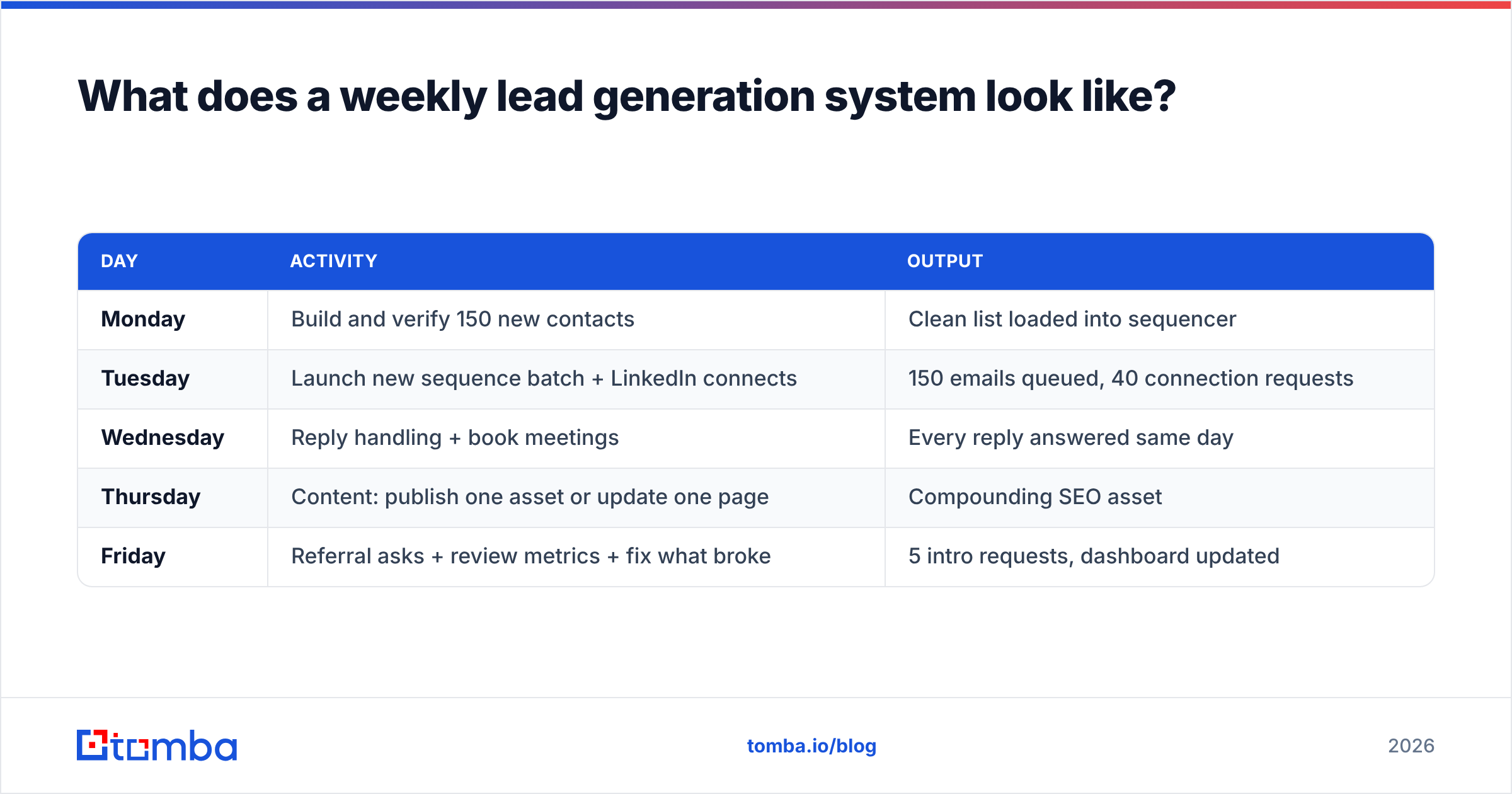
Channels do not fail because they are bad channels. They fail because they get run inconsistently. Here is a schedule a two-person team can actually sustain:
| Day | Activity | Output |
|---|---|---|
| Monday | Build and verify 150 new contacts | Clean list loaded into sequencer |
| Tuesday | Launch new sequence batch + LinkedIn connects | 150 emails queued, 40 connection requests |
| Wednesday | Reply handling + book meetings | Every reply answered same day |
| Thursday | Content: publish one asset or update one page | Compounding SEO asset |
| Friday | Referral asks + review metrics + fix what broke | 5 intro requests, dashboard updated |
That is roughly 600 verified new contacts per month, sustained. At a 4% reply rate and a 35% reply-to-meeting rate, that is about 8 meetings per month from cold email alone, before LinkedIn, content, or referrals contribute anything.
The math scales linearly with verified contact volume, which is exactly why list quality and list throughput are the constraint worth spending money on. Doubling your sending volume with a dirty list does not double meetings — it halves deliverability.
Which metrics tell you if lead generation is working?#
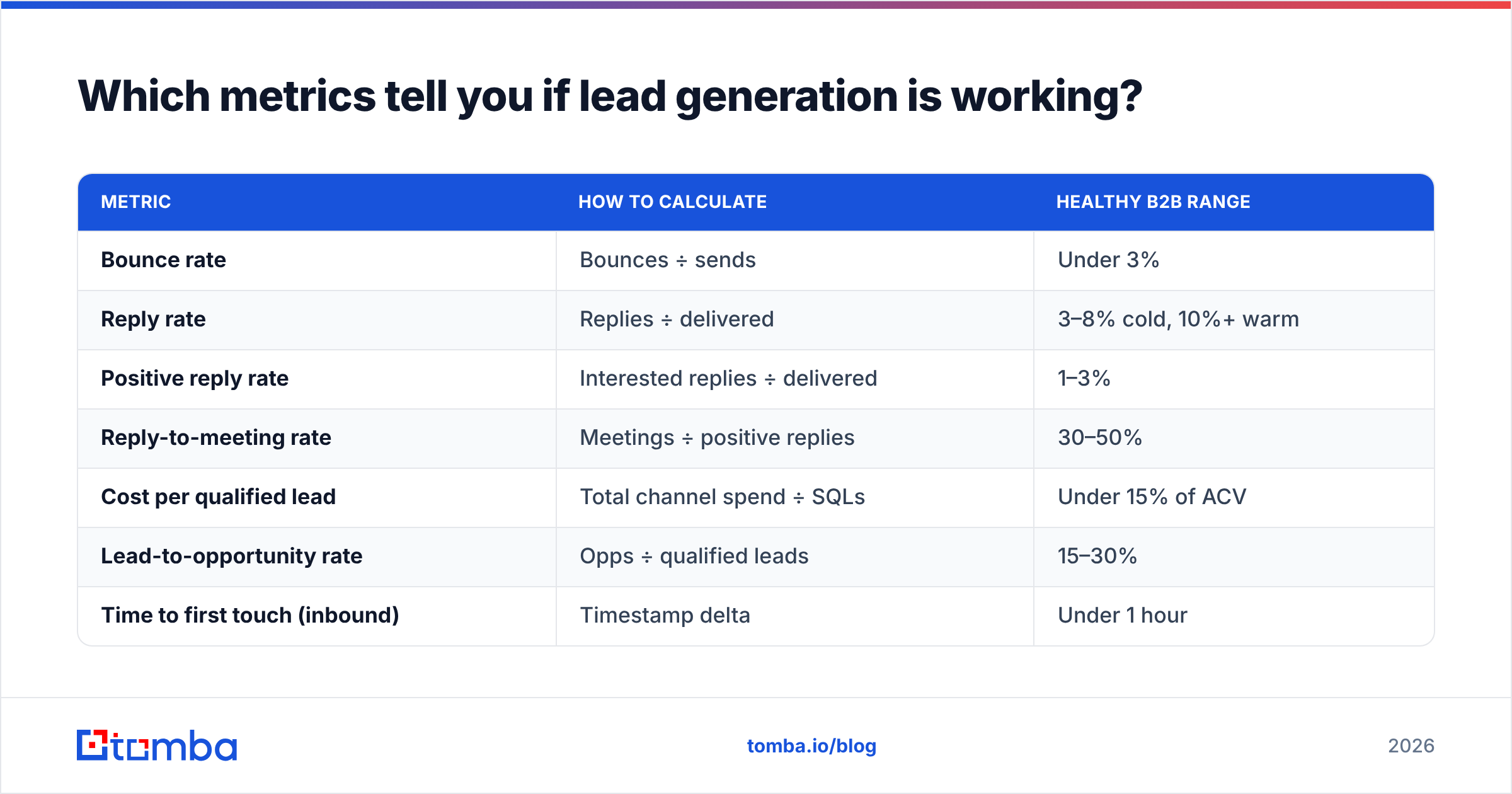
Stop reporting lead counts. Report these instead:
| Metric | How to calculate | Healthy B2B range |
|---|---|---|
| Bounce rate | Bounces ÷ sends | Under 3% |
| Reply rate | Replies ÷ delivered | 3–8% cold, 10%+ warm |
| Positive reply rate | Interested replies ÷ delivered | 1–3% |
| Reply-to-meeting rate | Meetings ÷ positive replies | 30–50% |
| Cost per qualified lead | Total channel spend ÷ SQLs | Under 15% of ACV |
| Lead-to-opportunity rate | Opps ÷ qualified leads | 15–30% |
| Time to first touch (inbound) | Timestamp delta | Under 1 hour |
Review these monthly, not weekly — weekly samples are too noisy to act on. And segment them by list source. You will usually find one source producing half your meetings and one producing almost none, which tells you exactly where the next hour of list-building should go.
The single most common diagnostic pattern: healthy reply rate, poor meeting rate means your targeting is fine and your qualification or offer is off. Poor reply rate with good deliverability means targeting or copy. Poor deliverability means go back to list verification and authentication before touching anything else.
What mistakes quietly kill lead generation?#
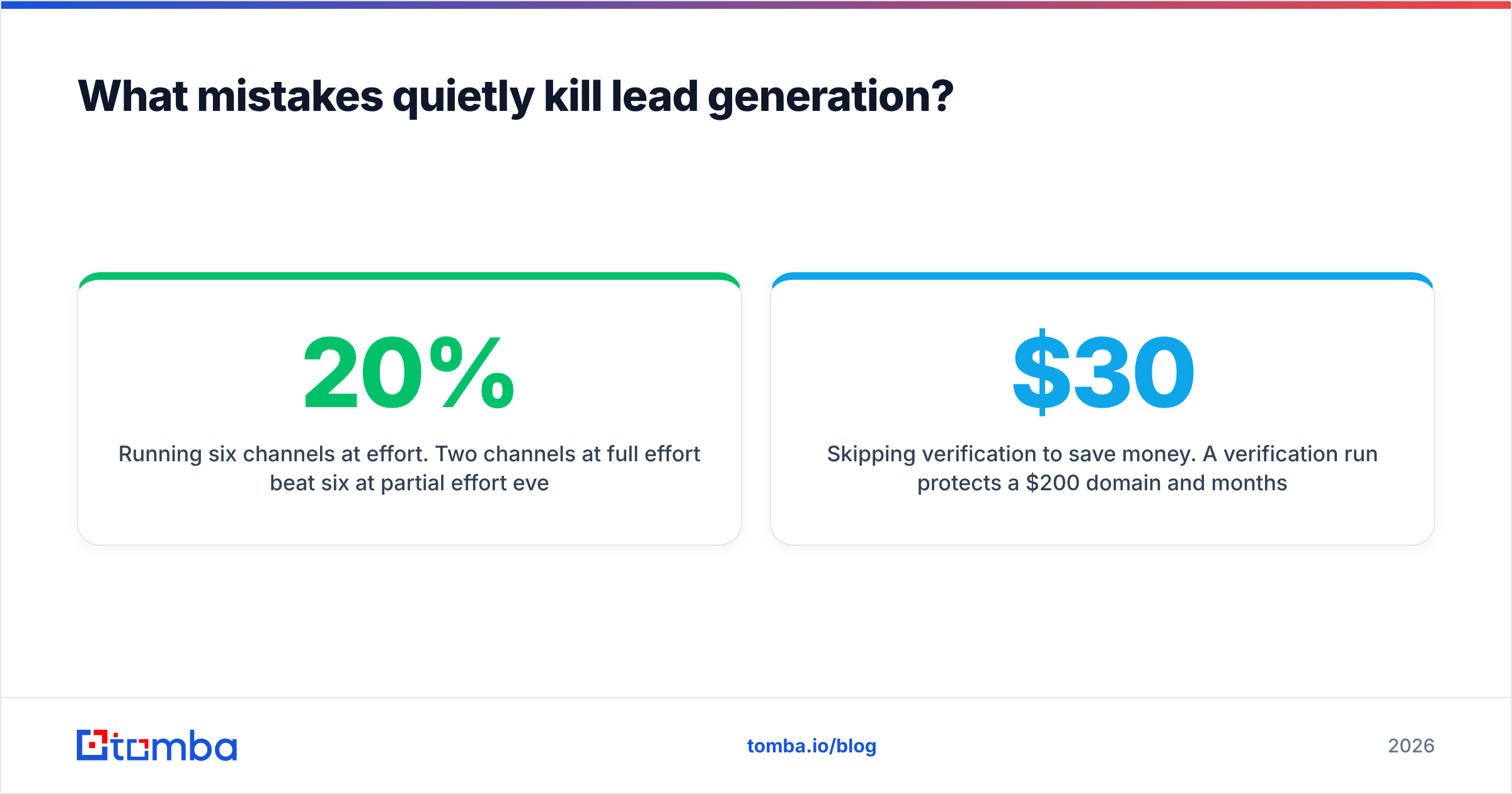
- Running six channels at 20% effort. Two channels at full effort beat six at partial effort every time.
- Skipping verification to save money. A $30 verification run protects a $200 domain and months of sender reputation. The math is not close.
- Changing the offer every two weeks. You cannot read a signal from a test you keep restarting. Give a sequence 300 sends before you judge it.
- Never asking for referrals. The cheapest channel you own is the one you are least likely to have a process for.
- Treating personalization as a first-line gimmick. "Loved your post about X" fools nobody. Relevance to their actual situation beats flattery about their content.
- No CRM hygiene. Duplicate records and stale contact enrichment data make every downstream number wrong.
Gartner and Forrester both keep publishing the same finding in different words: B2B buyers now do most of their evaluation before they ever talk to a vendor. That does not make outbound obsolete. It means outbound's job changed from pitching to being present and credible at the moment a buyer's problem becomes urgent — which requires consistent volume against a well-defined list, not clever one-off campaigns.
Where should you start this week?#
Pick your two channels. For most teams under $10M ARR, that is targeted cold email plus systematic referrals, with content started in parallel as a nine-month investment. Build a 300-contact list against a tightly defined ICP, verify every address, send four-touch sequences, and hold the volume steady for 90 days before you judge the channel.
The part you cannot skip is the data. Every channel above depends on knowing who to contact and being able to reach them. Tomba's Email Finder resolves names and domains into verified professional email addresses, with domain search, catch-all handling, and bulk processing built in alongside it. The free tier gives you 25 searches per month to test the workflow; paid plans start at $49/mo, with Growth at $99/mo for teams running real outbound volume — full Tomba pricing is public if you want to model the cost per lead before committing.
Build the list properly, verify it, and the rest of your lead generation stack finally has something solid to stand on.
Related guides#
Ready to find emails that actually work?
Join 150,000+ professionals who stopped guessing and started sending. Free credits on signup — no credit card required.
Get the Tomba newsletter
Practical outbound tactics and product updates — once every two weeks.
About the author