How to Generate Consistent Pipeline: A 2026 Operating System
Most teams do not have a pipeline problem — they have a consistency problem. Here is the weekly math, data hygiene, and channel mix that turn pipeline generation into a routine instead of a quarterly panic.
TL;DR
- Consistent pipeline is an input problem, not a motivation problem. Fix the weekly activity math first, then optimize messaging.
- Work backward from quota: revenue target → average deal size → win rate → required pipeline → required meetings → required contacts touched per week.
- Data decay is the silent killer. Roughly 2-2.5% of B2B contact records go stale every month, so a list built in January is meaningfully wrong by April.
- Run three channels at fixed weekly volumes (outbound email, phone, warm/social) rather than one channel at heroic volume.
- Track leading indicators weekly — new contacts sourced, sequences started, connects, meetings set — not just closed revenue.
What does "consistent pipeline" actually mean?#
Consistent pipeline means the same amount of qualified opportunity enters your funnel every week, regardless of how the quarter is going.
That sounds obvious, but almost no team measures it that way. Most measure pipeline as a quarterly snapshot: "we have $2.4M in stage 2+." That number hides the shape. A team that sourced $200K of new opportunity in week one, $0 in weeks two through six, and $2.2M in the final two weeks has the same snapshot as a team that sourced $300K every single week. Only one of those teams will hit next quarter's number.
Here is a practical definition: your pipeline is consistent when the standard deviation of weekly sourced pipeline is under about 30% of the weekly average, and you can explain any week that falls outside it.
The reason consistency matters more than raw volume is cycle time. If your average sales cycle is 60 days, pipeline you create in week 11 of the quarter is not this quarter's revenue — it is next quarter's. The famine you feel in Q3 was created by the quiet weeks in Q2. Every pipeline crisis is a lagging report on a prospecting decision made two months earlier.
Why does pipeline swing between feast and famine?#
Four causes, in order of how often they show up:
- Reps stop prospecting when they get busy. The moment a rep has five live deals, prospecting drops to zero because deal work feels more productive. Three weeks later the deals close or die, and the top of funnel is empty.
- Lists are built in bursts. Someone pulls 3,000 contacts in one afternoon, the team burns through them in three weeks, and nobody has budgeted time to build the next batch.
- Data quality collapses mid-campaign. Bounce rates climb, deliverability drops, and the same effort produces half the replies — but nobody notices because reply rate is measured monthly.
- Only one channel is doing real work. When email is the only motion, an inbox placement problem becomes a revenue problem within days.
None of these are effort problems. A rep working 55 hours a week with a decayed list and no fixed sourcing cadence will still produce lumpy pipeline. That is why "try harder" never fixes this and a system does.

What is the math behind predictable pipeline generation?#
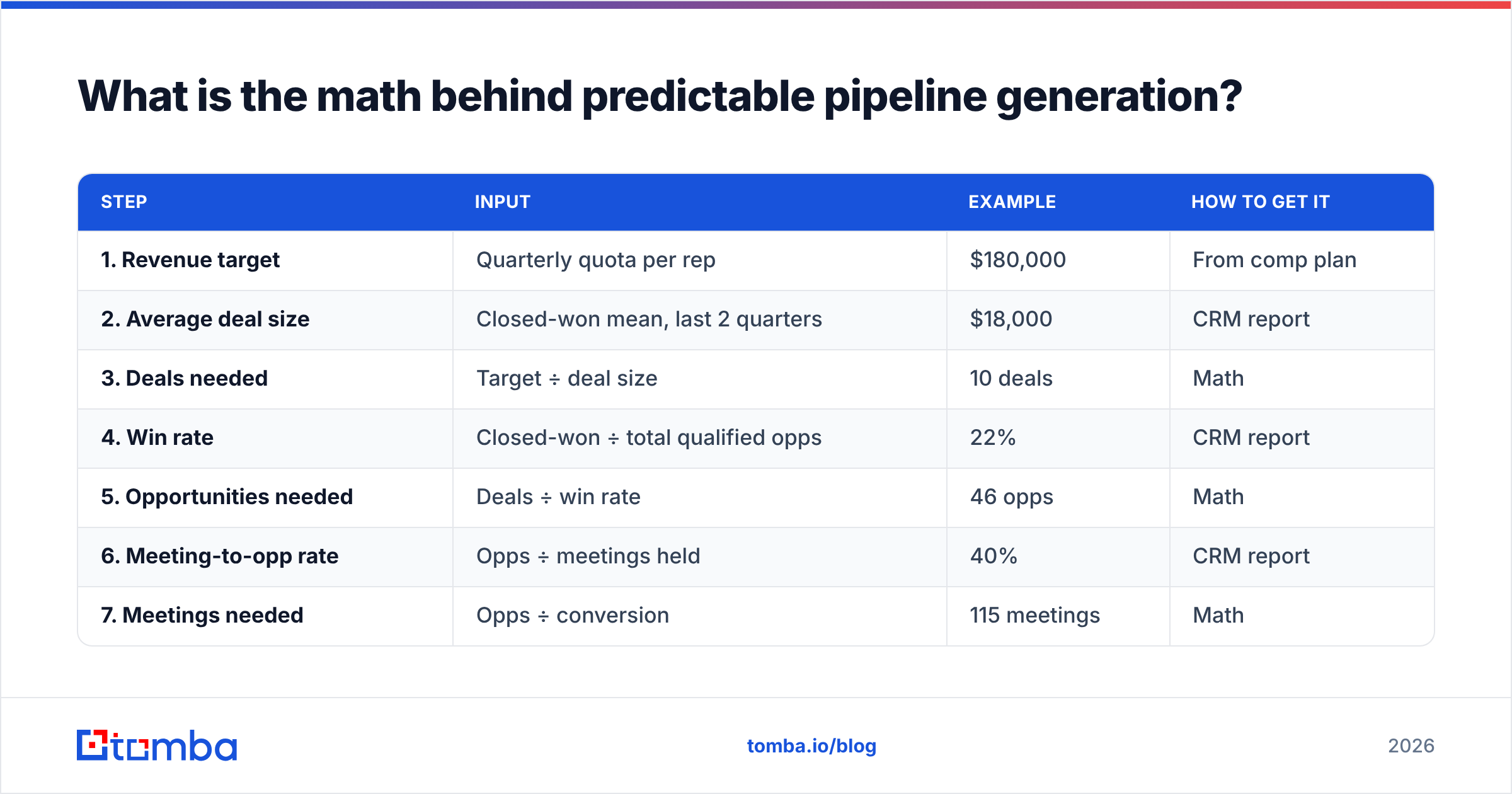
Work backward. This is the single highest-leverage exercise in learning how to generate consistent pipeline, and it takes about fifteen minutes.
Start with the quarterly revenue target and divide until you reach a weekly activity number you can actually check on a Friday.
| Step | Input | Example | How to get it |
|---|---|---|---|
| 1. Revenue target | Quarterly quota per rep | $180,000 | From comp plan |
| 2. Average deal size | Closed-won mean, last 2 quarters | $18,000 | CRM report |
| 3. Deals needed | Target ÷ deal size | 10 deals | Math |
| 4. Win rate | Closed-won ÷ total qualified opps | 22% | CRM report |
| 5. Opportunities needed | Deals ÷ win rate | 46 opps | Math |
| 6. Meeting-to-opp rate | Opps ÷ meetings held | 40% | CRM report |
| 7. Meetings needed | Opps ÷ conversion | 115 meetings | Math |
| 8. Contacts per meeting | Contacts touched ÷ meetings set | 90:1 | Sequencer report |
| 9. Contacts per week | (Meetings × 90) ÷ 13 weeks | ~795/week | Math |
That last row is the only number that matters on a Tuesday morning. Everything above it is context. If a rep touches 795 verified contacts per week with a competent sequence, the pipeline arrives whether or not anyone feels motivated.
Two warnings about this model. First, use your own conversion rates, not benchmarks — industry averages vary wildly by segment, and HubSpot's sales research is useful for sanity-checking, not for planning. Second, recalculate quarterly. Win rates drift, and a stale ratio produces a confidently wrong activity target.
How do you build a weekly pipeline engine?#
Six components. Each one is a calendar block, not an intention.
- Monday list build (60-90 min). Source next week's contacts before you need them. Never prospect from a list built the same day — that is how reps end up emailing whoever is easiest to find rather than whoever fits the ICP.
- Verification pass (15 min). Run every new batch through an email verifier before it enters the sequencer. A 4% bounce rate is a deliverability problem; a 1% bounce rate is background noise.
- Daily sequence starts (30 min, every day). Fixed number, every day, no exceptions. Daily beats weekly because a weekly block gets cancelled by one customer escalation.
- Daily phone block (45-60 min). Same hour every day. Phone still converts at multiples of email for senior titles, and it insulates you from inbox placement swings.
- Warm-lane work (30 min). Job changes, closed-lost revivals, product-qualified signups, website visitors. This lane has the highest conversion rate and the lowest volume — treat it as a supplement, never a substitute.
- Friday pipeline review (20 min). Compare actual weekly contacts touched, sequences started, connects, and meetings set against the model above. Any miss gets diagnosed the same day, not at quarter end.
The whole system is roughly three hours a day. That is the honest price of consistency, and it is why teams that outsource list-building to tooling out-produce teams that do it manually — those three hours become two.
Which channels produce the most consistent pipeline?#
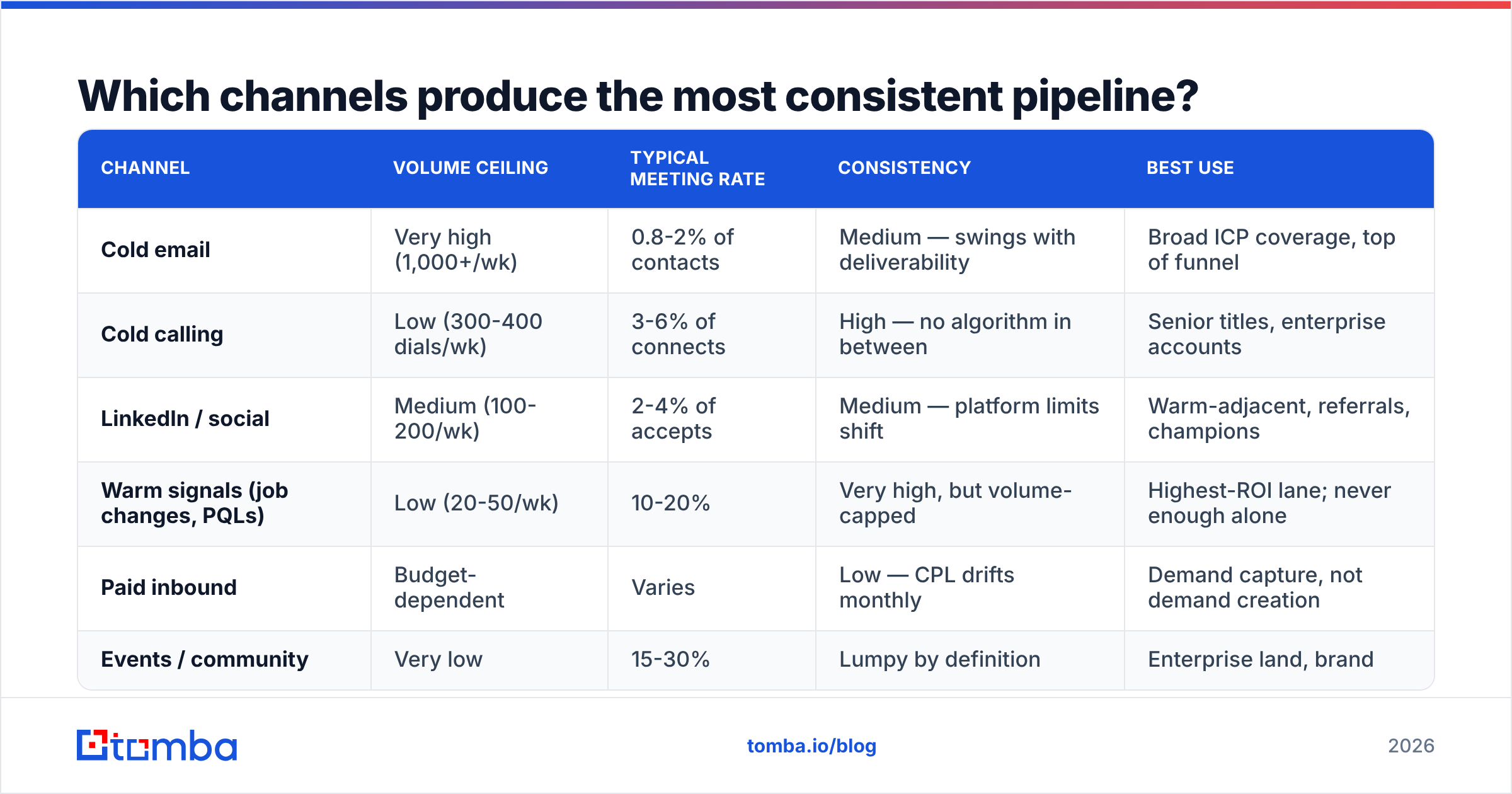
No channel is reliable on its own. The mix matters more than any single choice.
| Channel | Volume ceiling | Typical meeting rate | Consistency | Best use |
|---|---|---|---|---|
| Cold email | Very high (1,000+/wk) | 0.8-2% of contacts | Medium — swings with deliverability | Broad ICP coverage, top of funnel |
| Cold calling | Low (300-400 dials/wk) | 3-6% of connects | High — no algorithm in between | Senior titles, enterprise accounts |
| LinkedIn / social | Medium (100-200/wk) | 2-4% of accepts | Medium — platform limits shift | Warm-adjacent, referrals, champions |
| Warm signals (job changes, PQLs) | Low (20-50/wk) | 10-20% | Very high, but volume-capped | Highest-ROI lane; never enough alone |
| Paid inbound | Budget-dependent | Varies | Low — CPL drifts monthly | Demand capture, not demand creation |
| Events / community | Very low | 15-30% | Lumpy by definition | Enterprise land, brand |
The practical rule: pick two high-volume channels and one warm lane, then hold volumes fixed for a full quarter before judging. Teams that swap channels monthly never accumulate enough data to know what works. If you want a broader view of the tooling landscape per channel, the sales intelligence category on G2 is a reasonable neutral starting point.
How do you stop your list from decaying?#
You cannot stop decay. You can only build a refresh loop that outruns it.
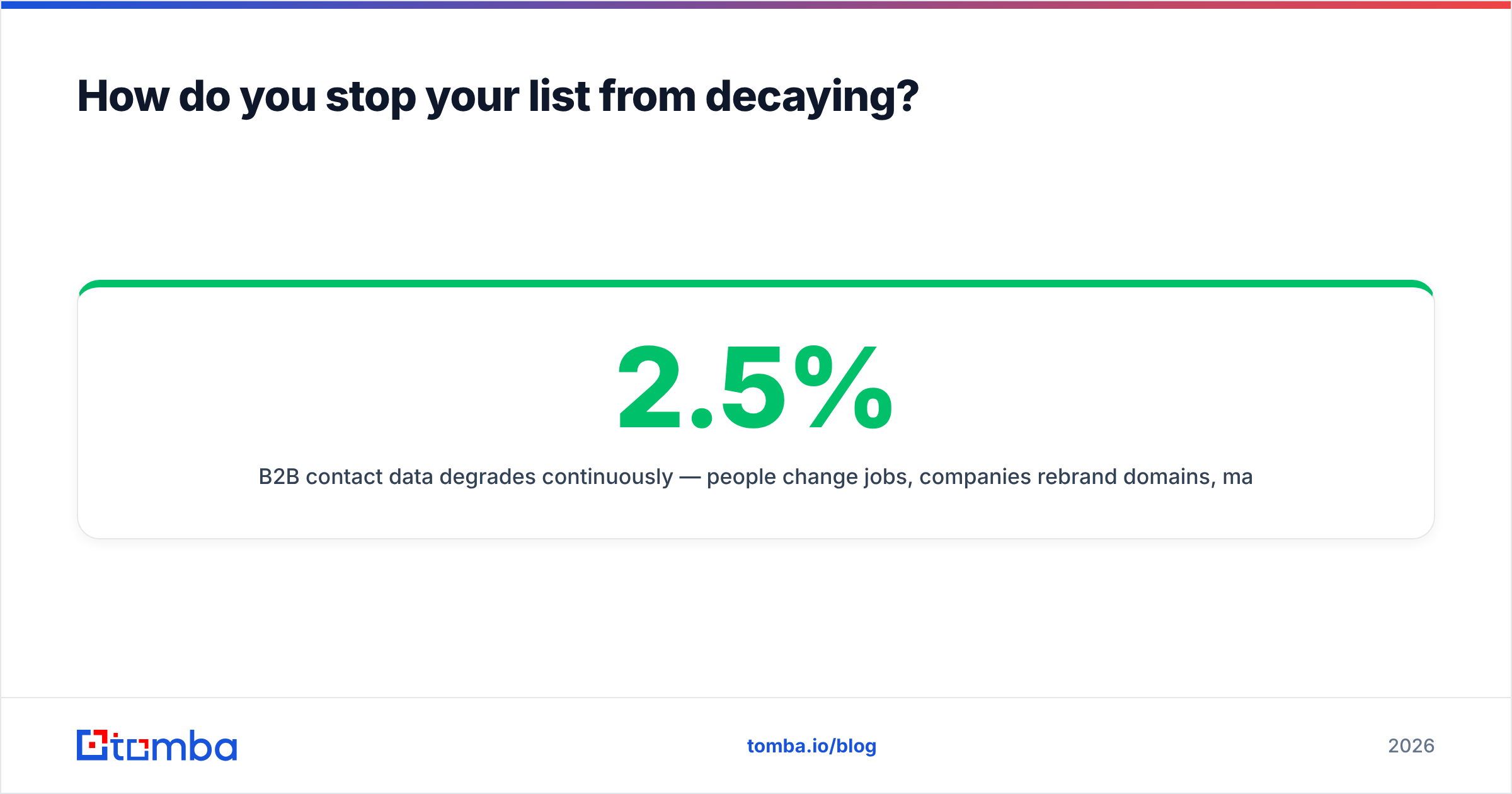
B2B contact data degrades continuously — people change jobs, companies rebrand domains, mail servers change acceptance rules. The commonly cited figure is around 2-2.5% per month, which compounds to roughly a quarter of your database being wrong within a year. Gartner's sales research has been flagging data quality as a top revenue-operations constraint for years, and it shows up most obviously in bounce rates that creep from 1% to 6% without any change in your sending behavior.
A refresh loop looks like this:
- Verify at build time, not send time. Every contact gets checked before it enters a sequence. This is non-negotiable.
- Re-verify anything older than 90 days. Cheap insurance. A bulk verify run on your dormant segments takes minutes and protects your sending domain.
- Handle catch-all domains separately. Catch-all servers accept everything, so a standard verification returns "unknown." Route those through a catch-all verifier or hold them in a lower-priority segment rather than treating them as valid.
- Re-enrich on trigger, not on schedule. When a contact bounces, when a company raises funding, when a champion changes jobs — that is when contact enrichment pays for itself.
- Source by domain, not by name. Pulling every relevant contact at an account via domain search gives you multi-threading options when your primary contact leaves.
On sourcing, you have three viable paths, and mixing them is normal: self-service finders and verifiers for continuous, ICP-specific building; a purchased list from a reputable provider like BookYourData when you need a large, clean seed set fast; and enrichment APIs to keep your CRM current in the background. Teams doing under 5,000 contacts a month usually find the self-service path cheaper and fresher; teams doing bulk market entry often combine a purchased seed with ongoing verification.

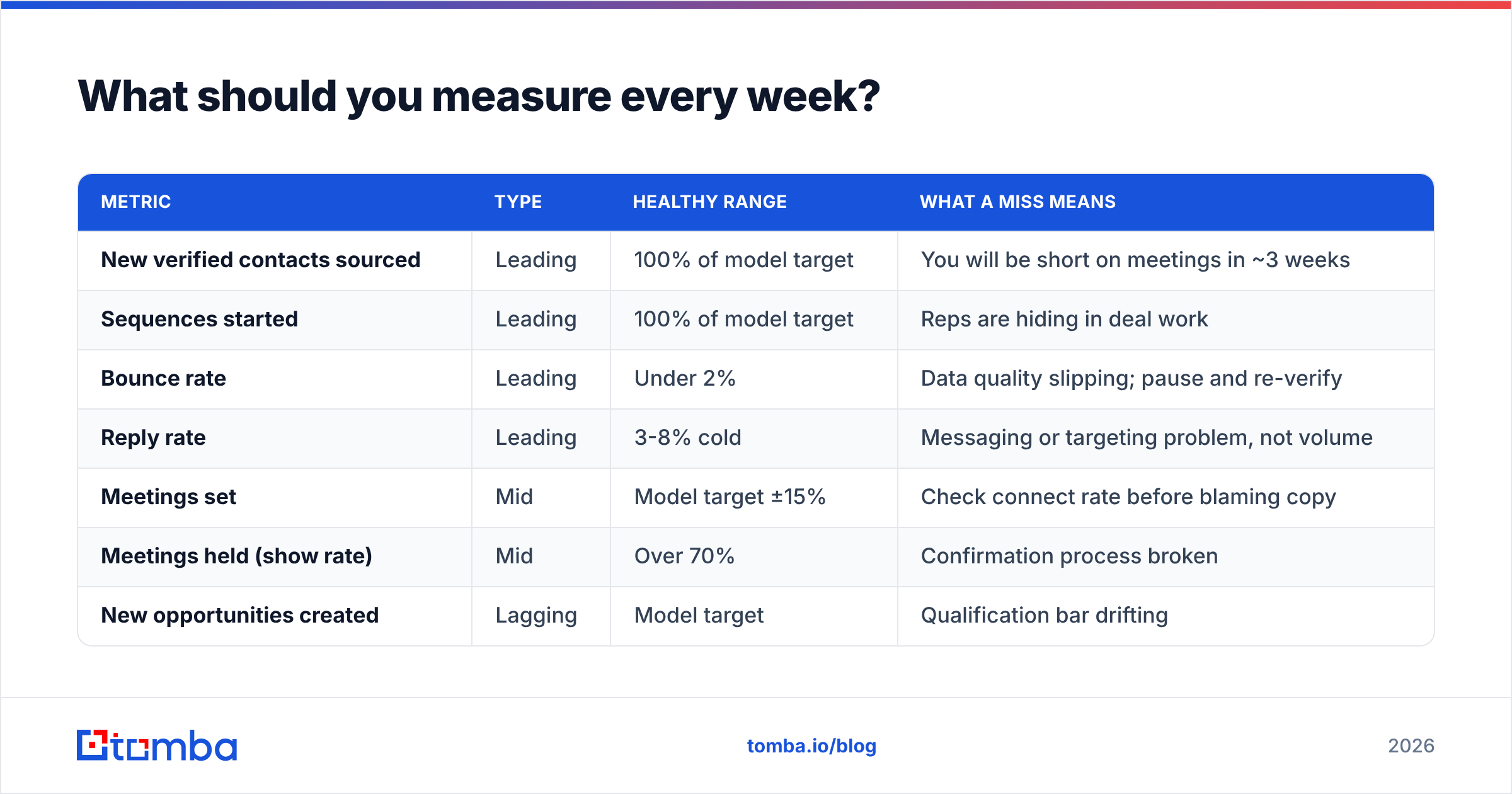
What should you measure every week?#
Lagging indicators tell you what happened. Leading indicators tell you what is about to happen. Review both, but act on the leading ones.
| Metric | Type | Healthy range | What a miss means |
|---|---|---|---|
| New verified contacts sourced | Leading | 100% of model target | You will be short on meetings in ~3 weeks |
| Sequences started | Leading | 100% of model target | Reps are hiding in deal work |
| Bounce rate | Leading | Under 2% | Data quality slipping; pause and re-verify |
| Reply rate | Leading | 3-8% cold | Messaging or targeting problem, not volume |
| Meetings set | Mid | Model target ±15% | Check connect rate before blaming copy |
| Meetings held (show rate) | Mid | Over 70% | Confirmation process broken |
| New opportunities created | Lagging | Model target | Qualification bar drifting |
| Sourced pipeline $ | Lagging | Model target | Deal-size mix shifted |
Two habits make this table useful. First, review it at the rep level, not the team level — team averages hide the one rep who stopped sourcing entirely. Second, when a number misses, walk up the table, not down. A meetings miss is almost always caused by a sourcing or bounce-rate miss three weeks earlier.
How long does it take to stabilize?#
Plan for one full sales cycle plus three weeks.
If your cycle is 45 days, you will see meeting volume stabilize in about three to four weeks and sourced-pipeline consistency in about nine. The first three weeks usually look worse, because you are now measuring activity you previously did not track, and the gap between the model and reality is uncomfortable. That gap is the whole point.
Three failure modes to watch during the ramp:
- Changing the model mid-quarter. If you recalculate targets every time a week misses, you never learn whether the system works. Hold it for a full quarter.
- Optimizing copy before fixing volume. A 2% reply rate on 800 contacts beats a 5% reply rate on 150. Get to volume, then test messaging.
- Letting the warm lane crowd out cold. Warm signals convert best, so reps drift toward them. Cap the warm lane's time budget explicitly.
What is the fastest way to start this week?#
Pick one rep, run the backward math, and give them one week of contacts built and verified before Monday. Do not roll it out to the whole team first — you want one clean proof that the model produces the meetings it predicts.
Then make list-building the cheapest part of the week. Sourcing is where most teams quietly lose their three hours a day, and it is the one step that automates well without any loss in quality. Use Tomba Email Finder to build the week's list by domain, role, or company in minutes, verify it in the same pass, and push it into your sequencer clean. The free tier covers 25 searches a month if you want to test the workflow on a single account list first, and Tomba pricing starts at $49/mo for Starter, with Growth at $99/mo for teams running real weekly volume.
Consistent pipeline is not a talent problem. It is a Monday-morning problem — and Monday morning is fixable.
Related guides#
// get started
Find, verify and enrich your first contacts today
Start on the free plan with 25 searches a month, then scale when your team is ready.
Free plan · No credit card required · GDPR & CCPA
// about the author