How To Generate Enquiry In Sales: 7 Methods That Work In 2026
Enquiries are not luck. They are the output of a repeatable system: a tight ICP, clean contact data, one strong offer, and a weekly cadence you actually run. Here is the full playbook, with cost math and a tool stack.
TL;DR
- An enquiry is a buyer-initiated signal — a reply, a form fill, a demo request, a "send me pricing" DM. You generate them by removing friction between a specific problem and a specific offer.
- The fastest reliable mix for most B2B teams in 2026: targeted outbound email, trigger-based outreach, LinkedIn conversations, and one high-intent inbound asset (calculator, teardown, comparison page).
- Bad contact data kills enquiry volume before copy ever gets a chance. A 30% bounce rate does not just waste sends — it damages the sending domain that carries every future campaign.
- Track enquiries per 100 verified contacts, not raw reply counts. Raw replies hide the "not interested" noise.
- The realistic starting stack costs under $150/month: a data source, a sender, a CRM, and a calendar link.
What is an enquiry in sales, and how is it different from a lead?#
An enquiry is a buyer raising their hand. A lead is a name in your database. The difference is who initiated.
You can buy 10,000 leads this afternoon. You cannot buy a single enquiry, because an enquiry requires someone on the other side to decide your message is worth answering. That decision is the whole game.
Practically, an enquiry looks like one of these:
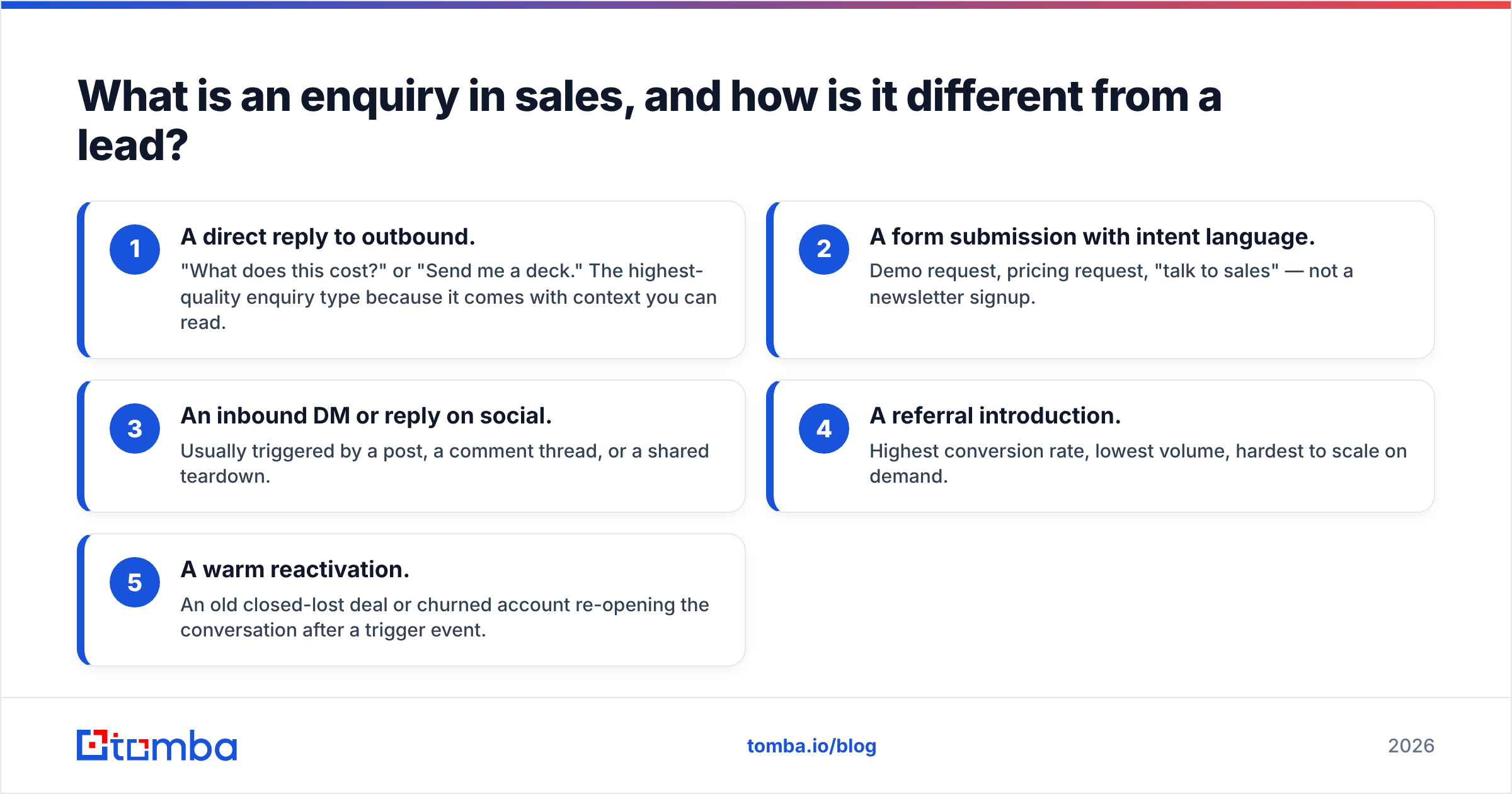
- A direct reply to outbound. "What does this cost?" or "Send me a deck." The highest-quality enquiry type because it comes with context you can read.
- A form submission with intent language. Demo request, pricing request, "talk to sales" — not a newsletter signup.
- An inbound DM or reply on social. Usually triggered by a post, a comment thread, or a shared teardown.
- A referral introduction. Highest conversion rate, lowest volume, hardest to scale on demand.
- A warm reactivation. An old closed-lost deal or churned account re-opening the conversation after a trigger event.
The reason this distinction matters: teams that measure "leads generated" almost always inflate the number with people who never asked for anything. Then pipeline conversion collapses and nobody can explain why. Measure enquiries, and the number stays honest.
Why do most teams fail to generate enquiries consistently?#
Four failure modes account for the overwhelming majority of flat enquiry counts.
The list is wrong. You are contacting job titles that cannot buy, at companies that do not have the problem. No amount of copy repairs a targeting error. If your ICP is "B2B SaaS," it is not an ICP — it is a category.
The data is dirty. Guessed email patterns, scraped LinkedIn exports from 2023, and unverified catch-all domains. Bounces above 5% start dragging your sender reputation down, which means fewer of your good messages land in the primary inbox. Enquiry volume drops for reasons that have nothing to do with your pitch.
The offer is vague. "I'd love to hop on a quick call to learn about your goals" asks the prospect to do all the work. An enquiry-generating offer names the outcome and the effort: "I mapped 14 vendors your team could consolidate — want the sheet?"
There is no cadence. Enquiries come from volume over time, not from one heroic campaign in Q1. A team sending 200 well-targeted emails a week beats a team sending 4,000 in one burst and then nothing for six weeks.
Which channels actually generate enquiries in 2026?#
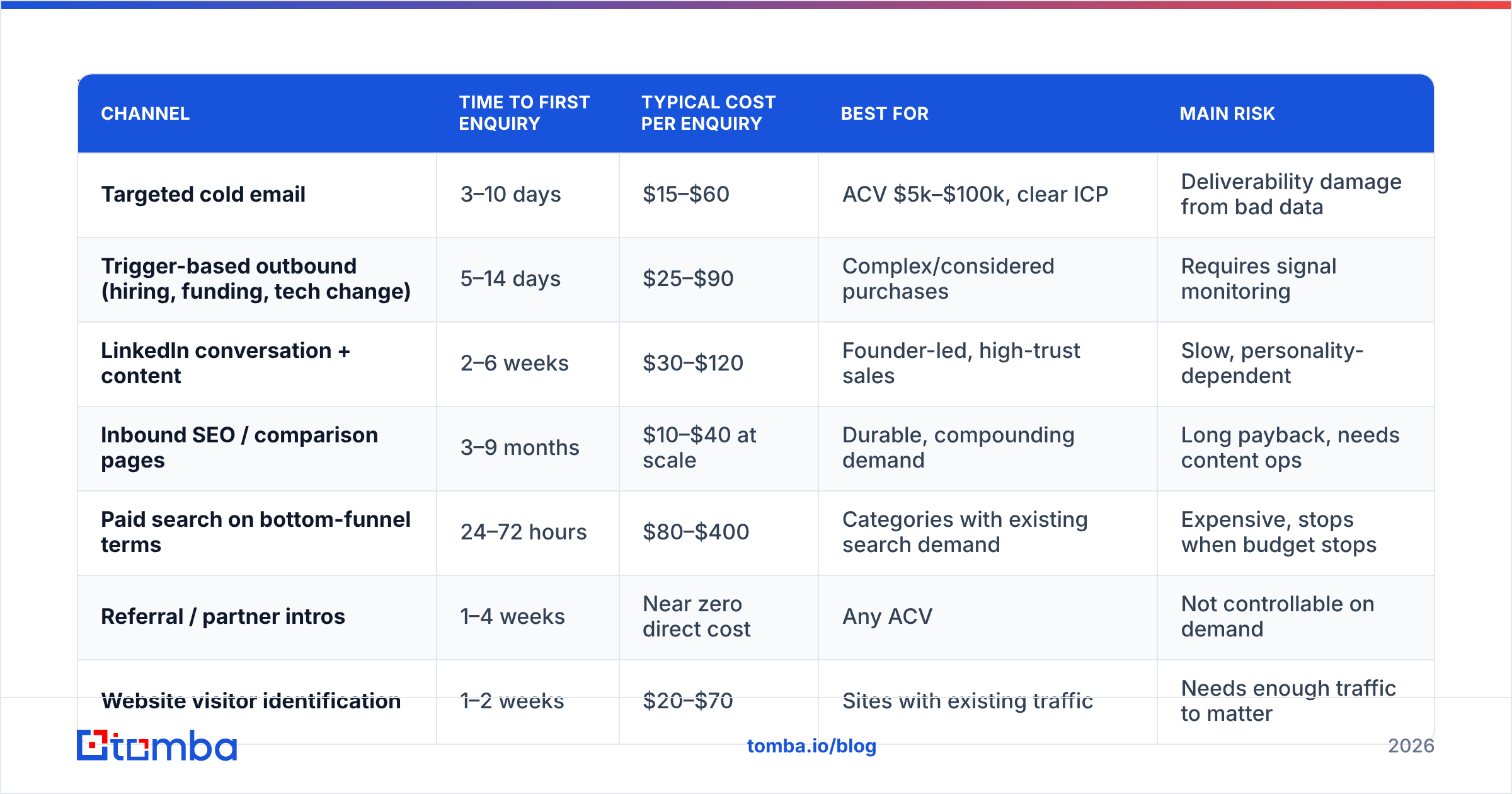
There is no single best channel — there is a best channel for your ACV and sales cycle. Here is how the main options compare on the metrics that decide whether you can afford them.
| Channel | Time to first enquiry | Typical cost per enquiry | Best for | Main risk |
|---|---|---|---|---|
| Targeted cold email | 3–10 days | $15–$60 | ACV $5k–$100k, clear ICP | Deliverability damage from bad data |
| Trigger-based outbound (hiring, funding, tech change) | 5–14 days | $25–$90 | Complex/considered purchases | Requires signal monitoring |
| LinkedIn conversation + content | 2–6 weeks | $30–$120 | Founder-led, high-trust sales | Slow, personality-dependent |
| Inbound SEO / comparison pages | 3–9 months | $10–$40 at scale | Durable, compounding demand | Long payback, needs content ops |
| Paid search on bottom-funnel terms | 24–72 hours | $80–$400 | Categories with existing search demand | Expensive, stops when budget stops |
| Referral / partner intros | 1–4 weeks | Near zero direct cost | Any ACV | Not controllable on demand |
| Website visitor identification | 1–2 weeks | $20–$70 | Sites with existing traffic | Needs enough traffic to matter |
Most teams that generate enquiries reliably run two or three of these at once — one fast channel to keep the calendar full this month, one slow channel that compounds. Running only the slow one starves you now. Running only the fast one means you rebuild demand from scratch every quarter.
How do you generate enquiries with outbound without burning your domain?#
Outbound is still the fastest way to manufacture an enquiry on demand. It is also the easiest to do badly. Here is the sequence that works.
1. Define a segment you can describe in one sentence. Not "B2B SaaS" but "Series A HR tech companies in North America that just hired their first SDR." Narrow enough that a single email can be relevant to everyone on the list.
2. Build the contact list from company data, not from a bulk export. Start with the target domains, then find the people. A domain search returns the addresses associated with a company plus the department and seniority, so you can filter to the two or three roles that would actually care. This is a fundamentally different quality tier than downloading a pre-built list of 50,000 contacts and hoping.
3. Verify before you send. Always. Run every address through an email verifier and drop anything that comes back invalid or risky. Catch-all domains need separate handling — they accept everything at the SMTP layer, so a standard check tells you nothing. Treat them as a separate, lower-priority segment rather than mixing them into your main send.
4. Write one message about one problem. The highest-performing outbound emails in our sample are 60–90 words, reference something specific about the account, and end with a low-commitment question. No calendar link in email one.
5. Ramp volume slowly on new domains. New sending domains need 3–4 weeks of gradual warmup. Sending 500 cold emails from a domain registered last Tuesday is the single fastest way to end up in spam permanently. A warmup calculator will tell you what daily volume your infrastructure can actually support.
6. Follow up three times, then stop. Most enquiries arrive on touch two or three. After touch four, reply rates collapse and complaint rates rise. Diminishing returns are real and measurable.
For benchmarks on what "good" looks like, the HubSpot sales blog publishes ongoing reply-rate and cadence data across thousands of teams, and it is worth checking your numbers against theirs rather than against whatever your last agency promised.
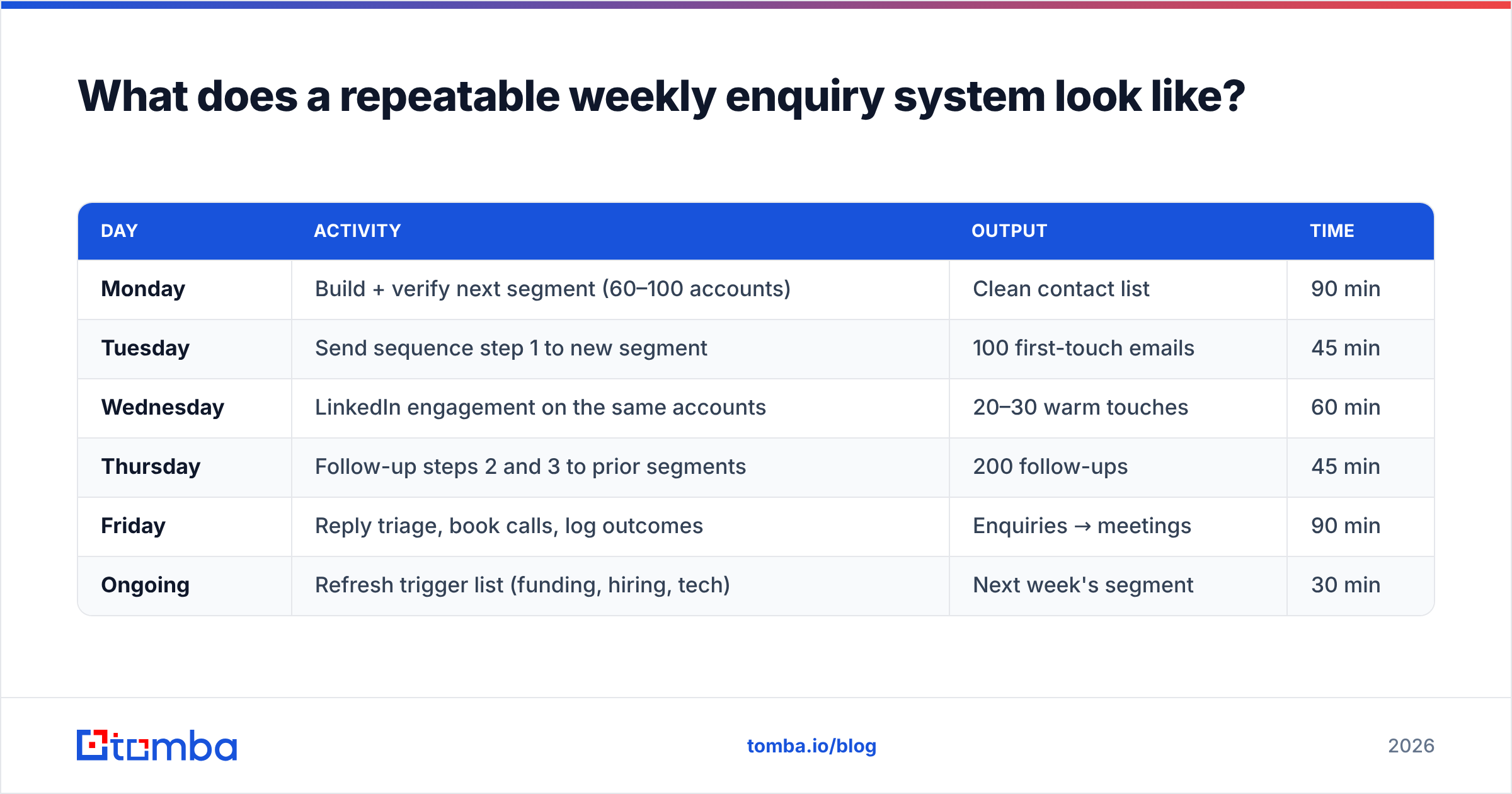
What does a repeatable weekly enquiry system look like?#
Consistency beats intensity. This is a cadence a single rep or founder can run in roughly six hours a week.
| Day | Activity | Output | Time |
|---|---|---|---|
| Monday | Build + verify next segment (60–100 accounts) | Clean contact list | 90 min |
| Tuesday | Send sequence step 1 to new segment | 100 first-touch emails | 45 min |
| Wednesday | LinkedIn engagement on the same accounts | 20–30 warm touches | 60 min |
| Thursday | Follow-up steps 2 and 3 to prior segments | 200 follow-ups | 45 min |
| Friday | Reply triage, book calls, log outcomes | Enquiries → meetings | 90 min |
| Ongoing | Refresh trigger list (funding, hiring, tech) | Next week's segment | 30 min |
Two things make this work. First, the segments never repeat — you are always working a fresh, tightly defined list, which keeps relevance high. Second, replies get handled the same week they arrive. An enquiry that sits for four days is often an enquiry that has already booked with somebody else.
If you want to scale this beyond one person, the list-building step is the one to automate first. A bulk email finder turns a spreadsheet of 500 company domains and contact names into verified addresses in one pass, which collapses Monday's 90 minutes into about ten.
How do you generate inbound enquiries that are worth answering?#
Inbound takes longer but produces enquiries with far higher intent, because the buyer arrived already knowing they have the problem.
The three assets that produce enquiries most reliably:
- Comparison and alternatives pages. Someone searching "X vs Y" or "alternative to X" is in-market right now. These pages convert several times better than top-of-funnel blog content, and they are cheap to produce because you already know both products.
- Calculators and interactive tools. A pricing calculator, ROI model, or diagnostic. The user gets a number they care about; you get a contextual reason to follow up. Free tools also earn links, which feeds the SEO side.
- Public teardowns. Analyze a real company's setup in your category, publish it, and offer the same for anyone who asks. The enquiries this generates are pre-qualified because the prospect has already seen how you think.
What does not generate enquiries: gated PDFs about "the future of" anything, and newsletter signups counted as leads. Both fill the CRM without filling the calendar.
One underrated inbound source is your existing traffic. Most B2B sites convert well under 2% of visitors, meaning 98% of the demand you already paid for leaves anonymously. Visitor identification turns a portion of that anonymous traffic into named companies you can then work through the outbound motion above — which is why the two channels compound instead of competing.
How do you measure whether your enquiry generation is working?#
Most dashboards measure activity. Measure conversion instead, at four points:
- Enquiries per 100 verified contacts. The core efficiency number. Under 1 means targeting or offer is broken. 2–5 is healthy for cold outbound. Above 8 usually means you are working a warm or referred list, not cold.
- Enquiry-to-meeting rate. If enquiries are high but meetings are low, your enquiries are mostly polite deflections. Tighten the offer.
- Meeting-to-opportunity rate. If this is low, you are generating enquiries from people who cannot buy. Fix the ICP, not the copy.
- Cost per enquiry, fully loaded. Include data credits, sending tools, and the hours. A $12 tool that eats eight hours a week is not cheap.
Track response rate separately from enquiry rate. A reply saying "please remove me" is a response, not an enquiry, and conflating them makes a failing campaign look fine for another month. Gartner's sales research has been consistent for years on this point: buyer-initiated engagement is the metric that predicts pipeline, and seller activity volume is not.
What tools do you need to generate enquiries?#
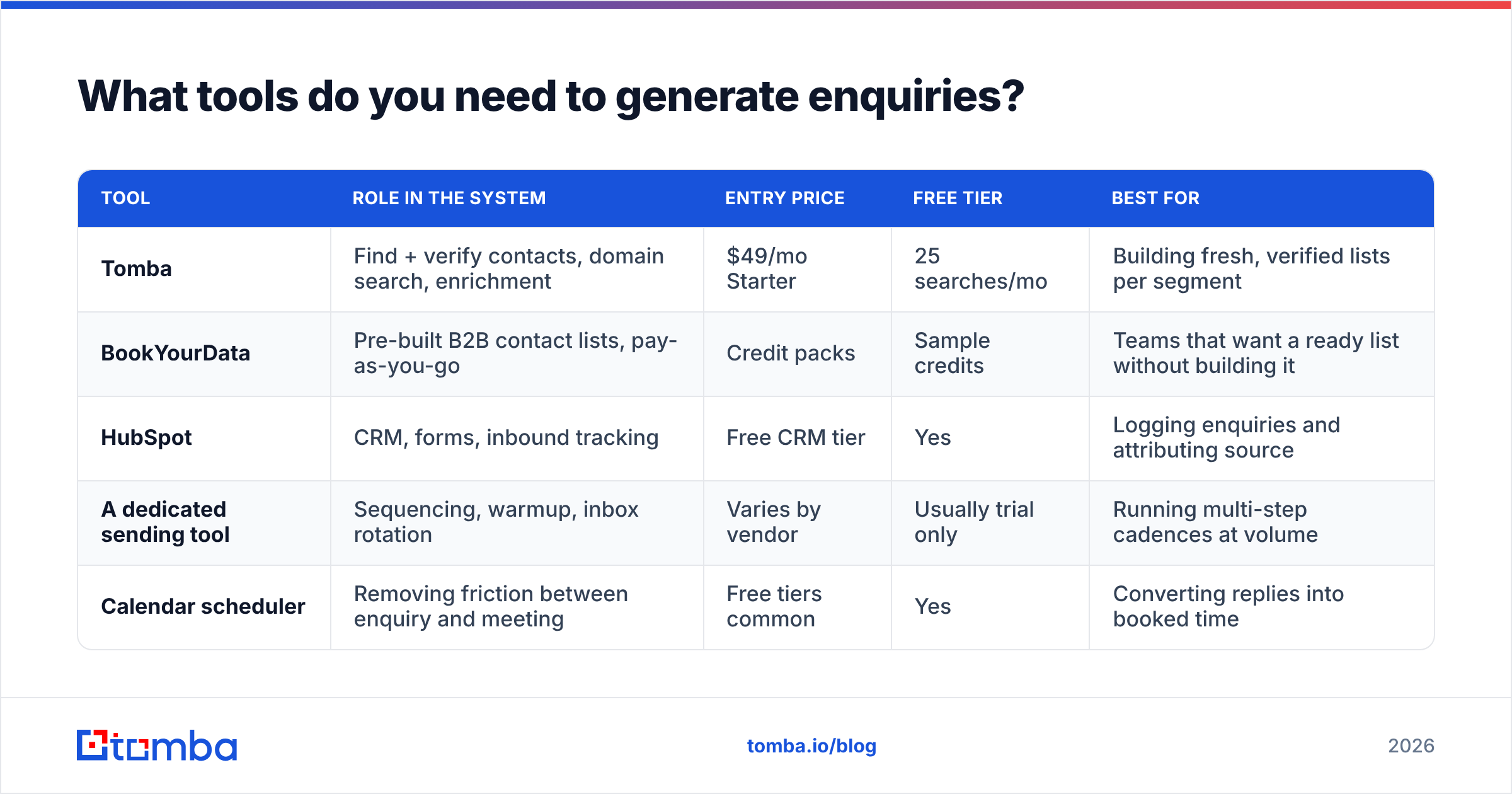
You need four categories: a data source, a sending tool, a CRM, and a scheduling link. That is genuinely it at the start.
| Tool | Role in the system | Entry price | Free tier | Best for |
|---|---|---|---|---|
| Tomba | Find + verify contacts, domain search, enrichment | $49/mo Starter | 25 searches/mo | Building fresh, verified lists per segment |
| BookYourData | Pre-built B2B contact lists, pay-as-you-go | Credit packs | Sample credits | Teams that want a ready list without building it |
| HubSpot | CRM, forms, inbound tracking | Free CRM tier | Yes | Logging enquiries and attributing source |
| A dedicated sending tool | Sequencing, warmup, inbox rotation | Varies by vendor | Usually trial only | Running multi-step cadences at volume |
| Calendar scheduler | Removing friction between enquiry and meeting | Free tiers common | Yes | Converting replies into booked time |
Two notes on choosing. First, do not buy a sequencer before you have a list you trust — sending faster with bad data just gets you blocked faster. Second, check what the tools actually do on real data rather than on their marketing pages; G2 reviews filtered to your company size are more useful than any vendor comparison chart, including this one.
Tomba's pricing runs Free (25 searches/mo), Starter at $49/mo, Growth at $99/mo, and Pro at $249/mo, with Enterprise custom. For a single rep running the weekly cadence above, Starter covers the volume. For a team of three or more building fresh segments every week, Growth is usually the right tier, and the Tomba API lets you wire list-building directly into whatever automation you already run.
Where should you start this week?#
Pick one segment. Sixty accounts, one job title, one problem you can describe without jargon. Find and verify the contacts. Write one 80-word email about that specific problem. Send it Tuesday, follow up Thursday and the following Tuesday. Log every reply.
That is one week's work and it will tell you more than three months of planning. If you get two or more real enquiries out of sixty accounts, you have a repeatable motion — scale the segment count, not the message volume per person. If you get zero, the segment or the offer is wrong, and you now know that after five days instead of a quarter.
The part that stops most teams is step one: getting accurate, verified contact details for the exact people they want to reach. The Tomba Email Finder handles that in bulk — search by domain, name, or company, verify in the same pass, and export a list that will not wreck your sending reputation. Start on the free tier with 25 searches, run one segment end to end, and see how many enquiries sixty well-chosen contacts actually produce.
Related guides#
// get started
Find, verify and enrich your first contacts today
Start on the free plan with 25 searches a month, then scale when your team is ready.
Free plan · No credit card required · GDPR & CCPA
// about the author