How to Generate Leads in 2026: A Practical B2B Playbook
Most lead gen advice is a list of channels with no numbers attached. This playbook ranks seven B2B channels by cost per meeting, shows how to build a clean list from scratch, and explains when buying data beats building it.
TL;DR
- Lead generation is two jobs, not one: building a list of the right accounts, and earning a reply from them. Most teams are bad at the first and blame the second.
- Outbound email still produces the cheapest B2B meetings when the data is clean. Reply rates collapse below 95% list accuracy because bounces wreck sender reputation before your copy ever gets read.
- Build lists from a defined ICP, enrich with a verified email finder, then verify again before send. Skipping the second verification is the single most common cause of a dead campaign.
- Buying data is not cheating. It is a speed decision — reputable vendors sell you time, and you still own the verification step.
- Track cost per qualified meeting, not leads. A channel producing 400 "leads" at $9 each is worse than one producing 12 meetings at $180 each if only the second closes.
What does "generate leads" actually mean in 2026?#
A lead is a person who could plausibly buy, whose contact details you can reach, and who has not told you to go away. That is the whole definition. Everything else — MQL, SQL, PQL — is internal accounting.
The reason this matters is that most lead generation programs fail at the first clause, not the third. Teams pour money into copy, sequencing tools, and AI personalization while sending to a list where 30% of contacts left the company, 12% of addresses bounce, and half the accounts were never a fit. No subject line survives that.
So when you ask how to generate leads, the honest answer splits into two workstreams that need separate budgets and separate metrics:
- Sourcing — deciding which companies and roles to target, and getting reachable contact data for them.
- Activation — the message, channel, and cadence that converts a name into a conversation.
The rest of this post treats them separately, because the tools, failure modes, and costs are completely different.
Which lead generation channels actually work right now?#
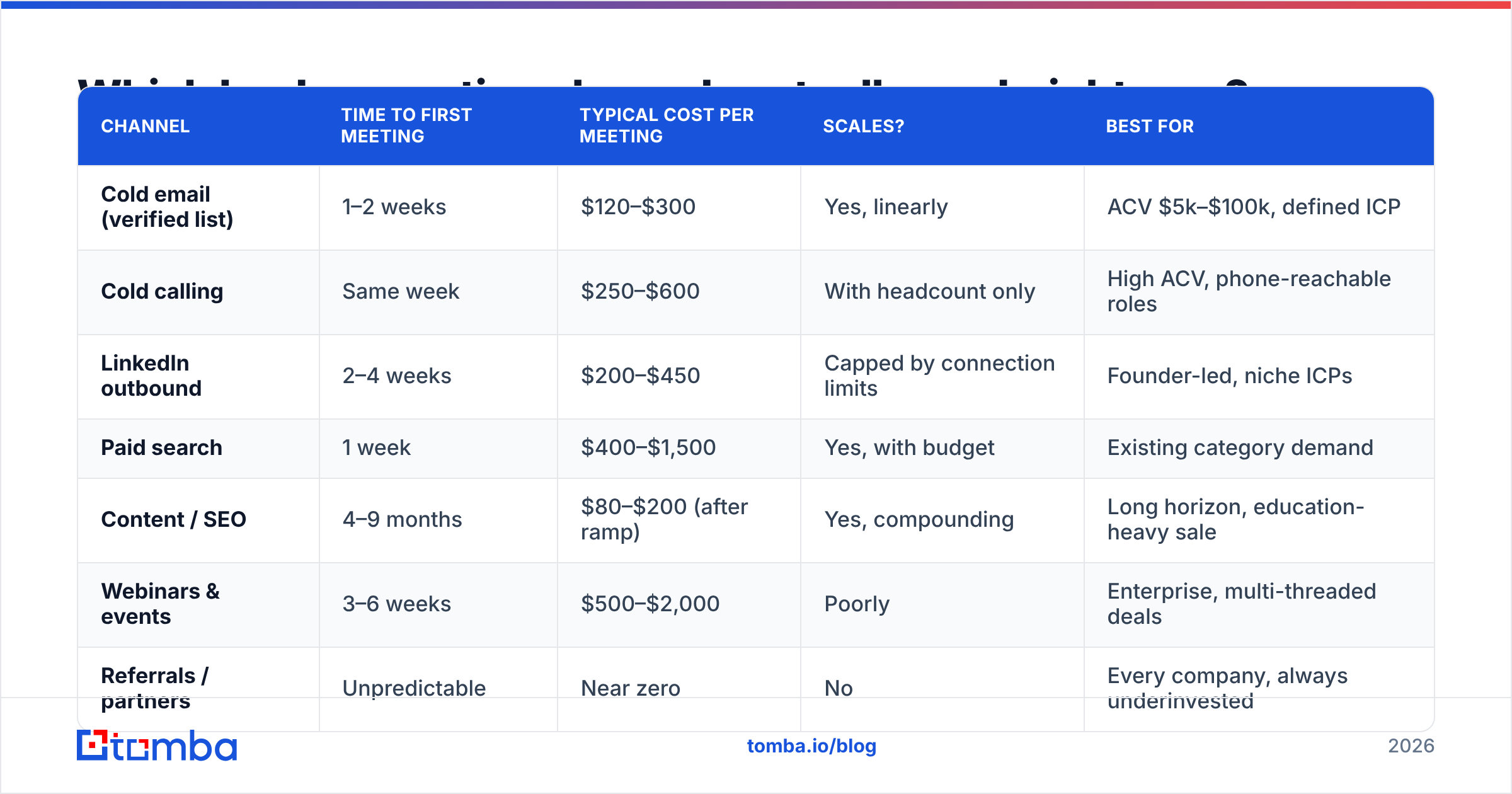
Here is the uncomfortable ranking. These are directional benchmarks from typical B2B SaaS and services motions — your numbers will move depending on ACV and category maturity, but the relative ordering holds more often than not.
| Channel | Time to first meeting | Typical cost per meeting | Scales? | Best for |
|---|---|---|---|---|
| Cold email (verified list) | 1–2 weeks | $120–$300 | Yes, linearly | ACV $5k–$100k, defined ICP |
| Cold calling | Same week | $250–$600 | With headcount only | High ACV, phone-reachable roles |
| LinkedIn outbound | 2–4 weeks | $200–$450 | Capped by connection limits | Founder-led, niche ICPs |
| Paid search | 1 week | $400–$1,500 | Yes, with budget | Existing category demand |
| Content / SEO | 4–9 months | $80–$200 (after ramp) | Yes, compounding | Long horizon, education-heavy sale |
| Webinars & events | 3–6 weeks | $500–$2,000 | Poorly | Enterprise, multi-threaded deals |
| Referrals / partners | Unpredictable | Near zero | No | Every company, always underinvested |
Two takeaways. First, cold email keeps winning on cost per meeting because the marginal cost of one more contact is a few cents — but only if the list is clean, which is exactly where the cost hides. Second, content and SEO have the best long-run economics and the worst short-run ones, which is why they get funded in year three and cut in year one.
HubSpot's marketing statistics show the same pattern across thousands of companies: teams that combine two or three channels outperform single-channel programs, largely because the channels compound on recognition rather than competing.
How do you build a targeted lead list from scratch?#
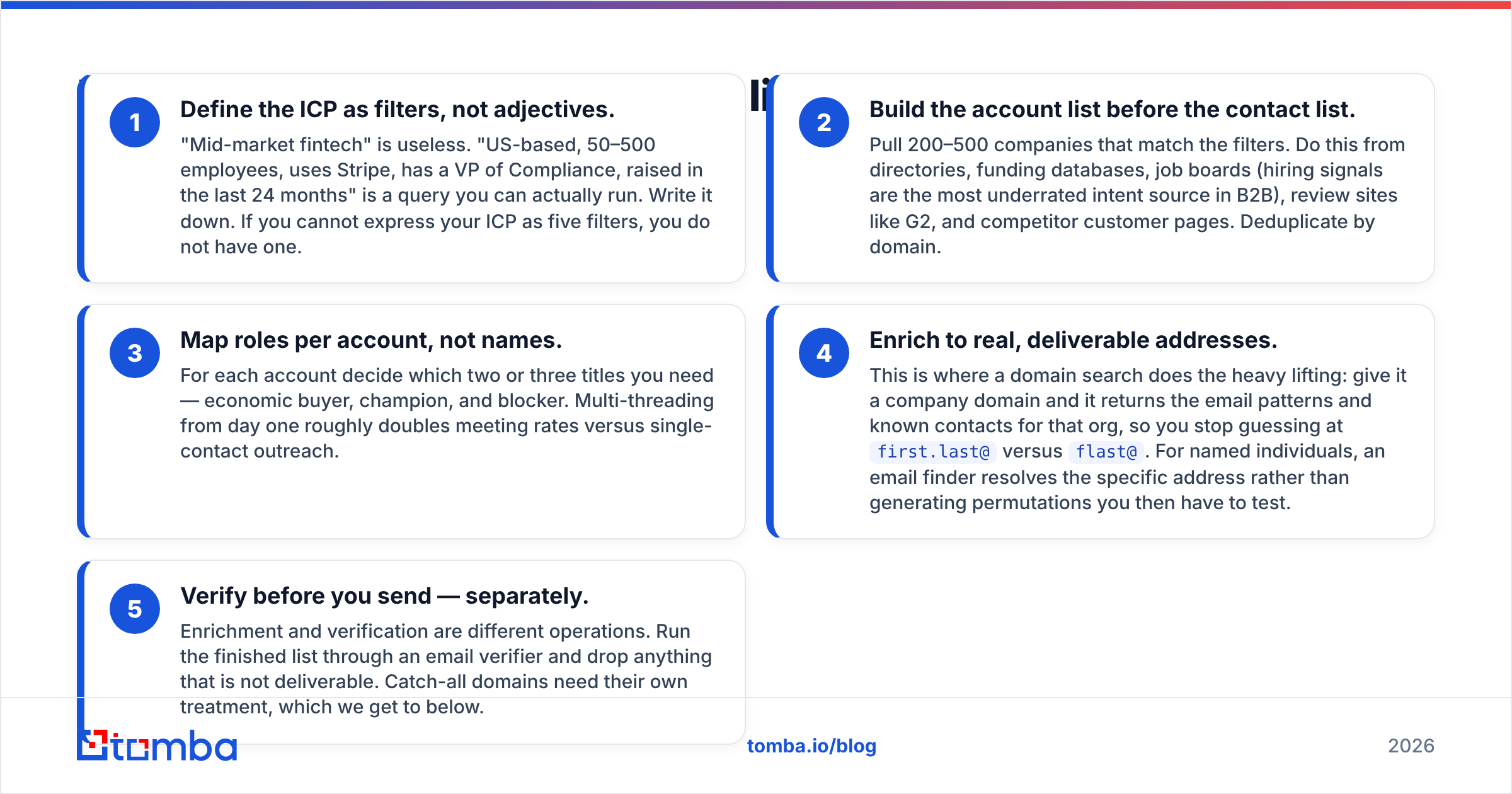
This is the part nobody wants to do and everybody outsources badly. Five steps, in order:
Define the ICP as filters, not adjectives. "Mid-market fintech" is useless. "US-based, 50–500 employees, uses Stripe, has a VP of Compliance, raised in the last 24 months" is a query you can actually run. Write it down. If you cannot express your ICP as five filters, you do not have one.
Build the account list before the contact list. Pull 200–500 companies that match the filters. Do this from directories, funding databases, job boards (hiring signals are the most underrated intent source in B2B), review sites like G2, and competitor customer pages. Deduplicate by domain.
Map roles per account, not names. For each account decide which two or three titles you need — economic buyer, champion, and blocker. Multi-threading from day one roughly doubles meeting rates versus single-contact outreach.
Enrich to real, deliverable addresses. This is where a domain search does the heavy lifting: give it a company domain and it returns the email patterns and known contacts for that org, so you stop guessing at
first.last@versusflast@. For named individuals, an email finder resolves the specific address rather than generating permutations you then have to test.Verify before you send — separately. Enrichment and verification are different operations. Run the finished list through an email verifier and drop anything that is not deliverable. Catch-all domains need their own treatment, which we get to below.
A 300-account list built this way takes a focused afternoon and outperforms a 20,000-row export every single time. The 20,000-row export feels like progress. It is mostly bounce risk.
Why do lead lists decay, and what does that cost you?#
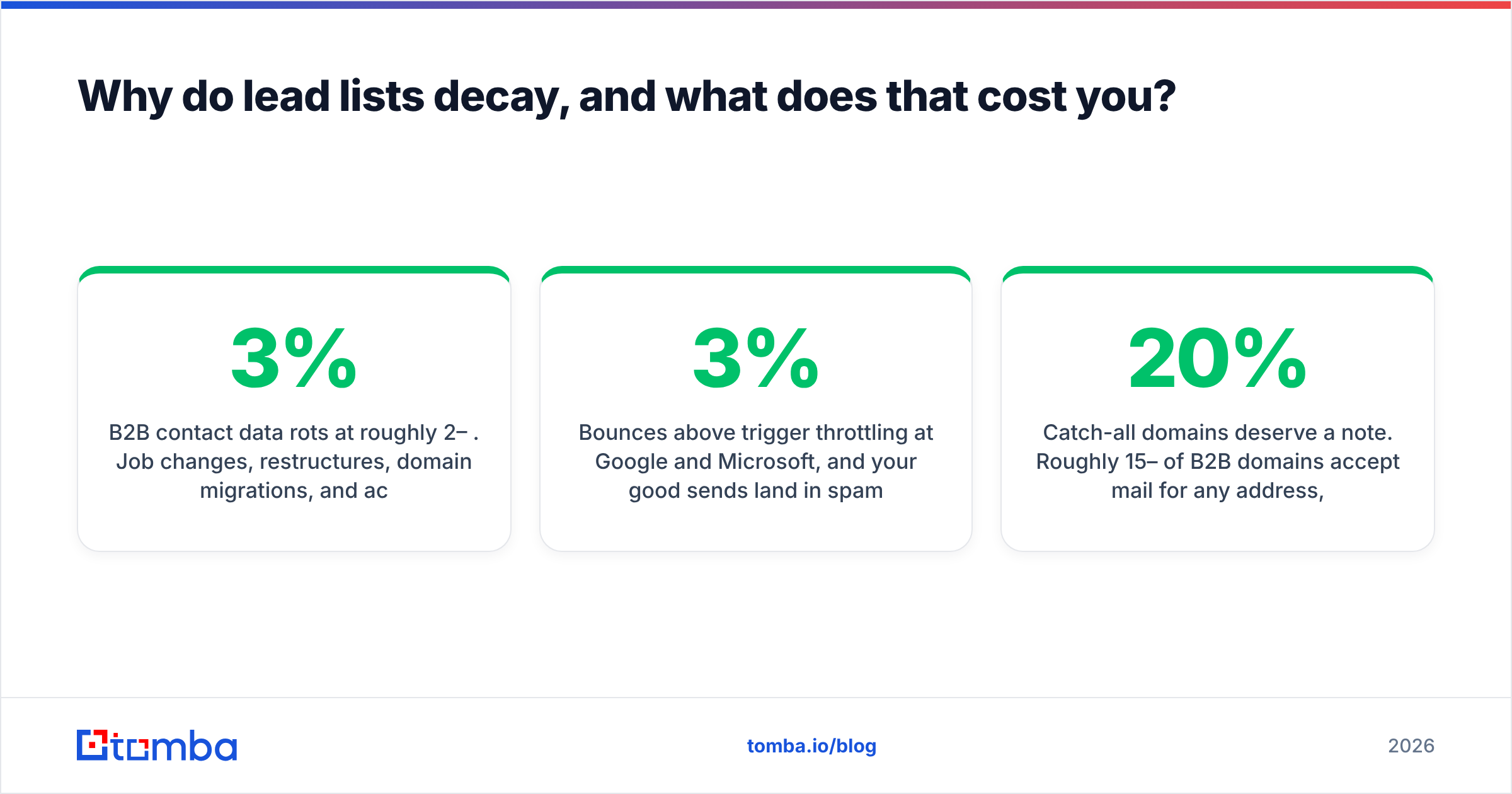
B2B contact data rots at roughly 2–3% per month. Job changes, restructures, domain migrations, and acquisitions all invalidate records quietly. Over a year, a list you built in January is meaningfully wrong by December — call it 25–30% degradation on the contact level, worse in high-churn functions like sales and marketing.
The cost is not just wasted sends. It is compounding:
- Bounces above 3% trigger throttling at Google and Microsoft, and your good sends land in spam alongside the bad ones.
- Spam complaints from irrelevant targeting damage domain reputation for months, not days.
- Rep time spent on contacts who left is the most expensive line item in the whole program.
The fix is boring and mechanical: re-verify any list older than 60 days, and re-verify the whole database quarterly. Bulk verification makes this a scheduled job rather than a project. If you send at any volume, put it on a calendar.
Catch-all domains deserve a note. Roughly 15–20% of B2B domains accept mail for any address, so standard SMTP verification returns "unknown" rather than valid or invalid. Dropping all of them throws away real prospects; sending to all of them invites bounces. A dedicated catch-all verifier uses pattern confidence and secondary signals to sort the recoverable ones from the guesses.
Should you buy leads or build them yourself?#
Both work. The question is what you are optimizing for.
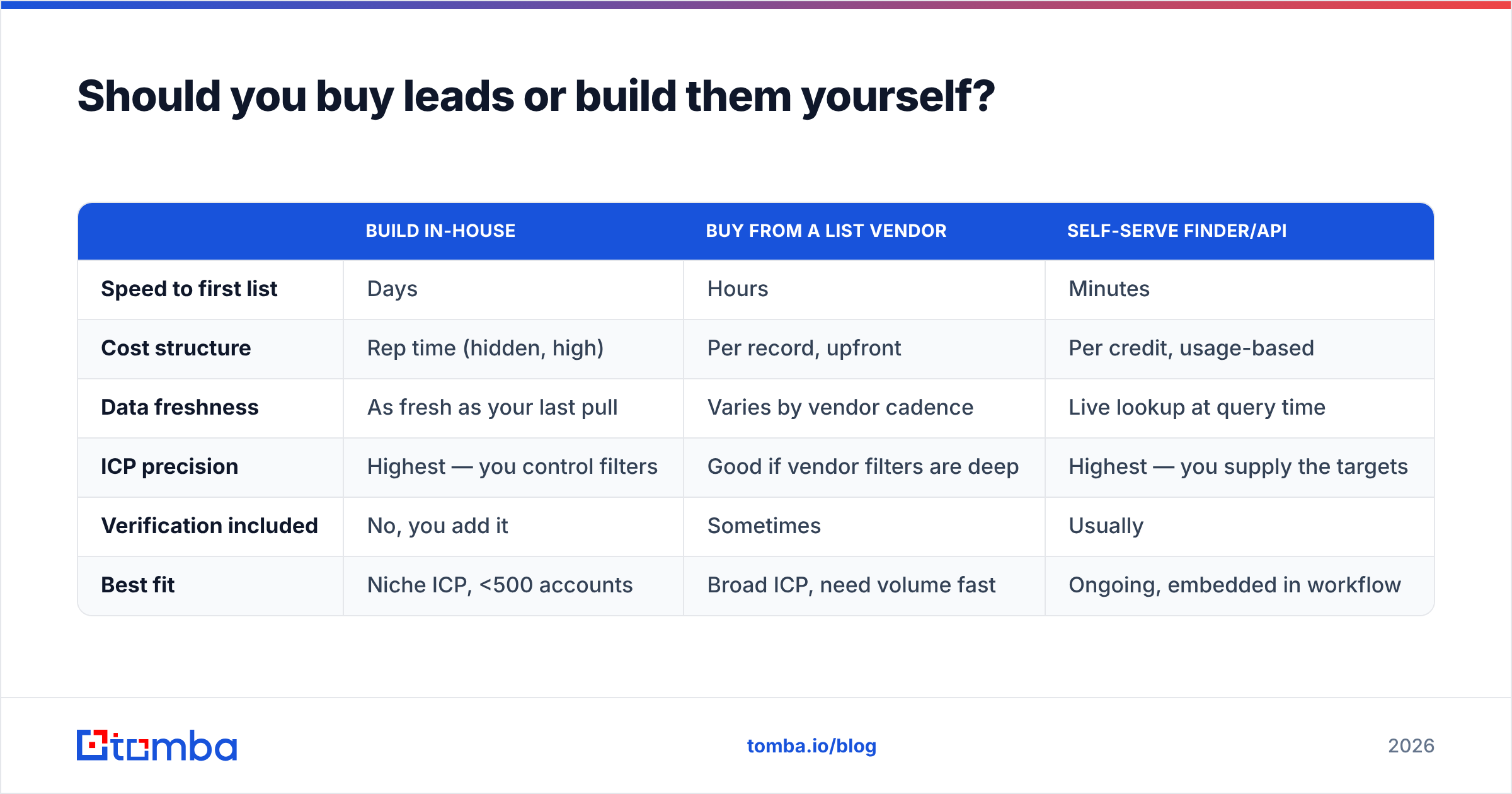
| Build in-house | Buy from a list vendor | Self-serve finder/API | |
|---|---|---|---|
| Speed to first list | Days | Hours | Minutes |
| Cost structure | Rep time (hidden, high) | Per record, upfront | Per credit, usage-based |
| Data freshness | As fresh as your last pull | Varies by vendor cadence | Live lookup at query time |
| ICP precision | Highest — you control filters | Good if vendor filters are deep | Highest — you supply the targets |
| Verification included | No, you add it | Sometimes | Usually |
| Best fit | Niche ICP, <500 accounts | Broad ICP, need volume fast | Ongoing, embedded in workflow |
Buying is a legitimate strategy when your ICP is broad and your bottleneck is volume. Vendors like BookYourData sell filtered, pre-verified B2B records and are a reasonable option if you want a list in your hands today rather than after two weeks of sourcing — the tradeoff is that you inherit their coverage and refresh cadence rather than controlling it.
Building is better when your ICP is narrow enough that no vendor has good coverage of it, which is more common than vendors admit. If your targets are "vertical SaaS companies serving veterinary clinics," no database has clean firmographics for that, and you will assemble it yourself.
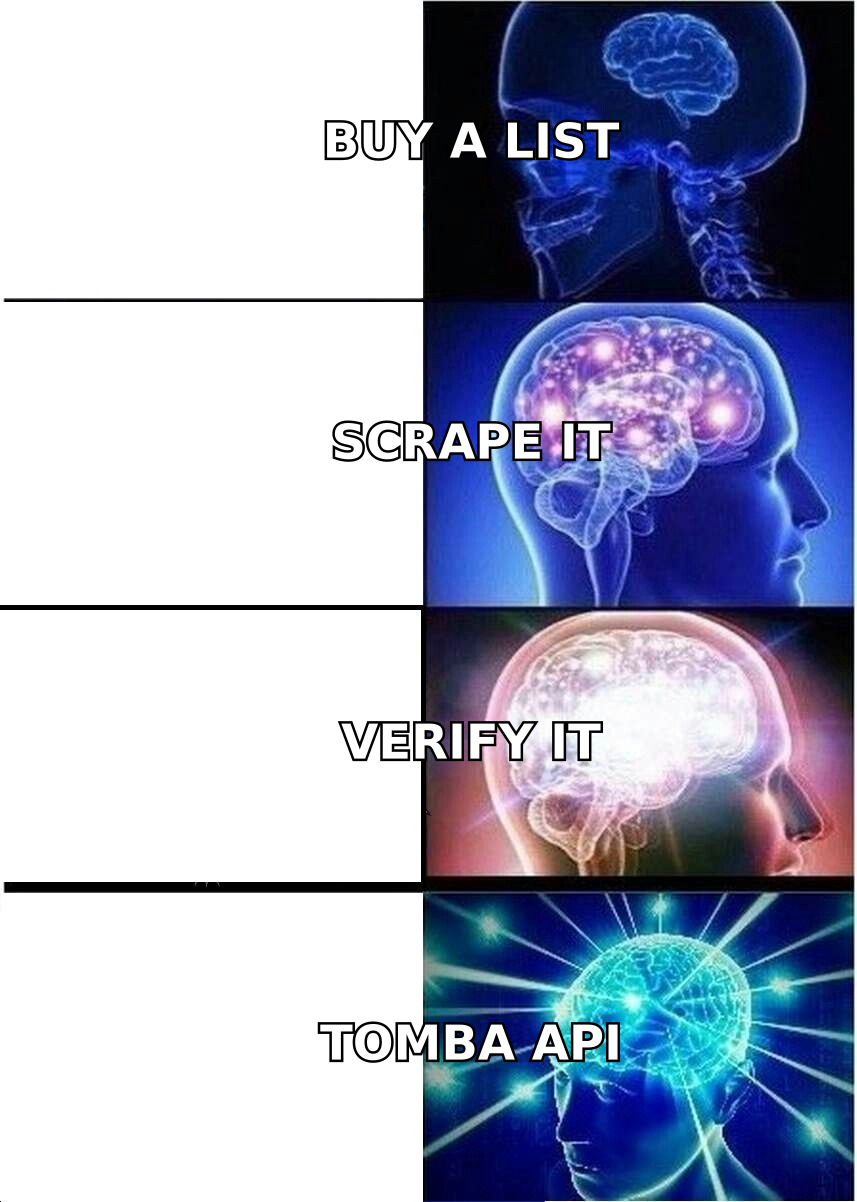
The hybrid most teams land on: buy or scrape the account layer, then use an email finder API to resolve contacts live at the moment of outreach. That way the address is fetched when you need it, not six months before.

How do you turn a clean list into actual replies?#
Sourcing gets you the right door. Activation gets it opened. Four things move response rate more than anything else:
Relevance over personalization. A line about their recent funding round is personalization. A sentence proving you understand the specific operational problem their role owns is relevance. The second one gets replies; the first one gets ignored because everyone does it now.
One ask, one idea. Emails with a single question outperform emails with a menu. "Worth a look?" beats "Would Tuesday or Thursday work, or should I send a deck?"
Send volume discipline. Fifty highly targeted sends per mailbox per day with warmed domains beats 500 sprayed sends. Gartner's research on B2B buying consistently finds buyers spend a small fraction of the cycle with any given vendor — you are competing for a narrow window of attention, and volume does not widen it.
Follow-up, but stop at four. Most replies land on emails two and three. After four touches you are generating complaints, not pipeline.
The mechanical prerequisites matter too: SPF, DKIM, and DMARC configured correctly, a separate sending domain from your primary, and a warmup period before you scale. None of these generate leads on their own, but any one of them missing will quietly cap everything else.
What metrics should you actually track?#
Cut the vanity numbers. Four metrics tell you whether lead generation is working:
- Deliverability rate — percentage of sends that reach an inbox. Below 90% and nothing downstream is measurable.
- Reply rate — total replies over delivered sends. Positive-only reply rate is the more honest version.
- Cost per qualified meeting — total channel cost (tools, data, rep time) divided by meetings that pass qualification. This is the number that decides budget.
- Meeting-to-opportunity rate — if this is under 40%, your targeting is wrong, not your closing.
Notice what is missing: lead count, open rate, and connection requests accepted. Open rate is now unreliable due to privacy proxies inflating it, and lead count rewards exactly the volume behavior that destroys deliverability.
Review these weekly at the channel level and monthly at the program level. Anything that has not produced a qualified meeting in six weeks gets cut or rebuilt, not "given more time."
What is the fastest path to your first 100 leads?#
If you are starting from zero this week:
- Day 1 — Write the five ICP filters. Pull 100 matching companies by domain.
- Day 2 — Run domain search across all 100 to map email patterns and existing contacts.
- Day 3 — Resolve 200–300 named contacts (two to three roles per account), then verify everything and drop invalids.
- Day 4 — Write three message variants against one hypothesis about the buyer's problem.
- Day 5–10 — Send 40–50 per day from a warmed domain. Four-touch sequence, five business days apart.
- Day 14 — Read the reply rate. Under 2% means the list or the hypothesis is wrong. Fix one variable, not both.
That cycle costs a couple hundred dollars in data credits and about fifteen hours of work. It will tell you more about your market than a quarter of planning.
Where to start#
If the bottleneck in your program is contact data rather than copy — and for most teams it is — start by fixing the list. The Tomba Email Finder resolves professional email addresses from a name and domain, verifies them in the same pass, and returns confidence scores so you know what you are sending to before you send it. The free tier covers 25 searches a month to test coverage against your own ICP, and paid plans start at $49/mo — full Tomba pricing is public, with no per-seat surprises.
Build the list properly once, verify it on a schedule, and the rest of lead generation gets dramatically easier.
Related guides#
// get started
Find, verify and enrich your first contacts today
Start on the free plan with 25 searches a month, then scale when your team is ready.
Free plan · No credit card required · GDPR & CCPA
Get the Tomba newsletter
Product and data updates
// about the author