How to Generate Leads for Digital Marketing Agencies in 2026
Referrals dry up. Here are seven repeatable channels agencies use to generate digital marketing leads in 2026 — with real costs, close rates, and the stack behind each one.
TL;DR
- Agency lead generation fails on targeting, not effort. Most agencies pitch "digital marketing" to everyone instead of one buyer with one measurable problem.
- The seven channels that actually work in 2026: audit-led outbound, SEO for commercial-intent keywords, partner/white-label referrals, paid search on competitor terms, LinkedIn thought leadership, review platforms (G2, Clutch), and reactivation of dead pipeline.
- Outbound still has the lowest cost per qualified meeting — roughly $40–$120 — but only if your list is verified. Bounce rates above 3% kill the whole channel.
- Build the list yourself. Scraped decision-maker names plus a verified email beat any purchased "agency leads" file.
- Your fastest win this quarter: a signal-based outbound motion off 200 companies running ads badly, with a free audit as the offer.
Why is lead generation harder for digital marketing agencies?#
Because you sell the same thing your prospect thinks they can buy from 4,000 other people, and half of them will do it for $500/month.
Digital marketing is the most commoditized service category in B2B. A CMO evaluating agencies gets 30 cold emails a week that all say "we help brands scale with data-driven performance marketing." There is no differentiation signal in that sentence, so buyers default to the two things they can actually compare: price and proof.
That reality shapes everything below. Every channel that works for agencies works because it delivers proof before the pitch — an audit, a ranked page, a case study on a peer company, a G2 score. Every channel that fails does so because it leads with capability claims.
The second structural problem is target ambiguity. "We work with e-commerce and SaaS and local services" is not a target market; it's a list of things you've been paid for once. Agencies that pick a single vertical and a single service — Shopify brands doing $2M–$20M who need paid social, say — generate leads 3–5x more efficiently, because the message, the case studies, and the list all sharpen at once.
What are the seven lead sources that actually work in 2026?#
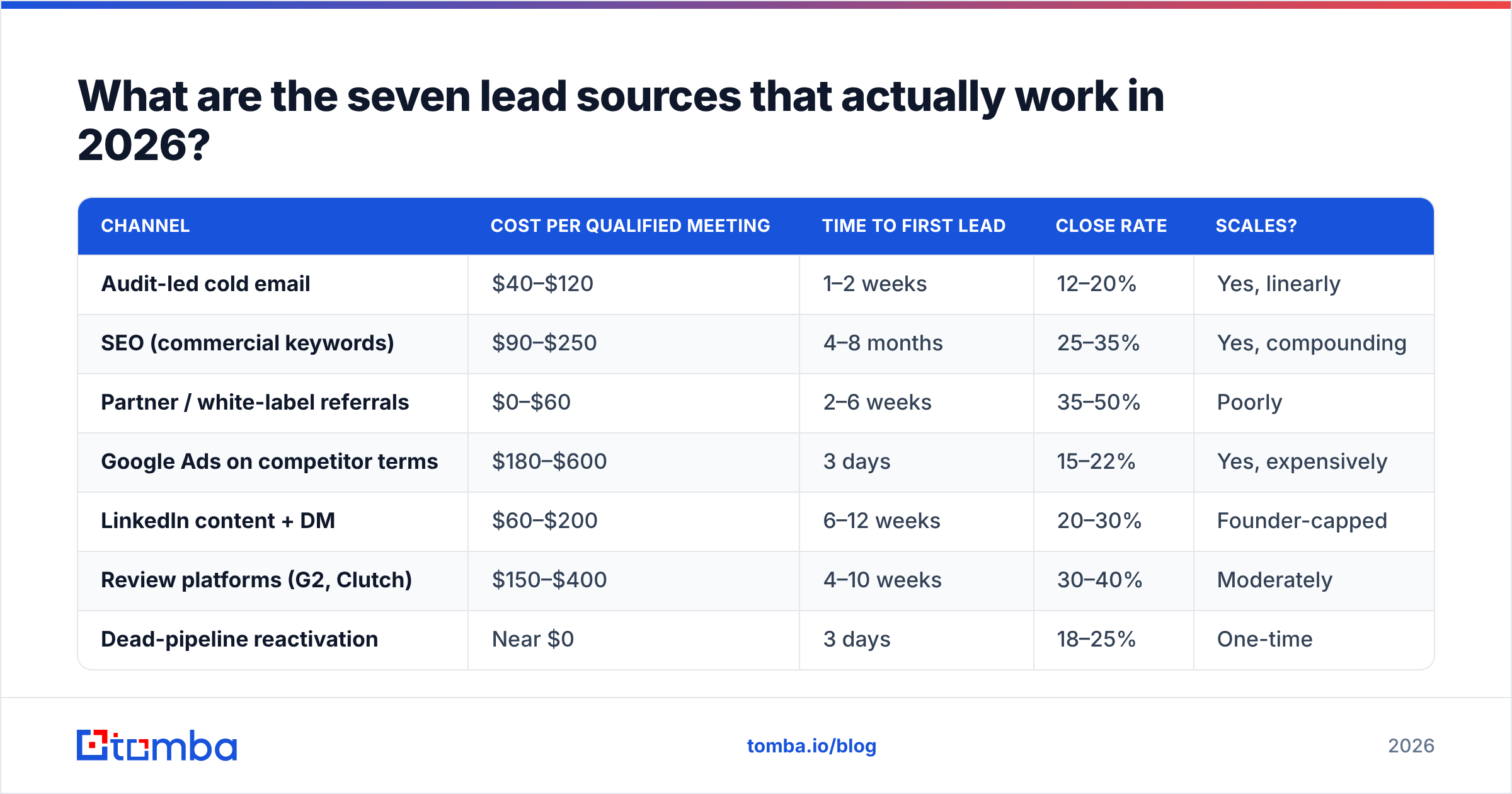
Here's the honest comparison. Costs assume a small agency (5–20 people) running each channel competently for 90 days.
| Channel | Cost per qualified meeting | Time to first lead | Close rate | Scales? |
|---|---|---|---|---|
| Audit-led cold email | $40–$120 | 1–2 weeks | 12–20% | Yes, linearly |
| SEO (commercial keywords) | $90–$250 | 4–8 months | 25–35% | Yes, compounding |
| Partner / white-label referrals | $0–$60 | 2–6 weeks | 35–50% | Poorly |
| Google Ads on competitor terms | $180–$600 | 3 days | 15–22% | Yes, expensively |
| LinkedIn content + DM | $60–$200 | 6–12 weeks | 20–30% | Founder-capped |
| Review platforms (G2, Clutch) | $150–$400 | 4–10 weeks | 30–40% | Moderately |
| Dead-pipeline reactivation | Near $0 | 3 days | 18–25% | One-time |
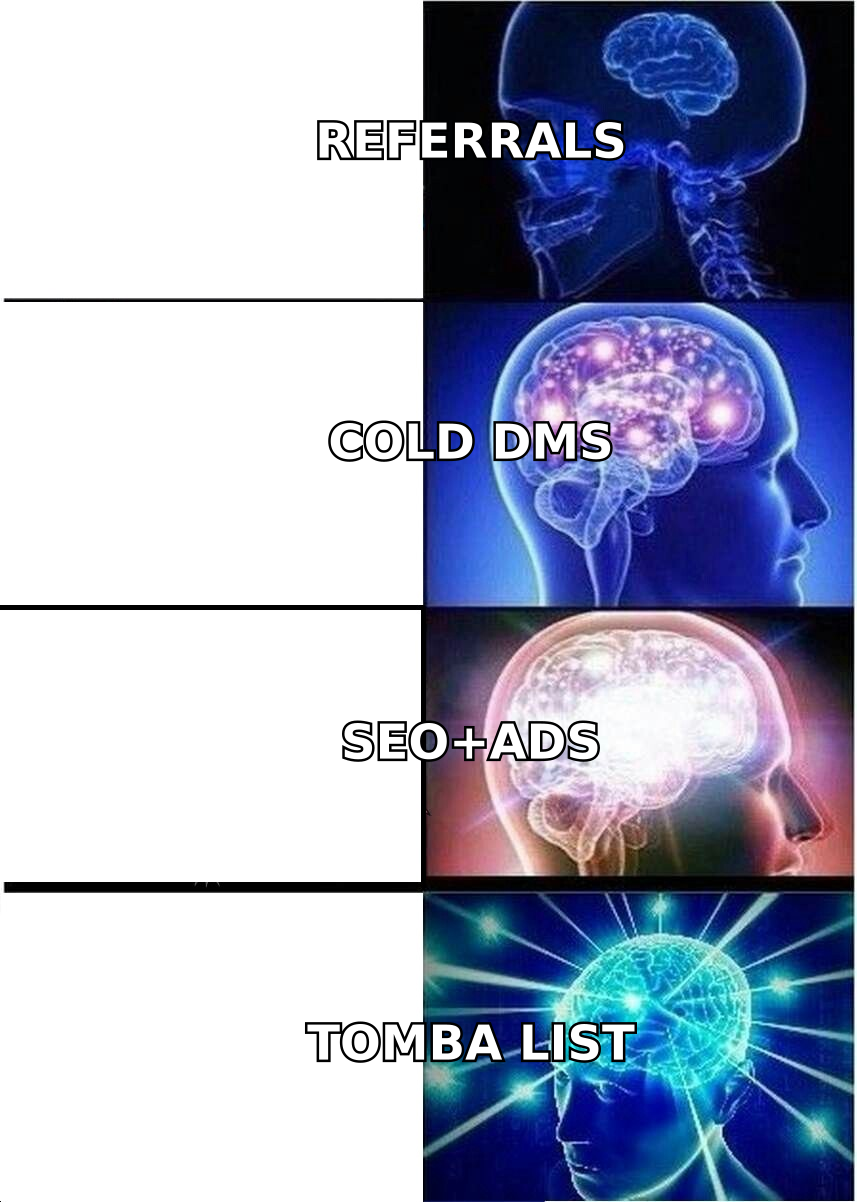
Read that table as a sequencing guide, not a menu. Reactivation and referrals come first because they're cheap and fast. Outbound comes second because it's the only channel you can turn up on demand. SEO and reviews come third because they compound but won't pay rent this quarter.
Two notes on the numbers. Close rates are meeting-to-client, not lead-to-client. And paid search looks terrible on cost per meeting but often wins on cost per dollar of revenue because competitor-term traffic is late-stage — those people are already shopping.
How do you build a target list that isn't garbage?#
Buy nothing. Build it from signals.
Purchased "digital marketing leads" lists are recycled, stale, and shared with every agency that bought them last quarter. The alternative takes an afternoon and produces a list nobody else has.
- Pick one buying signal. Companies running Meta ads with no landing page. Sites on Shopify with Core Web Vitals in the red. Brands that just raised a Series A. Job postings for a "Growth Marketing Manager" — that's a company admitting it has demand problems and budget.
- Scrape or filter the company set. Ad libraries, BuiltWith, Crunchbase, LinkedIn job boards, and Google Maps all export company domains. Aim for 200–500 domains, not 5,000.
- Find the decision maker per domain. For agencies, that's usually the Head of Growth, VP Marketing, or — at sub-50-person companies — the founder. Run the domains through a domain search to pull the marketing-team contacts and the company's email pattern in one pass.
- Verify before you send. Every address goes through an email verifier first. This is non-negotiable; see the deliverability section below.
- Enrich with the proof hook. Alongside each contact, store the specific observation you'll open with: "your Meta ad set has 14 creatives pointed at your homepage." That field is what makes the email land.
- Cap the list and work it hard. 250 well-researched contacts with three touches each will outperform 5,000 contacts with one.
Step 5 is the one most teams skip, and it's the whole game. A list without a per-contact observation is just a spray list wearing a nicer jacket.
For volume, push the whole domain set through a bulk email finder rather than looking up contacts one at a time, and pull the results straight into your Google Sheets workspace or CRM.
Does cold email still work for agencies?#
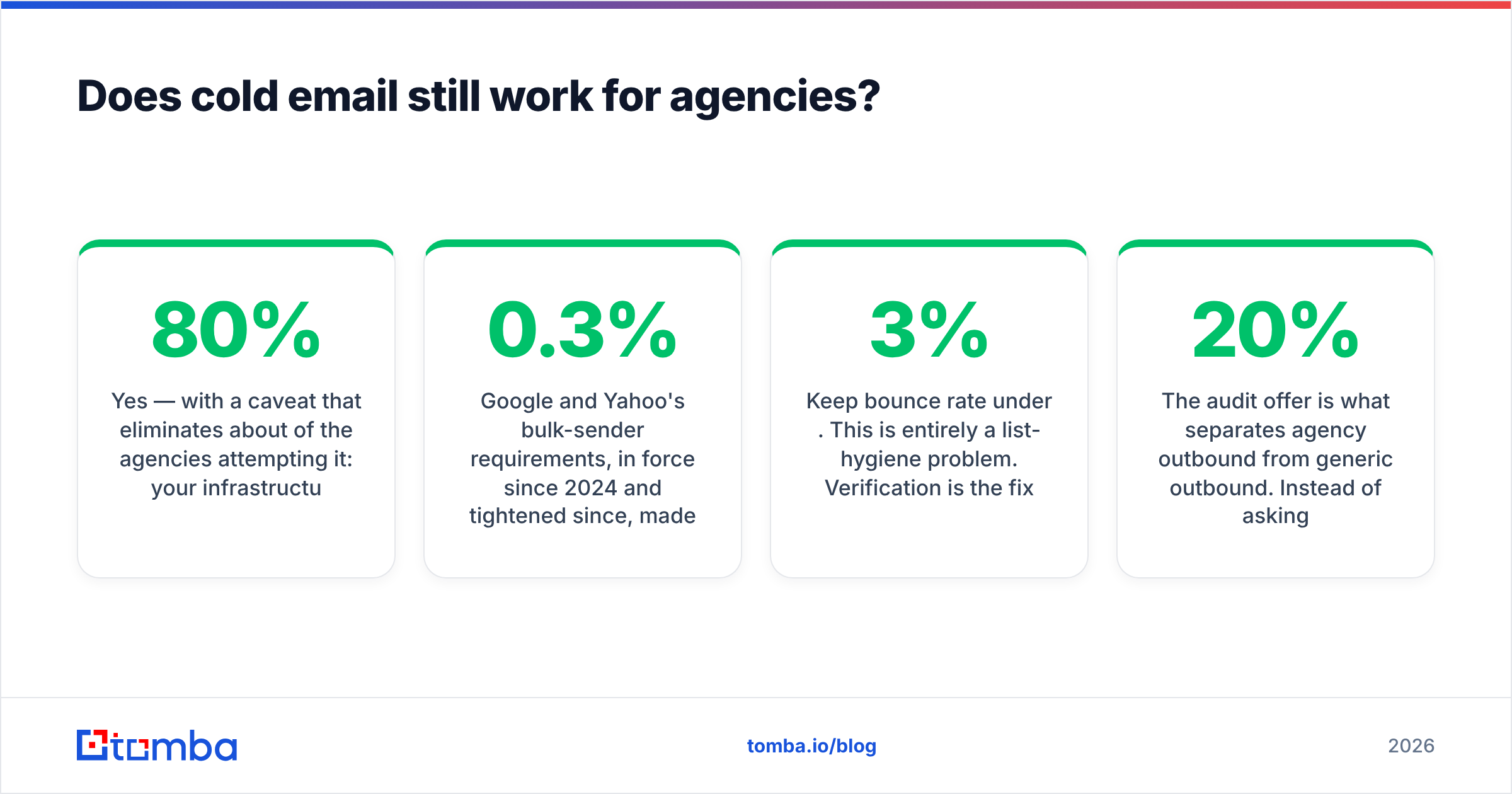
Yes — with a caveat that eliminates about 80% of the agencies attempting it: your infrastructure has to be clean and your list has to be verified.
Google and Yahoo's bulk-sender requirements, in force since 2024 and tightened since, made spam-rate thresholds a hard gate rather than a suggestion. Google's sender guidelines spell out the SPF/DKIM/DMARC baseline and the 0.3% spam-complaint ceiling. Miss it and your domain quietly stops reaching inboxes — no bounce, no warning, just silence.
The practical checklist:
- Send from a secondary domain.
getyouragency.com, notyouragency.com. Never risk the domain your invoices go out from. - Warm for 3–4 weeks before real volume. Ramp to no more than 30–50 sends per mailbox per day.
- Keep bounce rate under 3%. This is entirely a list-hygiene problem. Verification is the fix.
- Check your SPF record and DMARC alignment before the first send, not after replies dry up.
- One ask per email. "Worth a look?" converts better than a calendar link in email one.
The audit offer is what separates agency outbound from generic outbound. Instead of asking for 15 minutes, you send the finding: three specific things wrong with their paid social account, or the four commercial keywords their competitor outranks them on. You're not asking for time — you're giving away work. That's why audit-led sequences hit 12–20% meeting rates while "quick question about your marketing" sits at 2%.
A working structure, four sentences long:
Saw you're running 14 creatives on Meta, all pointing at your homepage — no dedicated LP. That's usually where 30–40% of the spend leaks. I pulled a two-page teardown of the account structure with the three fixes I'd make first. Want me to send it?
No case studies, no "we're a full-service agency," no calendar link. The reply rate on that email is the reason the channel still works.
How does SEO fit into agency lead generation?#
SEO is the channel that eventually makes outbound optional — but only if you target commercial-intent keywords instead of blog fluff.
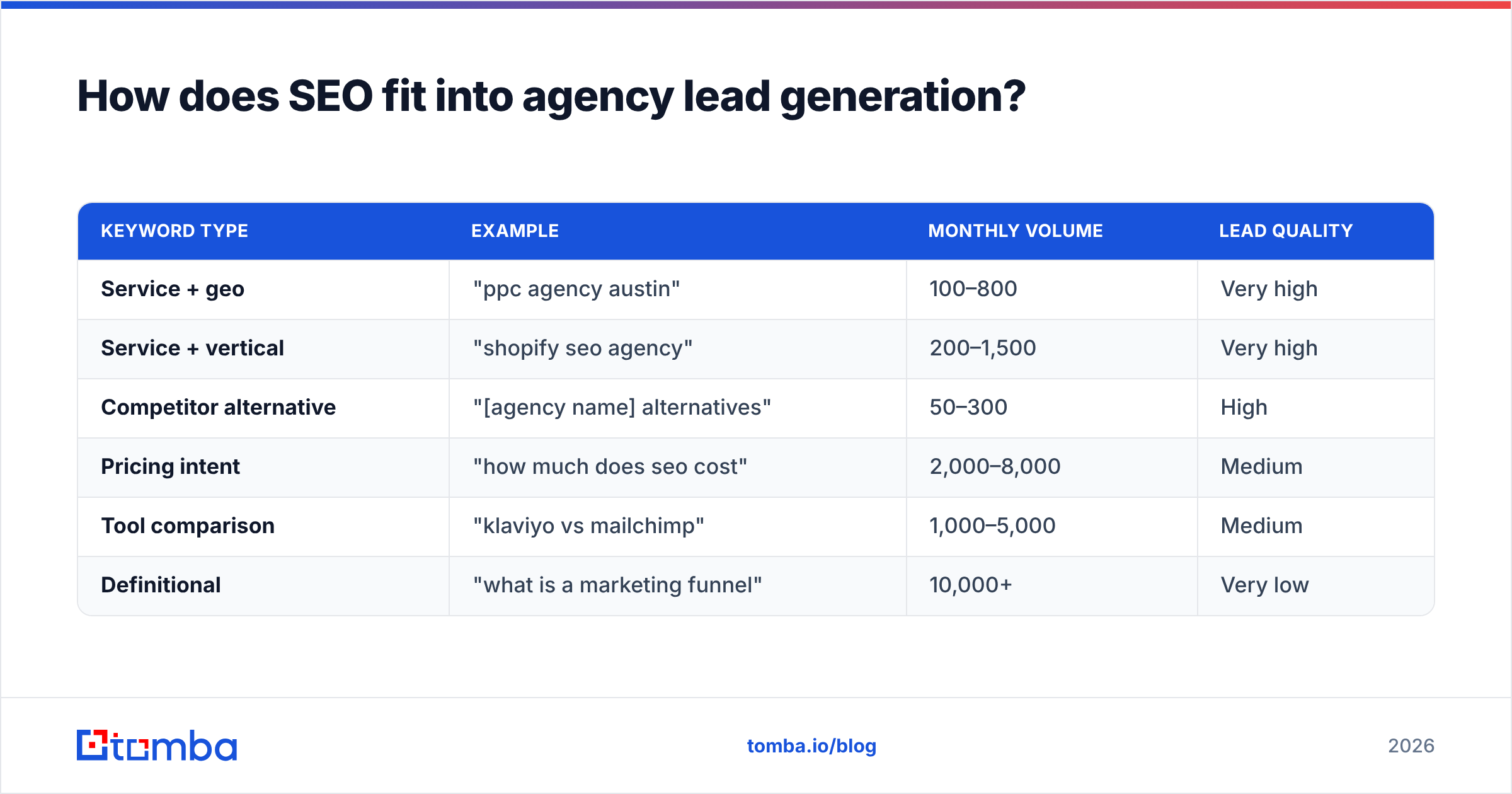
Most agency blogs rank for "what is content marketing" and generate zero pipeline, because the people searching that phrase are students and junior marketers. The keywords that produce clients look different:
| Keyword type | Example | Monthly volume | Lead quality |
|---|---|---|---|
| Service + geo | "ppc agency austin" | 100–800 | Very high |
| Service + vertical | "shopify seo agency" | 200–1,500 | Very high |
| Competitor alternative | "[agency name] alternatives" | 50–300 | High |
| Pricing intent | "how much does seo cost" | 2,000–8,000 | Medium |
| Tool comparison | "klaviyo vs mailchimp" | 1,000–5,000 | Medium |
| Definitional | "what is a marketing funnel" | 10,000+ | Very low |
Build the first three rows before you touch the last one. Ten pages targeting service-plus-vertical terms will out-earn 100 definitional posts, and they're easier to rank because the competition is other agencies who also haven't figured this out.
Two mechanics that compound: publish teardowns of real, named companies (they get shared, linked, and occasionally turn into clients), and put a genuinely useful free tool behind an email gate. A free audit tool that returns a real score generates more qualified leads per month than most agencies' entire content operation.
For link acquisition, skip the guest-post mills. Find the writers covering your vertical, use an author finder to get their direct address, and pitch them data they can't get elsewhere — your own aggregate benchmarks from client accounts, anonymized.

Which lead gen tools do agencies actually need?#
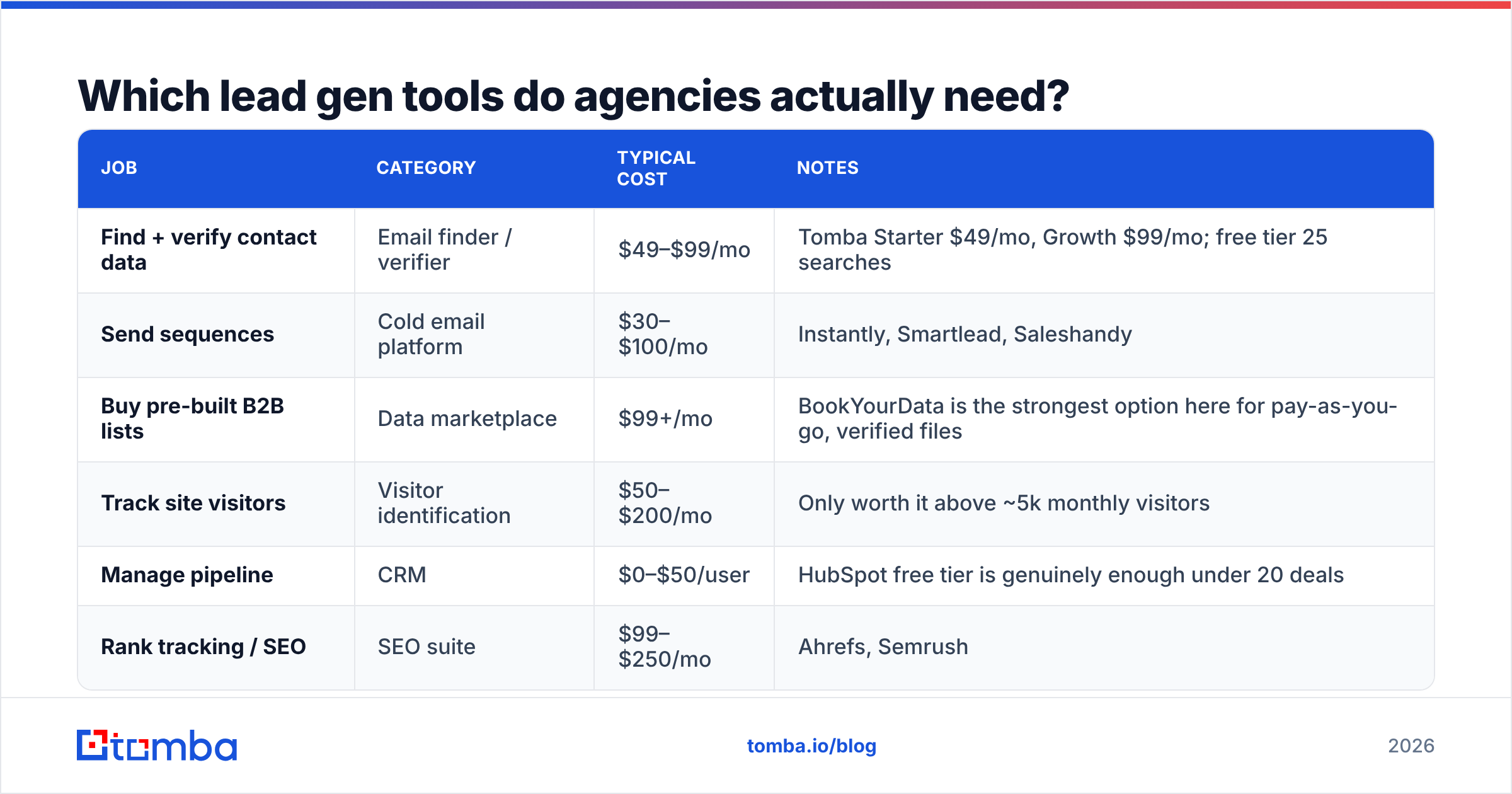
Fewer than the stack posts suggest. Here's what maps to what.
| Job | Category | Typical cost | Notes |
|---|---|---|---|
| Find + verify contact data | Email finder / verifier | $49–$99/mo | Tomba Starter $49/mo, Growth $99/mo; free tier 25 searches |
| Send sequences | Cold email platform | $30–$100/mo | Instantly, Smartlead, Saleshandy |
| Buy pre-built B2B lists | Data marketplace | $99+/mo | BookYourData is the strongest option here for pay-as-you-go, verified files |
| Track site visitors | Visitor identification | $50–$200/mo | Only worth it above ~5k monthly visitors |
| Manage pipeline | CRM | $0–$50/user | HubSpot free tier is genuinely enough under 20 deals |
| Rank tracking / SEO | SEO suite | $99–$250/mo | Ahrefs, Semrush |
The two you cannot skip are contact data and sending. Everything else is optional until you have consistent volume.
On the data side, there's a real fork in the road. If you want to define your own signal-based list — the approach in the section above — you need a finder that works domain-by-domain against companies you selected. If you'd rather buy a filtered file and start sending tomorrow, a marketplace like BookYourData sells verified contacts by role and industry with no subscription commitment, which suits agencies testing a new vertical before investing in a process.
Most agencies end up doing both: buy a starter file to validate that a vertical responds, then build proprietary lists once the ICP is proven. Compare Tomba pricing against your monthly contact volume — under about 1,000 lookups a month, Starter at $49 covers it; teams running multi-vertical outbound usually land on Growth at $99.
One more piece worth wiring: connect your finder to your CRM directly. A HubSpot integration that enriches new records automatically removes the manual export-import step that quietly kills most outbound processes by week three.
How do you turn agency leads into clients?#
The handoff from lead to client is where agencies lose more revenue than they lose in prospecting.
Respond in under an hour. Inbound agency leads are shopping three to five vendors simultaneously. HubSpot's research on lead response has consistently shown that speed to first contact dominates almost every other variable. First responder wins disproportionately often.
Run a discovery call that isn't a pitch. Twenty minutes of questions about their current numbers, their last agency, and what "working" would look like in 90 days. If you spend more than five minutes talking about your agency, you've lost.
Send the proposal within 24 hours. Not a 30-page deck. Two pages: what you diagnosed, what you'd do in the first 90 days, what it costs, what it should produce.
Price the first engagement small. A $3,000 paid audit or a 60-day pilot closes at 3–4x the rate of a 12-month retainer proposal, and it converts to a retainer roughly half the time.
Follow up seven times. Most agencies stop at two. The deals that close on touch five and six are the entire difference between a 15% and a 30% close rate.
Track all of this against your win rate by channel. You'll usually find one source producing meetings that never close — kill it and move that time into the channel producing clients, even if it produces fewer leads.
What should you do in the next 30 days?#
A concrete sequence, not a strategy deck.
Week 1. Pick one vertical and one service. Write the ICP in a single sentence. Export your last 24 months of closed deals and check which vertical actually paid, stayed, and referred.
Week 2. Build the 250-company list off one buying signal. Find and verify the decision-maker emails. Write the audit observation for each — yes, manually. It takes about four hours and it's the highest-leverage four hours in the quarter.
Week 3. Warm a secondary sending domain, load the sequence, start at 20 sends a day. Simultaneously, email every closed-lost deal from the past 18 months with a single line: what changed on your side since you last spoke.
Week 4. Publish two service-plus-vertical pages targeting commercial keywords. Ask your three happiest clients for a Clutch or G2 review. Review reply data from weeks 2–3 and rewrite the opener.
By day 30 you'll have reactivation replies, early outbound meetings, and two assets that compound. That's a functioning lead engine — not a complete one, but one you can turn up.
Start with a list you can trust#
Every channel above collapses back to the same dependency: reaching the right person at a working address. Bad data doesn't just waste sends — it burns the sending domain you need for the next twelve months of outbound.
Start with the Tomba Email Finder. Pull decision-maker emails by domain, name, or company, verify them before they enter a sequence, and export straight into your CRM or sheet. The free tier gives you 25 searches a month to test the workflow on a real target list; Starter at $49/mo covers most agencies running a single-vertical outbound motion. Build the list properly once, and every channel downstream gets cheaper.
Related guides#
// get started
Find, verify and enrich your first contacts today
Start on the free plan with 25 searches a month, then scale when your team is ready.
Free plan · No credit card required · GDPR & CCPA
// about the author