How to Generate Leads for a New Business: 2026 Playbook
No brand, no budget, no list. Here is the exact order of operations for generating your first 100 qualified leads as a new business — channels, costs, and the traps that burn month one.
TL;DR
- New businesses fail at lead gen because they pick a channel before they pick a customer. Define a narrow ICP first, then choose exactly two channels.
- The fastest zero-brand path to revenue conversations is targeted outbound: build a 200-account list, find verified contacts, send 40-60 personalized emails a week.
- Paid ads are the worst first channel for a new business — you pay to learn what a $0 customer-interview would have told you.
- Budget roughly $150-$400/month for tooling in month one (email finder, verifier, sending domain, CRM). That is enough.
- Track one metric until it moves: qualified conversations booked per week. Everything else is vanity.
You have no brand recognition, no inbound traffic, no referral network, and probably no marketing budget. That is the actual starting condition for most new businesses, and most lead generation advice quietly assumes none of it is true.
This guide fixes that. It walks through how to generate leads for new business from a genuine zero — what to do in week one, which channels actually pay off before you have proof, what the tooling costs, and where new founders reliably waste their first three months.
Why do most new businesses fail at lead generation?#
Not because they picked the wrong channel. Because they picked a channel at all before defining who they sell to.
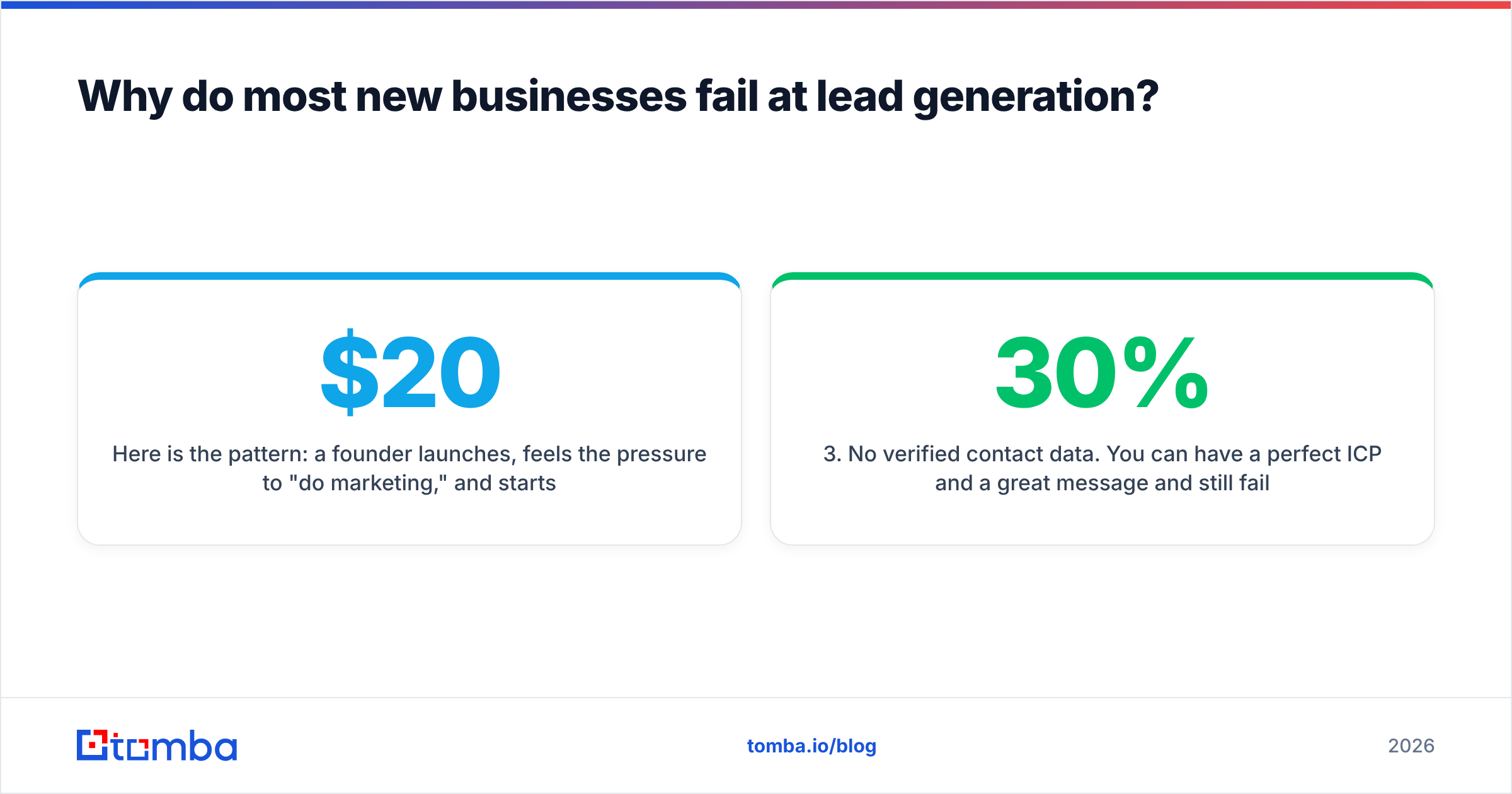
Here is the pattern: a founder launches, feels the pressure to "do marketing," and starts posting on LinkedIn, running $20/day of Google Ads, and cold emailing a scraped list — all in the same week, all aimed at "small businesses." Six weeks later there are three unqualified calls and no data on what worked, because nothing ran long enough or narrow enough to produce a signal.
Three failure modes account for most of it:
- The audience is too wide. "B2B SaaS companies" is not an ICP. "Seed-stage B2B SaaS with 5-25 employees, no dedicated RevOps hire, using HubSpot" is. Narrow targeting is what makes a no-brand cold email readable.
- Too many channels, none of them at depth. Two channels run properly beat six run casually. A channel needs 6-8 weeks and consistent volume before its numbers mean anything.
- No verified contact data. You can have a perfect ICP and a great message and still fail if 30% of your emails bounce. Bounces above 3% will get a new sending domain flagged fast, and a new domain has no reputation buffer to absorb that.
That last one is the silent killer for new businesses specifically. Established companies have inbox history. You do not. Your first 500 sends set your sender reputation for the next year.

Which lead generation channels actually work with no brand?#
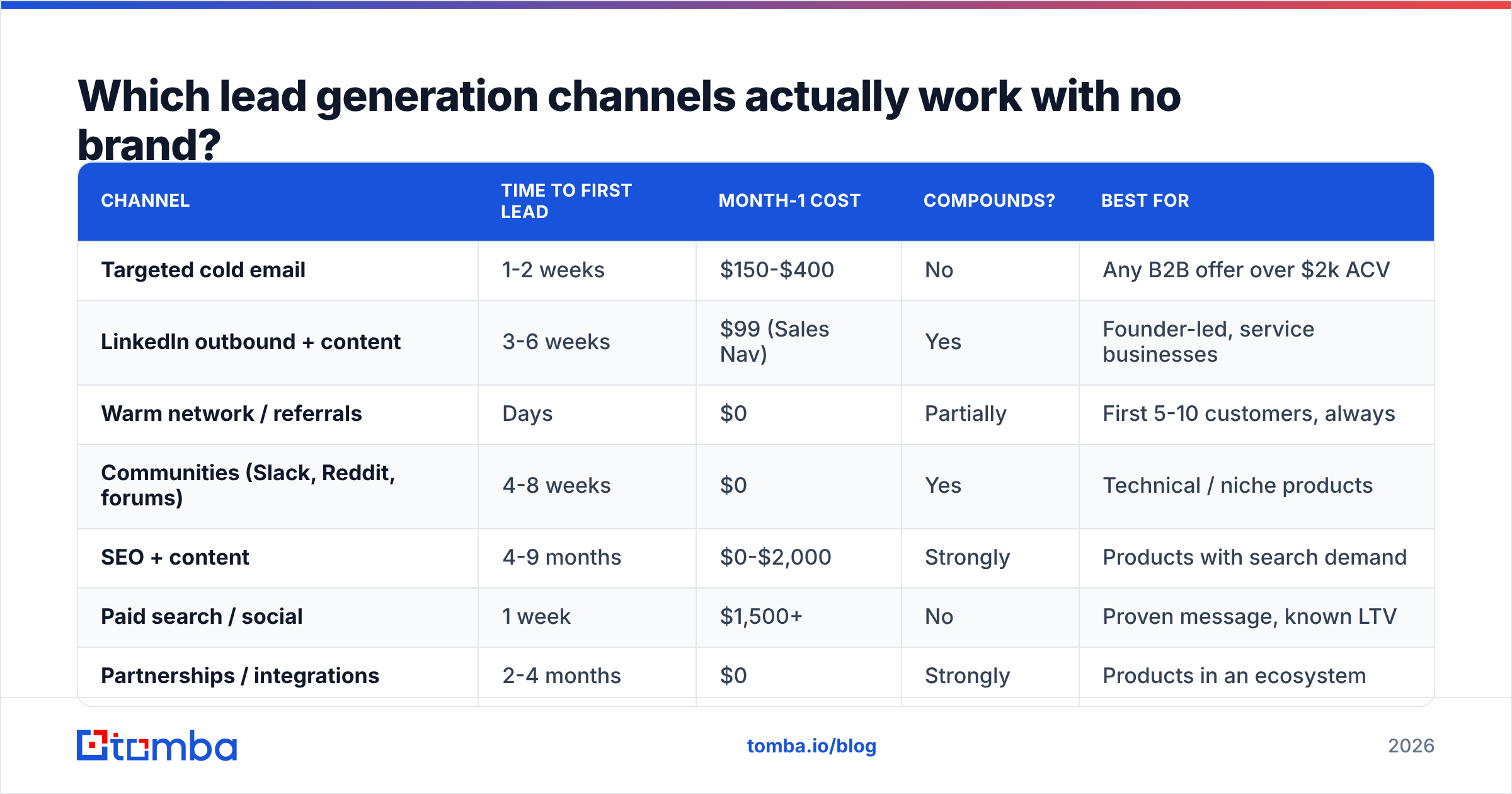
Rank channels by three things a new business cares about: how fast the first lead arrives, what it costs, and whether it compounds. Most advice optimizes only for the third, which is why founders run out of money.
| Channel | Time to first lead | Month-1 cost | Compounds? | Best for |
|---|---|---|---|---|
| Targeted cold email | 1-2 weeks | $150-$400 | No | Any B2B offer over $2k ACV |
| LinkedIn outbound + content | 3-6 weeks | $99 (Sales Nav) | Yes | Founder-led, service businesses |
| Warm network / referrals | Days | $0 | Partially | First 5-10 customers, always |
| Communities (Slack, Reddit, forums) | 4-8 weeks | $0 | Yes | Technical / niche products |
| SEO + content | 4-9 months | $0-$2,000 | Strongly | Products with search demand |
| Paid search / social | 1 week | $1,500+ | No | Proven message, known LTV |
| Partnerships / integrations | 2-4 months | $0 | Strongly | Products in an ecosystem |
| Events / meetups | 2-6 weeks | $200-$1,500 | Partially | High-ACV enterprise sales |
The honest read: cold email and warm network are the only two that reliably produce revenue conversations inside 30 days at a cost a new business can absorb. SEO and partnerships are where you should be investing, but they will not pay rent in Q1.
Paid ads deserve a specific warning. Ads convert existing demand; they do not create belief in an unknown brand. Until you know your message converts and roughly what a customer is worth, ad spend is tuition, not acquisition. G2's buyer behavior research consistently shows B2B buyers running peer and review-site research before they respond to any vendor ad — a brand-new company has nothing for them to find.
How do you define an ICP tight enough to actually target?#
Write your ICP as a list you could actually build. If you cannot turn the definition into a filter, it is a mood board, not a target.
A usable ICP has four layers:
- Firmographics — industry, headcount band, revenue band, geography. These are filterable in almost any data source.
- Technographics — what software they already run. "Uses Shopify Plus" or "runs HubSpot" is often a stronger buying signal than headcount. You can check a prospect's stack with a website tech stack lookup before you ever write to them.
- Trigger events — new funding, a new hire in the relevant role, a job posting, a product launch, an office opening. Triggers are what make an email timely instead of random.
- The person — exact job titles, plus who else gets pulled into the decision.
Then pressure-test it with the question most founders skip: what does this company do today instead of buying from me? If the honest answer is "nothing, and it's fine," your ICP is not in pain and no amount of outbound will fix that.
Start with 200 accounts. Not 2,000. Two hundred accounts you have genuinely researched will outperform a 5,000-row purchased list every time, and you can build the list in two days.
What does a first-100-leads workflow look like end to end?#
This is the operational core. Six steps, roughly two weeks of work for one person.
- Build the account list (day 1-2). Pull 200 companies matching your ICP from LinkedIn Sales Navigator, an industry directory, a conference attendee list, or a funding-announcement feed. Put them in a spreadsheet with domain, headcount, and the trigger you noticed.
- Identify the right person per account (day 2-3). One primary contact, one backup. Title-level precision matters more than seniority — a Head of Demand Gen will read a lead-gen pitch that a CMO deletes.
- Find verified emails (day 3-4). Run the domains through an email finder or use domain search to pull every public contact at each company and pattern-match from there. Expect 70-90% coverage on a well-built list; anything advertised above that is usually counting guesses as finds.
- Verify before you send (day 4). Push the whole list through an email verifier and drop everything that is not deliverable. Handle catch-all domains separately — they need a catch-all verifier rather than a standard SMTP check, and they are worth keeping if the rest of the account fits.
- Warm the sending domain (runs in parallel, day 1-14). Buy a secondary domain for outbound, set up SPF, DKIM, and DMARC, and ramp sends from 5/day to 30/day over two weeks. Never send cold volume from your primary domain.
- Send and iterate (week 3+). 40-60 emails per week per inbox, four-touch sequence, one variable changed per week. Measure reply rate, not open rate — Apple Mail Privacy Protection made open rates noise years ago.
At 200 contacts with a 6-10% positive reply rate, you are looking at 12-20 conversations. That is enough to learn whether the offer lands.
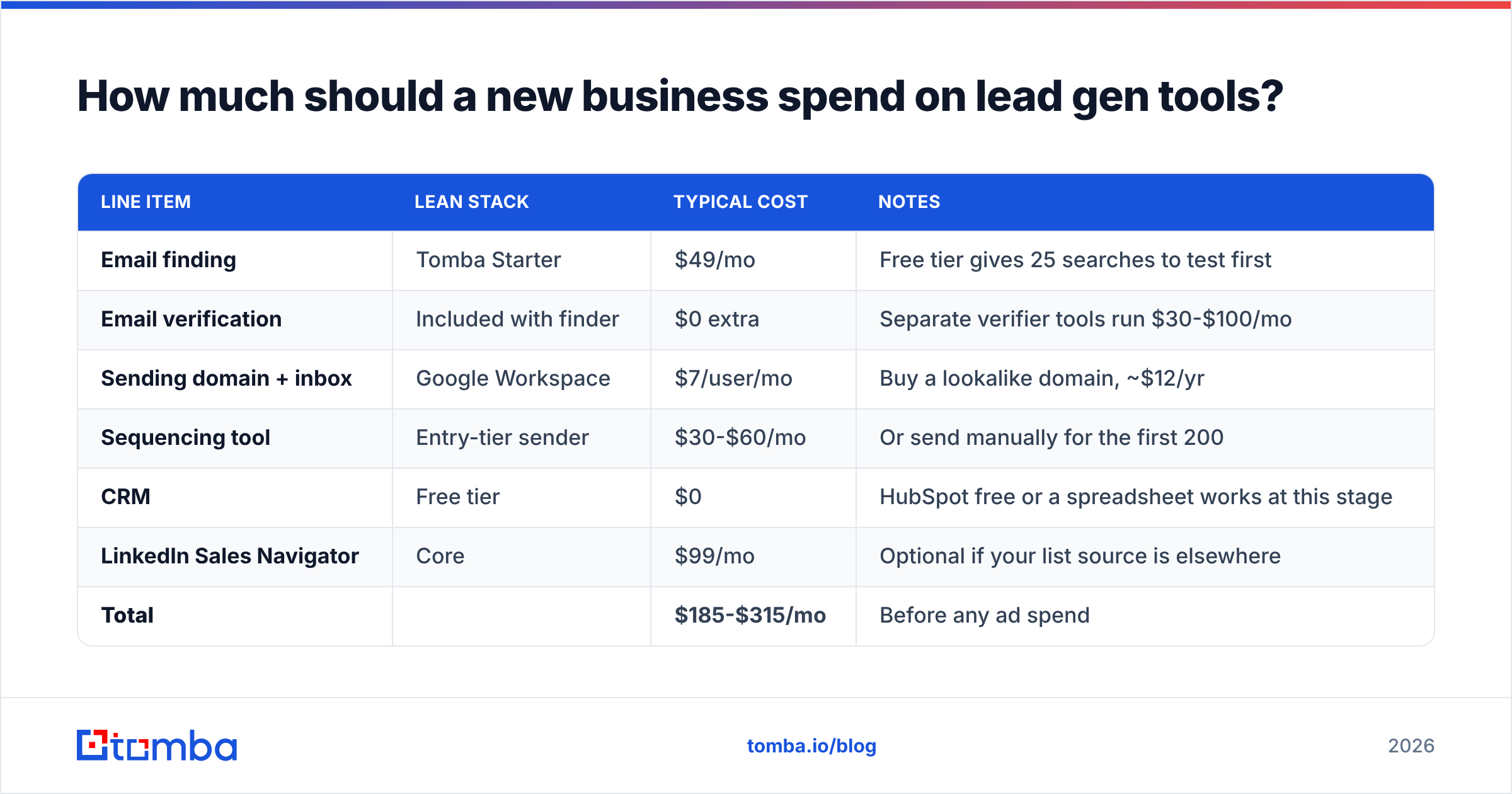
How much should a new business spend on lead gen tools?#
Less than you think, and specifically less than one all-in-one platform will quote you.
| Line item | Lean stack | Typical cost | Notes |
|---|---|---|---|
| Email finding | Tomba Starter | $49/mo | Free tier gives 25 searches to test first |
| Email verification | Included with finder | $0 extra | Separate verifier tools run $30-$100/mo |
| Sending domain + inbox | Google Workspace | $7/user/mo | Buy a lookalike domain, ~$12/yr |
| Sequencing tool | Entry-tier sender | $30-$60/mo | Or send manually for the first 200 |
| CRM | Free tier | $0 | HubSpot free or a spreadsheet works at this stage |
| LinkedIn Sales Navigator | Core | $99/mo | Optional if your list source is elsewhere |
| Total | $185-$315/mo | Before any ad spend |
Compare that to an all-in-one data platform at $500-$1,500/month with an annual commitment — a contract you sign before you know whether your ICP is right. Tomba pricing starts with a free tier at 25 searches/month, then $49/mo Starter, $99/mo Growth, and $249/mo Pro, which lets you validate the motion before committing budget. Bookmark the all-in-one platforms for month six.
One genuinely useful alternative for founders who want a pre-built list rather than building one: purpose-built B2B list vendors like BookYourData sell verified contacts by filter, which can be a reasonable shortcut when your ICP is broad and well-defined. Just apply your own verification pass on top of anything you buy — that rule holds for every vendor, including the good ones.
What actually goes in the email?#
Short answer: one specific observation, one specific problem, one low-friction ask. Under 120 words.
The structure that consistently works for unknown senders:
- Line 1 — the trigger. Why them, why now. "Saw you posted for two SDRs last month" beats "I hope this finds you well."
- Line 2 — the problem, in their words. Not your feature. The thing the trigger implies they are dealing with.
- Line 3 — one line of proof. A comparable customer, a number, a result. If you have no customers yet, use a specific mechanism instead: "we cut list-building time from 6 hours to 40 minutes by pulling contacts straight from domain patterns."
- Line 4 — the ask. Ask for a reply, not a meeting. "Worth a look?" converts better than a calendar link in a first touch.
Follow-ups matter more than the first email. Roughly half of positive replies to cold sequences land on touch two through four. Space them 3, 5, and 7 days out, and make each one add something — a case detail, a relevant article, a different angle on the problem — rather than "just bumping this."
Run drafts through a spam checker before the sequence goes live. Link-heavy, image-heavy, or attachment-bearing first touches from a fresh domain are the fastest route to the promotions tab. HubSpot's research on cold outreach points the same direction: plain-text, short, single-CTA emails outperform designed templates in first-touch B2B.
When should a new business add inbound and content?#
Start inbound in month one, expect returns in month six. The mistake is treating it as an either/or against outbound.
The practical sequencing:
- Months 1-3: Outbound is 80% of effort. Alongside it, publish one thing a week — a LinkedIn post, a teardown, a small tool. You are building the thing prospects find when they Google you after your email lands. That search happens on nearly every positive reply.
- Months 3-6: Turn your outbound learnings into content. The objections you hear on calls are your article topics, and they already have proven demand because real buyers raised them.
- Months 6-12: SEO and partnerships start producing. Outbound drops to 50% of effort and becomes more targeted because you now know which segments actually close.
Content has a second function people miss: it makes outbound work better. A prospect who gets your email, clicks your name, and finds three sharp articles on exactly their problem replies at a meaningfully higher rate than one who finds a one-page site. You can even find the writers and editors already covering your space with an author finder and pitch guest contributions — borrowed audience, zero ad spend.
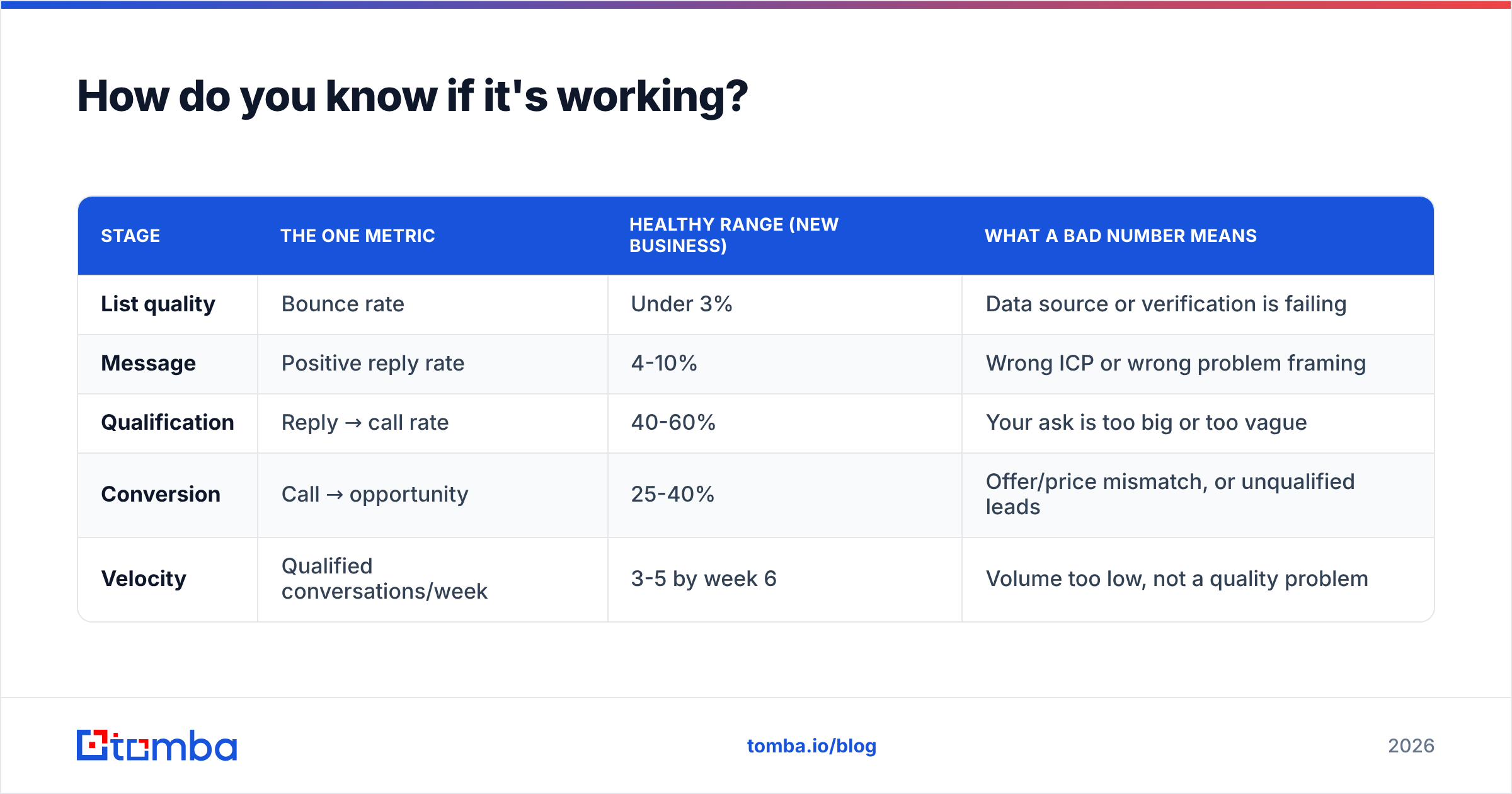
How do you know if it's working?#
Pick one number per stage and ignore the rest until it moves.
| Stage | The one metric | Healthy range (new business) | What a bad number means |
|---|---|---|---|
| List quality | Bounce rate | Under 3% | Data source or verification is failing |
| Message | Positive reply rate | 4-10% | Wrong ICP or wrong problem framing |
| Qualification | Reply → call rate | 40-60% | Your ask is too big or too vague |
| Conversion | Call → opportunity | 25-40% | Offer/price mismatch, or unqualified leads |
| Velocity | Qualified conversations/week | 3-5 by week 6 | Volume too low, not a quality problem |
Two diagnostic rules. If your bounce rate is fine but replies are near zero, the problem is targeting, not copy — rewriting subject lines will not save a wrong list. If replies are decent but calls do not convert, the problem is upstream qualification: you are talking to interested people who cannot buy.
Review weekly, change one variable at a time, and give each change at least 100 sends before judging it. Founders who change subject line, ICP, and CTA in the same week learn nothing.
Common mistakes that cost new businesses their first quarter#
- Sending from the primary domain. One bad campaign and your invoices stop reaching customers. Always use a separate outbound domain.
- Buying an unverified list. Cheap lists are cheap because they are stale. If you buy, verify everything before the first send — non-negotiable.
- Automating before validating. Do the first 100 emails manually. You will discover your ICP is wrong far faster by hand than through a sequencer.
- Optimizing open rates. They are unreliable post-MPP. Reply rate is the only honest early signal.
- Quitting a channel at week three. Cold email needs 6-8 weeks of consistent volume before the numbers stabilize. Most founders quit at week three and start over somewhere else.
- Ignoring the people who reply "not now." A "not now" from a qualified account is your best lead six months out. Tag them and set a reminder.
Start with a list you can trust#
Everything above collapses if the contact data is wrong. A precise ICP, a sharp email, and a warmed domain are worthless when a third of your sends bounce off a new domain with zero reputation.
That is the piece to get right first. Use the Tomba Email Finder to build your first 200-contact list from the accounts you have already researched — verification is built in, the free tier gives you 25 searches to test the data quality before you pay anything, and Starter runs $49/mo when you are ready to scale to real volume. Build the list, verify it, warm your domain, and send. The first hundred leads are closer than they look.
Related guides#
Ready to find emails that actually work?
Join 150,000+ professionals who stopped guessing and started sending. Free credits on signup — no credit card required.
Get the Tomba newsletter
Practical outbound tactics and product updates — once every two weeks.
About the author