How To Generate Leads In Sales: A 2026 Playbook That Works
Most lead gen advice is a channel list with no math behind it. Here is the actual playbook: pick a channel by CAC, build a clean list, run the reply-rate arithmetic backwards from your quota, and stop paying for leads you can source free.
TL;DR
- Lead generation is arithmetic before it is creativity. Decide how many meetings you need, divide by your reply and show rates, and the channel choice mostly picks itself.
- Outbound email is still the cheapest controllable channel for B2B — roughly $20–$80 per booked meeting when your list is clean, versus $150–$400+ for paid search in most software categories.
- Your bounce rate, not your copy, is the first thing that kills a cold email program. Verify before you send, every time.
- Inbound compounds but takes 6–12 months. Outbound produces this quarter. Most teams under $5M ARR need outbound first and inbound second.
- Free and near-free tactics — LinkedIn engagement, referral asks, job-post triggers, review-site intent — will carry a solo seller further than a $2K/month tool stack.
What does "generating leads in sales" actually mean in 2026?#
A lead is a person who could plausibly buy from you and whose contact details you can act on. That is the whole definition. Everything else — MQL, SQL, PQL, "hand-raiser" — is internal routing language, not a different species of human.
The reason this matters is that most teams inflate their lead count by counting things that will never convert: newsletter signups, webinar no-shows, scraped rows with no verified email. You end up with a dashboard that says 1,200 leads and a pipeline that says four opportunities.
A useful working definition has three parts:
- Fit — the account matches your ideal customer profile on size, industry, geography, and tech stack.
- Reachability — you have a deliverable email or a valid phone number, not a guess.
- Trigger — something happened recently that makes now a better time than six months ago (funding, hiring, a new tool, a leadership change).
Miss any one of those and you have a row in a spreadsheet, not a lead. Fit without reachability is a research project. Reachability without fit is spam. Both without a trigger is why your reply rate is 0.8%.
If you want the formal ladder of definitions your CRM expects, the marketing qualified lead entry lays out how leads get graded before they reach a rep.
Which lead generation channels actually produce pipeline?#
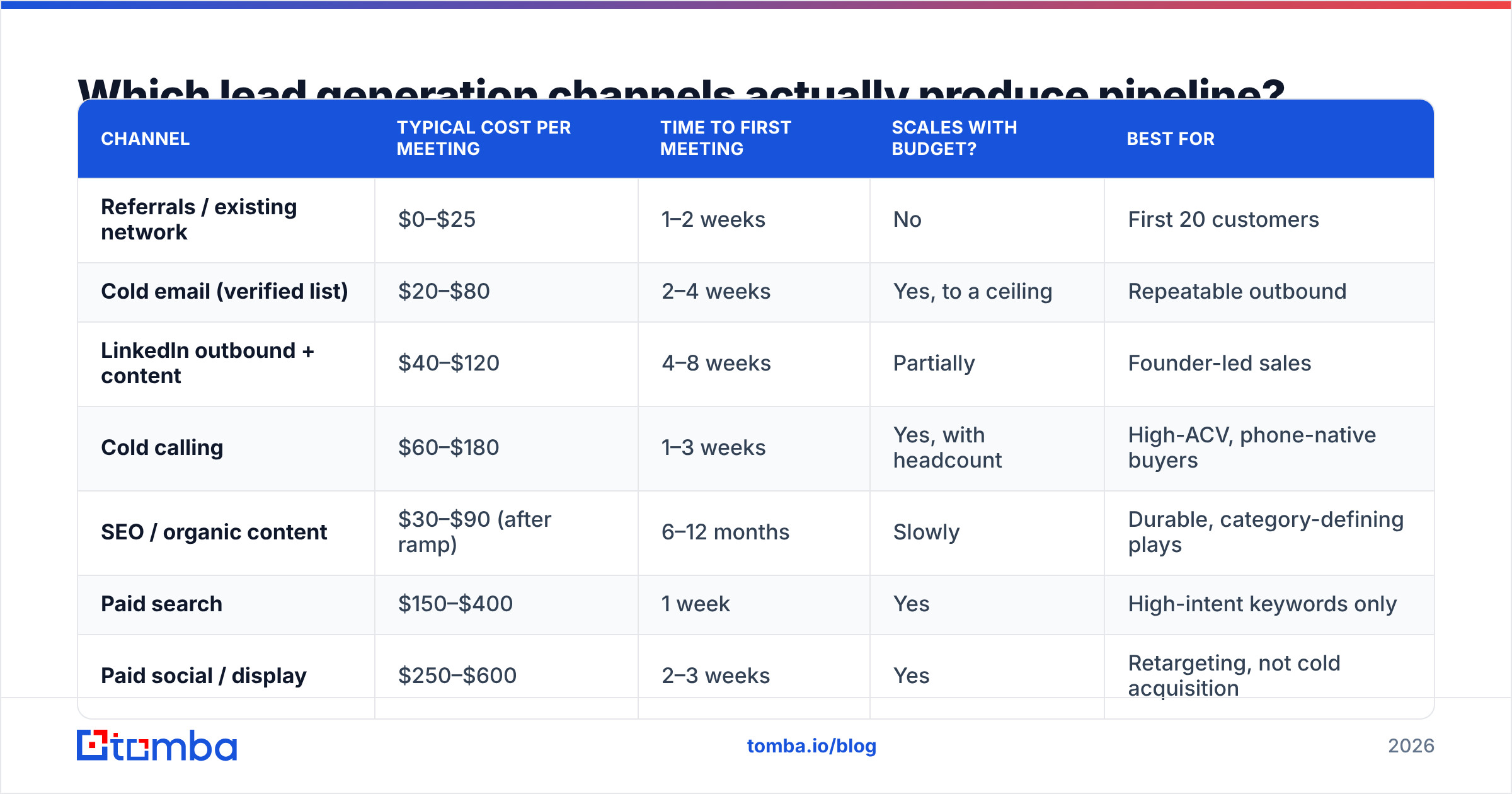
Here is the honest ranking by cost per booked meeting for a typical B2B software or services company selling a $5K–$50K annual contract. Numbers are ranges observed across mid-market teams — your category shifts them, but the ordering rarely changes.
| Channel | Typical cost per meeting | Time to first meeting | Scales with budget? | Best for |
|---|---|---|---|---|
| Referrals / existing network | $0–$25 | 1–2 weeks | No | First 20 customers |
| Cold email (verified list) | $20–$80 | 2–4 weeks | Yes, to a ceiling | Repeatable outbound |
| LinkedIn outbound + content | $40–$120 | 4–8 weeks | Partially | Founder-led sales |
| Cold calling | $60–$180 | 1–3 weeks | Yes, with headcount | High-ACV, phone-native buyers |
| SEO / organic content | $30–$90 (after ramp) | 6–12 months | Slowly | Durable, category-defining plays |
| Paid search | $150–$400 | 1 week | Yes | High-intent keywords only |
| Paid social / display | $250–$600 | 2–3 weeks | Yes | Retargeting, not cold acquisition |
| Events / conferences | $200–$800 | Immediate, then dead | No | Enterprise relationship building |
Two things jump out. First, the cheapest channels are the least scalable — you cannot 10x referrals by spending more. Second, the most scalable channels are the most expensive per unit. The practical answer for almost every team is a barbell: exhaust the free channels completely, then build one repeatable paid or outbound motion on top.
G2's category data is a decent sanity check on where buyers in your space actually start their research, and HubSpot's annual sales research publishes channel benchmarks worth comparing against your own numbers rather than trusting blindly.

How do you build a lead list that will not bounce?#
This is where most programs die quietly. You send 2,000 emails, 340 bounce, your domain reputation tanks, and the next 2,000 land in spam regardless of how good the copy is. Recovery takes weeks.
Build the list in this order:
- Define the account list first, not the people. Pull 200–500 companies that match your ICP by firmographics and a trigger. Company selection is where win rate is decided; contact selection only decides reply rate.
- Find the right role, not the most senior title. The VP is flattering to email. The manager who owns the problem actually replies and forwards internally. Target the person whose weekly job gets easier.
- Source the email from a pattern-plus-verification system. A domain search returns the company's active email format and known addresses in one call, which is far more reliable than permutating first.last@ and hoping.
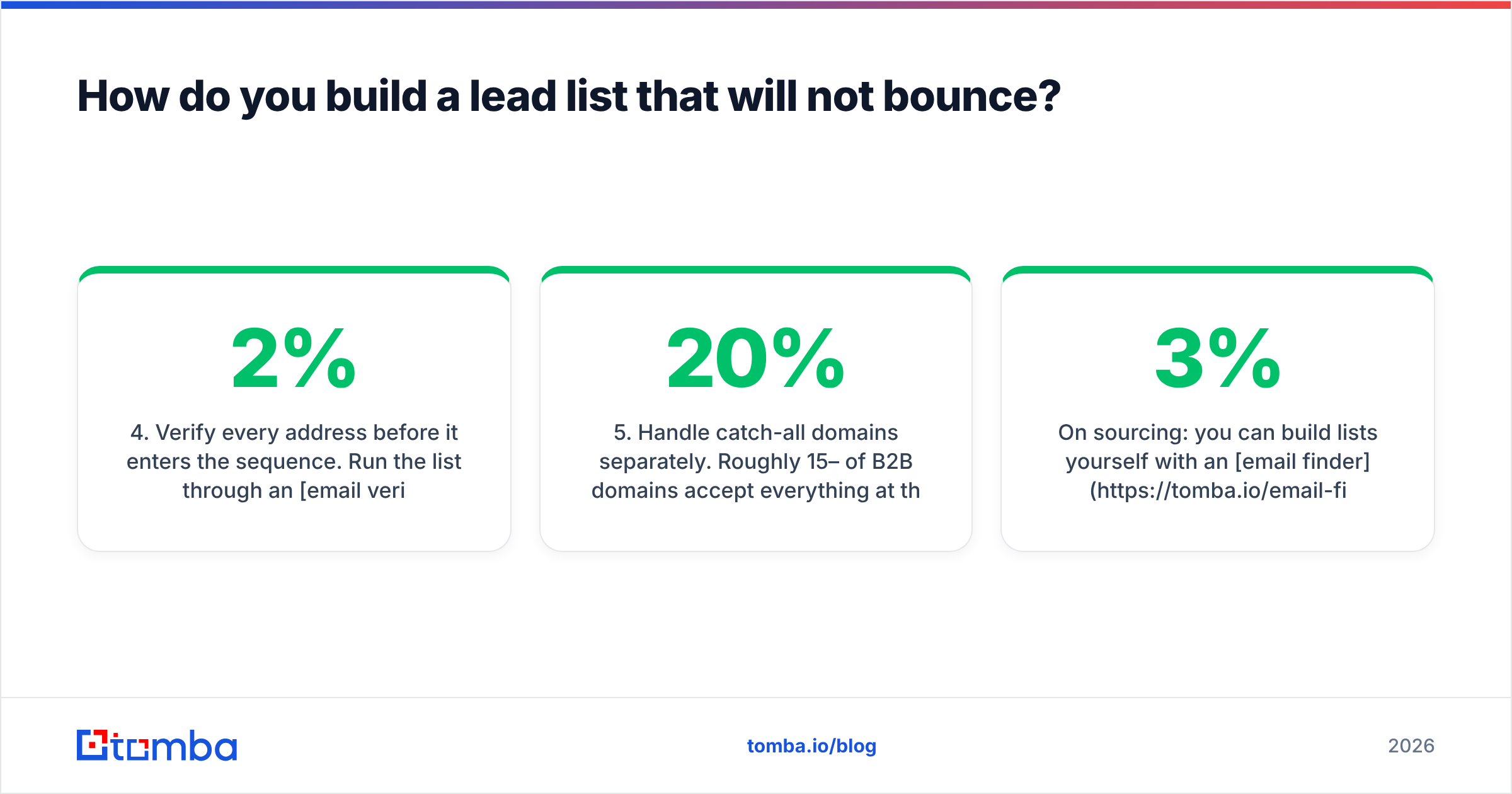
- Verify every address before it enters the sequence. Run the list through an email verifier and drop anything that is not deliverable. Aim for under 2% bounce; under 1% if you are on a new domain.
- Handle catch-all domains separately. Roughly 15–20% of B2B domains accept everything at the server level, so a standard SMTP check tells you nothing. A catch-all verifier scores these on secondary signals instead of guessing.
- Deduplicate against your CRM before sending. Nothing burns credibility like cold-emailing an account your colleague is mid-negotiation with. This is a five-minute check that saves quarterly embarrassment.
On sourcing: you can build lists yourself with an email finder, buy them from a compliance-focused provider like BookYourData when you need volume in a category you do not know well, or blend both. Bought data is legitimate when the vendor documents its sourcing and offers a bounce guarantee. It becomes a problem when nobody re-verifies it — B2B contact data decays at roughly 2–3% per month, so a list built in January is meaningfully wrong by June.
What is the outbound math behind a lead target?#
Work backwards from revenue. Say you need $500K in new bookings this year at a $25K average contract value. That is 20 closed deals.
- Close rate from qualified opportunity: 25% → you need 80 opportunities.
- Opportunity rate from held meeting: 50% → you need 160 held meetings.
- Show rate: 70% → you need ~230 booked meetings.
- Booked-meeting rate from positive reply: 40% → you need ~575 positive replies.
- Positive reply rate from delivered email: 3% → you need ~19,000 delivered emails.
- Deliverability: 95% → you need ~20,000 sent emails, across roughly 6,500 contacts at a 3-touch sequence.
Twenty thousand emails a year is about 80 per working day. That is one sender mailbox running conservatively, or two running very safely. Suddenly the plan is concrete instead of aspirational.
Now notice which lever moves the most. Doubling your reply rate from 3% to 6% halves the required volume. Doubling volume requires new domains, new mailboxes, more warmup, and more risk. Improving response rate through better targeting is almost always cheaper than improving volume — which is why the ICP work in the previous section pays for itself.
Also run the same math on your phone channel if you have one. Connect rates on mobile-verified direct dials sit far above office lines, so sourcing numbers with a phone finder changes the arithmetic materially for teams selling to operations, finance, or field roles.
How do you generate leads with no budget?#
Every one of these costs time, not money, and works for a solo founder or a rep with a locked-down tool budget.
Mine your own inbox and calendar. Export every person you have emailed or met in the past three years. Filter to ICP fit. This list has an implicit warm intro built into it and converts at several times cold rates.
Ask for referrals with a name, not a category. "Do you know anyone who might need this?" gets nothing. "You mentioned Priya at Northwind runs the same process — would an intro make sense?" gets a yes or a clean no.
Use hiring signals. A company posting for a "Revenue Operations Manager" is telling you it has a RevOps problem and budget attached to it. Job boards are a free, public intent feed that almost nobody systematically works.
Comment before you connect on LinkedIn. Ten substantive comments on prospects' posts per day, for two weeks, before any outreach. Acceptance and reply rates roughly double when your name is already familiar. The LinkedIn outreach sequence works far better as a second touch than a first.
Write to the people who publish about your problem. Analysts, journalists, and practitioner bloggers in your space have audiences full of buyers. An author finder pulls the contact from a byline in seconds, and a genuinely useful data point earns you a mention that outperforms most paid placement.
Reactivate closed-lost. Deals lost more than nine months ago have new budgets, new champions, and often a competitor they now regret. The reason for the loss usually expired.
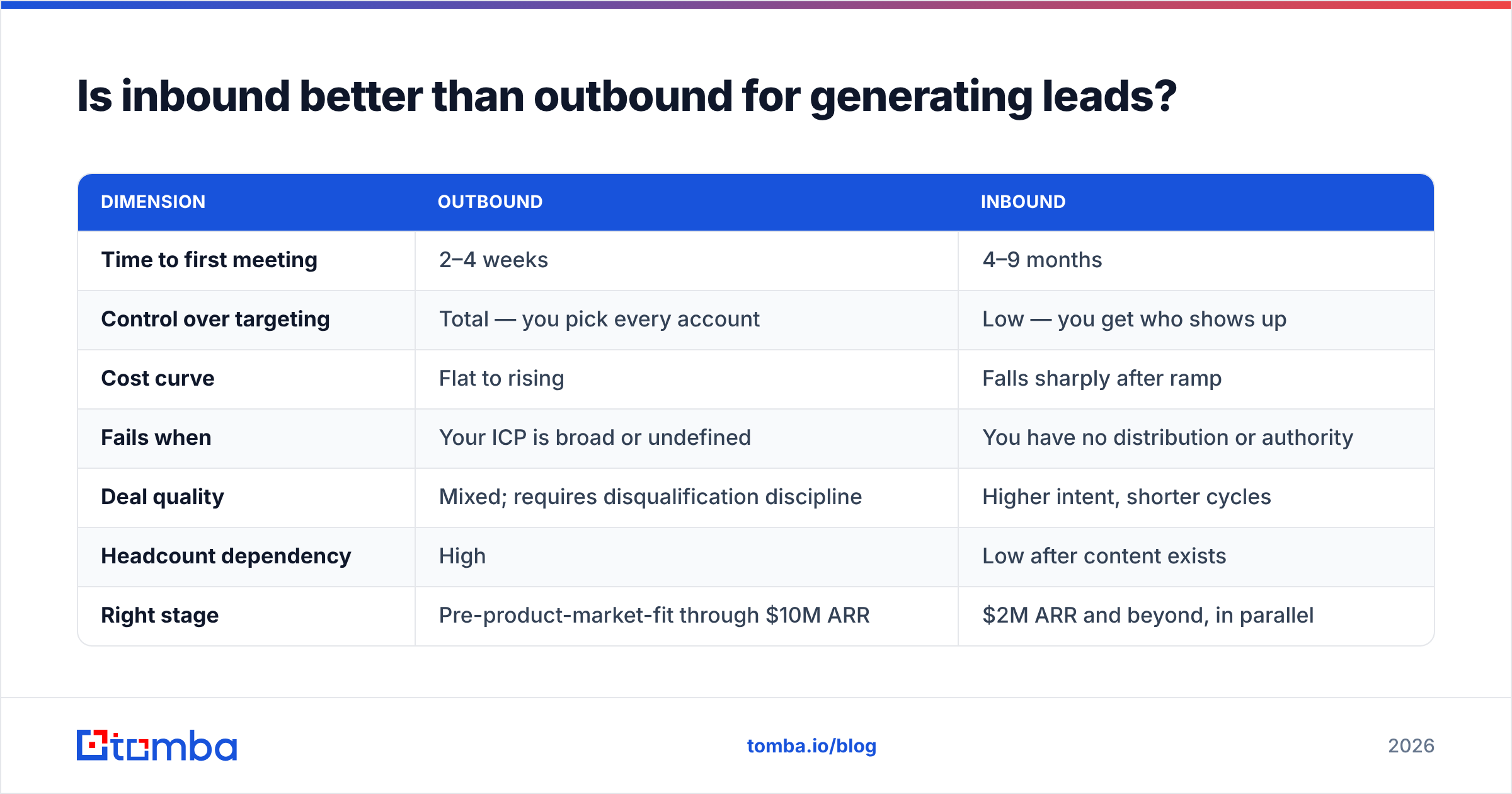
Is inbound better than outbound for generating leads?#
Neither wins in the abstract; they win at different company stages. The mistake is running both badly at once.
| Dimension | Outbound | Inbound |
|---|---|---|
| Time to first meeting | 2–4 weeks | 4–9 months |
| Control over targeting | Total — you pick every account | Low — you get who shows up |
| Cost curve | Flat to rising | Falls sharply after ramp |
| Fails when | Your ICP is broad or undefined | You have no distribution or authority |
| Deal quality | Mixed; requires disqualification discipline | Higher intent, shorter cycles |
| Headcount dependency | High | Low after content exists |
| Right stage | Pre-product-market-fit through $10M ARR | $2M ARR and beyond, in parallel |
The practical sequence for most teams: run outbound to learn who actually buys and what language they use, then convert those learnings into inbound content once the patterns are stable. Writing SEO content before you have talked to 100 prospects means guessing at the questions.
Gartner's research on B2B buying behavior is consistent on one point — buyers spend the large majority of the cycle without a vendor in the room. That argues for both: outbound to get in the room, inbound to be present while they are researching alone.
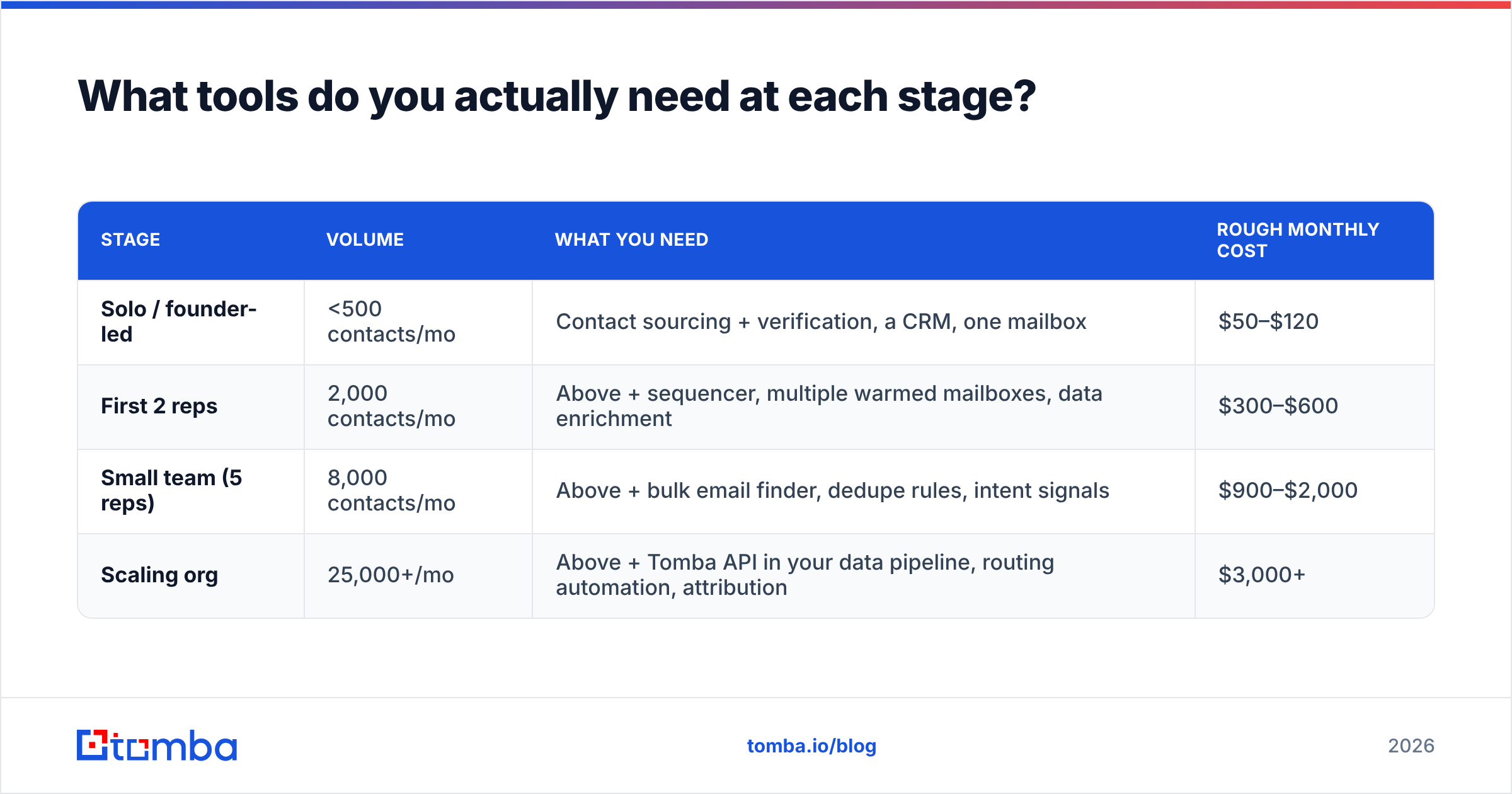
What tools do you actually need at each stage?#
Keep the stack proportional to the volume. A solo seller sending 40 emails a day does not need a $1,000/month platform.
| Stage | Volume | What you need | Rough monthly cost |
|---|---|---|---|
| Solo / founder-led | <500 contacts/mo | Contact sourcing + verification, a CRM, one mailbox | $50–$120 |
| First 2 reps | 2,000 contacts/mo | Above + sequencer, multiple warmed mailboxes, data enrichment | $300–$600 |
| Small team (5 reps) | 8,000 contacts/mo | Above + bulk email finder, dedupe rules, intent signals | $900–$2,000 |
| Scaling org | 25,000+/mo | Above + Tomba API in your data pipeline, routing automation, attribution | $3,000+ |
For reference on sourcing costs specifically, Tomba pricing starts free at 25 searches per month, with Starter at $49/mo, Growth at $99/mo, and Pro at $249/mo — which puts verified contact sourcing at a fraction of most sequencing platforms.
What kills lead generation programs most often?#
Skipping verification to save $50. A 12% bounce rate costs you the domain. Rebuilding sender reputation takes 4–8 weeks of near-zero output.
Chasing volume when reply rates are broken. If 1,000 emails produce four replies, 10,000 will produce forty and a spam complaint problem. Fix targeting and copy at small volume first.
No disqualification criteria. Reps who take every meeting run a full calendar and an empty pipeline. Write down what makes a lead not worth pursuing and enforce it.
Treating the list as a one-time build. Data decays monthly. Re-verification should be a recurring job, not a project.
Measuring leads instead of meetings. Lead count is a vanity number that any intern can inflate. Held meetings and opportunities created are the only two metrics that predict revenue.
Where should you start this week?#
Pick one ICP segment. Build a list of 200 accounts with a real trigger. Source and verify contacts for two roles per account. Write three emails that reference the trigger specifically. Send 40 a day for two weeks and measure replies, not opens.
That is roughly 400 contacts and about ten hours of work. If it produces zero positive replies, your targeting is wrong and no amount of extra volume will rescue it. If it produces eight, you have a repeatable motion and the only remaining question is how fast to scale it.
To build that first list without burning a week on manual research, start with the Tomba Email Finder — search by domain, name, or company, get the verification status alongside every result, and export straight into your sequencer. The free tier covers 25 searches a month, which is enough to test the approach before you commit a budget to it.
Related guides#
// get started
Find, verify and enrich your first contacts today
Start on the free plan with 25 searches a month, then scale when your team is ready.
Free plan · No credit card required · GDPR & CCPA
// about the author