How to Generate Leads Without Social Media in 2026
Social platforms are getting expensive and unreliable. Here are seven channels that still produce qualified B2B pipeline without a single post, plus the data stack that makes them work.
TL;DR
- Social media is a distribution channel, not a lead source. You can replace it with direct outreach, search, partnerships, events, referrals, communities, and intent data.
- The single biggest unlock is contact data quality: a verified email list beats any amount of posting. Bad data kills the channel before the copy ever gets read.
- Cold email plus SEO plus partner referrals is the cheapest working stack for most B2B teams under $10M ARR. Expect 60-120 days to first predictable pipeline.
- Budget realistically: roughly $150-400/month for data and sending infrastructure versus $2,000+/month for a competent social program that takes twice as long to pay back.
- Track channel-level cost per qualified meeting, not vanity engagement. If a channel can't produce a booked call in 90 days, cut it.
Why would you skip social media for lead generation?#
Because for most B2B companies it's the slowest, least attributable channel you can pick.
Organic reach on LinkedIn and X depends on an algorithm you don't control and that changes without notice. Paid social costs have climbed steadily while B2B click quality has not. And the payback loop is brutal: you post for six months, get some impressions, and still can't tell your CFO which deal came from which post.
There are also structural reasons to skip it. Regulated industries (healthcare, defense, finance) often restrict what employees can publish. Founder-led companies frequently have no one who wants to be the "face." Some ICPs — plant managers, municipal procurement officers, lab directors, franchise owners — simply aren't on professional social in any meaningful way. If your buyer isn't in the feed, the feed is a hobby.
None of that means you should stop marketing. It means you should route budget toward channels where the buyer's contact details are knowable and reachable directly.
Wait — that image needs a proper reference:

What are the seven channels that replace social media?#
Here's the working set, ranked by how fast they typically produce a booked meeting for a B2B team starting from zero.
- Cold email outreach — Fastest to first meeting (2-4 weeks if your domain is warm). Requires a verified contact list and disciplined sending volume. Cost scales with data, not headcount.
- Organic search and programmatic SEO — Slowest to start (4-8 months), highest compounding return. Comparison pages, alternative pages, and calculator tools pull buyers who are already shopping.
- Partner and referral loops — Highest close rate of anything on this list. A warm intro from an adjacent vendor converts 3-5x better than cold. Requires relationship work, not ad spend.
- Niche communities and forums — Slack groups, Discord servers, industry association boards, and subreddits. Not "social media" in the algorithmic sense; these are opt-in rooms where your buyer is asking questions publicly.
- Events, webinars, and trade shows — Expensive per lead but produces the highest-quality list you'll ever own. Attendee lists are frequently published in advance, which pairs perfectly with an email finder.
- Website visitor identification — Reveal the companies already hitting your pricing page, then reach the right person there. Converts existing anonymous traffic into named accounts.
- Outbound calling — Underrated in 2026 precisely because everyone abandoned it. Connect rates on direct dials are recovering as inbox competition intensifies.
Most teams pick three and run them properly rather than dabbling in all seven. Cold email plus SEO plus one relationship channel (partners or communities) is the standard configuration that works.
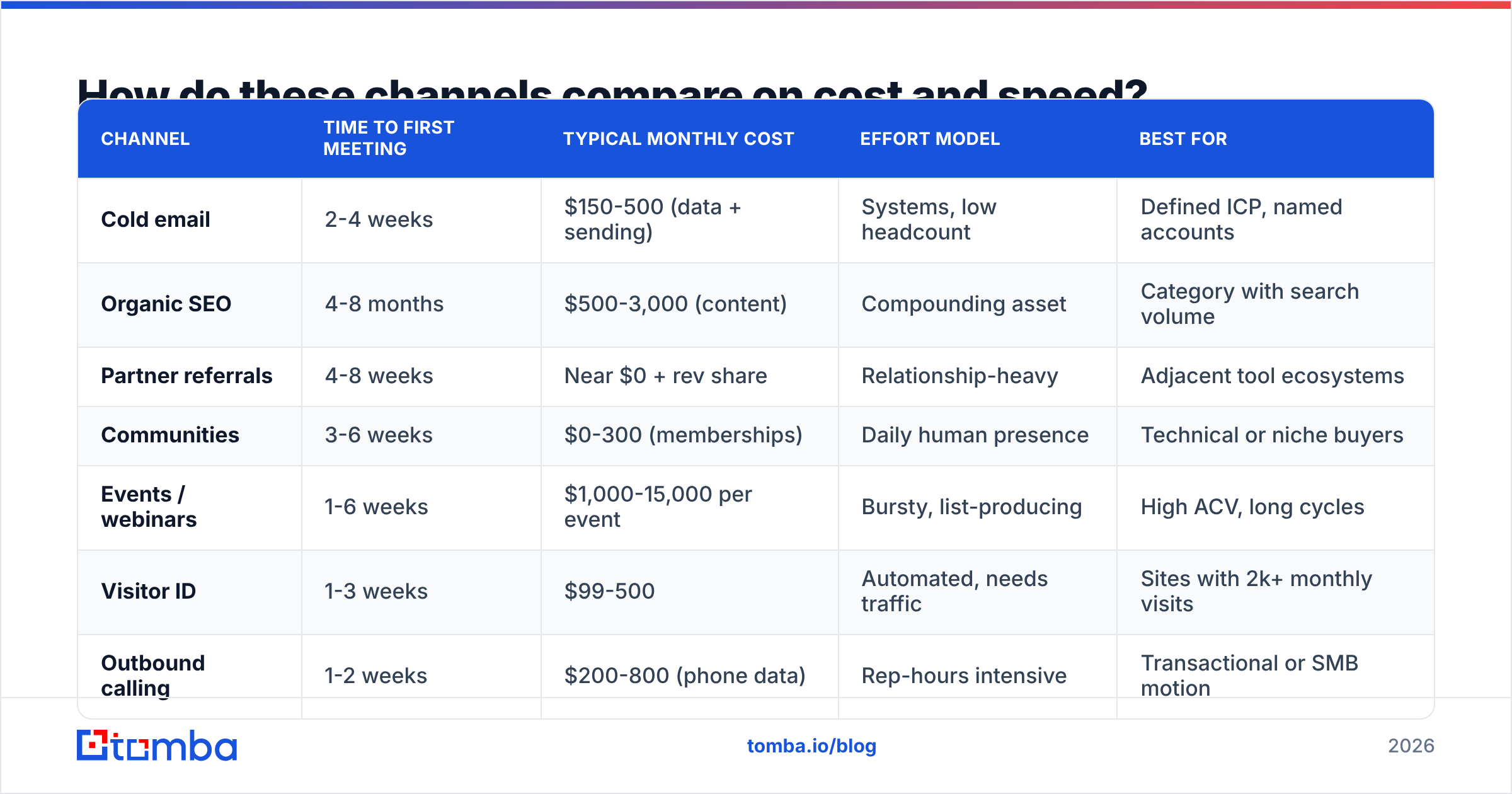
How do these channels compare on cost and speed?#
The honest comparison. Numbers reflect what a 5-25 person B2B company typically experiences, not enterprise budgets.
| Channel | Time to first meeting | Typical monthly cost | Effort model | Best for |
|---|---|---|---|---|
| Cold email | 2-4 weeks | $150-500 (data + sending) | Systems, low headcount | Defined ICP, named accounts |
| Organic SEO | 4-8 months | $500-3,000 (content) | Compounding asset | Category with search volume |
| Partner referrals | 4-8 weeks | Near $0 + rev share | Relationship-heavy | Adjacent tool ecosystems |
| Communities | 3-6 weeks | $0-300 (memberships) | Daily human presence | Technical or niche buyers |
| Events / webinars | 1-6 weeks | $1,000-15,000 per event | Bursty, list-producing | High ACV, long cycles |
| Visitor ID | 1-3 weeks | $99-500 | Automated, needs traffic | Sites with 2k+ monthly visits |
| Outbound calling | 1-2 weeks | $200-800 (phone data) | Rep-hours intensive | Transactional or SMB motion |
| Paid social (baseline) | 2-6 weeks | $2,000+ ad spend | Always-on spend | Broad, self-serve products |
Two things stand out. First, cold email and visitor ID are the only channels that produce meetings in under a month for under $500. Second, everything on this list except paid social keeps working when you stop paying — which is the entire argument for building pipeline this way.
How do you build a cold email pipeline without social media?#
You need three things in order: a target list, verified contact data, and sending infrastructure that doesn't get you filtered.
Step 1 — Define the account list, not the persona. Skip generic personas. Build a literal list of 200-500 companies that match your best current customers on firmographics: employee count, tech stack, funding stage, geography. Pull them from association directories, conference exhibitor lists, G2 category pages, job boards (companies hiring for a role you serve have budget), and industry awards lists. None of that requires a social platform.
Step 2 — Find the humans. Once you have domains, a domain search returns the email addresses associated with each company along with the pattern in use (first.last@, finitial-last@, and so on). For named individuals, an email finder resolves first name + last name + domain into a deliverable address. If your list came from articles or industry publications, an author finder pulls the writer's contact directly.
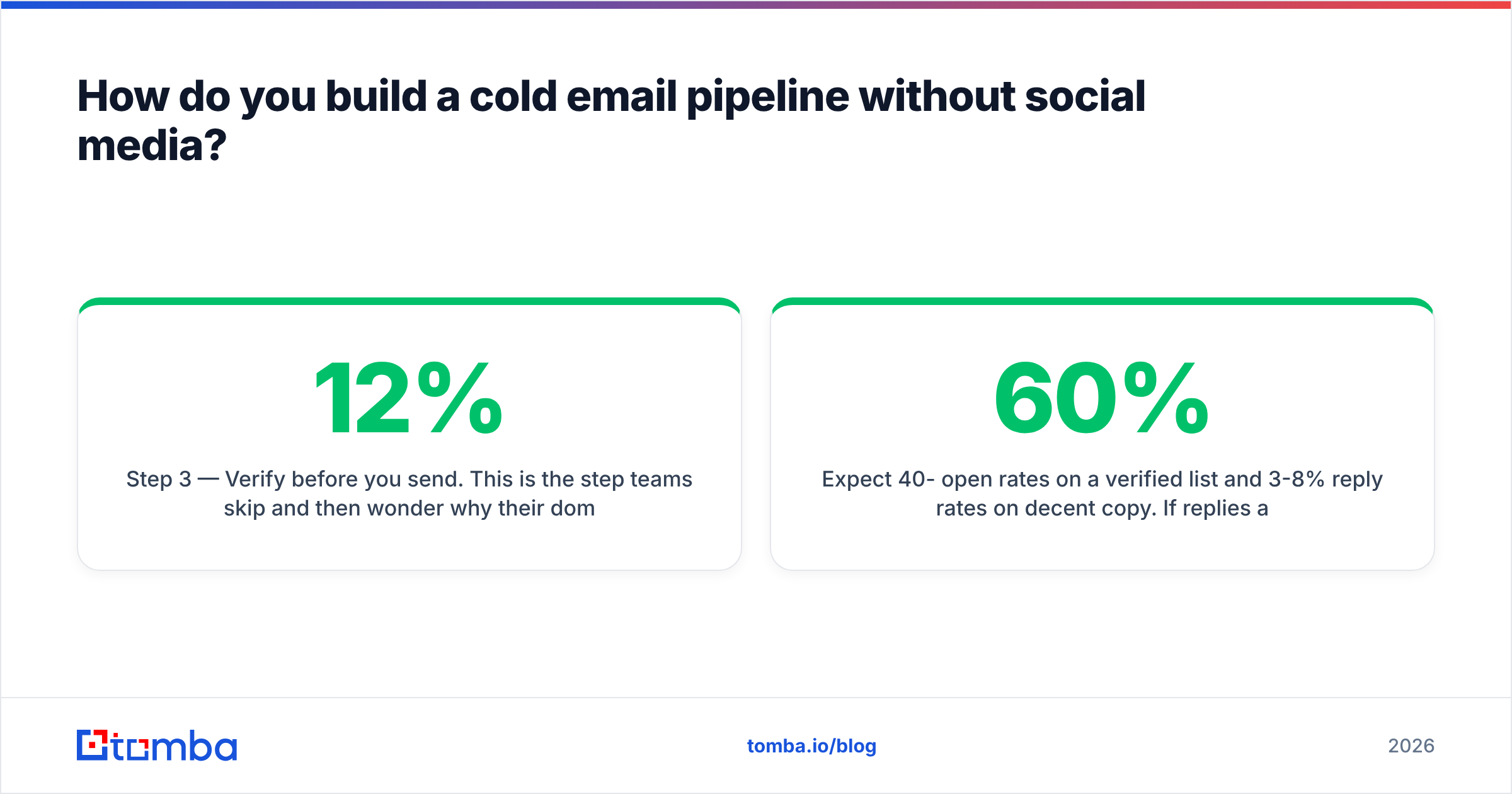
Step 3 — Verify before you send. This is the step teams skip and then wonder why their domain burned. Run every address through an email verifier and drop anything that isn't valid. A list with a 12% bounce rate will damage your sender reputation within two campaigns. Under 3% bounce is the working target; under 2% is safe.

Step 4 — Warm the sending domain. Use a secondary domain (not your primary), authenticate it properly with SPF, DKIM, and DMARC, and ramp volume over 3-4 weeks. Google's own Postmaster Tools documentation spells out the sender requirements — read it rather than guessing. Cap at roughly 30-50 sends per mailbox per day and add mailboxes to scale, never volume per mailbox.
Step 5 — Write for one person. Three to five sentences. One specific observation about their company, one sentence on the outcome you produce for companies like theirs, one low-friction ask. No "I hope this finds you well." No feature lists.
Expect 40-60% open rates on a verified list and 3-8% reply rates on decent copy. If replies are below 2% with good deliverability, the problem is your list quality or your offer, not your subject line.
Where does search fit if you're not promoting content socially?#
Search is the channel where the absence of social hurts least, because search demand exists independently of distribution.
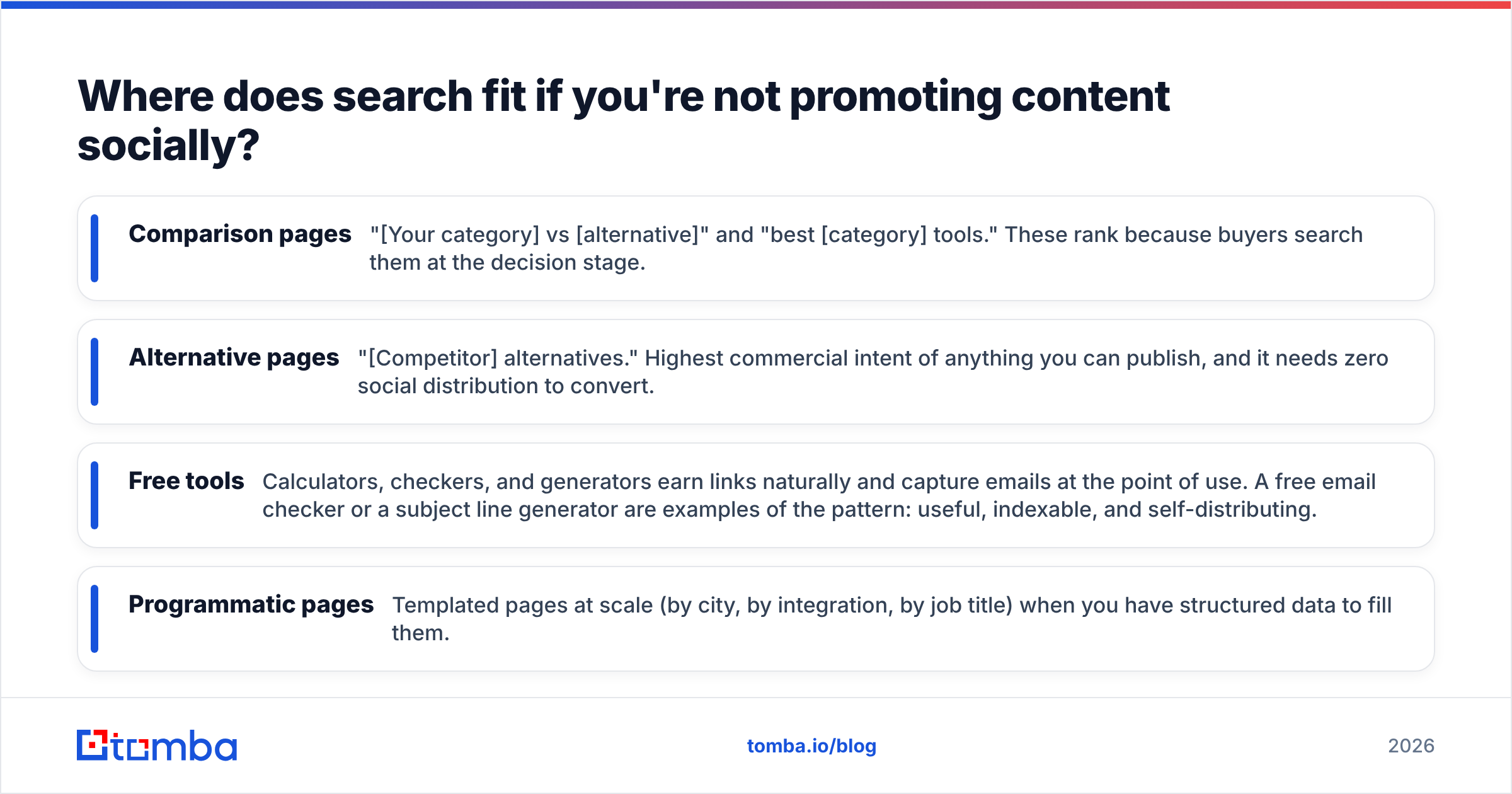
The mistake is writing "thought leadership" that needs social amplification to get read. Instead, write pages that intercept people already searching with intent:
- Comparison pages — "[Your category] vs [alternative]" and "best [category] tools." These rank because buyers search them at the decision stage.
- Alternative pages — "[Competitor] alternatives." Highest commercial intent of anything you can publish, and it needs zero social distribution to convert.
- Free tools — Calculators, checkers, and generators earn links naturally and capture emails at the point of use. A free email checker or a subject line generator are examples of the pattern: useful, indexable, and self-distributing.
- Programmatic pages — Templated pages at scale (by city, by integration, by job title) when you have structured data to fill them.
Link-building without social means earning links from real sources: digital PR, original data studies, partner directory listings, and guest posts in industry publications. Research from Backlinko's ranking factors analysis consistently shows referring domains among the strongest correlates with position — and none of that requires a feed.
The catch is honest: SEO takes months. Start it on day one, but don't budget on it for quarter one.
How do you turn partnerships and communities into pipeline?#
Partnerships work because you're borrowing trust that already exists.
Identify 10-20 companies serving your exact buyer with a non-competing product. A payroll tool and an HR consultancy. A warehouse robotics vendor and a WMS integrator. Approach them with a specific offer — co-hosted webinar, mutual referral fee, bundled onboarding — not a vague "let's explore synergies."
The mechanics that actually generate revenue: a shared Slack channel for warm handoffs, a documented referral fee (10-20% of first-year contract is standard), and a quarterly review of who sent what. HubSpot's partner program structure is a public template worth studying regardless of your size.
Communities are a different discipline. The rule is one contribution for every zero pitches. Answer questions in your area of expertise for 60 days before you mention what you sell. Then, when someone asks a question your product answers, you've earned the right to say so. Track which communities produce inbound DMs — usually two of the eight you join produce everything.
For events, the leverage move is the pre-event list. Exhibitor and speaker lists are published weeks in advance. Pull the companies, run them through a bulk email finder, verify, and book meetings before the event starts. Teams that do this get 15-30 meetings from a conference where competitors get four from booth traffic.
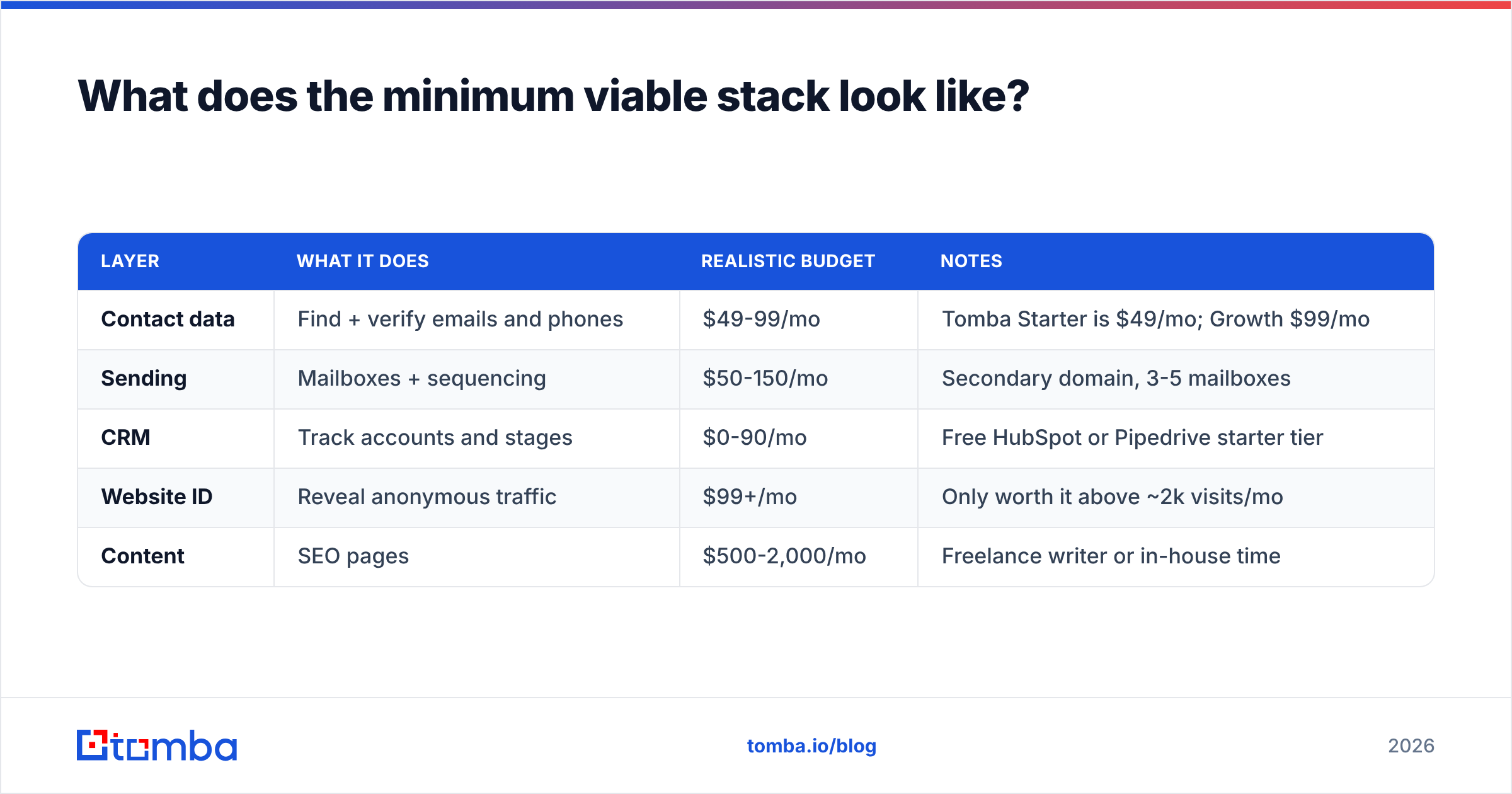
What does the minimum viable stack look like?#
You need less software than vendors want you to believe.
| Layer | What it does | Realistic budget | Notes |
|---|---|---|---|
| Contact data | Find + verify emails and phones | $49-99/mo | Tomba Starter is $49/mo; Growth $99/mo |
| Sending | Mailboxes + sequencing | $50-150/mo | Secondary domain, 3-5 mailboxes |
| CRM | Track accounts and stages | $0-90/mo | Free HubSpot or Pipedrive starter tier |
| Website ID | Reveal anonymous traffic | $99+/mo | Only worth it above ~2k visits/mo |
| Content | SEO pages | $500-2,000/mo | Freelance writer or in-house time |
Tomba's pricing starts free at 25 searches per month, which is enough to validate whether your ICP's emails are findable before you commit. Starter at $49/mo covers a typical 1-2 person outbound motion; Growth at $99/mo suits a small team running several hundred prospects weekly.
Peers worth evaluating honestly: BookYourData sells pay-as-you-go verified B2B lists, which suits teams that want a one-time list purchase rather than a search subscription. Apollo bundles data and sequencing in one product at a higher price point. Check current standing on G2's lead intelligence category before you sign anything annual — this market moves fast.
Whatever you choose, connect it to your CRM rather than living in CSVs. Tomba's integrations cover HubSpot, Salesforce, Pipedrive, Sheets, and Zapier, and the Tomba API handles it if you'd rather build the flow yourself.
How do you measure it without social metrics?#
Drop impressions, followers, and engagement rate. They were never the point.
Measure four numbers per channel:
- Cost per qualified meeting — Total channel spend divided by meetings with an ICP-fit account. This is your primary comparison metric across every channel above.
- Reply-to-meeting rate — For outbound. Below 20% means you're getting replies from the wrong people or your calendar ask is too heavy.
- Meeting-to-opportunity rate — Below 40% usually means your targeting is loose, not that your demo is bad.
- Channel payback period — Months until channel spend is recovered by closed revenue. Cold email should hit this in 2-3 months; SEO in 9-12.
Review monthly, cut quarterly. If a channel has had 90 days and hasn't produced a single opportunity, stop funding it and move the budget to whichever channel has the lowest cost per qualified meeting. That discipline is what makes a no-social strategy outperform — you're forced to be honest because there are no vanity numbers to hide behind.
What's the realistic 90-day plan?#
Days 1-30. Build the account list of 300 target companies. Set up a secondary sending domain with SPF, DKIM, and DMARC. Find and verify contacts for the first 150 accounts. Publish two comparison pages. Identify 15 potential partners and send 15 personal notes.
Days 31-60. Begin sending at 30 emails per mailbox per day. Join four communities and contribute without pitching. Publish two more SEO pages plus one free tool. Convert three partner conversations into a written referral agreement. First meetings should land here.
Days 61-90. Double outbound volume by adding mailboxes, not per-mailbox volume. Run one co-hosted webinar with a partner. Pull the exhibitor list for the next industry event and pre-book meetings. Review cost per qualified meeting per channel and reallocate.
By day 90 you should have a functioning pipeline, a repeatable list-building process, and clear evidence of which two channels deserve next quarter's budget. No posting required.
Where should you start today?#
Start with the list, because every channel here degrades to noise without accurate contact data. Cold email fails on bad addresses. Partner intros stall when you can't reach the right person. Event pre-booking is impossible without verified emails. The data layer is the dependency underneath all of it.
Build your first 100-contact target list this week with the Tomba Email Finder — the free tier gives you 25 searches to confirm your ICP is reachable before you spend a dollar, and every result comes with a confidence score plus the sources behind it. Verify what you find, send to 50 people, and you'll know more about your market in two weeks than six months of posting would have told you.
Related guides#
// get started
Find, verify and enrich your first contacts today
Start on the free plan with 25 searches a month, then scale when your team is ready.
Free plan · No credit card required · GDPR & CCPA
Get the Tomba newsletter
Product and data updates
// about the author