How to Generate Pipeline in 2026: A Repeatable 7-Step System
Pipeline generation is a math problem before it is a creativity problem. Here is the 7-step system: coverage math, list build, channel mix, and the quality checks that stop deals from stalling at stage two.
TL;DR
- Pipeline generation is arithmetic first: decide the coverage ratio you need (usually 3x-4x quota), work backwards to meetings, then to contacts touched.
- Your contact data quality caps everything downstream. A 40% bounce rate does not just waste sends — it damages the sending domain that every future campaign depends on.
- The fastest-compounding channel mix in 2026 is outbound email + LinkedIn + targeted calling on a narrow list, not broad blasts on a wide one.
- Track three quality metrics beside volume: stage-2 conversion, average days in stage 1, and percentage of pipeline sourced from your defined ICP.
- A 30-day sprint can realistically produce 15-25 qualified meetings for a two-rep team — but only if list building is finished before week one starts.
What does "generate pipeline" actually mean?#
Generating pipeline means creating a countable set of qualified opportunities that have a real chance of closing inside your sales cycle. Not leads. Not MQLs. Opportunities with a named buyer, a stated problem, and a next step on the calendar.
The distinction matters because most teams that say they have a pipeline problem actually have a definition problem. They count 400 "leads" and wonder why revenue is flat. Meanwhile the 12 accounts that had a scheduled second call get no dedicated attention.
Use one hard rule: an opportunity enters your pipeline only when a buyer has agreed to a next step with a date attached. Everything before that is prospecting activity. Everything after is forecast.
Once the definition is clean, the question "how to generate pipeline" stops being vague and becomes a set of four numbers you can solve for.
How much pipeline do you actually need?#
Start at the revenue target and divide backwards. This takes ten minutes and it eliminates most of the guesswork about how hard your team needs to work.
- Set the coverage ratio. If you close 25-30% of opportunities, you need roughly 3.5x your quarterly quota sitting in pipeline at quarter start. Weaker close rates need 4x-5x.
- Convert to opportunity count. $600K quarterly target ÷ $40K average deal = 15 closed deals. At 3.5x coverage that is ~53 open opportunities needed.
- Convert to meetings. If 45% of discovery calls become opportunities, you need ~118 discovery calls per quarter, or roughly 39 per month.
- Convert to contacts. At a 4% meeting-booked rate per contact touched across a full sequence, 39 meetings requires ~975 verified contacts entering sequences per month.
- Add a data buffer. Assume 10-15% of sourced contacts will fail verification or be role-mismatched. Source ~1,120 to net 975 usable ones.
That last line is where most plans quietly break. Teams build a 1,000-contact list, discover a third of it is stale, and end the month at 60% of the required volume without ever seeing the cause.
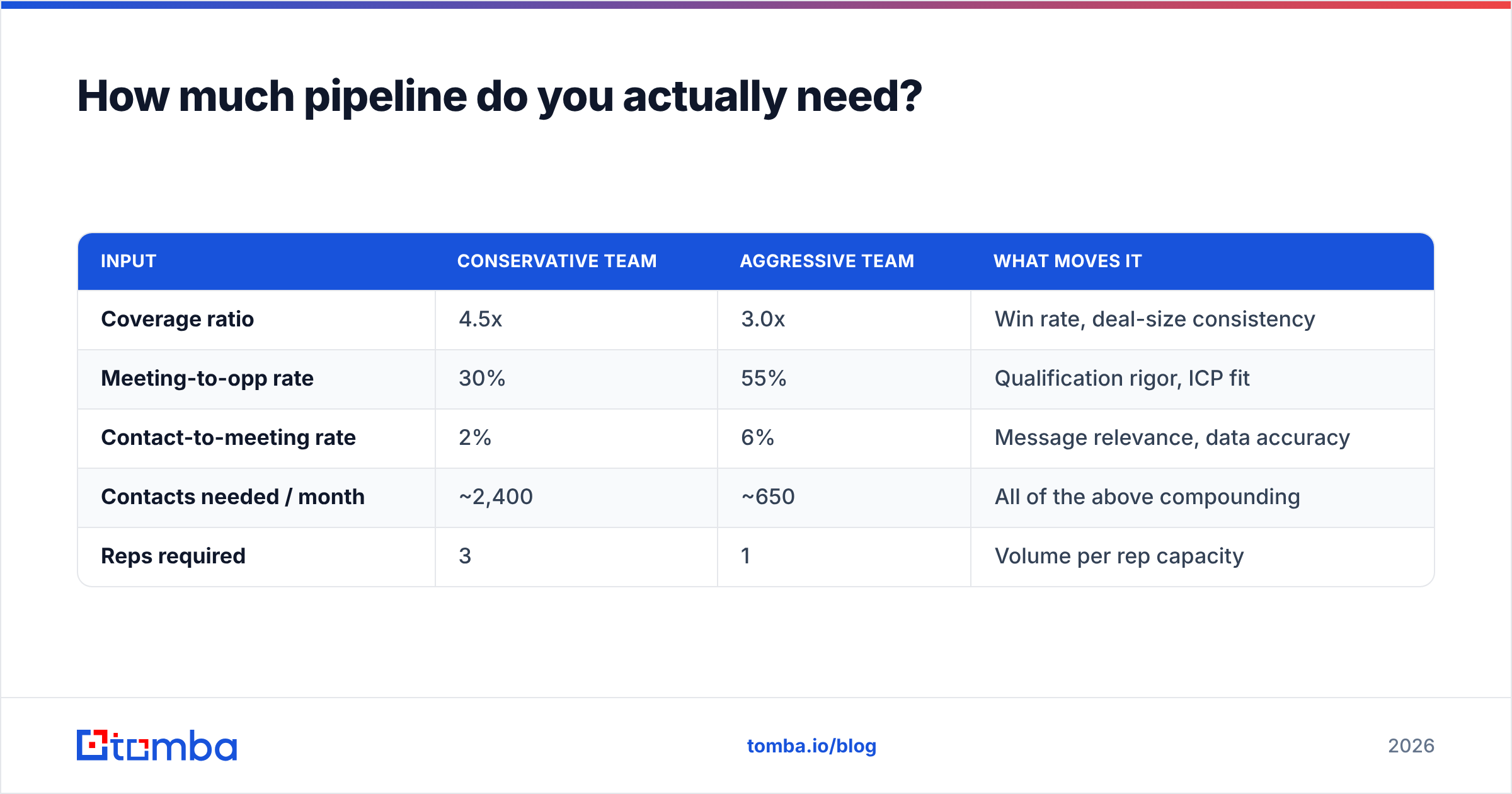
| Input | Conservative team | Aggressive team | What moves it |
|---|---|---|---|
| Coverage ratio | 4.5x | 3.0x | Win rate, deal-size consistency |
| Meeting-to-opp rate | 30% | 55% | Qualification rigor, ICP fit |
| Contact-to-meeting rate | 2% | 6% | Message relevance, data accuracy |
| Contacts needed / month | ~2,400 | ~650 | All of the above compounding |
| Reps required | 3 | 1 | Volume per rep capacity |
The right-hand column is the actual lever. Doubling your contact-to-meeting rate from 2% to 4% cuts required sourcing volume in half — cheaper and faster than hiring a second SDR.
Which channels generate pipeline fastest in 2026?#
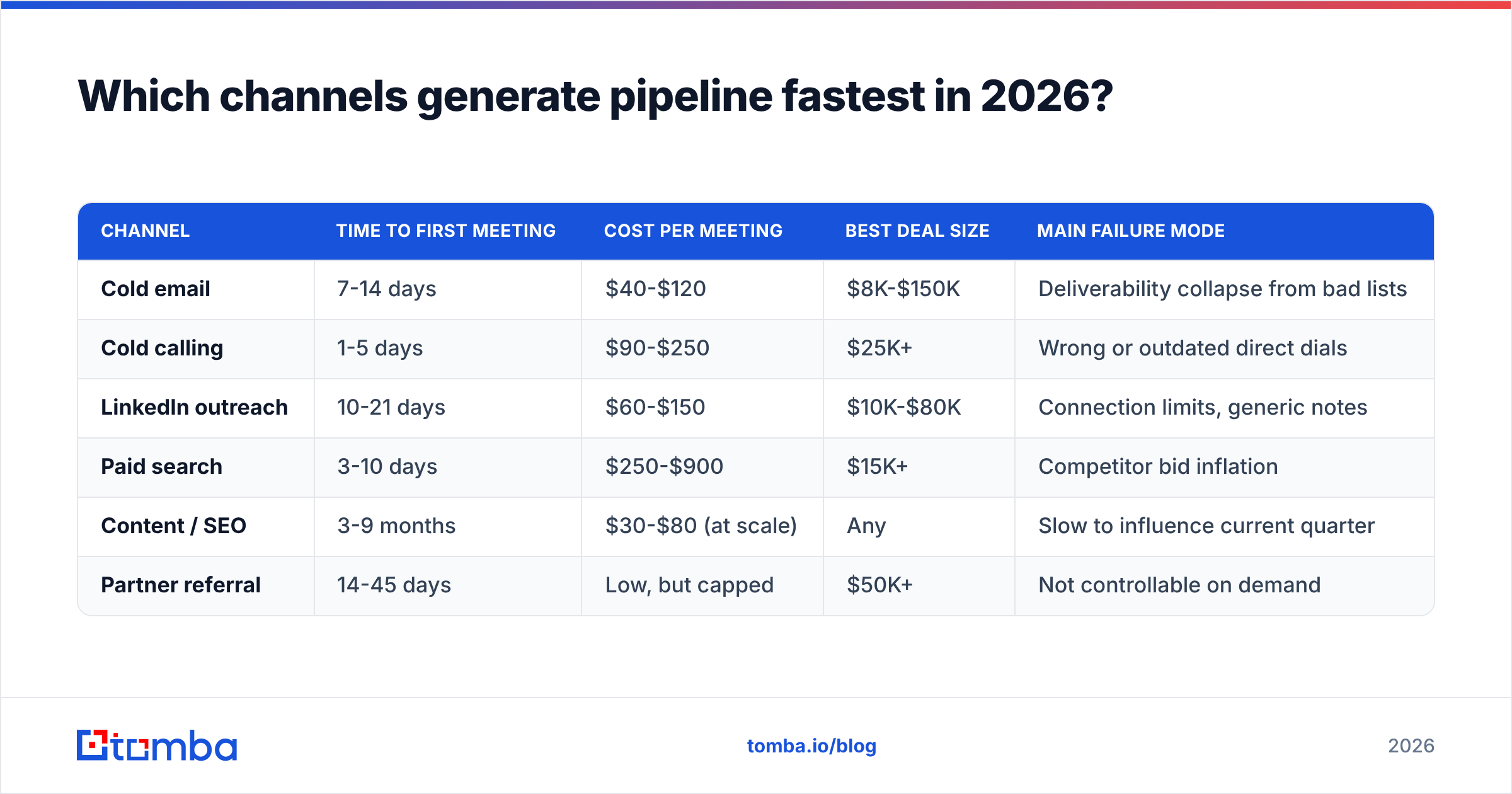
Channel choice depends on your deal size and how reachable your buyer is. Here is how the main options compare on the dimensions that matter for pipeline generation specifically.
| Channel | Time to first meeting | Cost per meeting | Best deal size | Main failure mode |
|---|---|---|---|---|
| Cold email | 7-14 days | $40-$120 | $8K-$150K | Deliverability collapse from bad lists |
| Cold calling | 1-5 days | $90-$250 | $25K+ | Wrong or outdated direct dials |
| LinkedIn outreach | 10-21 days | $60-$150 | $10K-$80K | Connection limits, generic notes |
| Paid search | 3-10 days | $250-$900 | $15K+ | Competitor bid inflation |
| Content / SEO | 3-9 months | $30-$80 (at scale) | Any | Slow to influence current quarter |
| Partner referral | 14-45 days | Low, but capped | $50K+ | Not controllable on demand |
Cold email plus calling remains the fastest controllable combination for most B2B teams, which is why it dominates when a quarter is behind. Content is the cheapest per meeting at scale, but it cannot rescue a quarter that started three weeks ago. Run both — fund content as an investment, run outbound as the throttle.
Gartner's research on the B2B buying journey makes the case for multi-threading: buyers now involve 6-10 stakeholders, and single-threaded outbound to one champion stalls at the committee stage. Plan two to three contacts per target account from the start, not after the first no-response.
How do you build a target list that converts?#
The list is the product. Message quality has a ceiling set by who receives it, and no amount of clever copy fixes a contact who cannot buy.
Work in this order:
- Define the account filter first. Industry, employee band, tech stack, funding stage, geography. Six criteria maximum. If you cannot name why each one predicts a closed deal, drop it.
- Name the roles, not the titles. "Owns the email deliverability budget" is durable. "VP of Demand Gen" is not — the same job carries eight different titles across companies.
- Source contacts by domain, not by scraping lists. Running a domain search across your account list returns the people who currently work there, along with the company's email pattern, which is far more reliable than a database snapshot taken 14 months ago.
- Verify before sequencing, not after. Push everything through an email verifier and drop anything that is not deliverable or safely catch-all. This is the single highest-ROI step in the whole process.
- Enrich for personalization hooks. Headcount changes, recent funding, new job postings, technology installed. One concrete hook beats three paragraphs of generic value proposition.
- Cap the list. 300 well-researched accounts outperform 3,000 skimmed ones, because your reps can actually multi-thread 300.
For teams sourcing several thousand contacts a month, a bulk email finder run against a CSV of domains is faster than any manual process, and it keeps the verification step inside the same workflow rather than bolted on afterward.
Why does data accuracy decide your pipeline ceiling?#
Because deliverability is a reputation system with a memory, and your list is the input.
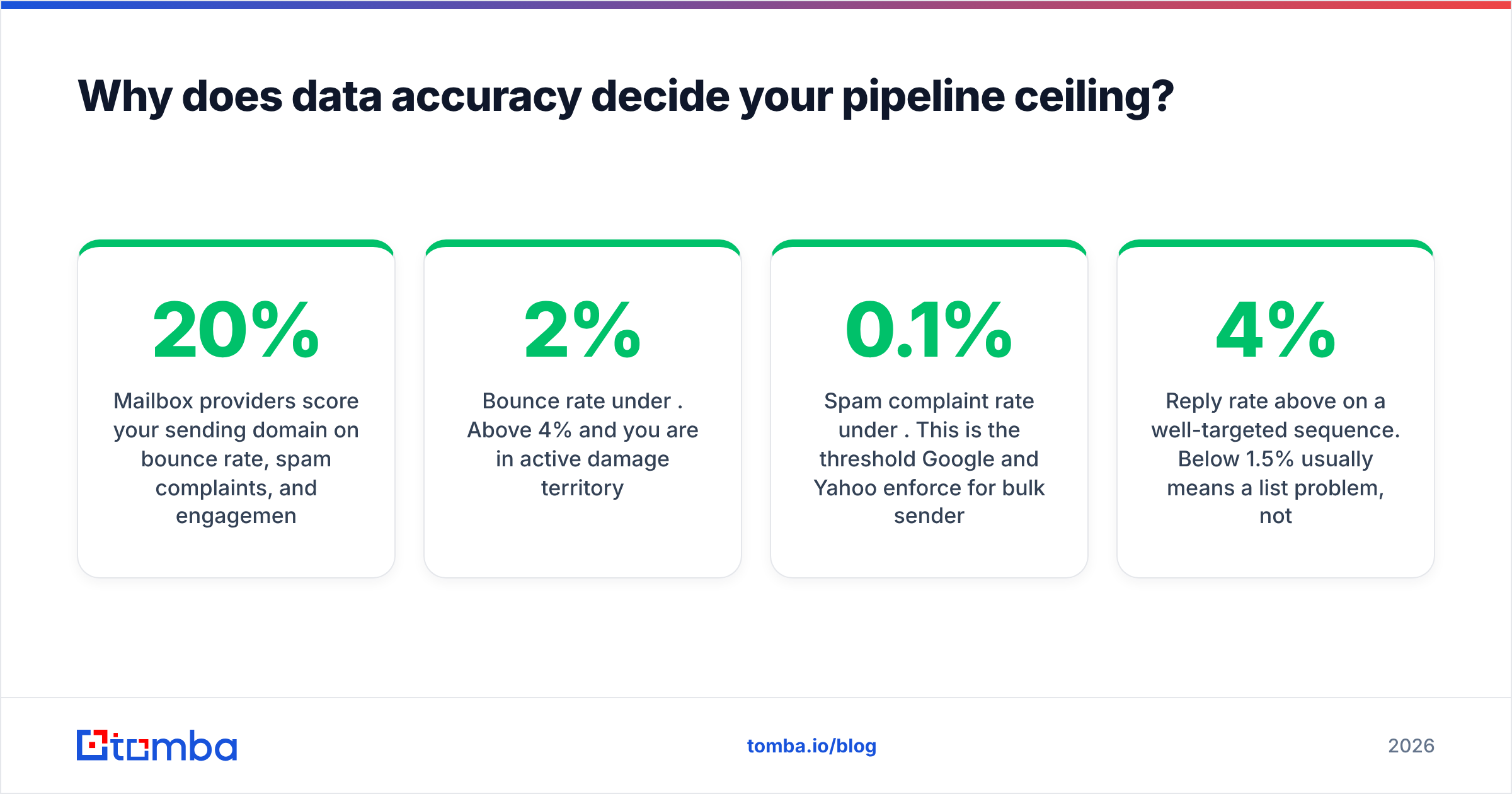
Mailbox providers score your sending domain on bounce rate, spam complaints, and engagement. Send to a list with a 20% invalid rate and you are not merely wasting 20% of your effort — you are teaching Gmail and Outlook to route the other 80% to spam. The damage persists for weeks after you fix the list.
Concrete numbers to hold yourself to:
- Bounce rate under 2%. Above 4% and you are in active damage territory.
- Spam complaint rate under 0.1%. This is the threshold Google and Yahoo enforce for bulk senders.
- Reply rate above 4% on a well-targeted sequence. Below 1.5% usually means a list problem, not a copy problem.
- Catch-all domains isolated. They will not bounce and they will not confirm — send to them from a separate domain so ambiguity does not pollute your main reputation signal.
The fix is procedural, not heroic. Verify at source, re-verify anything older than 90 days, and never import a purchased list into a domain you care about. If you want the mechanics of email deliverability in more depth, treat it as a prerequisite to scaling volume rather than a troubleshooting step.

What does a 30-day pipeline sprint look like?#
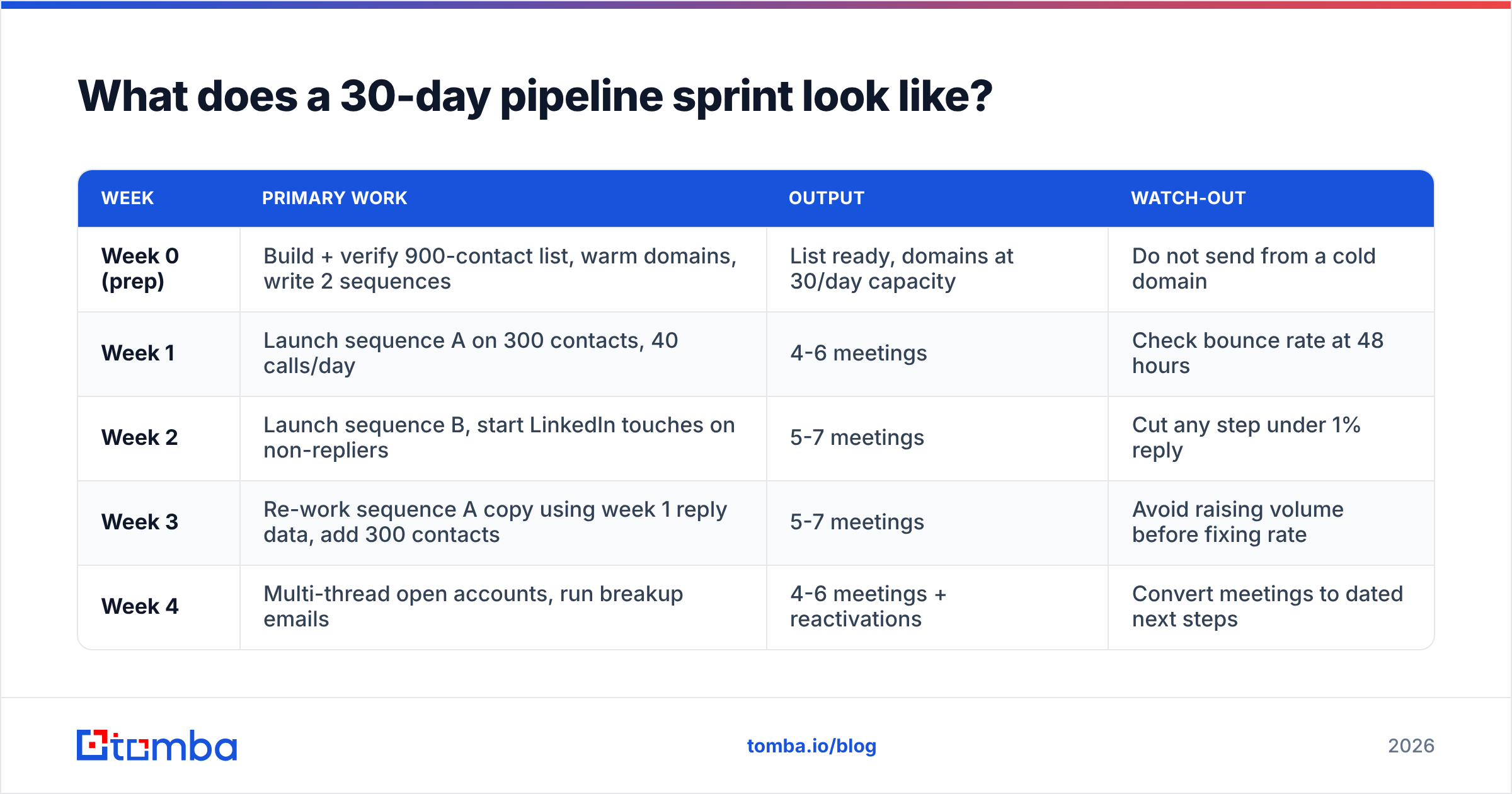
Here is a schedule that assumes two reps, a defined ICP, and a target of 20 qualified meetings.
| Week | Primary work | Output | Watch-out |
|---|---|---|---|
| Week 0 (prep) | Build + verify 900-contact list, warm domains, write 2 sequences | List ready, domains at 30/day capacity | Do not send from a cold domain |
| Week 1 | Launch sequence A on 300 contacts, 40 calls/day | 4-6 meetings | Check bounce rate at 48 hours |
| Week 2 | Launch sequence B, start LinkedIn touches on non-repliers | 5-7 meetings | Cut any step under 1% reply |
| Week 3 | Re-work sequence A copy using week 1 reply data, add 300 contacts | 5-7 meetings | Avoid raising volume before fixing rate |
| Week 4 | Multi-thread open accounts, run breakup emails | 4-6 meetings + reactivations | Convert meetings to dated next steps |
Two rules make this work. First, week 0 is not optional — teams that start sending on day one always spend week 2 repairing deliverability. Second, you diagnose reply rate before you increase volume. Scaling a broken sequence just burns list faster.
HubSpot's sales statistics consistently show that follow-up depth beats first-touch cleverness: most positive replies arrive on touches three through six. A sequence that stops at two emails throws away most of its own pipeline.
How do you measure pipeline quality, not just quantity?#
Volume metrics lie by omission. A rep who books 30 meetings with unqualified accounts looks better on a dashboard than one who books 12 with perfect-fit buyers, right up until the forecast review.
Track these four alongside opportunity count:
- ICP-fit percentage. What share of created pipeline matches your defined account filter? Below 70% means your targeting is drifting.
- Stage-2 conversion. Discovery-to-qualified is the earliest honest signal of whether meetings are real.
- Average days in stage 1. Rising days-in-stage is the leading indicator of a fake pipeline long before close rates move.
- Sourced-versus-inherited split. Pipeline generated this quarter versus rolled forward. A team living on rollover pipeline has already stopped generating.
Review these weekly, not quarterly. The whole advantage of outbound is a two-week feedback loop — quarterly review throws that away.
What are the most common pipeline generation mistakes?#
Sourcing before defining. Building a list without a written ICP means you optimize for volume because you have no other criterion.
Treating verification as optional. It costs pennies per contact and protects an asset — your domain reputation — that takes months to rebuild.
One contact per account. With 6-10 stakeholders in a modern buying committee, single-threading is a coin flip on whether your one contact stays employed and interested.
Copying a competitor's sequence. You are copying their answer to their ICP's problem. Read reviews on G2 for the category you sell into and write to the complaints buyers actually voice.
Adding reps before fixing conversion. If your contact-to-meeting rate is 1.5%, a second rep gives you two people at 1.5%. Fix the rate, then add capacity.
No system of record for next steps. If a meeting does not create a dated task, it is not pipeline. It is a conversation you had once.
Where should you start this week?#
Pick the smallest complete loop and run it end to end: 150 accounts, two contacts each, verified, one sequence, one week. Measure bounce rate, reply rate, and meetings booked. Then decide whether your problem is the list, the message, or the volume — you will not know until one clean cycle has run.
Everything in this system depends on contacts that are current and deliverable. Tomba's email finder resolves names and domains into verified professional addresses, with domain search, catch-all handling, and bulk processing in the same workspace, so your list is ready to sequence rather than ready to clean. The free tier covers 25 searches a month for testing the workflow, and paid plans start at $49/mo on Starter with $99/mo Growth for teams sourcing at sprint volume — see Tomba pricing for the full breakdown. Build the list right, and the rest of the pipeline math starts working in your favor.
Related guides#
Ready to find emails that actually work?
Join 150,000+ professionals who stopped guessing and started sending. Free credits on signup — no credit card required.
Get the Tomba newsletter
Practical outbound tactics and product updates — once every two weeks.
About the author