How To Get Car Leads in 2026: 9 Channels That Convert
Most dealership lead sources sell you the same shopper three times. Here are 9 car lead channels ranked by cost per sold unit, plus the data stack that makes cold outreach work.
TL;DR
- Third-party lead marketplaces (Autotrader, Cars.com, CarGurus) sell the same shopper to three or four dealers. You're not buying a lead, you're buying a footrace — budget accordingly.
- The cheapest cost-per-sold-unit in most stores comes from owned channels: service-drive equity mining, unsold showroom follow-up, and your own website's anonymous traffic.
- Commercial and fleet car leads behave like B2B, not retail. That's where an email finder and verified contact data beat any lead marketplace on margin.
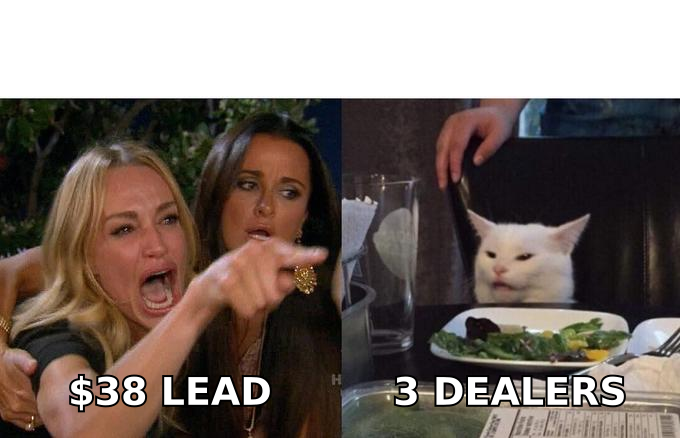
- Track cost per sold unit, not cost per lead. A $38 lead that closes at 4% is more expensive than a $120 lead that closes at 22%.
- Speed-to-lead under 5 minutes roughly doubles contact rates. Most dealers still average over an hour.
What counts as a car lead in 2026?#
A car lead is any identified person or business with a plausible reason to acquire a vehicle in the next 90 days. That definition does a lot of work, because it rules out most of what gets sold as "leads."
Think of lead sources like fishing spots. A third-party marketplace is a stocked pond that four other boats are also fishing. Your service drive is a private lake nobody else can access. Same fish, wildly different competition — and competition is what actually sets your close rate.
Car leads split into four categories that behave nothing alike:
- Retail inbound — someone submitted a form on your VDP, called about a stock number, or walked in. Highest intent, lowest volume, and you already paid for it through ads.
- Third-party marketplace — Autotrader, Cars.com, CarGurus, TrueCar. Medium intent, high volume, shared with competitors, and priced per lead regardless of outcome.
- Owned database — past customers, unsold showroom traffic, service ROs, expiring leases. Highest close rate per contact, effectively free, and almost universally neglected.
- Commercial / fleet / B2B — a contractor replacing three vans, a property manager buying pool cars, a regional rental operator. Long cycle, high gross, and reachable only through outbound prospecting with real contact data.
Most "how to get car leads" advice only addresses category two, which is the one with the worst unit economics. The stores winning in 2026 are the ones rebalancing toward one, three, and four.
Which car lead sources actually convert?#
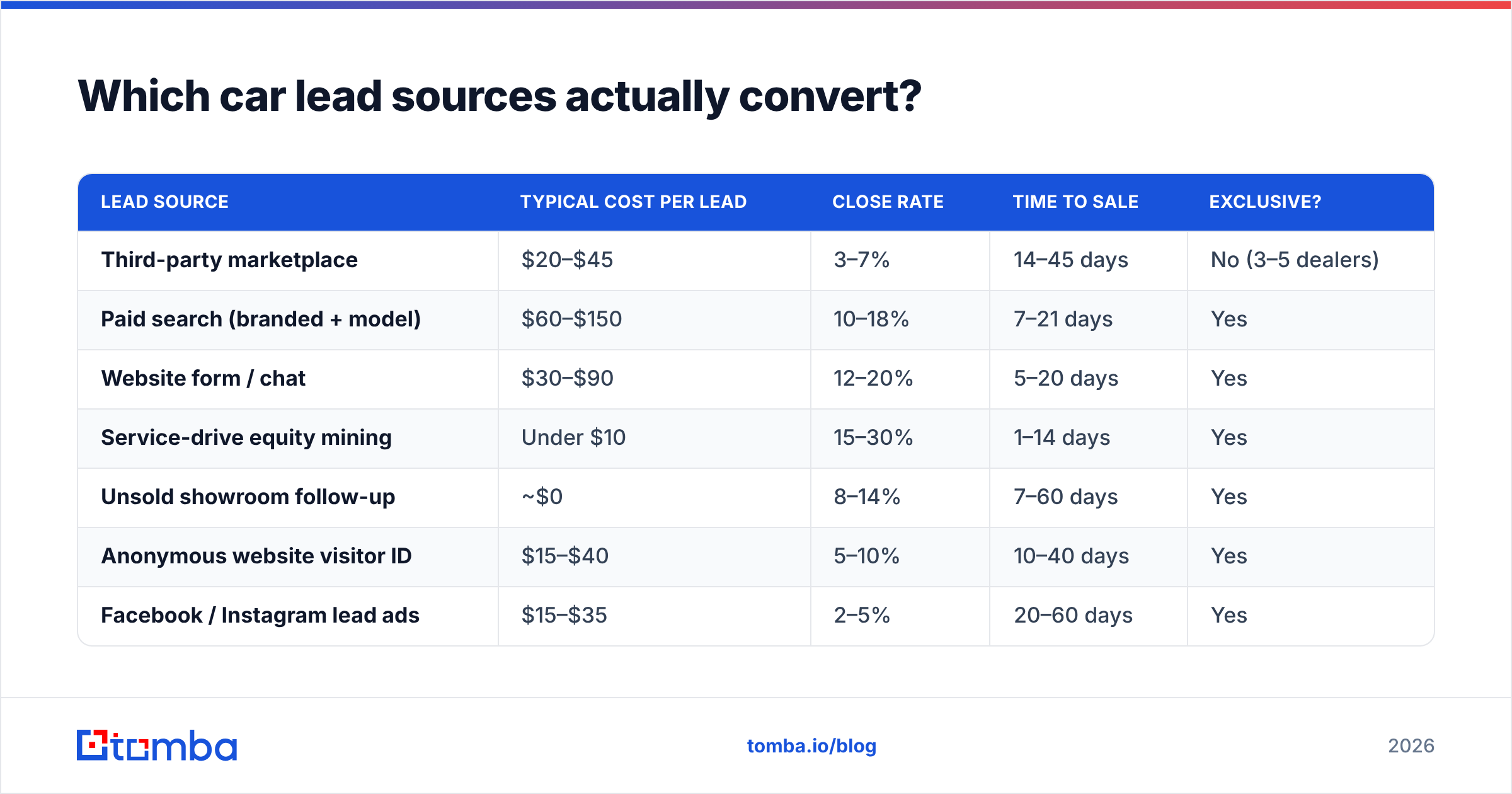
Here's the honest comparison. Numbers below are typical ranges reported across franchise and independent stores — your mileage varies by market, brand, and BDC discipline, so treat them as a starting benchmark, not gospel.
| Lead source | Typical cost per lead | Close rate | Time to sale | Exclusive? |
|---|---|---|---|---|
| Third-party marketplace | $20–$45 | 3–7% | 14–45 days | No (3–5 dealers) |
| Paid search (branded + model) | $60–$150 | 10–18% | 7–21 days | Yes |
| Website form / chat | $30–$90 | 12–20% | 5–20 days | Yes |
| Service-drive equity mining | Under $10 | 15–30% | 1–14 days | Yes |
| Unsold showroom follow-up | ~$0 | 8–14% | 7–60 days | Yes |
| Anonymous website visitor ID | $15–$40 | 5–10% | 10–40 days | Yes |
| Facebook / Instagram lead ads | $15–$35 | 2–5% | 20–60 days | Yes |
| Commercial / fleet outbound | $5–$25 | 8–15% | 30–120 days | Yes |
| Purchased consumer lists | $1–$5 | Under 1% | Unpredictable | No |
Two things jump out.
First, the cheapest lead is rarely the cheapest sale. A $38 marketplace lead closing at 5% costs $760 per sold unit. A $120 paid-search lead closing at 16% costs $750 — a wash, but with none of the "three dealers already called them" friction. Meanwhile equity mining at $8 a contact and 20% close is $40 per sold unit, and almost nobody runs it hard.
Second, purchased consumer lists are a trap for retail. They're stale, they're often non-compliant for calls and texts, and they poison your sender reputation. Purchased business data is a different story — more on that below.
How do you get car leads from your own database?#
Start here, because it's free and you already own it. A typical 100-unit store has 4,000+ prior customers, 600 unsold ups from the last year, and 900 service ROs a month. That's more addressable demand than any marketplace subscription.
The three plays worth building this quarter:
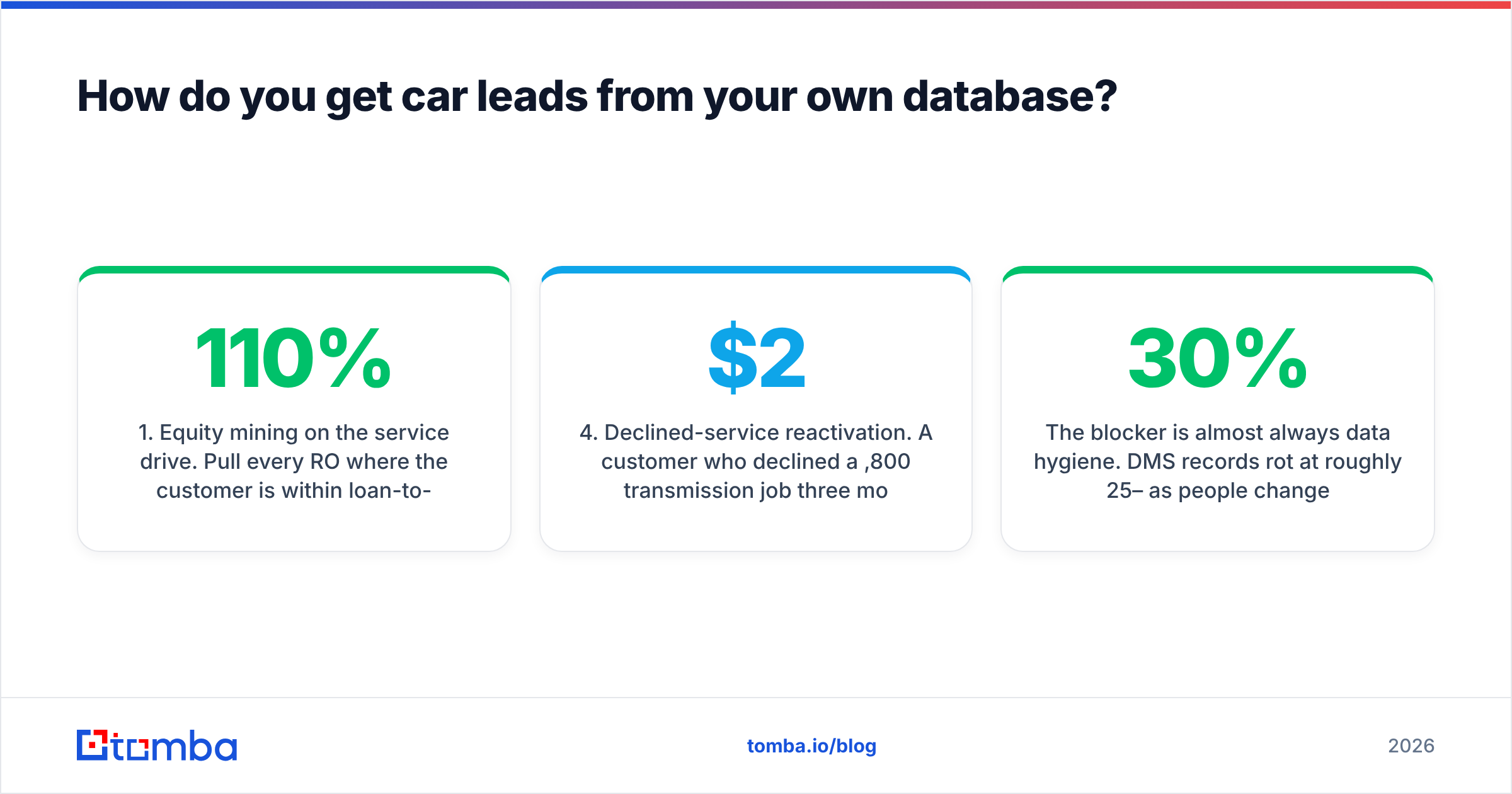
- Equity mining on the service drive. Pull every RO where the customer is within 110% loan-to-value, has 12 months or fewer remaining, or has driven materially over their lease allowance. Hand the advisor a one-line payment comparison. This is the single highest-yield lead source in the building.
- Unsold showroom re-engagement. Anyone who visited but didn't buy in the last 90 days gets a structured five-touch sequence: inventory match, price change alert, trade appraisal offer, service special, and a plain "did you buy somewhere else?" ask. That last one gets a startling number of replies.
- Lease maturity by month. Build a rolling 6-month window and contact at T-minus-150, T-minus-90, and T-minus-45 days. Waiting for the captive lender to reach out first means the customer is already shopping.
- Declined-service reactivation. A customer who declined a $2,800 transmission job three months ago is a trade candidate, not a repair candidate.
The blocker is almost always data hygiene. DMS records rot at roughly 25–30% per year as people change jobs and email addresses. Before you launch a sequence to 4,000 old records, run them through an email verifier — bouncing a quarter of your list on day one will tank your domain and make the next six campaigns underperform for reasons nobody in the store will diagnose correctly.
How do you get commercial and fleet car leads?#
This is the underpriced channel, and it's the one that behaves like B2B lead generation rather than retail advertising.
Commercial buyers don't fill out VDP forms. A contractor who needs four more work vans does not browse CarGurus at 11pm — they call the dealer they bought from last time, or they call whoever reached them first with a credible offer. Nobody is competing for their attention because most stores have no outbound motion at all.
The workflow is straightforward:
- Build the target list. Local trades, HVAC, plumbing, landscaping, property management, medical courier, food distribution, municipal contractors. Companies with 10–200 employees in a 60-mile radius. Public business registries, industry associations, and Google Maps scrapes all work as source material.
- Find the right human. You want the owner, the operations manager, or the fleet manager — not
info@. A domain search pulls the named contacts on a company domain along with the email pattern, so you can go from "Reliable HVAC LLC" to a specific decision-maker in seconds. - Verify before you send. Small-business domains are full of catch-all configurations that swallow anything and confirm nothing. Run addresses through verification and use a catch-all verifier for the ambiguous ones rather than guessing.
- Lead with a fleet-specific offer. Upfit availability, on-site service pickup, priority allocation, tax treatment under Section 179. Not "check out our inventory."
- Expect a 30–120 day cycle. Commercial deals close slower and gross higher. One five-van order beats twenty retail ups.
For dealers who want to keep it inside a spreadsheet workflow, the Google Sheets add-on turns a column of company domains into verified contacts without touching an API. If you'd rather automate it into your CRM, the Tomba API handles the same thing programmatically.
How do you capture leads from anonymous website traffic?#
Roughly 96–98% of your website visitors never submit a form. They browse three VDPs, check a payment calculator, and leave. In retail that traffic is mostly unrecoverable without consent-based identity resolution — and the compliance picture around that is genuinely messy, so tread carefully and get your attorney's read before signing with any consumer-identity vendor.
For commercial traffic, though, firmographic reveal is on much firmer ground. Identifying that a regional plumbing company with 40 employees spent six minutes on your Transit inventory page is a business signal, not a consumer one. Website visitor reveal surfaces the company, and from there you're back in the outbound workflow above.
Practical setup:
- Tag your commercial and fleet landing pages separately from retail VDPs.
- Route any identified business visitor to a dedicated commercial rep within the hour.
- Feed identified companies into a weekly prospecting list rather than an instant-blast sequence — a same-day cold email referencing their site visit reads as creepy, not helpful.
Is paid advertising still worth it for car leads?#
Yes, but the mix has shifted. Three things are true in 2026 that weren't in 2022.
Branded search is defensive spend. You're not generating demand, you're preventing third-party marketplaces and competing dealers from intercepting people who already typed your name. It looks like a great ROAS in the report and it's mostly cannibalized organic. Keep it, but don't credit it with growth it didn't create.
Model-plus-geography search is where incremental leads live. "2026 Tacoma near me" is a person in-market who hasn't picked a store. Expensive, worth it, and directly measurable against sold units.
Meta lead ads generate volume that lies to you. Cost per lead looks fantastic at $18. Close rate is often 2–4% because the form is two taps and half the submissions are curiosity. If you run them, treat the lead as a name, not an opportunity, and staff accordingly. Google's own advertising documentation is clear that lead form quality varies enormously by friction level — adding a single qualifying question typically cuts volume in half and doubles close rate.
For a broader view of how dealers are allocating budget across these channels, G2's marketing category reviews are a reasonable neutral read on what tooling stores are actually retaining versus churning.
What does a working car lead process look like?#
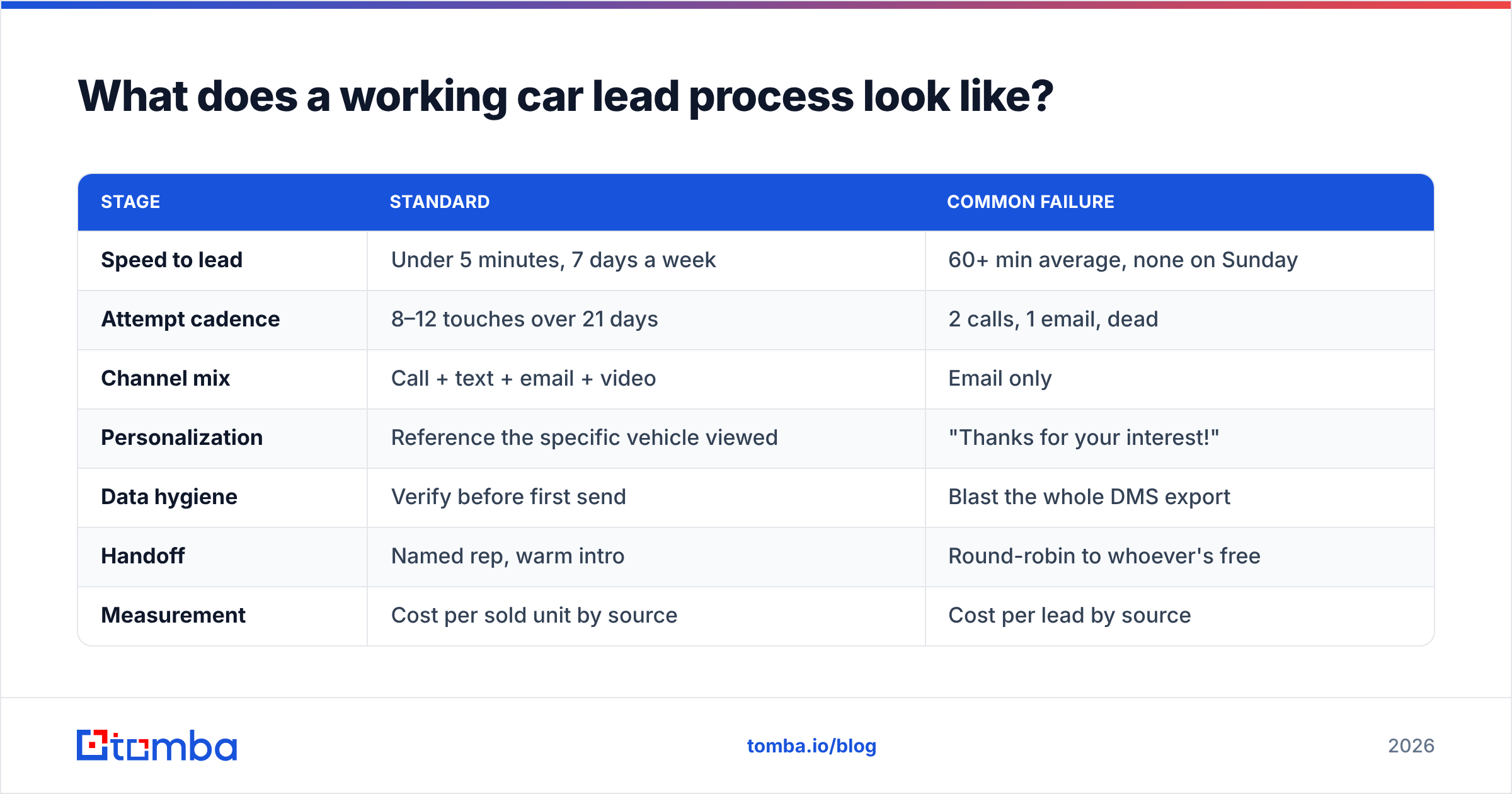
Sources don't close deals. Process does. Here's the operational spine that separates the 18% closers from the 6% closers:
| Stage | Standard | Common failure |
|---|---|---|
| Speed to lead | Under 5 minutes, 7 days a week | 60+ min average, none on Sunday |
| Attempt cadence | 8–12 touches over 21 days | 2 calls, 1 email, dead |
| Channel mix | Call + text + email + video | Email only |
| Personalization | Reference the specific vehicle viewed | "Thanks for your interest!" |
| Data hygiene | Verify before first send | Blast the whole DMS export |
| Handoff | Named rep, warm intro | Round-robin to whoever's free |
| Measurement | Cost per sold unit by source | Cost per lead by source |
The speed-to-lead number is not a soft guideline. HubSpot's research on response timing has consistently found that contact rates collapse as response time stretches past the first few minutes, and the effect is even sharper in automotive where the shopper submitted the same form to three other stores in the same session.
The cadence number matters just as much. Most dealership BDCs quit after three attempts. A meaningful share of sold units come from touches four through ten — which means half your paid leads are being thrown away after you've already paid for them.
How should you build the data layer behind all this?#
Every channel above eventually bottoms out in the same question: do you have a working way to reach this person?
For retail leads, the CRM handles it. For everything else — commercial prospecting, dead-lead reactivation, identified website companies, list-building from association directories — you need a contact data layer that turns a company or a name into a verified, deliverable address.
That stack looks like:
- Discovery — domain search across a target account list to surface named contacts and email patterns.
- Enrichment — data enrichment to attach titles, company size, and phone numbers so your reps prioritize correctly.
- Verification — validate every address before it enters a sequence, and re-validate your owned database quarterly.
- Volume — bulk email finder processing when you're working a list of 500 local businesses rather than one account at a time.
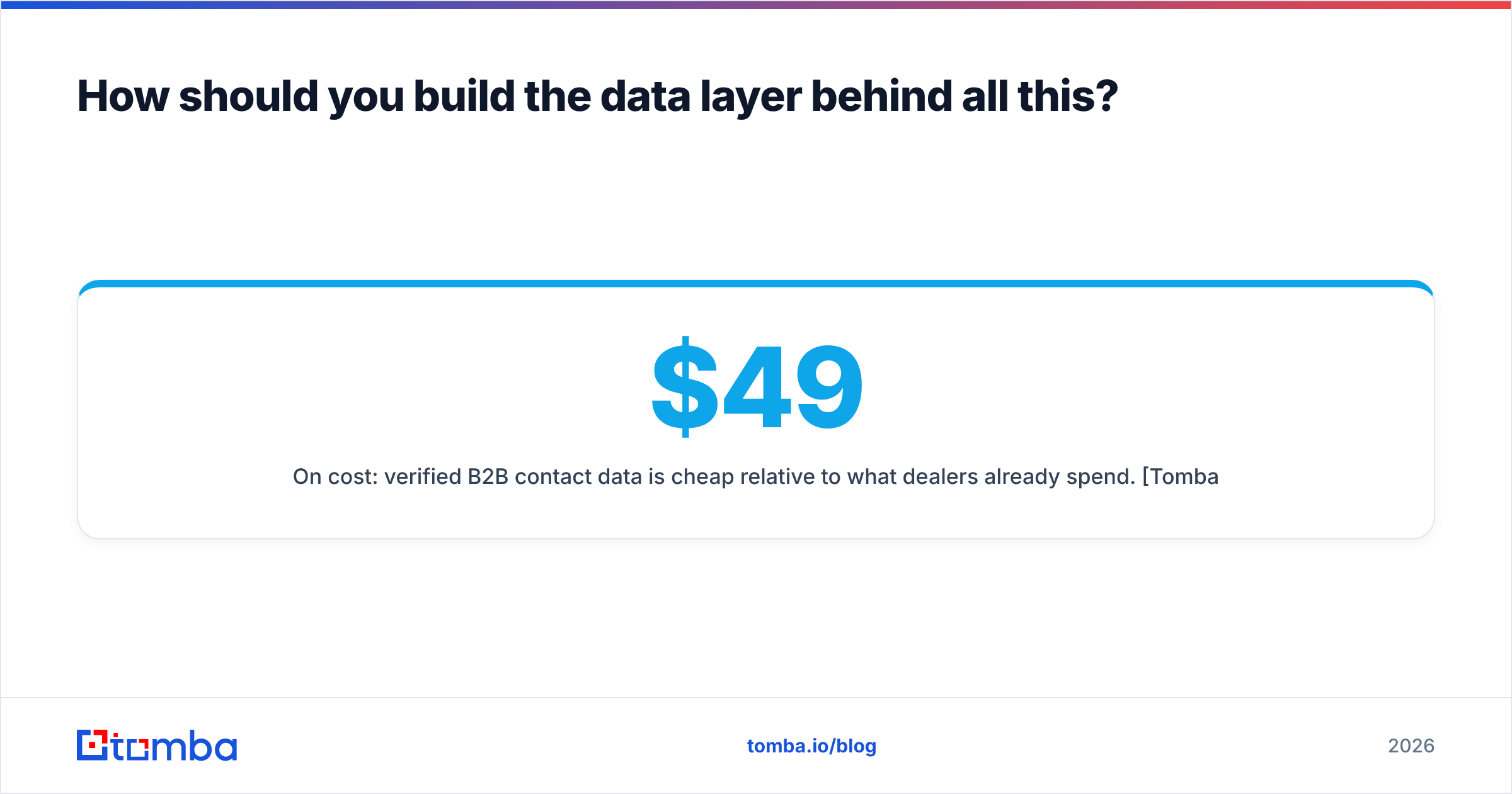
On cost: verified B2B contact data is cheap relative to what dealers already spend. Tomba pricing starts with a free tier at 25 searches a month, Starter at $49/mo, Growth at $99/mo, and Pro at $249/mo. Compare that to a single third-party marketplace subscription running $2,000–$6,000 monthly for shared leads, and the arithmetic makes itself.
If you're evaluating vendors, look at where the data comes from and how staleness is handled — providers like BookYourData publish their verification approach openly, and Tomba documents its data sources for the same reason. Any vendor that won't tell you how records are sourced and refreshed is asking you to trust a number you can't audit.
What should you stop doing?#
Three habits that quietly cost stores real money:
- Buying more of the lead source with the lowest CPL. If you rank sources by cost per sold unit instead, the ranking usually inverts.
- Letting the DMS rot. A database with 30% dead addresses isn't a database, it's a deliverability liability. Quarterly verification is a two-hour job that protects every campaign downstream.
- Ignoring commercial entirely. Most independent and franchise stores have zero outbound motion toward local businesses, in a market where those buyers have no competing suitors and gross that retail can't touch.
Where to start this week#
Pick one owned channel and one outbound channel. Run equity mining against last month's service ROs — that's your fastest revenue. Then build a 200-company local business list, find the fleet decision-maker at each, verify the addresses, and send a genuinely useful fleet offer.
The second half of that is the part most dealers stall on, because "find the operations manager's email at 200 local companies" sounds like a week of work. It isn't. Point Tomba Email Finder at a company domain and a name and you get a verified, deliverable address with a confidence score in under a second — free tier included, so you can validate the whole motion on 25 accounts before you commit a dollar. Build the list, verify it, work it. That's the entire moat.
Related guides#
// get started
Find, verify and enrich your first contacts today
Start on the free plan with 25 searches a month, then scale when your team is ready.
Free plan · No credit card required · GDPR & CCPA
Get the Tomba newsletter
Product and data updates
// about the author