How To Get Clients For Software Company: 7 Proven Channels
Referrals dry up. Ads get expensive. Here are seven channels software companies actually use to land clients in 2026, ranked by cost, speed to first deal, and how much founder time each one eats.
Most founders asking how to get clients for software company growth hit the same wall: referrals carry the first ten deals, then run dry. This guide ranks the seven channels that still work, by real cost, speed to first deal, and founder hours.
TL;DR
- Most software companies get their first 10 clients from referrals, then stall. Referrals are not a channel you control.
- The two channels with the shortest path to a first deal are targeted cold outbound and partner/subcontract work. Both can produce a signed contract in 30-60 days.
- Content, directories (Clutch, G2), and paid ads work, but they compound over 6-18 months. Start them early, don't depend on them early.
- Your list quality matters more than your copy. A 500-contact list of verified decision-makers beats 10,000 scraped rows every time.
- Track one number above all others: cost per qualified conversation. Everything else is vanity.
Why is getting clients for a software company harder than it looks?#
Because you are selling a promise, not a product. A buyer of a $120,000 custom build cannot inspect the thing before they pay. Neither can a buyer of a $2,000/month SaaS seat. They are paying for your ability to not waste their year.
That has three consequences for how you sell.
First, trust does the heavy lifting. Channels that borrow trust — referrals, partners, communities, published work — convert 3-5x better than channels that start from zero.
Second, cycle times are long. A mid-market custom software deal often runs 60-120 days from first touch to signature. The pipeline you build in September pays your December payroll.
Third, your buyer is usually two people. One is a technical evaluator who cares about stack and architecture. The other is an economic buyer — a VP, founder, or CFO — who cares about the business case. If your outreach speaks to only one of them, the deal stalls.
That's the shape of the problem. Now the channels.
What are the fastest channels to get software clients in 2026?#
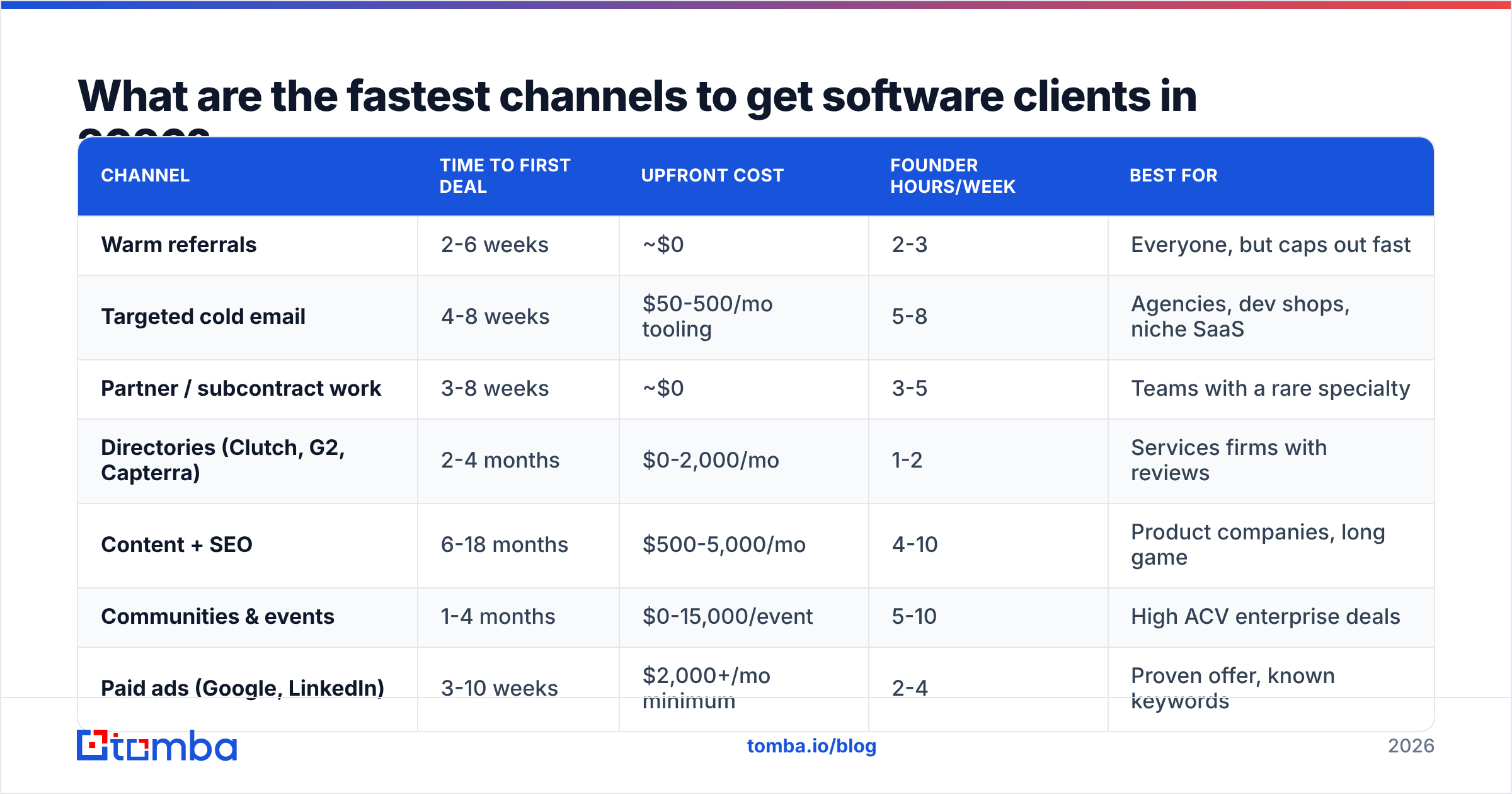
Here is the short answer to how to get clients for software company teams: pick from these seven channels. "Time to first deal" assumes you start from zero today, with no audience.
| Channel | Time to first deal | Upfront cost | Founder hours/week | Best for |
|---|---|---|---|---|
| Warm referrals | 2-6 weeks | ~$0 | 2-3 | Everyone, but caps out fast |
| Targeted cold email | 4-8 weeks | $50-500/mo tooling | 5-8 | Agencies, dev shops, niche SaaS |
| Partner / subcontract work | 3-8 weeks | ~$0 | 3-5 | Teams with a rare specialty |
| Directories (Clutch, G2, Capterra) | 2-4 months | $0-2,000/mo | 1-2 | Services firms with reviews |
| Content + SEO | 6-18 months | $500-5,000/mo | 4-10 | Product companies, long game |
| Communities & events | 1-4 months | $0-15,000/event | 5-10 | High ACV enterprise deals |
| Paid ads (Google, LinkedIn) | 3-10 weeks | $2,000+/mo minimum | 2-4 | Proven offer, known keywords |
Two things jump out. First, nothing is free. The cheap channels cost founder hours instead of dollars, and founder hours are your most expensive line item. Second, only three channels reliably produce a deal inside two months: referrals, outbound, and partnerships. All three start when you make contact.
So build the compounding channels in the background, and fund the company with the initiated ones.

How do you build a target list that actually converts?#
This is the step almost everyone skips, and it's the one that decides whether your outbound works at all. Do it in this order:
Define the trigger, not the industry. "SaaS companies" is not a segment. "Series A SaaS companies that posted a senior React role in the last 30 days" is. Triggers include funding rounds, new hires, tech-stack changes, a public migration announcement, or a competitor's product sunset. A trigger gives you a reason to write today rather than someday.
Cap the list at 300-500 accounts per quarter. A small list you research is worth more than a large one you blast. At 500 accounts you can still personalize the first line of every email without hiring anyone.
Find both buyers per account. The technical evaluator (CTO, Head of Engineering, Lead Architect) and the economic buyer (VP Product, COO, founder). Use a domain search to pull every public address on the company domain, then filter to the two roles that matter.
Get the actual addresses, not guesses. Pattern-guessing (first.last@) is right maybe 60% of the time. Every miss is a bounce, and each bounce hurts your sending domain. A dedicated email finder matches name + domain against real observed data instead of a permutation.
Verify before you send, every time. Run the finished list through an email verifier and drop anything that isn't valid. Keep your bounce rate under 2%. Above 3%, Google and Microsoft start to throttle you. That quietly kills every campaign you run after.
Enrich with one useful fact per contact. Headcount, funding stage, current stack, or a recent announcement. One fact is enough to make an email feel written rather than generated.
That process takes about a day per 300 accounts once you have the tooling wired up. It is the highest-leverage day in your quarter.
Is cold email still worth it for software companies?#
Yes — but only the version that looks nothing like what most people send.
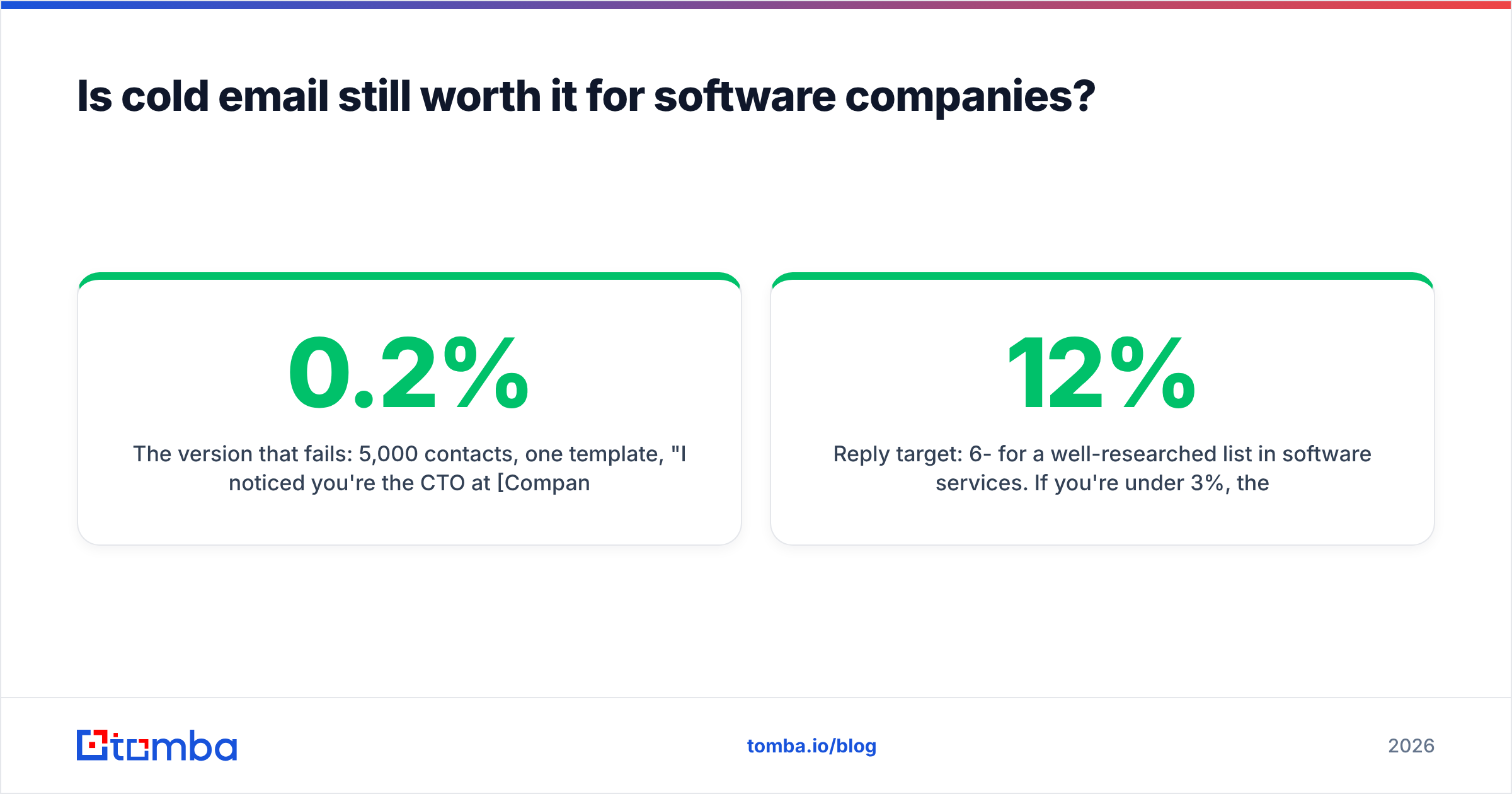
The version that fails: 5,000 contacts, one template, "I noticed you're the CTO at [Company] and thought you might be interested in our custom software development services." That gets 0.2% replies and burns your domain.
The version that works: 400 contacts, three variations, each opening with something specific and verifiable. Something like — "You're hiring two Rails engineers and one platform lead in Austin. We took over a Rails 5 → 7 migration for a fintech in the same spot last year; they shipped it in 11 weeks with three of our people instead of hiring four. Worth 20 minutes?"
The mechanics that matter:
- Volume ceiling: 30-50 emails per mailbox per day, on a secondary domain, warmed for at least three weeks. Never send outbound from your primary company domain.
- Sequence length: 3-4 touches over 12-14 days. The second and third emails should add new information, not "just bumping this."
- Reply target: 6-12% for a well-researched list in software services. If you're under 3%, the problem is the list or the offer, not the subject line.
- Meeting rate: expect roughly a third of positive replies to convert to a call.
HubSpot's sales statistics roundup is a decent sanity check on benchmarks. Just remember that those averages blend every industry. Technical B2B usually runs above them when the targeting is tight.
One warning on data. If you buy a list sight-unseen, verify it before you touch it. Reputable providers exist: BookYourData sells pay-as-you-go B2B contacts with a verification guarantee, and that is a fair way to seed a segment you can't source yourself. The failure mode isn't buying data. It's buying data and skipping the verification pass.

Should you rely on referrals and partnerships instead?#
Partly. They're your best-converting channel and your worst-scaling one.
Referrals convert at 30-50% to a first meeting. The trust transfer is done before you speak. But you can't turn the dial. Most software companies get 5-15 referrals a year from a passive network, and that number won't move unless you engineer it.
Three ways to engineer it:
Systematic ask. At every project close, ask one specific question: "Who else do you know dealing with the same thing we just fixed?" Specific beats "let me know if you hear of anyone." Do this within two weeks of a successful delivery, while the relief is fresh.
Subcontract relationships. Bigger agencies routinely have overflow work or capability gaps. If you're excellent at one thing — Elixir, embedded firmware, HIPAA-compliant infrastructure, Snowflake migrations — five agency relationships can keep a four-person team booked. Margins are thinner: expect 20-35% less than direct. But acquisition cost is near zero and cycles are short.
Complementary vendor partnerships. Design studios need engineering. Fractional CTOs need delivery teams. Salesforce implementation partners need custom integration work. Find the vendors who sit adjacent to your service, and refer first — reciprocity is a real and underused mechanism.
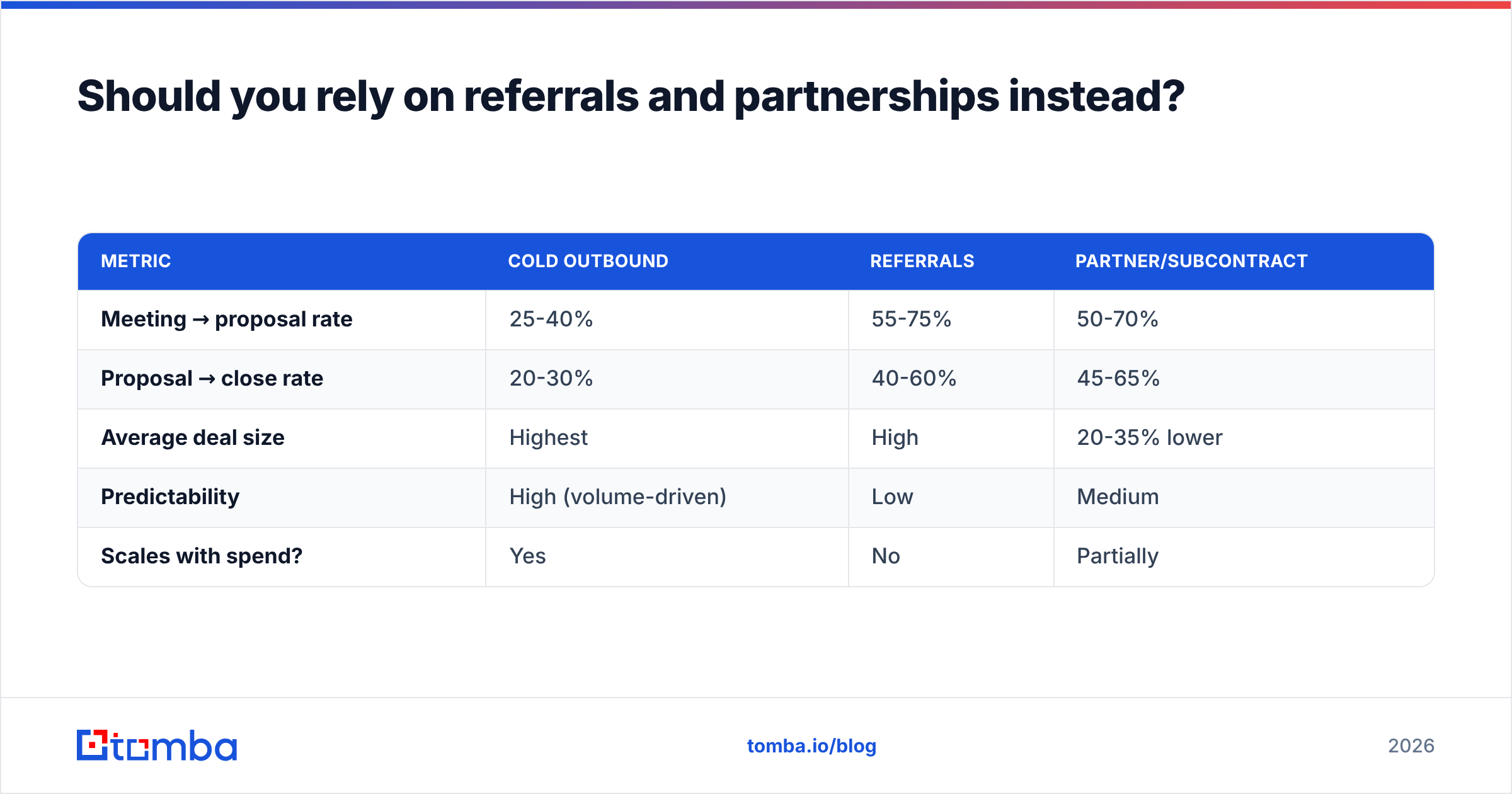
Here's how the three initiated channels compare once you're running all of them:
| Metric | Cold outbound | Referrals | Partner/subcontract |
|---|---|---|---|
| Meeting → proposal rate | 25-40% | 55-75% | 50-70% |
| Proposal → close rate | 20-30% | 40-60% | 45-65% |
| Average deal size | Highest | High | 20-35% lower |
| Predictability | High (volume-driven) | Low | Medium |
| Scales with spend? | Yes | No | Partially |
Read that table as a portfolio, not a ranking. Referrals and partners give you the best conversion rates, but you can't make more of them on demand. Outbound gives you the worst rates and the only dial you fully control. You need both.
What role do directories, content, and G2 play?#
They're the channels that make the other channels cheaper.
For services firms, Clutch is still the highest-intent directory. Buyers arrive there already scoping a project. To rank, you need 8-12 verified client reviews. That means asking clients, which means having a process. For product companies, G2 and Capterra serve the same function: buyers who are already in a comparison mindset.
Content works, but know what you are buying. A technical post ranking for "how to migrate from Heroku to AWS ECS" won't produce leads next month. Eighteen months from now, it makes every cold email you send land softer. The prospect who googles your company finds proof that you know things. Treat content as a conversion-rate multiplier on your outbound, not as a lead source.
Publish the things only you can publish: post-mortems from real projects, benchmark numbers from your own systems, architecture decisions with the trade-offs written out honestly. Generic "10 benefits of custom software" posts compete with 4,000 identical pages. They win nothing.
How do you turn a first meeting into a signed contract?#
Most software companies lose deals in the gap between "good call" and "here's the SOW." Close that gap with three moves:
Sell a paid discovery, not a project. A two-week discovery at $3,000-8,000 is a far easier yes than a $150,000 build. You deliver an architecture review, a scope, and a fixed-price estimate. It lowers the buyer's risk and pays for your pre-sales time. Roughly 70% of well-run discoveries convert to the full engagement. It also filters out tire-kickers fast.
Write the business case for them. Your economic buyer has to defend this inside their company. Give them the ammunition: the cost of the problem today in dollars or hours, the expected state after, and the payback period. Gartner's research on B2B buying finds that buyers spend most of the cycle not talking to vendors. They are building internal agreement. Make that job easy and you'll win deals against better-known competitors.
Set the next step before the call ends. Never end on "I'll send over some information." End on a calendar invite with a named attendee and a stated agenda.
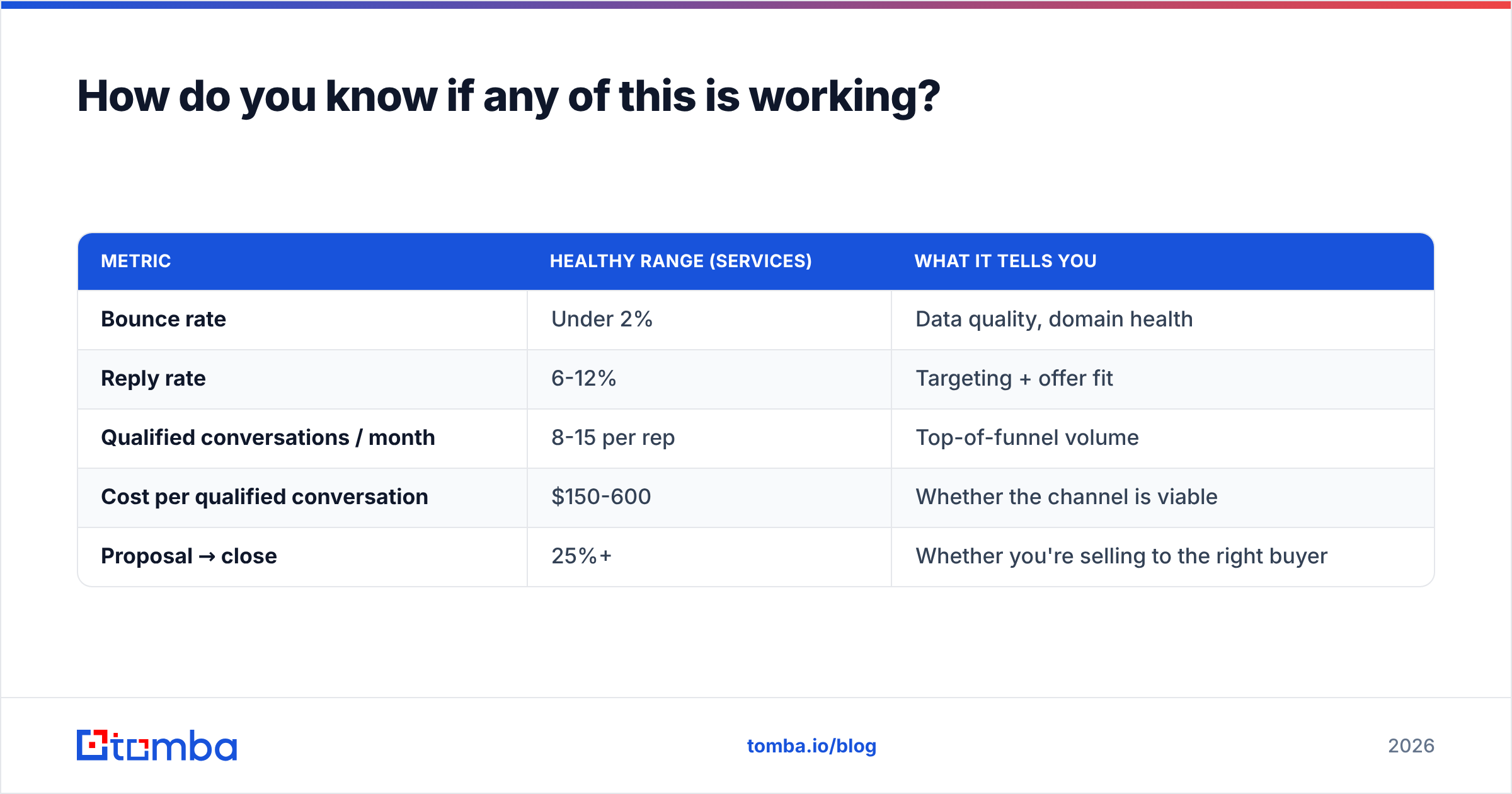
How do you know if any of this is working?#
Track four numbers weekly. Ignore everything else for the first two quarters.
| Metric | Healthy range (services) | What it tells you |
|---|---|---|
| Bounce rate | Under 2% | Data quality, domain health |
| Reply rate | 6-12% | Targeting + offer fit |
| Qualified conversations / month | 8-15 per rep | Top-of-funnel volume |
| Cost per qualified conversation | $150-600 | Whether the channel is viable |
| Proposal → close | 25%+ | Whether you're selling to the right buyer |
If bounce rate is high, fix the data first. It sits upstream of every other number. If replies are low but bounces are clean, the segment or the offer is wrong. If you get plenty of conversations but few proposals, you're reaching evaluators without economic buyers.
Set a review cadence: check bounce and reply weekly, conversations and cost monthly, close rate quarterly. Change one variable at a time or you'll never know what moved.
How to get clients for software company teams in the next 30 days#
Week 1: pick one trigger and build a 300-account list around it. Week 2: find and verify contacts for the two buyer roles at each account, and warm a secondary sending domain. Week 3: write three sequence variants and start sending 40/day. Week 4: ask your last five happy clients the specific referral question, and open conversations with three adjacent vendors.
That is the whole answer to how to get clients for software company owners in one month: four weeks, two channels, no ad spend. Repeat the cycle every quarter with a new trigger and you have a pipeline that doesn't depend on luck.
Start with the list. Every channel above collapses if the contact data under it is wrong. Bounced emails don't just fail. They degrade the domain you need for the next twelve months of outreach. Tomba's Email Finder finds decision-maker addresses from a name and company domain, using observed data rather than guessed patterns, with verification built into the same workflow. The free tier gives you 25 searches a month to test your first segment. Paid plans start at $49/mo; see the full breakdown on the Tomba pricing page. Build the 300-account list first, then send.
Related guides#
Ready to find emails that actually work?
Join 150,000+ professionals who stopped guessing and started sending. Free credits on signup — no credit card required.
Get the Tomba newsletter
Practical outbound tactics and product updates — once every two weeks.
About the author