How To Get Clients For Software Development Company In 2026
Referrals dry up. Upwork bids race to the bottom. Here are nine channels that actually fill a dev shop's pipeline in 2026 — with costs, ramp times, and the outreach math behind each one.
TL;DR — the short answer on how to get clients for software development company teams in 2026:
- Referrals close fastest, but you cannot scale them on purpose. Treat them as a bonus, not a channel.
- Outbound email is the one channel a 5-person dev shop can turn on this month. Expect meetings within 6 weeks — if your targeting is narrow and your list is verified.
- Marketplaces (Upwork, Clutch) buy you volume at the cost of margin. Use them to fund the first 12 months, not year three.
- Positioning beats prospecting. "We build Shopify apps for DTC brands doing $5M+" outperforms "full-stack development" on every channel.
- Budget 8-12 weeks of ramp for any channel you start. The agencies that fail switch channels at week 4.
Most software development companies get their first ten clients by accident — a former employer, a friend's startup, a founder who saw a GitHub repo. Then growth stalls, because accidents do not compound. This guide covers how to get clients for software development company teams on purpose: a repeatable pipeline instead of luck.
Why is selling software development so hard?#
Because you are selling an invisible, expensive, high-risk promise to a buyer who has been burned before.
Three structural problems make dev-shop sales harder than most B2B:
- The buyer cannot evaluate you. A CTO can read your case studies, but they cannot check your code quality before signing. So they use proxies instead: referrals, brand, specificity, and the way you run the sales process.
- The purchase is lumpy. A $180K build is not a monthly subscription. Buying cycles run 60-180 days, involve procurement, and die silently when budget shifts.
- You look identical to 40,000 competitors. Search "software development company" and every homepage says the same four things: agile, dedicated team, cost-effective, end-to-end.
The fix for all three is the same: get narrower. A generalist shop competes on price against firms billing $25/hour. A shop that says "we migrate legacy .NET insurance systems to Azure" competes against maybe six firms worldwide — and charges $150/hour.

How to get clients for software development company teams: 9 channels compared#
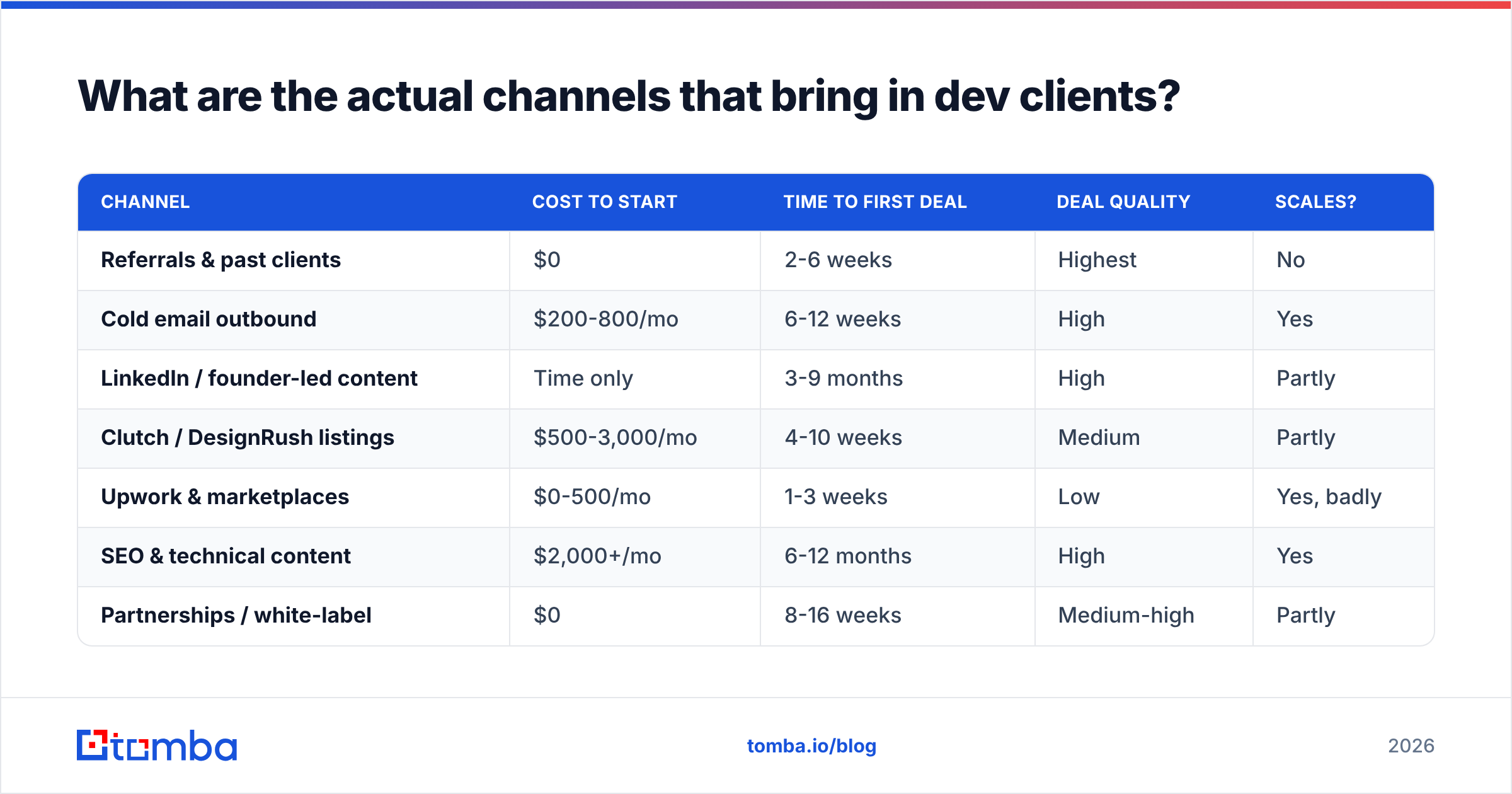
There are nine channels that work. Here is how they compare on the things that matter when cash is tight and your team bills instead of sells.
| Channel | Cost to start | Time to first deal | Deal quality | Scales? |
|---|---|---|---|---|
| Referrals & past clients | $0 | 2-6 weeks | Highest | No |
| Cold email outbound | $200-800/mo | 6-12 weeks | High | Yes |
| LinkedIn / founder-led content | Time only | 3-9 months | High | Partly |
| Clutch / DesignRush listings | $500-3,000/mo | 4-10 weeks | Medium | Partly |
| Upwork & marketplaces | $0-500/mo | 1-3 weeks | Low | Yes, badly |
| SEO & technical content | $2,000+/mo | 6-12 months | High | Yes |
| Partnerships / white-label | $0 | 8-16 weeks | Medium-high | Partly |
| Paid search (Google Ads) | $3,000+/mo | 4-8 weeks | Medium | Yes |
| Communities & events | $500-5,000 | 2-6 months | High | No |
Two takeaways. First, nothing except marketplaces produces revenue in under a month. If you are three weeks from missing payroll, bid on Upwork and fix the strategy after. Second, the channels with the best deal quality — referrals, content, communities — are the slowest and the least controllable. Outbound sits in the middle: controllable, reasonably fast, decent quality. That is why it is the default for a shop under 30 people.
How do you actually run outbound for a dev shop?#
Outbound fails for agencies for one reason: they blast 5,000 generic emails at "CTO" titles, then decide cold email is dead. It is not dead. It is just unforgiving of vague targeting.
Start with targeting. Get these three steps right and the copy writes itself:
- Define one ICP, not four. Pick an industry, a size band, and a technical trigger. Example: Series A-B fintechs, 20-200 employees, hiring backend roles in the last 60 days. Triggers beat firmographics. A company that just posted three React job ads has a budget problem you can solve.
- Build the list by hand first. Your first 100 accounts should be hand-picked. If you cannot say why an account should care, your copy will not either.
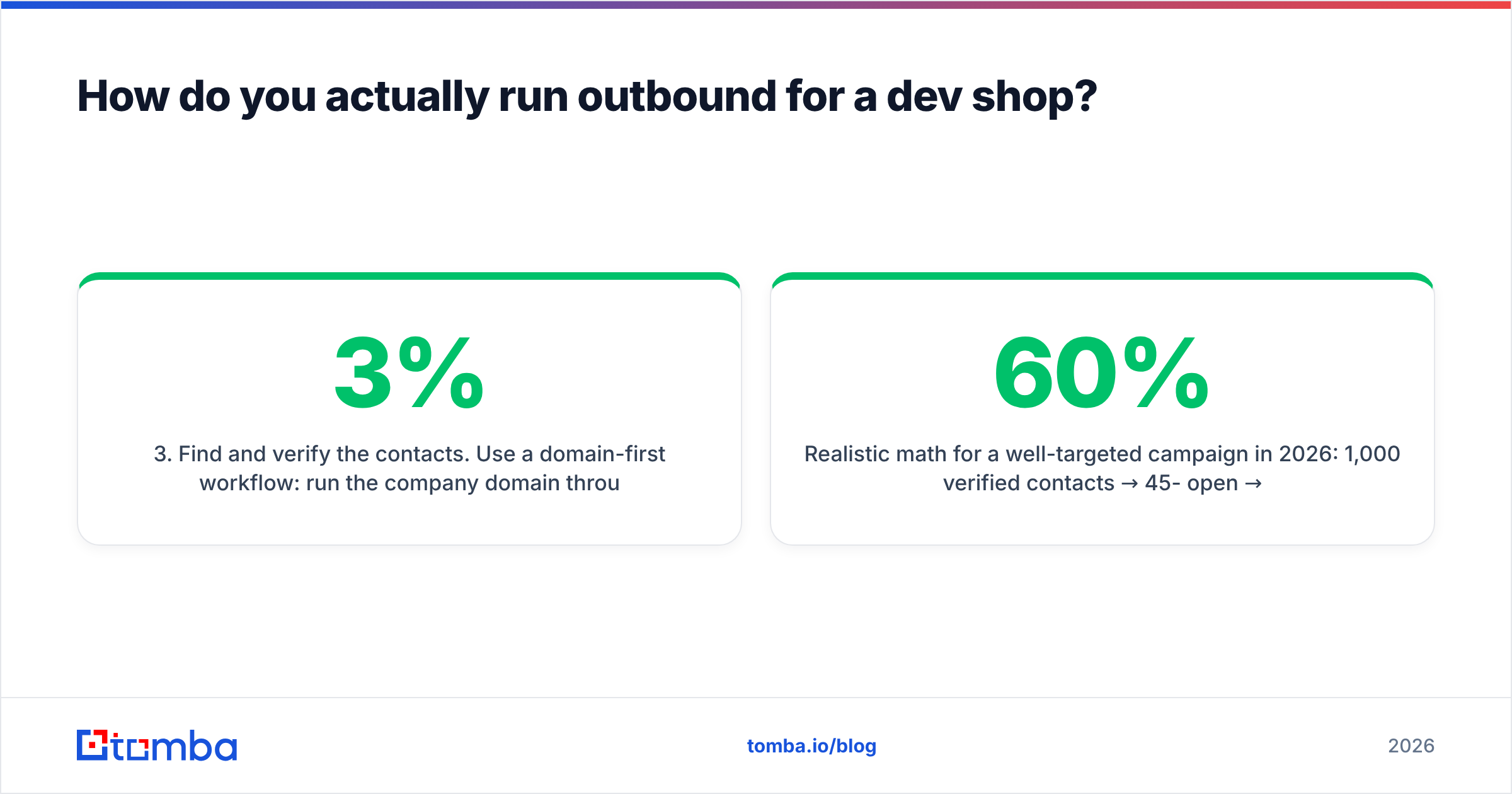
- Find and verify the contacts. Run the company domain through domain search to see who sits on the engineering side. Pull the decision-maker with an email finder. Then run every address through an email verifier before it reaches your sending tool. A bounce rate above 3% burns your domain reputation in two weeks.
Then send. The next three steps are where most agencies lose a deal they had already earned:
- Write about their problem, not your stack. "I saw you're hiring two Rails engineers — we placed a 3-person Rails pod with [similar company] in 11 days" beats any list of technologies.
- Send from a secondary domain. Never burn your primary domain on cold volume. Buy a lookalike domain, warm it for 3-4 weeks, and cap sends at 30-40 per inbox per day.
- Follow up four times. Roughly half of dev-shop replies come after the second message. Most agencies send one email and quit.
Realistic math for a well-targeted campaign in 2026: 1,000 verified contacts → 45-60% open → 4-8% reply → 1.5-3% positive reply → 15-30 conversations → 2-5 qualified opportunities → 1-2 closed deals. At a $90K average contract, that is $90-180K from one month of sending. The whole thing collapses if the list is dirty. That is why verification is not optional.
For the outreach infrastructure itself, Instantly and Smartlead handle sequencing and inbox rotation. The data layer is where most agencies underinvest.
Should you use Clutch, Upwork, or your own pipeline?#
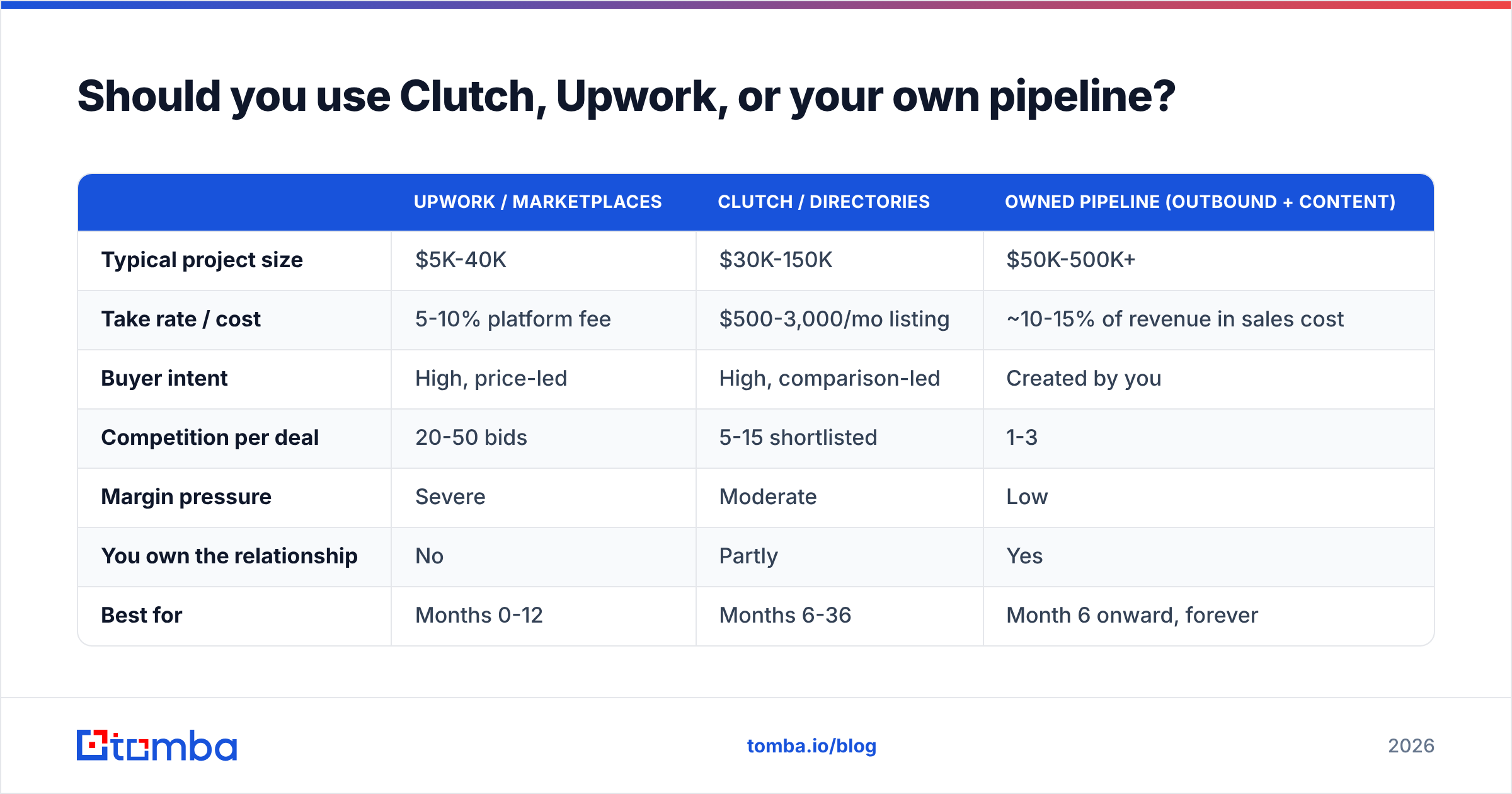
All three, in a deliberate sequence. They are not competing strategies — they are stages.
| Upwork / marketplaces | Clutch / directories | Owned pipeline (outbound + content) | |
|---|---|---|---|
| Typical project size | $5K-40K | $30K-150K | $50K-500K+ |
| Take rate / cost | 5-10% platform fee | $500-3,000/mo listing | ~10-15% of revenue in sales cost |
| Buyer intent | High, price-led | High, comparison-led | Created by you |
| Competition per deal | 20-50 bids | 5-15 shortlisted | 1-3 |
| Margin pressure | Severe | Moderate | Low |
| You own the relationship | No | Partly | Yes |
| Best for | Months 0-12 | Months 6-36 | Month 6 onward, forever |
The trap is staying on marketplaces too long. Upwork buys you cash flow and testimonials, which is genuinely useful when you are new. But you never own the demand. The buyer is trained to compare on hourly rate, and one platform policy change can halve your lead flow overnight. Treat marketplace revenue as a bridge you are actively dismantling.
Directories like Clutch work differently. Buyers arrive already convinced they need an agency, and they are choosing between five. Reviews are the whole game: 20 detailed reviews with named clients will outrank a slicker firm with four. Ask for a review at every project close, not once a year.
How does content bring in software development clients?#
Slowly, and then all at once. The agencies with inbound pipelines did not write "10 Benefits of Custom Software" posts. They wrote things only a practitioner could write.
What works for dev shops:
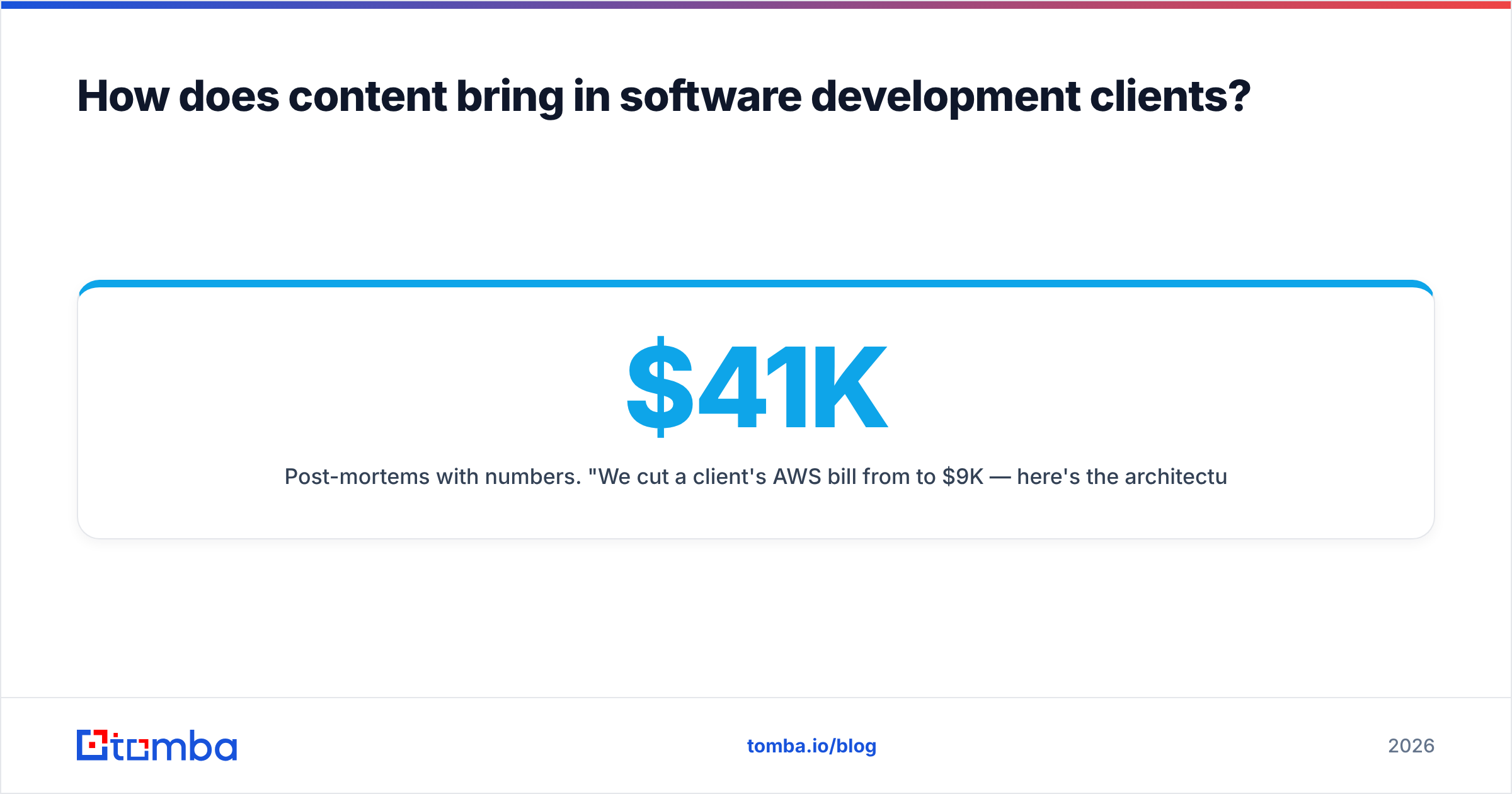
- Post-mortems with numbers. "We cut a client's AWS bill from $41K to $9K per month — here's the architecture change." These get shared inside target companies.
- Opinionated technology comparisons. Real trade-offs, real failure modes, no fence-sitting. Engineers trust writing that admits downsides.
- Open source with a business edge. A well-maintained library in your niche is a permanent lead magnet. It also proves code quality in a way no case study can.
- Founder-led LinkedIn. The founder's personal profile outperforms the company page by 5-10x on reach. Post three times a week about client problems you solved, not company milestones.
- Comparison and buyer-intent SEO. "Shopify app development agency" converts. "What is software development" does not. Chase the pages a buyer reads with a credit card nearby.
Content compounds, but it takes 6-12 months to produce real pipeline. Run it next to outbound, not instead of it. One useful hybrid: when you publish something technical, find the article author of related pieces and other engineering leaders, then send a short note that references your work. That converts far better than a cold pitch, because you lead with something they can use.
What about partnerships and referral engineering?#
Partnerships are the most underrated channel for dev shops. The trust problem is already solved by someone else.
Three partner types worth pursuing:
- Design and product agencies. They win the discovery work and need someone to build. One strong relationship with a 30-person product studio can produce $500K a year with zero marketing spend. Offer a 10-15% referral fee or a clean white-label deal.
- Platform ecosystems. Certified partner programs — HubSpot, Salesforce, Shopify, AWS — put you in a directory buyers already search. Certification takes weeks, not months, and the leads arrive pre-qualified.
- Adjacent consultancies. Fractional CTOs, VC talent partners, and RevOps consultants sit next to buyers who need engineering and do not compete with you.
Make referrals systematic instead of hopeful. Set a quarterly cadence. Every closed project ends with a documented ask ("who else on your team owns a system like this?"). Every past client gets a real check-in at 90 days. Every partner gets a monthly note with something useful in it. Log all of it in your CRM with next-action dates, or it will not happen.
How do you qualify leads so you stop wasting time?#
Most dev shops lose more money to bad-fit clients than to a thin pipeline. Score every opportunity against five criteria before you write a proposal:
- Budget reality. Have they bought software development before, and at what price? A first-time buyer with a $20K budget for a $200K scope will eat your team alive.
- Decision path. Who signs? If your champion cannot name the approver, you are in a research project, not a deal.
- Technical fit. Does the work sit inside the niche you want more of? Off-niche work dilutes the positioning that generates your next lead.
- Timeline honesty. "ASAP" with no start date means no budget yet. Ask what happens if the project starts in six months. If the answer is "nothing", it is not a real project.
- Replaceability. Are you one of five bids, or the only firm they called? One of five means you win on price.
Disqualify fast, and say so directly. Agencies that decline work read as confident and get referred more, not less.
What does a realistic 90-day plan look like?#
If you are starting from nothing but a delivery team and a bad website:
Days 1-15. Pick one niche. Rewrite your homepage and LinkedIn around it. Write two case studies with real numbers. Buy a secondary sending domain and start warming it.
Days 16-45. Build a 300-account target list around one trigger. Find and verify the contacts. Launch a four-step sequence at 40 sends a day. At the same time, ask every past client for a Clutch review and a referral introduction.
Days 46-75. Iterate copy every week based on reply rate, not open rate. Start founder-led LinkedIn posts three times a week. Open talks with three design-agency partners.
Days 76-90. Review the channel data. Kill nothing yet — 90 days is barely one buying cycle for a $100K deal. Double down on whichever channel produced conversations. Then add bulk lead generation workflows to scale the list-building step you have now proven.
Expect your first two months to look like failure. The agencies that build durable pipelines run the same motion for six months, while their competitors change strategy every four weeks.
Where should you start today?#
Start with the list. Every channel above eventually needs one: outbound needs contacts, partnerships need the right people at the right firms, and content needs someone to send it to.
Tomba's Tomba Email Finder gives you verified professional email addresses by name, domain, or company. The free tier covers 25 searches a month, so you can test the data before you commit. Paid plans start at $49/mo (Starter), $99/mo (Growth), and $249/mo (Pro) — see Tomba pricing for full credit allowances. Build your first 100-account list this week, verify it, and send. The pipeline problem is solvable. It just requires starting before you feel ready.
Related guides#
// get started
Find, verify and enrich your first contacts today
Start on the free plan with 25 searches a month, then scale when your team is ready.
Free plan · No credit card required · GDPR & CCPA
Get the Tomba newsletter
Product and data updates
// about the author