How to Get Clients for Web Development: 12 Proven Channels
Cold outreach, referrals, marketplaces, or partner channels? Here's a channel-by-channel breakdown of what actually books web development clients in 2026, with real cost and time-to-first-deal numbers.
TL;DR
- Referrals and repeat work close fastest but do not scale on demand — treat them as your base, not your growth plan.
- Targeted cold email to companies with visible website problems is the only channel you can turn on this week and control the volume of.
- Upwork and Fiverr fill an empty calendar but train buyers to compare you on price; use them as a bridge, not a business model.
- Partner channels (agencies, designers, marketing consultants) produce the highest-value contracts per hour invested.
- The bottleneck is almost never "how to get clients for web development" as a tactic — it is having a specific, verified list of decision-makers to contact.
Why is getting web development clients so hard right now?#
Because supply exploded and the obvious channels got saturated at the same time.
The freelance developer pool grew every year while AI site builders compressed the low end of the market. A $1,500 brochure site is no longer an easy sell — the prospect can get something passable from a template in an afternoon. Meanwhile the $15,000 to $80,000 projects (headless commerce, custom app work, performance rescue jobs, migration off a legacy CMS) are still very much alive and still hard to fill, because the buyers for those projects are not browsing freelance marketplaces.
That gap is the whole game. The clients worth having are not looking for you. You have to go find them.
Which means the practical question is not "how do I market myself" in the abstract. It is: which channel puts me in front of a person who has budget, a problem I can fix, and the authority to sign — for the least amount of my time?
What are the 12 channels that actually book web development work?#
Here they are, grouped by how much control you have over volume.
You control the volume (outbound):
- Cold email to companies with visible site problems — the site is slow, broken on mobile, running an EOL CMS, or missing schema markup. You lead with the specific defect, not with "I build websites."
- LinkedIn outreach to founders and marketing leads — softer than email, lower volume, better for larger contracts. See our notes on LinkedIn outreach for cadence structure.
- Local business walk-in / phone — unglamorous, still works in markets under 500k people, near-zero competition.
- Job-board arbitrage — companies posting for a full-time front-end dev often have a backlog they would happily contract out instead. Reply to the hiring manager, not the ATS.
Someone else controls the volume (inbound and partner):
- Referrals from past clients — highest close rate of any channel, roughly 3x cold outreach in most freelancer surveys.
- Agency subcontracting — design studios and marketing agencies constantly need dev capacity they don't want to hire for.
- Complementary-service partners — SEO consultants, copywriters, brand designers. They see the site problems before you do.
- Marketplaces (Upwork, Toptal, Contra) — fast to start, competitive on price, useful for filling gaps.
- Content and SEO — ranking for "shopify developer [city]" or "webflow to next.js migration" pays for years but takes six to twelve months to start.
- Community presence — Slack groups, indie hacker forums, local meetups, open-source contributions.
- Productized offers — "Core Web Vitals audit, $900, five business days." Turns a vague sale into a checkout.
- Directories and platform partner listings — Shopify Partners, Webflow Experts, WordPress VIP. Free traffic if you qualify.
Most developers who complain about a dry pipeline are running exactly one of these, badly, and it is usually number 8.
Which client acquisition channel is right for your situation?#
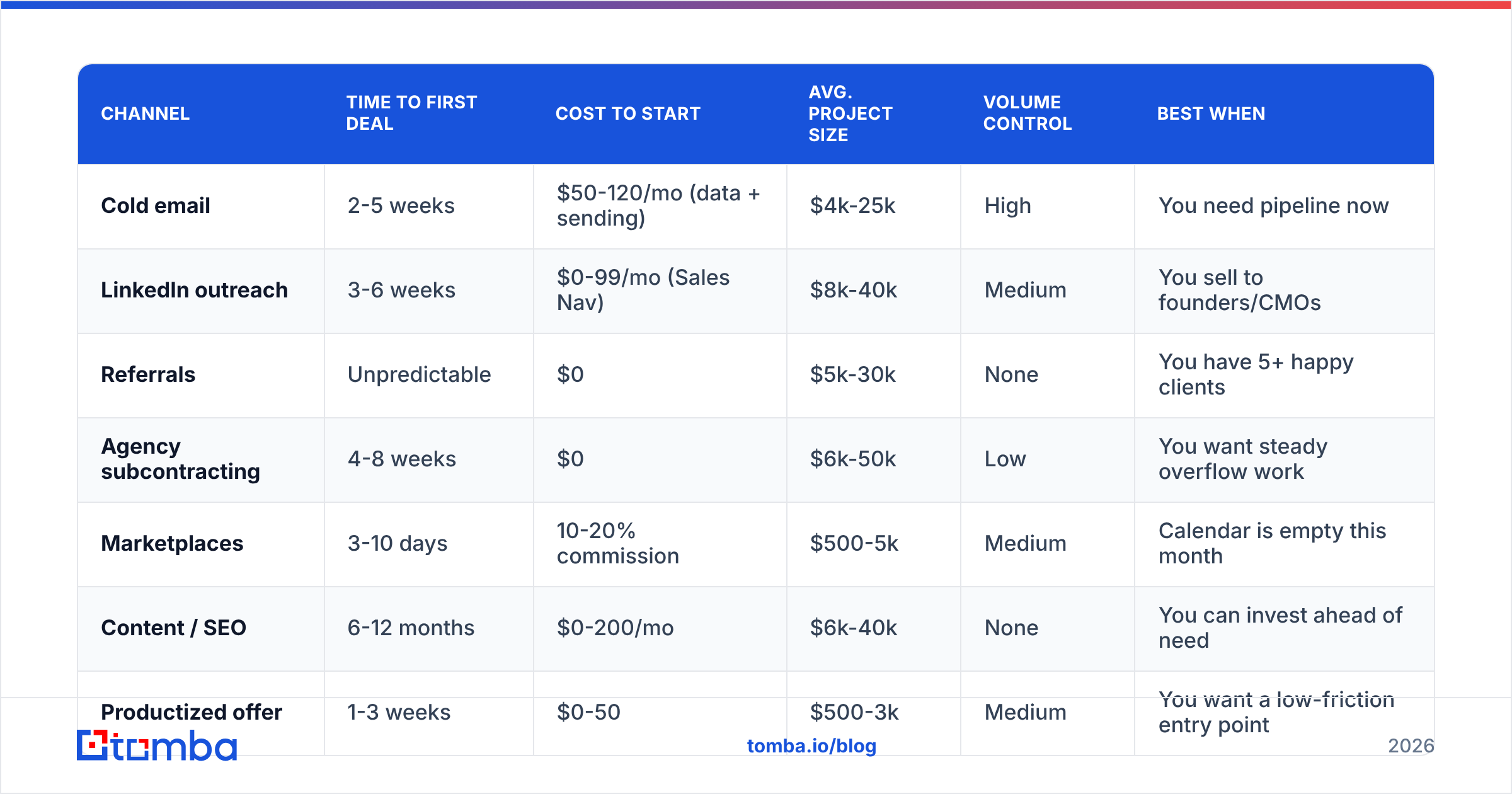
Pick based on how fast you need revenue and how much time you can spend per week.
| Channel | Time to first deal | Cost to start | Avg. project size | Volume control | Best when |
|---|---|---|---|---|---|
| Cold email | 2-5 weeks | $50-120/mo (data + sending) | $4k-25k | High | You need pipeline now |
| LinkedIn outreach | 3-6 weeks | $0-99/mo (Sales Nav) | $8k-40k | Medium | You sell to founders/CMOs |
| Referrals | Unpredictable | $0 | $5k-30k | None | You have 5+ happy clients |
| Agency subcontracting | 4-8 weeks | $0 | $6k-50k | Low | You want steady overflow work |
| Marketplaces | 3-10 days | 10-20% commission | $500-5k | Medium | Calendar is empty this month |
| Content / SEO | 6-12 months | $0-200/mo | $6k-40k | None | You can invest ahead of need |
| Productized offer | 1-3 weeks | $0-50 | $500-3k | Medium | You want a low-friction entry point |
| Partner directories | 1-4 months | $0-500/yr | $10k-60k | None | You specialize in one platform |
The pattern most sustainable freelance and small-agency operators land on: outbound for control, referrals for margin, one long-horizon inbound bet running quietly in the background. Marketplaces get cut once the first two are working.
How do you build a target list of web development clients?#
This is the step that separates people who "tried cold email and it didn't work" from people who book two discovery calls a week.
You are not looking for "small businesses." You are looking for companies with a trigger — an observable signal that they have a web problem and money to fix it.
Good triggers for web dev work:
- They just raised funding. Series A companies rebuild their marketing site within six months, almost without exception. Crunchbase and press releases are free.
- They are hiring for web roles. A posting for "WordPress developer" or "front-end engineer, contract" means budget was already approved.
- Their site fails a technical check. Run their domain through PageSpeed Insights. Under 40 on mobile is a conversation starter with a number attached.
- Their stack is dated or mid-migration. A website tech stack check that shows Magento 1, AngularJS, or an unpatched WordPress version is a live opportunity.
- They just launched a product or opened a location. New offering, old site, obvious mismatch.
- They advertise heavily but convert badly. If they are running Google Ads onto a page that loads in six seconds, you are selling money, not code.
Once you have the company list, you need the human. Titles that actually sign web development contracts: Founder/CEO (companies under 50 people), Head of Marketing or Marketing Director (50-500), Director of Digital / E-commerce Manager (retail and DTC), CTO or Head of Engineering (only when the project is integration-heavy).
Then you need their address. Guessing firstname@company.com and hoping is how you get a 30% bounce rate and a burned domain. Use a domain search to pull the verified contacts on a company domain, or a email finder when you already have a name from LinkedIn. Run everything through an email verifier before it enters your sequence — bounce rate above 3% is what triggers email deliverability problems that take weeks to unwind.
For a batch of 200 target companies, the workflow is: build the company list from triggers → pull decision-maker contacts via domain search → verify → export to your sending tool. That is an afternoon of work, not a week.
What does a cold email that books web development calls look like?#
Short, specific to their site, and asking for a low-commitment next step.
The structural rule: the first sentence must prove you looked at their website. Everything else is negotiable.
Here is the shape that works:
Subject: mobile load time on [domain]
Hi [Name] — ran [domain] through PageSpeed this morning, mobile scored 34. The main hit is four uncompressed hero images (2.1MB total) loading before anything renders.
We fixed the same thing for [similar company] last quarter — their mobile bounce rate dropped from 61% to 44% in three weeks.
Want me to send the full breakdown of what's slowing yours down? No charge, takes me about 20 minutes to put together.
[Your name]
Why it works: the number is verifiable, the diagnosis is specific enough that they know you actually looked, the proof point is adjacent, and the ask is a free document rather than a call. You can grade your own drafts against a spam checker before you send at volume.
What kills these emails: attachments, more than one link, the word "solutions," a calendar link in the first message, and any sentence that starts with "I hope this email finds you well."
Follow up three times over ten days. Roughly half of all replies to cold sequences arrive after the first message, and most developers quit after one send. According to HubSpot's sales research, the majority of sales require multiple follow-ups while the majority of reps send fewer than two.

Is referral marketing better than outbound for developers?#
Better close rate, worse reliability. You need both, and you need to stop treating referrals as something that happens to you.
Referred prospects close at meaningfully higher rates than cold ones and negotiate less on price, because the trust transfer already happened. The problem is timing — you cannot generate three referrals in the week your pipeline empties.
Make referrals systematic instead:
- Ask at the moment of visible success, not at project close. The day their Core Web Vitals go green, or the day their first order comes through the new checkout, is when they feel it.
- Ask for a specific introduction, not a general recommendation. "Do you know anyone who might need a developer?" gets nothing. "You mentioned your friend at [company] just rebranded — would an intro make sense?" gets a reply.
- Stay in the inbox after the invoice clears. A quarterly two-line email checking on site performance keeps you top of mind and frequently surfaces phase-two work.
- Pay for referrals openly. 10% of first project value to anyone who sends a closed deal. Designers and SEO consultants will take that arrangement all day.
Also mine your existing network before you go cold. Export your LinkedIn connections, filter for anyone at a company between 10 and 500 employees, and check whether their site has a problem worth flagging. A LinkedIn finder turns those profiles into contactable emails so you can reach people outside LinkedIn's message limits.
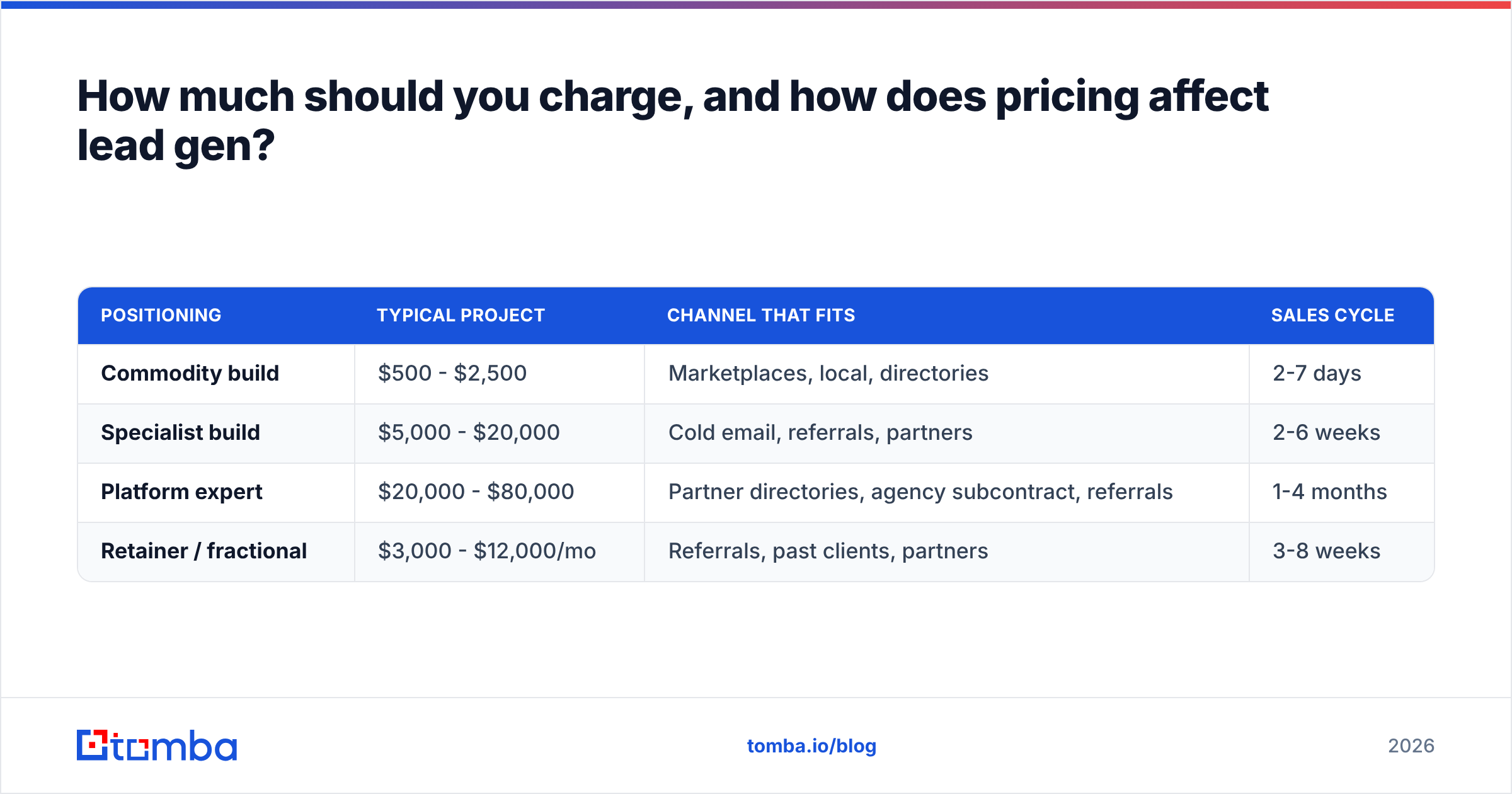
How much should you charge, and how does pricing affect lead gen?#
Your price determines which channel works, not the other way around.
| Positioning | Typical project | Channel that fits | Sales cycle |
|---|---|---|---|
| Commodity build | $500 - $2,500 | Marketplaces, local, directories | 2-7 days |
| Specialist build | $5,000 - $20,000 | Cold email, referrals, partners | 2-6 weeks |
| Platform expert | $20,000 - $80,000 | Partner directories, agency subcontract, referrals | 1-4 months |
| Retainer / fractional | $3,000 - $12,000/mo | Referrals, past clients, partners | 3-8 weeks |
If you charge $1,200 per site, cold outreach cannot pay for itself — you'd need a 20% reply rate to cover the hours. That is why marketplace sellers stay on marketplaces. Raising your price is often the actual unlock for outbound, not better copy.
The fastest way to move up a tier is to specialize on a platform or a problem, not on an industry. "Shopify Plus checkout performance" is a sellable position. "Websites for small businesses" is not.
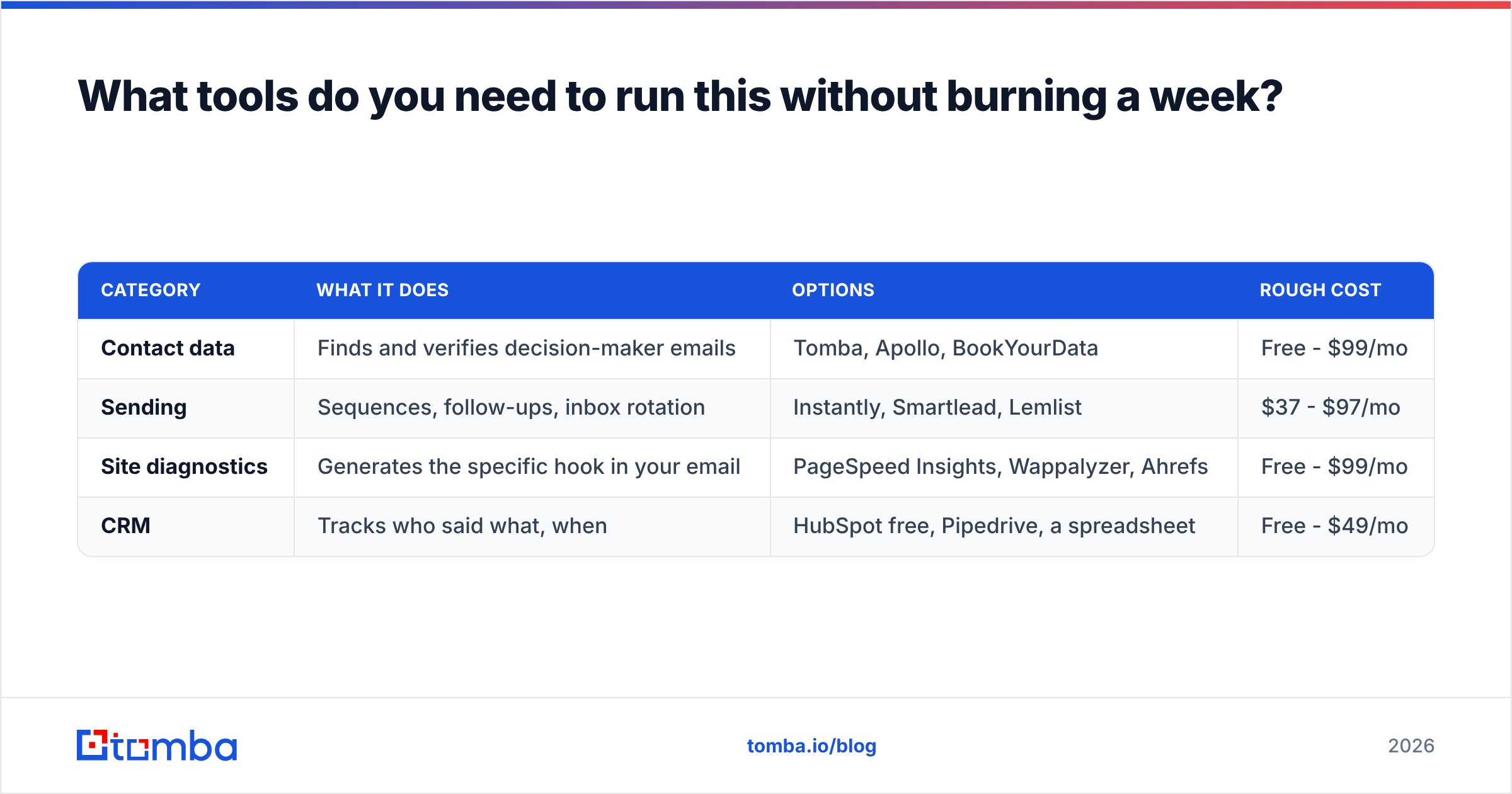
What tools do you need to run this without burning a week?#
Keep the stack small. Four categories cover everything.
| Category | What it does | Options | Rough cost |
|---|---|---|---|
| Contact data | Finds and verifies decision-maker emails | Tomba, Apollo, BookYourData | Free - $99/mo |
| Sending | Sequences, follow-ups, inbox rotation | Instantly, Smartlead, Lemlist | $37 - $97/mo |
| Site diagnostics | Generates the specific hook in your email | PageSpeed Insights, Wappalyzer, Ahrefs | Free - $99/mo |
| CRM | Tracks who said what, when | HubSpot free, Pipedrive, a spreadsheet | Free - $49/mo |
On the data side: Tomba pricing starts free at 25 searches per month, which is enough to test the channel before committing, then $49/mo for Starter and $99/mo for Growth once volume justifies it. BookYourData is a solid pay-as-you-go option if you prefer buying a verified list outright rather than searching domain by domain — different model, same goal. Apollo bundles data with sequencing, which is convenient but locks you into their sender. Compare on G2 before you commit annually.
If you already keep prospects in a spreadsheet, the Google Sheets add-on will fill in emails next to your company list without a CSV round-trip. For higher volume, the bulk email finder processes a whole list at once, and the Tomba API drops it into any script you already run.
Skip: proposal software (a Google Doc is fine until $30k deals), a second CRM, and anything that promises to "automate your entire outbound" — automated personalization at scale reads like automated personalization at scale.
What is a realistic 30-day plan to book your first three clients?#
Week 1 — build the list. Pick one niche and one trigger. Example: DTC brands on Shopify that raised funding in the last 12 months. Assemble 150 companies. Pull and verify decision-maker emails. Run each domain through PageSpeed and note the score in a column.
Week 2 — start sending. 25 emails per day, each with the target's own PageSpeed number in the first line. Three-message sequence over ten days. Meanwhile, message 20 past clients and network contacts with a specific ask.
Week 3 — handle replies, keep sending. Expect 3-8% reply rate on well-researched outbound at this volume. Every positive reply gets the free audit within 24 hours. Every audit ends with a scoped fixed-price offer.
Week 4 — close and compound. Convert audits into proposals. Ask every new client, at signature, whether they know one other company with the same problem. Add the two partner conversations (one designer, one SEO consultant) you have been putting off.
Three hundred emails, twenty warm messages, two partner conversations. That is enough activity to produce one to three closed projects in most B2B niches. It is not a growth hack — it is just volume applied to a list that was built properly.
Where should you start this week?#
Start with the list, not the pitch. Nearly every stalled web development pipeline traces back to the same root cause: the developer is writing to people whose addresses they guessed, at companies chosen because they happened to appear in a search.
Pick your niche, define one trigger you can verify from the outside, and build 150 rows before you write a single email. Then find the real decision-makers behind those domains with the Tomba Email Finder — start on the free tier at 25 searches to validate that your niche replies, then scale to Starter at $49/mo once the numbers hold. The clients worth having are already out there with broken sites and approved budgets. They just need you to email the right person first.
Related guides#
// get started
Find, verify and enrich your first contacts today
Start on the free plan with 25 searches a month, then scale when your team is ready.
Free plan · No credit card required · GDPR & CCPA
// about the author