How to Get Clients for Your Agency: 9 Proven Channels
Referrals dry up. Cold outbound scales. Here is a channel-by-channel breakdown of how agencies actually win clients in 2026 — with costs, ramp times, and the numbers behind each play.
TL;DR
- Referrals get most agencies to their first 8-12 clients, then flatten. Every agency that grows past that adds a channel it can control.
- The three channels with the best cost-to-ramp ratio for agencies under $2M: targeted cold email, partner/white-label referrals, and narrow-niche content.
- Cold outbound only works if your list is accurate. A 12% bounce rate will kill the domain you spent three months warming.
- Productize one offer with a fixed price before you prospect. "We do marketing" converts at a fraction of "We rebuild Shopify checkout flows for $8K."
- Pick two channels. Run them for 90 days with tracked numbers. Kill the loser, double the winner.
Why do most agencies stall at the same client count?#
Because the first clients came from a network, and networks are finite.
Think of it like fishing off a private dock. For the first year, the dock is stocked — old colleagues, former employers, the guy from that conference. You catch fish without a boat. Then the dock empties, and you discover you never learned to navigate open water.
The data backs the pattern. HubSpot's research on agency growth consistently shows referral-dependent firms hitting a revenue ceiling once their founder's personal network is exhausted, usually somewhere between $300K and $800K in annual billings. The agencies that break through are not better at delivery. They just built a repeatable acquisition motion that does not depend on who they already know.
The rest of this post is that motion, broken into channels you can actually pick from.

What are the 9 channels agencies actually use to get clients?#
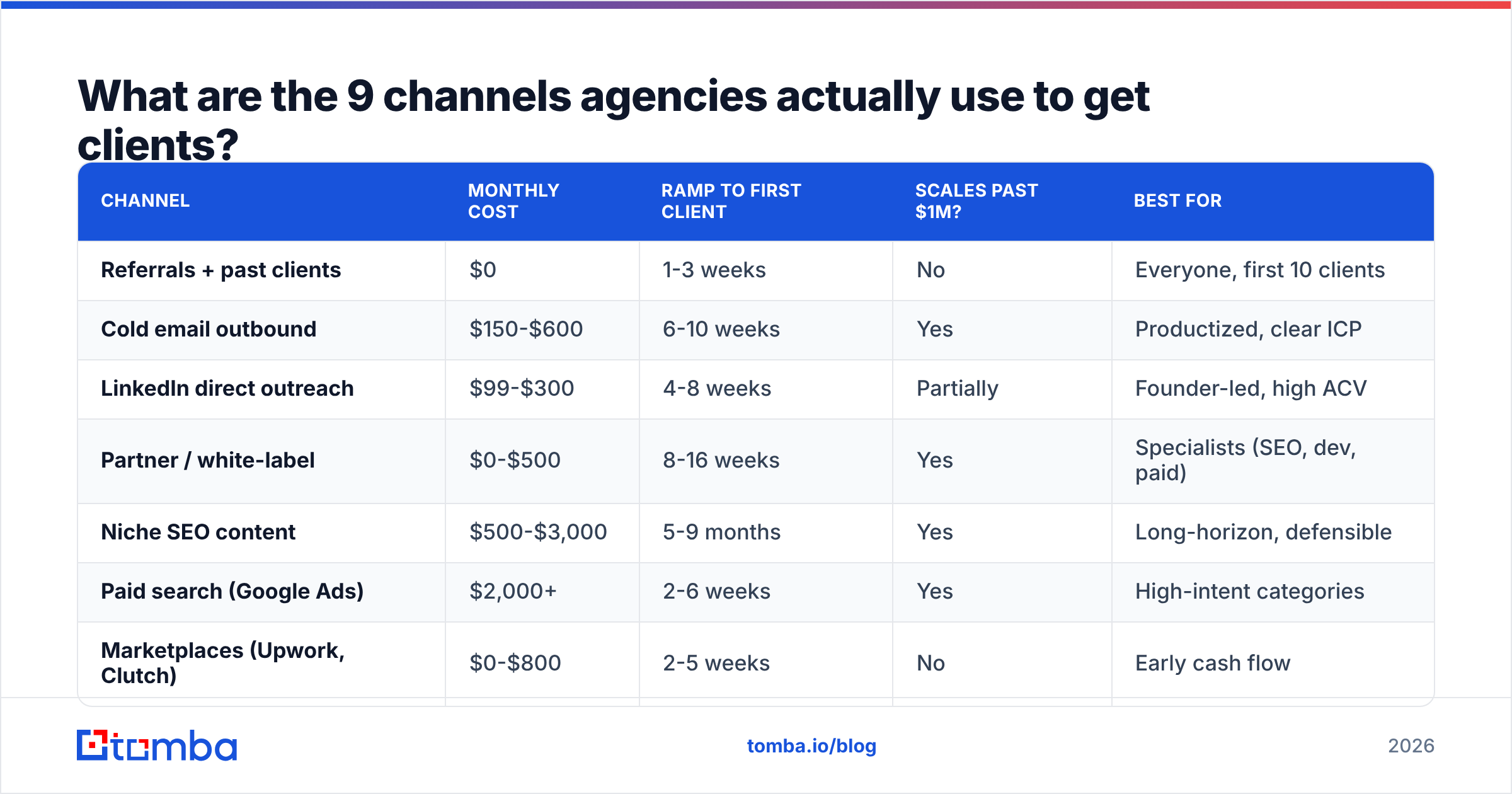
Here is the honest comparison. Cost is monthly spend excluding your own time. Ramp is how long before the first signed client, assuming competent execution.
| Channel | Monthly cost | Ramp to first client | Scales past $1M? | Best for |
|---|---|---|---|---|
| Referrals + past clients | $0 | 1-3 weeks | No | Everyone, first 10 clients |
| Cold email outbound | $150-$600 | 6-10 weeks | Yes | Productized, clear ICP |
| LinkedIn direct outreach | $99-$300 | 4-8 weeks | Partially | Founder-led, high ACV |
| Partner / white-label | $0-$500 | 8-16 weeks | Yes | Specialists (SEO, dev, paid) |
| Niche SEO content | $500-$3,000 | 5-9 months | Yes | Long-horizon, defensible |
| Paid search (Google Ads) | $2,000+ | 2-6 weeks | Yes | High-intent categories |
| Marketplaces (Upwork, Clutch) | $0-$800 | 2-5 weeks | No | Early cash flow |
| Communities + Slack groups | $0-$200 | 6-12 weeks | No | Trust-heavy niches |
| Events + local meetups | $300-$2,000 | 3-6 months | No | Regional, enterprise |
Two things jump out. First, nothing that scales past $1M ramps in under six weeks. Second, the cheap channels are cheap because they cost your time instead of your money — that is not free, it is just off the P&L.
How do you pick which channels to run first?#
Match the channel to two variables: your average contract value and how specific your offer is.
- Under $5K ACV, vague offer — Fix the offer first. No channel rescues "full-service digital marketing." Productize one deliverable with a fixed price and a fixed timeline.
- Under $5K ACV, specific offer — Marketplaces and communities. The economics of cold outbound rarely clear at low ACV unless you can automate almost everything.
- $5K-$25K ACV, specific offer — Cold email plus LinkedIn. This is the sweet spot. Enough contract value to justify the list-building cost, small enough that buyers decide in one or two calls.
- $25K-$100K ACV — Partner channels and targeted outbound to a named account list of 200-400 companies. Volume stops mattering; account research starts mattering.
- $100K+ ACV — Events, executive networking, and analyst relationships. Gartner and Forrester coverage moves deals in this bracket in a way it does not lower down.
- Any ACV, 12+ month horizon — Layer niche content underneath whatever else you run. It compounds while the outbound pays this quarter's bills.
Most agencies reading this land in bucket 3 or 4. That is why the next two sections go deep on outbound.
How do you build a cold outbound engine that actually books calls?#
Four parts, in order. Skip one and the whole thing underperforms.
1. Define the ICP narrowly enough to be uncomfortable.
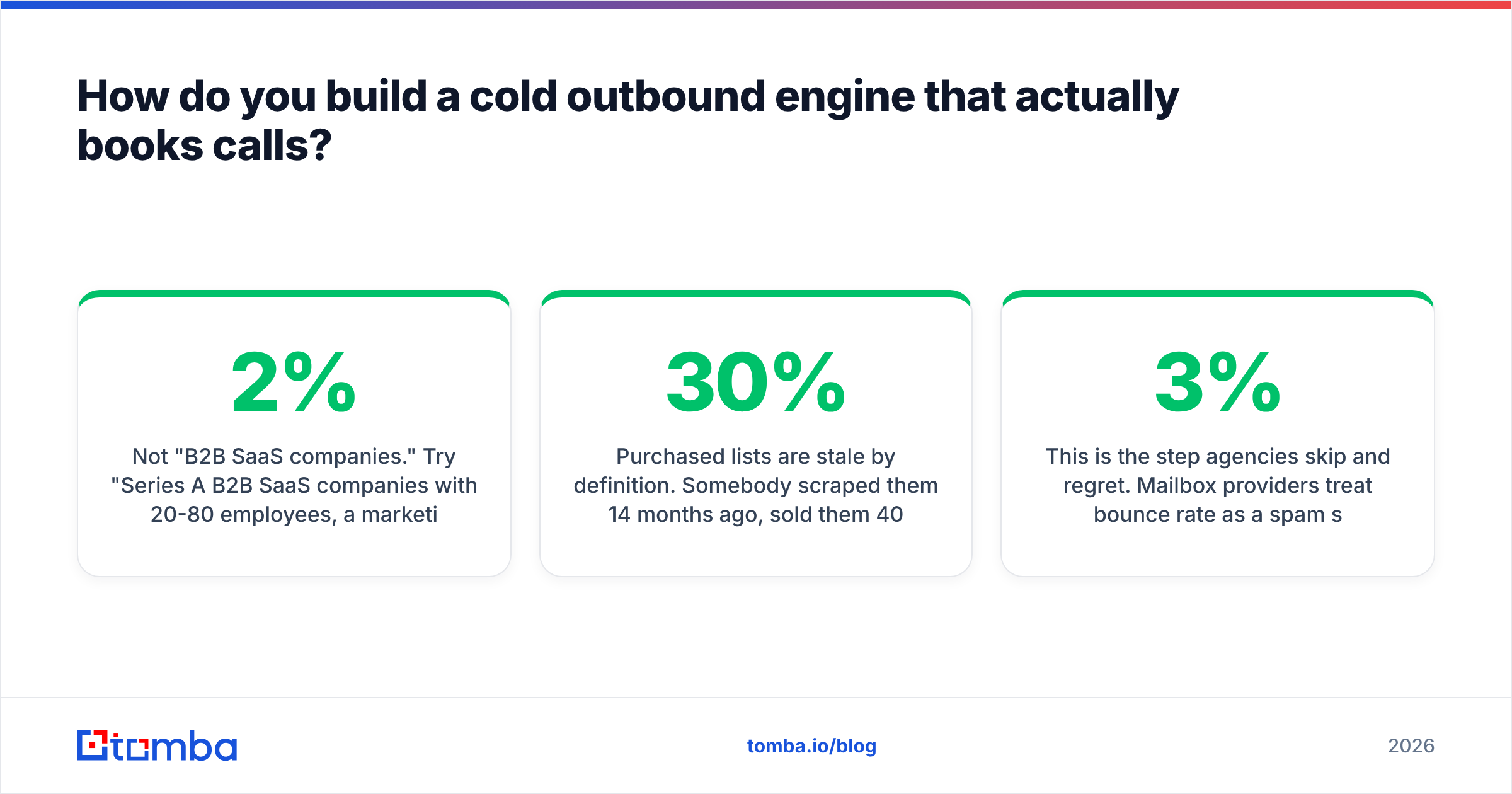
Not "B2B SaaS companies." Try "Series A B2B SaaS companies with 20-80 employees, a marketing team of 2-5, using HubSpot, whose blog has published fewer than four posts in the last 90 days." That last clause is a trigger — a reason to reach out now. Triggers are what separate a 2% reply rate from a 9% one.
2. Build the list from primary sources, not a bought CSV.
Purchased lists are stale by definition. Somebody scraped them 14 months ago, sold them 40 times, and the contacts have churned at the standard B2B rate of roughly 25-30% per year. Build instead: identify target companies, then find the specific decision-maker's address with a domain search to pull verified addresses per company, or use an email finder when you already have a name and a company.
3. Verify before you send. Every time.
This is the step agencies skip and regret. Mailbox providers treat bounce rate as a spam signal. Cross roughly 3% and your sender reputation starts sliding; cross 8-10% and you are in the folder nobody opens. Run the list through an email verifier and drop anything that comes back risky or unknown. A 500-contact clean list beats a 5,000-contact dirty one, and it costs less.
4. Write sequences that reference something specific.
Three to four emails over 12 days. First email: one observation about their business, one sentence on what you do, one soft ask. No case study dump. No calendar link in email one. The follow-ups add a proof point each and stay under 90 words.
The whole engine, once built, runs on maybe four hours a week. The build is the hard part.
What does the outbound math actually look like?#
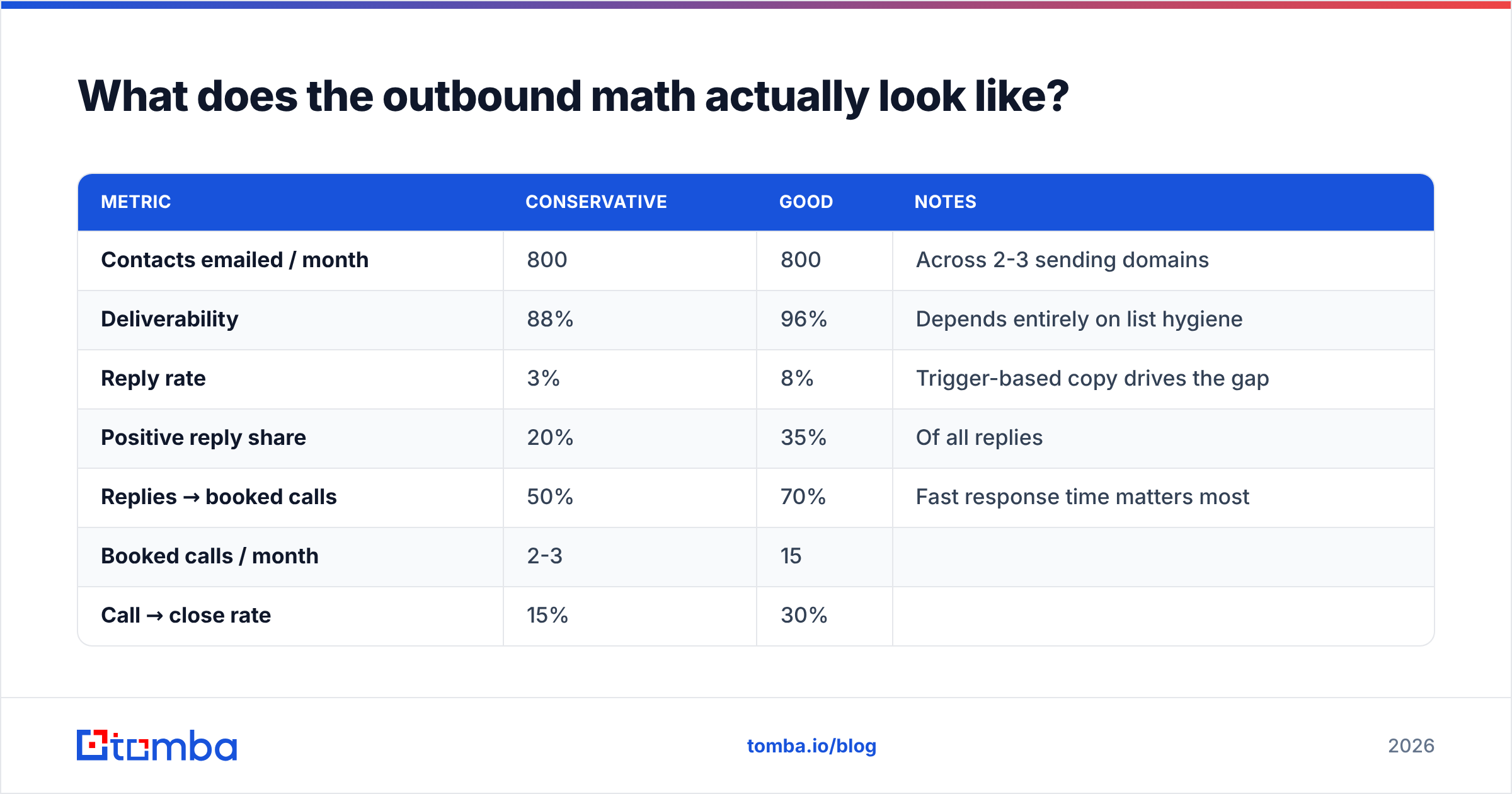
Run the numbers before you commit, because they are less forgiving than most agency owners expect.
| Metric | Conservative | Good | Notes |
|---|---|---|---|
| Contacts emailed / month | 800 | 800 | Across 2-3 sending domains |
| Deliverability | 88% | 96% | Depends entirely on list hygiene |
| Reply rate | 3% | 8% | Trigger-based copy drives the gap |
| Positive reply share | 20% | 35% | Of all replies |
| Replies → booked calls | 50% | 70% | Fast response time matters most |
| Booked calls / month | 2-3 | 15 | |
| Call → close rate | 15% | 30% | |
| New clients / month | ~0.4 | ~4.5 |
At a $9K average contract, the "good" column is roughly $40K in new monthly revenue from a channel costing you a few hundred dollars in tooling. At the conservative column, you are signing one client per quarter and questioning your life choices.
The single biggest lever between those columns is list quality. Deliverability and reply rate both hinge on it, and they multiply.

Are partner and white-label channels better than direct outbound?#
They are slower to start and better once running — different tool, different job.
A partner channel means another agency sends you work they cannot or will not do. A web dev shop that gets asked for SEO. A brand studio that gets asked for paid media. Their client already trusts them, so the trust transfers to you at close to zero acquisition cost.
What makes it work:
- Pick complementary, not adjacent. If they could plausibly hire one person to do what you do, they eventually will. If it needs a team, they will keep referring.
- Make the referral mechanically easy. A one-page scope doc, a fixed price, and a 24-hour response SLA. Partners refer to whoever makes them look competent fastest.
- Pay or reciprocate, explicitly. 10-15% of first-year revenue, or a reciprocal pipeline. Vague gratitude does not sustain a channel.
- Target 6-10 active partners. Fewer and you are exposed to one relationship; more and you cannot maintain any of them.
Finding partners is itself an outbound problem. Identify agencies in complementary categories, find the founder or head of partnerships, and pitch the mechanics rather than the vibe. Tomba's LinkedIn finder works well here because agency founders are more reachable through their LinkedIn presence than a generic info@ inbox.
One caution on where partners come from: directories like G2 and Clutch list thousands of agencies with their service categories and client sizes already segmented. That is a partner list, pre-qualified, sitting in public.
How should you use content and SEO without waiting a year?#
Narrow the topic until you can win it in 90 days, not 12 months.
Most agencies write "10 Tips for Better Marketing" and wonder why it never ranks. The competition for broad terms is every agency plus every SaaS content team plus HubSpot. You will not win that.
Instead, write for the search that only your exact buyer performs:
- Comparison posts inside your niche: "Shopify Plus vs. BigCommerce for subscription brands"
- Pricing and cost posts: "What does a Klaviyo migration actually cost?"
- Process posts: "How we cut checkout abandonment 22% for a $4M DTC brand"
- Tool-specific troubleshooting your buyer is Googling at 11pm
These get 40-300 visits a month, not 40,000. But the conversion rate is 10-20x a generic post because the intent is exact. Twelve of those beats one viral piece nobody buys from.
Publish weekly for a quarter. If nothing ranks and nothing converts by month five, the niche is too competitive and you should redirect the budget to outbound.
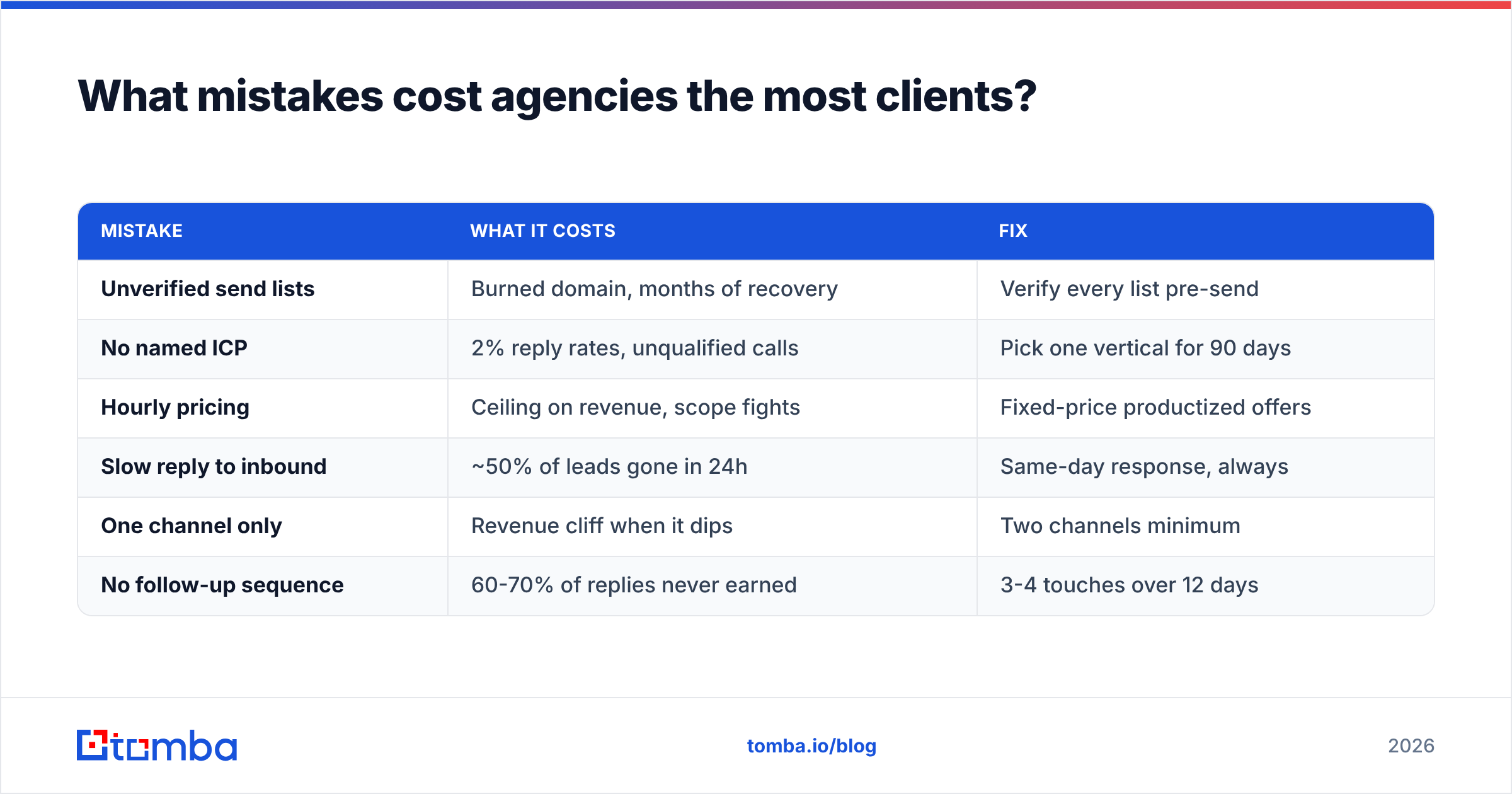
What mistakes cost agencies the most clients?#
Ranked by how much damage they do relative to how easy they are to fix.
| Mistake | What it costs | Fix |
|---|---|---|
| Unverified send lists | Burned domain, months of recovery | Verify every list pre-send |
| No named ICP | 2% reply rates, unqualified calls | Pick one vertical for 90 days |
| Hourly pricing | Ceiling on revenue, scope fights | Fixed-price productized offers |
| Slow reply to inbound | ~50% of leads gone in 24h | Same-day response, always |
| One channel only | Revenue cliff when it dips | Two channels minimum |
| No follow-up sequence | 60-70% of replies never earned | 3-4 touches over 12 days |
The reply-speed one deserves emphasis. Research summarized by HubSpot has consistently found that response time is among the strongest predictors of whether an inbound lead converts at all. An agency that answers in an hour beats a better agency that answers in two days.
How do you keep the pipeline full once it works?#
Treat acquisition as an operating rhythm, not a campaign.
Weekly: Add 150-250 new verified contacts to the outbound list. Review replies within one business day. Publish one piece of niche content.
Monthly: Check bounce rate and reply rate against last month. Re-verify any contact record older than 90 days — B2B data decays fast, and a list that was clean in January will not be in June. Data enrichment on your existing CRM records catches role changes before they turn into bounces.
Quarterly: Kill the worst-performing channel. Add one new one. Raise prices on new contracts by 10% if you closed above 30% last quarter — a high close rate means you are underpriced.
Annually: Re-examine the ICP. The clients you enjoyed and profited from most last year are probably a narrower group than the one you have been targeting.
Which channel should you start with this week?#
If you have fewer than 10 clients and a specific offer: cold email. It is the fastest controllable channel, the cost is low, and the feedback loop is measured in days rather than quarters.
If your offer is still vague: spend this week productizing it. Name it, price it, scope it. Then come back to the channel question.
Everything in outbound rests on reaching real people at real addresses. Start with Tomba's Email Finder to build your first 500-contact target list from verified sources rather than a resold CSV — the free tier gives you 25 searches to test your ICP before committing, and Tomba pricing starts at $49/mo on Starter when you are ready to scale the list. Build it clean once, and every other channel you add on top performs better.
Related guides#
Ready to find emails that actually work?
Join 150,000+ professionals who stopped guessing and started sending. Free credits on signup — no credit card required.
Get the Tomba newsletter
Practical outbound tactics and product updates — once every two weeks.
About the author