How to Get Corporate Clients in 2026: A 7-Step Playbook
Corporate clients don't come from cold luck. Here's the 7-step system for finding buying committees, reaching the right decision-makers, and closing five-figure enterprise contracts.
TL;DR
- Corporate clients are won by working accounts, not leads. A single enterprise deal typically involves 5-11 people, so one contact is never enough.
- Pick 50-200 named accounts with a written fit thesis before you send a single email. Broad lists produce broad rejection.
- Map the buying committee — economic buyer, champion, technical evaluator, procurement, security — and get verified contact data for each one.
- Lead with a business-case-shaped message (cost, risk, revenue), not a feature list. Corporate buyers approve budget, not products.
- Expect 3-9 month cycles, security reviews, and procurement. Build the pipeline math backwards from that.
What actually counts as a "corporate client"?#
A corporate client is an organization where the person who feels the pain is not the person who signs the check. That's the whole definition, and it's the only one that changes how you sell.
When you sell to a 12-person startup, the founder is the pain, the budget, and the signature. When you sell to a 4,000-person logistics company, the ops manager feels the pain, a VP owns the budget, IT owns the security review, legal owns the contract, and procurement owns the price. Learning how to get corporate clients is mostly learning how to serve five different people who all have veto power and none of whom have the same success metric.
That separation drives everything else in this playbook:
- Longer cycles. 3-9 months is normal for a first enterprise contract. Anything under 60 days is usually a departmental purchase disguised as an enterprise one.
- Higher contract values. Deals that justify the cycle length typically start in the $25K-$100K annual range. Below that, the buying process costs more than the deal.
- More stakeholders. Gartner's widely-cited B2B buying research puts the typical committee at six to ten people, each bringing four or five independently sourced pieces of information to the table.
- Documented risk review. Security questionnaires, SOC 2 requests, insurance certificates, vendor onboarding forms. These are gates, not formalities.
- Referenceability pressure. Corporate buyers ask "who else your size uses this?" before they ask about your features.
If your current offer, pricing, and operational maturity can't absorb those five realities, the fastest path to corporate clients is fixing the offer first — not sending more email.
How do you pick the right accounts to target?#
Start with 50-200 named accounts, not an industry. This is the single highest-leverage decision in the whole process, and most sellers skip it because building a list feels like real work while choosing a list feels like procrastination.
Write a one-paragraph fit thesis before you build anything:
"We win at 500-5,000 employee manufacturers in North America that run SAP and have hired a Supply Chain Analytics lead in the last 12 months, because our integration removes 20 hours a week of manual reconciliation that only exists at that scale."
That paragraph gives you filters — headcount, geography, tech stack, hiring signal — and it gives you the first line of your outreach. If you can't write it, you don't have a target market yet; you have a hope.
Then score each account against four dimensions:
- Pain intensity — is the problem you solve costing them money this quarter, or is it a nice-to-have on a 2027 roadmap?
- Budget authority — does a budget line already exist for this category, or are you asking someone to create one? Creating one adds months.
- Trigger events — new executive hire, funding round, acquisition, regulatory deadline, public product launch, or a competitor migration. Triggers compress cycles more than any subject line will.
- Access — do you have a warm path in via an investor, customer, former colleague, or community? A warm path is worth ten cold ones.
Anything scoring low on three of four dimensions comes off the list. A tight 80-account list you work for six months beats a 5,000-row export you burn in three weeks.

Who is actually on the buying committee?#
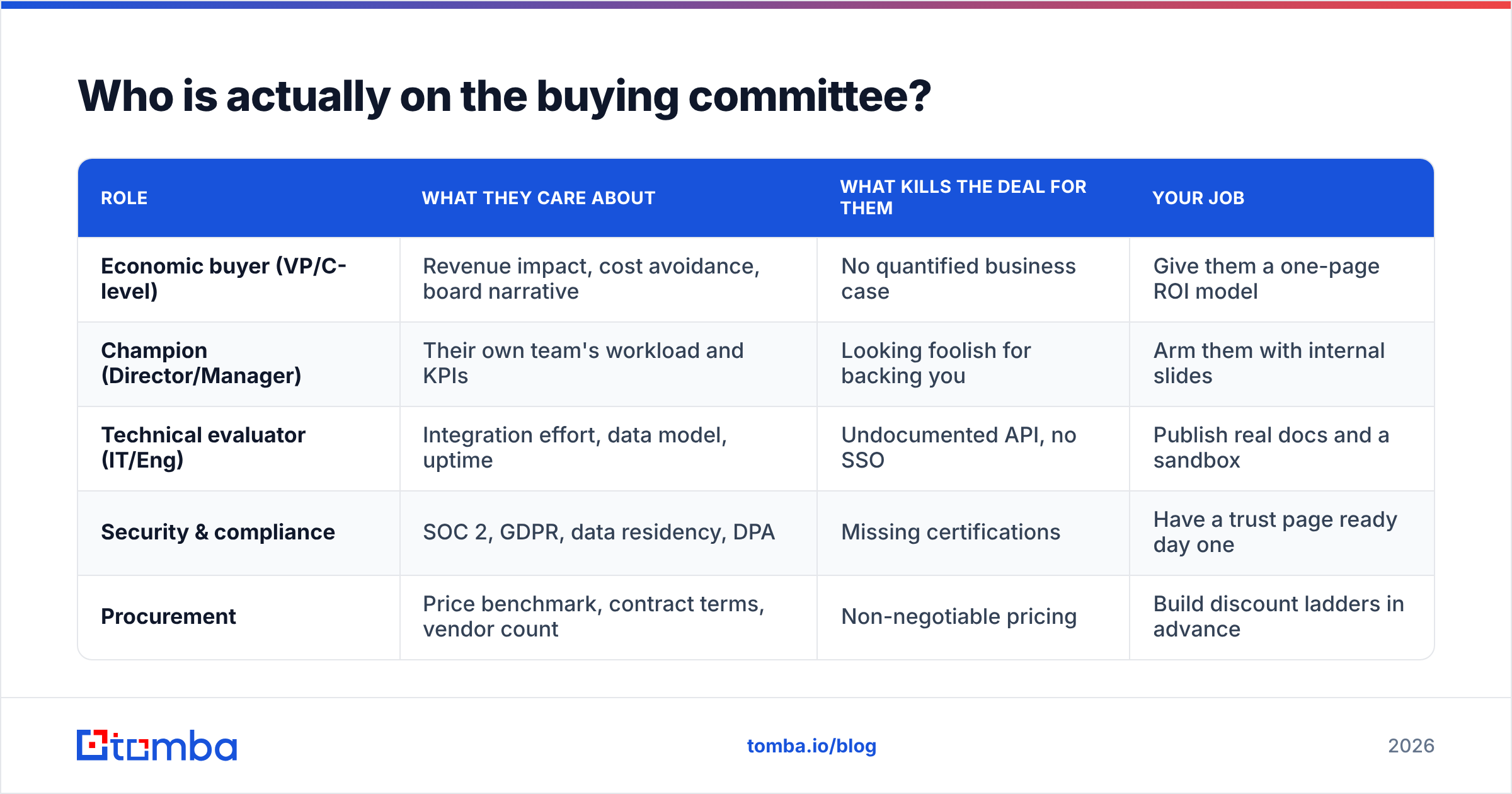
Five roles show up in nearly every corporate deal. You need a name, a title, a verified email, and ideally a phone number for each — which is where most outbound efforts quietly fall apart.
| Role | What they care about | What kills the deal for them | Your job |
|---|---|---|---|
| Economic buyer (VP/C-level) | Revenue impact, cost avoidance, board narrative | No quantified business case | Give them a one-page ROI model |
| Champion (Director/Manager) | Their own team's workload and KPIs | Looking foolish for backing you | Arm them with internal slides |
| Technical evaluator (IT/Eng) | Integration effort, data model, uptime | Undocumented API, no SSO | Publish real docs and a sandbox |
| Security & compliance | SOC 2, GDPR, data residency, DPA | Missing certifications | Have a trust page ready day one |
| Procurement | Price benchmark, contract terms, vendor count | Non-negotiable pricing | Build discount ladders in advance |
The practical consequence: you need contact data at depth, not width. Three verified contacts inside one target account are worth more than 300 unverified contacts spread across 300 accounts. Use a domain search to pull the full contact map for a target company in one pass, then run everything through an email verifier before it touches your sending domain. Bounces on enterprise domains are unusually expensive because corporate mail servers are aggressive about reputation, and one bad campaign can get your domain flagged across an entire org.
For senior roles that don't publish an address anywhere, the LinkedIn finder is usually the faster route than guessing patterns manually.
What outreach actually gets a reply from a corporate buyer?#
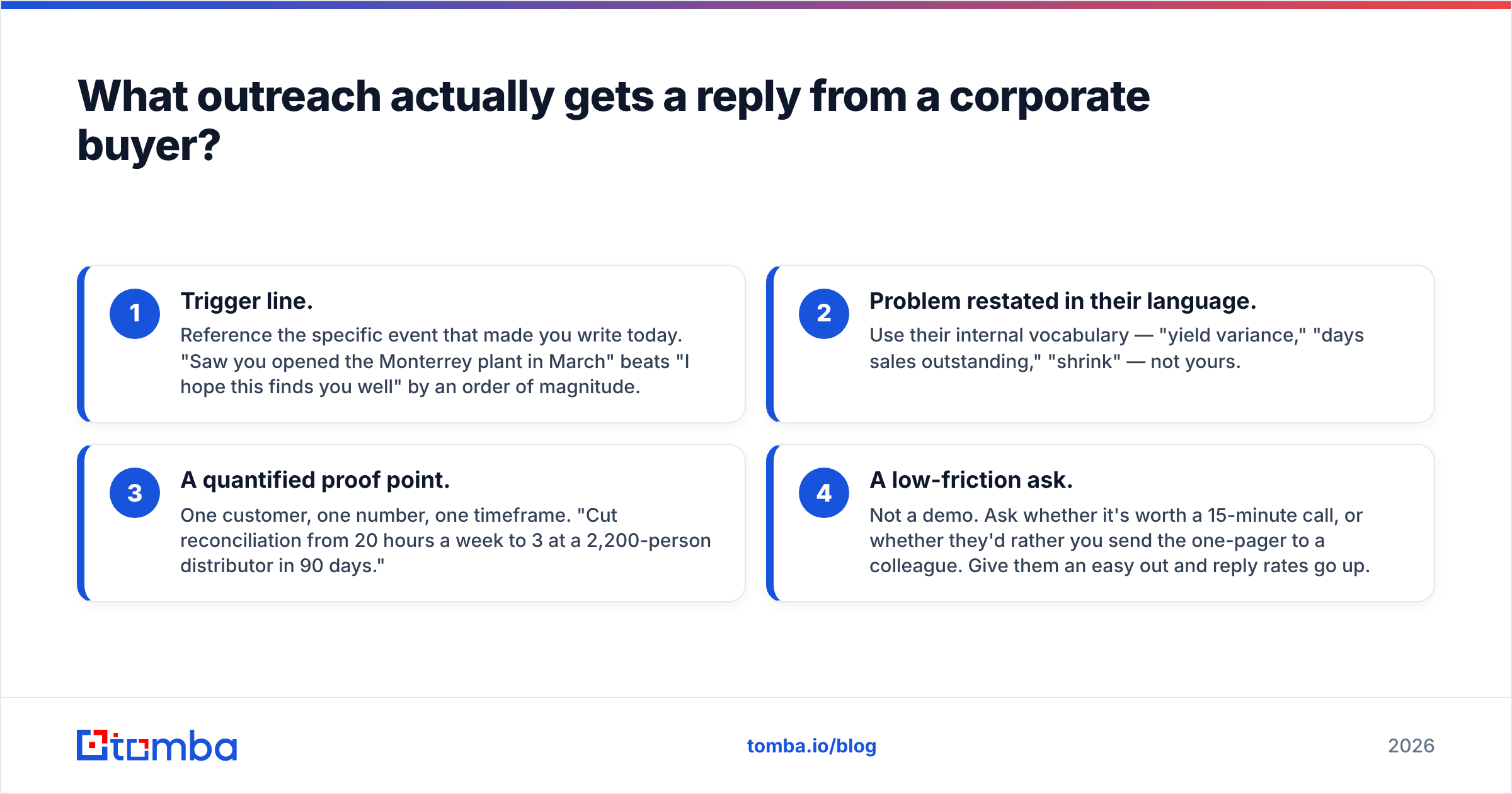
Lead with the business case, not the product. A VP who receives 60 vendor emails a week is not scanning for features — they're scanning for a number that matters to their P&L.
The structure that works:
- Trigger line. Reference the specific event that made you write today. "Saw you opened the Monterrey plant in March" beats "I hope this finds you well" by an order of magnitude.
- Problem restated in their language. Use their internal vocabulary — "yield variance," "days sales outstanding," "shrink" — not yours.
- A quantified proof point. One customer, one number, one timeframe. "Cut reconciliation from 20 hours a week to 3 at a 2,200-person distributor in 90 days."
- A low-friction ask. Not a demo. Ask whether it's worth a 15-minute call, or whether they'd rather you send the one-pager to a colleague. Give them an easy out and reply rates go up.
Multithread from the start. Send to the champion and the economic buyer in the same week, with different angles — the champion gets the workflow pain, the executive gets the cost. If you only email one person and they leave the company, your deal leaves with them. Roughly a third of B2B buyers change roles annually, which is why single-threaded enterprise deals evaporate without warning.
Sequence realistically: 5-7 touches over 3-4 weeks, mixing email, LinkedIn, and phone. Corporate buyers do not respond to the first message; they respond to the fourth, once they've seen your name enough times for it to register as a vendor rather than spam. And keep your volume honest — enterprise mail gateways treat high-volume identical sends as a signal, so protect email deliverability by keeping daily send counts low per mailbox and personalizing the first two lines for real.

How should you price and package for corporate buyers?#
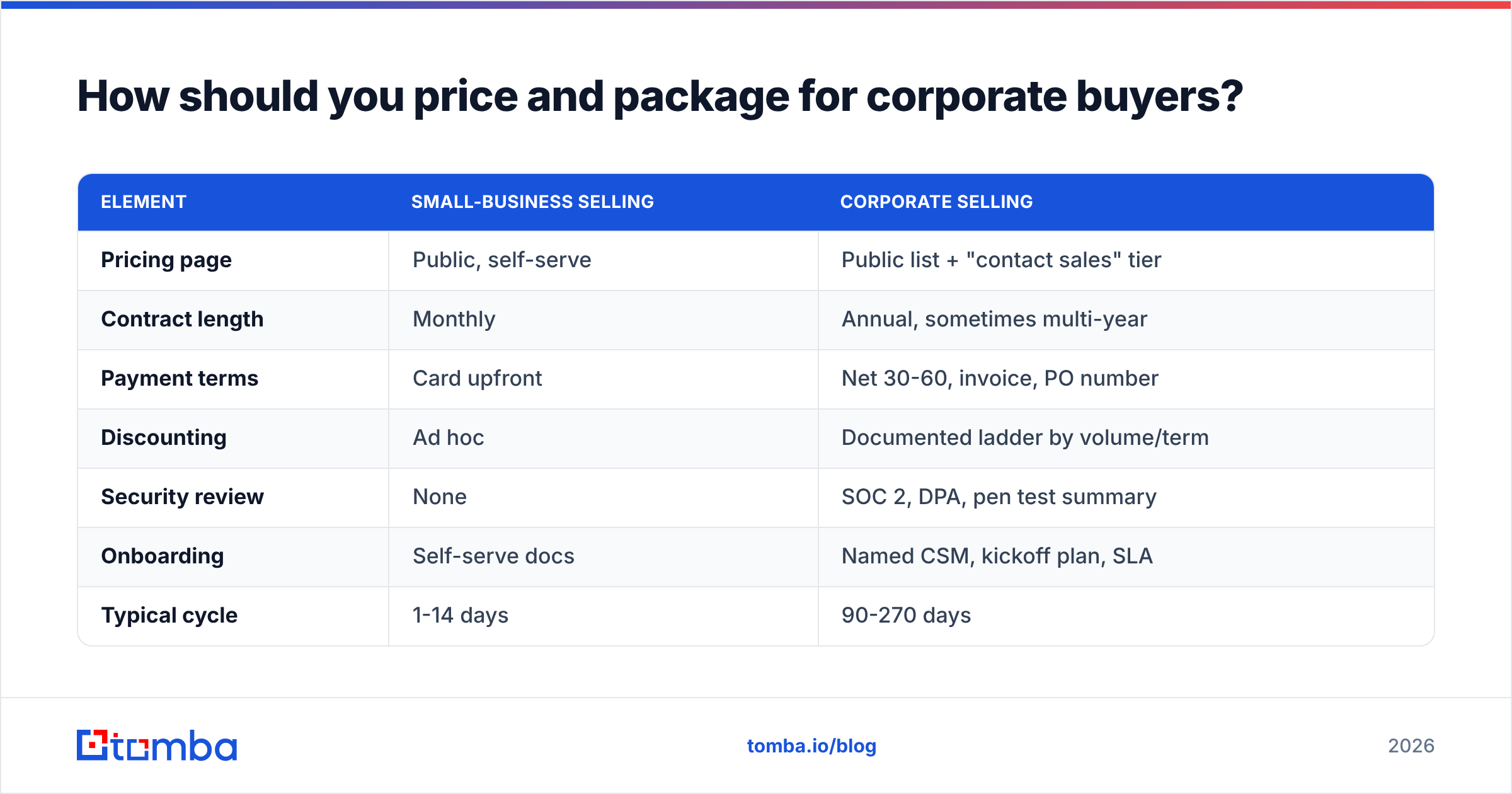
Price for the buying process, not just the value. Corporate procurement expects three things: a defensible list price, a volume ladder, and an annual commitment discount. Show up without them and you'll negotiate from scratch every time — always downward.
| Element | Small-business selling | Corporate selling |
|---|---|---|
| Pricing page | Public, self-serve | Public list + "contact sales" tier |
| Contract length | Monthly | Annual, sometimes multi-year |
| Payment terms | Card upfront | Net 30-60, invoice, PO number |
| Discounting | Ad hoc | Documented ladder by volume/term |
| Security review | None | SOC 2, DPA, pen test summary |
| Onboarding | Self-serve docs | Named CSM, kickoff plan, SLA |
| Typical cycle | 1-14 days | 90-270 days |
Two practical notes. First, don't lead with your lowest tier — corporate buyers read a cheap entry price as a signal that you're built for small teams and will break at their scale. Second, build the discount ladder before the negotiation. Procurement's job is to extract a concession; give them a pre-planned one (annual prepay, multi-year term, case-study rights) instead of an unplanned one that erodes margin permanently.
If you're building the outbound motion that feeds this, budget for the data layer too. Contact data pricing scales with volume — Tomba pricing runs from a free tier at 25 searches a month through Starter at $49/mo, Growth at $99/mo, and Pro at $249/mo, which is the range most teams working 100-300 named accounts land in.
How do you build credibility before you have logos?#
The chicken-and-egg problem is real: corporate buyers want corporate references, and you can't get references without corporate clients. Three routes out.
Route one: borrowed credibility. Partner with a systems integrator, consultancy, or agency that already sells into your target accounts. You ride their vendor status and their existing MSA. This is the fastest path and the most underused — a partner who already has procurement clearance can shave two months off your cycle.
Route two: land small, expand deliberately. Sell a single department a small, scoped pilot with a fixed end date and a written success metric. A $12K pilot in one business unit is a legitimate foothold if — and only if — you treat it as an expansion motion, not a win. Document results in the buyer's own numbers and let your champion carry them upward.
Route three: publish work no one else will. Original benchmark data, teardowns of the category, and honest comparison content earn inbound from buyers who are already researching. Most corporate buying now starts with independent research long before a vendor conversation. Sites like G2 and Capterra are where that research often begins, so a maintained profile with real reviews does compounding work.
Whichever route you take, tighten your operational proof: a public trust page, a status page, real API documentation, and named support contacts. These are the things that convert "interesting" into "approvable."
What does the corporate sales process look like end to end?#
Seven stages, and skipping any of them adds time rather than saving it.
- Account selection — build the 50-200 list against your fit thesis. Refresh quarterly.
- Committee mapping — identify five roles per account and get verified contact details. Enrichment tooling matters here; running names through data enrichment turns a title list into a workable contact map.
- Multithreaded outreach — 5-7 touches, two or more personas, three channels, three to four weeks.
- Discovery — quantify the current cost of the problem in their numbers. If you leave discovery without a dollar figure, you have no business case.
- Business case and pilot — one page: current cost, proposed change, expected impact, timeline, risk mitigation. Attach a scoped pilot if the deal is large.
- Security and procurement — run these in parallel with the final commercial conversation, never after. Start the security questionnaire the day verbal approval lands.
- Close and expansion plan — sign, onboard against a written 30/60/90 plan, and book the expansion conversation before the honeymoon ends.
Two failure modes account for most lost enterprise deals. Single-threading, already covered. And no compelling event — a deal with no deadline attached to it (a contract renewal, a regulatory date, a system sunset, a board commitment) will slip indefinitely regardless of how much the champion likes you. Find the event or manufacture one with a time-bound pilot.
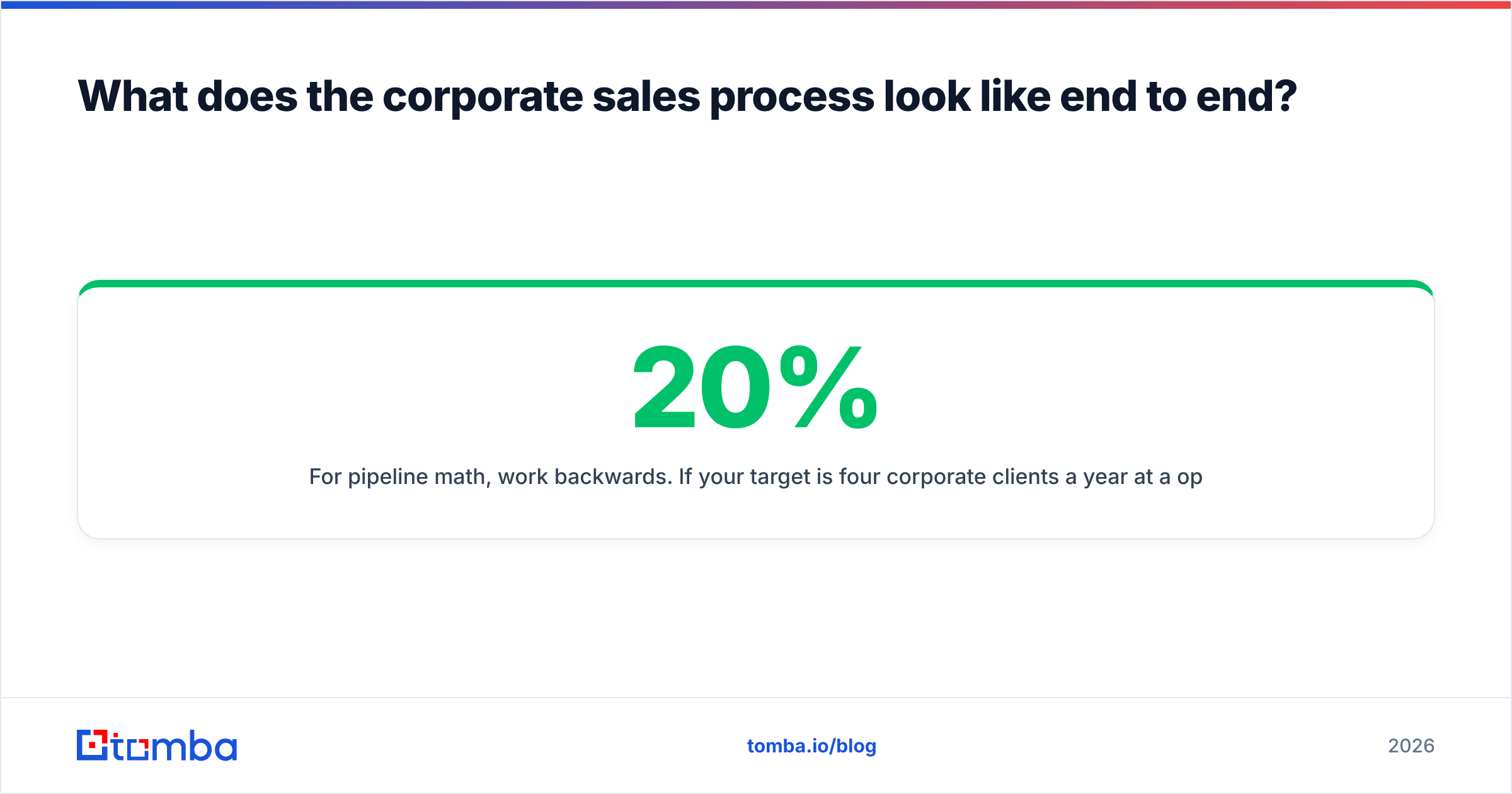
For pipeline math, work backwards. If your target is four corporate clients a year at a 20% opportunity-to-close rate, you need 20 real opportunities. At a 10% meeting-to-opportunity rate, that's 200 meetings — which, at a 4% reply-to-meeting rate on well-targeted outbound, means roughly 5,000 quality touches across your named accounts. That number is achievable with 150 accounts and multithreading. It is not achievable with a spray-and-pray list, because volume without verification collapses your response rate and your domain reputation at the same time.
Where do most teams go wrong?#
- Treating corporate outbound like SMB outbound. Same templates, same volume, same one-contact-per-company logic. It fails because the buying process is structurally different.
- Chasing logos instead of fit. A Fortune 500 name you can't actually serve is a two-year distraction with no revenue attached.
- Selling features to executives. Executives buy outcomes and risk reduction. Save the feature tour for the technical evaluator, who genuinely wants it.
- Waiting for procurement. Every week you wait to start the security review is a week added to the cycle.
- Neglecting the champion after signature. Champions get promoted, reorganized, and poached. Build a second relationship inside the account within 90 days of closing.
- Sending from unverified lists. Enterprise domains bounce hard and remember longer. Verify before you send, every time.
Start with the account list, not the pitch#
The teams that win corporate clients consistently aren't better writers — they're better at knowing exactly who to write to. A tight named-account list, a fully mapped buying committee, and verified contact data for every person on it will outperform a clever sequence sent to a scraped list every quarter of every year.
That mapping step is where Tomba Email Finder earns its place in the stack: give it a target company domain and a name, and you get the verified professional address you need to reach the economic buyer, the champion, and the technical evaluator — instead of guessing at patterns and burning your sending reputation to find out. Start on the free tier, map ten target accounts end to end, and see how different your pipeline looks when every contact on it is a real person who can actually say yes.
Related guides#
// get started
Find, verify and enrich your first contacts today
Start on the free plan with 25 searches a month, then scale when your team is ready.
Free plan · No credit card required · GDPR & CCPA
Get the Tomba newsletter
Product and data updates
// about the author