How to Get Customers for IT Business: 9 Proven Ways
Referrals dried up? Here are nine channels IT service firms actually close deals from in 2026 — with real cost-per-lead numbers, a channel comparison table, and the outbound stack that makes cold outreach work.
Referrals got you here, but they will not get you to the next tier. This guide is a ranked answer to how to get customers for IT business growth: nine channels, compared by real cost per client, time to first deal, and who each one actually works for.
TL;DR
- Most IT service firms stall at $500K–$1M ARR. More than 80% of revenue comes from referrals, and referrals do not scale on command.
- The three channels with the best economics for IT firms in 2026 are targeted outbound email, local/vertical SEO, and strategic partnerships (MSP vendors, accountants, commercial realtors).
- Outbound works for IT only when your list is tight — 200 verified decision-makers in one vertical beats 5,000 scraped addresses that bounce and burn your domain.
- Expect 4–9 months to first closed deal from SEO, 3–8 weeks from outbound, and 1–2 weeks from partner referrals. Budget accordingly.
- Your close rate is set before the first call. It depends on who is on the list, not on how good your pitch is.
Why do most IT businesses struggle to find customers?#
Because the thing that got you to your first ten clients does not get you to your fiftieth.
Almost every IT services company — MSP, dev shop, cybersecurity consultancy, cloud migration firm — starts the same way. A founder with a network lands work through people they already know. Word spreads. For two or three years, the pipeline fills itself. Then it doesn't.
The problem is built in. Referrals are a passive channel. You can encourage them, but you cannot dial up volume on a Tuesday because Q3 looks thin. When growth depends on other people's timing, you have a revenue lottery, not a sales motion.
The second problem: IT buying is slow, and a group decides. Gartner's B2B buying research puts the typical enterprise technology purchase at 6–10 stakeholders, each doing their own research. In managed services and infrastructure work, you also have to push out a vendor who is doing an adequate-if-unloved job. Nobody wakes up excited to switch IT providers.
So the real question is not how to make someone buy today. It is how to stay visible, credible, and easy to reach during the 3–5% of any quarter when a company is actually in market.
That shift changes which channels are worth your money.
How to get customers for IT business growth: the highest-ROI channels#
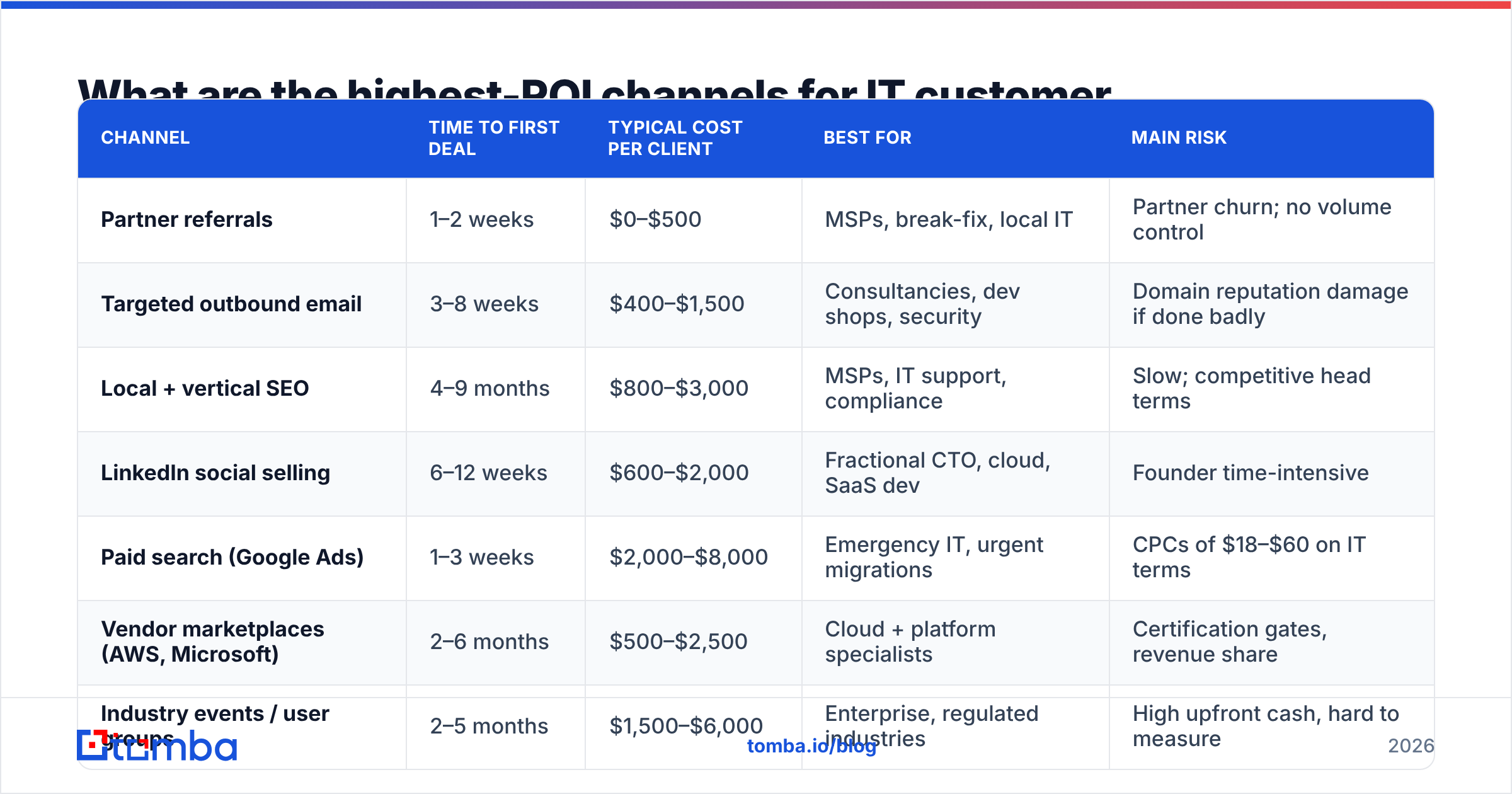
Here is the honest comparison. These ranges reflect what IT services firms in the $200K–$5M revenue band typically see. The numbers move with your vertical, your city, and your deal size.
| Channel | Time to first deal | Typical cost per client | Best for | Main risk |
|---|---|---|---|---|
| Partner referrals | 1–2 weeks | $0–$500 | MSPs, break-fix, local IT | Partner churn; no volume control |
| Targeted outbound email | 3–8 weeks | $400–$1,500 | Consultancies, dev shops, security | Domain reputation damage if done badly |
| Local + vertical SEO | 4–9 months | $800–$3,000 | MSPs, IT support, compliance | Slow; competitive head terms |
| LinkedIn social selling | 6–12 weeks | $600–$2,000 | Fractional CTO, cloud, SaaS dev | Founder time-intensive |
| Paid search (Google Ads) | 1–3 weeks | $2,000–$8,000 | Emergency IT, urgent migrations | CPCs of $18–$60 on IT terms |
| Vendor marketplaces (AWS, Microsoft) | 2–6 months | $500–$2,500 | Cloud + platform specialists | Certification gates, revenue share |
| Industry events / user groups | 2–5 months | $1,500–$6,000 | Enterprise, regulated industries | High upfront cash, hard to measure |
| Content + case studies | 3–8 months | $500–$2,000 | All (compounding asset) | Requires genuine expertise |
| Cold calling | 2–6 weeks | $700–$2,500 | Local SMB IT support | Low connect rates on IT buyers |
Two things stand out. First, the cheapest channel — partner referrals — gives you the least control over volume. Second, the fastest channel you can scale is outbound email. That is exactly why so many IT firms try it, do it badly, and decide it does not work.
How do you build a target list that actually converts?#
Start with 150–300 companies, not 5,000. Here's the sequence that works for IT services:
Pick one vertical and one trigger. "Manufacturing companies in the Midwest, 50–300 employees, running on-prem ERP" is a list. "SMBs that need IT help" is a wish. Verticals matter because IT buying depends on compliance and stack. A HIPAA story lands with a clinic and bounces off a logistics firm.
Define the buying trigger. A new CTO or IT director hired in the last 90 days. A funding round. An office move. A merger. A public compliance deadline. Triggers turn a cold contact into a warm one, and IT triggers are easy to spot: job posts for sysadmins, a careers page listing "Azure migration," a security incident in the news.
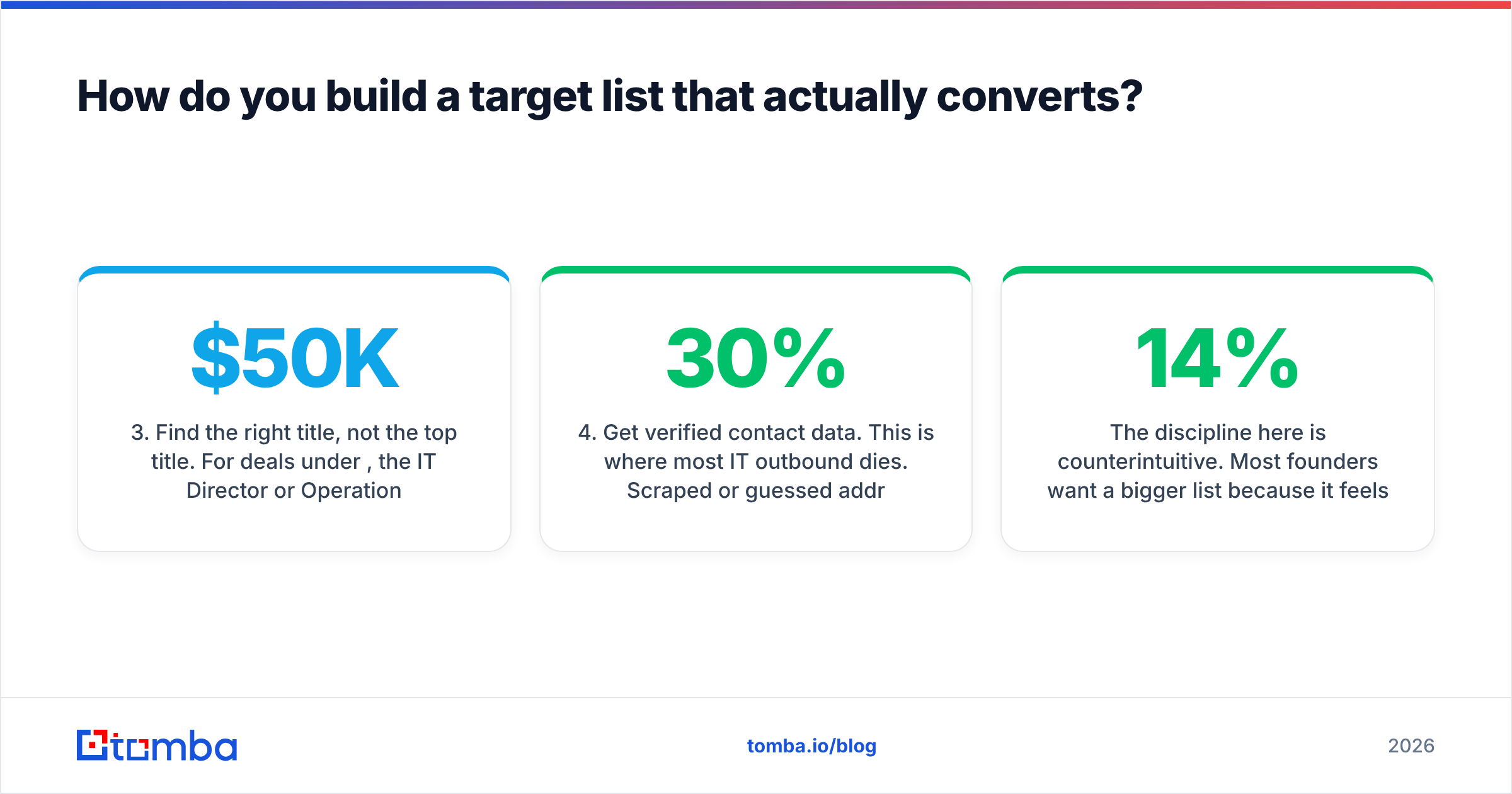
Find the right title, not the top title. For deals under $50K a year, the IT Director or Operations Manager decides. Above that, you need the CFO or COO in the room. Emailing the CEO of a 400-person company about endpoint management wastes a first impression.
Get verified contact data. This is where most IT outbound dies. Scraped or guessed addresses bounce at 15–30%, which torches your sending domain within two weeks. Use a proper email finder, then run the list through an email verifier before a single send. Anything above a 3% bounce rate on a new domain is a red flag.
Enrich before you write. Company size, tech stack, recent news, current vendor — these are what make your first line specific instead of generic. Tools that handle contact enrichment in bulk save hours per campaign.
Cap the list, then work it hard. 200 contacts, five touches each, across email and LinkedIn, over six weeks. That is 1,000 touches: enough signal to know whether the segment is right, and small enough to personalize for real.
This feels backwards. Most founders want a bigger list because it looks like more shots on goal. In practice, a tight list with clean data and real personalization beats a list ten times larger. Reply rates on well-targeted IT outbound run 6–14%. On spray-and-pray, they run under 1%.
Is cold email still worth it for IT services in 2026?#
Yes — with two large caveats.
The first is setup. Google and Yahoo have enforced bulk sender rules since 2024, so SPF, DKIM, and DMARC are not optional. Spam complaints above 0.3% get you filtered hard. Check your SPF record before you start. Warm new domains for at least three weeks, and never send from your main company domain — use a separate one like get-yourcompany.com.
The second is competition. IT buyers get more email than anyone else in B2B. An IT director at a 500-person firm sees 20+ vendor pitches a week. Your email is not up against silence. It is up against a reflex to delete anything that looks like a template.
What still works:
Specificity about their environment. "You're running Meraki across four branches" beats "we help companies like yours with networking."
A low-commitment ask. "Worth a 12-minute call?" converts better than "can I schedule a demo." IT buyers guard their calendars.
Proof from their vertical. One named client in their industry with a concrete number ("cut ticket volume 40% for a 220-person clinic group") does more than a page of capabilities.
Short sequences. Four to five touches. Buyers who ignore five emails will not reply to the ninth. You are just generating complaints.
Spend an hour on email deliverability basics before your first campaign, not after your first blacklist.
How does SEO work for an IT company specifically?#
Not the way most guides suggest. Broad terms like "IT services" or "managed IT" belong to directories and national players with seven-figure content budgets. You will not win those. You should not want to — that traffic converts badly anyway.
Three plays that do work:
Local intent. "Managed IT services Charlotte NC" or "cybersecurity consultant Portland" has real commercial intent and beatable competition. That means a properly optimized Google Business Profile, location pages that aren't doorway spam, and reviews. G2 and Capterra listings feed both direct leads and search visibility for comparison queries.
Vertical + problem intent. "HIPAA compliant file sharing for dental practices" or "SOC 2 readiness for Series A SaaS." Lower volume, far higher conversion, and almost no competition. If you serve three verticals, you have thirty of these pages to write.
Comparison and alternative content. People researching a switch search for "[incumbent vendor] alternatives" and "[Vendor A] vs [Vendor B]." Write an honest comparison — including where the incumbent is genuinely better — and you catch buyers at the moment they are in market.
The dull truth: SEO for IT firms takes 6–12 months to produce real pipeline. Start now so it pays off when you need it. Do not lean on it as your only channel while you wait.
Which partnerships bring IT businesses the most customers?#
Partner channels are the most under-used source of IT clients. The reason is simple: most firms treat them as networking instead of as a repeatable system.
The four partner types worth pursuing:
Adjacent service providers. Commercial real estate brokers know when a company is moving offices — the exact moment it needs cabling and network planning. Accountants and fractional CFOs know when a client is adding headcount. Insurance brokers know who just failed a cyber liability questionnaire.
Software vendors and VARs. If you specialize in a platform — NetSuite, Epicor, a specific EHR — the vendor's implementation partner program is a lead source. Many vendors route requests straight to certified partners.
Cloud marketplaces. AWS, Microsoft's partner network, and Google Cloud all list certified service partners. Getting listed takes certifications and reference customers, but the leads are pre-qualified and budget-approved.
Non-competing IT firms. A security-only firm refers infrastructure work. A dev shop refers ongoing managed services. Formalize it: written referral fee, defined handoff, quarterly check-in.
Make it mechanical. Pick eight partner targets and find the right contact. A LinkedIn finder helps when you know the person but not the address. Run the same disciplined outreach you would run on a prospect, then treat partners as accounts you nurture — not favors you cash in once.

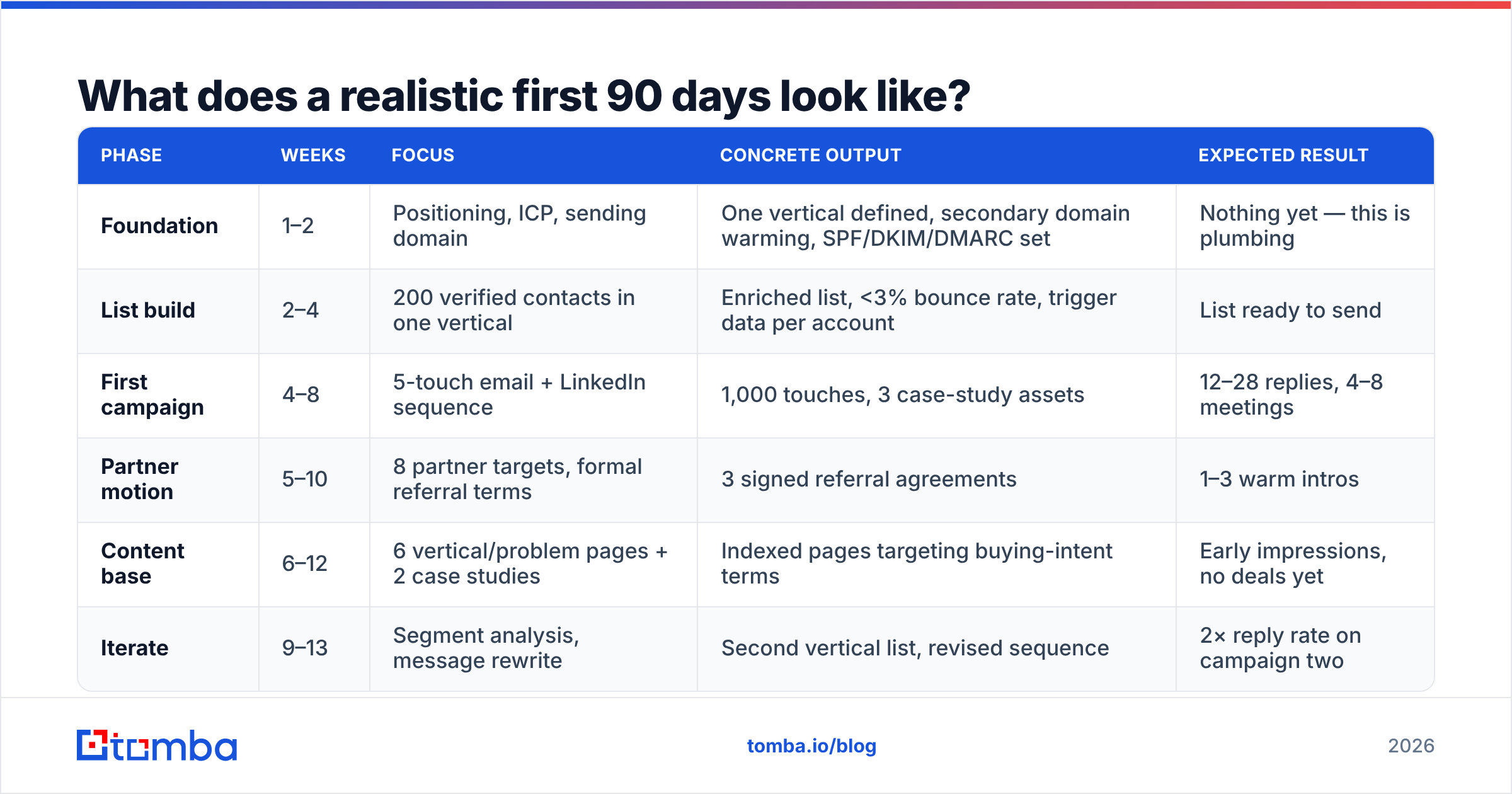
What does a realistic first 90 days look like?#
Here's a sequenced plan for an IT firm with no formal acquisition motion, assuming one founder or salesperson with roughly 15 hours a week for pipeline work.
| Phase | Weeks | Focus | Concrete output | Expected result |
|---|---|---|---|---|
| Foundation | 1–2 | Positioning, ICP, sending domain | One vertical defined, secondary domain warming, SPF/DKIM/DMARC set | Nothing yet — this is plumbing |
| List build | 2–4 | 200 verified contacts in one vertical | Enriched list, <3% bounce rate, trigger data per account | List ready to send |
| First campaign | 4–8 | 5-touch email + LinkedIn sequence | 1,000 touches, 3 case-study assets | 12–28 replies, 4–8 meetings |
| Partner motion | 5–10 | 8 partner targets, formal referral terms | 3 signed referral agreements | 1–3 warm intros |
| Content base | 6–12 | 6 vertical/problem pages + 2 case studies | Indexed pages targeting buying-intent terms | Early impressions, no deals yet |
| Iterate | 9–13 | Segment analysis, message rewrite | Second vertical list, revised sequence | 2× reply rate on campaign two |
Two notes on this table. First, nothing closes in month one. Any plan that promises otherwise is selling you something. Second, the slow channels — content and partners — keep paying long after the work. The fast ones — outbound and ads — stop the day you stop funding them. You need both.
What mistakes kill IT customer acquisition?#
Positioning as a generalist. "We do all things IT" competes with every other firm in your city on price. "We run infrastructure for multi-site dental groups" competes with almost nobody and commands a premium.
Skipping verification. A 20% bounce rate on your first campaign damages your domain before you have had a single conversation. Verification costs cents per contact and saves months of recovery.
Selling technology instead of outcomes. Buyers do not care about your RMM stack. They care about downtime, audit findings, and whether their staff can work on Monday.
No follow-up system. Most IT deals close on touch four through seven. Firms that send one email and stop leave most of their pipeline on the table. Track response rate per sequence step so you know where prospects go quiet.
Treating every channel as an experiment forever. Give a channel a defined budget and a defined window. Nine weeks of outbound with clean data and no meetings means the segment or the offer is wrong — not that outbound is broken.
Ignoring existing clients. Expansion revenue inside your current base is the cheapest growth you can buy. A quarterly technology review with each client surfaces projects nobody thought to ask you about.
How do you know which channel is working?#
Track four numbers per channel, every month: contacts reached, meetings booked, opportunities created, and closed revenue. Divide spend by closed deals and you get cost per client. It is the only number that lets you compare a $600 SEO retainer against a $2,000 ad budget honestly.
Give each channel a fair test window. Outbound: nine weeks. Paid search: six weeks. SEO: nine months. Partners: two quarters. Killing a channel before its window closes is how firms conclude that "nothing works" while cycling through every tactic in this article.
Separate the two failure modes. If nobody replies, your targeting or your data is wrong. If people reply but nothing closes, your offer or your qualification is wrong. Those need different fixes, and confusing them wastes quarters.
Where should you start?#
Start where the data is. Every answer to how to get customers for IT business growth — outbound, partner outreach, LinkedIn, even follow-up on inbound form fills — ends in the same place. You have to reach a real person at a real company at a deliverable address. That is the layer most IT firms skip, and it is why their first campaign underperforms.
Build your 200-account list, find the decision-makers with the Tomba Email Finder, verify every address before you send, and enrich with the trigger data that makes your first sentence specific. Tomba's free tier gives you 25 searches a month to test the workflow on a small segment. Paid plans start at $49/mo, with Growth at $99/mo and Pro at $249/mo — see Tomba pricing for the full breakdown. If you build lists in volume, the bulk email finder and the Tomba API plug straight into whatever CRM or sequencer you already run.
Clean data won't close a deal on its own. But bad data guarantees you never get the chance.
Related guides#
// get started
Find, verify and enrich your first contacts today
Start on the free plan with 25 searches a month, then scale when your team is ready.
Free plan · No credit card required · GDPR & CCPA
// about the author