How to Get Mortgage Loan Leads: 9 Channels That Work in 2026
Bought leads close at 1-3%. Referral and outbound leads close at 15-40%. Here is how nine mortgage lead channels actually compare on cost per funded loan, and how to build a pipeline you own.
TL;DR
- Purchased mortgage leads cost $20-$80 each and typically close at 1-3%. That math only works at volume with a follow-up machine behind it.
- Realtor, CPA, and financial-advisor referral partners produce the cheapest funded loans, but take 60-90 days to spin up.
- Outbound to referral partners — not to borrowers — is the fastest channel a solo loan officer can control, and it needs accurate contact data more than it needs clever copy.
- Speed-to-lead is the single biggest lever: contacting a lead in under 5 minutes beats contacting it in an hour by roughly 8x on connect rate.
- Build two channels deep rather than nine channels shallow. Pick one paid source and one owned source, and instrument both.
What Counts as a Mortgage Loan Lead in 2026?#
A mortgage loan lead is a person or business with a financing need, a timeline, and a way for you to reach them. Everything else is a name.
That definition matters because the industry sells three very different things under one word:
- Raw inquiry — someone filled out a rate form on a comparison site. They were probably sold to four other loan officers in the same second. Intent is real, exclusivity is not.
- Exclusive lead — sold to you only. Costs 2-4x a shared lead and usually converts 2-3x better, which is roughly a wash until you factor in your own time.
- Sourced contact — a realtor, builder, CPA, HR benefits manager, or past client you identified yourself and reached out to. Costs pennies in data, costs real hours in effort, and produces the loans that keep producing.
Most loan officers over-index on the first category because it's the only one that arrives without work. The trap is that raw inquiries decay in value the moment your competitors call first, so the channel rewards headcount and dialer capacity — not skill.
The reframe: stop asking "where do I buy mortgage loan leads" and start asking "which channel gives me the lowest cost per funded loan at my current capacity."
Which Mortgage Lead Channel Actually Wins on Cost Per Funded Loan?#
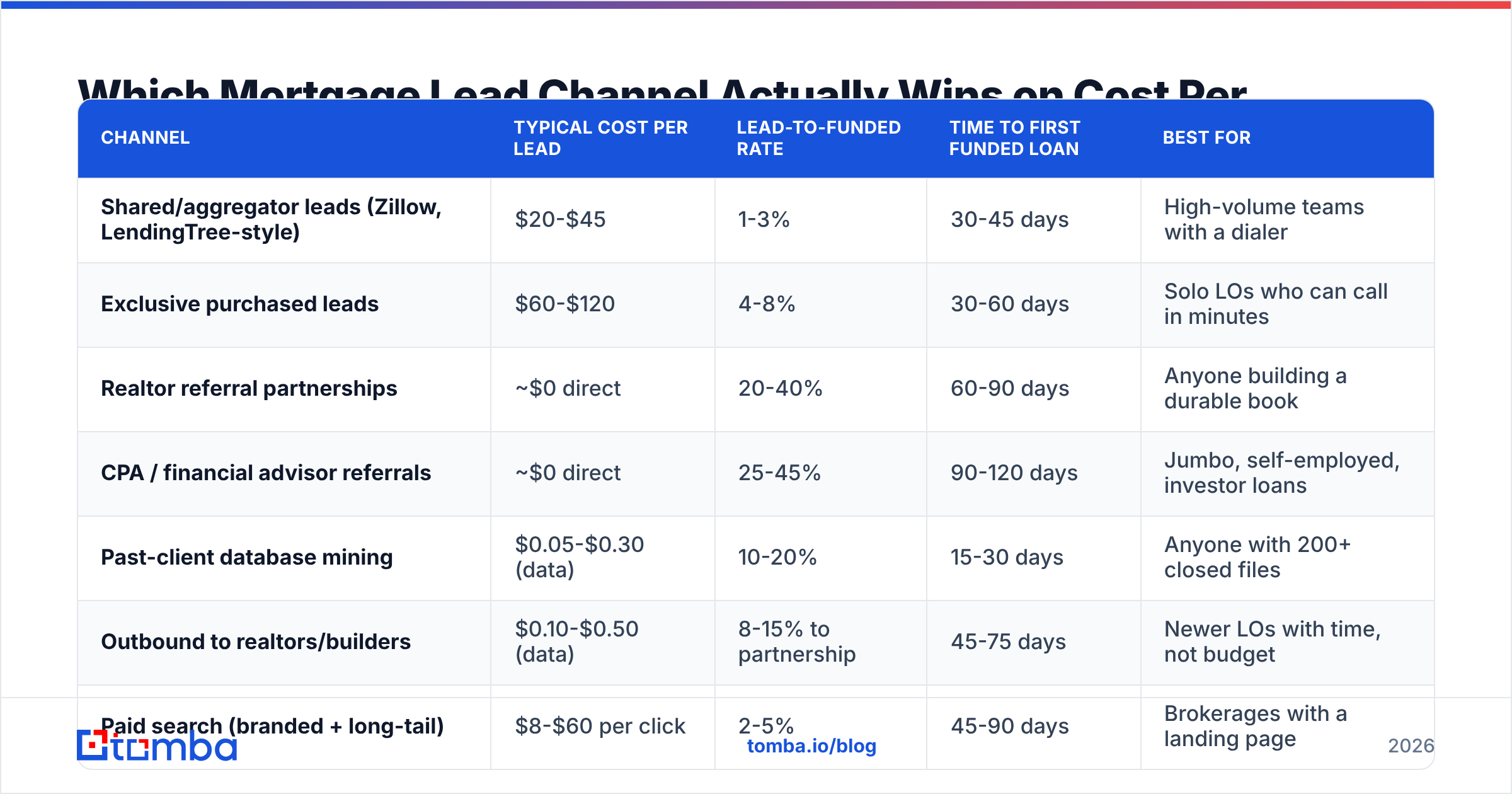
Here is how the main channels compare. Cost-per-lead figures are typical 2026 market ranges; close rates assume a competent follow-up process, not a heroic one.
| Channel | Typical cost per lead | Lead-to-funded rate | Time to first funded loan | Best for |
|---|---|---|---|---|
| Shared/aggregator leads (Zillow, LendingTree-style) | $20-$45 | 1-3% | 30-45 days | High-volume teams with a dialer |
| Exclusive purchased leads | $60-$120 | 4-8% | 30-60 days | Solo LOs who can call in minutes |
| Realtor referral partnerships | ~$0 direct | 20-40% | 60-90 days | Anyone building a durable book |
| CPA / financial advisor referrals | ~$0 direct | 25-45% | 90-120 days | Jumbo, self-employed, investor loans |
| Past-client database mining | $0.05-$0.30 (data) | 10-20% | 15-30 days | Anyone with 200+ closed files |
| Outbound to realtors/builders | $0.10-$0.50 (data) | 8-15% to partnership | 45-75 days | Newer LOs with time, not budget |
| Paid search (branded + long-tail) | $8-$60 per click | 2-5% | 45-90 days | Brokerages with a landing page |
| Local SEO + Google Business Profile | Time only | 8-15% | 90-180 days | Single-market LOs playing long |
| Social/community (LinkedIn, local FB groups) | Time only | 5-12% | 60-120 days | Niche lenders (VA, physician, ITIN) |
The pattern is obvious once it's in a table: the channels that cost money convert worst, and the channels that cost time convert best. Purchased leads aren't bad — they're a cash-for-time trade. If you have $3,000/month and no hours, buy leads. If you have hours and no budget, build referral and outbound. If you have both, run one of each and let the data decide which gets the next dollar.

How Do You Build a Realtor Referral Engine That Doesn't Die in Month Two?#
Referral partnerships fail for a boring reason: loan officers pitch agents like agents are customers. Agents don't want your rate sheet. They want to stop losing deals at the contract stage.
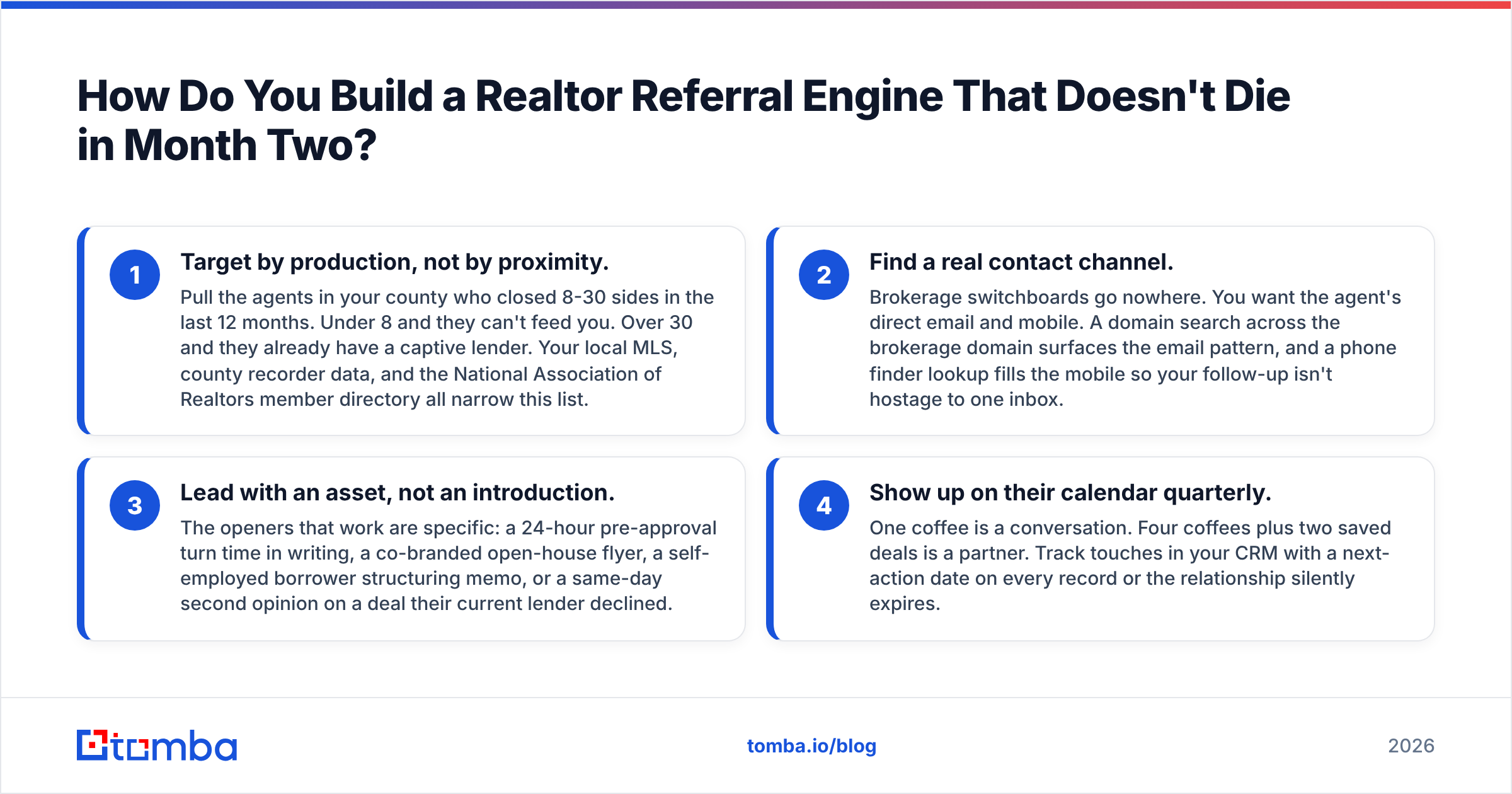
Run it as a four-step program:
- Target by production, not by proximity. Pull the agents in your county who closed 8-30 sides in the last 12 months. Under 8 and they can't feed you. Over 30 and they already have a captive lender. Your local MLS, county recorder data, and the National Association of Realtors member directory all narrow this list.
- Find a real contact channel. Brokerage switchboards go nowhere. You want the agent's direct email and mobile. A domain search across the brokerage domain surfaces the email pattern, and a phone finder lookup fills the mobile so your follow-up isn't hostage to one inbox.
- Lead with an asset, not an introduction. The openers that work are specific: a 24-hour pre-approval turn time in writing, a co-branded open-house flyer, a self-employed borrower structuring memo, or a same-day second opinion on a deal their current lender declined.
- Show up on their calendar quarterly. One coffee is a conversation. Four coffees plus two saved deals is a partner. Track touches in your CRM with a next-action date on every record or the relationship silently expires.
Expect 20-30 conversations to produce 3-5 active partners, and 3-5 active partners to produce 2-4 loans a month once warm. That's a 90-day investment that pays for years — which is exactly why most people skip it.
How Do You Run Outbound Without Buying a Single Lead?#
Outbound in mortgage works best when you aim it at partners and businesses, not at consumers. Cold-emailing homeowners about refinancing is a compliance minefield and a reputation grinder. Cold-emailing a builder's sales manager about a preferred-lender slot is normal B2B.
Four outbound plays that hold up:
- Builders and developers. Find the sales manager and VP of sales at every builder with active permits in your market. Preferred-lender arrangements are competitive but a single win can carry a quarter.
- HR and benefits managers. Pitch employer-sponsored homebuyer workshops at companies with 200+ local employees. It's a lead-gen event that HR wants to say yes to.
- CPAs and RIAs. Self-employed and investor borrowers are the hardest files to originate and the most profitable. The professionals who serve them are a short, findable list.
- Property managers and investor groups. DSCR and portfolio loans live here, and this audience buys on execution certainty rather than a quarter point.
The bottleneck in all four is data quality, not messaging. A list of 400 builders with 35% bad emails will torch your sender reputation before anyone reads the pitch. Two habits fix that:
- Verify every address before it enters a sequence. Run the list through an email verifier and drop anything that isn't deliverable — a 2% bounce rate is the ceiling you want to stay under.
- Enrich before you write. Knowing a builder closed 60 units last year and uses a specific title company changes the first line of your email far more than any subject-line template. Contact enrichment turns a name into a reason to reach out.
If you'd rather buy a pre-built list than assemble one, providers like BookYourData sell verified B2B contact records by industry and title, which is a reasonable shortcut for the builder and CPA plays. Just verify on arrival regardless of the guarantee — every database ages.
What Should Your Speed-to-Lead Process Look Like?#
Five minutes. That's the whole rule, and almost nobody follows it.
Inbound mortgage inquiries are usually shopped to multiple lenders simultaneously. The borrower talks to whoever calls first and stops answering after the third callback. Research across B2B and consumer lead response consistently shows a steep decay curve — responding within five minutes versus within thirty produces a multiple, not a margin. HubSpot's sales research library has been publishing versions of this finding for a decade and the number hasn't moved.
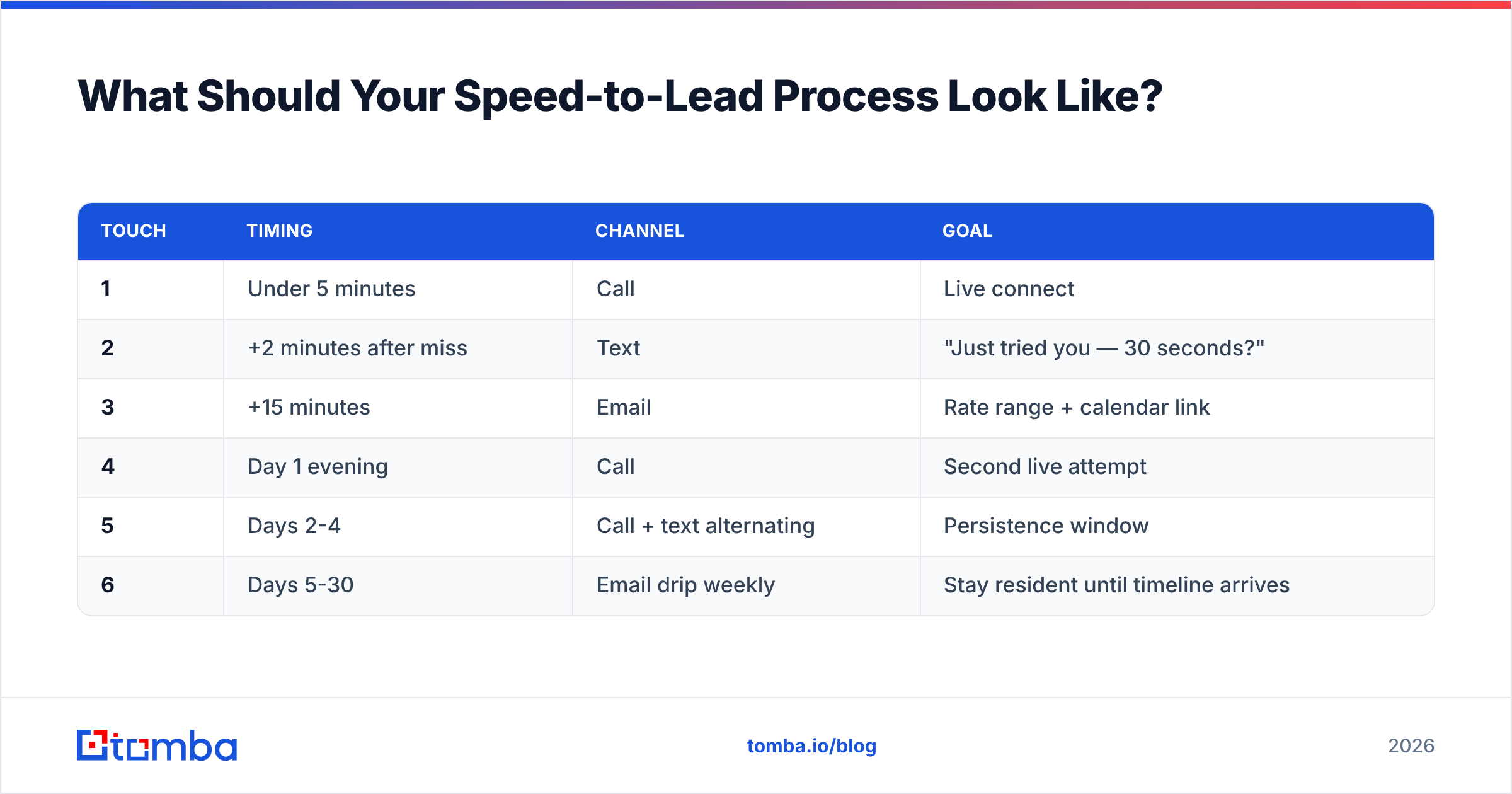
A working cadence for a purchased or web-form lead:
| Touch | Timing | Channel | Goal |
|---|---|---|---|
| 1 | Under 5 minutes | Call | Live connect |
| 2 | +2 minutes after miss | Text | "Just tried you — 30 seconds?" |
| 3 | +15 minutes | Rate range + calendar link | |
| 4 | Day 1 evening | Call | Second live attempt |
| 5 | Days 2-4 | Call + text alternating | Persistence window |
| 6 | Days 5-30 | Email drip weekly | Stay resident until timeline arrives |
Two implementation notes. First, texting requires prior express consent under TCPA — get it on the form and log it. Second, most leads that eventually fund are contacted six or more times; if your process stops at three, you are paying for leads and then abandoning them.

How Do You Mine the Database You Already Own?#
Your closed-loan database is the highest-ROI mortgage lead source in the building and it sits untouched in most LOS exports.
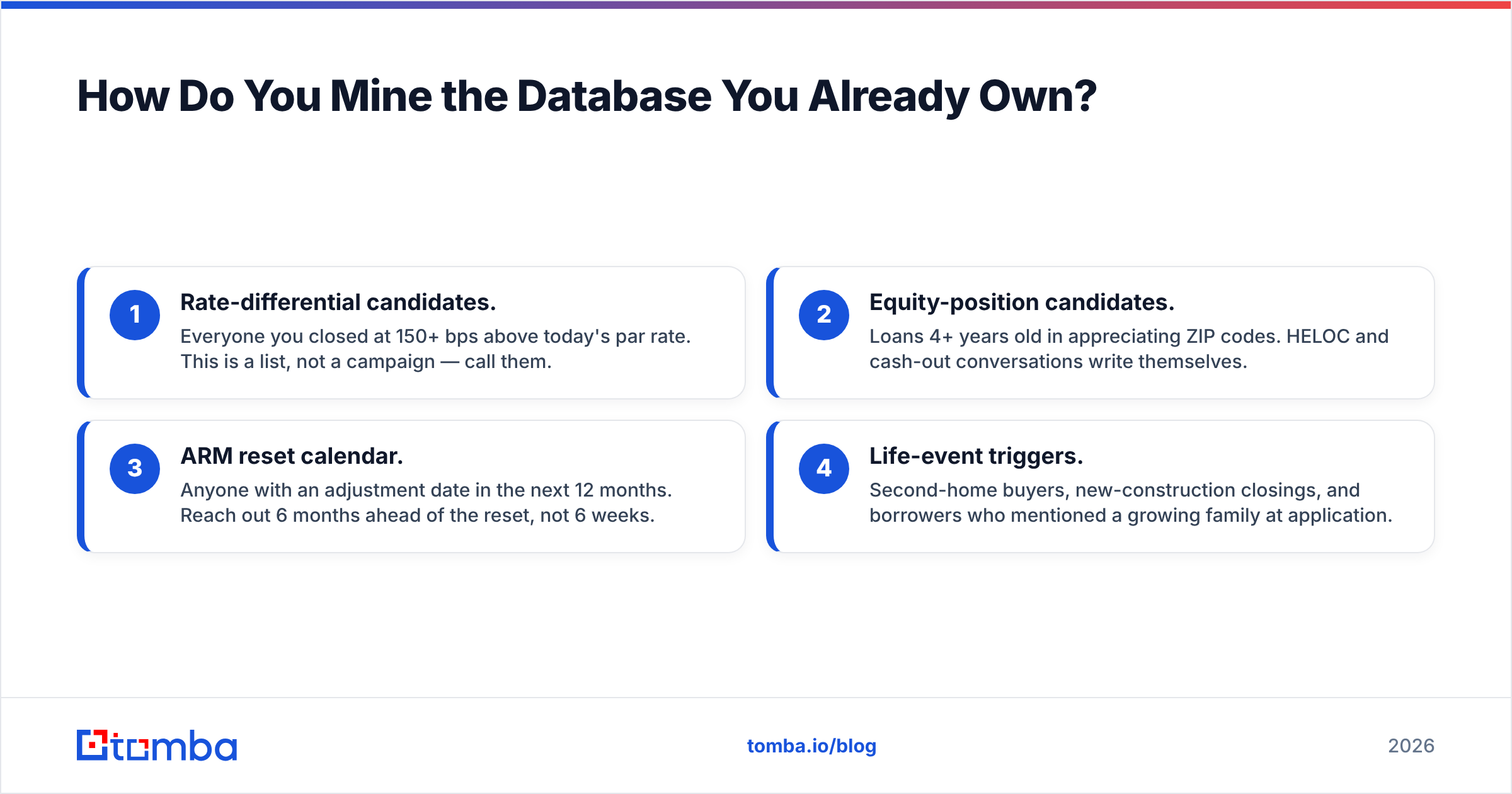
Run these four queries this week:
- Rate-differential candidates. Everyone you closed at 150+ bps above today's par rate. This is a list, not a campaign — call them.
- Equity-position candidates. Loans 4+ years old in appreciating ZIP codes. HELOC and cash-out conversations write themselves.
- ARM reset calendar. Anyone with an adjustment date in the next 12 months. Reach out 6 months ahead of the reset, not 6 weeks.
- Life-event triggers. Second-home buyers, new-construction closings, and borrowers who mentioned a growing family at application.
The practical problem is stale contact data. People change jobs, employers change domains, and personal emails go dormant. Re-enriching a 500-record past-client file with current work emails and mobile numbers typically recovers 60-75% reachability — through a bulk email finder run this is an afternoon of work, not a project. Compare that to spending $65 per shared lead to reach strangers with no relationship to you.
What Compliance Rules Apply to Mortgage Lead Generation?#
Mortgage is a regulated channel. Three things to keep straight:
- RESPA Section 8 prohibits paying for referrals of settlement service business. Marketing services agreements and co-marketing arrangements have to reflect fair market value for actual services rendered. The Consumer Financial Protection Bureau publishes the current guidance — read it before you sign a co-marketing deal with an agent.
- TCPA governs calls and texts to consumer numbers. Prior express written consent, scrubbing against DNC lists, and honoring opt-outs immediately are not optional. Purchased leads must come with documented consent — ask the vendor for it and keep it.
- Advertising rules (Reg Z / MAP Rule) apply to any rate you publish. If you state a rate, the triggered disclosures follow. This includes social posts and email subject lines.
None of this blocks the strategies above. B2B outreach to realtors, builders, and CPAs sits outside TCPA's consumer scope, and referral partnerships are legal when they exchange value for services rather than for referrals themselves. When in doubt, run the arrangement past compliance before it runs in the market.
What Does a Realistic 90-Day Plan Look Like?#
Days 1-30 — Build the base. Export your closed-loan database, re-enrich contact data, and work the rate-differential and equity lists. Simultaneously, build a target list of 40 agents and 15 builders. Stand up a single landing page with a form and a calendar link.
Days 31-60 — Open two channels. Start outbound to the agent and builder lists at 15-20 contacts per day, verified. Turn on one paid source at the smallest volume the vendor allows so you're testing conversion, not scaling waste. Instrument both: cost per lead, contact rate, application rate, funded rate.
Days 61-90 — Cut and double. Kill whichever channel has the worse cost per funded loan and move the budget or hours to the other. Convert your best 3-5 agent conversations into formal co-marketing arrangements. Set the past-client database on a recurring quarterly touch.
At the end of 90 days you should have measured cost-per-funded-loan for at least two channels. That single number is what separates loan officers who scale from loan officers who buy leads forever and wonder why margins are thin.
Compare that discipline to the alternative most people run: nine channels open, none measured, and a monthly lead invoice nobody audits.
Where Should You Start This Week?#
Start with the channel you can control. Pull 50 target realtors and builders in your market, find their direct work emails and mobile numbers, verify the list, and send 15 genuinely useful messages a day for two weeks. That's a partner pipeline built for the cost of coffee — and it doesn't reset to zero when a vendor raises prices.
The Tomba Email Finder is built for exactly that step: give it a brokerage or builder domain and a name, and it returns the verified professional email with a confidence score, so your outreach lands instead of bouncing. The free tier covers 25 searches a month if you want to test the workflow on a handful of agents first; paid plans start at $49/month on Starter and $99/month on Growth when you're ready to run real volume — full Tomba pricing is on the site. Build the list once, verify it, and stop renting your pipeline.
Related guides#
// get started
Find, verify and enrich your first contacts today
Start on the free plan with 25 searches a month, then scale when your team is ready.
Free plan · No credit card required · GDPR & CCPA
// about the author