How to Get Out of a Sales Slump: A 30-Day Recovery Plan
A sales slump is a math problem wearing an emotional costume. Here is the 30-day diagnostic — funnel stage by funnel stage — that tells you exactly which input broke and what to fix first.
TL;DR
- A sales slump is almost never a motivation problem. It is a broken input somewhere in the funnel, and the fix depends entirely on which input broke.
- Diagnose before you act: compare your last 90 days to your best 90 days across five metrics — contacts reached, connect rate, meetings booked, opportunity conversion, and average cycle length.
- The most common hidden cause is data decay. Contact databases rot at roughly 22–30% per year, so a list that worked last quarter can quietly stop working this one.
- Volume is the slowest lever and the one most reps pull first. Data quality and targeting are faster and cheaper.
- Run a 30-day recovery in three blocks: Week 1 diagnose, Weeks 2–3 rebuild the top of funnel with verified contacts, Week 4 reset your pipeline math and forecast honestly.
What is a sales slump, actually?#
A sales slump is a sustained period — usually four weeks or longer — where your closed-won number drops materially below your trailing average while your effort stays flat or rises. That last clause matters. If you stopped prospecting for three weeks, you do not have a slump. You have a consequence.
Think of your pipeline like a household water system. When the shower pressure drops, you do not fix it by standing under the faucet longer. You check the tank, the pipes, and the valve — in that order — because each one produces the same symptom for a completely different reason. A slump works the same way: low bookings is the symptom, and at least five distinct upstream failures produce it.
The trap is that a slump feels like a personal failing, so reps respond with effort instead of diagnosis. They send 400 emails instead of 200, take fewer notes, skip discovery steps, and start discounting. That is how a four-week dip becomes a two-quarter dip.
Why do sales slumps happen?#
Almost every slump traces back to one of five root causes. Identify yours before you touch your calendar.
- Your contact data decayed. People change jobs, companies rebrand domains, and mailboxes get deprovisioned. Industry estimates put B2B data decay between 22% and 30% annually. A list built nine months ago is meaningfully worse than the one you tested it on.
- Your ICP drifted without you noticing. The segment that converted last year got acquired, cut budget, or filled the need with an in-house tool. You are still selling to a market that stopped buying.
- Your messaging went stale. Your best-performing subject line has now been copied by every competitor in the category. Prospects pattern-match it as noise within half a second.
- Your pipeline math was always wrong. You hit quota for two quarters on three oversized deals and never built the volume underneath. When those deals closed, nothing replaced them.
- Your deliverability quietly degraded. Bounce rates crept up, spam complaints ticked up with them, and your sends started landing in Promotions or Junk. Your open rate did not crash — it just faded by two points a week until it looked normal.
Notice that only one of those five is a "work harder" problem, and it is not the common one. Most slumps are input-quality problems wearing an effort costume.

How do you diagnose which part of the funnel broke?#
Pull two windows: your best 90 days in the last 18 months, and your most recent 90 days. Put them side by side. The stage where the ratio moved most is your actual problem.
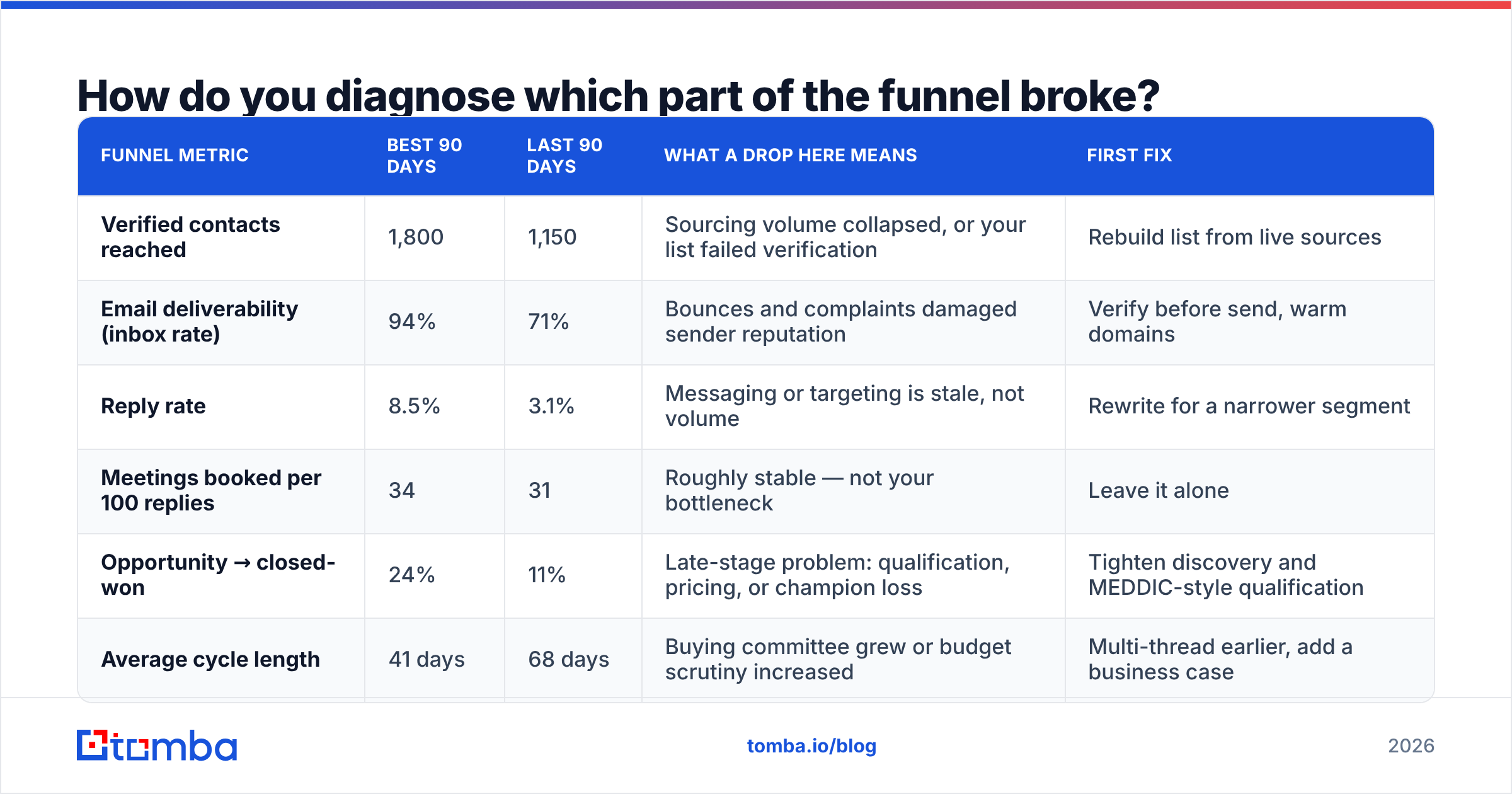
| Funnel metric | Best 90 days | Last 90 days | What a drop here means | First fix |
|---|---|---|---|---|
| Verified contacts reached | 1,800 | 1,150 | Sourcing volume collapsed, or your list failed verification | Rebuild list from live sources |
| Email deliverability (inbox rate) | 94% | 71% | Bounces and complaints damaged sender reputation | Verify before send, warm domains |
| Reply rate | 8.5% | 3.1% | Messaging or targeting is stale, not volume | Rewrite for a narrower segment |
| Meetings booked per 100 replies | 34 | 31 | Roughly stable — not your bottleneck | Leave it alone |
| Opportunity → closed-won | 24% | 11% | Late-stage problem: qualification, pricing, or champion loss | Tighten discovery and MEDDIC-style qualification |
| Average cycle length | 41 days | 68 days | Buying committee grew or budget scrutiny increased | Multi-thread earlier, add a business case |
This table does more work than any pep talk. If your reply rate held steady but your closed-won ratio halved, sending more cold email is the wrong medicine entirely — you have a late-stage qualification issue and more top-of-funnel just adds noise.
Conversely, if contacts reached fell 36% and inbox rate fell 23 points, you have a data and deliverability problem, and no amount of call coaching will move the number.
Is more volume or better data the faster way out?#
Better data, in almost every case. Here is the arithmetic.
Say you send 1,000 emails from a list with a 12% bounce rate and 30% stale contacts. You reach roughly 880 mailboxes, of which maybe 615 belong to a person still in that role. At a 4% reply rate on live contacts, you get about 25 replies.
Now clean the same list. Verify it, drop the invalid addresses, and re-source the job-changers. You now send 700 emails with a sub-2% bounce rate to contacts who actually exist. At the same 4% reply rate you get 27 replies — from 30% fewer sends, with a sender reputation that gets better instead of worse each week.
The volume path requires you to send 1,400 emails to match that, which accelerates domain damage and burns your total addressable market twice as fast. Use an email verifier before any campaign during a slump, not after.
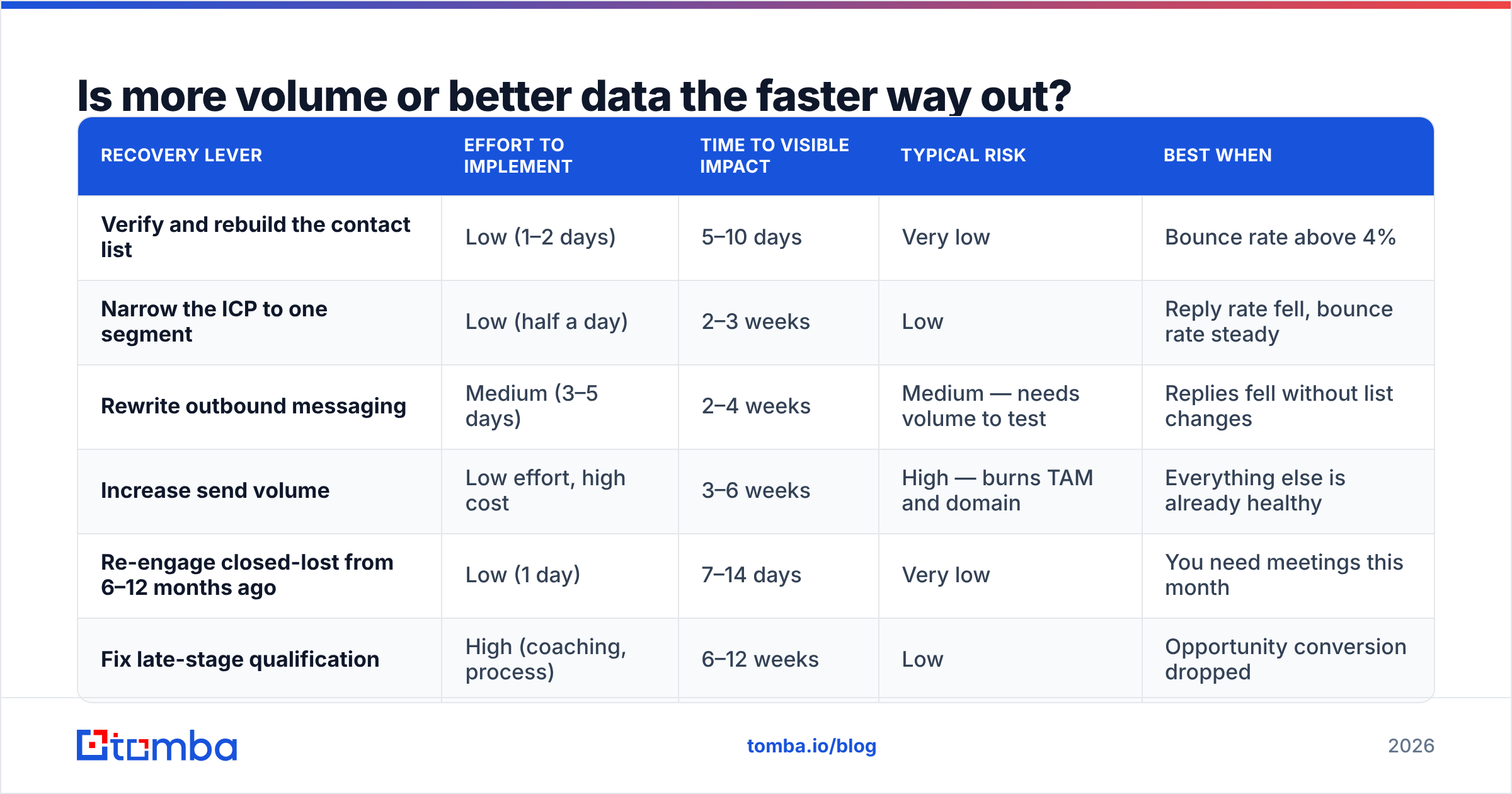
| Recovery lever | Effort to implement | Time to visible impact | Typical risk | Best when |
|---|---|---|---|---|
| Verify and rebuild the contact list | Low (1–2 days) | 5–10 days | Very low | Bounce rate above 4% |
| Narrow the ICP to one segment | Low (half a day) | 2–3 weeks | Low | Reply rate fell, bounce rate steady |
| Rewrite outbound messaging | Medium (3–5 days) | 2–4 weeks | Medium — needs volume to test | Replies fell without list changes |
| Increase send volume | Low effort, high cost | 3–6 weeks | High — burns TAM and domain | Everything else is already healthy |
| Re-engage closed-lost from 6–12 months ago | Low (1 day) | 7–14 days | Very low | You need meetings this month |
| Fix late-stage qualification | High (coaching, process) | 6–12 weeks | Low | Opportunity conversion dropped |
The two fastest paths on that table — verified list rebuild and closed-lost re-engagement — are also the two cheapest. Start there.
What should you do in the first seven days?#
Day-by-day, this is the block that resets momentum.
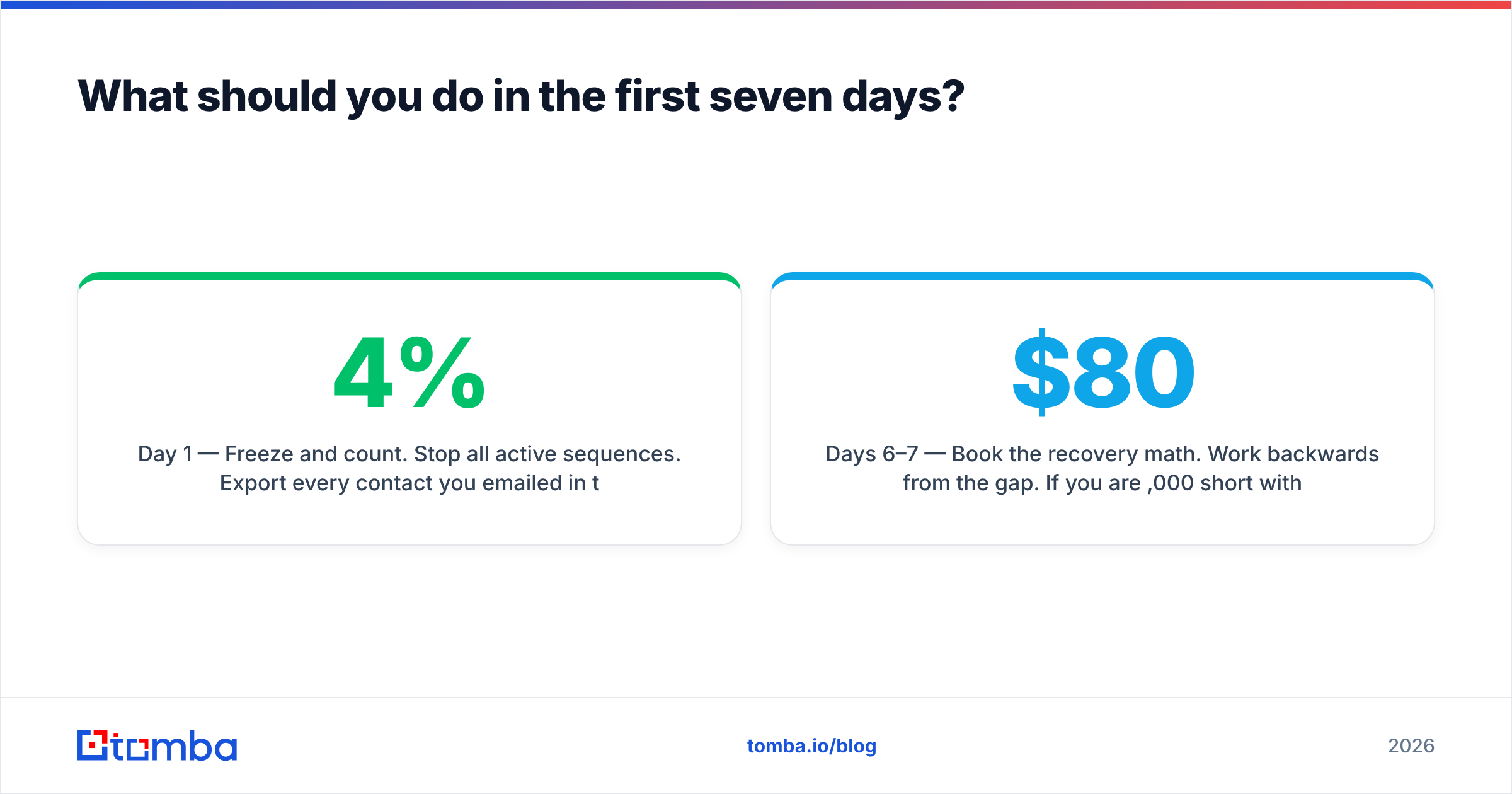
Day 1 — Freeze and count. Stop all active sequences. Export every contact you emailed in the last 90 days and run a bounce audit. If more than 4% bounced, your data is the primary suspect and everything else is secondary.
Day 2 — Rebuild one clean segment. Pick a single vertical and a single title band. Not three. One. Use domain search to pull current contacts at 50–100 target accounts, then verify every address before it enters a sequence. A hundred verified, correctly-titled contacts beat two thousand scraped ones, and you will be able to read the results.
Day 3 — Mine your own graveyard. Pull every closed-lost opportunity from 6–18 months ago where the reason was "timing," "budget," or "no champion." Those are not dead; they are dormant. Check whether your original contact still works there — job changes turn a dead deal into a warm intro at their new company. Re-verify the ones who moved, and enrich the accounts that grew with contact enrichment so you know who the new decision-maker is.
Day 4 — Rewrite one message, not ten. Write a single, specific email for the single segment you chose. Reference something only that segment would recognize: a regulation, a tooling migration, a seasonal pressure. Generic personalization ("loved your recent post") reads as automation now.
Day 5 — Fix the plumbing. Check SPF, DKIM, and DMARC records. Check your domain against blacklists. If you have been running hot, park the primary domain and run recovery volume through a secondary one while reputation recovers.
Days 6–7 — Book the recovery math. Work backwards from the gap. If you are $80,000 short with a $12,000 average deal and a 22% opportunity win rate, you need roughly 31 qualified opportunities to close 7 deals. At a 30% meeting-to-opportunity rate that is about 103 meetings. Now you know whether your slump is recoverable this quarter or whether you are actually building next quarter. Both are fine. Pretending is not.
What should you stop doing during a slump?#
Slump behavior compounds the slump. Cut these first.
- Stop discounting to force a close. A discount in week three of a slump trains your buyers and your manager. It also drags your average deal value down, which raises the number of deals you need next quarter.
- Stop expanding your ICP. The instinct to "open up the criteria" halves your message relevance and doubles your list size. Both make diagnosis impossible.
- Stop checking your CRM dashboard hourly. According to HubSpot's sales research, reps who batch administrative and reporting time outperform those who context-switch through it. Slumps make people refresh dashboards instead of dialing.
- Stop skipping discovery to protect the pipeline number. Weakly qualified opportunities inflate the forecast, then collapse in month two and extend the slump into the next quarter.
- Stop scaling anything that is not yet working. Doubling volume on a sequence with a 1% reply rate produces a 1% reply rate at twice the cost — and burns the accounts you will want later.

How do you rebuild pipeline math for the next 90 days?#
Once the first week stabilizes, stop managing to activity and start managing to coverage. Coverage is the ratio of open pipeline value to your remaining quota. Most B2B teams target 3x to 4x; Gartner's sales research consistently finds that teams tracking coverage weekly forecast more accurately than teams tracking activity alone.
Build the 90-day plan in three layers:
- Layer one — this month's meetings. Sourced from re-engagement, referrals, and inbound. Fastest to convert, smallest volume.
- Layer two — next month's meetings. Sourced from the clean, verified segment you rebuilt in week one. This is where consistent outbound belongs.
- Layer three — the quarter after. Sourced from account research and multi-threading into accounts you already know. Slowest, highest value, and the layer everyone skips during a slump — which is precisely why the next slump arrives on schedule.
If all three layers are empty, you do not have a slump. You have a system that never had a top of funnel, and no tactical fix will hold. That is a process rebuild, not a recovery sprint.
A useful habit: every Friday, log your response rate, bounce rate, and coverage ratio in a single row of a spreadsheet. Three numbers, five minutes. Four weeks of that data turns your next dip from a mystery into a diagnosis you can read in a glance.
How do you keep from sliding back?#
Slumps recur because the conditions that caused them are structural, not situational. Three habits prevent most repeats.
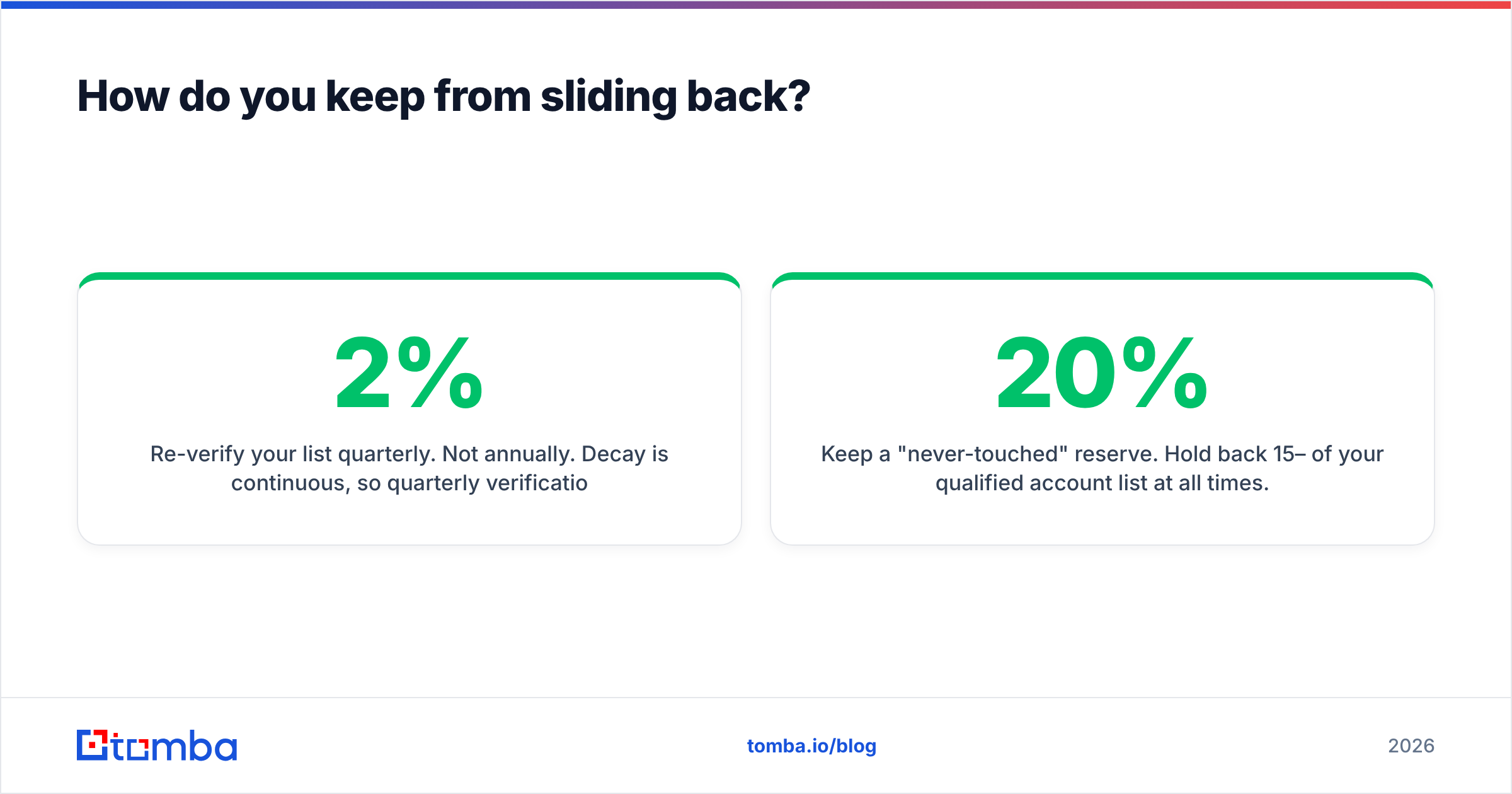
Re-verify your list quarterly. Not annually. Decay is continuous, so quarterly verification keeps your bounce rate under 2% permanently instead of letting it creep to 8% and then panicking. Batch it — running a full database through a bulk verify pass takes minutes and costs less than one lost deal.
Keep a "never-touched" reserve. Hold back 15–20% of your qualified account list at all times. When a slump hits, you have fresh accounts to work instead of re-emailing people who already ignored you twice.
Review your ICP every six months against actual closed-won data. Not against the deck marketing made in 2024. Pull your last 40 wins, look at the common attributes, and rewrite the criteria to match reality. Buyer patterns shift faster than positioning documents do, and vendor category pages on sites like G2 are a reasonable free signal for where budget is moving in your category.
Protect the boring block. One hour, same time daily, prospecting only. The single strongest predictor of whether a rep recovers from a slump in four weeks or fourteen is whether that block survived the panic.
What is the honest expectation for recovery?#
If your slump is data or deliverability driven, expect visible movement in 10–14 days and a restored meeting rate inside 30. If it is messaging or ICP driven, expect 3–5 weeks, because you need enough volume to read a signal. If it is late-stage — qualification, pricing, or competitive losses — expect a full quarter, because you have to work through the deals already in flight before the new process shows up in closed-won.
What does not happen is a same-week recovery from doubling activity. Every rep tries it. It has never worked, because the funnel does not respond to effort at the point of failure; it responds to fixing the input that broke.
Start with the input you can fix today#
The fastest, cheapest move out of a slump is almost always the same: replace a decayed list with a verified one, aimed at one clearly defined segment, and send fewer, better emails.
Tomba's Email Finder does that first step — find current, verified professional email addresses by domain, name, or company, so your recovery sequence lands in real inboxes instead of bouncing off deprovisioned mailboxes. The free tier gives you 25 searches a month to test the diagnosis before you commit; the Starter plan runs $49/month, Growth $99/month, and Pro $249/month if you need volume and team seats. Full Tomba pricing is on the site.
Rebuild the list first. Then send. Slumps end when the inputs get clean, not when the effort gets louder.
Related guides#
// get started
Find, verify and enrich your first contacts today
Start on the free plan with 25 searches a month, then scale when your team is ready.
Free plan · No credit card required · GDPR & CCPA
// about the author