How to Get Past the Gatekeeper: 9 Tactics That Work in 2026
Gatekeepers block roughly 8 in 10 cold calls before a rep ever reaches a decision-maker. Here are nine scripts, routing tactics, and data plays that actually get you through — plus the one shortcut most teams ignore.
TL;DR
- The gatekeeper is not an obstacle to defeat — she is a router. Treat her as a colleague and your connect rate roughly doubles versus trickery.
- Most "get past the gatekeeper" scripts fail because they signal sales in the first four seconds. Fix the opener, not the objection handling.
- Calling before 8:30 a.m. or after 5:15 p.m. bypasses the switchboard entirely on a meaningful share of dials.
- The highest-ROI move in 2026 is not a better script — it's a verified direct dial or a warm email that makes the call expected.
- Blended sequences (email first, call second) convert better than cold dials into a main line, because the name is already familiar to the person answering.
What is a gatekeeper, and why do they exist?#
A gatekeeper is anyone who controls access to a decision-maker: an executive assistant, a receptionist, an office manager, a chief of staff, or increasingly an IVR menu and a spam-labeling carrier.
Think of a gatekeeper like the host at a busy restaurant. They are not there to stop you from eating. They are there to make sure the people who sit down actually have a reservation, and that the kitchen doesn't get slammed by walk-ins who wandered in by accident. Yell at the host and you're waiting an hour. Tell them clearly who you are and why you're there, and they'll walk you to a table.
Technically, the gatekeeper's job is triage. An executive assistant supporting a VP of Operations may field 40 to 60 unsolicited calls a week. Her performance is judged on whether her executive's calendar contains valuable meetings — not on how many salespeople she deflected. That distinction is the whole game. If you can make a credible case that the meeting is valuable, you are aligned with her incentives instead of fighting them.
Three things follow from that:
- Deception burns the relationship permanently. Pretending to be a vendor "returning a call" works once, maybe. It gets you flagged in the CRM notes forever.
- Vagueness reads as evasion. "I just need to speak with him about a business matter" is the single most common tell that you're a rep.
- Confidence is the strongest signal. People who genuinely have business with an executive don't apologize for calling.
Why do most gatekeeper scripts fail?#
Because they optimize for the wrong moment. Reps spend hours rehearsing rebuttals to "Can I ask what this is regarding?" — a question that only gets asked after you've already lost.
Here's the sequence that actually happens on a cold dial into a main line:
- Second 0–2: Tone, pace, background noise. The gatekeeper subconsciously classifies you.
- Second 2–5: Your opening words. Formal vs. casual, first-name vs. full-name, question vs. statement.
- Second 5–15: Everything else. By now the decision is mostly made and you're either being transferred or handled.
Most training material lives in that third bucket. The leverage is in the first two.
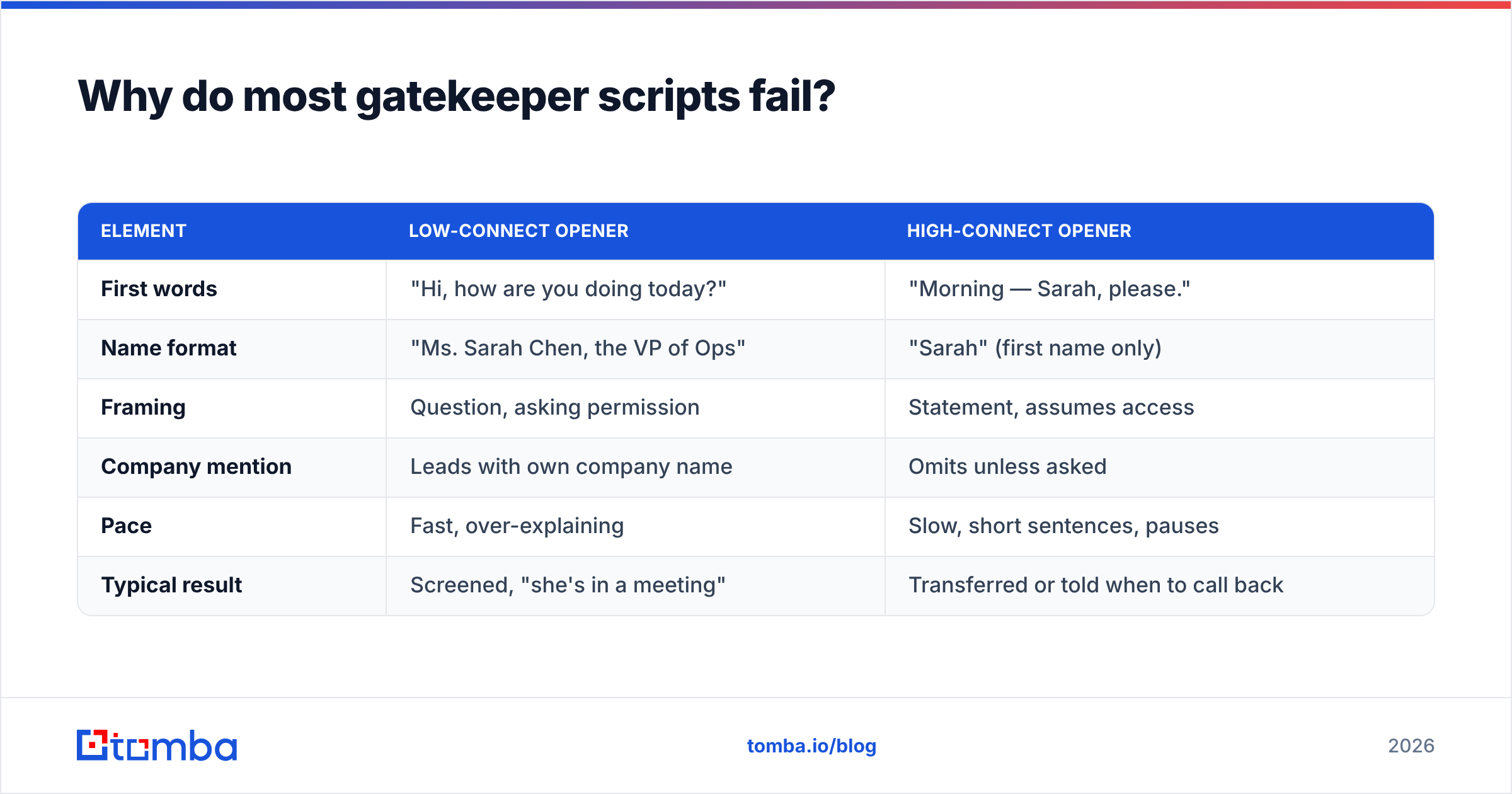
Compare the two openers below. Same rep, same product, same list.
| Element | Low-connect opener | High-connect opener |
|---|---|---|
| First words | "Hi, how are you doing today?" | "Morning — Sarah, please." |
| Name format | "Ms. Sarah Chen, the VP of Ops" | "Sarah" (first name only) |
| Framing | Question, asking permission | Statement, assumes access |
| Company mention | Leads with own company name | Omits unless asked |
| Pace | Fast, over-explaining | Slow, short sentences, pauses |
| Typical result | Screened, "she's in a meeting" | Transferred or told when to call back |
The high-connect version isn't a trick. It's how a peer, a client, or a board member would call. You are simply not doing the things that scream "cold call."
How do you get past the gatekeeper on the phone?#
Nine tactics, ordered roughly by how reliably they work in 2026.
1. The first-name assumption#
"Morning — Sarah, please." Then stop talking. Silence does an enormous amount of work here. Reps who fill the pause with credentials undo the effect.
2. Name the gatekeeper#
Look up the executive assistant before you dial. Opening with "Hi Dana, it's Marcus — is Sarah around?" changes the interaction from stranger-to-stranger into something that sounds like an existing relationship. A reverse email lookup or a quick LinkedIn scan usually surfaces the EA in under a minute.
3. Be honest and specific when asked#
When the gatekeeper asks what it's regarding — and she will, eventually — give a real, compressed answer:
"I'm following up on the note I sent Sarah Tuesday about their warehouse routing costs. She may have flagged it already."
Specific beats vague every time. It also gives the gatekeeper something to relay, which means even a "no" turns into a message that lands.
4. Ask her for help#
"You probably know this better than anyone — is Sarah the right person for supply-chain vendor decisions, or does that sit with someone else?"
This works because it's true. Assistants often know org structure better than the org chart does. Roughly half the time you get a correction that saves you three weeks of chasing the wrong contact.
5. Call outside switchboard hours#
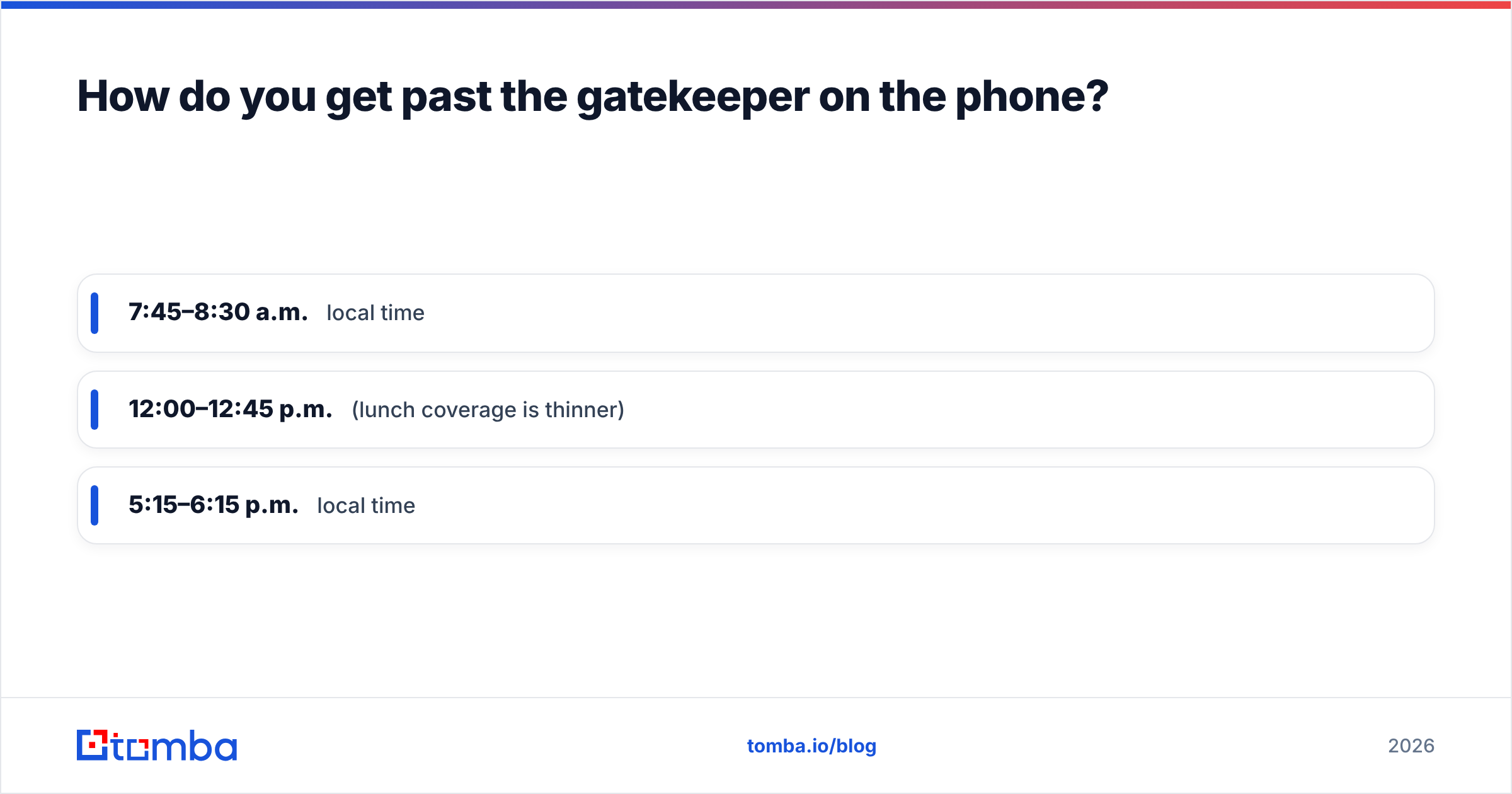
Executives arrive before their assistants and stay after them. Windows that consistently outperform:
- 7:45–8:30 a.m. local time
- 12:00–12:45 p.m. (lunch coverage is thinner)
- 5:15–6:15 p.m. local time
The main line often rolls straight to the extension when reception isn't staffed.
6. Dial the extension neighbors#
If you have one direct dial at a company, the numbers immediately above and below it usually belong to the same floor or team. Someone will answer, and internal transfers don't get screened the way external calls do.
7. Ask for a different department#
Call sales or accounts payable. Internal staff transfer internal-sounding requests without a second thought. "Hi — I got routed wrong, can you push me over to Sarah in Ops?" is rarely challenged.
8. Leave a message worth relaying#
If you're blocked, make the voicemail or relayed message do the selling. Two sentences, one specific number, one clear ask. "Tell her Marcus called about the 14% they're overpaying on LTL freight — I'll try again Thursday at 8."
9. Skip the switchboard entirely#
The most durable answer to how to get past the gatekeeper is to not have one. A verified mobile or direct line removes the routing layer altogether. This is where data quality does more for your connect rate than any script rewrite.

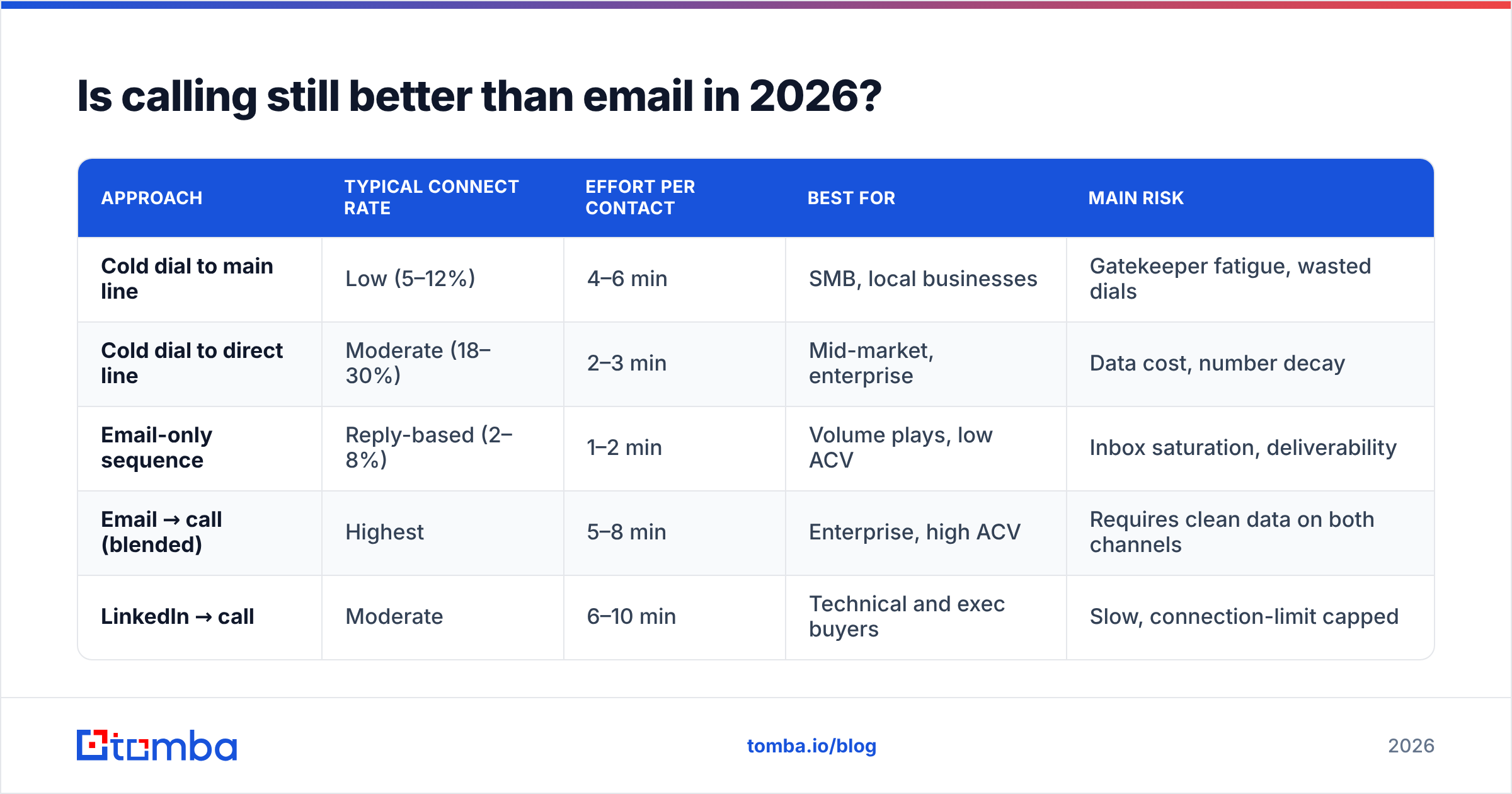
Is calling still better than email in 2026?#
Neither alone. The teams with the best connect rates run both, in a deliberate order.
Cold dialing into a main line with zero prior touch is the hardest version of this job. The gatekeeper has no reason to recognize your name, so the only variable you control is delivery. But when a decision-maker has already seen two emails from you, the calculus changes — assistants frequently check with the exec, and "Marcus from the freight thing" gets through.
| Approach | Typical connect rate | Effort per contact | Best for | Main risk |
|---|---|---|---|---|
| Cold dial to main line | Low (5–12%) | 4–6 min | SMB, local businesses | Gatekeeper fatigue, wasted dials |
| Cold dial to direct line | Moderate (18–30%) | 2–3 min | Mid-market, enterprise | Data cost, number decay |
| Email-only sequence | Reply-based (2–8%) | 1–2 min | Volume plays, low ACV | Inbox saturation, deliverability |
| Email → call (blended) | Highest | 5–8 min | Enterprise, high ACV | Requires clean data on both channels |
| LinkedIn → call | Moderate | 6–10 min | Technical and exec buyers | Slow, connection-limit capped |
The blended play wins because it converts a cold call into a warm one before the phone rings. That requires two things you can't fake: an accurate email address and an accurate phone number for the same person.
How do you find direct dials and skip the switchboard?#
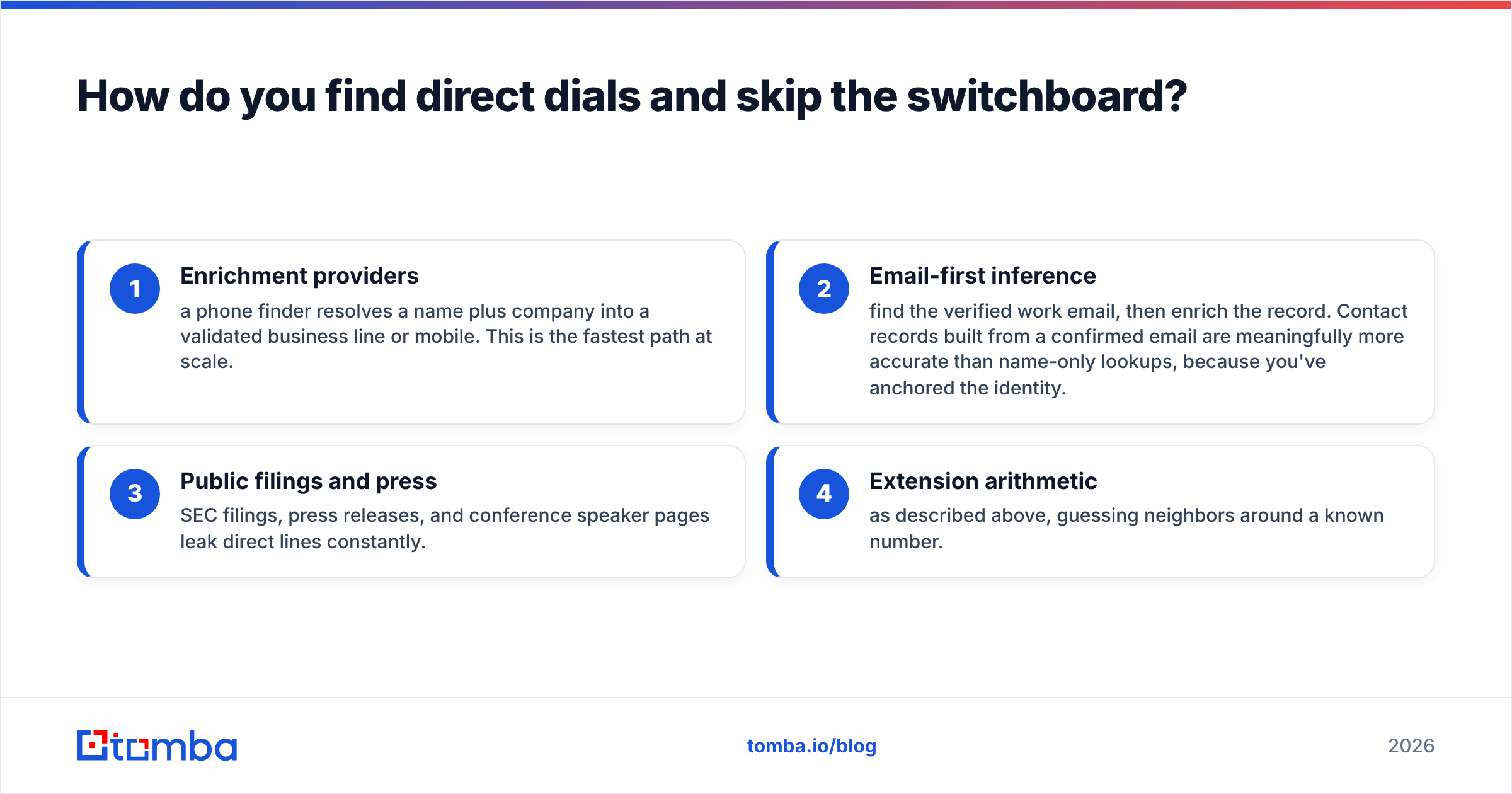
Direct dials come from four places, in descending order of reliability:
- Enrichment providers — a phone finder resolves a name plus company into a validated business line or mobile. This is the fastest path at scale.
- Email-first inference — find the verified work email, then enrich the record. Contact records built from a confirmed email are meaningfully more accurate than name-only lookups, because you've anchored the identity.
- Public filings and press — SEC filings, press releases, and conference speaker pages leak direct lines constantly.
- Extension arithmetic — as described above, guessing neighbors around a known number.
A word on decay. Business phone data goes stale fast — people change roles, companies move to softphones, mobile numbers get reassigned. Whatever source you use, validate before you dial. Burning 40 dials on disconnected numbers doesn't just waste time; high invalid-dial rates contribute to carrier spam flagging on your outbound number, which then hurts the calls that would have connected. A phone validator pass before a calling block is cheap insurance.
For the email half of the blend, the workflow is the same idea: find the address, then confirm it's deliverable. Tomba's email verifier handles the confirmation step, and domain search pulls the full contact map for a target account so you know who the alternates are when your primary contact stonewalls.
What should you never say to a gatekeeper?#
Some phrases are instant disqualifiers. Assistants trade these in Slack channels and Reddit threads. Avoid:
- "Is the owner in?" — signals you don't know who you're calling.
- "He knows what it's about." — if it isn't true, you've lied, and it's checkable in ten seconds.
- "I'll only take two minutes of her time." — nobody with real business promises brevity upfront.
- "Can I speak with whoever handles your IT?" — pure spray-and-pray tell.
- "How are you today?" as the opener — universally recognized as the cold-call greeting.
- Over-explaining the product before you've been transferred — the gatekeeper is not the buyer; pitching her wastes the one chance you had.
Also, don't fight the "send me an email" deflection. Take it, ask which address, and use it. Then actually send something good. A relayed email that gets read beats a transfer you argued your way into. If your follow-up lands in spam, none of it matters — check your SPF record and sender setup before you run the campaign.
How do you handle IVRs and AI gatekeepers?#
Human receptionists are shrinking as a category. What's replacing them is harder: automated attendants, directory lookups, and increasingly AI answering agents that transcribe and summarize your call before anyone hears it.
Practical adaptations:
- Say the full name clearly at the directory prompt. Voice directories match on surname; mumbling routes you to a random Sanders.
- Press 0 twice. Many systems escalate to a live operator on repeated zero.
- Skip the menu with an extension. If you have any extension at the company, dial it directly — you'll land in the internal system.
- Assume you're being transcribed. AI summarizers relay what you said. Make your first sentence relay-worthy: specific, short, and about a business outcome rather than a product.
- Check your caller ID reputation. If your number is labeled "Spam Likely," you never even reach the menu. Carriers use complaint rates and answer rates to score outbound numbers, and it degrades quietly over months.
The AI shift actually favors honest, specific reps. A machine transcribing "calling about their Q3 freight spend" passes that along faithfully. A machine transcribing "it's a personal matter" flags it.
How does this fit into a real prospecting workflow?#
Here's a sequence that consistently outperforms pure dialing, run over roughly two weeks per contact:
- Build the account map. Identify the decision-maker, one lateral influencer, and the executive assistant. Domain search gives you the whole floor, not just one name.
- Verify emails before sending. Bounces damage sender reputation, and a damaged domain makes every later touch weaker.
- Send touch one. Short, specific, no attachment, no calendar link.
- Call on day three, mid-morning. If a gatekeeper answers, reference the email by name and date.
- Send touch two on day five. Reply in the same thread with one new data point.
- Call the direct dial on day six, early or late. This is your highest-probability dial of the sequence.
- Ask the gatekeeper for routing help on day nine. By now she's seen your name three times; the "who owns this decision?" question lands as legitimate rather than intrusive.
- Break up on day twelve. A clean, unbothered close-the-loop message pulls a surprising number of replies.
Notice that the gatekeeper appears twice as a resource, not an obstacle. That's the mental shift that separates reps with 25% connect rates from reps at 8%.
For teams building lists at volume, HubSpot's ongoing sales statistics research is worth reading on touch counts and timing, and G2's phone data category is a reasonable place to compare enrichment vendors on verified-review data rather than vendor claims. Peers like BookYourData take a database-first approach that suits teams who want to buy a list outright rather than enrich record by record — worth evaluating alongside API-driven tools depending on whether your bottleneck is coverage or freshness.
What's the fastest way to stop fighting gatekeepers?#
Cut the number of calls that need a gatekeeper in the first place.
Every hour spent rehearsing rebuttals is an hour not spent improving the list. A rep with 200 verified direct dials and mediocre scripting will out-book a rep with perfect scripting and 200 main-line switchboard numbers. The data is upstream of the technique, and it compounds — better contact data also means fewer bounces, fewer wrong-person conversations, and cleaner attribution when you review what worked.
Start by fixing the identity layer: get the right person, at the right company, with an address and number that actually resolve. The Tomba Email Finder locates verified professional emails by name and domain, and it pairs with phone enrichment so your blended sequences run on one clean record instead of three half-matched ones. The free tier gives you 25 searches a month to test coverage on your own accounts before committing, and paid plans start at $49/mo on Starter — full Tomba pricing is public if you want to size it against your list volume.
Run twenty of your hardest target accounts through it, call the direct dials at 7:50 a.m., and compare that connect rate against a week of switchboard dials. The gatekeeper problem tends to look a lot smaller from the other side of that test.
Related guides#
// get started
Find, verify and enrich your first contacts today
Start on the free plan with 25 searches a month, then scale when your team is ready.
Free plan · No credit card required · GDPR & CCPA
// about the author