How to Get SEO Customers in 2026: 9 Channels That Work
Most SEO agencies chase referrals and hope. Here are nine acquisition channels ranked by cost per signed client, plus the outreach stack that turns a domain list into booked audits.
TL;DR
- Referrals close fastest but do not scale — treat them as revenue, not a strategy.
- Cold outreach built on a specific technical finding (not "I noticed your website") is still the cheapest repeatable channel for agencies under $50k MRR.
- Your close rate is mostly a data problem: wrong contact, wrong seniority, bounced email. Fix the list before you rewrite the pitch.
- Productized audits, partner channels (web devs, PR firms, Shopify agencies), and marketplace listings each fill a different stage of the funnel.
- Budget roughly 20 verified decision-maker contacts per booked audit call, and 4-6 audit calls per signed retainer.
Getting SEO customers is a distribution problem disguised as a marketing problem. You already know how to rank a page. What you probably do not have is a repeatable way to put a relevant, specific message in front of the person who signs the contract — 40 times a week, without burning your domain or your afternoons.
This guide ranks the nine channels agencies and freelancers actually use, with honest numbers on cost, speed, and the kind of client each one produces.
Why is selling SEO harder than delivering it?#
Three structural reasons.
First, SEO has a trust deficit. Most prospects have been burned. Gartner's research on B2B buying consistently shows buyers spend the majority of their journey doing independent research rather than talking to vendors, and SEO buyers research harder than most because they have a bad prior. Your outreach competes with a memory of the last agency.
Second, the buyer is hard to identify. For a 40-person e-commerce brand, the SEO decision might sit with the founder, the head of growth, the marketing manager, or an outsourced CMO. Guessing wrong costs you the deal before the pitch starts.
Third, the value is delayed. You are selling an outcome that arrives in month five against competitors selling clicks that arrive on Tuesday. That means your acquisition motion has to lead with proof, not promise.
Everything below is organized around those three constraints: build trust fast, reach the right person, show proof early.
What are the nine channels for getting SEO clients?#
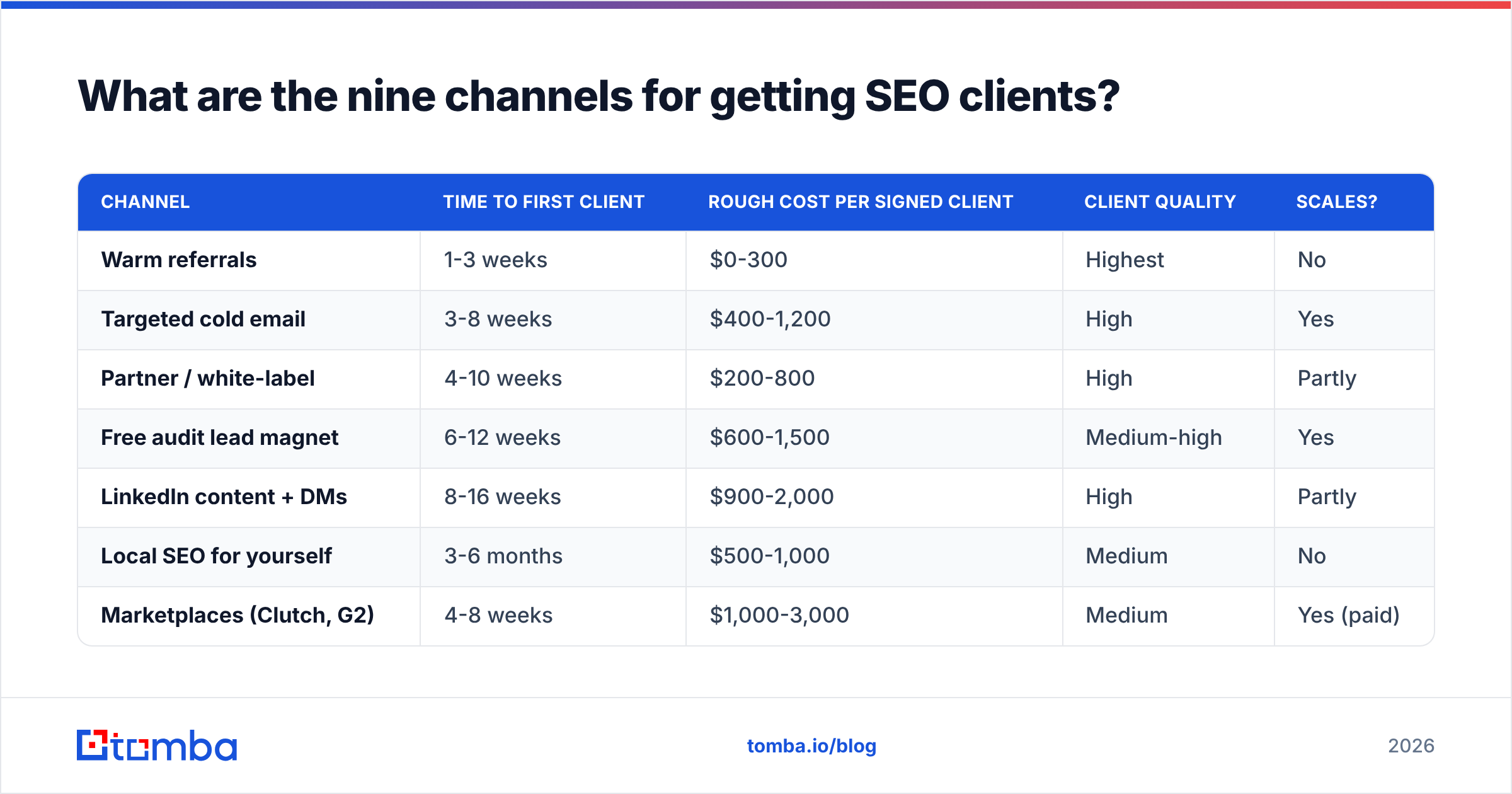
Here is the honest ranking. "Cost per signed client" assumes a solo operator or small agency valuing their own time at $75/hour.
| Channel | Time to first client | Rough cost per signed client | Client quality | Scales? |
|---|---|---|---|---|
| Warm referrals | 1-3 weeks | $0-300 | Highest | No |
| Targeted cold email | 3-8 weeks | $400-1,200 | High | Yes |
| Partner / white-label | 4-10 weeks | $200-800 | High | Partly |
| Free audit lead magnet | 6-12 weeks | $600-1,500 | Medium-high | Yes |
| LinkedIn content + DMs | 8-16 weeks | $900-2,000 | High | Partly |
| Local SEO for yourself | 3-6 months | $500-1,000 | Medium | No |
| Marketplaces (Clutch, G2) | 4-8 weeks | $1,000-3,000 | Medium | Yes (paid) |
| Upwork / freelance boards | 1-2 weeks | $300-900 | Low-medium | Yes |
| Paid search on "SEO agency" | 2-4 weeks | $2,500-6,000 | Medium | Yes (expensive) |
Two things jump out. Referrals win on every axis except the one that matters for growth — you cannot make more of them on demand. And paid search for "SEO agency" is brutal, because you are bidding against every agency in the world plus the enterprise players with a 90-day payback tolerance.
That leaves outbound, partnerships, and audits as the practical engine for most shops.
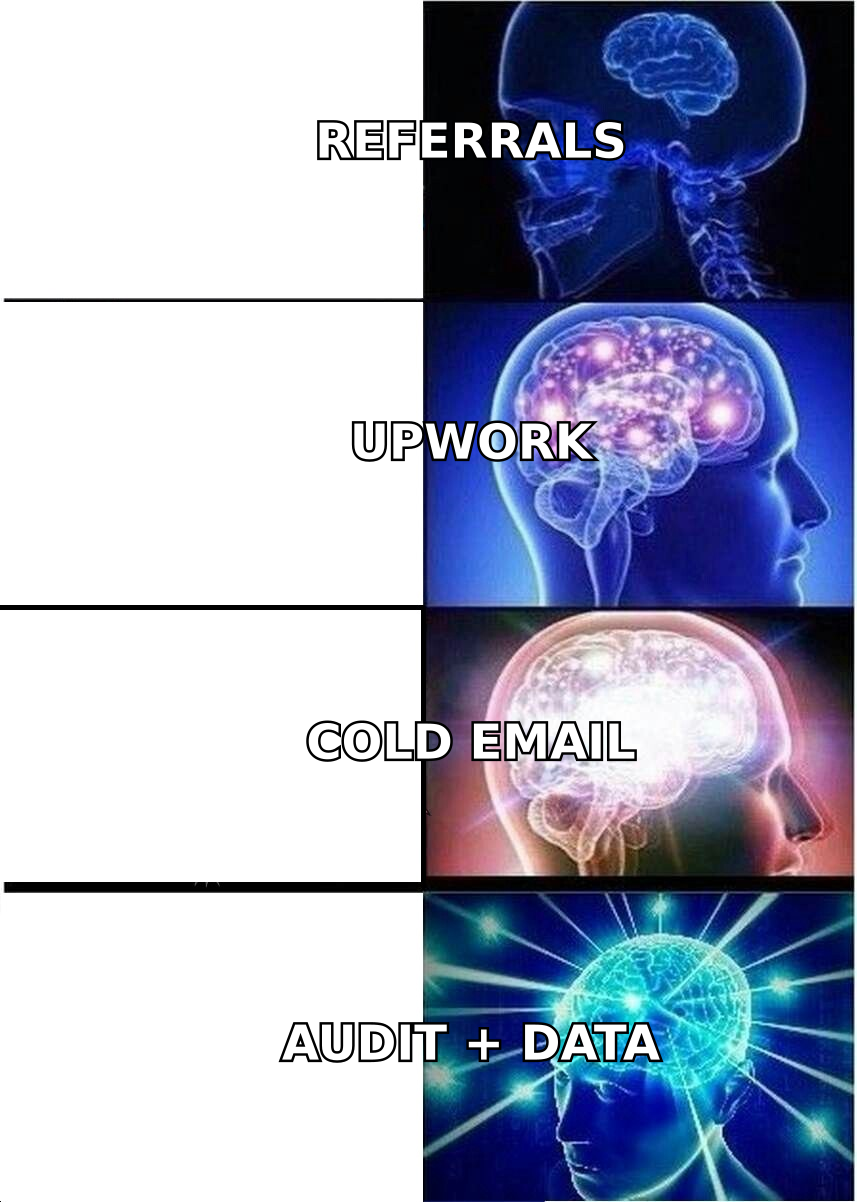
The four channels worth building first#
- Targeted cold email with a real finding. Not "I ran an audit on your site." Instead: "Your /collections pages are canonicalized to /collections/all, so 340 product URLs are not indexed." Specificity is the entire pitch.
- Partner referral loops. Web design shops, Shopify/Webflow agencies, PR firms, and paid-media agencies all get asked about SEO and mostly do not want it. One good partner is worth 500 cold emails.
- A productized entry offer. A $500-1,500 technical audit or a $2,000 content-gap sprint. It converts prospects who will not sign a 12-month retainer cold, and it converts them into retainers at 30-50% once you have proven you can execute.
- LinkedIn teardowns. Publicly analyze a well-known site's SEO problems, twice a week. It compounds slowly and it produces inbound from people who already believe you know what you are doing.
How do you build a prospect list that actually converts?#
This is where most agencies quietly lose. They pick a good channel and feed it a bad list.
A usable SEO prospect list has four layers:
- A qualifying signal. Something that proves this company has an SEO problem and the budget to fix it. Examples: they run Google Ads on head terms (budget exists, organic does not), they just raised a seed round, they migrated platforms in the last 90 days, they publish blog content but rank for nothing, or they have thin/duplicate title tags at scale.
- The right person. For sub-100-employee companies, target the founder, Head of Marketing, or Head of Growth. Above 200 employees, target the Demand Gen or Content lead — the founder will never read it.
- A deliverable contact. A guessed
first.last@pattern is a coin flip. Verified addresses are the difference between a 2% bounce rate and a 22% one, and past roughly 5% bounces your sending reputation starts to decay. - The finding. One concrete, checkable technical or content observation per prospect.
For the sourcing step, a domain search turns a list of qualified company domains into named contacts with role labels, which is faster than scraping LinkedIn and safer than buying a static list that has been resold 40 times. If you already have names and companies from a conference list or a funding database, an email finder fills in the addresses directly.
The finding is the message#
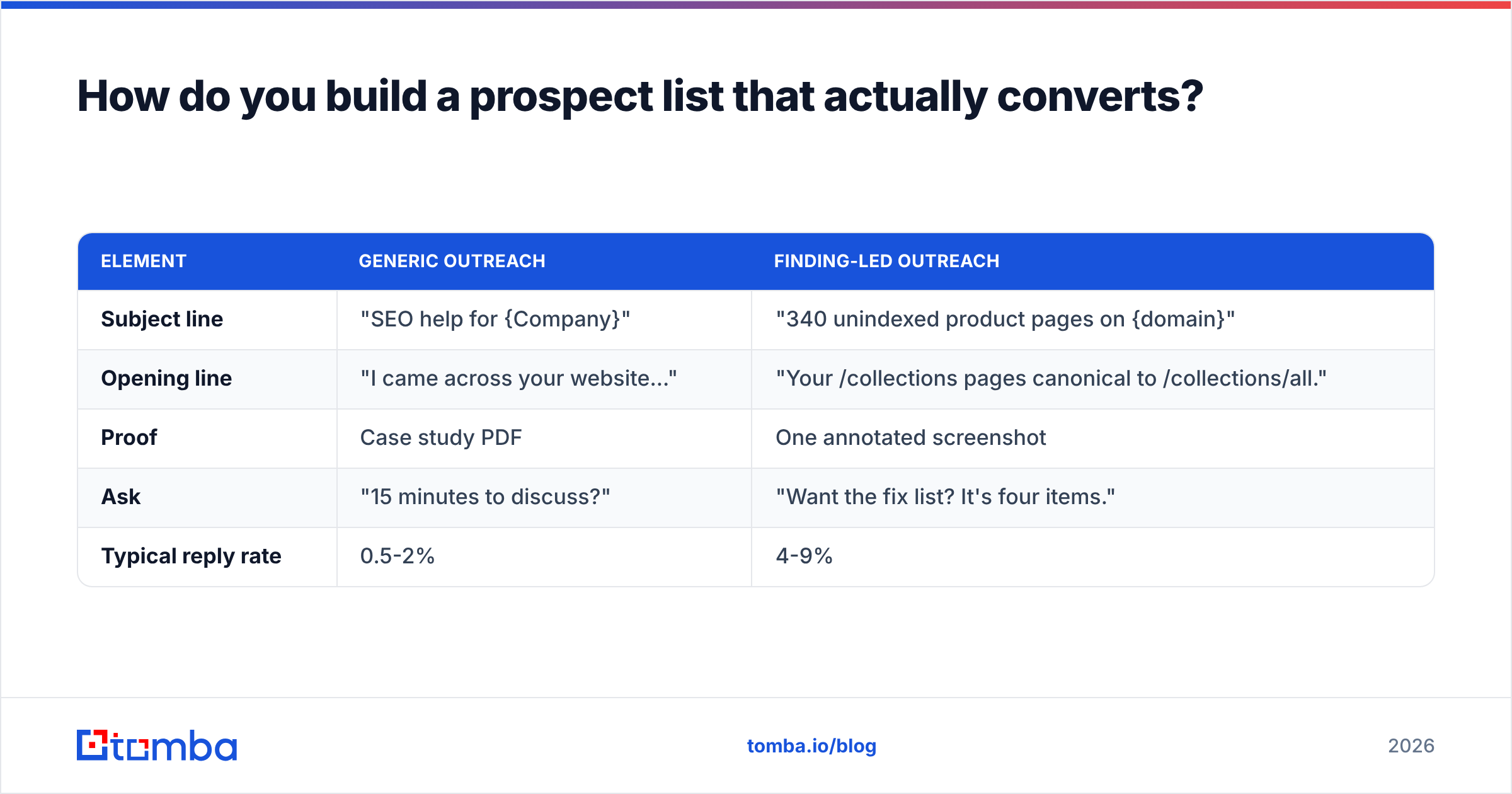
Here is the difference in practice:
| Element | Generic outreach | Finding-led outreach |
|---|---|---|
| Subject line | "SEO help for {Company}" | "340 unindexed product pages on {domain}" |
| Opening line | "I came across your website..." | "Your /collections pages canonical to /collections/all." |
| Proof | Case study PDF | One annotated screenshot |
| Ask | "15 minutes to discuss?" | "Want the fix list? It's four items." |
| Typical reply rate | 0.5-2% | 4-9% |
The right-hand column takes about eight minutes of research per prospect. That is the actual cost of the channel, and it is why volume-only outbound fails for SEO services specifically — the value of the service is diagnostic, so the outreach has to be diagnostic too.
How many contacts do you need per signed client?#
Work backwards from the retainer.
Assume a $2,500/month retainer and a 12-month expected lifetime — $30,000 in lifetime value. The funnel math for finding-led cold outreach, based on what small agencies typically report:
- 100 verified decision-maker contacts sent
- 6-9 replies (finding-led, personalized)
- 3-4 positive replies
- 2 booked audit calls
- 0.4-0.6 signed retainers
So roughly 170-250 verified contacts per signed retainer, or about 20 contacts per booked call. That number is your planning unit. If you want two new clients a month, you need to reliably produce and contact 400-500 qualified people a month, which is 20-25 per working day.
That volume is only survivable if the sourcing is automated and the personalization is templated around a repeatable finding type. Pick three finding types you can diagnose in under five minutes each — indexation bloat, missing internal links to money pages, cannibalized title tags — and build your whole list around companies exhibiting one of them.
Which tools do you need for the outbound stack?#
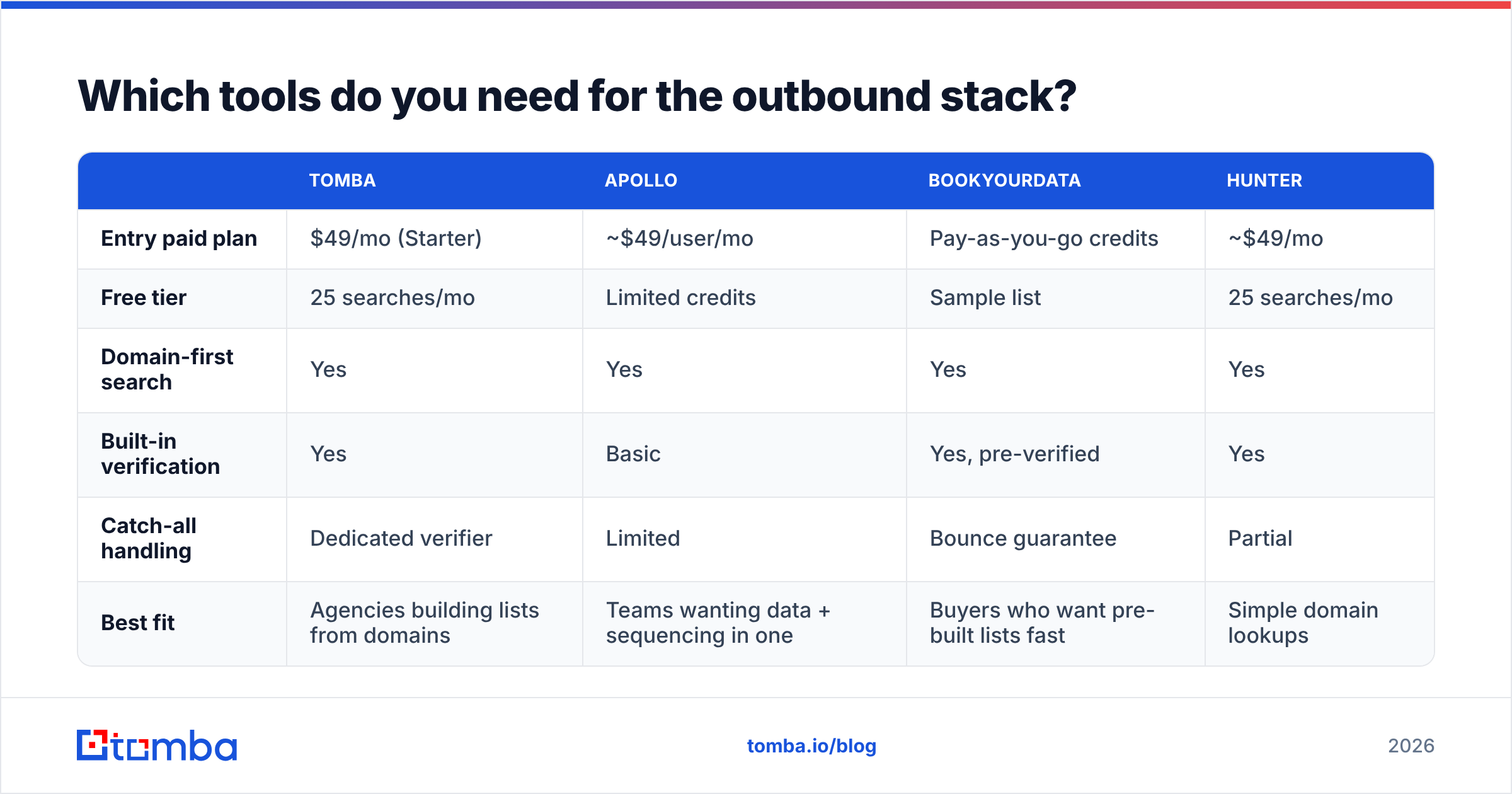
You need four things: a source of companies, a source of contacts, verification, and a sending tool. Here is how the common contact-data options compare for this specific use case.

Accuracy matters more here than in most B2B use cases, because SEO outreach lives or dies on domain reputation. You are typically sending from your agency domain — the same domain your inbound leads use to reply. One bad list can cost you months.
| Tomba | Apollo | BookYourData | Hunter | |
|---|---|---|---|---|
| Entry paid plan | $49/mo (Starter) | ~$49/user/mo | Pay-as-you-go credits | ~$49/mo |
| Free tier | 25 searches/mo | Limited credits | Sample list | 25 searches/mo |
| Domain-first search | Yes | Yes | Yes | Yes |
| Built-in verification | Yes | Basic | Yes, pre-verified | Yes |
| Catch-all handling | Dedicated verifier | Limited | Bounce guarantee | Partial |
| Best fit | Agencies building lists from domains | Teams wanting data + sequencing in one | Buyers who want pre-built lists fast | Simple domain lookups |
Apollo is the better pick if you want prospecting and sequencing in a single seat and can live with variable data quality on smaller companies. BookYourData suits agencies who would rather buy a clean, pre-verified list for a defined vertical than build one — a genuinely different workflow, and a good one if your ICP is stable. Tomba fits the pattern most SEO agencies actually run: you already have a list of domains (from Ahrefs, SEMrush, a SERP scrape, or a funding round tracker) and you need names, roles, and deliverable addresses attached to them.

Whatever you pick, run the final list through an email verifier before the first send. Catch-all domains are the trap — they accept everything at the SMTP layer and bounce silently later, which is why a dedicated catch-all verifier is worth the extra step on enterprise-ish targets.

How do you turn a free audit into a paid retainer?#
The free-audit-to-retainer path is the highest-converting sequence in agency sales, and most people run it wrong by giving away a 40-page automated PDF.
Run it this way instead:
- Give away the diagnosis, not the cure. Show three specific problems with estimated traffic impact. Do not include the implementation steps.
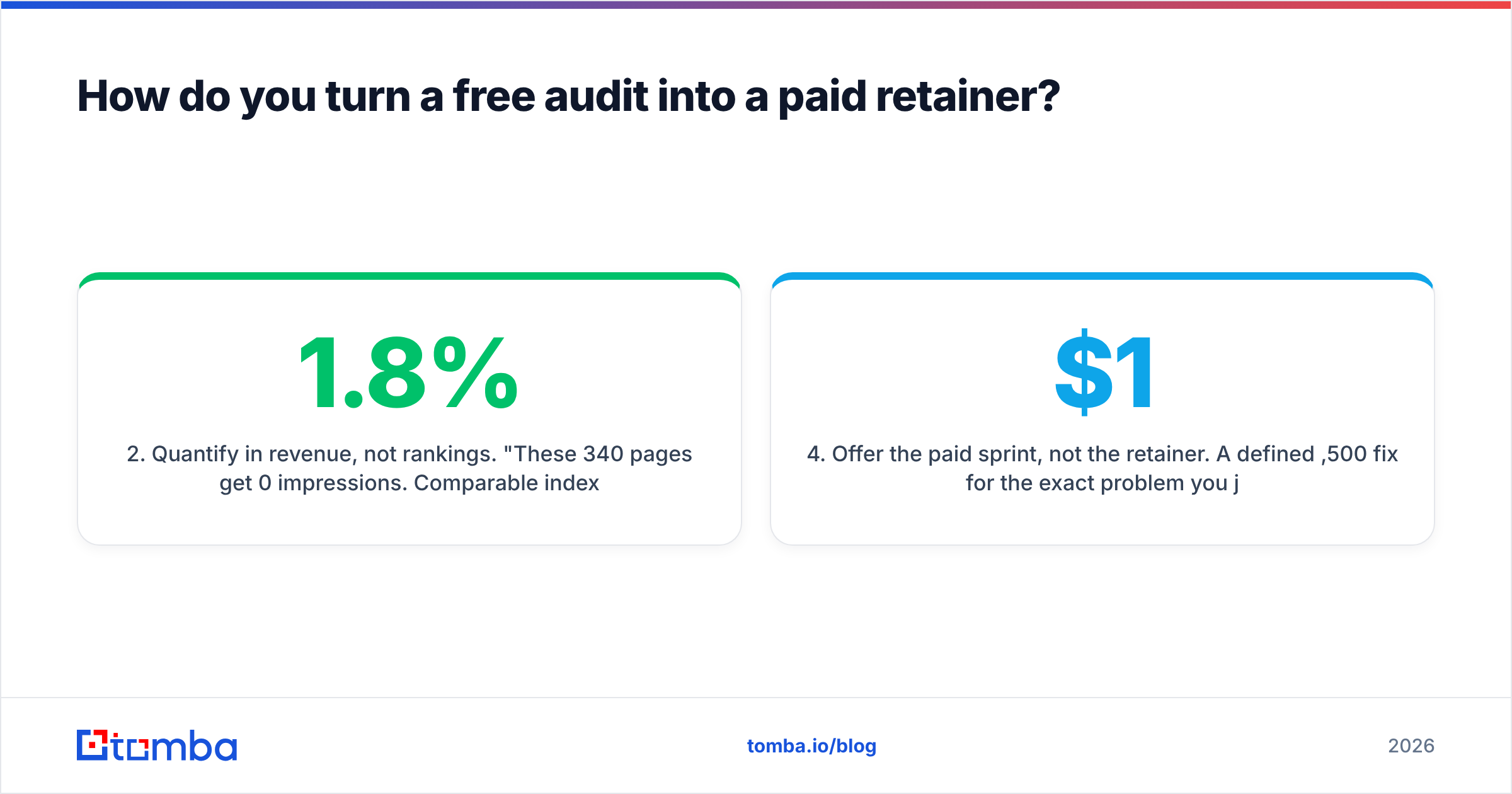
- Quantify in revenue, not rankings. "These 340 pages get 0 impressions. Comparable indexed pages average 22 sessions/month at your 1.8% conversion rate and $84 AOV — that's about $9,000/month unrealized."
- Deliver it live, not as an attachment. A 20-minute screen-share converts several times better than a PDF, because objections surface where you can answer them.
- Offer the paid sprint, not the retainer. A defined $1,500 fix for the exact problem you just showed. Small enough to approve without a committee.
- Convert on results. After the sprint ships and the pages index, the retainer conversation is about maintaining a win, not buying a promise.
For the diagnosis itself, tools like Google Search Console give you indexation and query data for clients who grant access, and Ahrefs or Semrush cover the pre-access research. Neither replaces manually looking at the site for ten minutes.
What about partnerships and inbound?#
Partnerships are the most underrated channel in this list because the trust transfer is already done.
Target agencies that sell to your ICP but do not sell SEO:
- Web design and Webflow/Shopify shops — they hand off sites that were never built to rank, and they get asked about it constantly.
- PR and digital-first agencies — they earn links as a byproduct and have no one to hand the technical work to.
- Paid media agencies — their clients ask "why is our CPC so high?" and organic is the honest answer.
- Fractional CMOs — one person, many portfolio companies, constant need for vetted specialists.
Offer a 10-15% referral fee or a white-label rate, and make the first collaboration free or near-free so they can see the delivery quality. To find the decision-maker at those agencies, a LinkedIn finder resolves profiles you have already vetted into contactable addresses — better than a connection request that sits unanswered for six weeks.
On inbound: rank your own site, but be realistic. "SEO agency" head terms are a five-figure content-and-links investment. The winnable terms are long-tail and vertical-specific — "SEO for dental practices," "Shopify collection page SEO," "SaaS programmatic SEO consultant." Those convert better anyway, because the searcher has self-qualified.
What is the 30-day plan?#
If you are starting from zero this month:
- Days 1-3. Define one vertical and one qualifying signal. Not "SMBs" — "Shopify brands doing $2-10M that run branded Google Ads."
- Days 4-7. Build a list of 300 qualifying domains. Enrich to named contacts and verified addresses. Expect 200-240 usable contacts from 300 domains.
- Days 8-10. Pick three finding types. Write one email template per finding type. Warm your sending domain if it is new.
- Days 11-25. Send 20-25 personalized emails per working day. Two follow-ups each, spaced four and nine days out.
- Days 15-30. Book and run audit calls as replies land. Aim for 4-6 calls.
- Day 30. Review reply rate by finding type. Kill the worst performer, double the best one, rebuild the list for month two.
The single most common failure mode is sending 300 emails once and concluding "cold email doesn't work." It is a per-day habit, not a campaign. The second most common failure is skipping verification and wondering why replies stopped in week three — that is your sender reputation eroding, not your copy.
Get the list right, and the rest follows#
Every channel above depends on the same underlying asset: an accurate list of the people who can say yes. Referrals need it less; everything that scales needs it more. If you want to stop guessing at firstname@company.com and start sending to addresses that land, start with the Tomba Email Finder — the free tier gives you 25 searches a month to test your first vertical, and the Starter plan at $49/mo covers a typical agency's outbound volume. Check Tomba pricing for the Growth and Pro tiers if you are running multi-vertical campaigns or building lists for clients as part of your service.
Related guides#
// get started
Find, verify and enrich your first contacts today
Start on the free plan with 25 searches a month, then scale when your team is ready.
Free plan · No credit card required · GDPR & CCPA
// about the author