How to Get Started With Intent Data in 2026: A Practical Guide
Intent data is sold as a crystal ball and usually delivered as noise. Here is a concrete 6-step rollout — signal sources, contact resolution, scoring thresholds, and the mistakes that burn your first quarter.
TL;DR
- Intent data tells you which accounts are researching your category right now. It does not tell you who to email — you still need contact data to act on it.
- Start with first-party signals (your own site, docs, pricing page) before you pay a cent for third-party intent. They are free, higher confidence, and already sitting in your logs.
- A working pilot needs four parts: a signal source, a topic taxonomy, a scoring threshold, and a contact-resolution layer that turns "Acme is in-market" into "email Priya, VP Ops at Acme."
- Budget 60–90 days. Most intent programs fail in week three because nobody defined what score triggers what action.
- The cheapest failure mode is buying premium third-party intent and having no way to reach the humans behind the account. Fix contact resolution first.
Intent data has been oversold for a decade. Vendors pitch it as a list of accounts about to buy from you; in practice it is a probabilistic signal that some anonymous person at a company read something adjacent to your category. That is still useful — it is just useful in a narrower, more operational way than the pitch decks suggest.
This guide is the version I would hand a RevOps lead with a $0–$30k budget and one quarter to prove the thing works.
What is intent data, actually?#
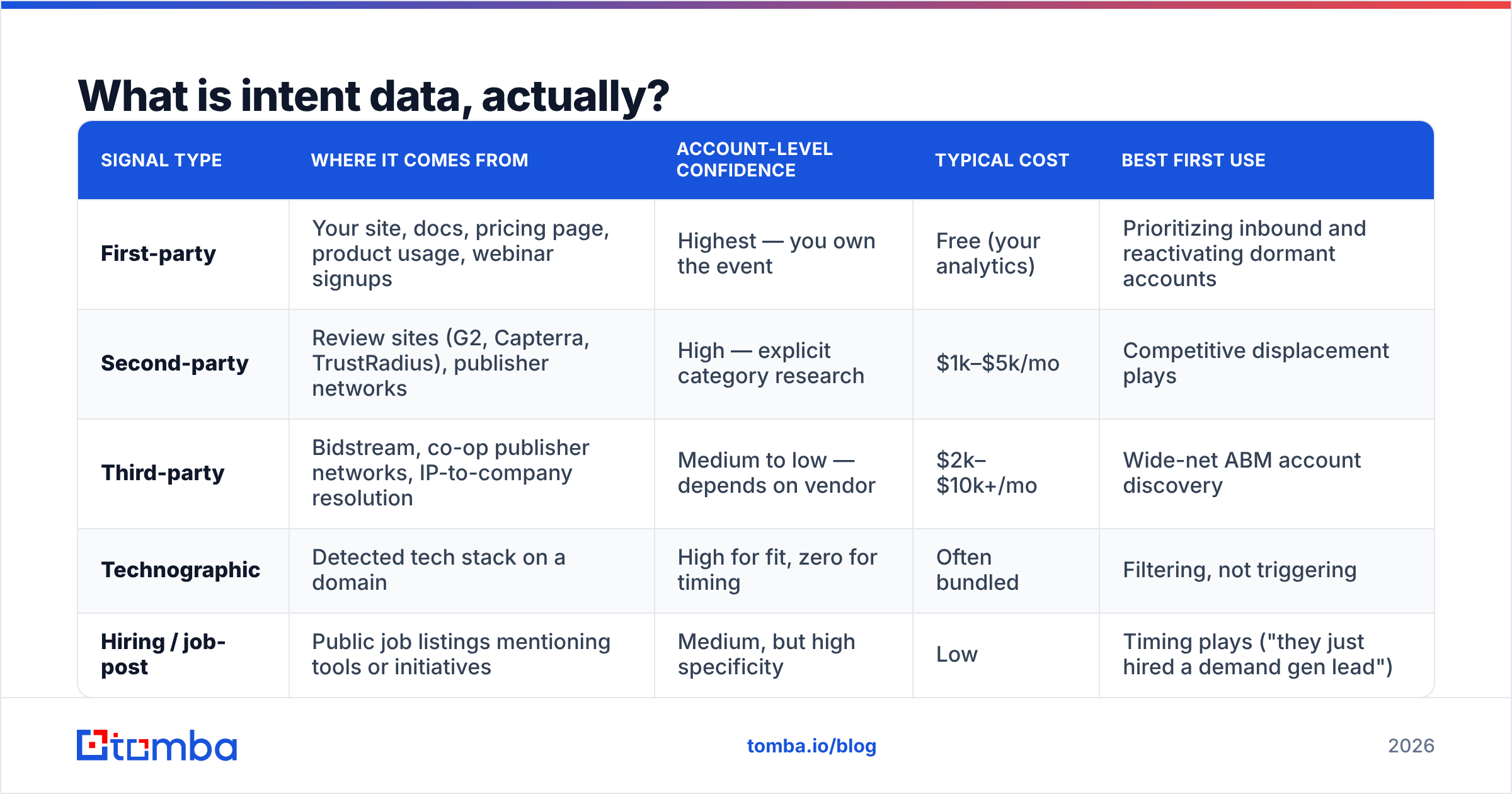
Intent data is behavioral evidence that an account is researching a problem you solve. It comes in three flavors, and conflating them is the single most common reason pilots go sideways.
Think of it like a bookstore. First-party intent is watching someone in your store pick up your book and read the back cover. Second-party is a review site telling you they read a competitor's book on their shelves. Third-party is a network of stores reporting that someone from that company has been reading about the topic somewhere in town — you know the company, not the person, and the confidence is fuzzier.
| Signal type | Where it comes from | Account-level confidence | Typical cost | Best first use |
|---|---|---|---|---|
| First-party | Your site, docs, pricing page, product usage, webinar signups | Highest — you own the event | Free (your analytics) | Prioritizing inbound and reactivating dormant accounts |
| Second-party | Review sites (G2, Capterra, TrustRadius), publisher networks | High — explicit category research | $1k–$5k/mo | Competitive displacement plays |
| Third-party | Bidstream, co-op publisher networks, IP-to-company resolution | Medium to low — depends on vendor | $2k–$10k+/mo | Wide-net ABM account discovery |
| Technographic | Detected tech stack on a domain | High for fit, zero for timing | Often bundled | Filtering, not triggering |
| Hiring / job-post | Public job listings mentioning tools or initiatives | Medium, but high specificity | Low | Timing plays ("they just hired a demand gen lead") |
The pattern to internalize: first-party tells you who is close, third-party tells you who is early. You need both eventually. You need first-party immediately.
How do you get started with intent data without wasting a quarter?#
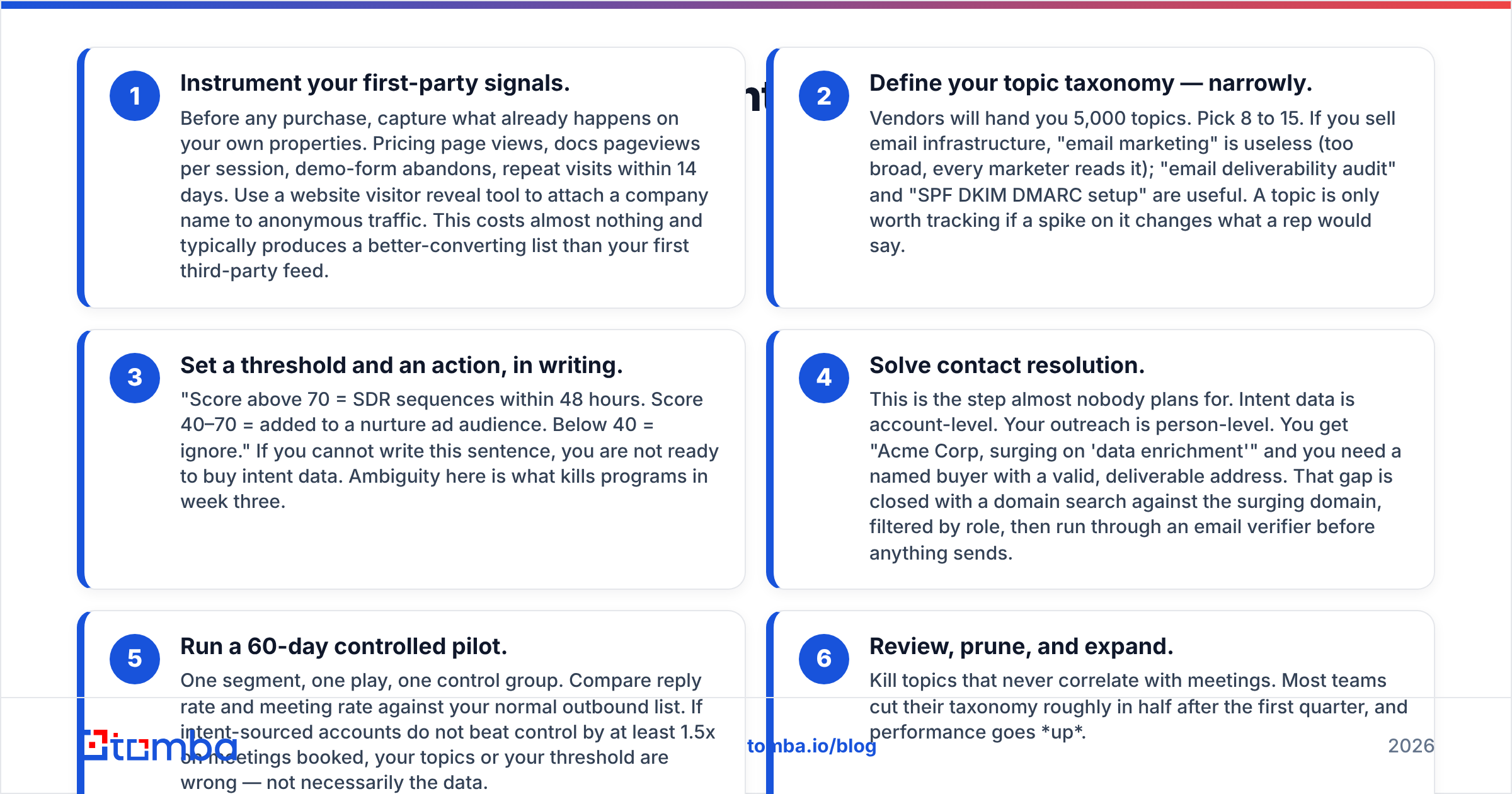
Six steps, in order. Do not skip step two — every failed program I have seen skipped step two.
Instrument your first-party signals. Before any purchase, capture what already happens on your own properties. Pricing page views, docs pageviews per session, demo-form abandons, repeat visits within 14 days. Use a website visitor reveal tool to attach a company name to anonymous traffic. This costs almost nothing and typically produces a better-converting list than your first third-party feed.
Define your topic taxonomy — narrowly. Vendors will hand you 5,000 topics. Pick 8 to 15. If you sell email infrastructure, "email marketing" is useless (too broad, every marketer reads it); "email deliverability audit" and "SPF DKIM DMARC setup" are useful. A topic is only worth tracking if a spike on it changes what a rep would say.
Set a threshold and an action, in writing. "Score above 70 = SDR sequences within 48 hours. Score 40–70 = added to a nurture ad audience. Below 40 = ignore." If you cannot write this sentence, you are not ready to buy intent data. Ambiguity here is what kills programs in week three.
Solve contact resolution. This is the step almost nobody plans for. Intent data is account-level. Your outreach is person-level. You get "Acme Corp, surging on 'data enrichment'" and you need a named buyer with a valid, deliverable address. That gap is closed with a domain search against the surging domain, filtered by role, then run through an email verifier before anything sends.
Run a 60-day controlled pilot. One segment, one play, one control group. Compare reply rate and meeting rate against your normal outbound list. If intent-sourced accounts do not beat control by at least 1.5x on meetings booked, your topics or your threshold are wrong — not necessarily the data.
Review, prune, and expand. Kill topics that never correlate with meetings. Most teams cut their taxonomy roughly in half after the first quarter, and performance goes up.
Why does contact resolution break most intent programs?#
Because the two halves of the problem are sold by different vendors, and the handoff is left to you.
Here is the actual sequence a signal has to survive to become revenue:
- Signal fires — third-party network reports acme.com surging on "lead enrichment API."
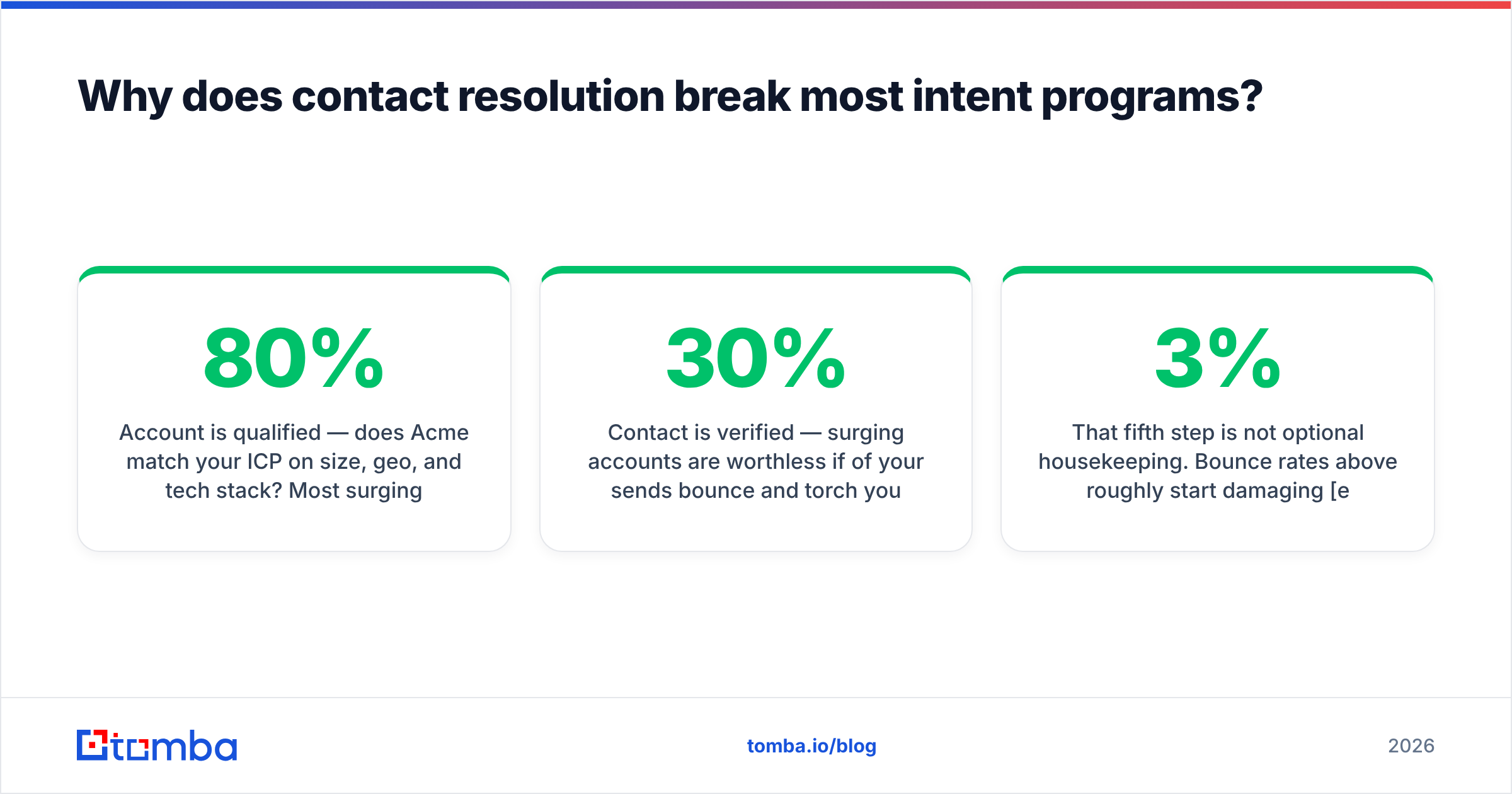
- Account is qualified — does Acme match your ICP on size, geo, and tech stack? Most surging accounts do not. Expect 60–80% attrition here alone.
- Buyer is identified — who at Acme owns this? Usually a title-based guess plus LinkedIn confirmation.
- Contact is found — you need a work email and ideally a direct dial. This is where a bulk email finder matters, because you are resolving dozens of accounts a week, not one.
- Contact is verified — surging accounts are worthless if 30% of your sends bounce and torch your sender reputation.
- Message references the signal — carefully — never say "I saw you researching X." Say something that is relevant to X.
That fifth step is not optional housekeeping. Bounce rates above roughly 3% start damaging email deliverability, which means your best-timed intent play lands in spam. An intent program with unverified contacts is a very expensive way to hurt your domain.
Tomba sits specifically at steps four and five: given a surging domain from any intent vendor, it returns named contacts with role filters and verification in one pass. The Tomba API makes this an automated step in your enrichment workflow rather than a manual research task for an SDR.
Which intent data vendors should you evaluate?#
Rather than a "best of" list, here is the honest segmentation by what you are trying to do and what you can afford.
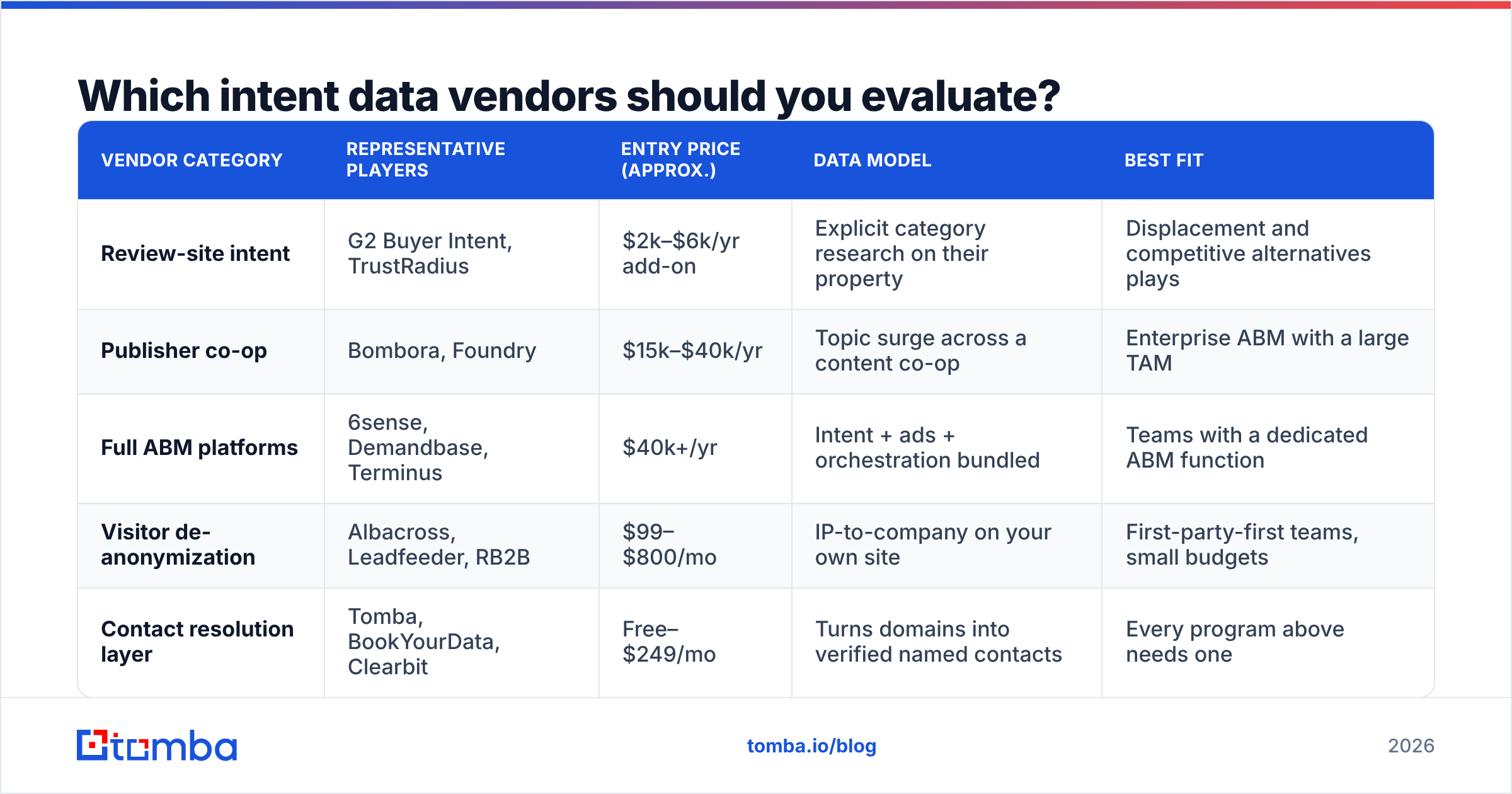
| Vendor category | Representative players | Entry price (approx.) | Data model | Best fit |
|---|---|---|---|---|
| Review-site intent | G2 Buyer Intent, TrustRadius | $2k–$6k/yr add-on | Explicit category research on their property | Displacement and competitive alternatives plays |
| Publisher co-op | Bombora, Foundry | $15k–$40k/yr | Topic surge across a content co-op | Enterprise ABM with a large TAM |
| Full ABM platforms | 6sense, Demandbase, Terminus | $40k+/yr | Intent + ads + orchestration bundled | Teams with a dedicated ABM function |
| Visitor de-anonymization | Albacross, Leadfeeder, RB2B | $99–$800/mo | IP-to-company on your own site | First-party-first teams, small budgets |
| Contact resolution layer | Tomba, BookYourData, Clearbit | Free–$249/mo | Turns domains into verified named contacts | Every program above needs one |
A note on that last row: it is not an alternative to the others, it is the connective tissue. BookYourData is a solid option if you prefer buying pre-built verified lists by filter; Tomba is the better fit when your input is a stream of domains arriving from an intent feed and you need on-demand lookup plus verification via API. Both are honest about verification, which is more than can be said for a lot of the list market.
If your budget is under $1,000/month total, skip the co-op vendors entirely for now. Run visitor de-anonymization plus review-site intent, and spend the difference on contact quality. That combination beats a cheap third-party feed you cannot act on.
What does a first intent play actually look like?#
Concrete example. You sell a compliance tool to fintech ops teams.
Trigger: account matches ICP (fintech, 200–2,000 employees, US/UK) and shows a surge on two of your tracked topics and has visited your pricing page in the last 21 days.
Resolution: run the domain through a domain search filtered to Compliance, Risk, and Operations titles at director level and above. Take the top three contacts. Verify all three. Discard anything that comes back catch-all without passing a catch-all verifier check.
Play: a four-touch sequence over 12 days. Touch one references the problem implied by the topic, never the surveillance. "Most fintech ops teams hit a wall with SOC 2 evidence collection around Series B" is fine. "I noticed your team researching SOC 2" is creepy and tanks reply rates.
Measurement: meetings booked per 100 accounts worked, versus a control cohort of ICP-matched accounts with no intent signal. Track for 60 days minimum — intent windows are typically 30–90 days, so a two-week read tells you nothing.

How accurate is intent data, and how should you sanity-check it?#
Treat every vendor accuracy claim as a marketing number until you test it on your own accounts.
Three cheap validations before you sign anything:
- Backtest against closed-won. Ask the vendor to run your last 50 closed-won accounts through their history. Did those accounts surge before they bought? If fewer than half did, the coverage is not there for your category.
- Check the resolution method. IP-to-company resolution degrades badly with remote work and consumer ISPs. Ask what percentage of their signal comes from IP resolution versus authenticated publisher events. Higher authenticated share means better data.
- Test the false-positive rate manually. Take 20 surging accounts, call or check 10 of them. If none has any plausible reason to be in-market, the topic mapping is broken.
For a broader view on how buying committees actually research, Gartner's B2B buying research is worth reading — it explains why account-level signals are noisy in the first place: the typical buying group is 6–10 people and they research asynchronously, so you are seeing fragments of a group process.
Also accept a structural limitation: intent data has no idea about budget, timing, or internal politics. It tells you a topic got warm. Whether that is a funded initiative or an intern writing a report is not knowable from the signal.
What should you avoid in your first 90 days?#
- Buying before instrumenting. Your own site data is the highest-confidence intent you will ever get, and you already own it.
- Tracking too many topics. Fifty topics means everything surges and nothing means anything.
- Referencing the signal in your copy. Buyers find it invasive, and it converts worse than a plain relevant opener.
- Skipping verification. Intent-sourced lists are often worse on deliverability than curated ones, because the domains are new to you and email patterns are unconfirmed.
- Routing intent to reps with no workflow change. If the signal shows up as a Salesforce field nobody looks at, you bought a field. Build it into a queue, a task, or a sales automation trigger.
- Judging the pilot on pipeline instead of meetings. Sixty days is too short for pipeline. Measure meetings booked and reply rate; pipeline reads come in quarter two.
How do you scale it once the pilot works?#
Once your control group is beaten cleanly, the scaling levers are mostly operational rather than data-related:
- Automate the enrichment hop. Signal in, verified contacts out, no human in the middle. An API call on a webhook beats an SDR doing manual lookups every time.
- Add a second signal layer. Hiring signals and technographic filters stack well on top of topic surge and cut false positives sharply.
- Split plays by signal strength. High-confidence signals get a human-written sequence and a call; medium-confidence signals get ads and a lighter touch.
- Feed outcomes back into topic selection. Every closed-won deal should update which topics you keep tracking. This is the compounding part of the program.
- Watch your sending health. As volume grows, sender reputation becomes the ceiling on the whole system. Verification at ingest, not at send, keeps it clean.
- Push signals into the CRM properly. A surge score and a timestamp on the account record, visible in the rep's daily view. HubSpot's guide to intent data has reasonable patterns for CRM field design if you are starting from scratch.
The teams that make intent work are not the ones with the fanciest vendor. They are the ones who wrote down the threshold, automated the contact hop, and pruned their topics ruthlessly after 90 days.
Ready to turn surging accounts into people you can actually email?#
Intent data hands you domains. Revenue requires named, verified humans at those domains. That gap is exactly what the Tomba Email Finder closes — feed it a surging domain, filter by role and seniority, and get back verified work emails ready to sequence, with catch-all handling and bulk processing built in.
Start on the free tier (25 searches/month) to validate the workflow against a handful of accounts from your intent feed. When the play works, the Starter plan at $49/month covers most single-SDR programs, and Growth at $99/month handles a full pilot cohort. Full Tomba pricing is public, and the API is available on every paid tier so the enrichment step can run automatically the moment a signal fires.
Related guides#
// get started
Find, verify and enrich your first contacts today
Start on the free plan with 25 searches a month, then scale when your team is ready.
Free plan · No credit card required · GDPR & CCPA
// about the author