How To Get Your First 10 Customers: A 2026 Playbook
Your first 10 customers do not come from ads or content. They come from 200 well-chosen conversations. Here is the exact channel math, outreach sequence, and tooling to get there in 60 days.
TL;DR
- Your first 10 customers come from roughly 200 targeted conversations, not from ads, SEO, or a launch. Budget for volume, not virality.
- Build a list of 200 named humans — not 2,000 companies — and personalize the first line for every one of them. Reply rates of 8-15% are realistic at that size.
- Manual, unscalable outreach is the correct strategy at this stage. Founders who automate too early kill the feedback loop that tells them what to build.
- Data quality beats copy quality when your list is small: a 12% bounce rate on 200 emails means 24 wasted shots you cannot afford.
- Charge from customer one. Free pilots produce testimonials, not revenue, and they teach you nothing about pricing.
Why do your first 10 customers behave nothing like your next 100?#
The first 10 are bought, not attracted. Nobody is searching for your category yet, nobody trusts your logo wall (you don't have one), and nobody is going to stumble onto your pricing page. Every one of those first deals gets pulled across the line by a founder having a direct conversation with a specific person.
This changes the math. Content marketing works on a 6-12 month lag. Paid ads need a working funnel to optimize against, and you don't have conversion data yet. Partnerships need something to partner on. What's left is direct outreach — email, LinkedIn, phone, and warm intros — plus communities where your buyers already gather.
Think of it like opening a restaurant on a side street. You don't buy a billboard on day one. You walk up and down the block handing out samples until 10 people come in, and then you ask each of them, in detail, what made them walk through the door.
The other thing that changes: your goal isn't revenue. Ten customers at $200/month is $2,000 MRR, which funds nothing. What those 10 buy you is proof that a specific problem is painful enough that a specific type of person will move budget to solve it. That's the asset.
What are the actual channels that produce the first 10 customers?#
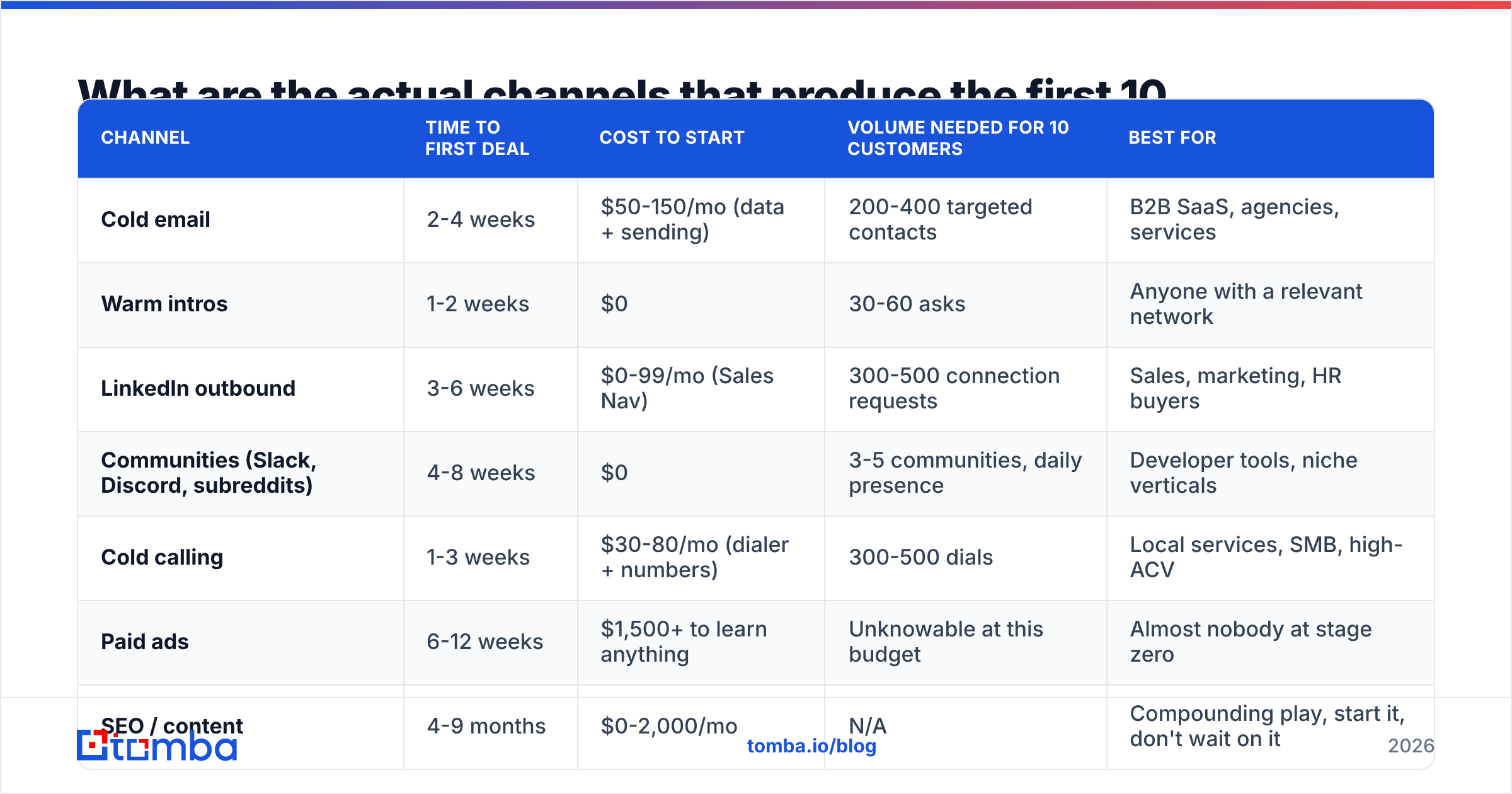
Here's how the realistic options compare when you're at zero. "Time to first deal" assumes a founder working the channel roughly 15 hours a week.
| Channel | Time to first deal | Cost to start | Volume needed for 10 customers | Best for |
|---|---|---|---|---|
| Cold email | 2-4 weeks | $50-150/mo (data + sending) | 200-400 targeted contacts | B2B SaaS, agencies, services |
| Warm intros | 1-2 weeks | $0 | 30-60 asks | Anyone with a relevant network |
| LinkedIn outbound | 3-6 weeks | $0-99/mo (Sales Nav) | 300-500 connection requests | Sales, marketing, HR buyers |
| Communities (Slack, Discord, subreddits) | 4-8 weeks | $0 | 3-5 communities, daily presence | Developer tools, niche verticals |
| Cold calling | 1-3 weeks | $30-80/mo (dialer + numbers) | 300-500 dials | Local services, SMB, high-ACV |
| Paid ads | 6-12 weeks | $1,500+ to learn anything | Unknowable at this budget | Almost nobody at stage zero |
| SEO / content | 4-9 months | $0-2,000/mo | N/A | Compounding play, start it, don't wait on it |
Two observations founders resist. First, cold email and warm intros beat everything else on speed-to-signal, which is what you actually need. Second, paid ads are the single most common way pre-product-market-fit founders burn their runway — you're paying to optimize a funnel that has no baseline.
Pick two channels. Not five. Two channels worked hard for 60 days will out-produce five channels worked casually, and you'll be able to tell which one is working.
How do you build a list of 200 people worth contacting?#
Start from a definition, not a database. Write one sentence: "A [role] at a [company type] with [trigger] who currently does [painful workaround]." If you can't fill in the trigger, you're not ready to send anything.
Then work the list in this order:
- Define the account filter. Industry, headcount band, geography, and one technographic or behavioral signal (they use a specific tool, they just hired for a role, they posted about the problem). Aim for 150-250 companies — small enough to research, large enough to produce statistical signal.
- Find the named human, not the department. You want the person who owns the pain, not
info@. For a 40-person company that's usually a director or the founder. Skip generic aliases entirely; they convert near zero. - Get the email address. Use a domain search to pull the pattern and contacts for each company, or run names through an email finder one by one. For a 200-row list this takes an afternoon, not a week.
- Verify before you send. Run the full list through an email verifier. At 200 contacts, a 12% invalid rate means 24 people you never reach and a bounce rate that damages your brand-new sending domain.
- Enrich with one personalization hook per row. A recent hire, a funding round, a podcast appearance, a specific line on their careers page. One column, one sentence, written by you. This is the part you cannot outsource yet.
- Log everything in one place. A spreadsheet is fine at 200 rows. A CRM is fine too. What matters is that every reply, objection, and no-show is recorded, because the objection log is the most valuable document your company will produce this quarter.
The list-building step is where founders quietly cheat. They buy 5,000 contacts, send a generic template, get 4 replies, and conclude that cold email doesn't work. What didn't work was skipping steps 2, 4, and 5.
If your buyers live on LinkedIn, a LinkedIn finder converts profile URLs into verified work emails, which lets you run the same list across two channels instead of building two lists.
What does the outreach sequence actually look like?#
Five touches over 14 business days, all from the founder, all signed with a real name and a real phone number.
Touch 1 (Day 1) — the specific observation. Two to four sentences. Open with the thing you noticed about them, state the problem you solve in their language, ask one low-friction question. No calendar link in email one. No attachment. No "Hope this finds you well."
Touch 2 (Day 3) — the proof. Reply in-thread with one concrete detail: a number from another customer, a screenshot, a 40-second Loom showing the workaround you'd replace. Still no pitch deck.
Touch 3 (Day 7) — the alternative ask. If they haven't replied, they may not be the right person. "If this sits with someone else on your team, happy to be pointed there." This single line routes a meaningful share of your list to the correct human.
Touch 4 (Day 10) — the different angle. Same person, different problem framing. Founders assume the buyer rejected them; usually the buyer just didn't recognize the problem as theirs.
Touch 5 (Day 14) — the close-the-loop. "I'll stop here — if this becomes relevant in Q3, I'm easy to find." Polite exits produce a surprising number of delayed replies.
Across LinkedIn, interleave: connection request on Day 2, a comment on their content around Day 5, a short DM on Day 8. Same person, two channels, one narrative. HubSpot's research on sales follow-up cadence consistently shows most deals need five or more touches while most reps stop at two — at your stage, you're the rep, so don't stop at two.
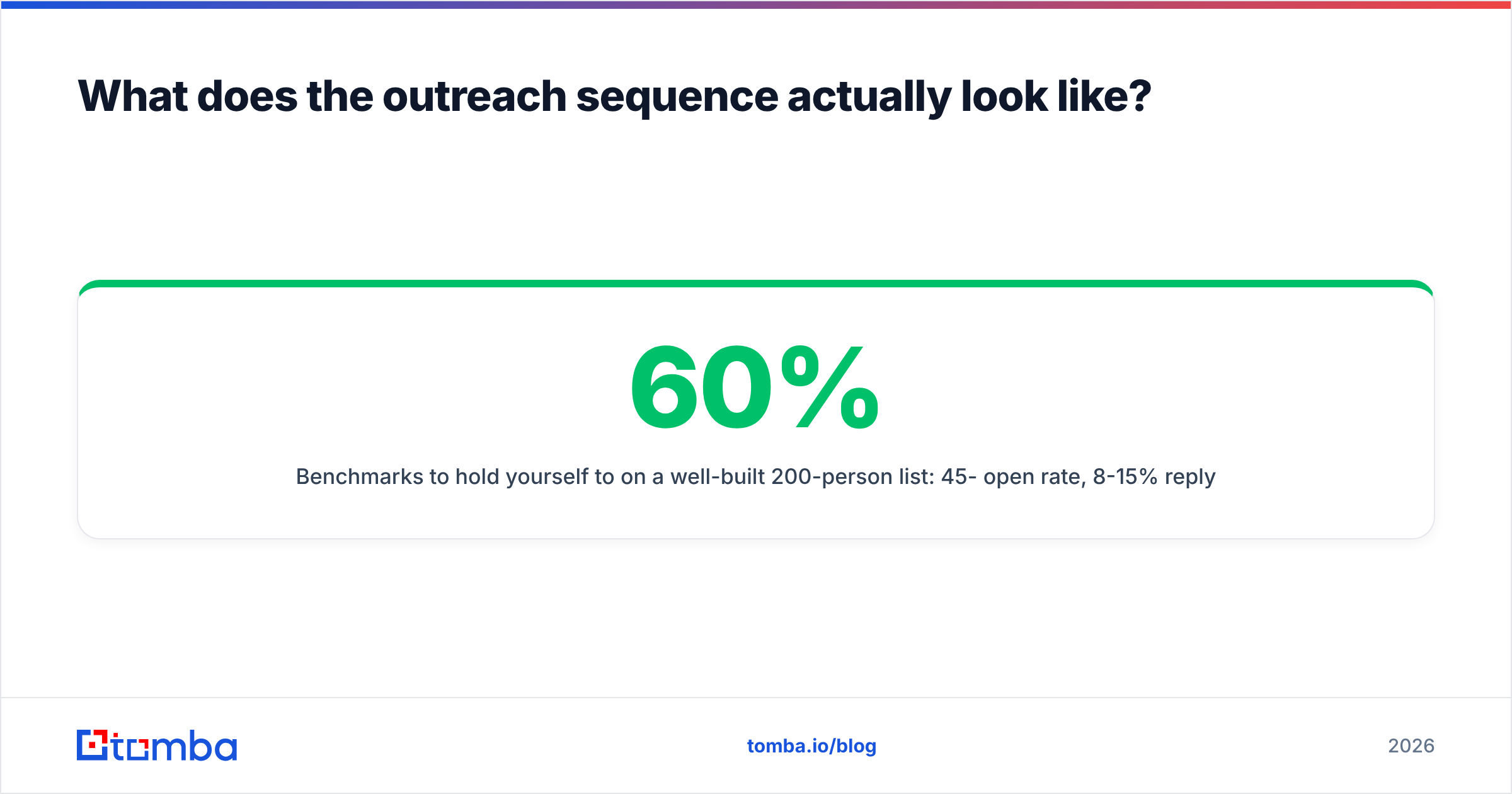
Benchmarks to hold yourself to on a well-built 200-person list: 45-60% open rate, 8-15% reply rate, 3-6% meeting rate. That's 6-12 meetings from 200 contacts. Run it twice and you're in range of 10 customers, assuming you close roughly a third of the meetings — which you will, because at this stage every meeting is with someone who self-selected into the problem.
Should you charge the first 10, or give it away?#
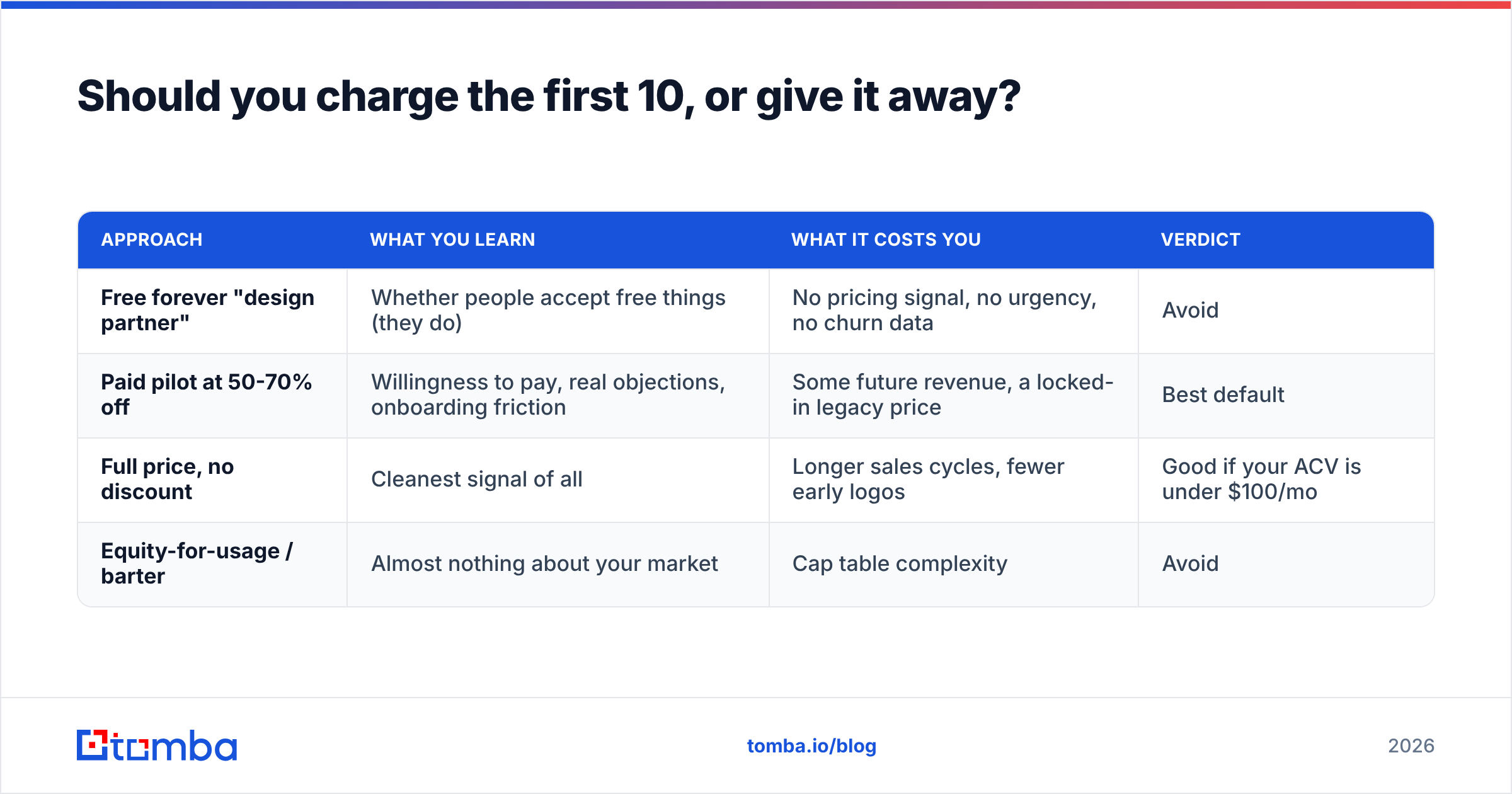
Charge. The number can be small and the discount can be large, but the transaction has to happen.
| Approach | What you learn | What it costs you | Verdict |
|---|---|---|---|
| Free forever "design partner" | Whether people accept free things (they do) | No pricing signal, no urgency, no churn data | Avoid |
| Paid pilot at 50-70% off | Willingness to pay, real objections, onboarding friction | Some future revenue, a locked-in legacy price | Best default |
| Full price, no discount | Cleanest signal of all | Longer sales cycles, fewer early logos | Good if your ACV is under $100/mo |
| Equity-for-usage / barter | Almost nothing about your market | Cap table complexity | Avoid |
The paid pilot at a founder discount is the workhorse. Put an end date on the discount in writing so the price conversation is scheduled rather than avoided. And ask for the money on the call — not in a follow-up email, not via a link you'll "send over." Founders who can't ask for $200 on a Zoom call will not be able to ask for $20,000 later.
One more thing: write down every objection verbatim. Not your summary of it. The actual words. After 15 sales calls you'll have a ranked list of the four reasons people don't buy, and fixing the top two is your entire roadmap for the next quarter.
How do you do this without hiring a sales team?#
You don't hire. You compress. The whole point of the first 10 is that the founder is in the loop for every conversation — that's the feature, not the bug. What you can compress is the mechanical work around the conversations.
Rough weekly rhythm for a solo founder:
- Monday (3 hrs): Build or refresh 50 new contacts. Verify, enrich, add the personalization hook.
- Tuesday-Thursday (2 hrs/day): Send touch 1 to the new 50, work the follow-up queue for prior cohorts, take calls.
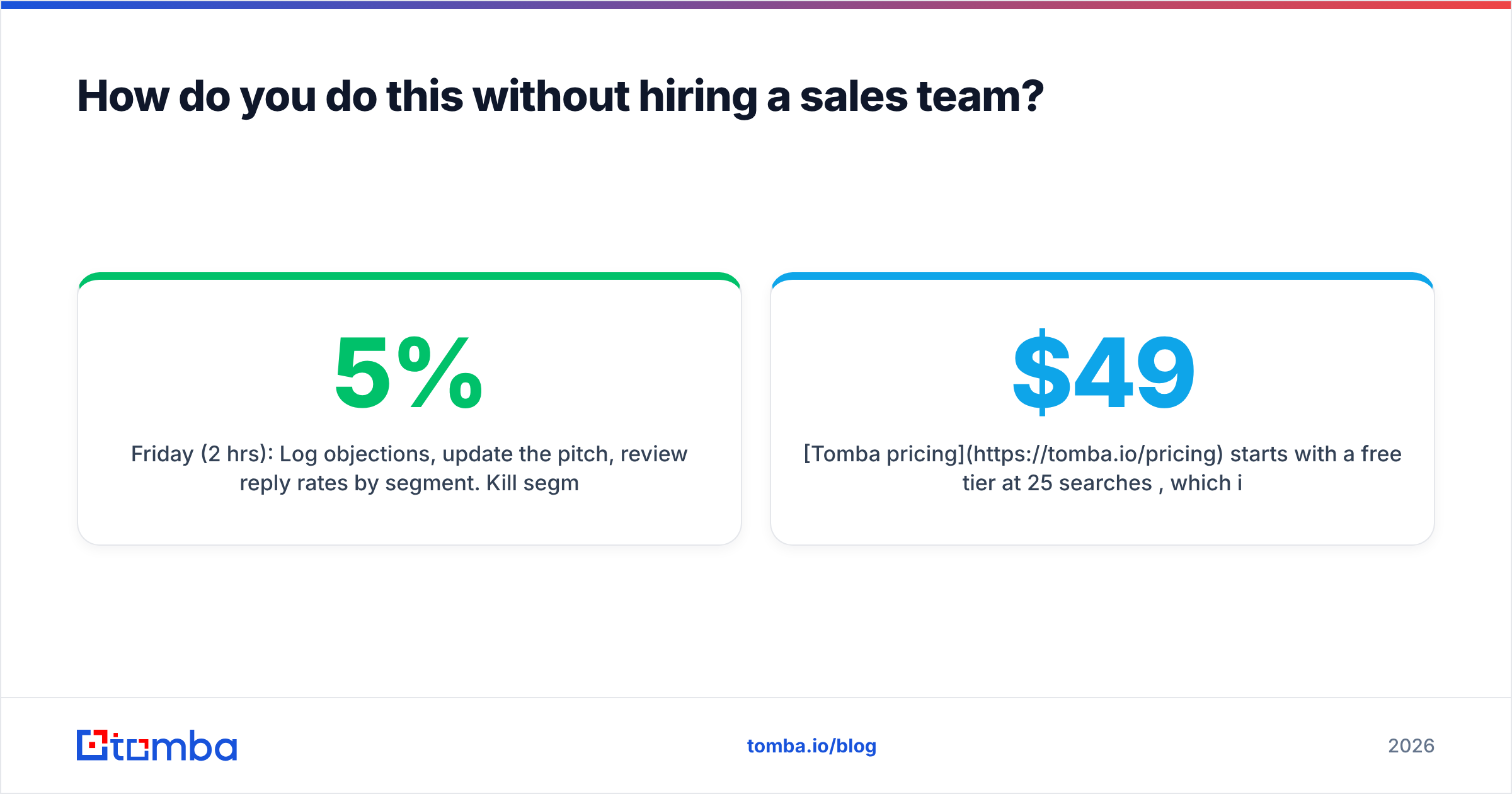
- Friday (2 hrs): Log objections, update the pitch, review reply rates by segment. Kill segments under 5% reply, double the ones over 12%.
For the mechanical parts, a few things pay for themselves fast. A bulk email finder turns a CSV of names and domains into verified addresses in one pass, so list-building stops eating your Monday. A Google Sheets add-on keeps everything in the spreadsheet you already live in. If you're technical, the Tomba API drops enrichment straight into whatever script or CRM you've hacked together. Peers in this space — Apollo, Findymail, and BookYourData among them — solve overlapping pieces of the same problem, and it's worth comparing them on the dimension you actually care about: verified-contact cost per usable lead, not headline database size.
Tomba pricing starts with a free tier at 25 searches per month, which is enough to test the workflow before committing. The Starter plan at $49/month covers a founder running a 200-300 contact list every month; Growth at $99/month makes sense once you're running parallel segments. Compare that to what a single ad experiment costs and the ROI question answers itself.
What not to buy yet: a full sales engagement platform, a data warehouse, an intent-data subscription, or a CRM with a six-week implementation. Those are for the team you'll hire after customer 30. Reviews on G2 will happily convince you otherwise — read them with the awareness that most reviewers are 50-person sales orgs, not you.
What are the mistakes that keep founders stuck at three customers?#
Talking to the wrong altitude. Pitching a VP when your product is used by an analyst, or vice versa. The buyer and the user are often different people, and at 10 customers you need both in the room.
Personalizing the wrong thing. "I saw you went to Michigan" is not personalization; it's a party trick. "You're hiring three SDRs and still running attribution in a spreadsheet" is personalization, because it names the pain.
Sending from a domain you haven't warmed. A brand-new domain sending 200 cold emails in week one will land in spam and take months to recover. Warm for 3-4 weeks, keep daily volume under 30-40 per inbox, authenticate with SPF and DKIM, and check your sender reputation before you scale.
Building instead of selling. Every hour spent on a feature nobody has asked to pay for is an hour not spent finding out what they would pay for. If you're at three customers and your calendar has more build blocks than call blocks, that's the whole diagnosis.
Quitting a channel at 50 contacts. Fifty contacts produces two to four replies, which is statistically indistinguishable from noise. Give a channel 200 contacts and 14 days before you judge it.
Not asking for referrals. Each of your first 10 customers knows 5-10 people with the identical problem. Ask on day 30 of their usage, when the value is visible and the honeymoon isn't over. This is the cheapest source of customers 11 through 25.
What does "done" look like?#
You've hit the real milestone when three things are true at once: 10 customers are paying, you can describe the pattern connecting them in one sentence, and you can predict roughly how many contacts it takes to produce one deal. That third number — contacts per customer — is what turns a scramble into a repeatable process, and it's the only metric that lets you decide whether to hire, raise, or double down.
If you're at 10 customers with no pattern, you don't have 10 customers. You have 10 favors. Go back to the objection log and find the segment that converted twice as fast as the rest.
Start with the list. The bottleneck for most founders isn't the pitch — it's having 200 real, verified, correctly-targeted humans to send it to. Tomba Email Finder gets you from a list of target companies to verified decision-maker emails in an afternoon, with a free tier of 25 searches to test the workflow and Starter at $49/month once you're running weekly cohorts. Build the list this week, send touch one on Monday, and let the replies tell you what to build.
Related guides#
// get started
Find, verify and enrich your first contacts today
Start on the free plan with 25 searches a month, then scale when your team is ready.
Free plan · No credit card required · GDPR & CCPA
// about the author