How to Give a Sales Pitch That Actually Closes Deals
Most sales pitches fail in the first 30 seconds. Here is a repeatable 7-step structure, the research prep that makes it land, and the exact mistakes that kill deals.
TL;DR
- A sales pitch is not a presentation. It is a structured conversation that moves a buyer from "why change?" to "why you, why now?" in under 15 minutes of actual talking.
- The pitch is won before you open your mouth: research the account, verify the contact, and know the one problem you are there to solve.
- Use a 7-step structure — hook, problem, stakes, proof, mechanism, objection pre-empt, single next step — and keep your talk time under 45%.
- The three deal-killers are opening with your company history, pitching to a non-decision-maker, and ending with "let me know what you think."
- Pitch quality collapses if your contact data is wrong. Reaching the right person with a verified email matters more than any slide.
What is a sales pitch, really?#
A sales pitch is your argument for change, delivered in the buyer's language, compressed to fit their attention span.
Think of it like a doctor's appointment. A bad doctor walks in and lists every treatment the clinic offers. A good doctor asks where it hurts, confirms the diagnosis out loud, explains what happens if you ignore it, then prescribes one thing. Patients follow the second doctor. Buyers do the same.
That reframe changes the deliverable. Most reps prepare a deck. What you actually need is a thesis: a one-sentence claim about the buyer's business that is specific enough to be wrong. "You're running outbound with three SDRs and a 4% reply rate, which means you're burning roughly $18K a month producing meetings you could get for a third of that." If your thesis could be pasted into any prospect's inbox unchanged, it isn't a thesis — it's a brochure.
Research from HubSpot's sales statistics consistently shows buyers want reps who understand their business over reps who know their own product cold. That is the whole game.
How do you prepare before you give a sales pitch?#
Preparation is roughly 70% of pitch outcome, and almost all of it happens in the 30 minutes before the call.
Work through these five inputs in order. Each one narrows what you will say.
- Confirm you have the right human. Job title, tenure, and whether they own the budget line. A pitch to a manager who must "run it by leadership" is a demo, not a pitch. Use reverse email lookup or LinkedIn to confirm role before you build the story.
- Find one trigger event. New funding, a new VP of Sales, a job posting for three SDRs, a pricing page change. Triggers give you a legitimate reason to be in the room this week rather than last quarter.
- Map the current-state cost. What are they doing today, and what does it cost in dollars, hours, or risk? If you cannot state this number, your pitch has no stakes.
- Pick exactly one outcome to sell. Not the platform. One outcome. "Cut your list-building time from six hours a week to twenty minutes" beats "all-in-one revenue platform" every time.
- Prepare the two objections you know are coming. Price and switching cost, usually. Write the 20-second answer to each and say it out loud once.
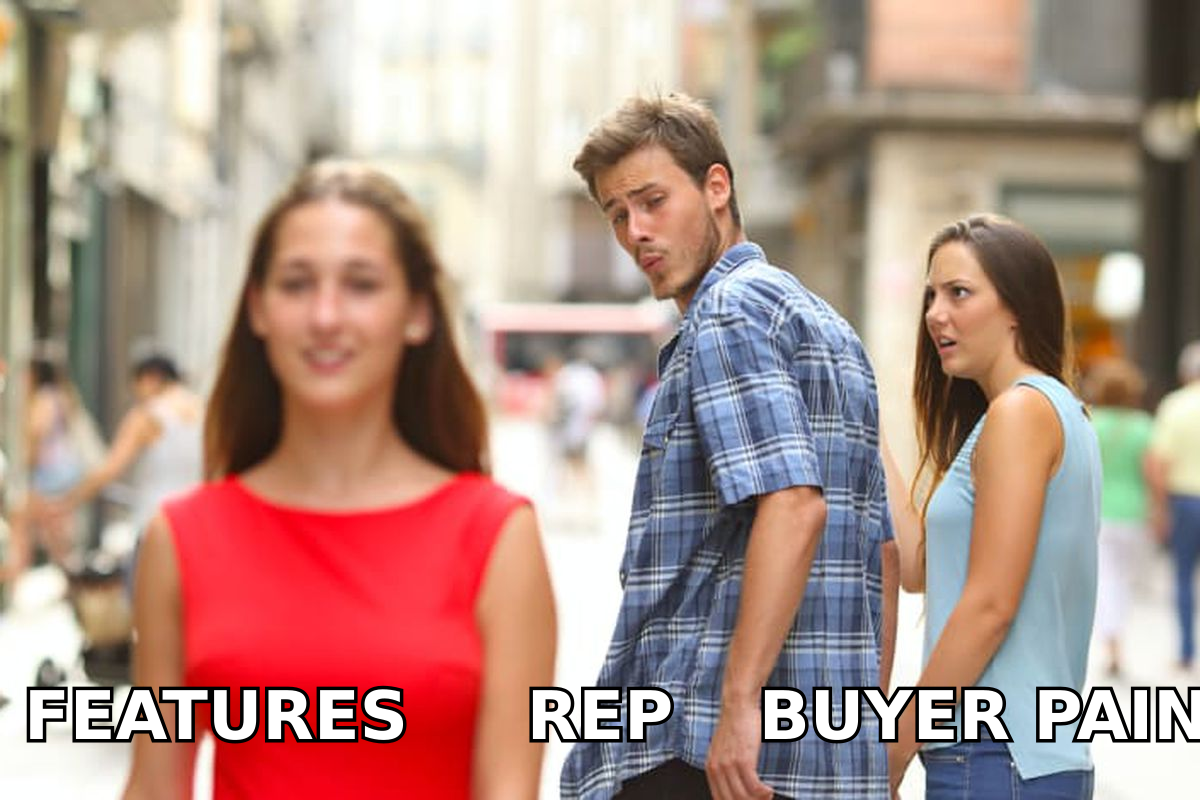
A note on step one, because it quietly sinks more pitches than anything on this list: if your contact data is stale, everything downstream is wasted. You research the wrong company, pitch the wrong pain, and address a person who left nine months ago. Running your target list through a bulk email finder before a pitch week costs minutes and protects hours of prep.
What is the 7-step sales pitch structure?#
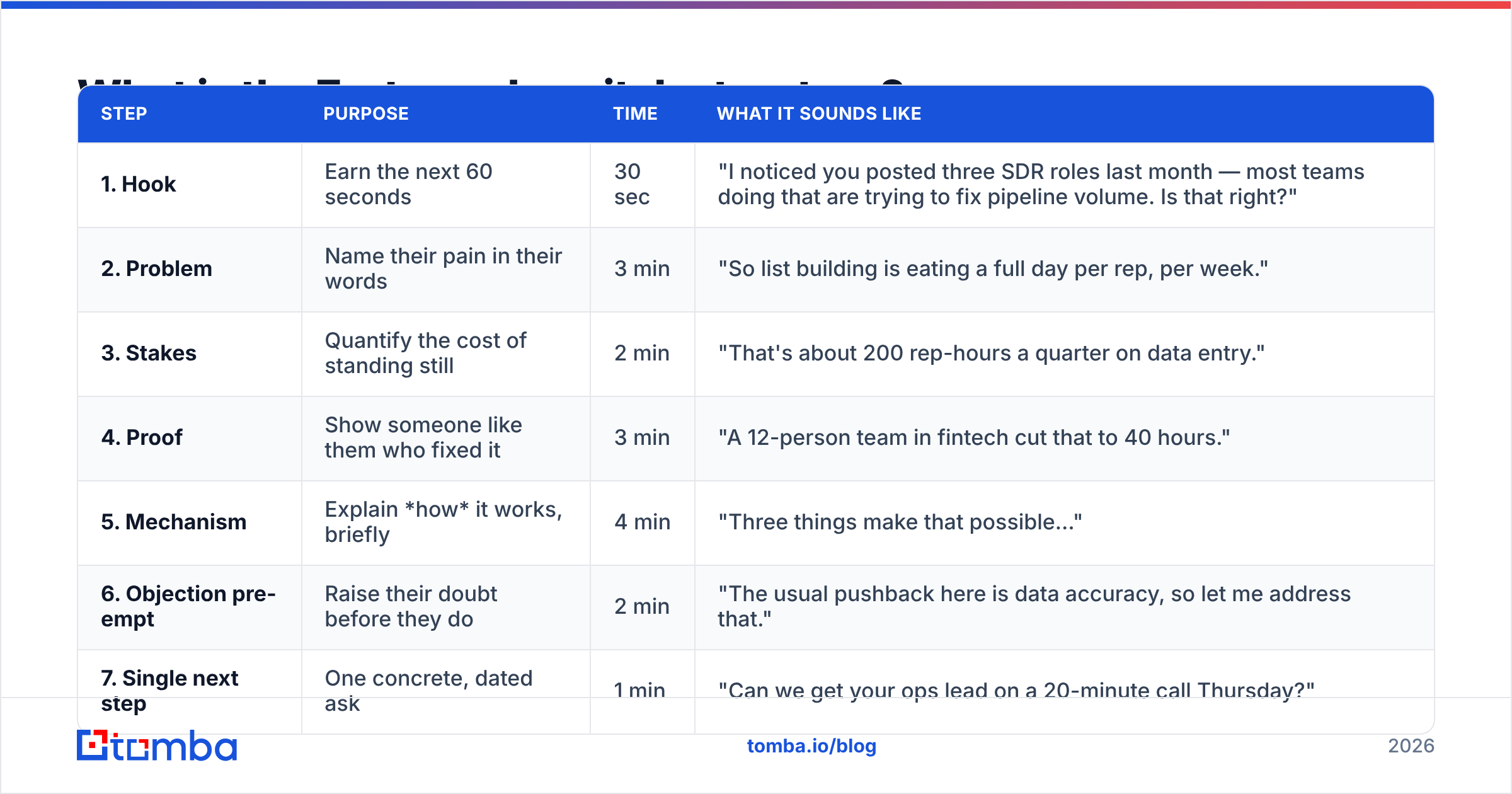
Here is the structure that survives contact with real buyers. Time budgets assume a 30-minute call.
| Step | Purpose | Time | What it sounds like |
|---|---|---|---|
| 1. Hook | Earn the next 60 seconds | 30 sec | "I noticed you posted three SDR roles last month — most teams doing that are trying to fix pipeline volume. Is that right?" |
| 2. Problem | Name their pain in their words | 3 min | "So list building is eating a full day per rep, per week." |
| 3. Stakes | Quantify the cost of standing still | 2 min | "That's about 200 rep-hours a quarter on data entry." |
| 4. Proof | Show someone like them who fixed it | 3 min | "A 12-person team in fintech cut that to 40 hours." |
| 5. Mechanism | Explain how it works, briefly | 4 min | "Three things make that possible…" |
| 6. Objection pre-empt | Raise their doubt before they do | 2 min | "The usual pushback here is data accuracy, so let me address that." |
| 7. Single next step | One concrete, dated ask | 1 min | "Can we get your ops lead on a 20-minute call Thursday?" |
The remaining time is theirs. If you fill 30 minutes, you did not pitch — you presented, and presentations do not close.
Two structural rules matter more than the wording:
- Stakes come before proof. Buyers do not care about your case study until they have agreed there is a problem worth solving. Reverse the order and your best customer story lands as noise.
- Mechanism is not a feature tour. Three bullets on why it works, not fourteen screenshots of what it does. Save the tour for the demo, which is a separate meeting with a separate goal.
How is a sales pitch different from an elevator pitch or a demo?#
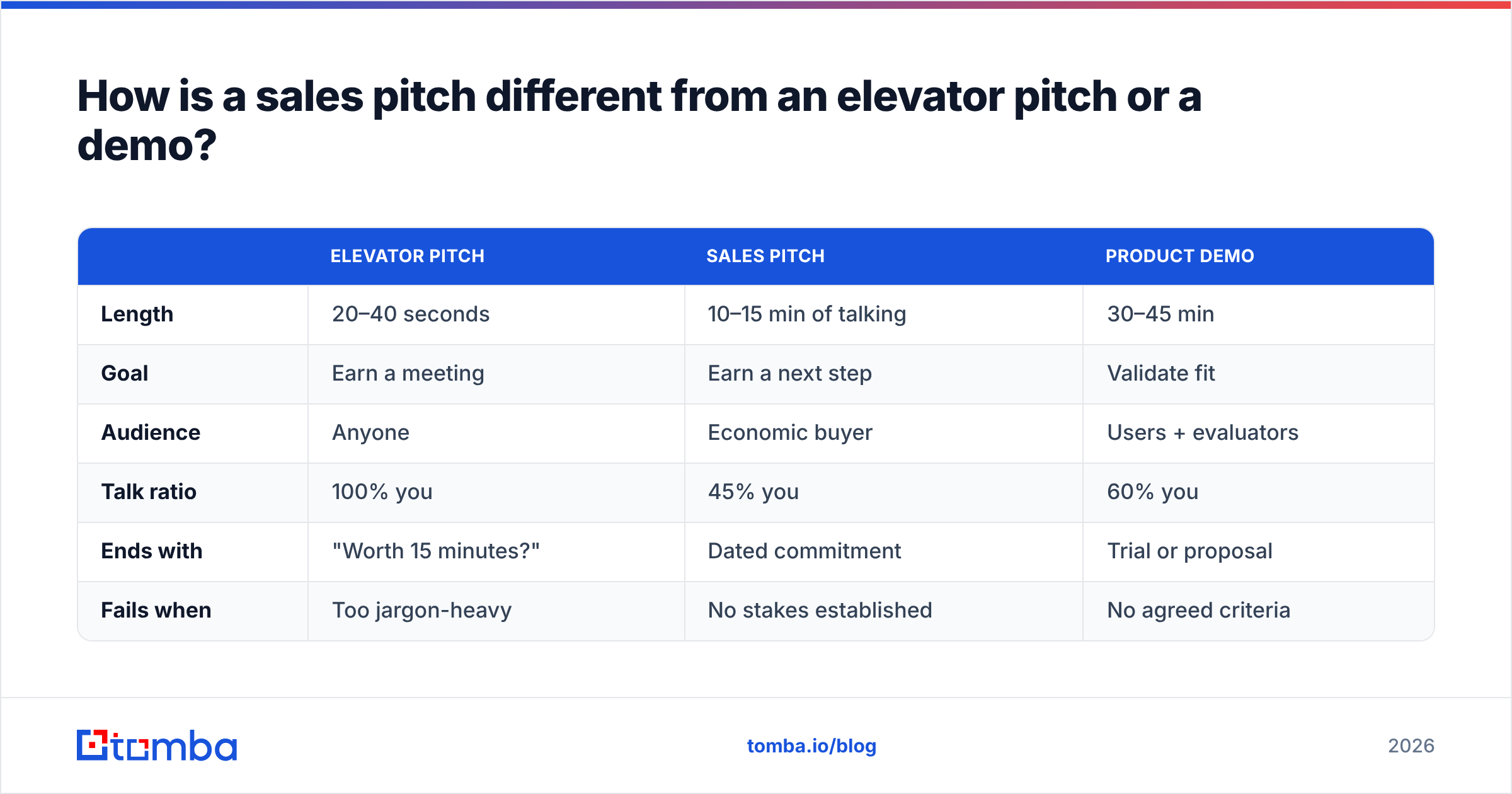
They are three different tools, and using the wrong one is why deals stall.
| Elevator pitch | Sales pitch | Product demo | |
|---|---|---|---|
| Length | 20–40 seconds | 10–15 min of talking | 30–45 min |
| Goal | Earn a meeting | Earn a next step | Validate fit |
| Audience | Anyone | Economic buyer | Users + evaluators |
| Talk ratio | 100% you | 45% you | 60% you |
| Ends with | "Worth 15 minutes?" | Dated commitment | Trial or proposal |
| Fails when | Too jargon-heavy | No stakes established | No agreed criteria |
The common failure is running a demo when you were supposed to pitch. You get enthusiastic nods from three users who cannot sign anything, and the deal dies in procurement six weeks later. Establish the business case first. Show the product second.
How do you open a sales pitch without losing the room?#
Open with a claim about them, never with a fact about you.
Compare these two openings for the same product:
"Thanks for the time. Tomba was founded in 2019, we have over 100,000 users, and we're a leading B2B data provider…"
versus
"Before I show you anything — I looked at your careers page and you're hiring two more SDRs. My guess is the current three are spending more time finding contact details than actually selling. How far off am I?"
The second one does three jobs at once: proves you did homework, states a hypothesis, and hands the buyer the microphone. If your guess is wrong, they correct you — and now you have a pitch built on their diagnosis instead of yours.
Openings that reliably fail:
- The credential dump. Founding year, funding round, logo wall. Nobody bought anything because a vendor had a Series B.
- The permission ask. "Is now still a good time?" You booked the meeting. Act like it.
- The open-ended discovery loop. "So tell me about your priorities for the year." On a pitch call this reads as unprepared. Discovery belongs in the previous call.
- The agenda recital. Three minutes describing what you are about to say instead of saying it.
What are the biggest sales pitch mistakes to avoid?#
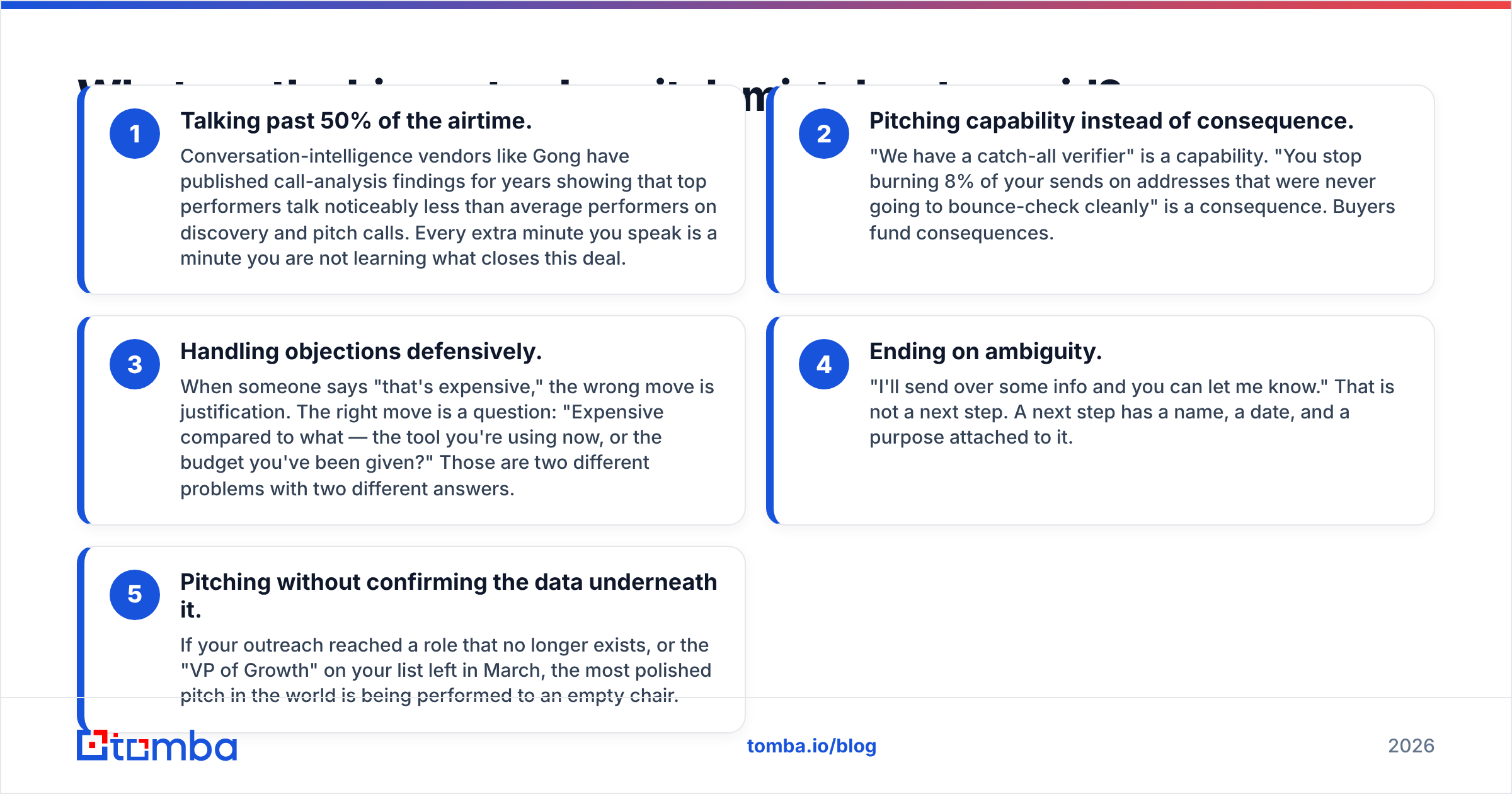
Most losing pitches share the same five failures, and all five are fixable without changing your product.
- Talking past 50% of the airtime. Conversation-intelligence vendors like Gong have published call-analysis findings for years showing that top performers talk noticeably less than average performers on discovery and pitch calls. Every extra minute you speak is a minute you are not learning what closes this deal.
- Pitching capability instead of consequence. "We have a catch-all verifier" is a capability. "You stop burning 8% of your sends on addresses that were never going to bounce-check cleanly" is a consequence. Buyers fund consequences.
- Handling objections defensively. When someone says "that's expensive," the wrong move is justification. The right move is a question: "Expensive compared to what — the tool you're using now, or the budget you've been given?" Those are two different problems with two different answers.
- Ending on ambiguity. "I'll send over some info and you can let me know." That is not a next step. A next step has a name, a date, and a purpose attached to it.
- Pitching without confirming the data underneath it. If your outreach reached a role that no longer exists, or the "VP of Growth" on your list left in March, the most polished pitch in the world is being performed to an empty chair.

That last one deserves more weight than it usually gets. Pitch coaching almost always focuses on delivery — tone, pacing, slide design — while the input that determines whether the pitch happens at all is contact quality. A team that verifies its list before a pitch cycle simply gets more pitches, and more pitches to the right title. That is a bigger lever than any rewording of your hook.
How do you close a sales pitch and set the next step?#
Close by making the next step smaller than the decision.
Buyers rarely say yes to "do you want to buy this?" at the end of a first pitch, and asking forces a premature no. Instead, ask for the smallest action that proves genuine interest and moves the deal forward:
- Get a stakeholder added. "Who else would need to see this before it's real? Can we get them on Thursday?"
- Agree evaluation criteria. "If we ran a two-week pilot, what would need to be true at the end for you to say it worked?"
- Trade a resource for a commitment. "I'll put together a cost model with your actual rep count — can we book 20 minutes next week to walk through it?"
Then confirm in writing within an hour, with the date, the attendees, and the one thing you agreed to bring. Deals do not die from bad pitches nearly as often as they die from vague endings and slow follow-up. G2's buyer behavior research has repeatedly found that responsiveness and clarity in the evaluation process weigh heavily on vendor selection — the pitch gets you in, the follow-through keeps you there.
One more thing worth measuring: track your pitch-to-next-step rate, not just your close rate. If 8 of 10 pitches produce a dated next step, your structure works and your problem is later in the funnel. If it's 3 of 10, your stakes section is too weak and no amount of pipeline volume will fix it. Understanding your win rate stage by stage tells you which part of the pitch to rebuild.
How do you practice and improve your pitch over time?#
Treat the pitch like code: version it, test it, and only change one thing at a time.
A practical loop that works for a team of any size:
- Record every pitch call (with consent) and re-listen to the first 90 seconds only. That is where most deals are won or lost, and it is the cheapest segment to review.
- Run a weekly 20-minute pitch clinic. One rep pitches, the rest play the buyer's hardest objection. No feedback on slides — only on whether the stakes landed.
- A/B test one variable per month. Hook wording, or the case study you cite, or where you place pricing. Changing three things at once teaches you nothing.
- Keep a live objection log. Every new objection gets a written 20-second answer within 24 hours, shared with the team. After a quarter you will have covered 90% of what buyers throw at you.
- Audit your list quality quarterly. Falling reply rates are usually blamed on copy when the real cause is data decay — B2B contact data goes stale at roughly 2–3% per month as people change roles.
Where does contact data fit into a better pitch?#
Pitch skill sets your conversion rate; data quality sets how many conversations you get to have.
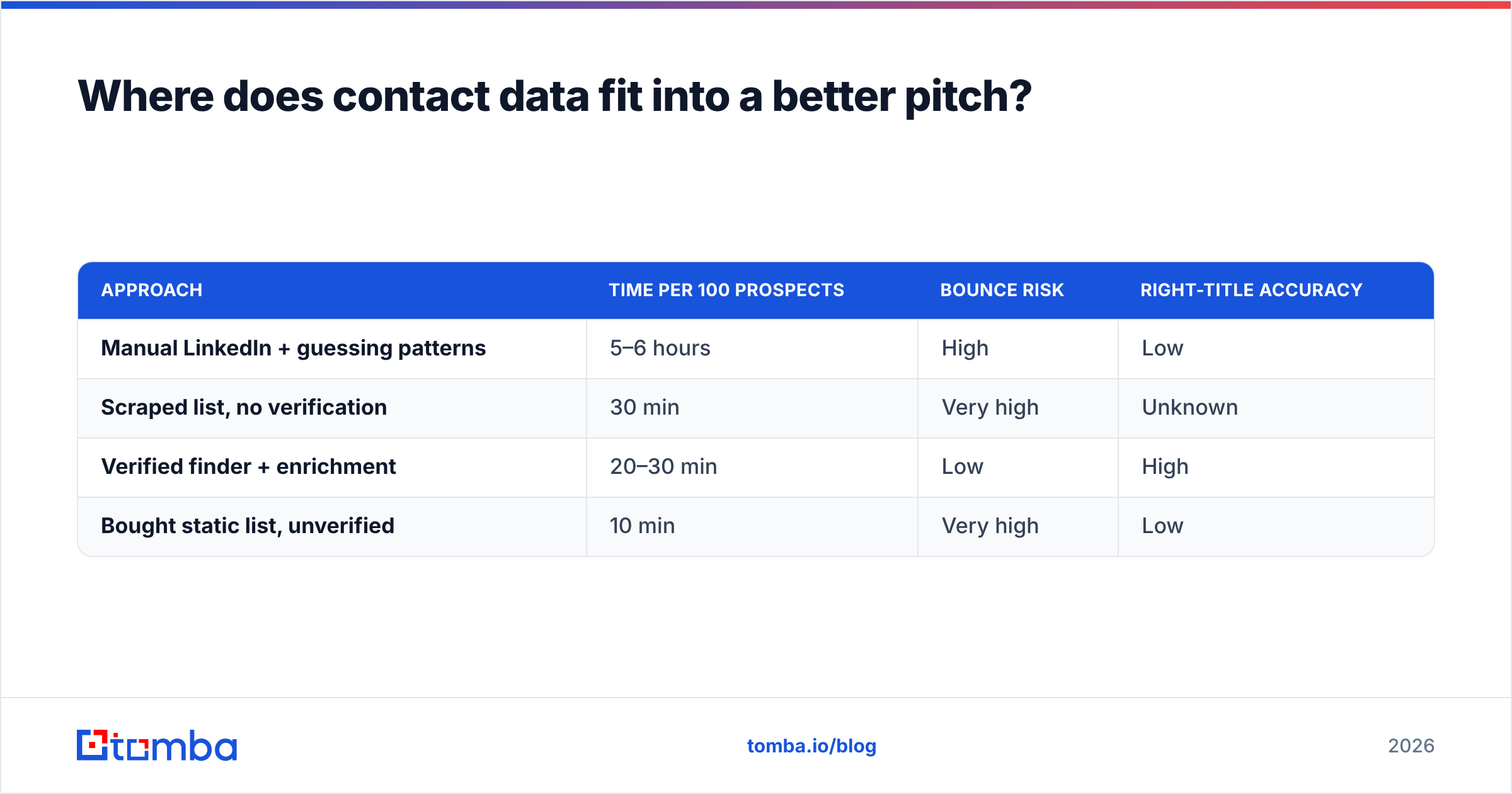
You can rehearse a great pitch and still miss quota if half your outreach lands on invalid addresses or the wrong seniority level. Here is how a typical prep stack compares:
| Approach | Time per 100 prospects | Bounce risk | Right-title accuracy |
|---|---|---|---|
| Manual LinkedIn + guessing patterns | 5–6 hours | High | Low |
| Scraped list, no verification | 30 min | Very high | Unknown |
| Verified finder + enrichment | 20–30 min | Low | High |
| Bought static list, unverified | 10 min | Very high | Low |
The middle path — find, verify, enrich, then pitch — is the only one where your prep time actually converts into meetings. Tools like Tomba, Hunter, and peers such as BookYourData all address parts of this problem; the important thing is that verification happens before the pitch cycle, not after the bounces come back. If you want to see how a domain search narrows a company down to the two or three people who can actually approve a purchase, that is where to start.
Ready to pitch the right people?#
A great pitch delivered to the wrong inbox is a rounding error. Before your next outbound cycle, build the list properly: use the Tomba Email Finder to locate decision-maker addresses by name or domain, verify them so your carefully prepared hook actually gets read, and enrich the record with the title and seniority data your pitch depends on. The free tier gives you 25 searches a month to test it, with paid plans starting at $49/mo — see Tomba pricing for the full breakdown. Fix the input, then run the 7-step structure. That combination is what turns a good pitch into a booked next step.
Related guides#
// get started
Find, verify and enrich your first contacts today
Start on the free plan with 25 searches a month, then scale when your team is ready.
Free plan · No credit card required · GDPR & CCPA
// about the author