How to Grow a Mailing List: 9 Tactics That Work in 2026
Most list-growth advice is a decade old and quietly broken. Here are the nine acquisition tactics that still compound in 2026, what each one costs, and the two that quietly destroy your sender reputation.
TL;DR
- List growth is two separate problems: acquisition (getting addresses) and retention (keeping them deliverable). Most teams solve the first and ignore the second, then wonder why open rates collapse at 10,000 subscribers.
- The highest-yield channels in 2026 are still owned surfaces — content upgrades, product-led signups, and referral loops — not paid lead magnets.
- Never buy a scraped list. Two tactics on this page will actively damage your sender reputation; they're flagged in the comparison table.
- Verified-at-capture is non-negotiable. A 3% invalid rate at signup compounds into a 12–20% bounce rate within a year of list decay.
- Outbound list building (finding and verifying business emails yourself) and inbound list growth are different disciplines with different legal footing. Don't blend the two into one send.
Why do most mailing lists stop growing?#
Because the list is leaking faster than it fills.
Think of your mailing list like a bathtub with the drain half-open. You measure the tap — signups per week — and celebrate. Nobody measures the drain: unsubscribes, hard bounces, spam complaints, and the silent killer, addresses that quietly went dead when someone changed jobs.
B2B email data decays at roughly 22–30% per year. People switch companies, domains get consolidated after acquisitions, and role-based aliases get retired. If you add 500 subscribers a month to a 10,000-person list, you're netting closer to 250 once decay is priced in.
So "how to grow a mailing list" is really two questions:
- Which acquisition channels produce subscribers who actually open?
- What hygiene process keeps those subscribers reachable 18 months later?
Skip the second and the first stops mattering. Gmail and Microsoft both weight engagement heavily in inbox placement — a bloated list of non-openers drags down delivery for the people who do want to hear from you. Google's bulk sender requirements made this explicit: keep spam complaints under 0.3% or your mail starts landing in spam for everyone.
What are the nine tactics that actually grow a list in 2026?#
Ranked by yield-per-hour for a small B2B team, not by how often they show up in listicles.
1. Content upgrades on your top 10 pages. Not a site-wide popup — a specific, page-matched asset. A post about SPF records offers a DNS record checklist. Conversion rates on matched upgrades run 3–8x a generic newsletter box. Start by pulling your top 10 organic landing pages and building one asset each.
2. Product-led signup capture. If you have a free tool, the tool is the lead magnet. Free calculators, checkers, and generators convert at 15–40% because the user already got value before you asked. Tomba runs dozens of these — a free email checker and a subject line generator each pull traffic that a blog post never would.
3. Referral loops with a real incentive. "Share with a friend" does nothing. "Share with a friend and both get 50 extra credits" works. The incentive has to cost you something.
4. Webinar and workshop registration. Highest-intent list additions you can get. Registration inherently requires a work email, and attendees pre-qualify themselves.
5. Partner newsletter swaps. Two non-competing lists in the same ICP cross-promote. Zero cost, and the subscribers arrive warm because someone they trust vouched for you.
6. Community-first capture. Slack groups, Discord servers, and LinkedIn newsletters. Slower, but retention is dramatically higher because there's a relationship behind the address.
7. Exit-intent offers (used sparingly). Works. Annoying. Cap it at one impression per visitor per 30 days or you'll trade subscribers for bounce rate.
8. Verified outbound list building. For B2B, you can build a targeted prospect list by finding and verifying business emails at companies matching your ICP. This is not newsletter marketing — it's outbound, it needs its own consent basis and its own sending domain.
9. Offline-to-online capture. Conferences, workshops, podcast sponsorships. Low volume, absurdly high intent. Use a memorable short URL, not a QR code nobody scans.
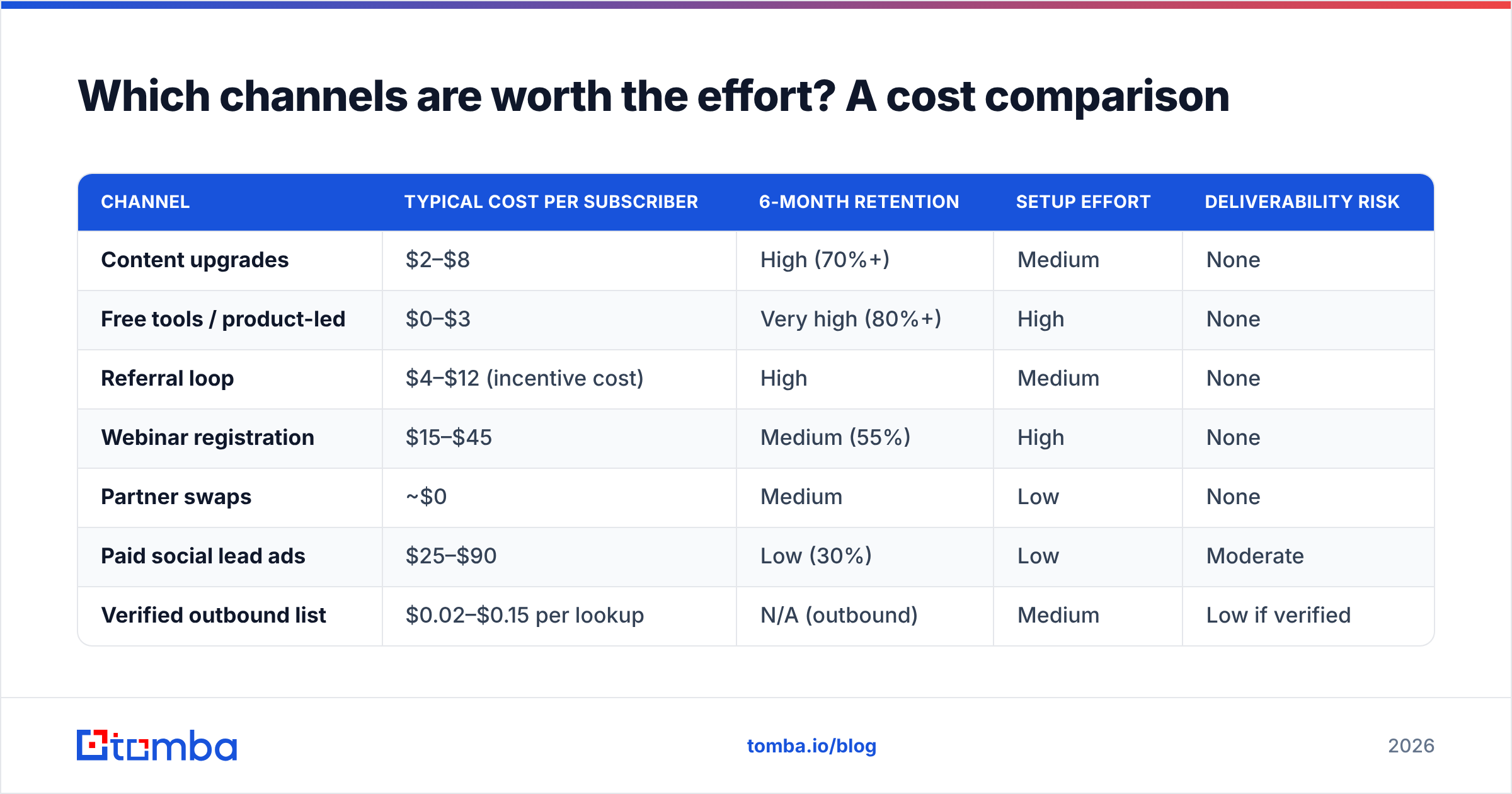
Which channels are worth the effort? A cost comparison#
Numbers below reflect typical B2B SaaS benchmarks. Your mileage varies by vertical, but the ranking holds up remarkably consistently.
| Channel | Typical cost per subscriber | 6-month retention | Setup effort | Deliverability risk |
|---|---|---|---|---|
| Content upgrades | $2–$8 | High (70%+) | Medium | None |
| Free tools / product-led | $0–$3 | Very high (80%+) | High | None |
| Referral loop | $4–$12 (incentive cost) | High | Medium | None |
| Webinar registration | $15–$45 | Medium (55%) | High | None |
| Partner swaps | ~$0 | Medium | Low | None |
| Paid social lead ads | $25–$90 | Low (30%) | Low | Moderate |
| Verified outbound list | $0.02–$0.15 per lookup | N/A (outbound) | Medium | Low if verified |
| Purchased list | $0.01–$0.05 | Near zero | Low | Severe |
| Scraped email list | $0 | Near zero | Low | Severe |
The bottom two rows are the trap. They look like the cheapest rows in the table and they are the most expensive thing you will ever do to a sending domain.
Why does buying a list destroy deliverability?#
Because purchased lists are full of spam traps, and spam traps are how blocklists find you.
A spam trap is an address that has never opted into anything. Some are recycled — abandoned mailboxes that a provider reactivated specifically to catch senders mailing stale data. Others are pristine traps, seeded on web pages purely to catch scrapers. Hit a handful and Spamhaus lists your IP or domain. Once that happens, every email you send — including transactional password resets — starts failing.
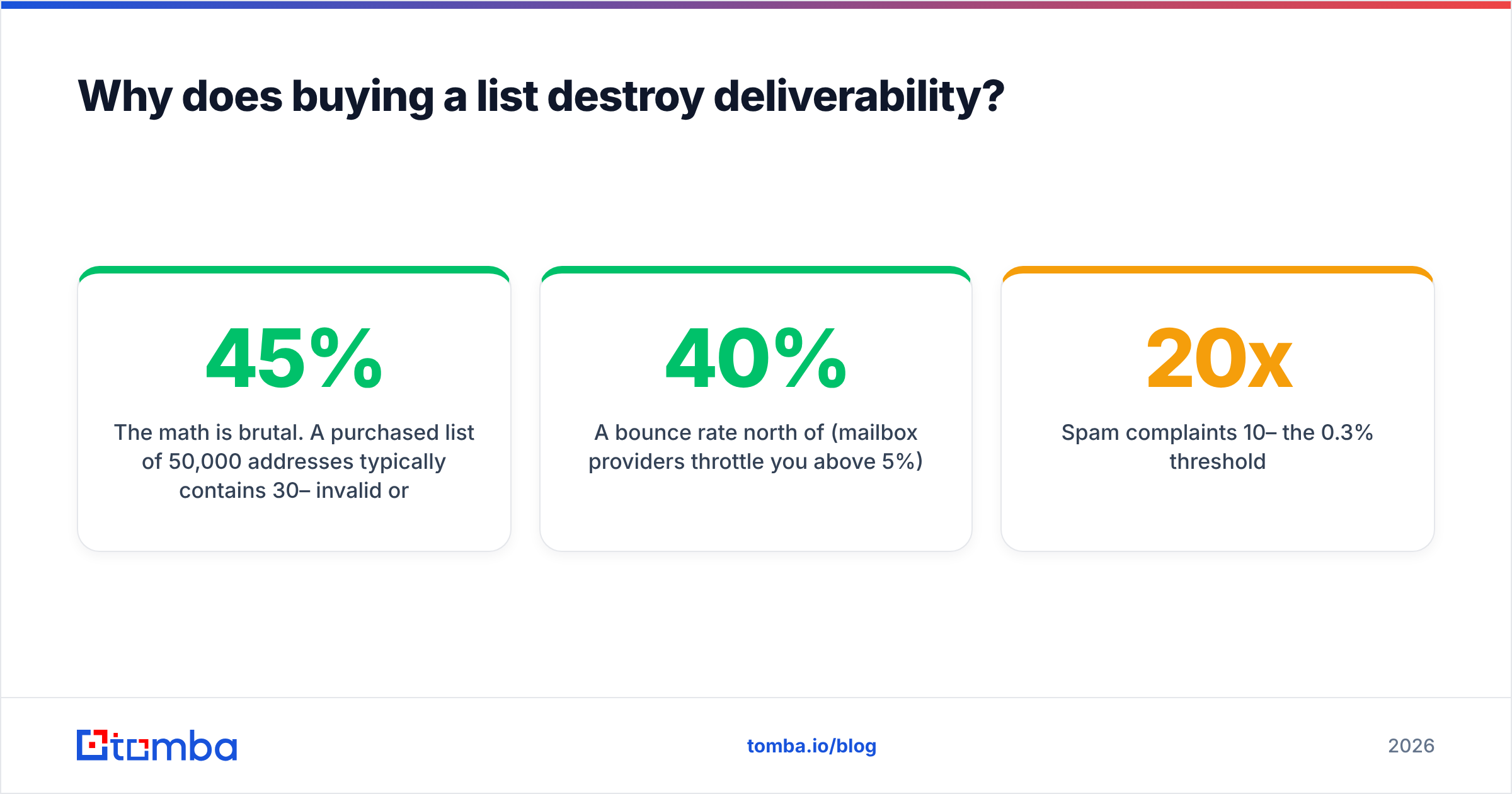
The math is brutal. A purchased list of 50,000 addresses typically contains 30–45% invalid or trap addresses. Send to it once and you'll see:
- A bounce rate north of 40% (mailbox providers throttle you above 5%)
- Spam complaints 10–20x the 0.3% threshold
- Domain reputation damage that takes 60–120 days of careful warming to reverse, if it reverses at all

Run a blacklist checker before and after any large send so you catch a listing in hours rather than in next month's revenue report. And if you inherited a list you didn't build, verify it before touching it — a bulk pass through an email verifier costs a fraction of a reputation rebuild.
How do you keep the list you already have?#
Growth without hygiene is just churn with extra steps. Four practices, in priority order:
- Verify at the point of capture. Real-time API validation on your signup form kills typos ("gmial.com"), disposable addresses, and known-invalid mailboxes before they enter the database. This is the single highest-ROI hygiene step — it costs almost nothing and prevents the problem instead of cleaning it up.
- Re-verify quarterly. Even clean lists decay. A quarterly bulk pass catches job-changers before they become hard bounces. Use a bulk verify run rather than verifying one address at a time.
- Sunset non-openers deliberately. If someone hasn't opened in 180 days, run a two-email re-engagement sequence, then suppress. Painful to delete subscribers; far more painful to let them drag your engagement rate into the spam folder.
- Segment by engagement, not just persona. Send your most frequent campaigns to your most engaged segment. Mailbox providers read the signal and reward you with better placement across the board.
Double opt-in deserves its own note. It costs you roughly 20–30% of raw signups and buys back a list where nearly everyone confirmed they wanted it. For B2B newsletters with a long sales cycle, that trade is almost always worth it — you're optimizing for pipeline, not for a vanity subscriber count.
Is inbound list growth different from B2B outbound?#
Yes, and conflating them is the most common way small teams get themselves into trouble.
Inbound list growth is consent-based. Someone gave you their address in exchange for something. You can send them newsletters, product updates, and promotional campaigns. GDPR and CAN-SPAM both accommodate this cleanly as long as you honor unsubscribes and identify yourself.
Outbound prospecting is a different motion. You're finding business contacts who haven't heard of you, using a legitimate-interest or equivalent basis, and sending one-to-one style messages. Different tooling, different sending domain, different metrics, and — critically — those contacts do not belong on your newsletter list unless they opt in separately.
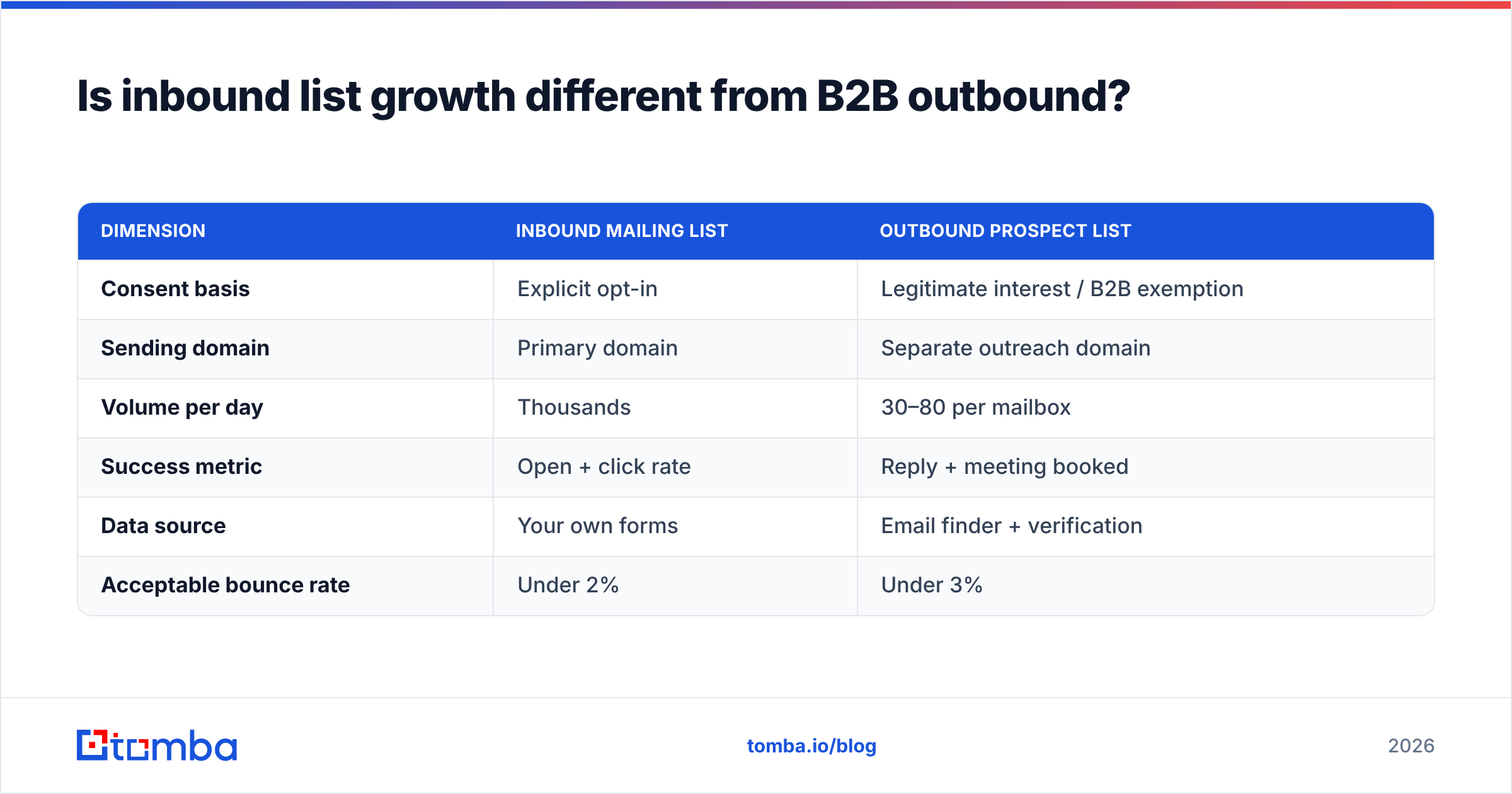
Here's how the two compare in practice:
| Dimension | Inbound mailing list | Outbound prospect list |
|---|---|---|
| Consent basis | Explicit opt-in | Legitimate interest / B2B exemption |
| Sending domain | Primary domain | Separate outreach domain |
| Volume per day | Thousands | 30–80 per mailbox |
| Success metric | Open + click rate | Reply + meeting booked |
| Data source | Your own forms | Email finder + verification |
| Acceptable bounce rate | Under 2% | Under 3% |
If you're building the outbound side, the workflow is: define the ICP, pull companies, run a domain search to surface the contacts at each one, then verify before the first send. Tools like Apollo bundle sequencing with data; specialists like Tomba focus on finding and verifying the addresses accurately and hand off to whatever sequencer you already use. Peers such as BookYourData take a different approach — prebuilt, verified B2B datasets you can buy by segment — which suits teams that would rather purchase a curated slice than build queries themselves. All three are legitimate paths; the deciding factor is whether you want data, workflow, or both in one bill.
What does a realistic 90-day growth plan look like?#
Concrete, in order, assuming you're starting from a few hundred subscribers.
Days 1–30 — Fix the drain. Audit the existing list. Bulk-verify everything, suppress hard bounces, and set up real-time verification on every form. Check your SPF, DKIM, and DMARC records — a missing SPF record undermines every other tactic here. Baseline your open rate so you can prove improvement later.
Days 31–60 — Build the two best taps. Pick your top three organic pages and ship one content upgrade for each. Simultaneously, ship or improve one free tool relevant to your product. These two channels compound; everything else is linear.
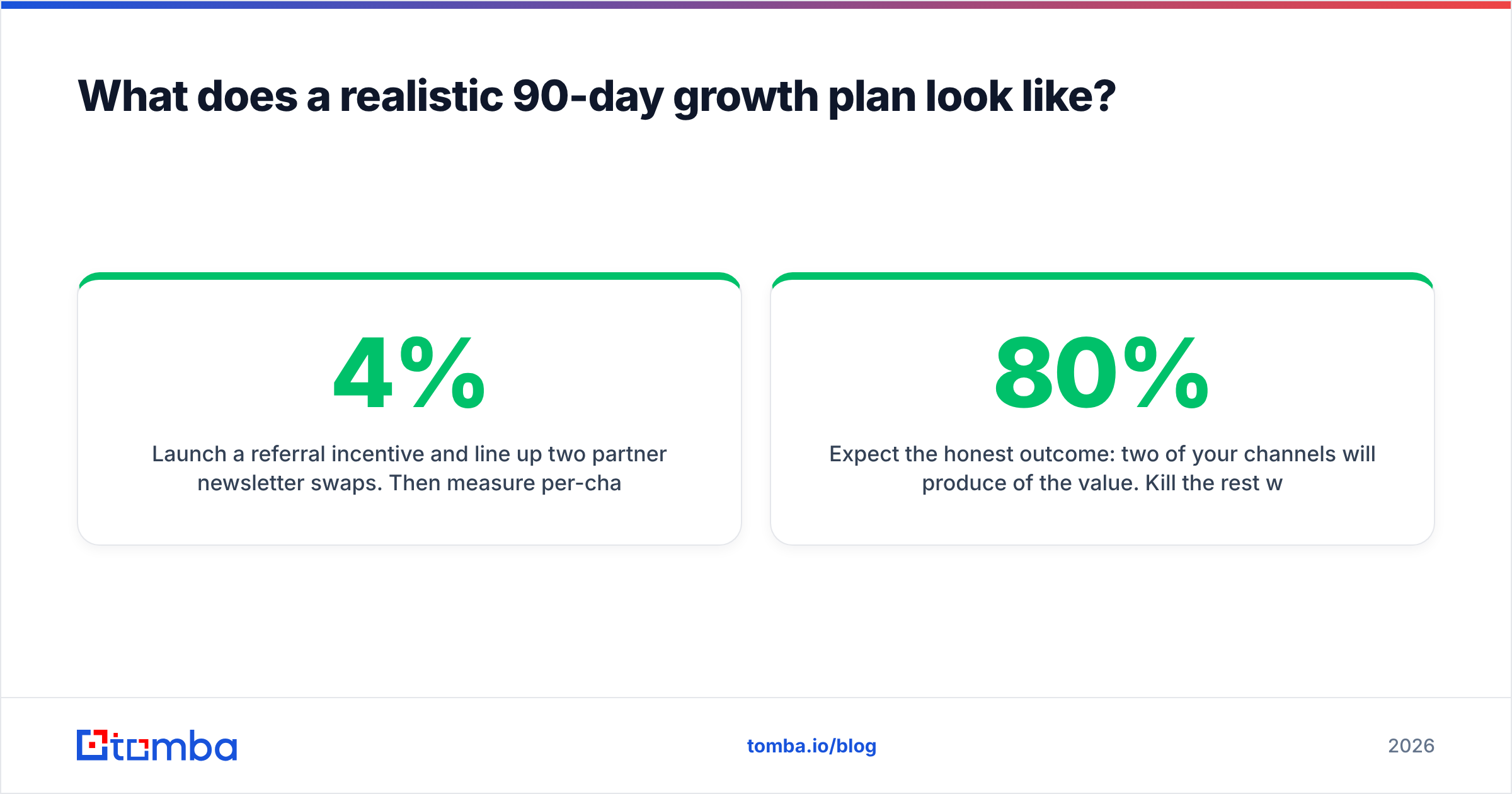
Days 61–90 — Add a loop and measure. Launch a referral incentive and line up two partner newsletter swaps. Then measure per-channel: subscribers added, 30-day open rate by source, and cost per engaged subscriber. That last metric is the only one that matters. A channel producing 1,000 subscribers at a 4% open rate is worse than one producing 150 at 40%.
Expect the honest outcome: two of your channels will produce 80% of the value. Kill the rest without sentiment and reinvest the hours.
What tools do you actually need?#
Fewer than the vendor landscape suggests. You need a sending platform, a form/capture layer, and a verification layer. That's it to start.
- Sending platform — whatever your team already knows. Switching ESPs rarely fixes a growth problem.
- Capture layer — your CMS forms plus one popup tool, configured conservatively.
- Verification layer — real-time at capture, bulk quarterly. This is the piece most teams skip and the one that determines whether the other two matter in 18 months.
- Enrichment (optional, B2B only) — turning an email into firmographics so you can segment properly. Data enrichment pays for itself the moment you start segmenting by company size or industry.
Pricing-wise, verification and finding are cheap relative to what they protect. Tomba's free tier covers 25 searches a month, Starter runs $49/mo, Growth $99/mo, and Pro $249/mo — full Tomba pricing is public. Compare that against the 60–120 days of remediation a blocklisting costs and the decision makes itself.
Where should you start this week?#
Do the boring thing first: verify what you have, then add real-time verification to your forms. It takes an afternoon and it's the only step on this page that makes every other step work better.
If you're also building the outbound side of the house — targeted B2B contacts at companies that match your ICP — the Tomba Email Finder finds professional addresses by domain, name, or company and verifies them in the same pass, so nothing enters your sequence unvalidated. Start on the free tier, run your first 25 lookups against accounts you already want, and see what the reply rate looks like before you commit to a plan.
Grow the list. Then keep it deliverable. In that order.
Related guides#
// get started
Find, verify and enrich your first contacts today
Start on the free plan with 25 searches a month, then scale when your team is ready.
Free plan · No credit card required · GDPR & CCPA
// about the author