How to Handle Inbound Sales Calls: The 2026 Playbook
Most inbound sales calls are lost in the first 60 seconds — not on price, but by a rep reading a script instead of the caller. Here is the routing, qualification, and follow-up system that fixes it.
TL;DR#
- An inbound sales call is a lead that already raised its hand. Your job is not to convince — it is to qualify fast, route correctly, and book the next step before the caller cools off.
- Speed dominates every other variable. Answering within five minutes versus thirty minutes changes qualification odds by an order of magnitude, according to the lead-response research popularized by Harvard Business Review.
- Run a fixed opening: confirm identity, state a time box, ask why they called today, then shut up and listen for 90 seconds.
- Pick one qualification framework and use it every time. BANT, CHAMP, MEDDIC, and GPCTBA each fit different deal sizes — the table below shows which one to run on a live inbound call.
- Enrich the caller record during the call. Knowing headcount, tech stack, and the actual decision-maker's contact details before you hang up is the difference between one call and a six-week chase.
What counts as an inbound sales call in 2026?#
An inbound sales call is any live phone conversation initiated by the prospect — or by you within minutes of a prospect action. That second half surprises people. If someone books a demo, fills a pricing form, or starts a trial and you call them back in three minutes, that call behaves like inbound: they know who you are, they expect contact, and the gatekeeper problem does not exist.
The practical categories you will handle:
- Direct dials to your sales line. Highest intent, lowest volume. These callers usually have a deadline or a competitor already in play.
- Demo-request callbacks. The prospect submitted a form and expects a call. Intent is high but the timeline may be soft.
- Support calls that are really sales calls. An existing user asking about seat limits or an API rate cap is an expansion conversation wearing a support hat.
- Partner and referral calls. Warmest possible traffic. Treat these as named accounts, not tickets.
- Wrong-fit inbound. Students, competitors doing research, and companies 10x below your price floor. Disqualify these in under four minutes without being rude — they leave reviews too.
Every one of those needs a different second half of the call. They all need the same first sixty seconds.
Why does response speed decide the outcome?#
Because intent decays. A buyer who fills in a form is comparing three or four vendors in the same session. Whoever gets to a live conversation first frames the evaluation criteria, and the vendor who frames the criteria usually wins.
The often-cited Lead Response Management data — reproduced widely across HubSpot's sales resources — puts the effect starkly: contacting a lead within five minutes versus thirty minutes changes the odds of a meaningful qualification conversation by roughly 20x. The decay is not linear. It is a cliff at minute five and a slow bleed after that.
What this means operationally:
- Have a named human on call during your two peak inbound hours. Do not rotate this by fairness; rotate by conversion rate.
- Set a hard SLA — five minutes during business hours, first thing next morning for overnight leads — and instrument it. If your CRM does not report median response time weekly, the SLA does not exist.
- Kill the qualification form gate. Every extra field costs you calls. Capture the email and the phone number, then enrich the rest yourself.
What should you do in the first 60 seconds?#
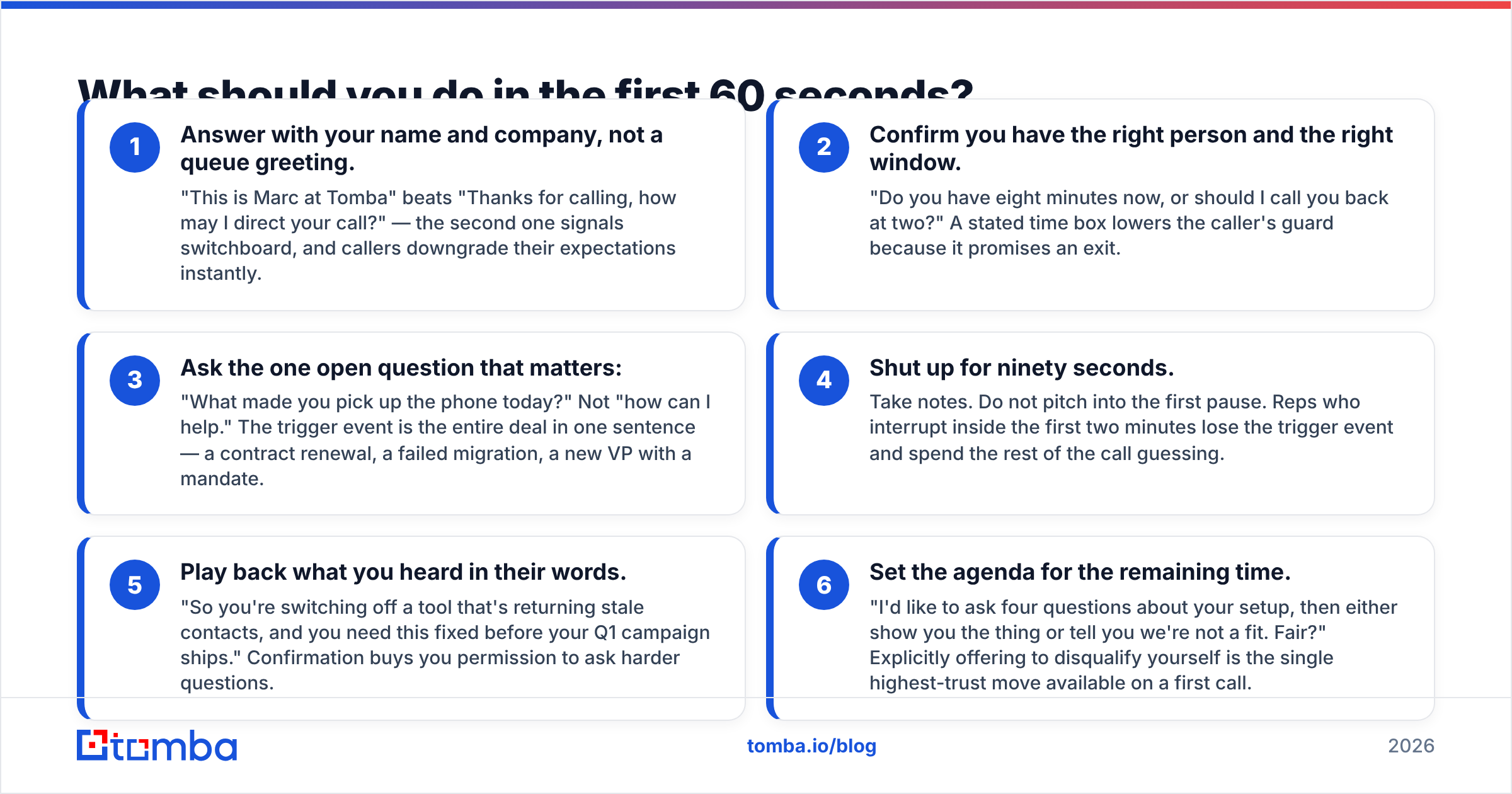
This is the part most reps improvise, and it is the part that should be identical every time. Six moves, in order:
- Answer with your name and company, not a queue greeting. "This is Marc at Tomba" beats "Thanks for calling, how may I direct your call?" — the second one signals switchboard, and callers downgrade their expectations instantly.
- Confirm you have the right person and the right window. "Do you have eight minutes now, or should I call you back at two?" A stated time box lowers the caller's guard because it promises an exit.
- Ask the one open question that matters: "What made you pick up the phone today?" Not "how can I help." The trigger event is the entire deal in one sentence — a contract renewal, a failed migration, a new VP with a mandate.
- Shut up for ninety seconds. Take notes. Do not pitch into the first pause. Reps who interrupt inside the first two minutes lose the trigger event and spend the rest of the call guessing.
- Play back what you heard in their words. "So you're switching off a tool that's returning stale contacts, and you need this fixed before your Q1 campaign ships." Confirmation buys you permission to ask harder questions.
- Set the agenda for the remaining time. "I'd like to ask four questions about your setup, then either show you the thing or tell you we're not a fit. Fair?" Explicitly offering to disqualify yourself is the single highest-trust move available on a first call.
Notice what is absent: no feature list, no pricing, no company history. None of that survives contact with a caller who has not told you their problem yet.
Which qualification framework should you run on a live inbound call?#
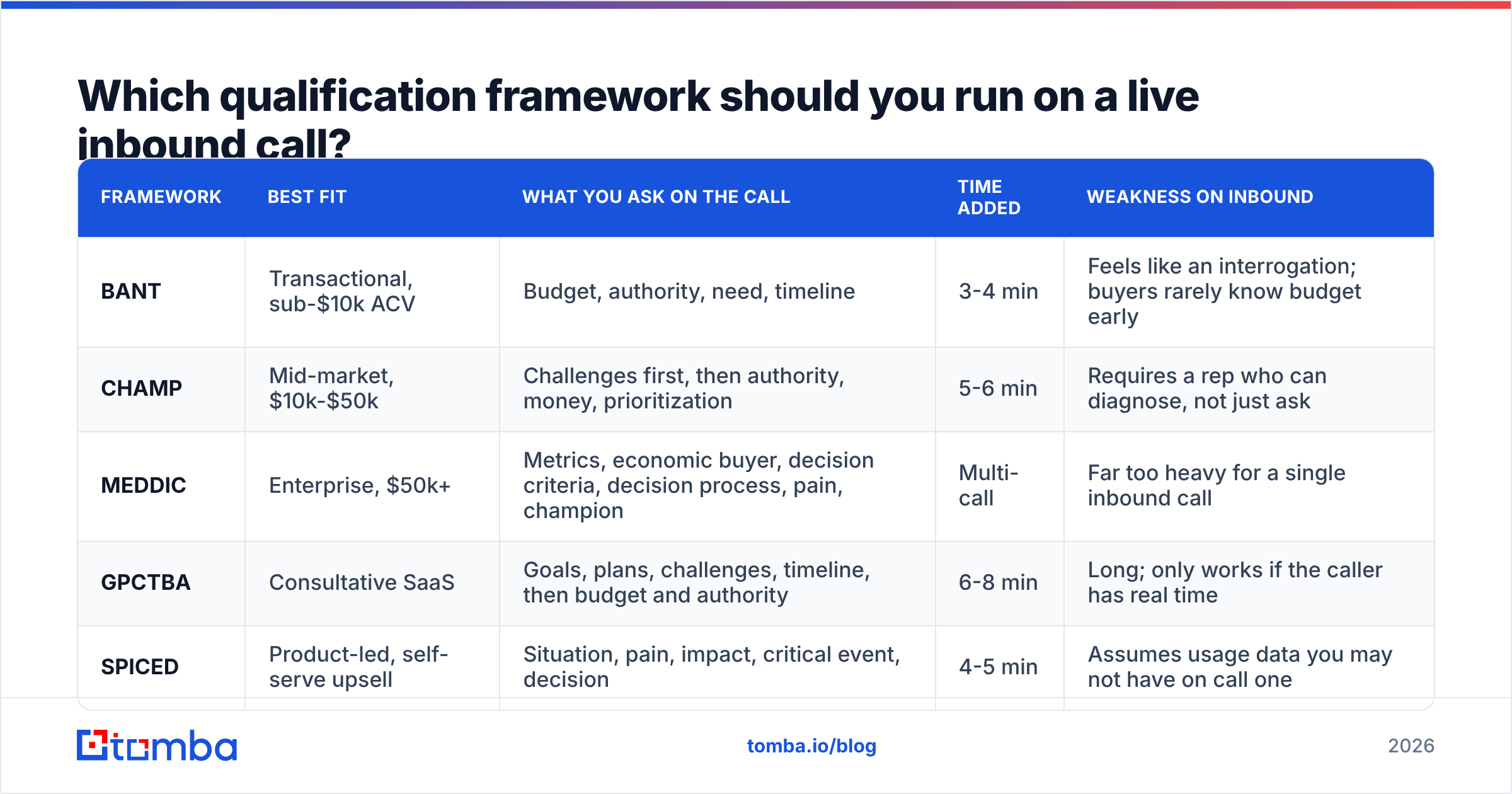
Pick one and standardize. Mixing frameworks between reps makes pipeline reviews meaningless because "qualified" stops meaning anything.
| Framework | Best fit | What you ask on the call | Time added | Weakness on inbound |
|---|---|---|---|---|
| BANT | Transactional, sub-$10k ACV | Budget, authority, need, timeline | 3-4 min | Feels like an interrogation; buyers rarely know budget early |
| CHAMP | Mid-market, $10k-$50k | Challenges first, then authority, money, prioritization | 5-6 min | Requires a rep who can diagnose, not just ask |
| MEDDIC | Enterprise, $50k+ | Metrics, economic buyer, decision criteria, decision process, pain, champion | Multi-call | Far too heavy for a single inbound call |
| GPCTBA | Consultative SaaS | Goals, plans, challenges, timeline, then budget and authority | 6-8 min | Long; only works if the caller has real time |
| SPICED | Product-led, self-serve upsell | Situation, pain, impact, critical event, decision | 4-5 min | Assumes usage data you may not have on call one |
For most inbound calls in the $10k-$50k band, CHAMP wins. It opens with the caller's challenge — which is what they already want to talk about — and defers budget until you have earned the right to ask. BANT's failure mode on inbound is that "what's your budget" in minute two makes a warm caller feel processed.
Whichever you pick, write the four questions on a card and keep the wording constant. Consistency is what makes call recordings comparable across a team.
How do you handle the pricing question in minute two?#
Never dodge it, never answer it flat.
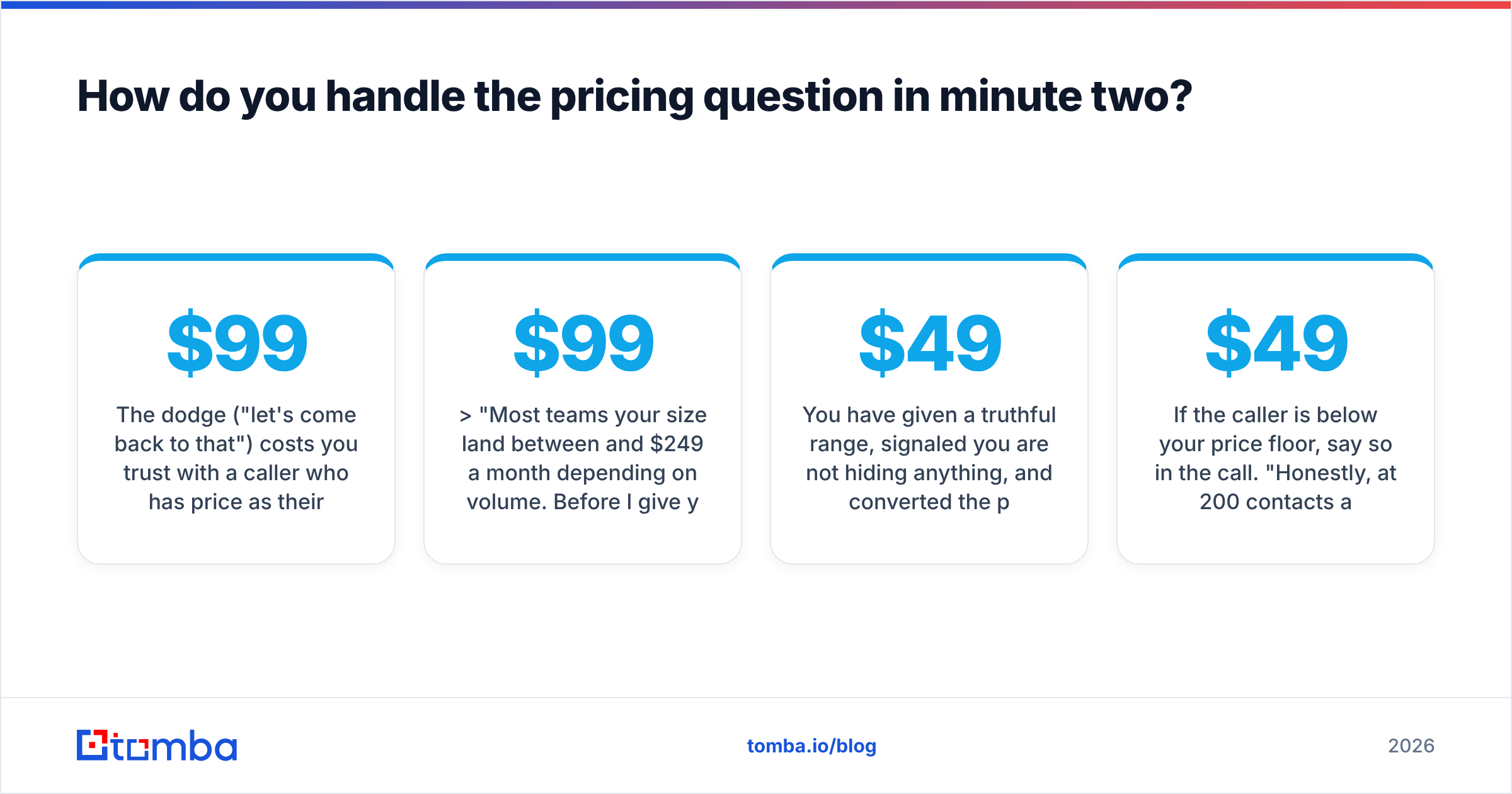
The dodge ("let's come back to that") costs you trust with a caller who has price as their qualifying criterion. The flat answer ("$99 a month") costs you the deal when the number lands before the value does.
The move is a bracket plus a question:
"Most teams your size land between $99 and $249 a month depending on volume. Before I give you a real number — how many contacts are you working through in a typical month?"
You have given a truthful range, signaled you are not hiding anything, and converted the pricing question into a discovery question. If your published pricing is public anyway — as Tomba's plans are, with a free tier at 25 searches, Starter at $49/mo, Growth at $99/mo and Pro at $249/mo — hiding it is actively counterproductive. They already looked.
If the caller is below your price floor, say so in the call. "Honestly, at 200 contacts a month, our free tier or a $49 plan covers you — you don't need to talk to sales." That call takes four minutes, generates a review, and often returns as a $99/mo account in eight months.
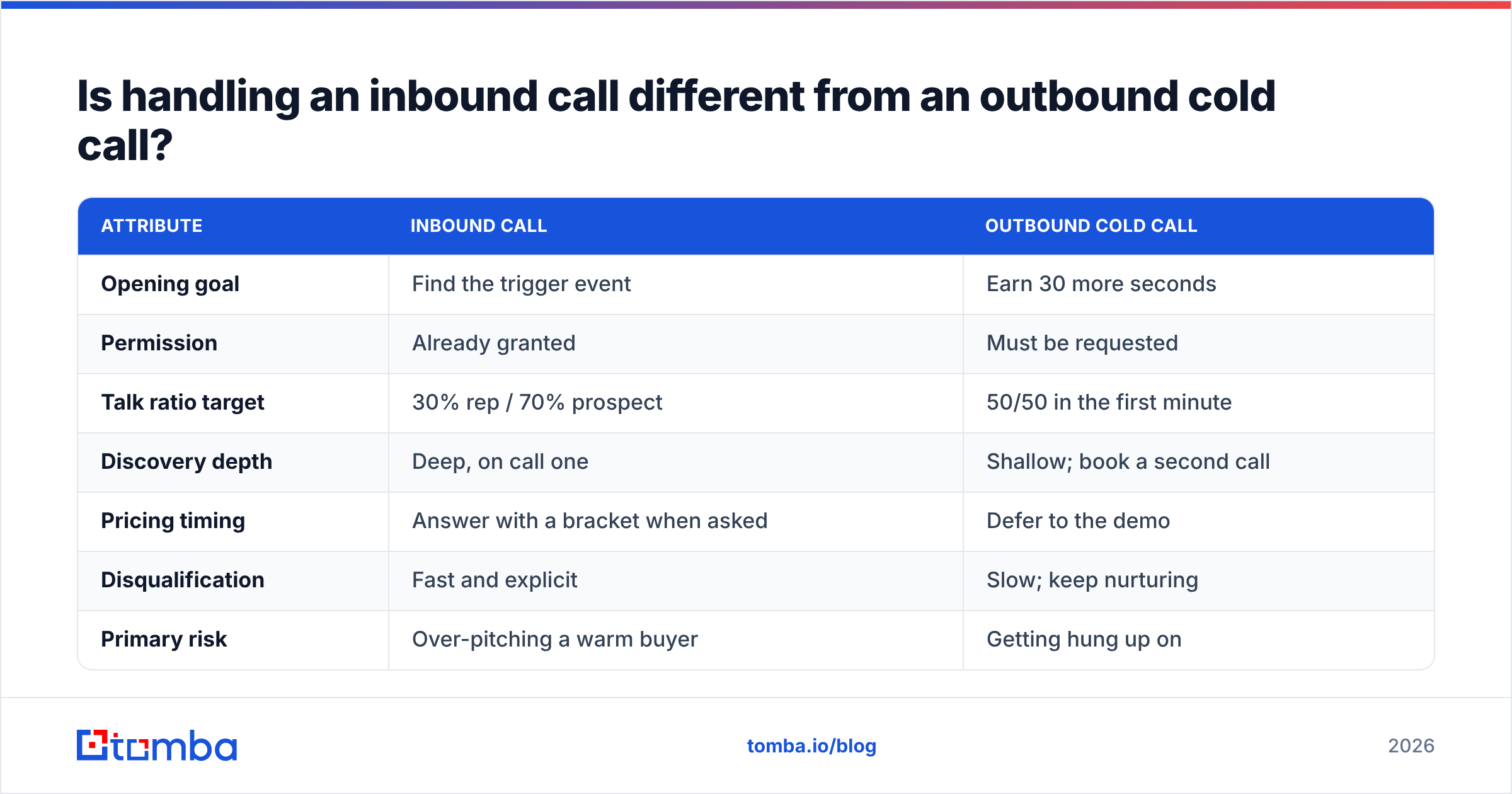
Is handling an inbound call different from an outbound cold call?#
Fundamentally, yes. The same script does not transfer.
| Attribute | Inbound call | Outbound cold call |
|---|---|---|
| Opening goal | Find the trigger event | Earn 30 more seconds |
| Permission | Already granted | Must be requested |
| Talk ratio target | 30% rep / 70% prospect | 50/50 in the first minute |
| Discovery depth | Deep, on call one | Shallow; book a second call |
| Pricing timing | Answer with a bracket when asked | Defer to the demo |
| Disqualification | Fast and explicit | Slow; keep nurturing |
| Primary risk | Over-pitching a warm buyer | Getting hung up on |
| Success metric | Meeting booked or clean disqualification | Connect-to-meeting rate |
The most common failure I see in call reviews: reps using their outbound energy on inbound calls. High-tempo, feature-heavy, permission-seeking language on a caller who has already decided to evaluate you reads as desperate. Lower the tempo. Ask more. Sell less.

What should you do when the caller is not the decision-maker?#
This happens on roughly half of inbound calls, and most reps handle it badly — either bulldozing past the caller to reach the "real" buyer, or treating the caller as a dead end.
Neither works. Do this instead:
- Keep the caller as an ally, not an obstacle. They took the initiative to research you. Ask, "Who else needs to be comfortable with this before it moves?" — not "can you connect me with your boss."
- Map the account while you are still on the line. Ask for titles, not names. "Is it your CTO who signs off on tooling, or does that sit with ops?"
- Enrich the record before you hang up. Once you know the title and the domain, a domain search surfaces the verified email pattern and the likely decision-maker in seconds, and a phone finder fills the direct dial. You are not going around your caller — you are prepared for the moment they say "you should talk to Priya."
- Send a forwardable summary, not a follow-up. Write the recap email so your caller can forward it untouched: their problem in their words, three bullets on fit, one clear next step. Anything with "great speaking with you" at the top does not get forwarded.
- Verify before you send anything to the second contact. Bouncing an email to the economic buyer on your first touch is an unforced error. Run it through an email verifier first — Tomba's data sources page explains how the confidence scoring works.
How should you log and route the call afterwards?#
The call is worth nothing if the next person cannot reconstruct it. Three non-negotiables:
- Log the trigger event verbatim. Not "interested in email finder." The actual sentence: "our data vendor's contract ends March 31 and their bounce rate hit 14%." That sentence is what your renewal email in February will be built on.
- Set the next step before you leave the CRM record. A call with no dated next action is a lost lead with extra steps. If they said "call me in six weeks," create the task now, with the trigger event in the task body.
- Route by fit, not by round robin. Enterprise-shaped callers routed to an SMB rep churn in month three. If your qualification framework produced a segment, let the routing rule read it.
Teams running a real revenue operations function should audit this monthly: pull twenty inbound calls, check response time, check whether the trigger event is in the record, check whether a next step exists. Three numbers, twenty minutes, and it will tell you more than a quarter of pipeline dashboards. Buyer-review data on G2 consistently shows the same pattern — vendors that respond fast and follow up specifically outrank vendors with better feature sets.
What are the most common inbound call mistakes?#
- Reading a script verbatim. Structure, yes. Word-for-word delivery, no. Callers hear it immediately.
- Talking more than 40% of the time. Pull your call recordings and check the talk ratio. It is almost always worse than you think.
- Refusing to disqualify. A clean "we're not the right fit, here's who is" call earns more referrals than a forced demo.
- Sending a generic follow-up. If the recap email does not quote the caller, it will not be read.
- Not enriching the account. Hanging up with only a first name and a Gmail address means you will spend the next two weeks doing manual research you could have automated in thirty seconds.
- Ignoring the second contact. Deals with two engaged contacts close at materially higher rates than single-threaded deals — a pattern Salesforce has documented across its own sales org for years.
Where do you start tomorrow?#
Set a five-minute callback SLA, write your six-move opening on a card, pick one qualification framework, and audit twenty recorded calls against those three things. That is a week of work with an outsized return.
Then close the data gap. The reason most inbound calls stall is not the script — it is hanging up without knowing who else needs to sign off or how to reach them. Tomba Email Finder gives you verified professional emails by name and domain while you are still on the call, so your recap email reaches the economic buyer the same afternoon instead of six weeks later. Start on the free tier at 25 searches a month, and move to Starter at $49/mo when inbound volume justifies it.
Related guides#
// get started
Find, verify and enrich your first contacts today
Start on the free plan with 25 searches a month, then scale when your team is ready.
Free plan · No credit card required · GDPR & CCPA
Get the Tomba newsletter
Product and data updates
// about the author