How To Handle Objections In Sales: A 2026 Field Guide
Most objections are not rejections — they are missing information, bad timing, or the wrong contact. Here is a repeatable framework for handling the seven objections that actually kill B2B deals.
TL;DR
- Most "objections" are not refusals. They are missing information, bad timing, or the wrong person on the call — and each type needs a different response.
- Use a five-step loop: pause, clarify, isolate, reframe, confirm. Skipping the clarify step is the single most common rep error.
- Price objections are almost never about price. Budget objections are. Learn to tell them apart before you discount.
- "Send me some information" and "call me next quarter" are stalls, not objections — handle them with a scheduled next step, not a rebuttal.
- A meaningful share of objections start upstream: wrong contact, wrong company, stale data. Fix the list before you rewrite the script.
Why do sales objections happen at all?#
An objection is your prospect telling you, out loud, what is standing between them and a yes. That is a gift. A prospect who says nothing and ghosts you gives you nothing to work with; a prospect who says "we already use Apollo" has just handed you the exact shape of the gap you need to close.
The mistake most reps make is treating every objection as the same object. It isn't. There are four distinct categories, and mixing them up is why scripts fail:
- Information objections — the prospect lacks a fact. "Does this integrate with Salesforce?" The fix is an answer, not persuasion.
- Belief objections — the prospect has a fact but doesn't believe it applies to them. "AI tools never work for our niche." The fix is proof, ideally from a lookalike customer.
- Priority objections — the prospect agrees but has three fires burning hotter. "Not this quarter." The fix is a scheduled return, not pressure.
- Authority or fit objections — the prospect cannot buy, or shouldn't. "I'm not the decision maker." The fix is routing, not rebuttal.
Only one of these four is actually solved by a clever comeback. The other three are solved by information, evidence, or moving on. Reps who memorize twenty rebuttals but never diagnose the category end up arguing with people who were already interested.

What is the five-step objection handling framework?#
Every durable objection-handling method — Sandler's reverse, Chris Voss's mirroring, the classic Feel-Felt-Found — is a variation on the same loop. Here it is stripped to five moves you can run in under ninety seconds on a live call.
Step 1 — Pause. Two full seconds of silence after the objection lands. It signals you heard it, and it stops you from launching into a canned rebuttal that answers a different objection than the one you got.
Step 2 — Clarify. Ask one question that makes the objection specific. "Too expensive" becomes "Too expensive relative to what — the budget you've been given, or the results you're expecting?" Those are two completely different conversations. This step is where most reps fail; they assume they know which one it is and guess wrong roughly half the time.
Step 3 — Isolate. Confirm this is the only blocker. "If we solved the integration piece, is there anything else keeping you from moving forward this quarter?" If a second objection appears, you just saved yourself from solving the wrong one. If nothing appears, you now have a commitment attached to a condition.
Step 4 — Reframe. Answer the isolated objection using their language and their metric. Not "our accuracy is high" but "you said you're burning 20% of your sequence volume on bounces — here's what that number looks like at a 3% bounce rate."
Step 5 — Confirm. Get explicit agreement that the objection is resolved before you move on. "Does that address the integration concern?" A silent nod is not agreement; unconfirmed objections resurface at the contract stage.
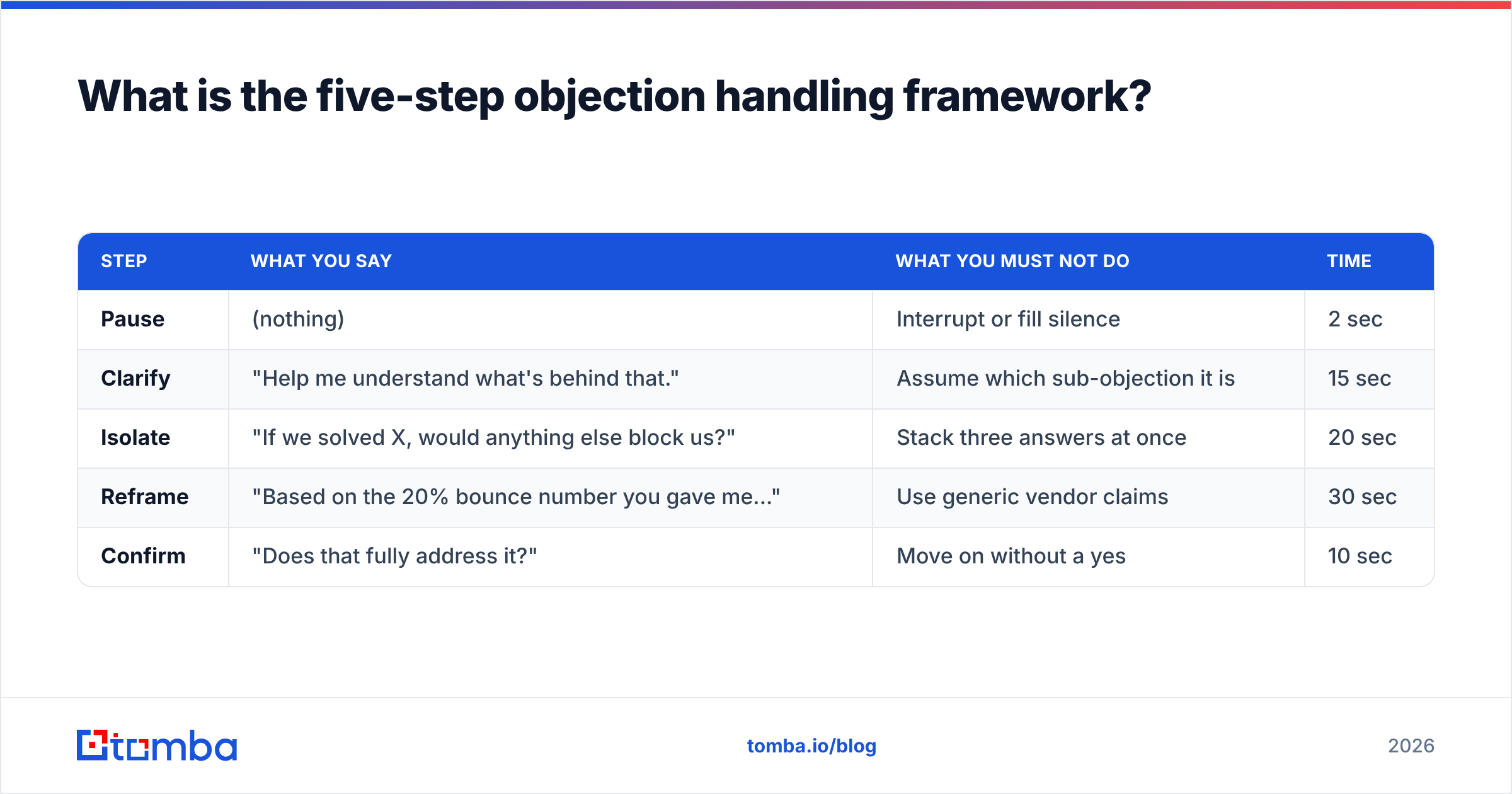
| Step | What you say | What you must NOT do | Time |
|---|---|---|---|
| Pause | (nothing) | Interrupt or fill silence | 2 sec |
| Clarify | "Help me understand what's behind that." | Assume which sub-objection it is | 15 sec |
| Isolate | "If we solved X, would anything else block us?" | Stack three answers at once | 20 sec |
| Reframe | "Based on the 20% bounce number you gave me..." | Use generic vendor claims | 30 sec |
| Confirm | "Does that fully address it?" | Move on without a yes | 10 sec |
How do you handle the seven most common B2B objections?#
Below are the objections that actually appear in B2B pipelines, with the diagnosis first and the response second. The diagnosis matters more than the wording.
"It's too expensive"#
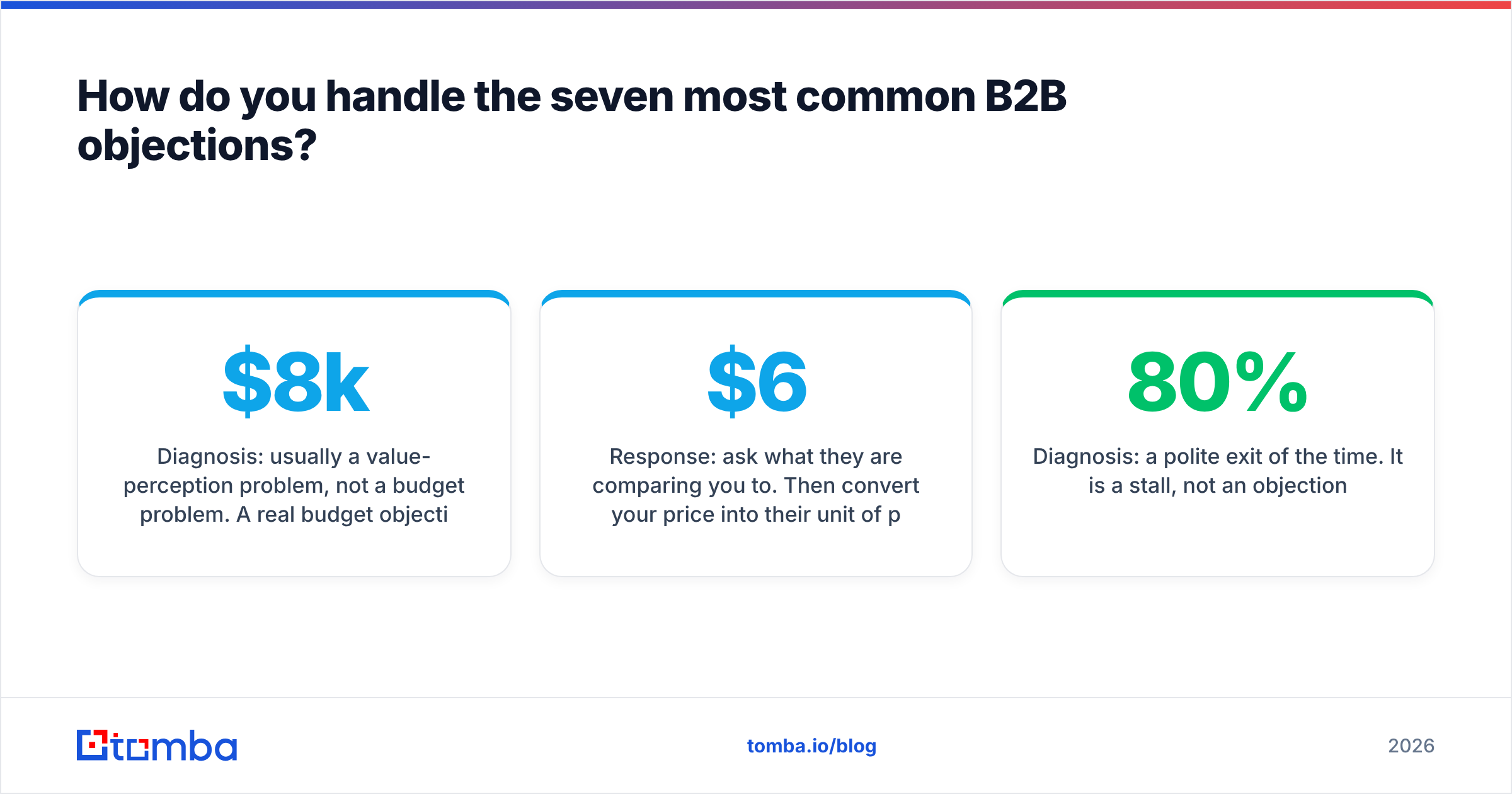
Diagnosis: usually a value-perception problem, not a budget problem. A real budget objection sounds like "I have $8k allocated and you're at $14k." A price objection sounds vague because the prospect hasn't built a mental ROI model yet.
Response: ask what they are comparing you to. Then convert your price into their unit of pain. If a rep costs $6,000/month fully loaded and spends eight hours a week on manual list building, a $99/month tool that returns six of those hours is not a cost conversation.
"We already use a competitor"#
Diagnosis: often a comfort objection. Switching costs are real, and "we already use X" is shorthand for "convince me the migration pain is worth it."
Response: do not attack the incumbent — you will trigger loyalty. Ask what they'd change about it if they could. The answer is your wedge. Many teams end up running two tools: one for coverage, one for verification, because no single vendor wins every domain.
"Send me some information"#
Diagnosis: a polite exit 80% of the time. It is a stall, not an objection.
Response: agree, then attach a calendar event. "Happy to — I'll send the two-page version. Can we grab fifteen minutes Thursday so I'm not sending you the wrong thing?" If they refuse the fifteen minutes, you have your real answer and can stop spending cycles.
"I'm not the decision maker"#
Diagnosis: routing problem, and frequently a data problem that started before the call.
Response: thank them, then ask two questions — who owns this decision, and what does that person care about? Then ask for a warm intro rather than a name. If you're consistently hitting this, your targeting is off, not your pitch. A quick domain search on the account before you dial usually surfaces the actual owner of the function.
"Now isn't a good time"#
Diagnosis: priority objection. Real, and usually honest.
Response: don't fight it. Ask what would need to be true for it to become a priority, then set a specific return date tied to that trigger. "You said you're re-evaluating stack in January — should I check back the first week of December so you have data before that review?"
"We tried something like this and it didn't work"#
Diagnosis: belief objection, backed by a scar.
Response: ask what specifically failed. Nine times out of ten it was implementation, not the category. Acknowledge the scar, then differentiate on the exact failure point. Never say "well, that was a bad tool" — you're insulting a decision they made.
"Just email me and I'll look at it"#
Diagnosis: could be genuine, could be a stall. The tell is whether they give you a timeframe unprompted.
Response: confirm the email address out loud on the call, and confirm the next step. This is also where a lot of pipeline quietly dies — reps send to an address that bounces and assume they were ghosted. Running the address through an email verifier before you hit send removes that ambiguity entirely.
Is objection handling different on the phone versus email?#
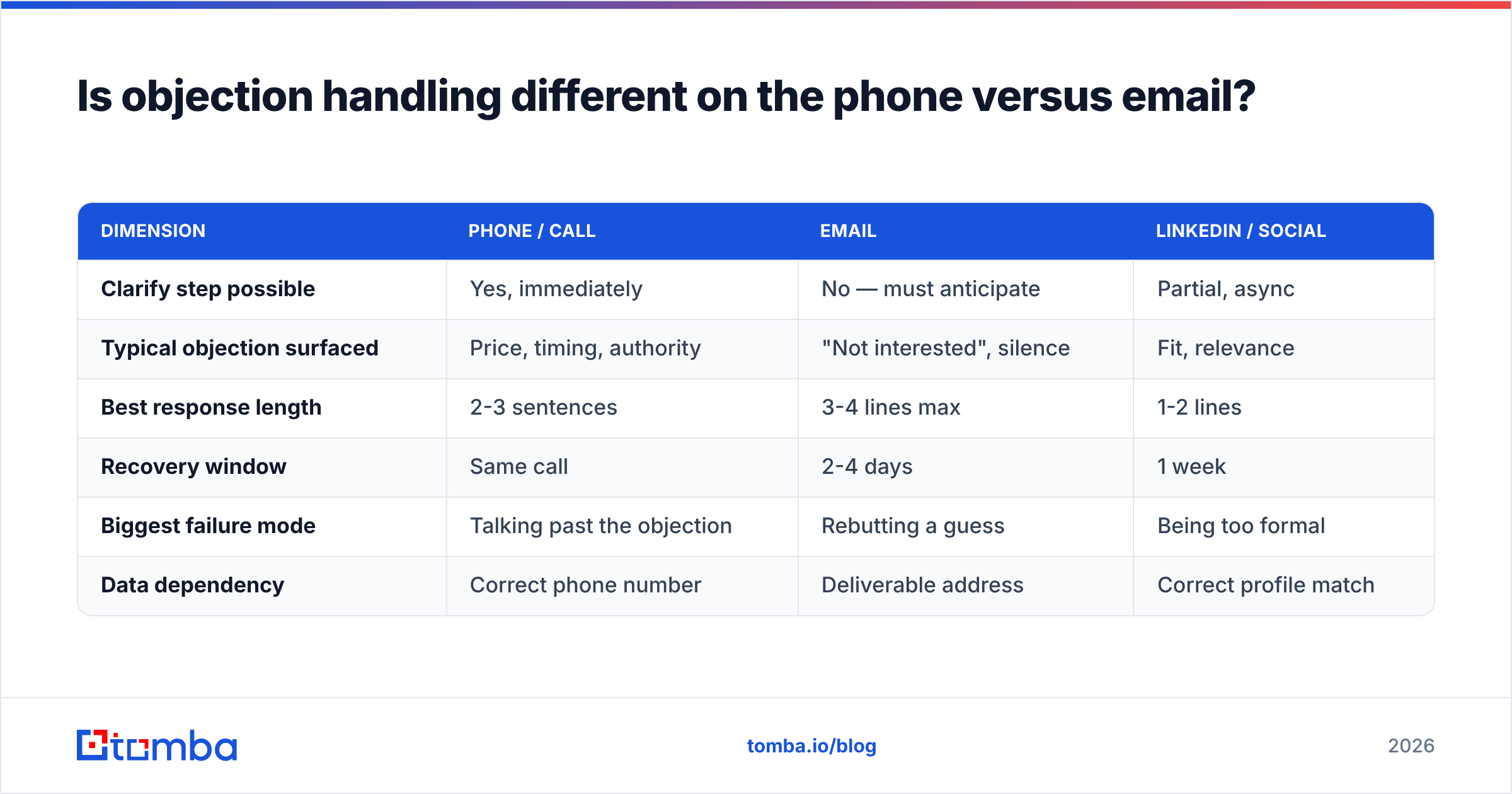
Yes, and the difference is bigger than most playbooks admit. On a call you get tone, hesitation, and the ability to run the full five-step loop in real time. In email, you get one shot and no clarify step.
| Dimension | Phone / call | LinkedIn / social | |
|---|---|---|---|
| Clarify step possible | Yes, immediately | No — must anticipate | Partial, async |
| Typical objection surfaced | Price, timing, authority | "Not interested", silence | Fit, relevance |
| Best response length | 2-3 sentences | 3-4 lines max | 1-2 lines |
| Recovery window | Same call | 2-4 days | 1 week |
| Biggest failure mode | Talking past the objection | Rebutting a guess | Being too formal |
| Data dependency | Correct phone number | Deliverable address | Correct profile match |
The practical takeaway: in email, you cannot diagnose, so you must reduce the number of possible objections up front. That means tighter targeting, more specific relevance, and a single clear ask. Anticipate the two most likely objections for that segment and preempt one of them in the body — not both, or you sound defensive.
For phone work, the constraint is different. You need a number that actually connects. Reps who spend forty minutes dialing switchboards are not having objection-handling problems; they are having phone finder problems. Fix the input before you blame the technique.

What separates a real objection from a brush-off?#
A real objection is specific, and the prospect is willing to elaborate. A brush-off is vague, and the prospect deflects when you probe.
Test it with one question: "Can you tell me more about that?"
- Real objection → they give you detail. "We signed a twelve-month contract in March and finance won't approve overlapping tools."
- Brush-off → they repeat the same phrase or get shorter. "It's just not a fit right now."
When you get a brush-off twice in a row, stop selling and start qualifying out. This is unpopular advice because it feels like giving up, but the math is straightforward: time spent nursing a brush-off is time not spent on an account that would have converted. Research from firms like Gartner consistently shows B2B buying groups have grown larger and slower — which means your scarce resource is attention, not leads.
There is one exception worth naming. A brush-off from a prospect who matches your ICP perfectly is worth one more attempt through a different channel or a different contact at the same account. A brush-off from a poor-fit account is a gift; take it and move on.
How much of objection handling is actually a data problem?#
More than most sales managers want to hear. Before you invest in another objection-handling workshop, audit where your objections are coming from.
- Wrong person — "I'm not the decision maker" is a targeting failure, not a talk-track failure. If more than one in five conversations ends here, your contact data or your ICP definition needs work.
- Wrong company — "We don't do that" means the account never should have entered the sequence. Firmographic filters fix this, not scripts.
- Never reached — bounced emails and dead numbers look like objections in your dashboard because they show up as non-responses. They aren't objections; they're plumbing.
- Right person, wrong timing — legitimate, and the only category where a nurture sequence pays off.
- Right person, right time, real doubt — this is the only bucket where objection-handling skill actually moves the number.
Most teams discover that buckets 1 through 3 account for a large chunk of what they've been coaching as "objection handling." Cleaning contact data with a bulk email finder and verifying before send is unglamorous, but it converts phantom objections back into real conversations. Vendors in this space vary widely — BookYourData is a solid option for pre-built, verified B2B lists when you want coverage without building the list yourself, while an on-demand finder suits teams that already have target accounts and need contacts within them.
What should you never do when handling an objection?#
Short list, learned expensively:
- Never argue. You can win the argument and lose the deal. Reframing is not the same as contradicting.
- Never discount on the first price objection. You teach the buyer that your price is fiction, and you'll get the same objection at renewal.
- Never stack answers. One objection, one answer. Three rapid-fire responses signal anxiety.
- Never say "I understand" without demonstrating it. Repeat their words back instead.
- Never leave a call without a next step. "I'll follow up" is not a next step; a date is.
- Never handle an objection you invented. If they didn't raise price, don't preemptively defend it.
If you want to sharpen the language itself, HubSpot's sales blog publishes ongoing research on buyer behavior that's worth reading alongside your own call recordings — but your recordings will always beat generic advice, because they contain your buyers.
How do you build an objection library your team actually uses?#
Skip the 40-page document. Nobody reads it. Build this instead:
- A living table with five columns: objection verbatim, category (info / belief / priority / authority), clarifying question, best response, and the rep who closed a deal after hearing it.
- Sourced from call recordings, not brainstorms. Pull the actual phrasing prospects use. Their words outperform your paraphrase every time.
- Capped at fifteen entries. If you have more than fifteen, you have a targeting problem disguised as an objection problem.
- Reviewed monthly, with dead entries deleted. An objection library that only grows is a library nobody trusts.
- Attached to your CRM so the clarifying question appears on the call screen, not in a wiki tab.
Track one metric against it: the percentage of objections that get a clarifying question before a response. Not close rate — that moves too slowly and has too many confounders. Clarify rate is coachable, measurable in a week, and correlates with everything downstream.
Where should you start this week?#
Pick the highest-frequency objection from last month's calls. Write one clarifying question for it. Have every rep use only that question for a week, no rebuttals allowed. You will learn more about your buyers in five days than in a quarter of role-plays — because you'll finally hear what the objection actually means.
Then fix the upstream half. If a chunk of your "objections" are really bounced emails, wrong contacts, and dead numbers, no script will save you. Start with a clean, verified contact list so the conversations you do have are with people who can actually say yes.
Get the input right before you polish the output. Tomba's Email Finder locates verified professional addresses by name, domain, or company, so your sequences reach real decision makers instead of generating phantom objections in your dashboard. The free tier includes 25 searches a month; paid plans start at $49/mo for Starter, $99/mo for Growth, and $249/mo for Pro — full Tomba pricing is public, and there's an email finder API if you'd rather wire verification directly into your sequencing stack. Clean data first, better objections second.
Related guides#
// get started
Find, verify and enrich your first contacts today
Start on the free plan with 25 searches a month, then scale when your team is ready.
Free plan · No credit card required · GDPR & CCPA
Get the Tomba newsletter
Product and data updates
// about the author