How To Handle Objections In Sales: Examples That Close Deals
Twelve real objections, twelve word-for-word responses, and the framework behind them. Learn how to handle objections in sales with examples you can steal for your next call.
TL;DR
- Most objections are not rejections. They are missing information, missing urgency, or the wrong person on the call.
- The highest-performing pattern is four steps: pause, clarify, reframe, confirm. Skip the pause and you sound defensive.
- Price objections are almost never about price. They are about a value gap you failed to close earlier in the conversation.
- "Send me some info" and "we're already using someone" are the two objections that kill the most pipeline, and both have specific, tested responses.
- Objection handling starts before the call. Bad contact data means you are pitching to people who were never going to buy.
What is an objection in sales, really?#
An objection is a request for more information dressed up as a refusal.
Think of it like a customer at a hardware store saying "that drill is expensive." They are not walking out. They are asking you to justify the price tag before they commit. If you respond by dropping the price, you have just told them the drill was overpriced. If you respond by asking what they are drilling into, you have started a conversation.
That is the whole game. Reps who lose deals treat objections as verdicts. Reps who win treat them as questions.
Research from Gartner on B2B buying consistently shows buying groups have grown to six to ten stakeholders, which means the objection you hear on a call is often a secondhand relay of someone else's concern. The person saying "it's too expensive" may personally love your product but has to defend the purchase to a CFO who has never heard of you. Handling the objection means arming your champion, not winning an argument.
Here is the structural difference that matters most:
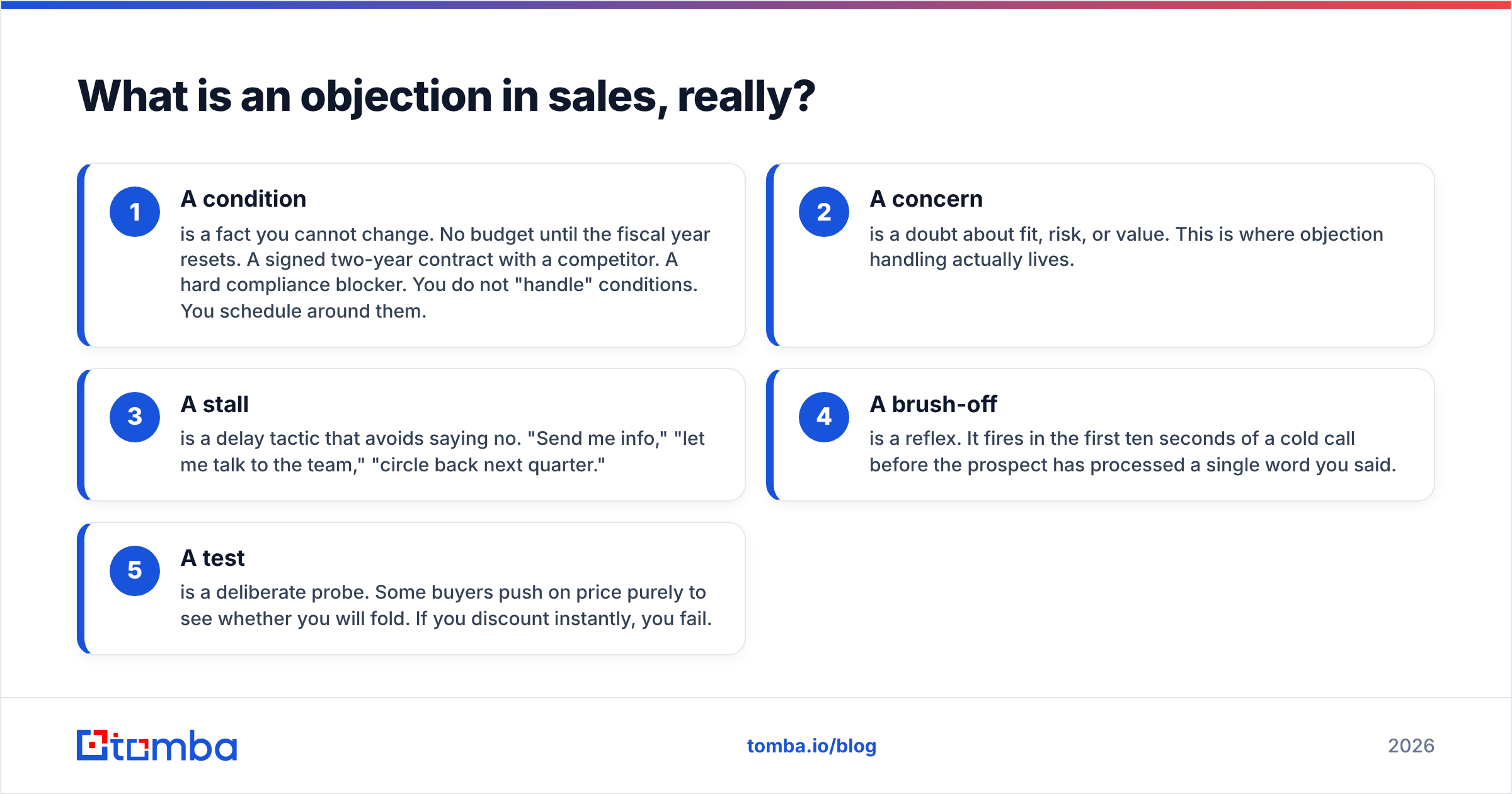
- A condition is a fact you cannot change. No budget until the fiscal year resets. A signed two-year contract with a competitor. A hard compliance blocker. You do not "handle" conditions. You schedule around them.
- A concern is a doubt about fit, risk, or value. This is where objection handling actually lives.
- A stall is a delay tactic that avoids saying no. "Send me info," "let me talk to the team," "circle back next quarter."
- A brush-off is a reflex. It fires in the first ten seconds of a cold call before the prospect has processed a single word you said.
- A test is a deliberate probe. Some buyers push on price purely to see whether you will fold. If you discount instantly, you fail.
Diagnose which one you are facing before you open your mouth. Answering a brush-off with a value pitch is why cold calls die at second twelve.
What framework should you use to handle any objection?#
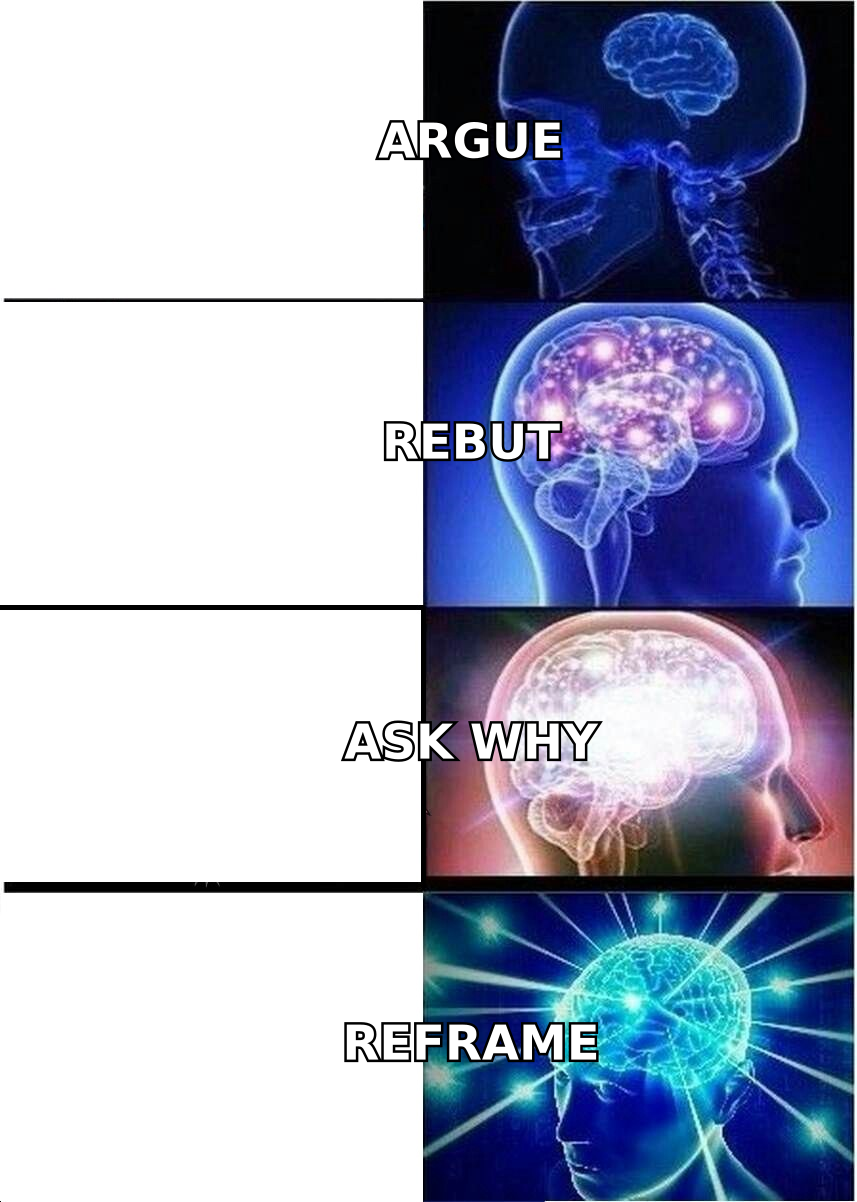
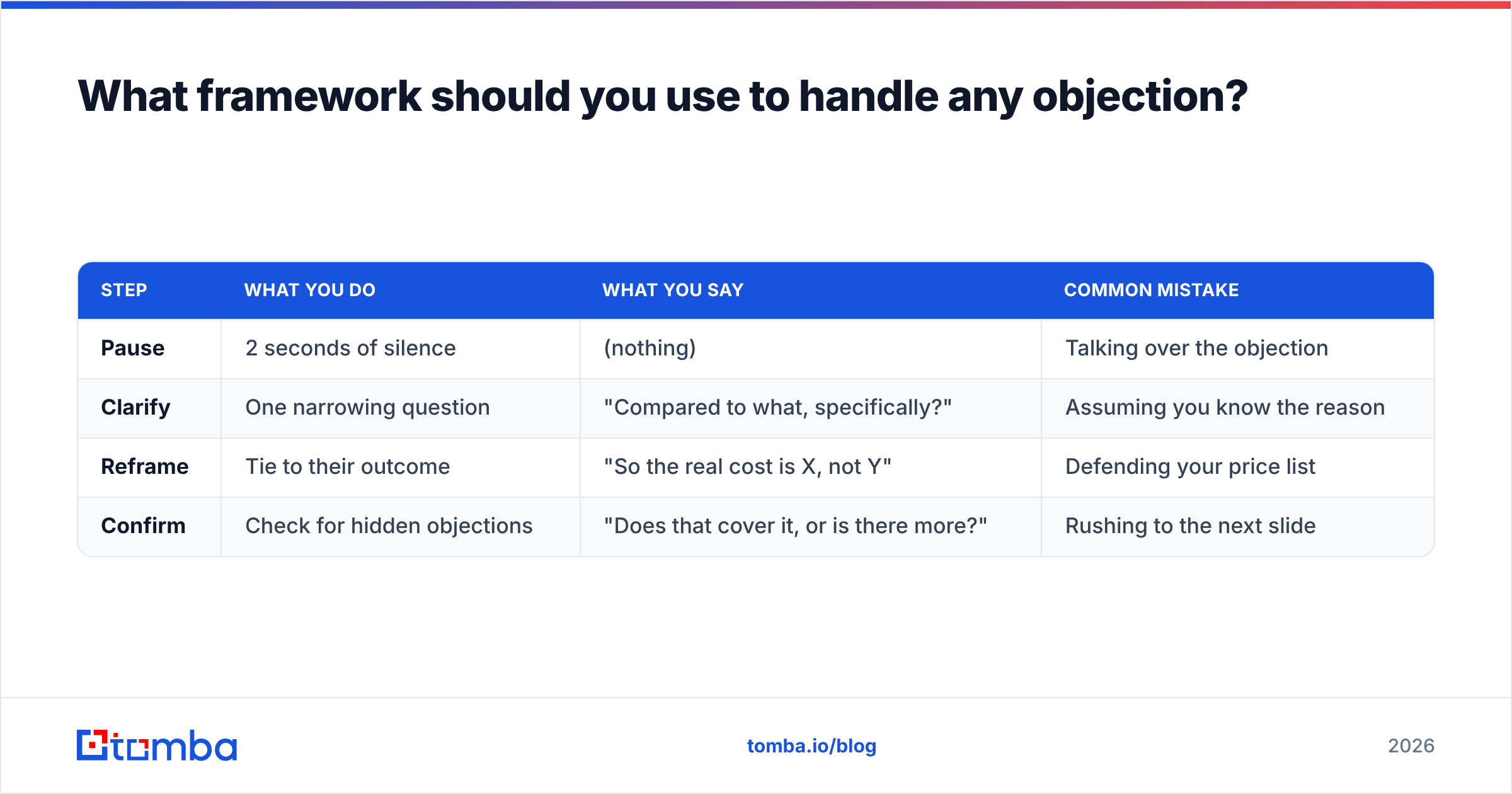
Use four steps: pause, clarify, reframe, confirm. It works on every objection type because it forces you to understand before you respond.
Step 1 — Pause. Count two seconds. Silence signals you heard something worth thinking about. Immediate rebuttals signal you have a script and the prospect is an obstacle in it.
Step 2 — Clarify. Ask one question that narrows the objection. "Too expensive compared to what?" "When you say the timing is bad, what's happening in Q1 that changes it?" Ninety percent of objections change shape the moment you ask this.
Step 3 — Reframe. Restate the objection in terms of the outcome the buyer cares about. Not "our price is fair" but "you're weighing $99 a month against the cost of your SDRs bouncing 30% of their sends."
Step 4 — Confirm. Close the loop explicitly. "Does that address the concern, or is there another piece to it?" This surfaces the real objection hiding behind the stated one.
| Step | What you do | What you say | Common mistake |
|---|---|---|---|
| Pause | 2 seconds of silence | (nothing) | Talking over the objection |
| Clarify | One narrowing question | "Compared to what, specifically?" | Assuming you know the reason |
| Reframe | Tie to their outcome | "So the real cost is X, not Y" | Defending your price list |
| Confirm | Check for hidden objections | "Does that cover it, or is there more?" | Rushing to the next slide |
What are real examples of price objections and how do you answer them?#
Price objections split into three distinct versions, and each needs a different answer.
Objection: "It's too expensive."
"Totally fair. Can I ask — expensive relative to your current spend, or relative to the budget you've been given for this?"
Why it works: "Relative to current spend" means you have a value conversation ahead. "Relative to budget" means you have a procurement conversation ahead. Those are opposite plays and you cannot pick one without asking.
Objection: "Your competitor is cheaper."
"They are. We're usually 15 to 20% above them. The teams that pick us do it because their bounce rate drops enough to pay the difference back in the first month. Want me to walk through the math with your list size?"
Why it works: You concede the true fact immediately, which buys credibility, then move the comparison from price to unit economics.
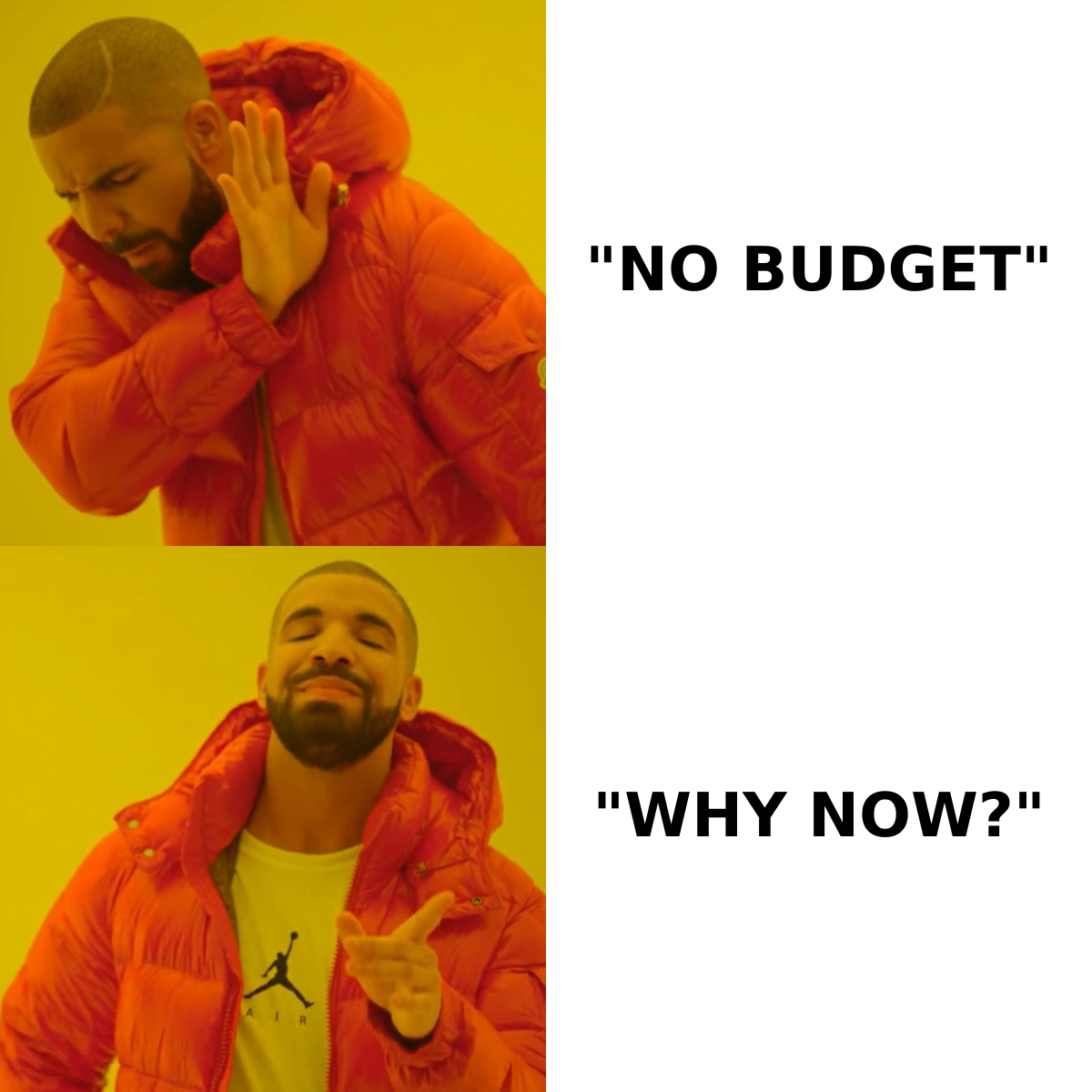
Objection: "We don't have budget this quarter."
"Understood — I'd rather not push against a hard wall. Two questions: when does the next budget cycle open, and if I could show a version that fits under the discretionary threshold, would that be worth twenty minutes?"
Why it works: It respects the condition while testing whether it is actually a condition. Roughly half the time, "no budget" is "no budget for something I'm not convinced about."
Note what none of these do: none discount on the spot. HubSpot's sales research has repeatedly found that reps who discount early train buyers to expect discounting on every renewal.
How do you handle "send me some information"?#
This is the single most common stall in B2B, and the standard response — sending the info — is the wrong one.
"Happy to. So I don't send you a fifteen-page deck you'll never open, what's the one thing you'd need to see to know whether this is worth a real conversation?"
If they can answer, you have a qualified next step. If they cannot answer, the request was a polite exit and you should say so gracefully: "Sounds like this isn't a priority right now — should I check back in the fall?" Naming the reality often gets you an honest yes or no, which is worth more than a document nobody reads.
A variant that works on inbound leads:
"I'll send it over today. Can I put fifteen minutes on the calendar for Thursday to go through the two slides that actually matter for a team your size? If it's not relevant by then, cancel it and I'll stop chasing."
The explicit permission to cancel dramatically increases acceptance. You are removing the fear of being trapped in a sales cycle.
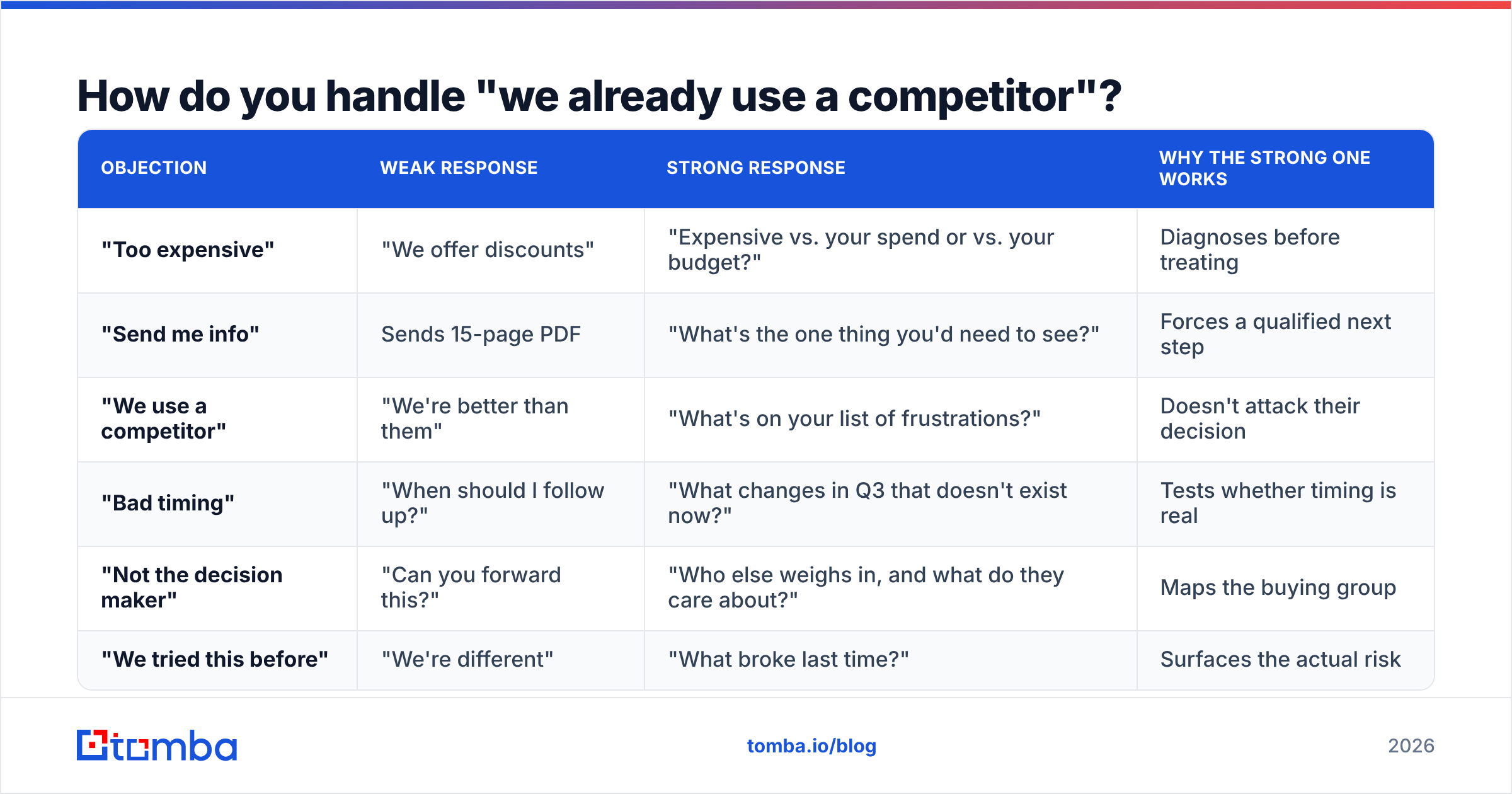
How do you handle "we already use a competitor"?#
Do not attack the incumbent. Attacking the incumbent attacks the decision of the person you are talking to, and people defend their own decisions harder than they defend vendors.
"Good — that means you've already solved the easy part. Most teams we talk to who use [incumbent] are happy with the core product and frustrated with one specific thing. Is there anything on your list, or is it genuinely working end to end?"
The phrasing "is there anything on your list" gives them permission to complain without disowning their choice. If the answer is genuinely "it works end to end," thank them and ask to be the backup vendor when the contract renews. That is a real position, and renewal windows are when incumbent satisfaction gets tested.
For displacement plays specifically, know the incumbent's weak spot before you dial. If you are selling against a tool with strong data coverage but weak verification, lead there. Buyers respect specificity; they tune out "we're better."
| Objection | Weak response | Strong response | Why the strong one works |
|---|---|---|---|
| "Too expensive" | "We offer discounts" | "Expensive vs. your spend or vs. your budget?" | Diagnoses before treating |
| "Send me info" | Sends 15-page PDF | "What's the one thing you'd need to see?" | Forces a qualified next step |
| "We use a competitor" | "We're better than them" | "What's on your list of frustrations?" | Doesn't attack their decision |
| "Bad timing" | "When should I follow up?" | "What changes in Q3 that doesn't exist now?" | Tests whether timing is real |
| "Not the decision maker" | "Can you forward this?" | "Who else weighs in, and what do they care about?" | Maps the buying group |
| "We tried this before" | "We're different" | "What broke last time?" | Surfaces the actual risk |
What are the best responses to timing and authority objections?#
"Now isn't a good time."
"That's usually true. What I've found is that 'not now' means one of two things — either there's something bigger on fire this quarter, or this isn't painful enough yet to displace anything. Which is closer?"
The binary choice does the work. Most people will pick one rather than deflect, and both answers are useful. "Something on fire" gives you a real date. "Not painful enough" tells you your discovery failed and you need to go back to problem-finding.
"I need to run it by my boss."
"Makes sense. When you take it to them, what's the first question they'll ask you? I'd rather help you answer it than have you guess."
This flips you from vendor to coach. It also reveals whether your contact is a champion or a gatekeeper. Champions will tell you the boss's objection. Gatekeepers will say "I don't know."
"We tried something like this two years ago and it didn't work."
"That's the most useful thing you could have told me. What specifically broke — was it the data quality, the adoption, or the integration?"
Failed prior implementations are objections with the highest close rate once addressed, because the buyer has already accepted the category. They just need proof this attempt fails differently.
How does bad data create objections that were never real?#
Half the objections your team hears are self-inflicted. You are pitching the wrong person, at the wrong company, from a list that was scraped eighteen months ago.
Consider what "we don't need this" actually means when your list is dirty:
- The contact left the company in 2024 and the new person has a different mandate.
- You reached a support address, not a decision maker.
- The company already churned out of your ICP after a pivot you never tracked.
- The email bounced, your sender reputation dropped, and the follow-ups you did land went to spam — so the "objection" was really invisibility.
None of that is an objection-handling problem. It is a data problem wearing an objection costume. Before you invest in another rebuttal training session, audit where your contacts come from. A verified list with accurate titles removes an entire category of fake objections from your day.
Practically: run your target accounts through a domain search to pull current employees and email patterns, verify every address with an email verifier before it enters a sequence, and enrich records with role and seniority so your rep knows whether they are talking to an evaluator or a signer. Vendor comparison sites like G2 are useful for auditing which tools your prospects already run, which changes how you frame the displacement conversation entirely.
How do you practise objection handling without burning live deals?#
Three drills, in order of value.
- Objection inventory. Have every rep list the objections they heard last month, verbatim. Cluster them. Most teams discover they face six distinct objections, not thirty. Write one response per cluster and get the whole team using it.
- Recorded role-play, not live role-play. Live role-play produces performance. Recorded role-play produces evidence. Have reps record two-minute responses to each of the six objections, then review the recordings as a group.
- Call-review tagging. Tag every recorded call with the objections that appeared and whether the deal advanced. After thirty calls you will see which responses correlate with progression and which correlate with polite exits.
Track the outcome, not the delivery. A smooth-sounding rebuttal that ends the conversation is worse than an awkward question that books a second call. Your response rate and meeting-set rate are the scoreboard, not how confident the rep sounded.
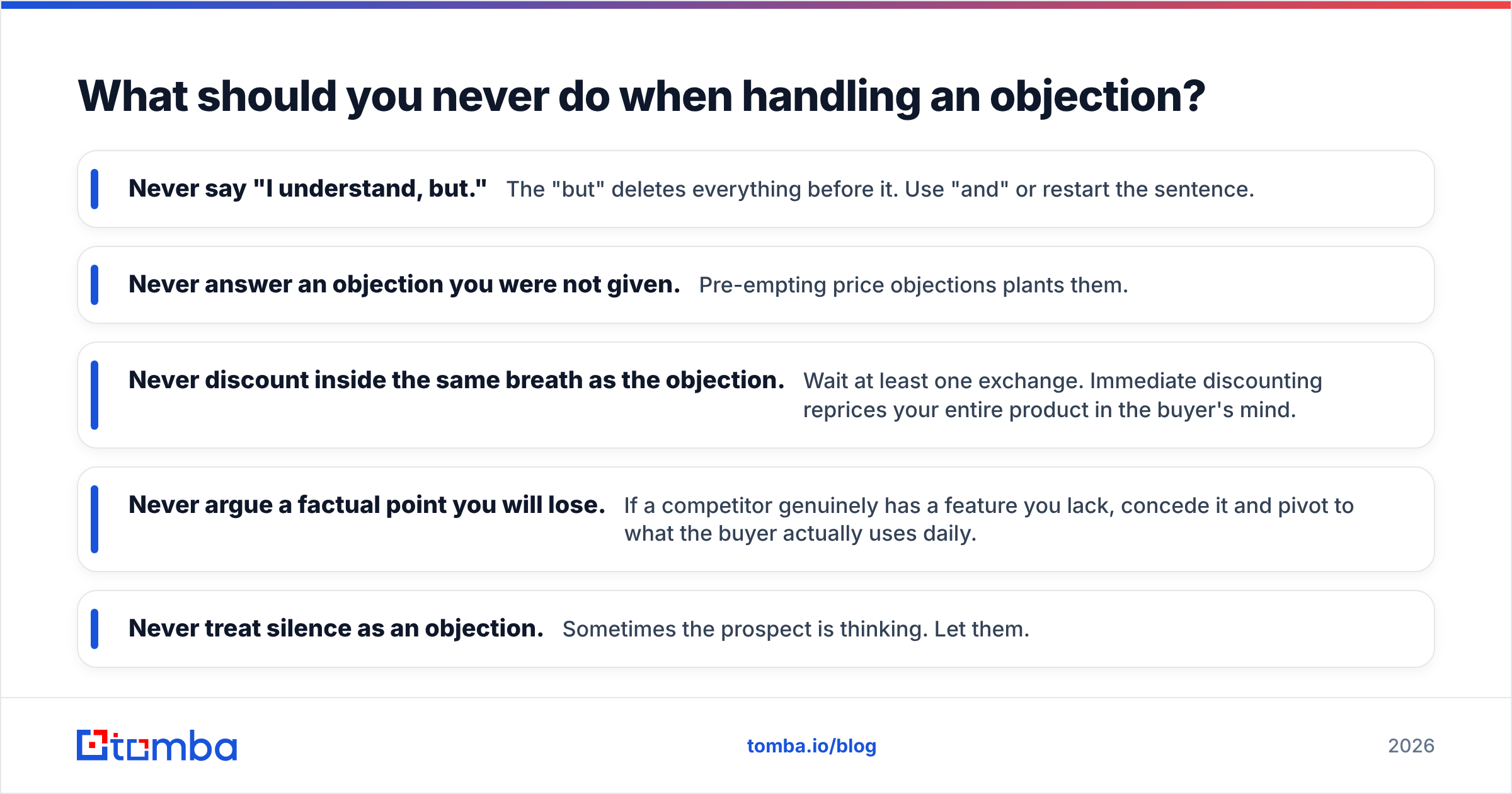
What should you never do when handling an objection?#
- Never say "I understand, but." The "but" deletes everything before it. Use "and" or restart the sentence.
- Never answer an objection you were not given. Pre-empting price objections plants them.
- Never discount inside the same breath as the objection. Wait at least one exchange. Immediate discounting reprices your entire product in the buyer's mind.
- Never argue a factual point you will lose. If a competitor genuinely has a feature you lack, concede it and pivot to what the buyer actually uses daily.
- Never treat silence as an objection. Sometimes the prospect is thinking. Let them.
One more: never take the first objection as the real one. The stated objection and the actual objection match maybe 40% of the time. The confirm step exists precisely to surface the gap.
Where should you start tomorrow?#
Pick the six objections your team hears most, write one clarifying question for each, and drill them for a week. That single change moves more pipeline than any script library.
Then fix the input. If your reps are handling objections from people who were never going to buy, you are optimising the wrong end of the funnel. Start with a clean, verified contact list built from current company data — Tomba's Email Finder pulls verified professional emails by name and domain, with a free tier at 25 searches a month and paid plans starting at $49/mo, so you can test the difference on a single target account list before committing. Check the full Tomba pricing if you want to run it across a whole team. Fewer bounces, fewer wrong contacts, and the objections you do hear will be the real ones worth handling.
Related guides#
// get started
Find, verify and enrich your first contacts today
Start on the free plan with 25 searches a month, then scale when your team is ready.
Free plan · No credit card required · GDPR & CCPA
Get the Tomba newsletter
Product and data updates
// about the author