How To Handle Price Objections in B2B Sales: 2026 Playbook
"Too expensive" almost never means the price. Here are seven tested scripts, a diagnostic framework, and the discovery habits that stop price objections from ever reaching your close.
TL;DR
- "Too expensive" is a label, not a reason. Diagnose which of the five real objections is hiding behind it before you respond with anything.
- Never answer a price objection with a price change. Every discount you give in the first 60 seconds trains the buyer to push harder in renewal negotiations.
- The highest-leverage fix happens 3 weeks earlier: quantified discovery. Reps who capture a dollar-value cost of inaction see roughly half as many late-stage price fights.
- Use the Pause → Clarify → Isolate → Reframe → Confirm loop. It works on all five objection types and takes under two minutes.
- If you must concede, trade — never give. Shorter term, annual prepay, case study, reference call, expanded seat count. Price moves only when something moves back.
What does "your price is too expensive" actually mean?#
It means almost nothing on its own. "Too expensive" is the socially acceptable phrase buyers reach for when the real reason is harder to say out loud — that they don't believe your numbers, that they don't have signing authority, that a competitor quoted lower, or that they were never going to buy this quarter.
Learning how to handle price objections starts with refusing to take the sentence at face value. When you respond to the surface words, you negotiate against yourself. When you respond to the underlying reason, you often don't have to negotiate at all.
There are five things a price objection usually is:
- No perceived value. The buyer understands the cost but not the return. This is a discovery failure, not a pricing failure — and it's the most common one.
- No budget right now. They want it. The money is committed elsewhere until Q3. This is a timing problem wearing a price costume.
- No authority. Your champion is repeating what their CFO said. The objection isn't in the room with you.
- Anchored to a cheaper competitor. They have a number in their head from a rival quote, a free tool, or the last vendor they used.
- Soft "no." They've decided against you and price is the exit that doesn't require an argument.
Each one needs a different response. Discounting works on exactly zero of them, because a discount answers a question nobody actually asked.
How do you diagnose which objection you're facing?#
Ask one question and shut up. The single most useful line in B2B sales is some version of:
"When you say it's more than you expected — what were you comparing it to?"
The answer sorts the buyer into a bucket almost immediately. "We were quoted $X by [competitor]" is an anchoring problem. "We only have $X left this year" is budget. "Finance said no" is authority. Silence followed by vagueness usually means soft no.
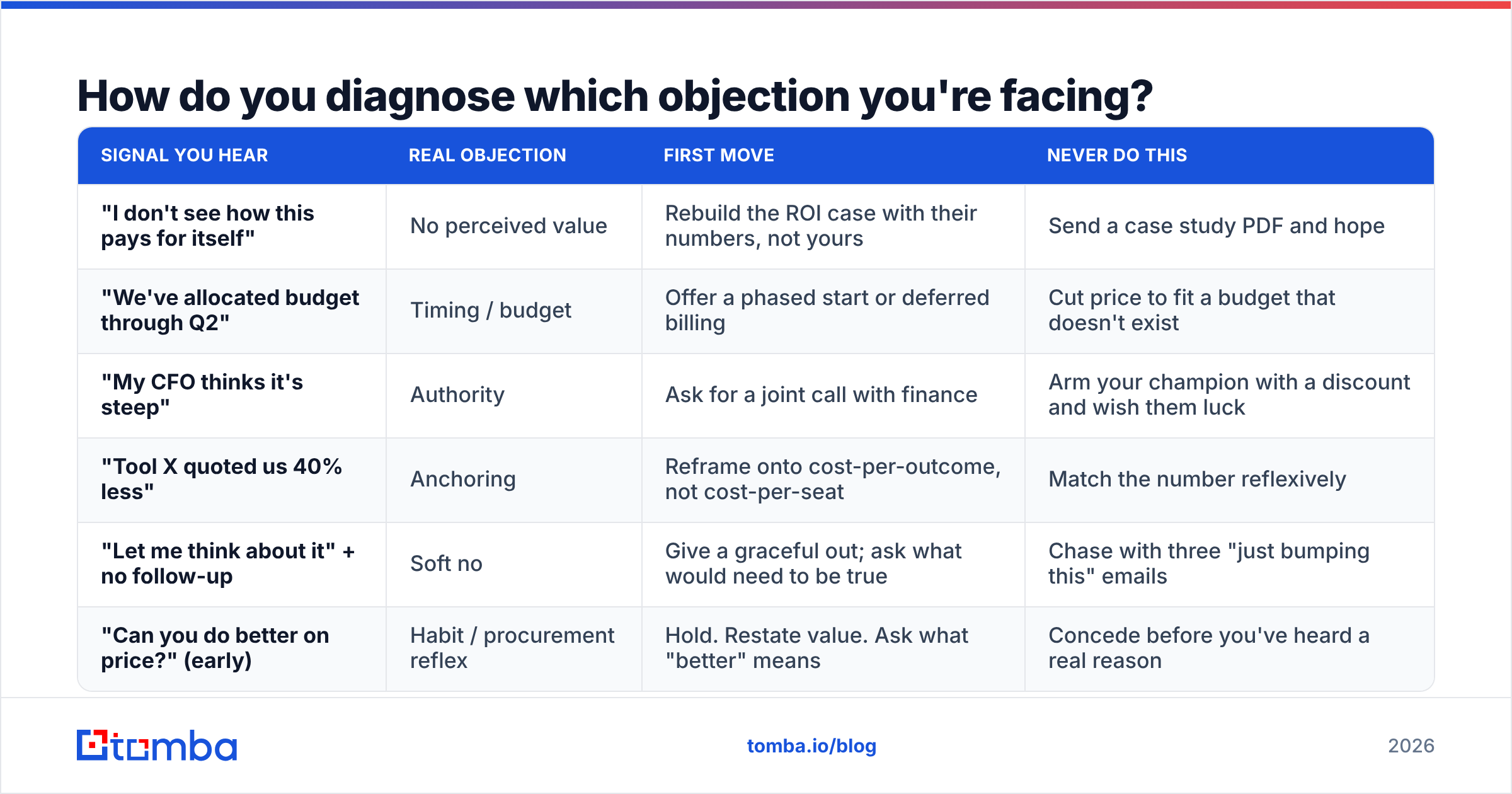
Here's the diagnostic map I'd hand a new rep on day one:
| Signal you hear | Real objection | First move | Never do this |
|---|---|---|---|
| "I don't see how this pays for itself" | No perceived value | Rebuild the ROI case with their numbers, not yours | Send a case study PDF and hope |
| "We've allocated budget through Q2" | Timing / budget | Offer a phased start or deferred billing | Cut price to fit a budget that doesn't exist |
| "My CFO thinks it's steep" | Authority | Ask for a joint call with finance | Arm your champion with a discount and wish them luck |
| "Tool X quoted us 40% less" | Anchoring | Reframe onto cost-per-outcome, not cost-per-seat | Match the number reflexively |
| "Let me think about it" + no follow-up | Soft no | Give a graceful out; ask what would need to be true | Chase with three "just bumping this" emails |
| "Can you do better on price?" (early) | Habit / procurement reflex | Hold. Restate value. Ask what "better" means | Concede before you've heard a real reason |
Notice the pattern: five of six correct first moves cost you nothing. Price is the last lever you touch, not the first.
What framework should you use in the moment?#
Use a loop, not a script. Scripts break when the buyer says something unexpected. A loop keeps working.
The five-step objection loop:
- Pause. Two full seconds of silence. It signals you're taking the objection seriously and it stops you blurting a concession out of discomfort. Most blown negotiations are lost in the first four seconds.
- Clarify. "Help me understand — expensive relative to what?" You are gathering the diagnosis from the table above.
- Isolate. "Setting the investment aside for a second — is there anything else standing between you and moving forward?" This is the most valuable question in the loop. If they name three more issues, price was never the blocker. If they say "no, just price," you now have a closable deal with one variable.
- Reframe. Convert the number into a unit the buyer already thinks in: cost per qualified meeting, cost per rep per day, cost of one bad quarter of pipeline. $99/month is abstract. $3.30 a day against a $40,000 rep-productivity gap is not.
- Confirm. "If we solved the budget timing, would you be ready to sign this month?" This gets you a commitment before you spend a concession.
Steps 3 and 5 are where most reps skip ahead, and they're the two that convert. Isolating tells you whether the deal is real; confirming makes sure any concession you make actually buys the close instead of buying another meeting.
What are the seven scripts that actually work?#
These are field-tested phrasings you can adapt. Say them out loud once before you use them — anything you can't say naturally will sound rehearsed.
1. The comparison unlock (no perceived value) "Totally fair. Can I ask what you're comparing it against — another vendor, your current process, or doing nothing? I want to make sure I'm answering the right question."
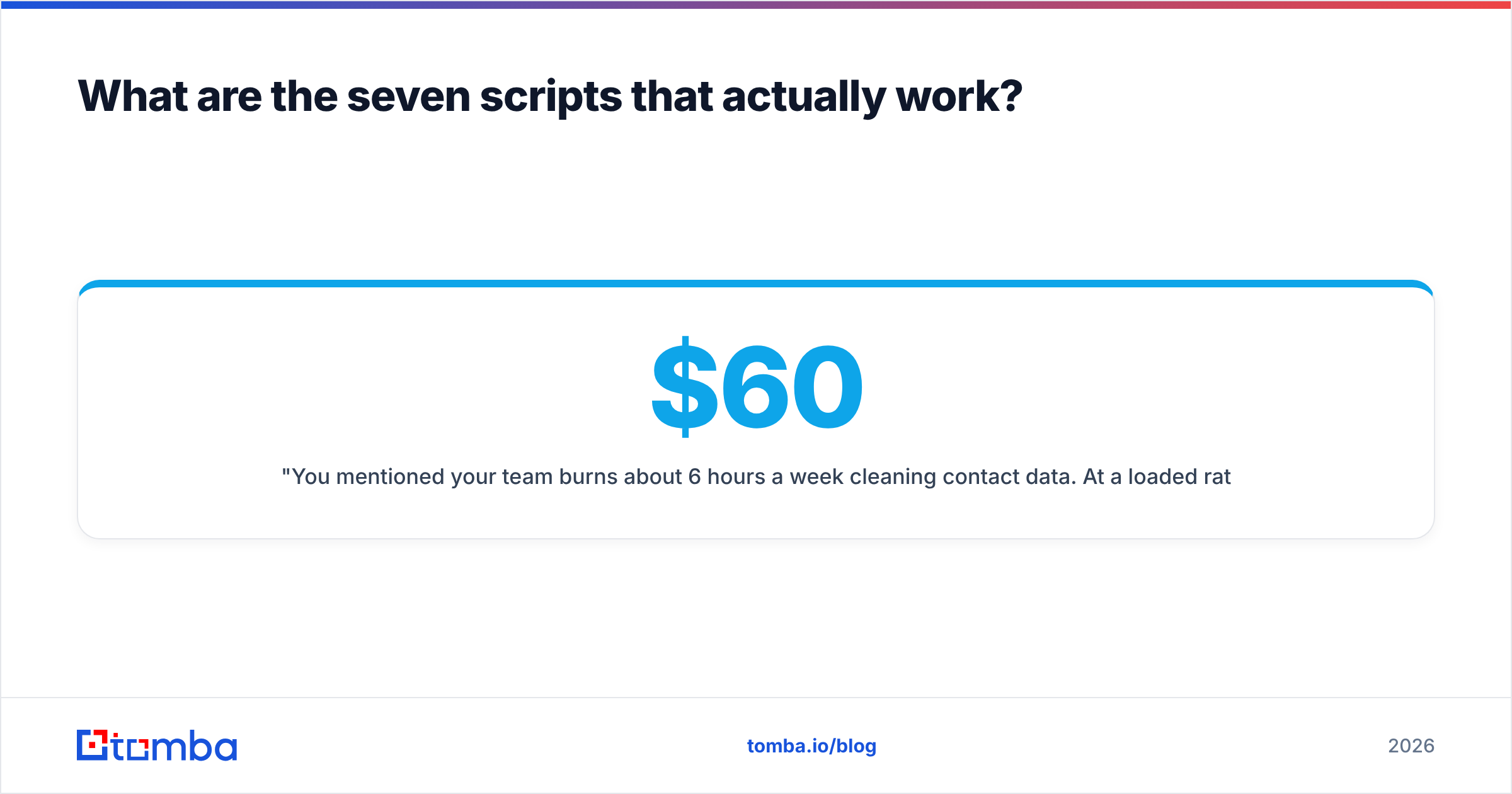
2. The cost-of-inaction flip (no perceived value) "You mentioned your team burns about 6 hours a week cleaning contact data. At a loaded rate of $60/hour across 8 reps, that's roughly $150,000 a year. The question isn't whether this costs $99 a month — it's whether it recovers even 2% of that."
3. The isolation close (any type) "If price weren't part of the conversation at all, would you be moving forward with us? … Good. Then let's solve for price, because everything else is settled."
4. The finance bridge (authority) "Your CFO is doing exactly what a good CFO does. Rather than me sending you numbers to defend on my behalf, can we get 20 minutes with them together? I'd rather answer the hard questions directly than have you take the arrows for me."
5. The anchor break (competitor pricing) "They're cheaper, and I'd expect them to be — we're solving different problems. If the only metric is cost per record, they win. If the metric is cost per verified record that doesn't bounce, our number is usually lower. Want me to run both on 200 of your actual contacts?"
6. The trade (real budget constraint) "I can get to that number. In exchange I'd need annual prepay instead of monthly, and a logo reference after 90 days. Does that work?"
7. The graceful out (soft no) "It sounds like this might not be a priority this quarter, and that's genuinely fine. Should I close the file and check back in six months, or is there a version of this that's worth exploring now?"
Script 7 feels counterintuitive and closes more deals than any of the others. Giving the buyer permission to say no removes the pressure that made them hide behind price in the first place — and a surprising number of them respond with the real objection.
How do you prevent price objections before they happen?#
Most price objections are created weeks earlier, by discovery that never quantified anything.
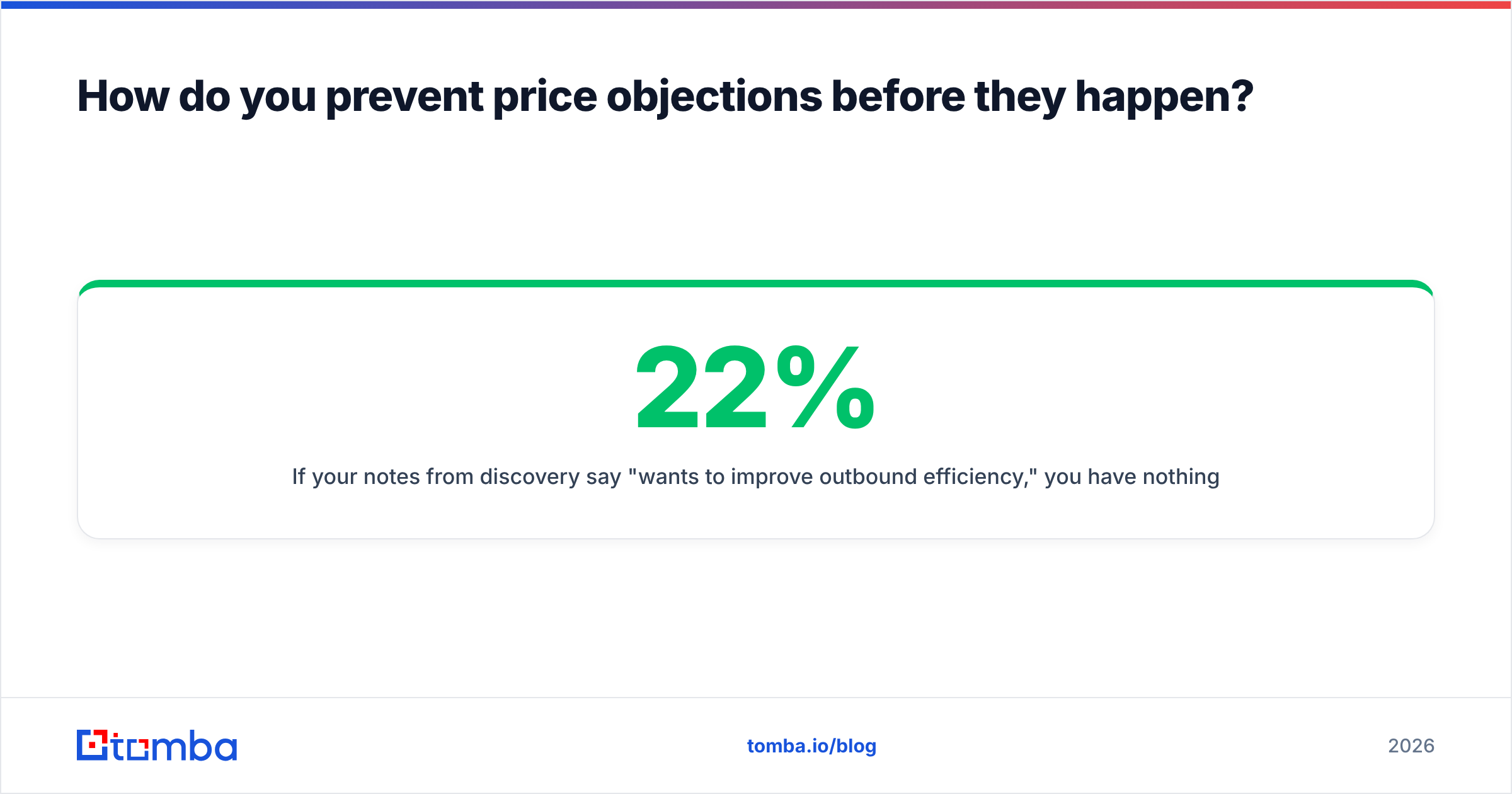
If your notes from discovery say "wants to improve outbound efficiency," you have nothing to defend a price with. If they say "3 SDRs, 22% bounce rate, 40% of prospecting time spent finding contacts, $310K fully loaded team cost," you have a math argument that survives contact with a CFO.
Four habits that eliminate late-stage price fights:
- Quantify the cost of inaction in discovery. Get a dollar figure the buyer says out loud. Buyers defend numbers they generated; they argue with numbers you generated.
- Surface budget early and bluntly. "Most teams solving this land between $X and $Y a year. Is that in the range you were expecting?" Asking on call one costs you nothing. Discovering it on call four costs you the quarter.
- Get the economic buyer in the room before the proposal. Every deal where your champion presents pricing on your behalf is a deal you're negotiating blind.
- Give price context, not just price. A number with no anchor gets compared to zero. A number next to the cost of the status quo gets compared to the alternative.
- Pre-empt the known competitor. If you always lose the anchor fight to one rival, address the delta before they do. Naming it first makes you credible; getting caught by it makes you defensive.
There's a data angle here too. A meaningful share of "we don't see the value" objections come from pilots that underperformed because the contact data was bad, not because the product was. If a prospect's trial fails on bounced sends, no script rescues the price conversation. Running a clean list through an email verifier before a pilot removes the most common cause of a disappointing proof of concept.

How do value-based, cost-plus, and competitor-anchored responses compare?#
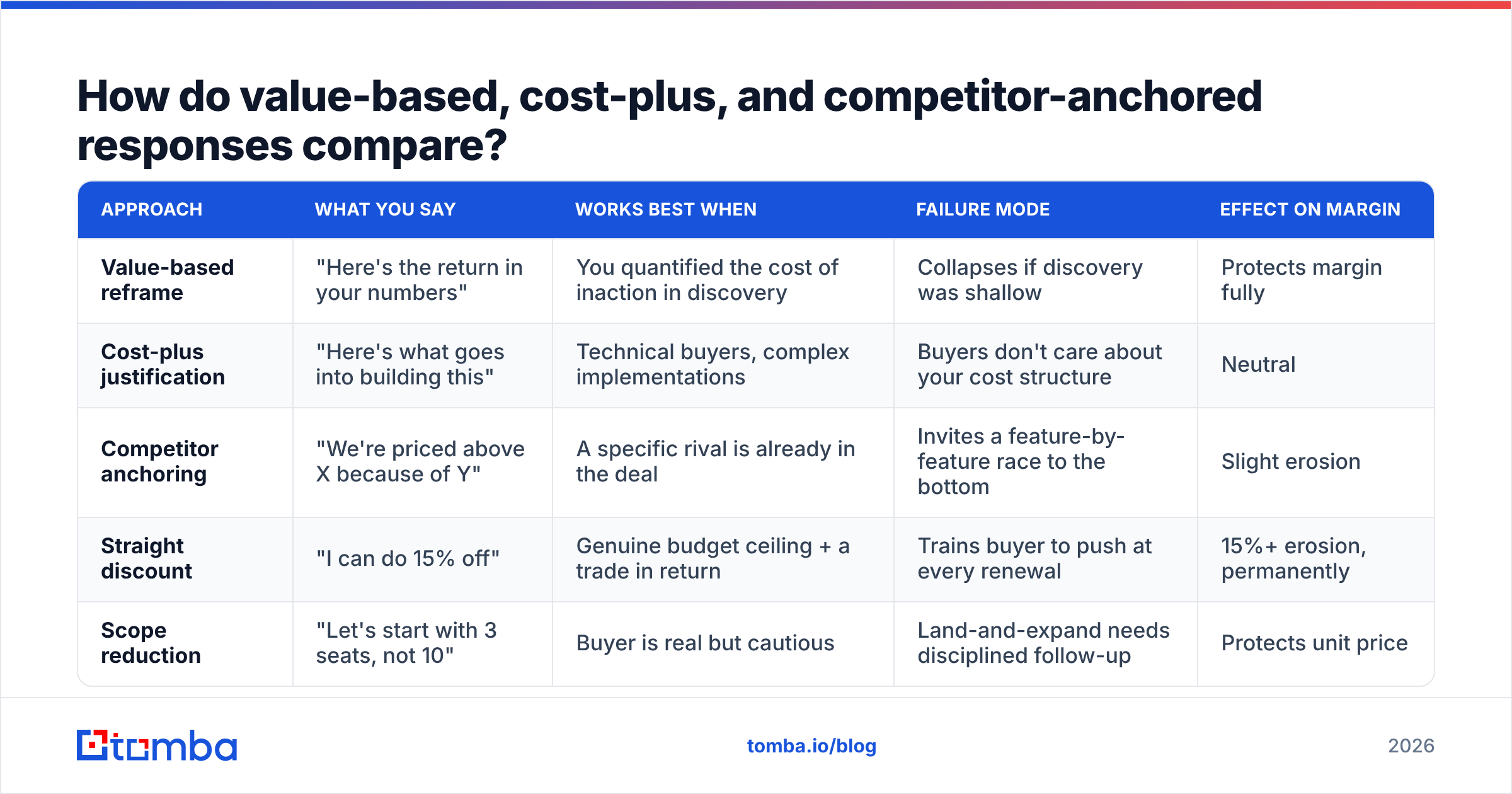
Not all price defenses are equal. Here's how the three common approaches actually perform in B2B deals:
| Approach | What you say | Works best when | Failure mode | Effect on margin |
|---|---|---|---|---|
| Value-based reframe | "Here's the return in your numbers" | You quantified the cost of inaction in discovery | Collapses if discovery was shallow | Protects margin fully |
| Cost-plus justification | "Here's what goes into building this" | Technical buyers, complex implementations | Buyers don't care about your cost structure | Neutral |
| Competitor anchoring | "We're priced above X because of Y" | A specific rival is already in the deal | Invites a feature-by-feature race to the bottom | Slight erosion |
| Straight discount | "I can do 15% off" | Genuine budget ceiling + a trade in return | Trains buyer to push at every renewal | 15%+ erosion, permanently |
| Scope reduction | "Let's start with 3 seats, not 10" | Buyer is real but cautious | Land-and-expand needs disciplined follow-up | Protects unit price |
The last row deserves more attention than it usually gets. Reducing scope keeps your per-unit price intact and gives the buyer a lower absolute number — you win on both axes. Discounting keeps the scope and destroys the price. Given a choice, shrink the deal before you shrink the rate.
HubSpot's sales research has consistently found that deals where reps discount early close at lower rates than deals where they hold price, which runs against intuition — a fast discount reads as an admission that the original number was fiction. Gartner's B2B buying research points at the same thing from the buyer's side: buyers describe purchases as difficult mainly because of information overload and internal consensus problems, not price.
How should you handle procurement versus your champion?#
They are two different conversations and blending them loses both.
Your champion needs ammunition: a one-page business case, the ROI math in their language, and answers to the three questions their CFO will ask. Send it in a format they can forward without editing.
Procurement needs structure: clear terms, defensible list pricing, and a reason your number isn't arbitrary. Procurement's job is to extract a concession — they will often ask for one purely to justify their involvement. Plan for this. Hold back one small, pre-approved concession (waived onboarding fee, an extra month, a training session) that you can "fight for" and deliver. It satisfies the mandate without touching your rate card.
Two rules that survive contact with any procurement team:
- Never discount without a trade. Term length, payment timing, reference rights, expanded seats, case study participation. Something crosses the table in both directions.
- Discount once, and mean it. If your second number moves, your third will too, and the buyer knows it. "This is my best number and here's why" only works if it's true.
For teams building the outbound motion feeding these deals, the same discipline applies upstream. Pipeline quality determines how much price pressure you feel: when you're prospecting into companies that genuinely fit, price objections drop because value is obvious. Targeted domain search into ICP accounts beats volume-blasting a purchased list every time — and it's why teams comparing Tomba pricing against per-seat data platforms usually find the credit-based model easier to defend internally.
What should you do in the 24 hours after a price objection?#
Don't send a revised quote. That's the reflex and it's wrong.
Send a recap that restates the problem in their words, the quantified cost of leaving it unsolved, and the specific outcome your solution produces. Then ask one question: "Is the gap the total number, or the timing of the spend?" Those two problems have completely different solutions — a phased start solves timing, and nothing but value solves the total.
If they go quiet for a week, use script 7. The graceful out re-opens more stalled deals than any follow-up sequence, because it costs the buyer nothing to answer honestly.
And log the objection. If 40% of your losses cite price, the problem is not your reps' rebuttals — it's your targeting, your discovery template, or your packaging. Objection data is revenue operations data. Treat it that way. G2's software buyer behavior reports are a useful external benchmark for whether your win/loss reasons look normal for your category.
The bottom line#
Handling price objections well is mostly about what you do before the objection appears. Quantified discovery, an economic buyer in the room, and honest budget conversations on call one prevent more price fights than any rebuttal script ever will. When one does surface, pause, diagnose which of the five objections you're actually facing, isolate it, and reframe into a unit the buyer already thinks in. Concede only in trade, only once, and only after you've confirmed the concession buys the close.
The upstream half of this — putting your reps in front of prospects who genuinely need what you sell — is a data problem. If your team is spending prospecting hours hunting contact details instead of running discovery calls that surface real numbers, that's the constraint to fix first. The Tomba Email Finder gets you verified contacts by name, company, or domain so your reps spend their time on conversations instead of lookups. Start on the free tier at 25 searches a month, or move to Starter at $49/month when the pipeline justifies it.
Related guides#
// get started
Find, verify and enrich your first contacts today
Start on the free plan with 25 searches a month, then scale when your team is ready.
Free plan · No credit card required · GDPR & CCPA
// about the author