How to Handle Rejection in Sales: A 2026 Field Guide
Rejection is 90% of outbound. Here's a repeatable system for reading the no, logging the reason, and turning dead deals into a pipeline that compounds instead of drains you.
TL;DR
- Rejection in sales is mostly a data problem wearing an emotional costume. Bad list, wrong timing, or wrong message produces most of the no's you take personally.
- Separate the three rejection types — no-response, soft no, and hard no — because each one gets a different next action, and only one of them deserves to be closed out.
- Build a rejection log. Every no with a reason code turns into targeting intelligence within a quarter.
- Set a rejection quota, not just a meeting quota. Reps who track "no's collected" burn out slower than reps who only track wins.
- Fix the input before you fix your mindset. Verified contact data and correct timing cut your rejection volume before any resilience training does.
Why does rejection hurt more in sales than in other jobs?#
Because in most jobs, feedback arrives quarterly. In sales, it arrives forty times a day, by name, in writing.
Think of it like a goalkeeper. A striker misses ten shots and is still called clinical if two go in. A goalkeeper who concedes twice hears about both. Sales reps process feedback at goalkeeper frequency with striker expectations, and nobody warns them about the mismatch on day one.
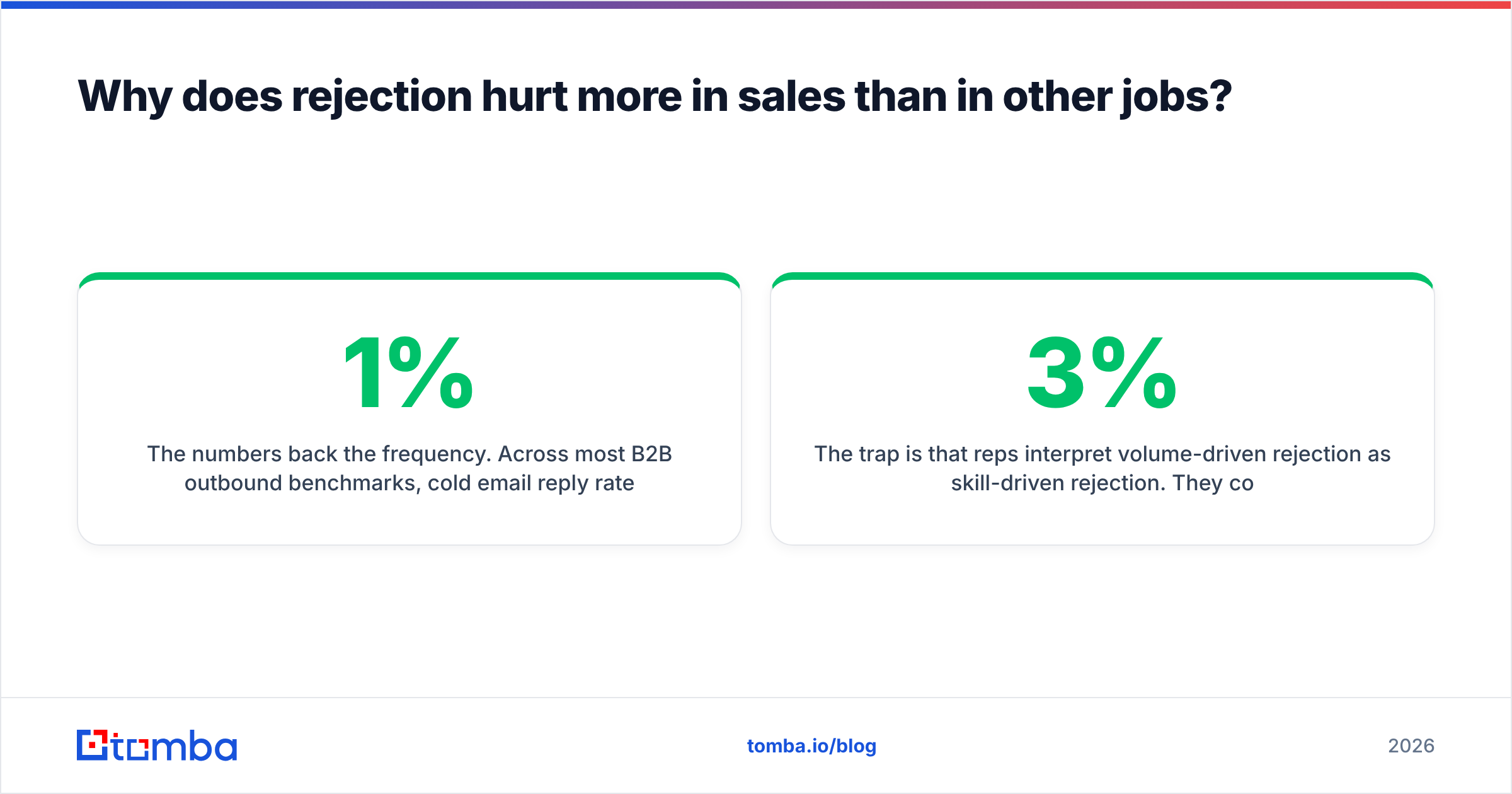
The numbers back the frequency. Across most B2B outbound benchmarks, cold email reply rates land between 1% and 5%, and positive replies are a fraction of that. That means a rep sending 50 emails a day is structurally guaranteed to be ignored 47 to 49 times before lunch. That is not failure. That is the arithmetic of the channel.
The trap is that reps interpret volume-driven rejection as skill-driven rejection. They conclude "I'm bad at this" when the honest reading is "this channel has a 3% response rate and I sent 50 emails." Those two conclusions lead to completely different behaviors — one makes you rewrite your opener for the ninth time, the other makes you look at your list quality.

Actually, use the placeholder:

What are the three types of sales rejection?#
Not all no's are the same object. Treating them as one bucket is why reps either give up too early or chase corpses for months.
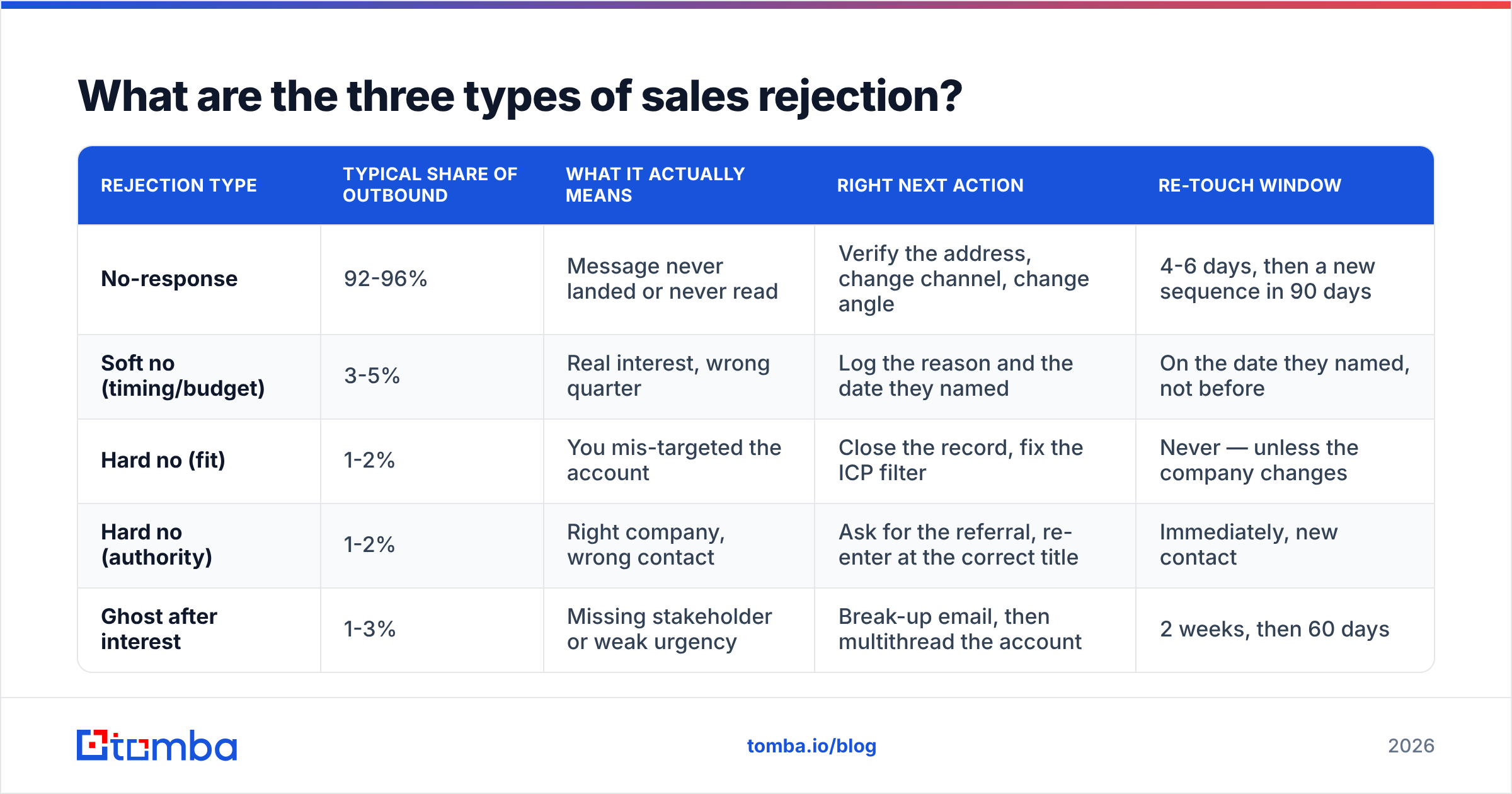
- No-response (silence). The prospect never engaged. This is the most common outcome and the least informative one. Silence is not rejection — it's an absence of data. It usually means wrong inbox, wrong timing, or a message that never got read.
- Soft no (timing or budget). "Not right now," "we just signed with someone," "circle back in Q3." This is a real signal with an expiry date. Roughly a third of soft no's convert on a second cycle if you actually return.
- Hard no (fit or authority). "We don't buy this category," "I'm not the right person," "remove me." This closes the current path. But a "wrong person" hard no is a routing opportunity, not a dead end.
- Ghost-after-interest. The prospect replied, took a call, then vanished. This is the most painful type and the most diagnosable — it almost always means you skipped a stakeholder or never established a compelling reason to change.
| Rejection type | Typical share of outbound | What it actually means | Right next action | Re-touch window |
|---|---|---|---|---|
| No-response | 92-96% | Message never landed or never read | Verify the address, change channel, change angle | 4-6 days, then a new sequence in 90 days |
| Soft no (timing/budget) | 3-5% | Real interest, wrong quarter | Log the reason and the date they named | On the date they named, not before |
| Hard no (fit) | 1-2% | You mis-targeted the account | Close the record, fix the ICP filter | Never — unless the company changes |
| Hard no (authority) | 1-2% | Right company, wrong contact | Ask for the referral, re-enter at the correct title | Immediately, new contact |
| Ghost after interest | 1-3% | Missing stakeholder or weak urgency | Break-up email, then multithread the account | 2 weeks, then 60 days |
The practical implication: only one row in that table deserves a permanent close. Most reps close all five.
How do you stop taking rejection personally?#
Change what you're measuring. That's the whole answer, and it's more mechanical than motivational.
Track activity you control, not outcomes you don't. You control emails sent, calls dialed, accounts researched, and message quality. You do not control whether a VP of Ops is mid-reorg the week you email her. Rep scorecards that weight only closed-won produce reps who read every no as a verdict on themselves.
Set a rejection quota. Some of the healthiest outbound teams give reps a target number of no's per week — say 100 — and treat hitting it as success. It sounds like a gimmick. It works because it inverts the emotional valence: the no is now progress toward a number instead of a subtraction from one.
Do a 60-second post-mortem, not a 60-minute one. After a rejection, ask three questions: Was this the right account? Was this the right person? Was this the right time? If the answer to all three is yes, the message was the variable. If any answer is no, your targeting was the variable — and no amount of grit fixes targeting.
Separate the person from the pipeline. The prospect is not rejecting you. They are rejecting a 40-word interruption from a stranger about a category they may not have budget for. That is an extremely reasonable thing to reject.
The research on this is unglamorous but consistent. HubSpot's sales statistics research has repeatedly found that a large share of reps stop following up after one or two attempts, while most closed deals require five or more touches. The gap between those two numbers is where quota lives — and it's a gap made almost entirely of reps who took an early no as final.
Can better data reduce how much rejection you get?#
Yes, and this is the part most "handling rejection" advice skips entirely.
Here's the uncomfortable math. If 30% of your list has stale, guessed, or catch-all email addresses, then roughly a third of your no-response rejections were never rejections at all. Nobody said no. Nobody saw the message. You absorbed the emotional cost of a rejection that never happened.
Three input fixes cut rejection volume before any mindset work:
- Verify before you send. Running your list through an email verifier removes bounces and unknowns that would otherwise register as silence. It also protects your sender reputation, which quietly determines whether your good emails land at all.
- Target by pattern, not by guess. Guessing
first.last@for a company that usesflast@produces a bounce, not a rejection. A domain search tells you the real pattern in seconds. - Reach the right title first. An authority-based hard no ("I'm not the right person") is a self-inflicted wound. Enriching contacts with role and seniority data before the first touch removes most of them.

There's a second-order effect worth naming. Reps who work clean lists get more replies, which means their emotional baseline is higher, which means they follow up more, which produces more replies. Reps on dirty lists spiral the other way. Data quality is a resilience intervention disguised as an ops task.
What should you actually say when someone rejects you?#
Short answer: acknowledge, ask one question, then leave cleanly. Never argue.
To a soft no ("not right now"):
"Understood — sounds like this isn't the quarter for it. Two things: what would need to be true for this to be worth a look, and when should I check back? I'll set a reminder and stay out of your inbox until then."
That does three jobs. It respects the no, it extracts a qualification criterion, and it earns a dated permission to return.
To an authority no ("I'm not the right person"):
"Appreciate you saying so rather than ignoring me. Who owns [specific problem] on your side? Happy to go direct and leave you out of it."
Referral rates on this phrasing are meaningfully higher than on a generic "who should I speak to?" because it names the problem, not the product.
To a ghost:
"I'll assume the timing didn't work and close this out on my end. If that's wrong, one line and I'll pick it back up."
The break-up email remains one of the highest-reply messages in outbound, precisely because it removes the pressure and gives the prospect a graceful exit — which many of them decline to take.
To a hard no ("remove me"): Remove them. Immediately, permanently, no last pitch. Anything else is a deliverability liability and a brand liability. Suppression list, done.
What you never do: "Just curious what made you say no?" as an opener to re-pitch. Prospects recognize the maneuver, and it converts a neutral no into a hostile one.
How do you build a rejection log that improves targeting?#
This is the highest-ROI habit in outbound and almost nobody does it, because it feels like documenting your own failures.
Reframe it: you're not logging losses, you're building an ICP dataset that your competitors don't have.
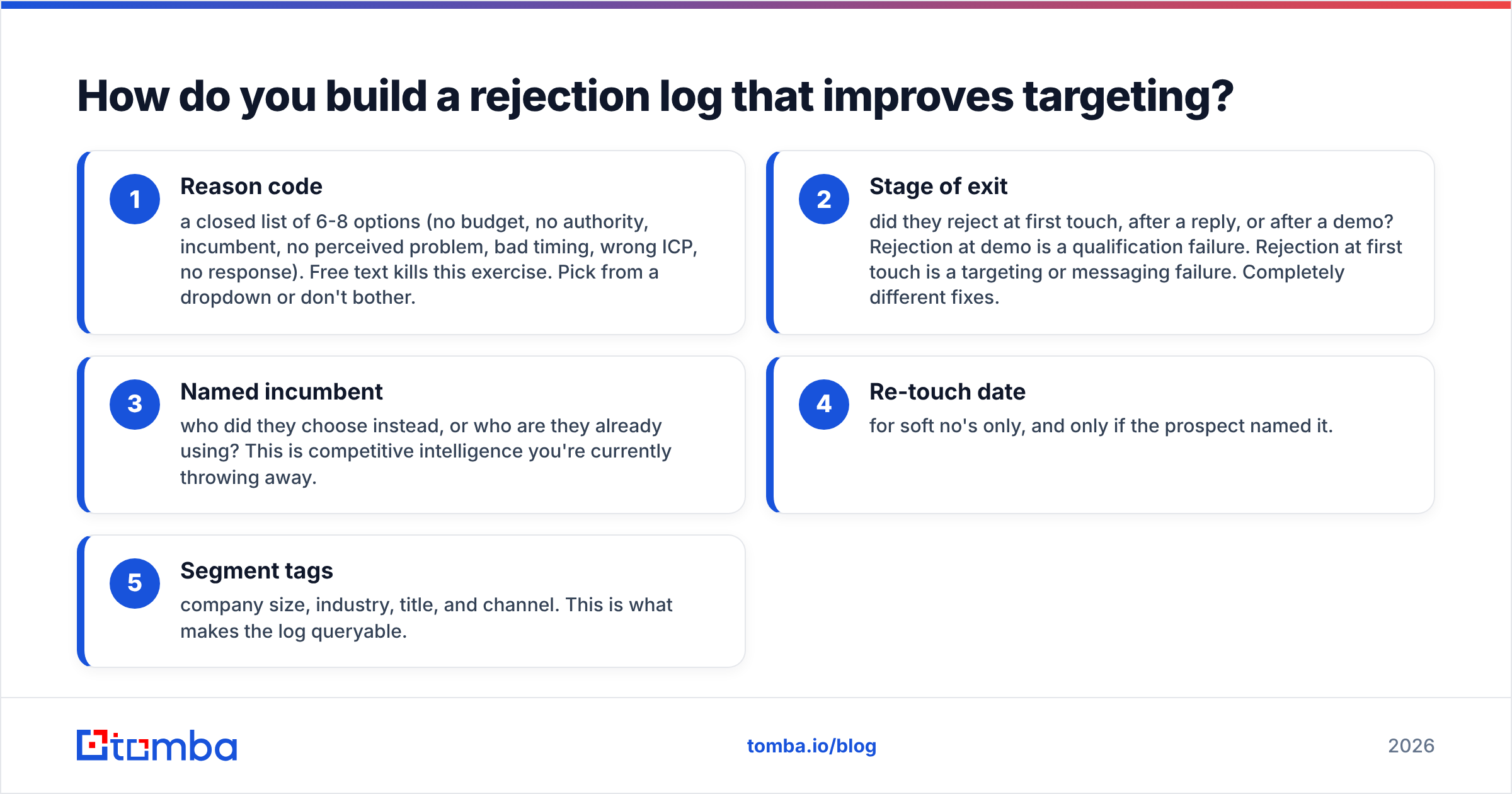
The five fields that matter:
- Reason code — a closed list of 6-8 options (no budget, no authority, incumbent, no perceived problem, bad timing, wrong ICP, no response). Free text kills this exercise. Pick from a dropdown or don't bother.
- Stage of exit — did they reject at first touch, after a reply, or after a demo? Rejection at demo is a qualification failure. Rejection at first touch is a targeting or messaging failure. Completely different fixes.
- Named incumbent — who did they choose instead, or who are they already using? This is competitive intelligence you're currently throwing away.
- Re-touch date — for soft no's only, and only if the prospect named it.
- Segment tags — company size, industry, title, and channel. This is what makes the log queryable.
After 90 days, run one query: which segment has the worst hard-no rate? That segment shouldn't be in your sequences. Most teams discover they've been spending 20-30% of outbound effort on a segment that structurally never buys — and no amount of rejection-resilience coaching would have surfaced that. Only the log does.
Store it wherever your team actually lives. If you use HubSpot or Pipedrive, a custom "loss reason" property on the deal record is enough. The tool matters far less than the discipline of a closed reason list. If you're pushing enriched contact records into your CRM already, the reason code belongs on the same object.
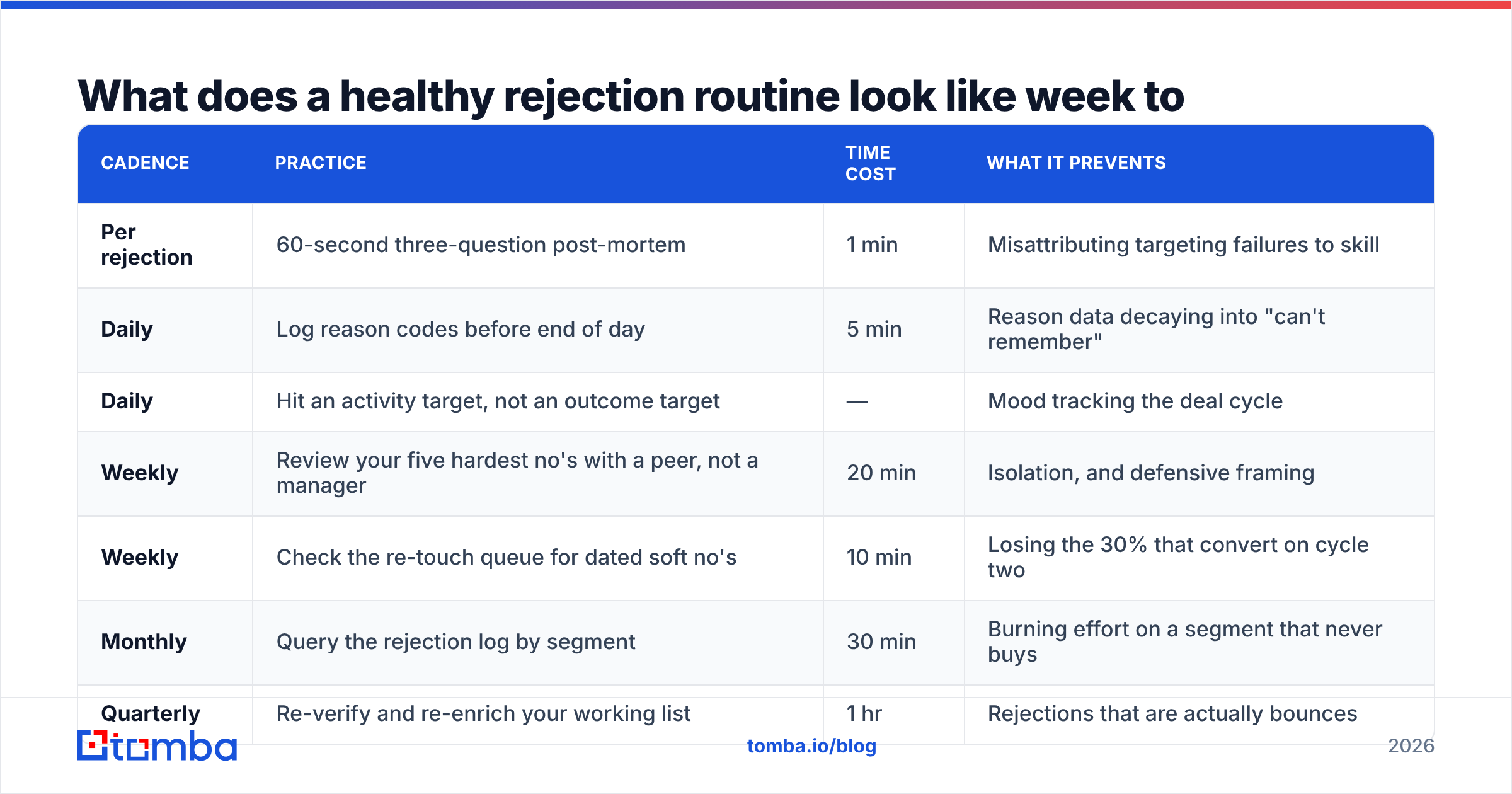
What does a healthy rejection routine look like week to week?#
| Cadence | Practice | Time cost | What it prevents |
|---|---|---|---|
| Per rejection | 60-second three-question post-mortem | 1 min | Misattributing targeting failures to skill |
| Daily | Log reason codes before end of day | 5 min | Reason data decaying into "can't remember" |
| Daily | Hit an activity target, not an outcome target | — | Mood tracking the deal cycle |
| Weekly | Review your five hardest no's with a peer, not a manager | 20 min | Isolation, and defensive framing |
| Weekly | Check the re-touch queue for dated soft no's | 10 min | Losing the 30% that convert on cycle two |
| Monthly | Query the rejection log by segment | 30 min | Burning effort on a segment that never buys |
| Quarterly | Re-verify and re-enrich your working list | 1 hr | Rejections that are actually bounces |
Two notes on the weekly peer review. Do it with a peer rather than a manager — the goal is honest diagnosis, and honest diagnosis dies when the listener also writes your performance review. And review the hardest five, not the most recent five; recency bias will hand you five silences that teach you nothing.
On the quarterly re-verification: B2B contact data decays fast. Industry estimates put annual B2B database decay somewhere in the 25-30% range as people change roles, companies get acquired, and email formats change. A list that was clean in January is measurably rotten by July. Running a periodic pass with a bulk email finder or a re-verification job is cheaper than the pipeline you lose to silent bounces.
When is rejection actually a signal to change strategy?#
Not on any single no. But there are four patterns where the rejection is telling you something structural, and pushing harder is the wrong response.
- Same objection, 10+ times, same segment. That's not an objection — that's a positioning problem. Your message is describing a problem this segment doesn't have.
- High reply rate, near-zero meeting rate. People are engaging and still saying no. Your value proposition survives the subject line but not the pitch. Fix the offer, not the volume.
- Meetings that go well, then ghost. You're single-threading. The person you charmed can't buy alone, and the person who can buy never heard your case.
- Reply rate falling week over week on an unchanged sequence. That's usually deliverability, not messaging. Check your domain reputation and email deliverability before rewriting a single line of copy.
The general rule: rejection at scale is diagnostic, rejection in isolation is noise. One no tells you nothing. Fifty no's with reason codes tell you exactly what to change. Vendor-neutral review sites like G2's sales engagement category are useful for sanity-checking whether an objection is you or the category — if every review of your space mentions the same buyer hesitation, it's the category.
How do sales managers reduce team-wide rejection burnout?#
Managers own three levers, and most only pull the third.
Lever one: input quality. If your reps are working a list nobody verified, you are manufacturing rejection and then coaching them on how to feel about it. Buy clean data or build a verification step. This is a budget decision that presents as a morale problem.
Lever two: scorecard design. What you measure determines what rejection means. A scorecard weighted entirely to closed-won makes every no a personal loss. A scorecard that also counts qualified conversations, accounts researched, and reason codes logged makes a no a completed unit of work. Same rep, same day, radically different psychology.
Lever three: normalization. Share the no's out loud. Teams where the manager opens the weekly meeting with their own worst rejection have measurably lower rep turnover than teams where only wins get airtime. Rejection kept private compounds into shame; rejection said out loud compounds into pattern recognition.
One anti-pattern to kill: the "just be more resilient" conversation with a rep whose list is 40% invalid. That conversation tells the rep their emotional response is the defect, when the defect is upstream and yours. Check the data before you check the mindset — every time.
Where should you start this week?#
Pick two things, not seven.
If your reply rate is under 2%, start with input quality — verify the list and confirm email patterns before touching your copy. If your reply rate is healthy but meetings aren't converting, start with the rejection log and find out which reason code dominates. If you're personally burned out, start with the activity-based scorecard and the peer review; those two change how the same day feels.
The through-line across all of it: rejection stops being an emotional event when it becomes a logged one. A no with a reason code and a date is a row in a dataset. A no with nothing attached is just a bad afternoon.
Most of the rejection reduction available to you is upstream of the conversation. If you want fewer no's that were never really no's, start by making sure your messages reach real, current, verified inboxes — Tomba's Email Finder surfaces verified professional addresses by name and domain so your outreach lands with the right person the first time. The free tier gives you 25 searches a month to test your list quality, and paid plans start at $49/mo; see Tomba pricing for the full breakdown. Clean the input, log the output, and let the pattern do the coaching.
Related guides#
Ready to find emails that actually work?
Join 150,000+ professionals who stopped guessing and started sending. Free credits on signup — no credit card required.
Get the Tomba newsletter
Practical outbound tactics and product updates — once every two weeks.
About the author