How to Implement MEDDIC: A Step-by-Step Guide for 2026
MEDDIC fails in most teams because it gets rolled out as a CRM field, not a deal-inspection habit. Here is the 30-day rollout that actually sticks, with the checkpoints, the metrics, and the traps.
TL;DR
- MEDDIC is a qualification checklist, not a sales methodology. It tells you whether a deal is real; it does not tell you how to run the call.
- Most rollouts fail for one reason: teams add six CRM fields, no one defines what "good" looks like per field, and reps fill them with guesses to clear the required-field warning.
- A workable rollout takes about 30 days: define the criteria, pilot on 10 live deals, wire it into your CRM and forecast call, then enforce it at stage gates.
- The Economic Buyer is where 80% of rollouts break. If your reps cannot name, reach, and quote that person, the rest of the letters are theater.
- Measure the rollout with slippage rate, no-decision rate, and stage-2-to-close conversion — not with "% of fields completed".
What is MEDDIC, and why do most rollouts fail?#
MEDDIC is a six-point qualification checklist built at PTC in the 1990s to answer one question on every enterprise deal: is this real, and do we know how it closes? The letters stand for Metrics, Economic Buyer, Decision Criteria, Decision Process, Identify Pain, and Champion.
Think of it like a pre-flight checklist. A pilot does not skip the fuel check because the plane looked fine on the tarmac. MEDDIC does the same job for a forecast — it forces a rep to prove, with evidence, that a deal has a buyer with budget authority, a documented reason to act, and a path through procurement.
The failure pattern is consistent, and it has nothing to do with the framework. Teams treat implementation as a CRM configuration task. Six new picklists go live on a Monday, reps get a 45-minute enablement session, and by Friday the fields are full of text like "CFO probably" and "cost savings". You now have worse data than before, because the fields look authoritative.
Two things separate teams where MEDDIC sticks from teams where it dies in a quarter:
- Evidence over opinion. A field is only filled when the rep can point to a call recording, an email, or a document. "The champion is Sara" is an opinion. "Sara sent us the internal business case draft on March 4" is evidence.
- Inspection, not compliance. Managers inspect two or three letters per deal review and ask for the proof. If nobody ever asks, nobody ever fills it honestly.
Everything below assumes you agree with those two rules. If you do not, save yourself the effort and skip the rollout.
What does each letter actually require?#
Here is the operational version — what a rep must be able to produce, not the textbook definition.
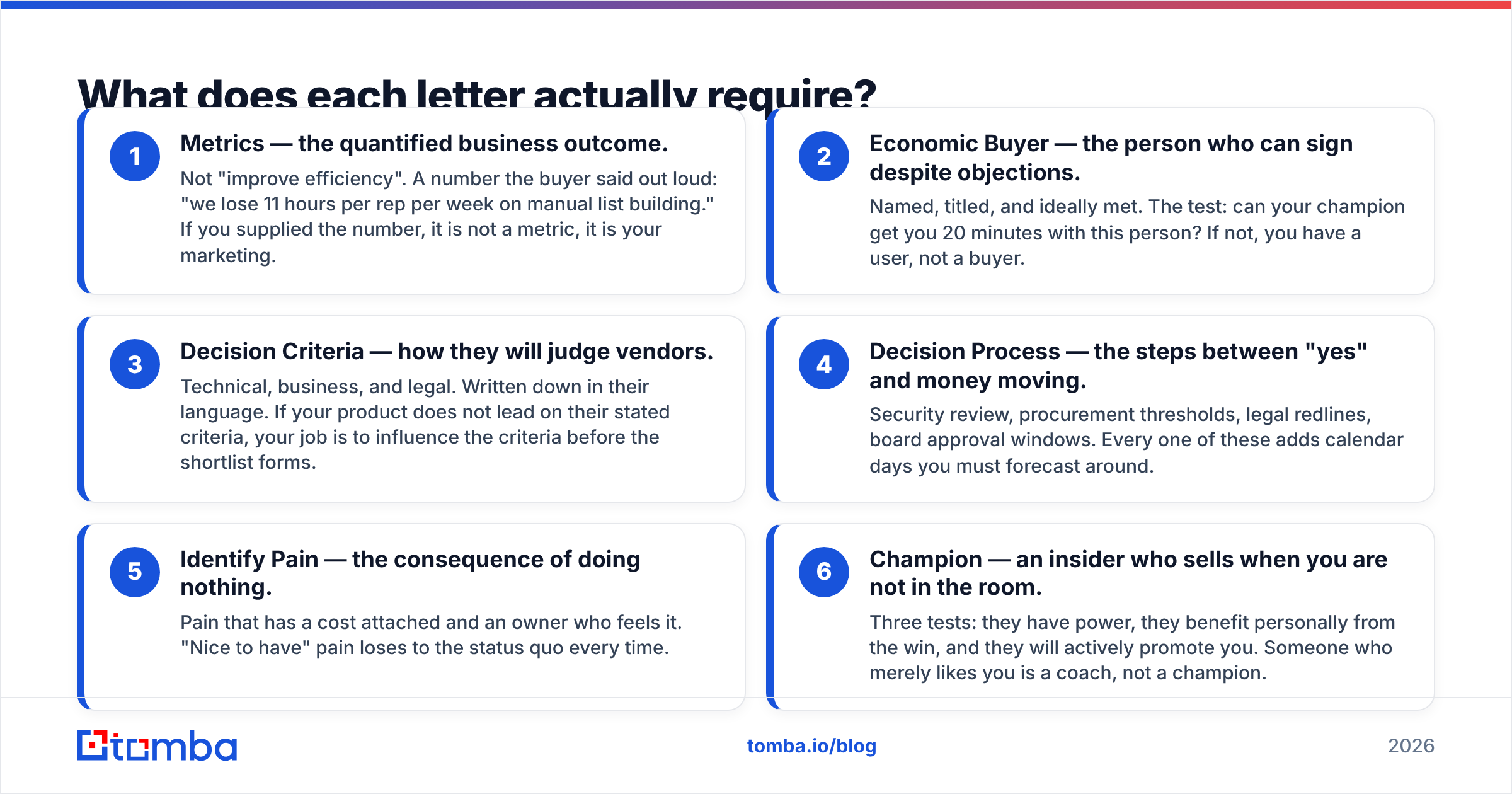
- Metrics — the quantified business outcome. Not "improve efficiency". A number the buyer said out loud: "we lose 11 hours per rep per week on manual list building." If you supplied the number, it is not a metric, it is your marketing.
- Economic Buyer — the person who can sign despite objections. Named, titled, and ideally met. The test: can your champion get you 20 minutes with this person? If not, you have a user, not a buyer.
- Decision Criteria — how they will judge vendors. Technical, business, and legal. Written down in their language. If your product does not lead on their stated criteria, your job is to influence the criteria before the shortlist forms.
- Decision Process — the steps between "yes" and money moving. Security review, procurement thresholds, legal redlines, board approval windows. Every one of these adds calendar days you must forecast around.
- Identify Pain — the consequence of doing nothing. Pain that has a cost attached and an owner who feels it. "Nice to have" pain loses to the status quo every time.
- Champion — an insider who sells when you are not in the room. Three tests: they have power, they benefit personally from the win, and they will actively promote you. Someone who merely likes you is a coach, not a champion.
MEDDIC vs MEDDPICC vs BANT: which one should you implement?#
Pick one and stay with it for at least two quarters. Switching frameworks mid-rollout resets every habit you built.
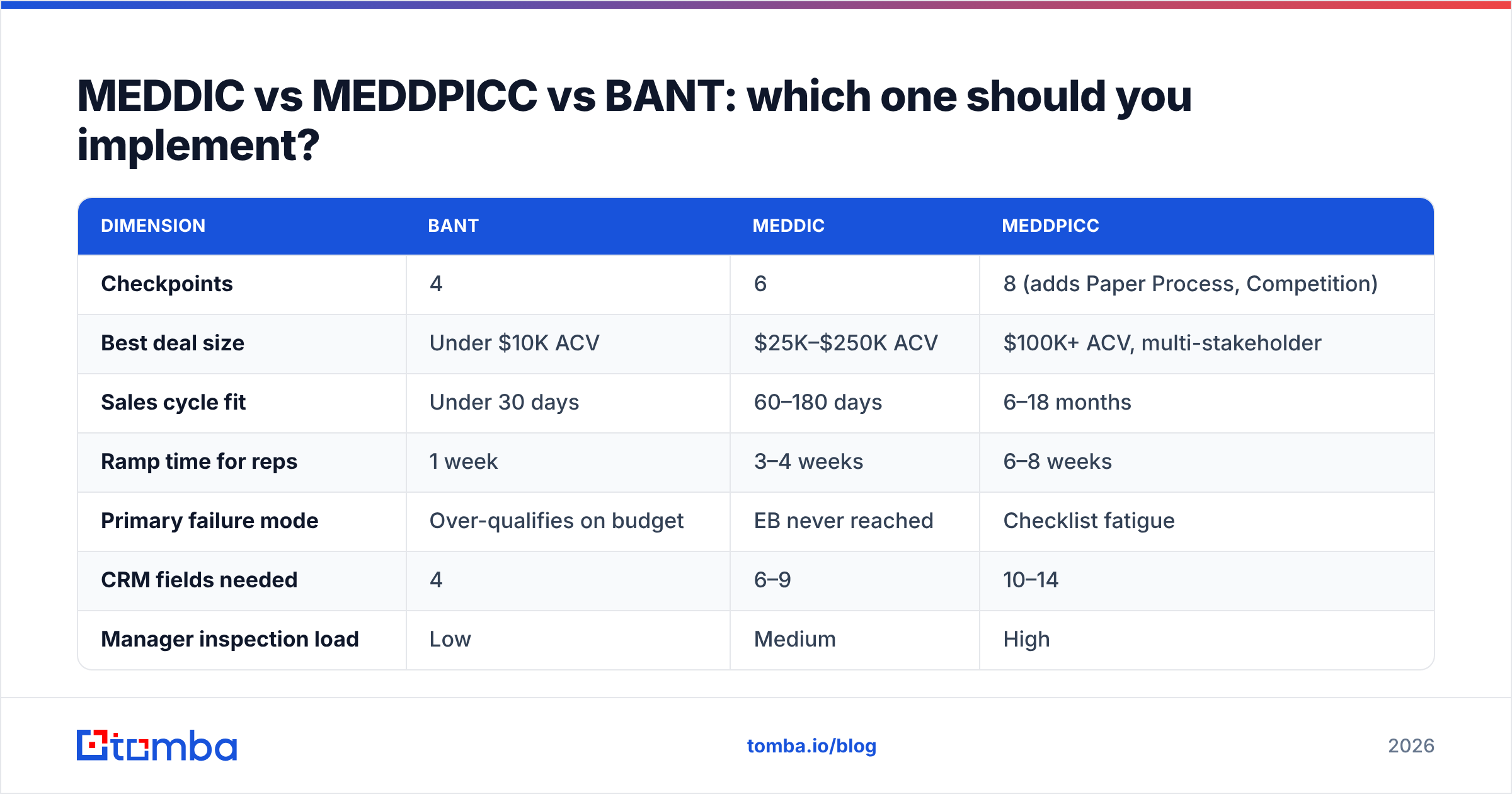
| Dimension | BANT | MEDDIC | MEDDPICC |
|---|---|---|---|
| Checkpoints | 4 | 6 | 8 (adds Paper Process, Competition) |
| Best deal size | Under $10K ACV | $25K–$250K ACV | $100K+ ACV, multi-stakeholder |
| Sales cycle fit | Under 30 days | 60–180 days | 6–18 months |
| Ramp time for reps | 1 week | 3–4 weeks | 6–8 weeks |
| Primary failure mode | Over-qualifies on budget | EB never reached | Checklist fatigue |
| CRM fields needed | 4 | 6–9 | 10–14 |
| Manager inspection load | Low | Medium | High |
If your average deal closes in under a month with a single decision-maker, MEDDIC is overhead. If your deals involve a security review and a procurement team, MEDDIC is the floor and MEDDPICC is the ceiling. Most B2B SaaS teams selling between $30K and $200K land on plain MEDDIC and add Paper Process later, once reps have stopped resenting the checklist.
For background on how qualification frameworks map to broader enterprise buying behavior, Gartner's sales research is worth reading before you commit, and MEDDICC publishes the canonical definitions from the practitioners who commercialized the model.
How do you implement MEDDIC in 30 days?#
The rollout order matters more than the content. Define, pilot, wire, enforce.
Week 1 — Define what "good" means, in writing.
Take your last 10 closed-won and 10 closed-lost deals. For each letter, write the specific answer that was true in the wins and missing in the losses. This produces your definitions — not a generic template. Output: a one-page rubric with a filled example per letter, drawn from a real account your reps recognize.
Also decide your evidence standard now. A common one: every letter needs a linked artifact in the CRM (call recording timestamp, forwarded email, uploaded document) or it counts as blank.
Week 2 — Pilot on live deals with three reps.
Pick three reps — one top performer, one mid, one new — and score their open pipeline against the rubric. Do it together, live, one deal at a time. You are looking for disagreements: where two people score the same deal differently, your definition is ambiguous. Fix the rubric, not the rep.
Expect an uncomfortable result. Teams routinely find that 40–60% of "commit" pipeline has no confirmed Economic Buyer. That number is the business case for the rollout — bring it to your leadership meeting.
Week 3 — Wire it into the CRM and the forecast call.
Now, and only now, build the fields. Six fields, each with a help text that quotes the rubric. Add a computed qualification score if your CRM supports formula fields — a simple count of letters with evidence attached works fine.
Two configuration decisions that determine whether this survives:
- Do not make fields required at deal creation. Require them at stage gates instead: Metrics and Pain to enter Stage 2, Economic Buyer and Champion to enter Stage 3, Decision Process and Criteria to enter Stage 4.
- Put the score on the forecast view. If the number is not visible in the weekly pipeline review, it does not exist.
Week 4 — Enforce at the stage gate and inspect in reviews.
Change the deal review script. Instead of "walk me through the account", ask two letter-specific questions per deal: "who is the Economic Buyer and what did they say the cost of inaction is?" and "what is the next step in their paper process?" Managers must ask for the artifact. Three weeks of that and reps start collecting evidence proactively, because they know it is coming.

What CRM fields and stage gates should you build?#
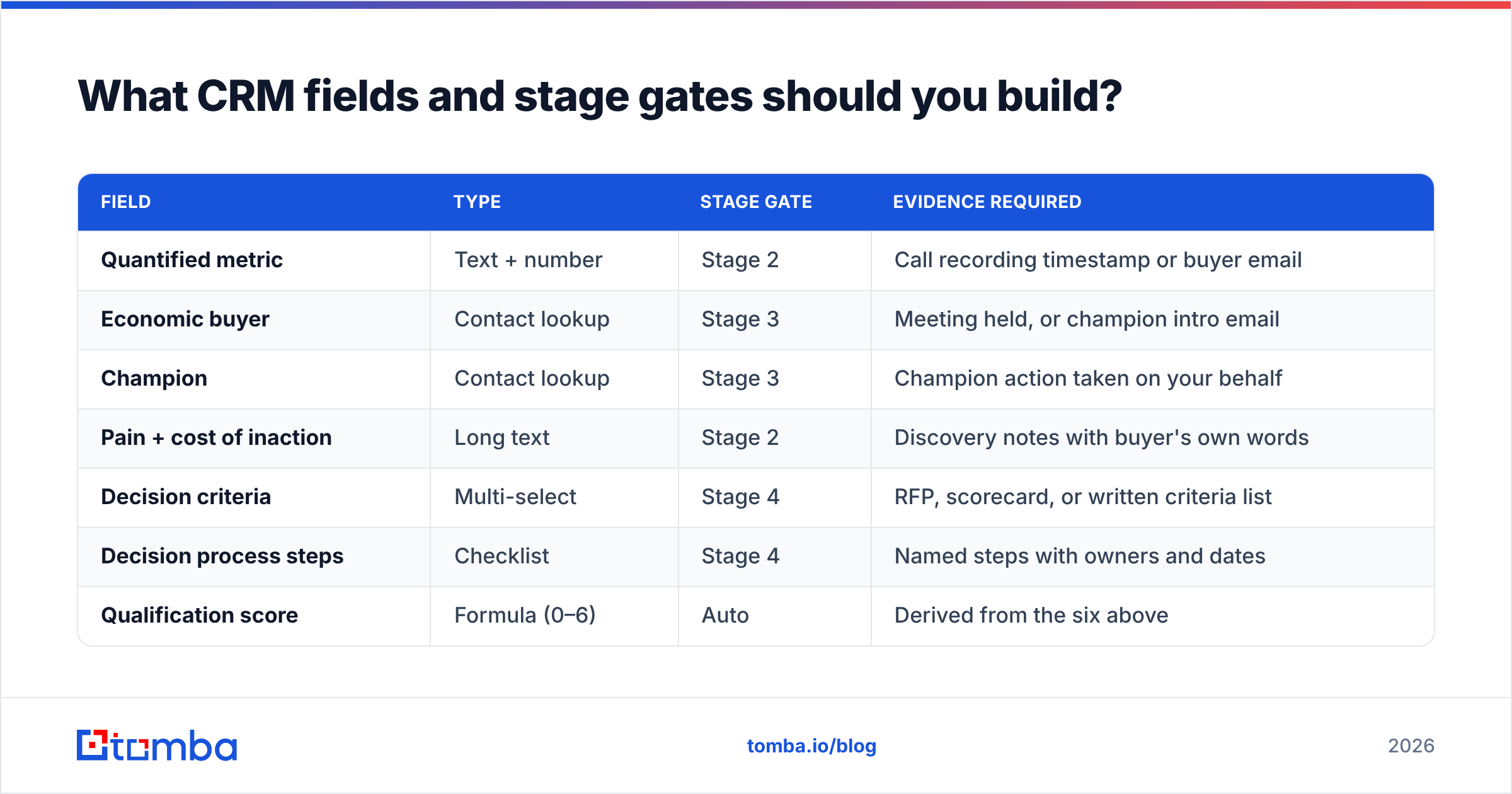
Keep the schema small enough to fill in under three minutes per deal.
| Field | Type | Stage gate | Evidence required |
|---|---|---|---|
| Quantified metric | Text + number | Stage 2 | Call recording timestamp or buyer email |
| Economic buyer | Contact lookup | Stage 3 | Meeting held, or champion intro email |
| Champion | Contact lookup | Stage 3 | Champion action taken on your behalf |
| Pain + cost of inaction | Long text | Stage 2 | Discovery notes with buyer's own words |
| Decision criteria | Multi-select | Stage 4 | RFP, scorecard, or written criteria list |
| Decision process steps | Checklist | Stage 4 | Named steps with owners and dates |
| Qualification score | Formula (0–6) | Auto | Derived from the six above |
Notice that Economic Buyer and Champion are contact lookups, not free text. That single choice forces a real record — a name, a title, an email address — instead of "VP Finance, TBD". It also makes the gap visible: an empty contact field on a $120K deal in Stage 3 is a report you can run every Monday.
How do you actually reach the Economic Buyer you identified?#
This is the operational gap nobody covers in MEDDIC training. Reps identify the Economic Buyer from a LinkedIn org chart, then have no way to contact them because the champion is slow-walking the introduction.
Two paths, and you should run both:
Champion-led introduction. Always the preferred route. Give your champion a forwardable email — three sentences, the metric, and a specific 20-minute ask. If the champion will not forward it, that is diagnostic information: they are a coach, not a champion, and your deal score should drop.
Direct outreach as a parallel track. When the introduction stalls for two weeks, go direct with a message that references the internal work already underway. To do that you need a verified address, and guessing at firstname.lastname@ patterns burns your domain reputation. Use an email finder to resolve the exact address from the name and company domain, then run it through an email verifier before you send. A bounced email to a CFO is not a neutral event — it teaches their mail server that your domain sends to bad addresses.
The same applies to account mapping. Before a Stage 3 review, reps should be able to list every stakeholder in the buying committee with a working contact record. Running a domain search across the target company surfaces the finance, security, and procurement contacts your champion never mentioned — the people who will appear in Week 6 of the decision process and ask a question that resets your timeline. Pushing those records into your CRM through contact enrichment means your Decision Process field is populated with real humans instead of job titles.
One caution: contact data quality decays. B2B email databases lose roughly 2–2.5% of accuracy per month as people change roles, so a stakeholder map built in January is meaningfully stale by June. Re-verify before any late-stage multi-threading push.
What metrics tell you the rollout is working?#
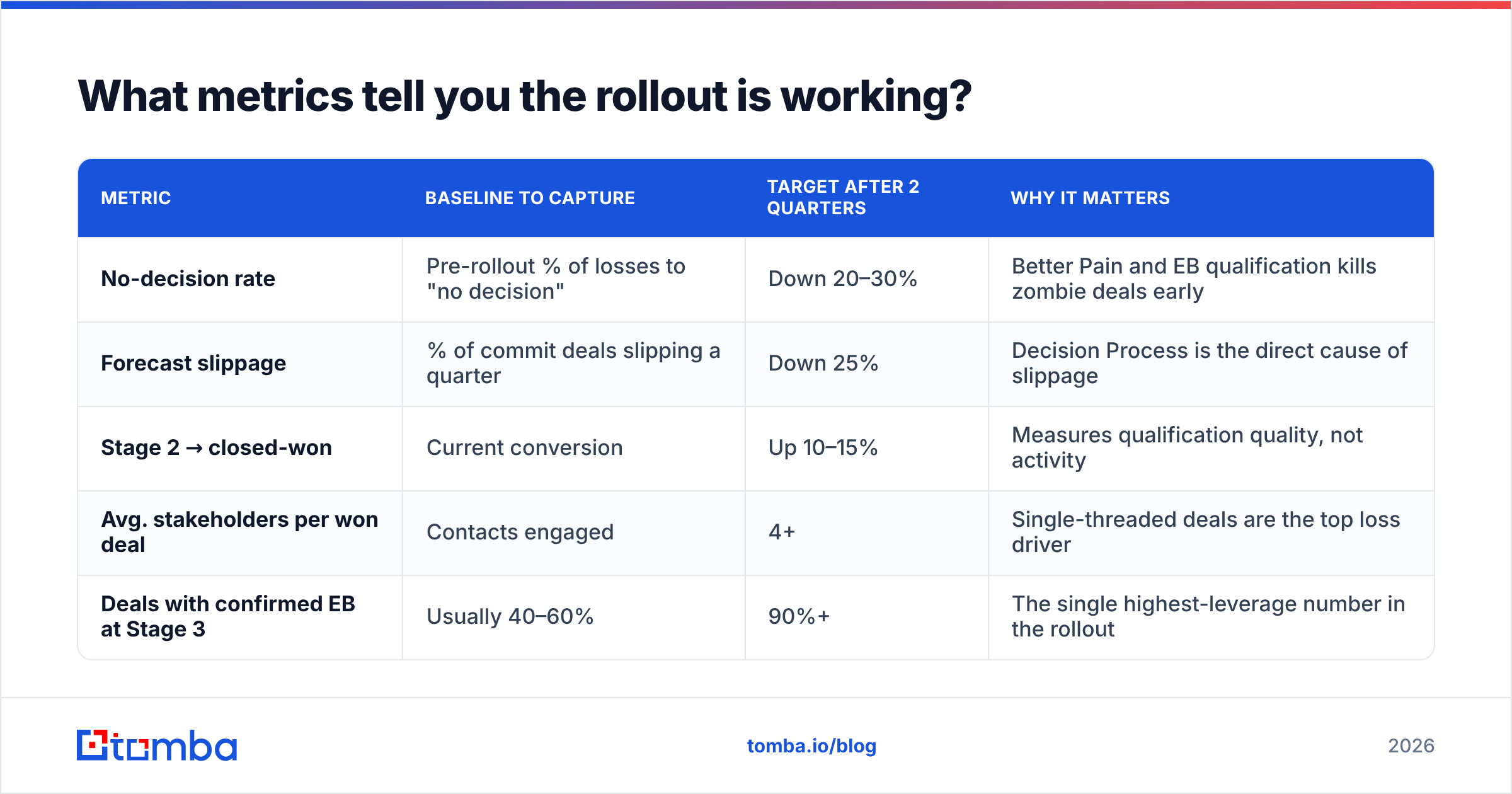
Do not measure field completion. Reps optimize for whatever you measure, and field completion is trivially gamed.
| Metric | Baseline to capture | Target after 2 quarters | Why it matters |
|---|---|---|---|
| No-decision rate | Pre-rollout % of losses to "no decision" | Down 20–30% | Better Pain and EB qualification kills zombie deals early |
| Forecast slippage | % of commit deals slipping a quarter | Down 25% | Decision Process is the direct cause of slippage |
| Stage 2 → closed-won | Current conversion | Up 10–15% | Measures qualification quality, not activity |
| Avg. stakeholders per won deal | Contacts engaged | 4+ | Single-threaded deals are the top loss driver |
| Deals with confirmed EB at Stage 3 | Usually 40–60% | 90%+ | The single highest-leverage number in the rollout |
Track win rate as the lagging indicator, but expect it to move last — typically two full sales cycles after the rollout. If leadership expects a win-rate jump in six weeks, reset that expectation in Week 1 or the program gets cancelled before it can work.
What are the most common MEDDIC implementation mistakes?#
Rolling it out to the whole team at once. A three-rep pilot surfaces every ambiguity in your rubric at one-tenth the political cost. Skipping the pilot means your first 200 field entries are garbage, and garbage data poisons the credibility of the whole program.
Letting reps self-score without evidence. Self-reported qualification scores drift upward. Every rep believes their deal is a 5 of 6. The artifact requirement is what makes the score mean anything.
Applying it to transactional deals. If a deal closes in 14 days at $6K, MEDDIC is pure friction. Set an ACV or cycle-length threshold and exempt everything below it.
Confusing the Champion with the friendly user. The person who takes your calls and loves the demo is often powerless. Test the champion by asking for something that costs them political capital — an intro to the EB, an internal forwarding, a slot in a team meeting. Their response is the answer.
Treating it as a one-time training. Qualification frameworks decay without inspection. HubSpot's sales resources make the same point about any methodology rollout: the manager cadence, not the training day, is the mechanism. Put two MEDDIC questions in every deal review script permanently.
Ignoring the Paper Process. Technically it belongs to MEDDPICC, but security reviews and procurement queues cause more slipped quarters than bad discovery. Ask about it by Stage 3 even if you never add the letter.
Is MEDDIC worth implementing for your team?#
Yes, if three things are true: your deals involve more than two stakeholders, your cycle runs longer than 45 days, and your forecast is currently unreliable enough that leadership has noticed. Under those conditions the checklist pays for itself in the deals you disqualify early — the reps' time returned to real opportunities is usually a bigger gain than the win-rate lift.
No, if you sell fast and transactionally, or if your managers will not run the inspection cadence. MEDDIC without inspection is six empty fields and a resentful sales team.
Start narrow. One rubric page, three pilot reps, six fields, two questions in the deal review. Expand only after the pilot reps can score a deal the same way you would.
The one dependency most teams underestimate is contact data. Every letter after Pain depends on reaching people — the Economic Buyer who never joins the demo, the security lead who appears in week six, the procurement contact your champion forgot to mention. If your reps are stuck guessing email formats, the checklist stalls at the exact point where it creates value. Tomba's Email Finder resolves verified business addresses from a name and company domain, with a free tier of 25 searches per month to test against your own pipeline and paid plans starting at $49/mo. Map the buying committee first, then let MEDDIC tell you which deals are actually real.
Related guides#
// get started
Find, verify and enrich your first contacts today
Start on the free plan with 25 searches a month, then scale when your team is ready.
Free plan · No credit card required · GDPR & CCPA
// about the author