How to Improve Conversion Rate in B2B Sales: 9 Fixes
Most conversion-rate advice stops at button colors. Here are nine fixes that actually move B2B pipeline — from data quality to stage exit criteria — with benchmarks and a diagnostic table.
TL;DR
- Conversion rate is not one number. It is a chain of stage-to-stage rates, and you only fix what you can isolate — measure each handoff before you touch anything.
- The single largest B2B conversion leak is usually upstream data quality, not copy. Bad contact data caps every downstream rate no matter how good your messaging is.
- Median B2B funnel math: ~3-5% visitor-to-lead, ~13% MQL-to-SQL, ~20-25% SQL-to-opportunity, ~20% opportunity-to-close. Compare your rates against your own trailing 90 days first, industry benchmarks second.
- The highest-ROI fixes in order: clean your list, tighten ICP targeting, cut form fields, add stage exit criteria, shorten your follow-up gap.
- Track conversion rate by segment, not in aggregate. A flat 12% often hides a 28% segment and a 3% segment you should stop paying for.
What Does "Conversion Rate" Actually Mean in B2B?#
Conversion rate is the percentage of people who move from one defined stage to the next. That's it. The trouble starts because most teams say "our conversion rate is 4%" without saying which two stages they're measuring between.
Think of your funnel like a set of locks on a canal. Each lock raises the boat one level. If you only measure how many boats leave the first lock and how many exit the last, you learn nothing about which lock is jammed. You have to meter each chamber.
In practice you should be tracking at least five distinct rates:
- Visitor → lead — someone lands on your site and gives you an identity (form fill, demo request, content download).
- Lead → MQL — the lead matches your fit and intent criteria. See the definition of a marketing qualified lead if your team disagrees on where this line sits.
- MQL → SQL — sales accepts the lead as worth working.
- SQL → opportunity — a real, dated, scoped deal exists.
- Opportunity → closed-won — your win rate.
For outbound, the chain looks different: contacts sourced → emails delivered → opens → replies → meetings booked → opportunities. Same principle, different locks.
Why Is Your Conversion Rate Low? (Diagnose Before You Fix)#
Run the diagnosis before you run the fix. Most teams skip this and spend a quarter rewriting subject lines when the actual problem was a 32% bounce rate poisoning their sending domain.
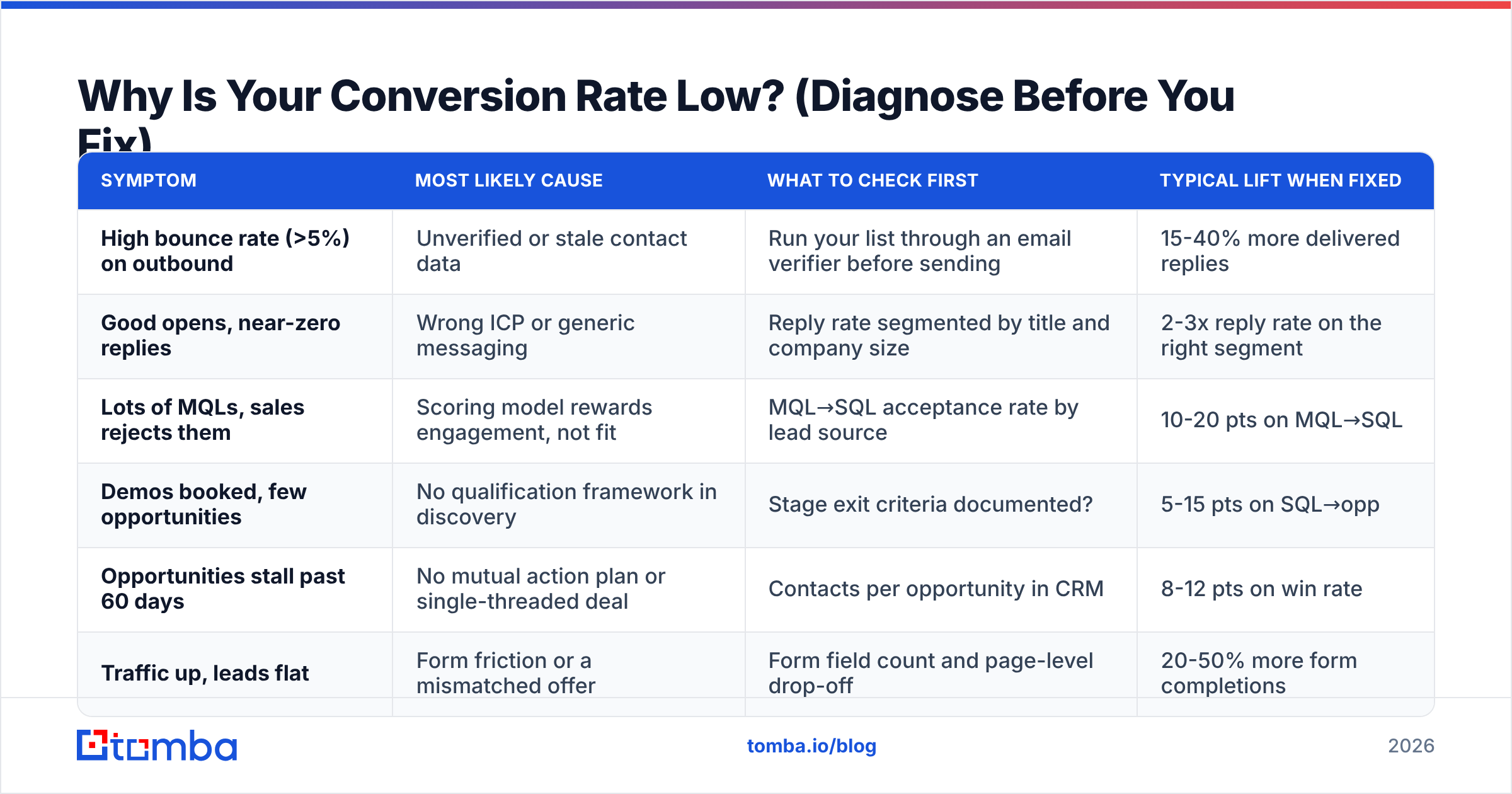
Here is the diagnostic table. Find the symptom, then read across.
| Symptom | Most likely cause | What to check first | Typical lift when fixed |
|---|---|---|---|
| High bounce rate (>5%) on outbound | Unverified or stale contact data | Run your list through an email verifier before sending | 15-40% more delivered replies |
| Good opens, near-zero replies | Wrong ICP or generic messaging | Reply rate segmented by title and company size | 2-3x reply rate on the right segment |
| Lots of MQLs, sales rejects them | Scoring model rewards engagement, not fit | MQL→SQL acceptance rate by lead source | 10-20 pts on MQL→SQL |
| Demos booked, few opportunities | No qualification framework in discovery | Stage exit criteria documented? | 5-15 pts on SQL→opp |
| Opportunities stall past 60 days | No mutual action plan or single-threaded deal | Contacts per opportunity in CRM | 8-12 pts on win rate |
| Traffic up, leads flat | Form friction or a mismatched offer | Form field count and page-level drop-off | 20-50% more form completions |
Two rules for reading this table. First, fix the top row before the bottom rows — deliverability problems corrupt every metric below them. Second, isolate one change per test window, or you will not know what worked.
How Do You Improve Conversion Rate at the Top of the Funnel?#
Top-of-funnel conversion is a targeting problem disguised as a copy problem.
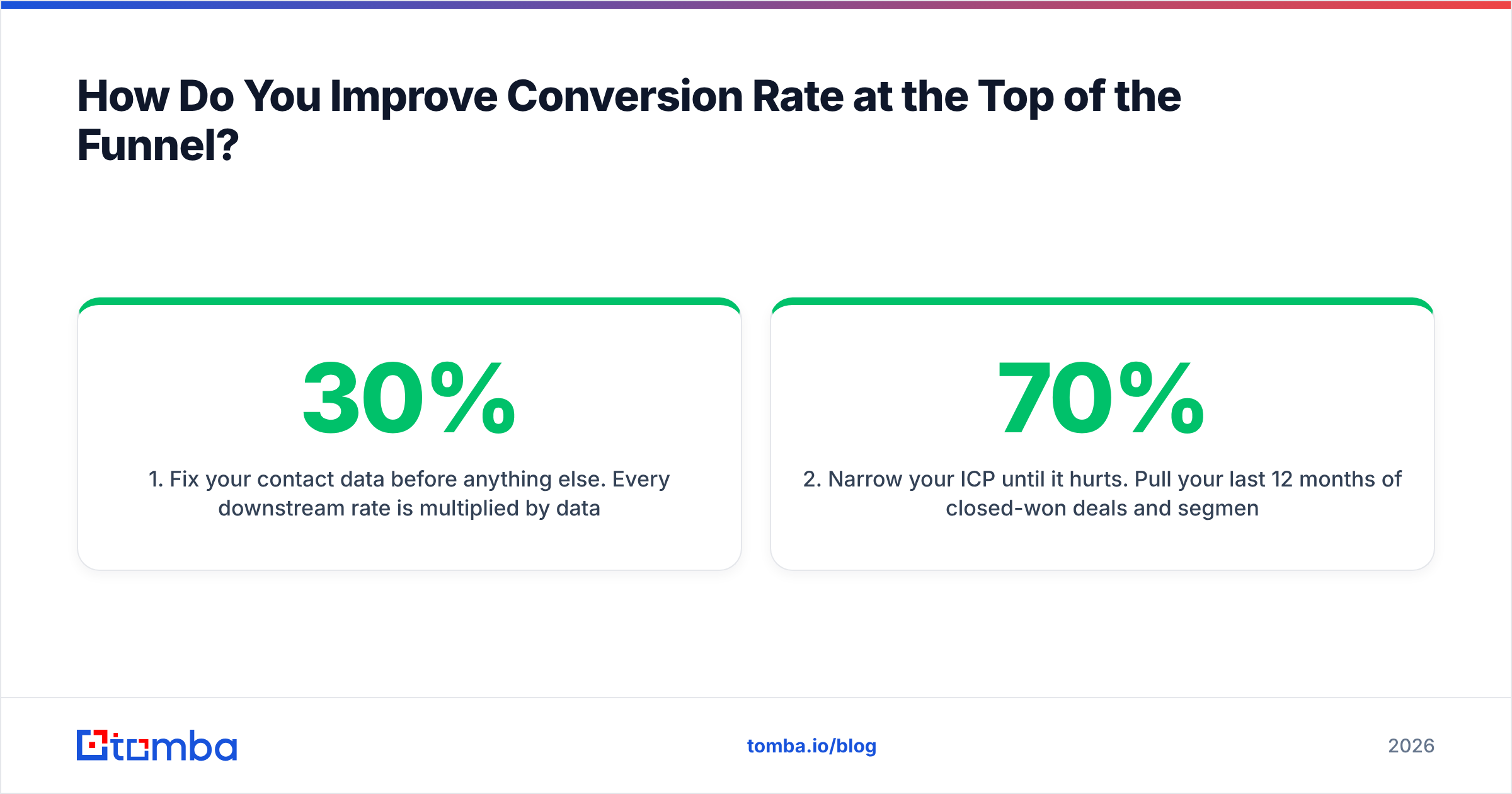
1. Fix your contact data before anything else. Every downstream rate is multiplied by data accuracy. If 30% of your addresses are invalid, your ceiling on reply rate is 70% of what it should be, and your sender reputation degrades in parallel — which then reduces inbox placement for the 70% that were good. It compounds in the wrong direction. Verify every list with an email verifier before it enters a sequence, and re-verify anything older than 90 days. Contact data decays at roughly 22-30% annually as people change roles.
2. Narrow your ICP until it hurts. Pull your last 12 months of closed-won deals and segment by industry, headcount, and buyer title. Most teams find that 60-70% of revenue came from two or three narrow segments. Stop sourcing outside those segments for one quarter and watch every rate in the funnel rise — not because your messaging improved, but because you stopped counting bad-fit prospects in the denominator.
3. Cut form fields. HubSpot's research on form length has consistently shown that fewer fields raise completion rates. Ask for the email and the company domain. You can enrich the rest — title, headcount, tech stack, LinkedIn — automatically with data enrichment after the submit. Every field you remove is a field you are no longer asking a stranger to fill in.
4. Match the offer to the stage. A "book a demo" CTA on a top-of-funnel blog post converts at a fraction of a "get the benchmark report" CTA on the same page. Someone reading a definitional article is not in a buying window. Give them the next small step, not the biggest one.
Which Middle-Funnel Changes Move the Needle?#
The middle of the funnel — MQL to opportunity — is where most B2B revenue quietly leaks, because nobody owns it cleanly. Marketing considers the lead delivered; sales considers it unqualified.
5. Write stage exit criteria and enforce them. A deal cannot move to "opportunity" unless the prospect has confirmed a problem, a rough budget range, and a decision timeline. Write those criteria in one sentence each, put them in your CRM as required fields, and audit weekly. Teams that do this usually see their forecast accuracy improve before their conversion rate does — and the accuracy improvement is what lets you find the real leak.
6. Shorten the response gap. The classic Lead Response Management study found that companies contacting a lead within an hour were roughly seven times more likely to have a meaningful conversation than those waiting even two hours. That advantage has not gone away; if anything, competitors are faster now. Route inbound leads to a live human within minutes, not hours.
7. Multi-thread every deal above your average contract value. Single-threaded deals die when your champion changes jobs — which, at current B2B tenure rates, happens to a meaningful fraction of your pipeline every quarter. Add two more contacts per account with a domain search and build relationships with the economic buyer and the technical evaluator before you need them.
8. Follow up more than you think is reasonable. Most B2B deals require five to eight touches to reach a first conversation, yet the median rep stops after two. The follow-up gap is the cheapest conversion lift available to you because it requires no new leads, no new spend, and no new copy.
9. Kill your worst-performing segment. Look at conversion rate by lead source. If paid social converts at 1.4% and organic search converts at 9%, moving budget is a bigger conversion lever than any on-page test you will run this year.
What Are Realistic B2B Conversion Rate Benchmarks for 2026?#
Benchmarks are useful for sanity checks and dangerous for goal-setting. Your own trailing 90 days is a better baseline than any industry median, because your ACV, deal cycle, and channel mix are yours alone.
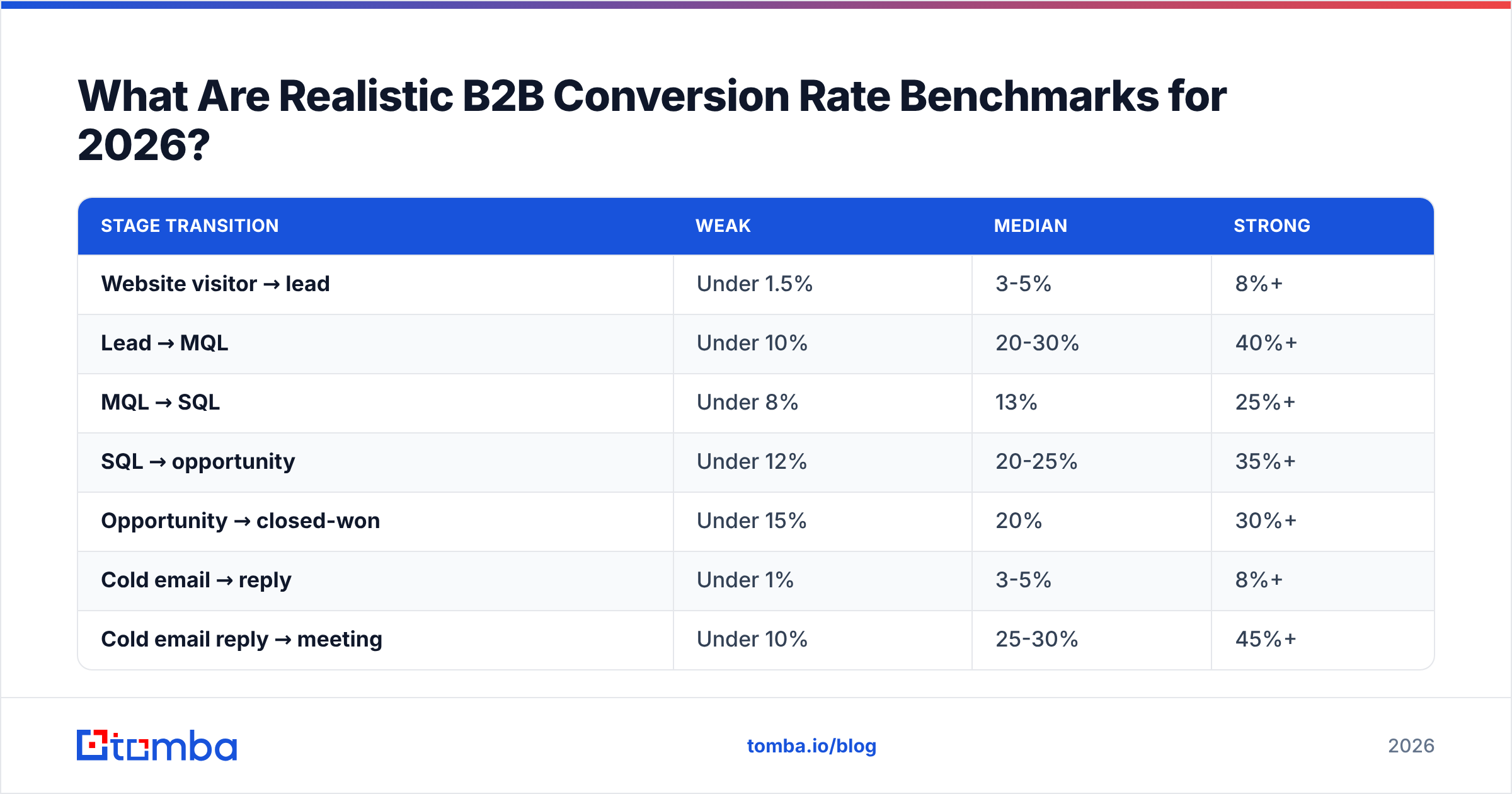
That said, here is a rough map of where healthy B2B SaaS funnels sit:
| Stage transition | Weak | Median | Strong |
|---|---|---|---|
| Website visitor → lead | Under 1.5% | 3-5% | 8%+ |
| Lead → MQL | Under 10% | 20-30% | 40%+ |
| MQL → SQL | Under 8% | 13% | 25%+ |
| SQL → opportunity | Under 12% | 20-25% | 35%+ |
| Opportunity → closed-won | Under 15% | 20% | 30%+ |
| Cold email → reply | Under 1% | 3-5% | 8%+ |
| Cold email reply → meeting | Under 10% | 25-30% | 45%+ |
Notice the multiplication. A funnel at median across every stage converts about 0.13% of visitors into customers. Improving each stage by five percentage points roughly doubles that. Compounding small stage gains beats one heroic fix at a single stage — which is exactly why the diagnostic step matters more than the fix step.
For a broader view of how peers report these numbers, G2's software buyer behavior research and Gartner's B2B buying-journey work are both worth reading against your own data.
How Do You Measure Conversion Rate Correctly?#
Three measurement mistakes destroy more conversion programs than bad tactics do.
- Aggregating across segments. A blended 12% MQL→SQL rate can hide a 28% enterprise segment and a 3% SMB segment. Always cut by segment, source, and rep before you conclude anything.
- Using the wrong denominator. If you count every scraped contact as a "lead," your conversion rate will look terrible and you will optimize the wrong thing. Define the denominator as contacts that met your minimum fit bar.
- Measuring in-period instead of by cohort. Dividing this month's closed deals by this month's new leads is meaningless when your sales cycle is 90 days. Track cohorts: leads created in March, measured through June.
Set the reporting cadence to match your cycle length. If deals take 60 days, a weekly conversion-rate review is noise. Monthly cohort reviews with a quarterly deep-dive is enough.
How Does Data Quality Change Your Conversion Math?#
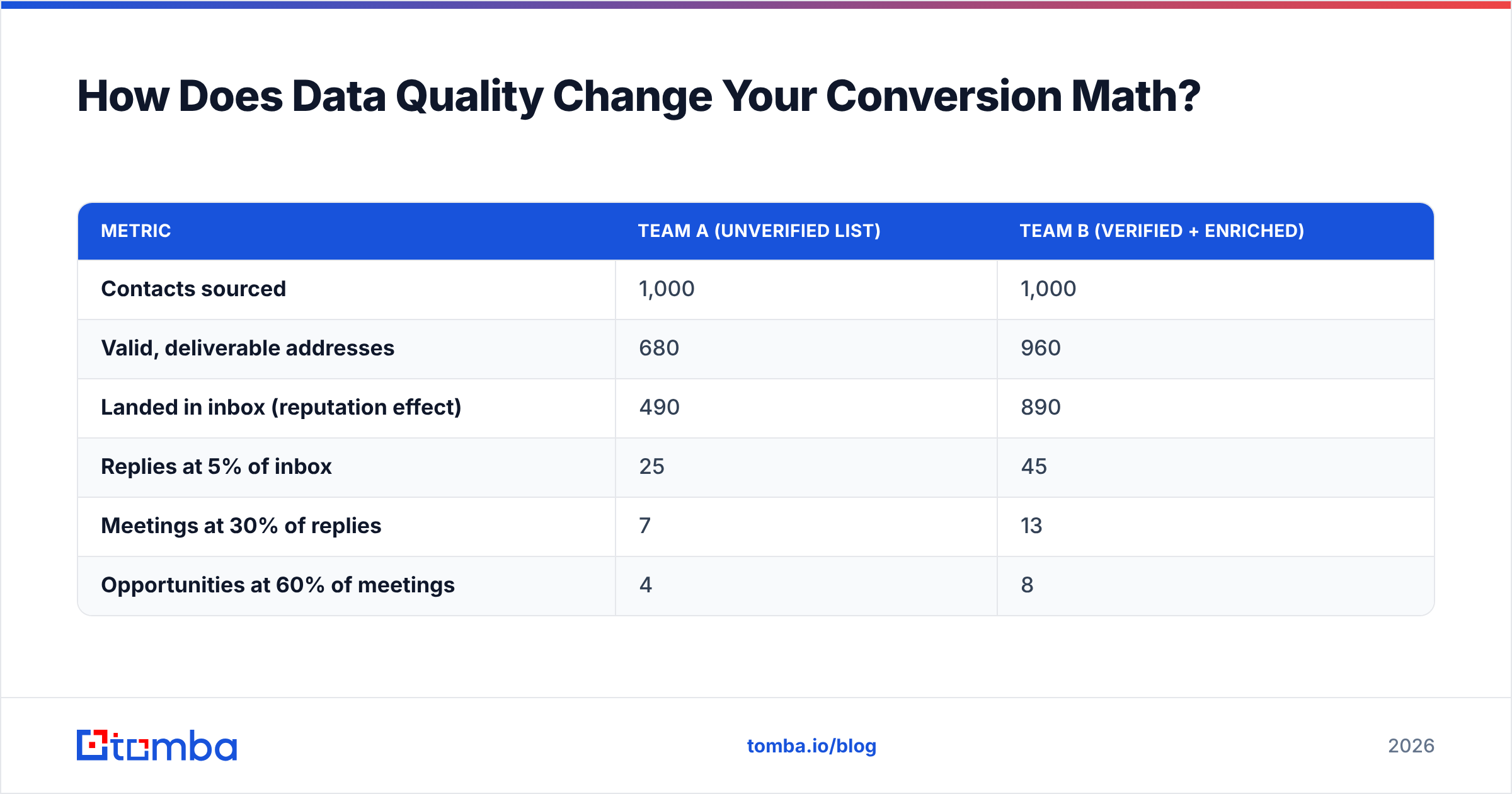
Here is the arithmetic that convinces most skeptics. Take two teams sending the same 1,000-contact sequence with the same copy.
| Metric | Team A (unverified list) | Team B (verified + enriched) |
|---|---|---|
| Contacts sourced | 1,000 | 1,000 |
| Valid, deliverable addresses | 680 | 960 |
| Landed in inbox (reputation effect) | 490 | 890 |
| Replies at 5% of inbox | 25 | 45 |
| Meetings at 30% of replies | 7 | 13 |
| Opportunities at 60% of meetings | 4 | 8 |
Same copy. Same offer. Same rep. Nearly double the pipeline, entirely from the data layer. And the compounding effect is worse than the table shows, because Team A's bounce rate damages sender reputation for every future campaign, not just this one.
This is why "how to improve conversion rate" almost always starts with a list-hygiene answer rather than a copywriting answer. Copy improvements are real but they operate on a smaller base.
What Does a 90-Day Conversion Improvement Plan Look Like?#
Days 1-14 — Measure. Instrument every stage transition. Build one dashboard with the five rates, cut three ways (source, segment, rep). Do not change anything yet.
Days 15-30 — Clean. Verify your entire active database. Remove duplicates. Enrich missing firmographic fields so segmentation is possible. Establish the baseline you will measure against.
Days 31-60 — Fix the biggest leak. Pick the single stage with the worst gap versus benchmark and versus your own best segment. Run one change. Measure for a full cycle length.
Days 61-90 — Systematize. Whatever worked, write it into stage exit criteria, sequence templates, or routing rules so it survives the next rep who joins. Then repeat from the second-worst stage.
The temptation is to run all four phases at once. Don't. You will get a lift and never know which change caused it, which means you cannot repeat it.
Start With the Layer Everything Else Multiplies Against#
Conversion rate improvement is unglamorous. It is mostly measurement discipline, segment honesty, and clean data — not clever copy. The teams that compound gains quarter after quarter are the ones that fixed their inputs first.
If your diagnosis points upstream — bounces, bad-fit contacts, missing firmographics — start there. The Tomba Email Finder gives you verified, deliverable contacts by name, domain, or company, so the funnel you are optimizing is built on addresses that actually exist. The free tier includes 25 searches per month, and paid plans start at $49/mo on Starter with 25-search bulk workflows, API access, and verification bundled in; full Tomba pricing is public if you want to model the cost per verified contact before committing. Fix the base of the multiplication first, then go optimize your subject lines.
Related guides#
// get started
Find, verify and enrich your first contacts today
Start on the free plan with 25 searches a month, then scale when your team is ready.
Free plan · No credit card required · GDPR & CCPA
Get the Tomba newsletter
Product and data updates
// about the author