How To Improve Forecast Accuracy: A 2026 RevOps Playbook
Most sales forecasts miss because the pipeline data underneath them is stale, not because the model is wrong. Here are seven fixes that move forecast accuracy from 50% to 85%+ in two quarters.
TL;DR
- Forecast accuracy is a data problem before it is a modeling problem. If 30% of your contact records are stale, no weighted-pipeline formula will save you.
- The fastest wins are unglamorous: enforce exit criteria per stage, timestamp every stage change, and kill "commit" deals that have had no buyer-side activity in 14 days.
- Rep-submitted forecasts alone typically land at 45-60% accuracy. Adding stage-based and historical-conversion models as cross-checks pushes a well-run team into the 85-90% band.
- Track forecast accuracy as a rolling metric with a defined formula, not a vibe. Measure at week 1, week 6, and close of every quarter.
- Enrichment matters more than most RevOps leaders admit: bad email and phone data inflates top-of-funnel counts, which distorts every downstream conversion rate you forecast with.
What does forecast accuracy actually mean?#
Forecast accuracy is the percentage gap between what you said you would close and what you actually closed, measured at a fixed point in the quarter.
The standard formula:
Forecast Accuracy = 1 - |Actual - Forecast| / ActualIf you forecast $2.0M and close $1.7M, that is 1 - |1.7 - 2.0| / 1.7 = 82.4% accuracy. Note that this formula punishes overcalls and undercalls equally — which is correct, because sandbagging destroys capacity planning just as badly as happy ears destroy board credibility.
Three things break this metric in practice:
- No fixed measurement point. "Our forecast" changes daily. Pick week 1, week 6, and week 12 of the quarter and lock the snapshot at each.
- No segmentation. A 90% company-level number can hide a rep-level distribution of 40% and 140% that cancel out.
- No unit consistency. Forecasting bookings, then measuring against recognized revenue, guarantees a permanent gap that has nothing to do with sales judgment.
Before you touch anything else, publish the formula, the snapshot dates, and the unit. Half the "forecast accuracy problem" at most companies is that four teams are measuring four different things.
Why do most sales forecasts miss?#
Because the inputs are rotten. A forecast is a chain of estimates — lead volume, contact reachability, meeting rate, stage conversion, cycle length, average deal size — and each estimate compounds the error of the one before it.
Here is where the error actually enters, ranked by how much damage it does relative to how easy it is to fix:
- Stale contact data at the top of funnel. If 25-35% of your prospect emails bounce or route to someone who left, your "1,000 leads worked" is really 680. Every conversion rate calculated on the inflated number is wrong, and forecasts built from those rates inherit the error. Running your list through an email verifier before it enters the CRM is the single cheapest accuracy fix available.
- Subjective stage definitions. "Discovery" means whatever the rep wants it to mean. Without written exit criteria, stage-based probability models are noise.
- No close-date discipline. Deals that slip get their close date pushed one month at a time, forever. A deal that has slipped three times should be flagged automatically, not silently rolled forward.
- Single-threaded deals counted as commit. One champion, no economic buyer, no procurement contact — that is a best-case deal, not a commit.
- No activity signal in the model. A deal with zero inbound buyer email in 14 days is dying regardless of what the rep says on the call.
- Manager override without a record. When a VP cuts the number by 15% on instinct, nobody can later tell whether the reps or the VP was wrong.
How do the main forecasting methods compare?#
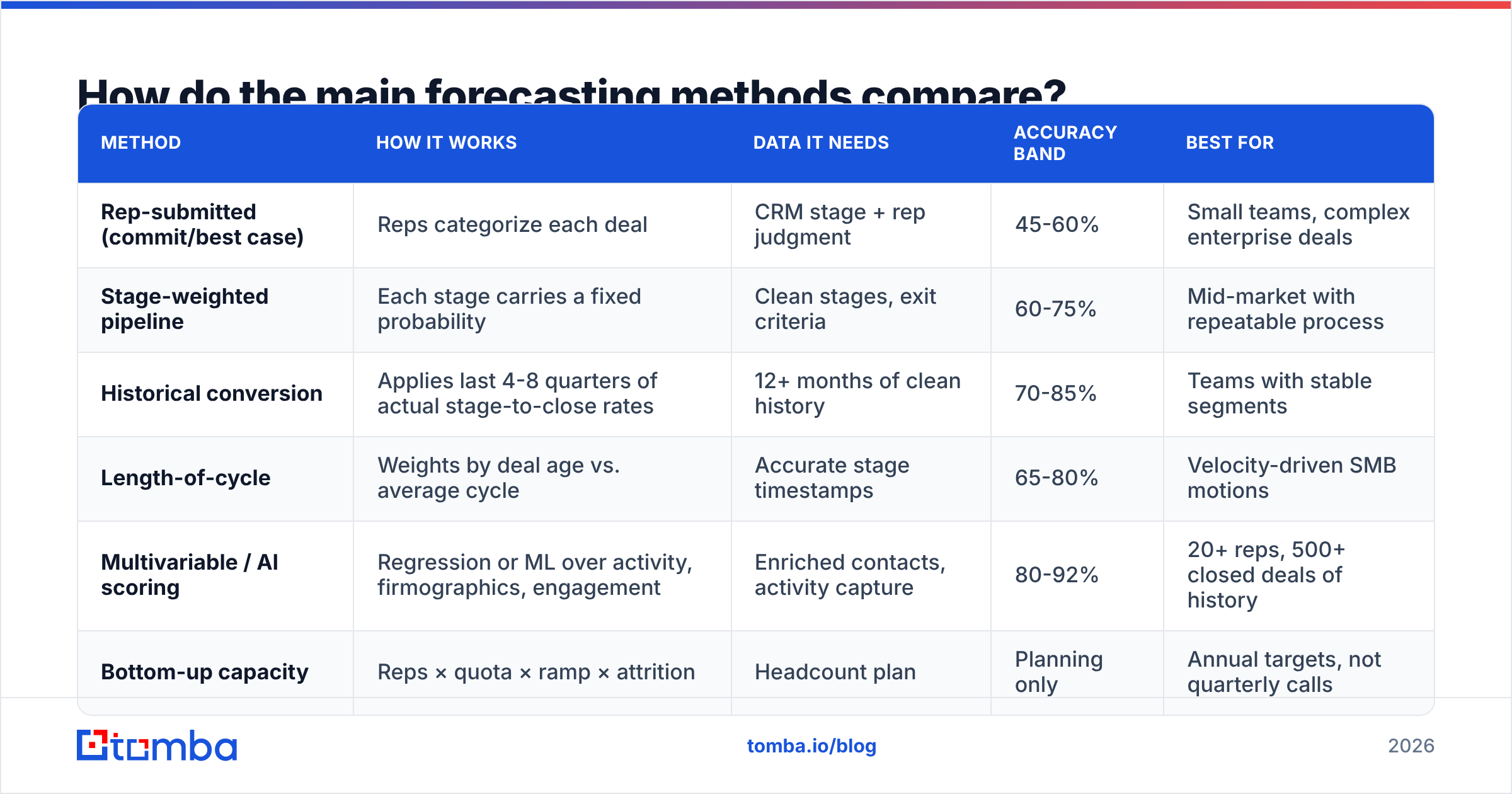
You should run at least two methods in parallel and investigate the delta. One method is a guess; two methods with a small delta is a forecast.
| Method | How it works | Data it needs | Accuracy band | Best for |
|---|---|---|---|---|
| Rep-submitted (commit/best case) | Reps categorize each deal | CRM stage + rep judgment | 45-60% | Small teams, complex enterprise deals |
| Stage-weighted pipeline | Each stage carries a fixed probability | Clean stages, exit criteria | 60-75% | Mid-market with repeatable process |
| Historical conversion | Applies last 4-8 quarters of actual stage-to-close rates | 12+ months of clean history | 70-85% | Teams with stable segments |
| Length-of-cycle | Weights by deal age vs. average cycle | Accurate stage timestamps | 65-80% | Velocity-driven SMB motions |
| Multivariable / AI scoring | Regression or ML over activity, firmographics, engagement | Enriched contacts, activity capture | 80-92% | 20+ reps, 500+ closed deals of history |
| Bottom-up capacity | Reps × quota × ramp × attrition | Headcount plan | Planning only | Annual targets, not quarterly calls |
The pattern is unmistakable: every method above 70% depends on data hygiene that most teams do not have. The AI scoring row is not magic — it is the same math, fed better inputs. Feed it a CRM where 30% of contacts are unreachable and it will confidently produce a wrong number faster than a human would.
What are the seven fixes that actually move the number?#
These are ordered by return on effort. Do them in order; do not skip to number six because it sounds more sophisticated.
1. Write exit criteria for every stage. One sentence per stage, verifiable by someone who was not on the call. "Discovery → Demo requires: named economic buyer, stated compelling event, budget range confirmed." If a rep cannot point to the artifact, the deal does not advance. This alone typically adds 8-12 points of accuracy within one quarter because it makes stage-weighted models mean something.
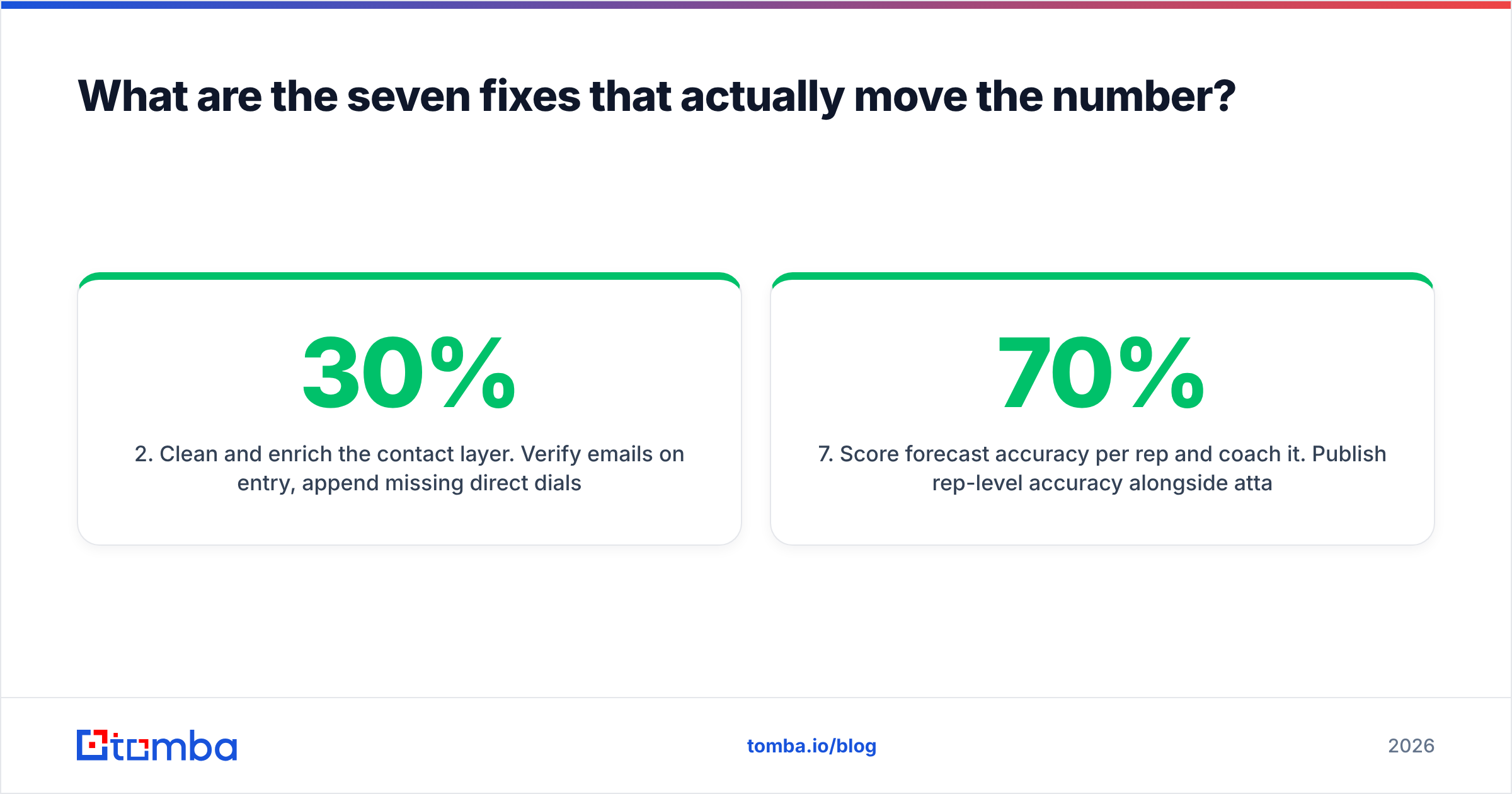
2. Clean and enrich the contact layer. Verify emails on entry, append missing direct dials, and re-verify anything older than 90 days. B2B contact data decays at roughly 22-30% per year as people change jobs. Use a bulk email finder to re-validate your active pipeline contacts quarterly, and data enrichment to fill in the buying-committee members your reps never captured. A deal with three verified stakeholder contacts forecasts very differently from a deal with one unverified one.
3. Instrument time-in-stage. Log a timestamp on every stage transition. Then compute your median time-in-stage per segment. Any deal sitting at 2x the median is a stall, and stalls close at a fraction of the base rate. This single field enables the length-of-cycle method for free.
4. Add a buyer-activity gate to "commit." No deal enters commit without buyer-initiated activity in the last 10 business days — a reply, a meeting they scheduled, a document they opened. This is the highest-signal, lowest-cost filter in forecasting. Most CRMs can automate it with a rollup field.
5. Run a weekly deal inspection with a fixed question set. Not "how's it looking?" Instead: What changed since last week? Who else is now involved? What is the mutual action plan date? What would have to be true for this to slip? Record the answers in the deal record so next quarter's model can learn from them.
6. Snapshot the pipeline weekly and never overwrite it. You cannot diagnose forecast error without history. Store a weekly copy of every open deal's stage, amount, and close date. After two quarters you will be able to see exactly which stage, which rep, and which segment produces the most drift.
7. Score forecast accuracy per rep and coach it. Publish rep-level accuracy alongside attainment. A rep at 70% attainment and 95% forecast accuracy is more valuable to planning than a rep at 105% attainment and 55% accuracy — and treating it that way changes behavior fast.
How does data quality change the math?#
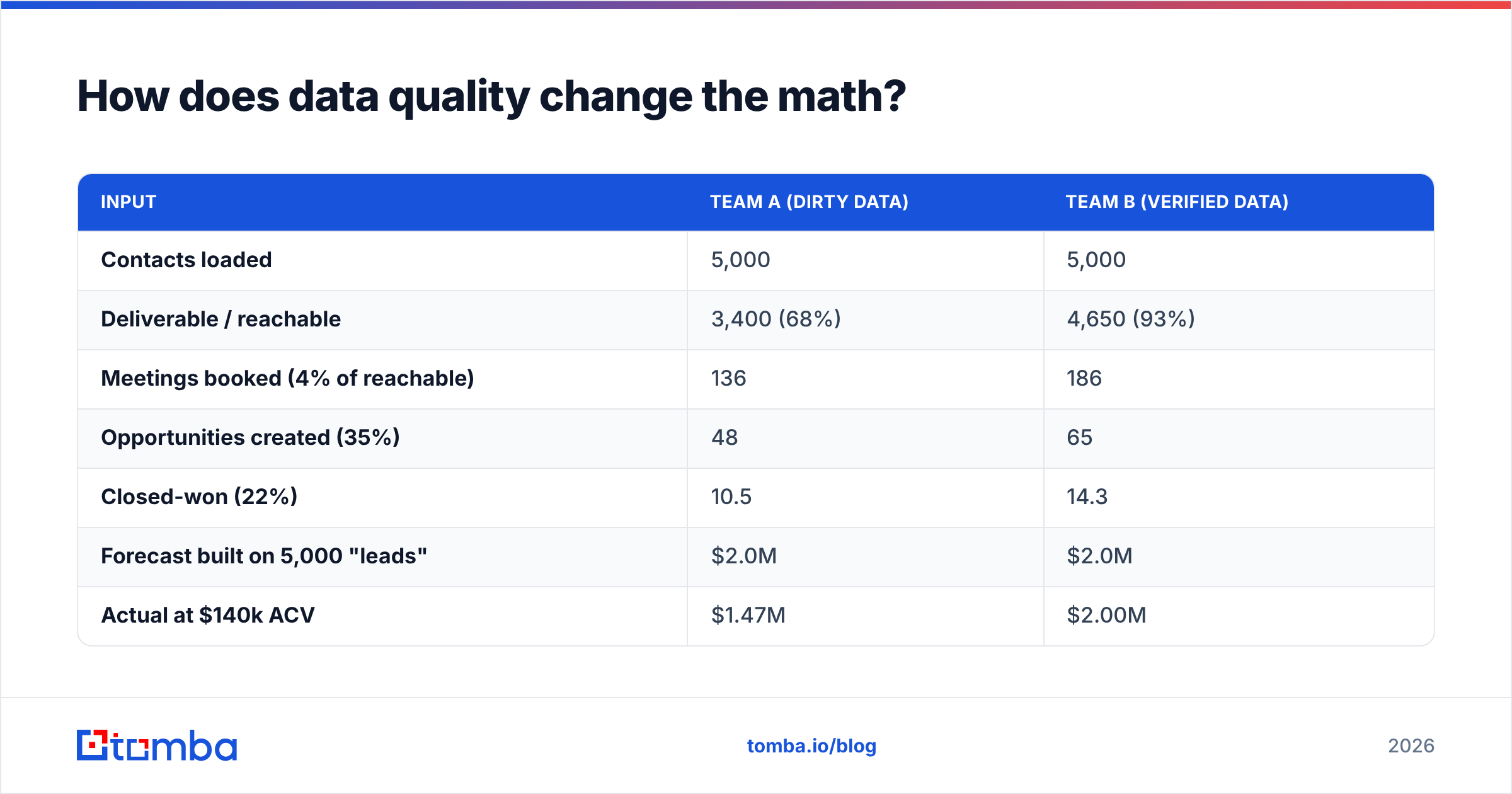
Here is the compounding effect in concrete numbers. Assume two teams with identical rep skill, identical product, identical target of $2.0M.
| Input | Team A (dirty data) | Team B (verified data) |
|---|---|---|
| Contacts loaded | 5,000 | 5,000 |
| Deliverable / reachable | 3,400 (68%) | 4,650 (93%) |
| Meetings booked (4% of reachable) | 136 | 186 |
| Opportunities created (35%) | 48 | 65 |
| Closed-won (22%) | 10.5 | 14.3 |
| Forecast built on 5,000 "leads" | $2.0M | $2.0M |
| Actual at $140k ACV | $1.47M | $2.00M |
| Resulting forecast accuracy | 64% | 100% |
Team A did not have a forecasting problem. It had a data accuracy problem that presented as a forecasting problem. This is why RevOps leaders who start with the model instead of the inputs spend two quarters tuning weights and end up in the same place.
The same logic applies to phone-based motions. If your SDRs are dialing numbers with a 40% connect-rate ceiling because a third of the records are wrong, your dial-to-meeting ratio is not a real ratio. Validating numbers with a phone validator before a calling sprint gives you a denominator you can actually forecast from.
Which tools help, and what do they actually cost?#
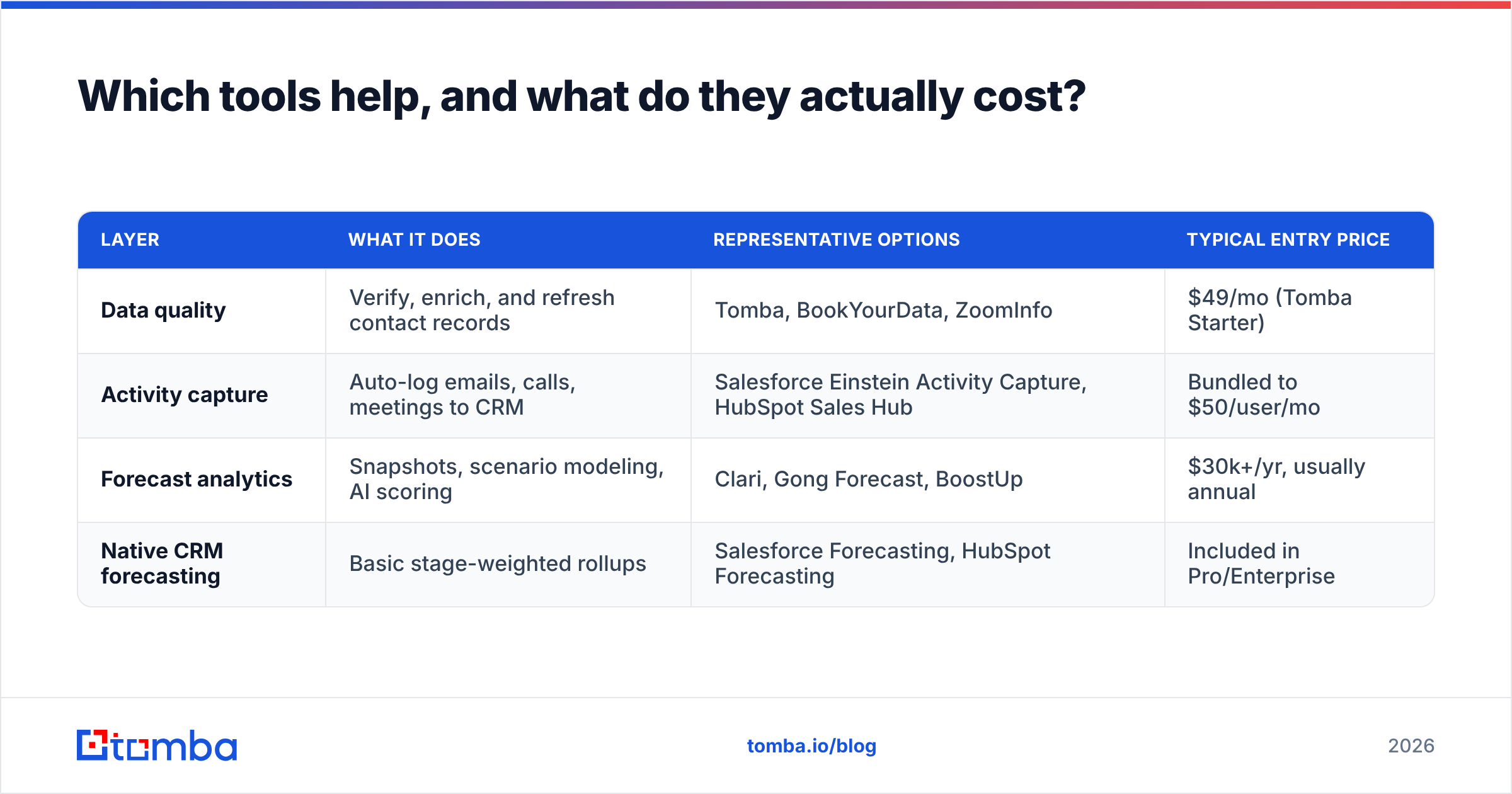
The tooling stack for forecast accuracy splits into three layers: data quality at the source, activity capture in the CRM, and the forecasting/analytics layer on top. Buying layer three without layers one and two is the most common and most expensive mistake in RevOps.
| Layer | What it does | Representative options | Typical entry price |
|---|---|---|---|
| Data quality | Verify, enrich, and refresh contact records | Tomba, BookYourData, ZoomInfo | $49/mo (Tomba Starter) |
| Activity capture | Auto-log emails, calls, meetings to CRM | Salesforce Einstein Activity Capture, HubSpot Sales Hub | Bundled to $50/user/mo |
| Forecast analytics | Snapshots, scenario modeling, AI scoring | Clari, Gong Forecast, BoostUp | $30k+/yr, usually annual |
| Native CRM forecasting | Basic stage-weighted rollups | Salesforce Forecasting, HubSpot Forecasting | Included in Pro/Enterprise |
A practical sequencing note: teams under roughly 15 reps almost never need the dedicated forecast-analytics layer. Native CRM forecasting plus disciplined weekly snapshots in a spreadsheet gets you to 80%+ if the underlying records are clean. Spend the budget on the data layer first — it is an order of magnitude cheaper and it improves every downstream metric, not just the forecast.
On the data layer specifically, compare on three axes: verification accuracy (what percentage of "valid" emails actually deliver), coverage in your target geographies, and whether the pricing is per-credit or per-seat. Tomba pricing runs Free (25 searches/mo), Starter $49/mo, Growth $99/mo, and Pro $249/mo with credit-based billing, which suits teams that enrich in bursts before a campaign rather than continuously. BookYourData is a solid choice when you want to purchase a pre-built list outright rather than run lookups. ZoomInfo prices at the enterprise end and bundles intent data, which matters if you are also building an ABM motion.
For the mechanics of pulling clean contacts into your CRM at scale, a domain search run across your target-account list is usually faster than exporting from a static database — you get current records rather than a snapshot of whatever the vendor crawled last year. G2's sales intelligence category is a reasonable place to sanity-check vendor claims against recent user reviews before you commit to an annual contract.
How do you build the weekly forecast cadence?#
Accuracy is a cadence problem as much as a data problem. The rhythm that works:
- Monday, rep level. Each rep updates stage, amount, close date, and next step. Anything not updated by 10am is auto-flagged, not chased manually.
- Monday, manager level. Manager reviews only the delta from last week — deals that moved, slipped, or appeared. Reviewing the whole pipeline every week guarantees nobody reviews anything carefully.
- Tuesday, roll-up. RevOps produces three numbers: rep-submitted commit, stage-weighted model output, and historical-conversion model output. The spread between them is the discussion agenda.
- Month 2, week 6 checkpoint. Compare current commit to the week-1 snapshot. Quantify the slip. Deals that slipped from this quarter get a mandatory reason code.
- Post-quarter, always. Run the accuracy calc per rep, per segment, per stage. Feed the findings back into stage probabilities. A forecast model that is not recalibrated quarterly decays as fast as your contact data.
Salesforce publishes a useful primer on sales forecasting methodology if you want a vendor-neutral framework to adapt; HubSpot's sales forecasting guide covers the same ground for smaller teams. Both make the same point this article makes from a different angle: the process discipline is what produces accuracy, and the software only amplifies whatever discipline already exists.
What should you measure to know it is working?#
Four metrics, reviewed monthly:
- Forecast accuracy (company). Target 85%+ by week 6, 92%+ by week 10.
- Forecast accuracy variance (rep-level standard deviation). Falling variance means the process is taking hold, not just that two errors cancelled.
- Slip rate. Percentage of week-1 commit dollars that push out of the quarter. Above 20% means your commit criteria are too loose.
- Data freshness. Percentage of pipeline contacts verified in the last 90 days. Below 70% and you are forecasting on fiction.
Track them on the same dashboard. When accuracy drops, the freshness number usually dropped first — typically one to two quarters earlier, right after a big list import that nobody verified.
Ready to fix the input layer first?#
Every forecasting model you will ever build sits on top of contact records. If those records are stale, unverified, or missing half the buying committee, the model inherits the error and you spend quarters tuning weights that were never the problem.
Start at the source. Use the Tomba Email Finder to build and refresh your pipeline contacts with verified, deliverable addresses — free tier gives you 25 searches a month to test the accuracy against your own known-good list, and Starter at $49/mo covers most teams running quarterly enrichment sweeps. Clean the input, then trust the forecast.
Related guides#
// get started
Find, verify and enrich your first contacts today
Start on the free plan with 25 searches a month, then scale when your team is ready.
Free plan · No credit card required · GDPR & CCPA
Get the Tomba newsletter
Product and data updates
// about the author