How to Improve Sales Conversion Rate: A 2026 Playbook
Most conversion-rate advice stops at "follow up more." This playbook breaks the funnel into measurable stages, shows where deals actually leak, and gives you seven fixes you can ship this quarter.
TL;DR
- Conversion rate is not one number. Split it into lead-to-MQL, MQL-to-meeting, meeting-to-opportunity, and opportunity-to-close, then fix the worst stage first.
- The single largest source of "low conversion" in outbound is bad contact data — bounced and mis-targeted sends inflate your denominator and destroy sender reputation at the same time.
- Speed-to-lead beats almost every copy tweak. Responding in under five minutes routinely produces multiples of the contact rate you get at an hour.
- Qualification discipline (a written disqualification rule) raises close rate more reliably than adding sequence steps.
- Measure conversion by cohort, not by month. Monthly snapshots hide the fact that your pipeline mix changed.
What does "sales conversion rate" actually mean?#
Sales conversion rate is the percentage of prospects that move from one defined stage to the next. That's it. The confusion starts when three people in the same company use the phrase to mean three different ratios: marketing means visitor-to-lead, the SDR team means lead-to-meeting, and the AE means opportunity-to-closed-won.
Think of it like a factory line with four machines. If you only measure "units shipped divided by raw material in," you know the line is inefficient but not which machine is jamming. You have to instrument each handoff.
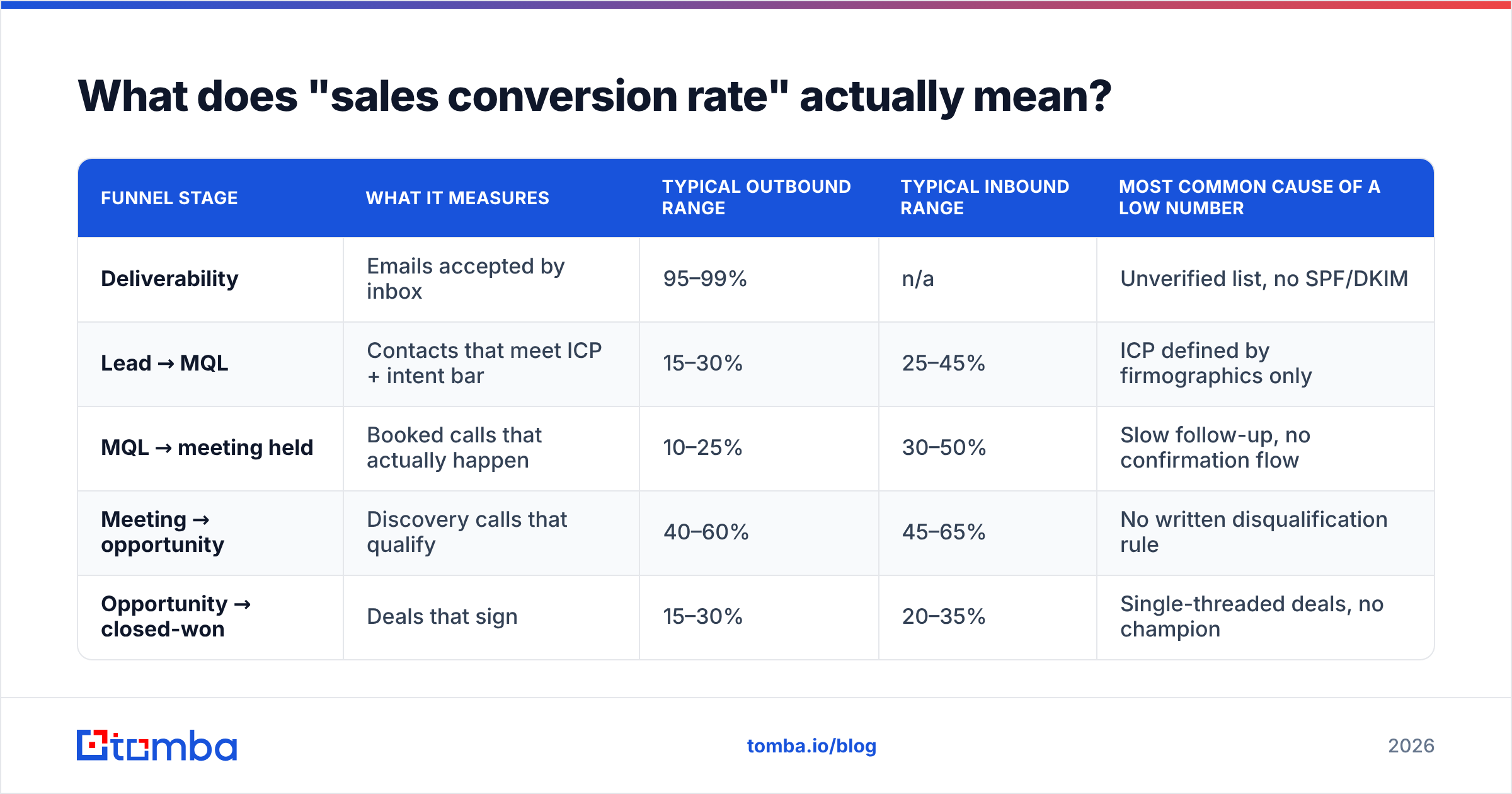
Here is the stage map most B2B teams should track, with rough ranges that are common in mid-market SaaS outbound. Treat these as orientation, not gospel — your ICP, ACV, and channel mix move them a lot.
| Funnel stage | What it measures | Typical outbound range | Typical inbound range | Most common cause of a low number |
|---|---|---|---|---|
| Deliverability | Emails accepted by inbox | 95–99% | n/a | Unverified list, no SPF/DKIM |
| Lead → MQL | Contacts that meet ICP + intent bar | 15–30% | 25–45% | ICP defined by firmographics only |
| MQL → meeting held | Booked calls that actually happen | 10–25% | 30–50% | Slow follow-up, no confirmation flow |
| Meeting → opportunity | Discovery calls that qualify | 40–60% | 45–65% | No written disqualification rule |
| Opportunity → closed-won | Deals that sign | 15–30% | 20–35% | Single-threaded deals, no champion |
Run your own numbers into that shape before touching anything else. The stage with the widest gap between your number and the range is where your quarter's effort goes.
Why is your conversion rate low in the first place?#
Four causes explain most of it, and they are not equally weighted.
- Bad data at the top. If 18% of your sends bounce, you are not measuring conversion — you are measuring list decay. Bounces suppress your sender reputation, which suppresses inbox placement for the good addresses too. The damage compounds.
- Wrong people, right message. A perfect email to a director who has no budget authority converts at roughly zero. Persona drift is invisible in aggregate metrics.
- Latency. Every hour between a trigger event (demo request, pricing page visit, funding announcement) and your first touch decays conversion. This is the cheapest fix on the list and the one most teams postpone.
- No exit criteria. Reps hold onto dead deals because nobody defined "dead." Pipeline inflates, close rate collapses, forecasting becomes fiction.

Notice that only one of those four is about your email copy. Copywriting matters, but it is a multiplier on a base — and if the base is a stale list sent to the wrong titles three days late, a better subject line moves nothing.
How do you fix the top of the funnel first?#
Start with contact quality, because it is the one input that silently corrupts every downstream metric.
A practical top-of-funnel hygiene sequence:
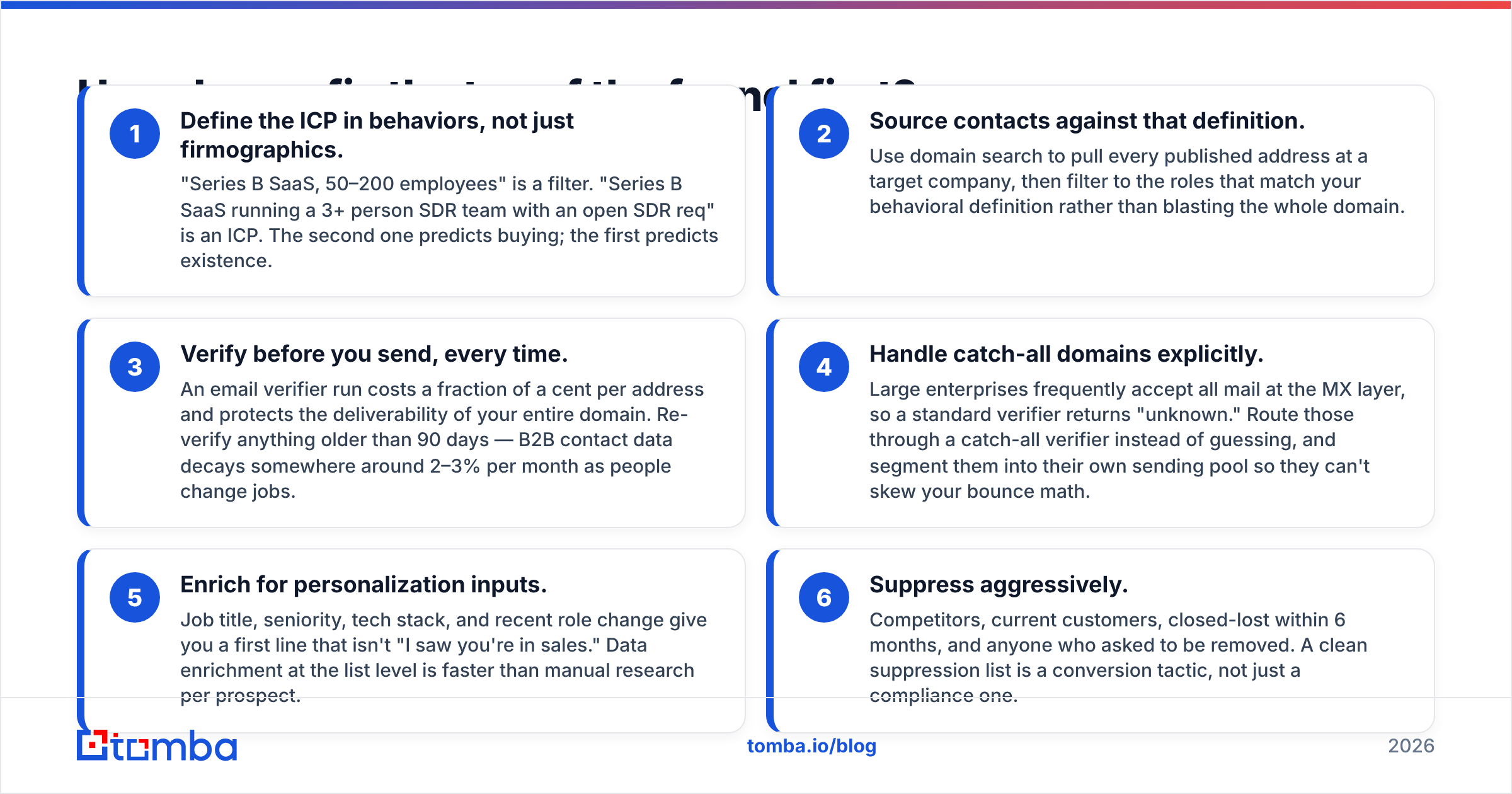
- Define the ICP in behaviors, not just firmographics. "Series B SaaS, 50–200 employees" is a filter. "Series B SaaS running a 3+ person SDR team with an open SDR req" is an ICP. The second one predicts buying; the first predicts existence.
- Source contacts against that definition. Use domain search to pull every published address at a target company, then filter to the roles that match your behavioral definition rather than blasting the whole domain.
- Verify before you send, every time. An email verifier run costs a fraction of a cent per address and protects the deliverability of your entire domain. Re-verify anything older than 90 days — B2B contact data decays somewhere around 2–3% per month as people change jobs.
- Handle catch-all domains explicitly. Large enterprises frequently accept all mail at the MX layer, so a standard verifier returns "unknown." Route those through a catch-all verifier instead of guessing, and segment them into their own sending pool so they can't skew your bounce math.
- Enrich for personalization inputs. Job title, seniority, tech stack, and recent role change give you a first line that isn't "I saw you're in sales." Data enrichment at the list level is faster than manual research per prospect.
- Suppress aggressively. Competitors, current customers, closed-lost within 6 months, and anyone who asked to be removed. A clean suppression list is a conversion tactic, not just a compliance one.
Teams that do this consistently usually see the biggest single jump not in reply rate but in meeting-held rate — because they were previously booking calls with people who were never going to buy.
Which levers move each stage the most?#
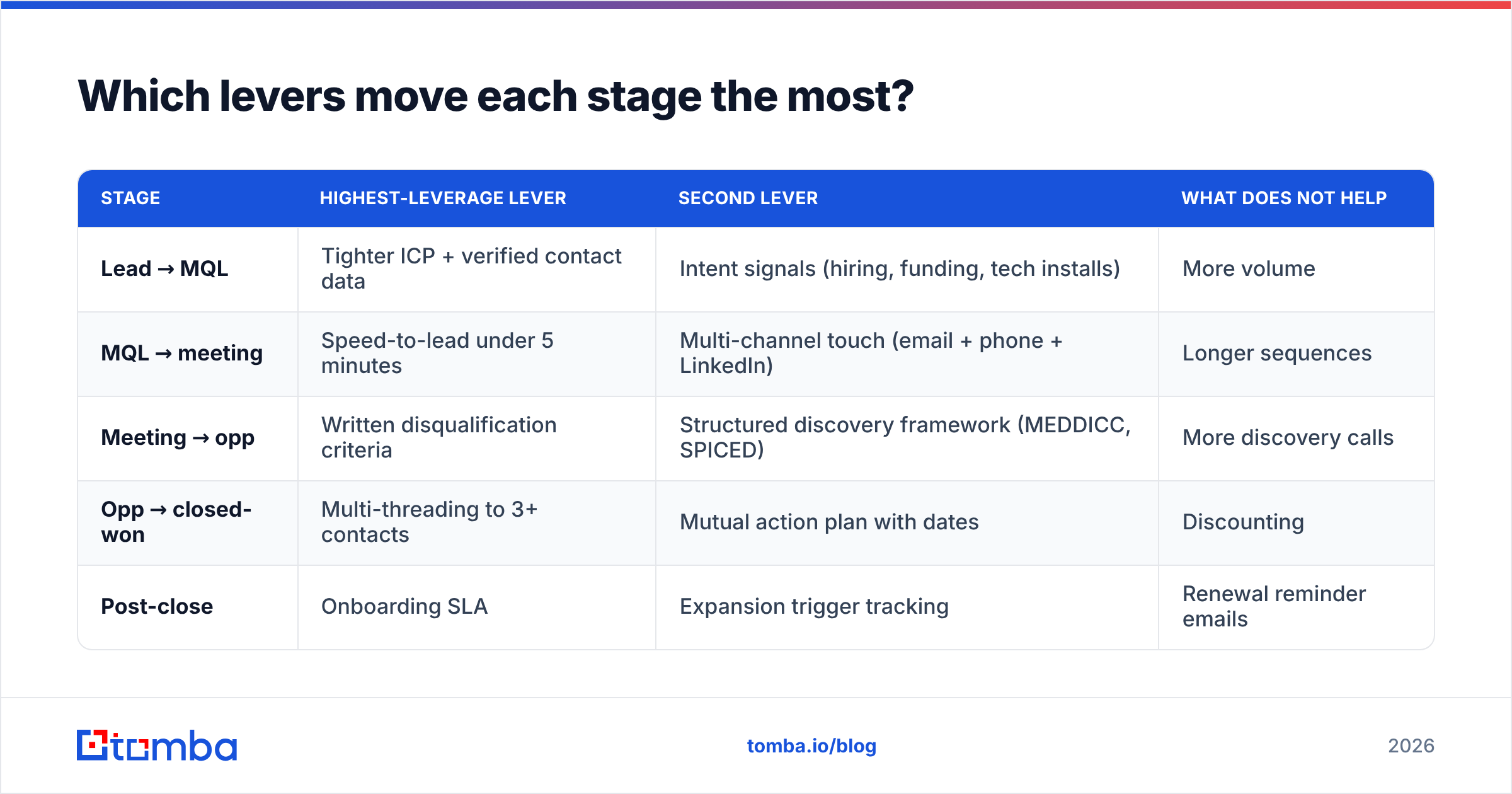
Different stages respond to different interventions. Applying a mid-funnel fix to a top-funnel problem is the most common wasted quarter in sales ops.
| Stage | Highest-leverage lever | Second lever | What does NOT help |
|---|---|---|---|
| Lead → MQL | Tighter ICP + verified contact data | Intent signals (hiring, funding, tech installs) | More volume |
| MQL → meeting | Speed-to-lead under 5 minutes | Multi-channel touch (email + phone + LinkedIn) | Longer sequences |
| Meeting → opp | Written disqualification criteria | Structured discovery framework (MEDDICC, SPICED) | More discovery calls |
| Opp → closed-won | Multi-threading to 3+ contacts | Mutual action plan with dates | Discounting |
| Post-close | Onboarding SLA | Expansion trigger tracking | Renewal reminder emails |
Two of those deserve detail.
Speed-to-lead. HubSpot's research on response times and the widely cited Lead Response Management study both point the same direction: contact rates fall off a cliff after the first few minutes. If a form fill sits in a queue overnight, you have converted a hot lead into a cold one at no cost savings. Route inbound to a live rep, or at minimum to an automated calendar link, within minutes. This is an operations problem, not a sales-skill problem.
Multi-threading. Deals with a single contact die when that contact changes jobs, gets reorganized, or simply goes quiet. Aim for three named stakeholders in every opportunity above your median ACV: the user, the economic buyer, and one skeptic. Getting there means finding contacts you weren't given — an email finder or phone finder is how you reach the CFO your champion never introduced you to.
How do you actually measure improvement?#
Measure by cohort. This is the discipline that separates teams who improve from teams who report.
A monthly conversion snapshot mixes deals sourced in January with deals sourced in April. If your April list quality improved, the January deals still dragging through the pipeline hide it for two more quarters. Instead:
- Tag every lead with its source week and source channel.
- Report stage conversion for each weekly cohort as it ages.
- Compare week-over-week cohorts at the same age, e.g. "week 12 cohort at day 30" vs "week 20 cohort at day 30."
You will need enough volume for this to be statistically meaningful. A useful rule: don't act on a conversion difference until the smaller cohort has at least 100 entries at the stage in question. Below that, you are reading noise. G2's B2B benchmarking resources and Gartner's sales research are reasonable external sanity checks when your internal sample is thin.
Also fix your denominators. If you count "leads" as everyone who downloaded a PDF and "conversions" as closed-won, your headline number will be under 1% forever and will never be actionable. Every ratio needs both a defined numerator and a defined stage entry criterion written down where the whole team can see it.
What does a realistic 90-day improvement plan look like?#
Sequenced, because doing all of these at once means you learn nothing about which worked.
Days 1–30 — instrument and clean. Write down the stage definitions. Audit your CRM for stage-entry consistency. Run your entire active list through verification and quarantine anything risky. Set up cohort tagging. Expect your reported conversion rates to get worse this month — you are removing the fake volume that was inflating them.
Days 31–60 — fix the biggest leak. Pick exactly one stage: the one furthest below benchmark. If it's MQL→meeting, build the speed-to-lead routing. If it's meeting→opp, write the disqualification criteria and enforce them in the CRM as a required field. One change, measured against the cohorts you started tagging in month one.
Days 61–90 — scale what worked, kill what didn't. Now add the second lever from the table above for the same stage. Only after the first stage is inside its benchmark range do you move to the next stage. Resist the urge to fix everything; parallel changes make attribution impossible.
Throughout, keep a running log of what you changed and when. Six months from now, when someone asks why Q2 conversion jumped, that log is the only honest answer available.
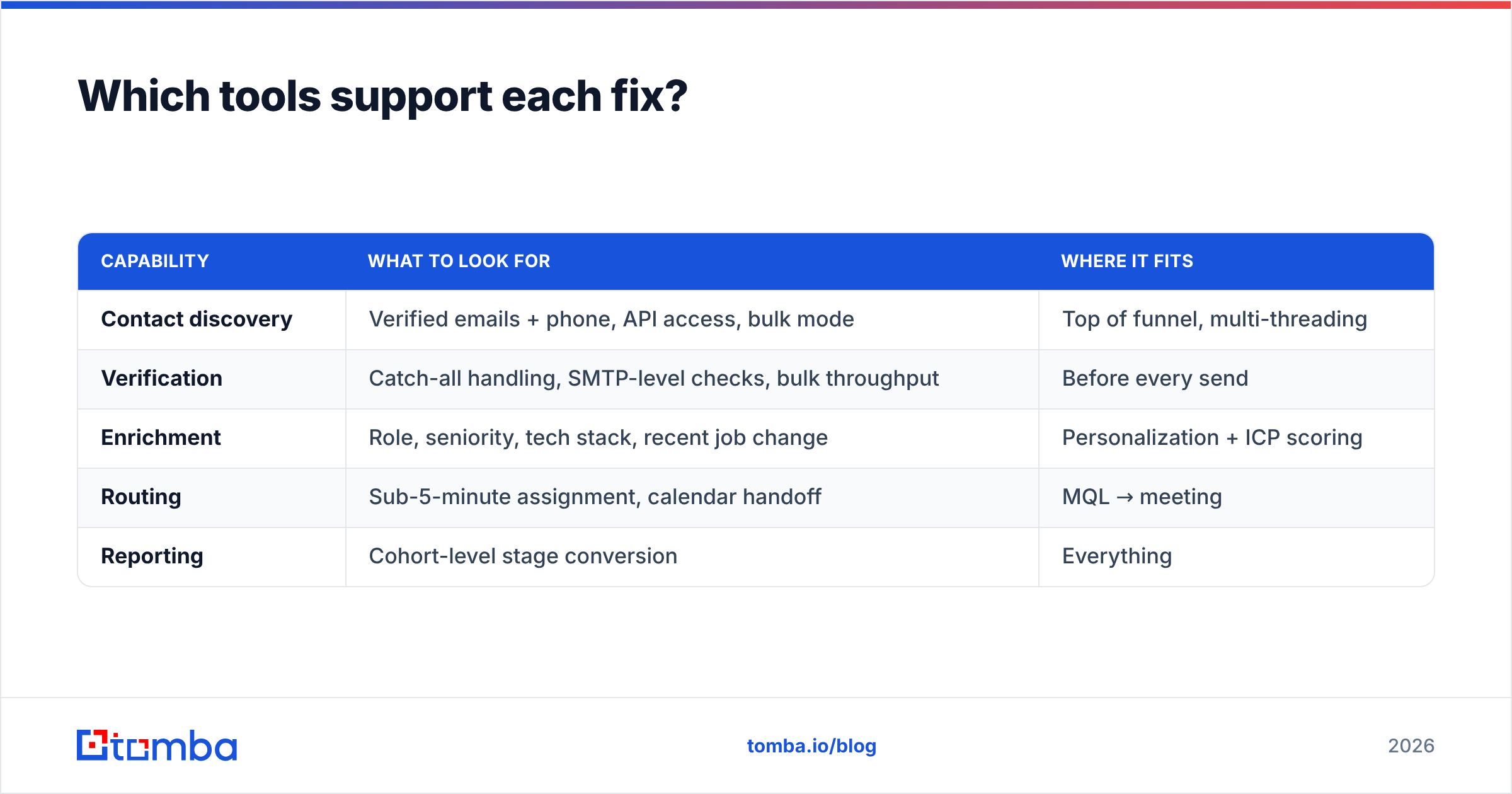
Which tools support each fix?#
You do not need a new tech stack. You need three capabilities wired together: accurate contact data, fast routing, and stage-level reporting.
| Capability | What to look for | Where it fits |
|---|---|---|
| Contact discovery | Verified emails + phone, API access, bulk mode | Top of funnel, multi-threading |
| Verification | Catch-all handling, SMTP-level checks, bulk throughput | Before every send |
| Enrichment | Role, seniority, tech stack, recent job change | Personalization + ICP scoring |
| Routing | Sub-5-minute assignment, calendar handoff | MQL → meeting |
| Reporting | Cohort-level stage conversion | Everything |
On the data side, Tomba pricing starts with a free tier at 25 searches/month, then Starter at $49/mo, Growth at $99/mo, and Pro at $249/mo, with Enterprise custom. Peers like BookYourData take a different approach — pay-as-you-go prebuilt lists with a strong accuracy guarantee — which suits teams that want a purchased list rather than a search-and-verify workflow. Both are legitimate models; pick based on whether your motion is "I know exactly which companies I want" (search) or "give me 5,000 verified contacts in this segment" (list purchase).
For routing and reporting, your CRM almost certainly already does this. The gap is usually configuration discipline, not missing software. Before buying anything, check whether your existing CRM can enforce stage-entry criteria as required fields. Most can.
What should you do this week?#
Three concrete actions, in order:
- Export your last 90 days of outbound sends and calculate your true bounce rate. If it's above 3%, stop everything else and fix the list.
- Write one sentence defining each pipeline stage. Circulate it. You will discover at least two people disagreed.
- Time your inbound response from form fill to first human contact. Measure the median, not the average — averages hide the overnight cases.
None of these require budget approval. All three will tell you more about your conversion problem than another week of A/B testing subject lines.
Start where the leak is biggest. If your audit points at contact quality — bounces above 3%, meetings with the wrong titles, deals stuck single-threaded — fix the input before you tune the process. Tomba Email Finder gives you verified professional addresses by domain, name, or company, with a free tier of 25 searches a month so you can test your ICP hypothesis before committing budget. Clean data in, honest conversion rates out.
Related guides#
// get started
Find, verify and enrich your first contacts today
Start on the free plan with 25 searches a month, then scale when your team is ready.
Free plan · No credit card required · GDPR & CCPA
// about the author