How to Improve Sales Revenue in 2026: A Practical Playbook
Revenue growth is not a motivation problem. It is a math problem across five levers: pipeline volume, conversion, deal size, cycle time, and retention. Here is how to pull each one.
TL;DR
- Revenue is an equation, not a vibe:
leads × conversion rate × average deal size × deals per period + expansion − churn. You can only improve what you isolate. - Most teams default to "more activity" when the cheapest gains sit in conversion rate, deal size, and cycle time — levers that need no extra headcount.
- Bad contact data silently taxes every other lever. A 25% bounce rate on outbound doesn't just waste sends; it damages sender reputation and depresses every campaign after it.
- Expansion and retention revenue is usually 2-5x cheaper to win than net-new, and most B2B teams still have no owner for it.
- Run one lever per 90-day cycle with a single tracked metric. Pulling five at once means you learn nothing.
Why does "work harder" fail to improve sales revenue?#
Because effort is an input, and revenue is an output of a system with five multiplicative variables. If your close rate is 8% and you double activity, you get twice as many losses alongside twice as many wins — plus a burned-out team and a damaged domain.
Write your revenue equation out before you change anything:
Revenue = Qualified Opportunities × Win Rate × Average Contract Value × Deal Velocity + Expansion − Churn
Each term is a lever. Each lever has a different cost, a different time-to-impact, and a different owner. The teams that grow predictably pick the lever with the best ratio of impact to effort and ignore the rest for a quarter.
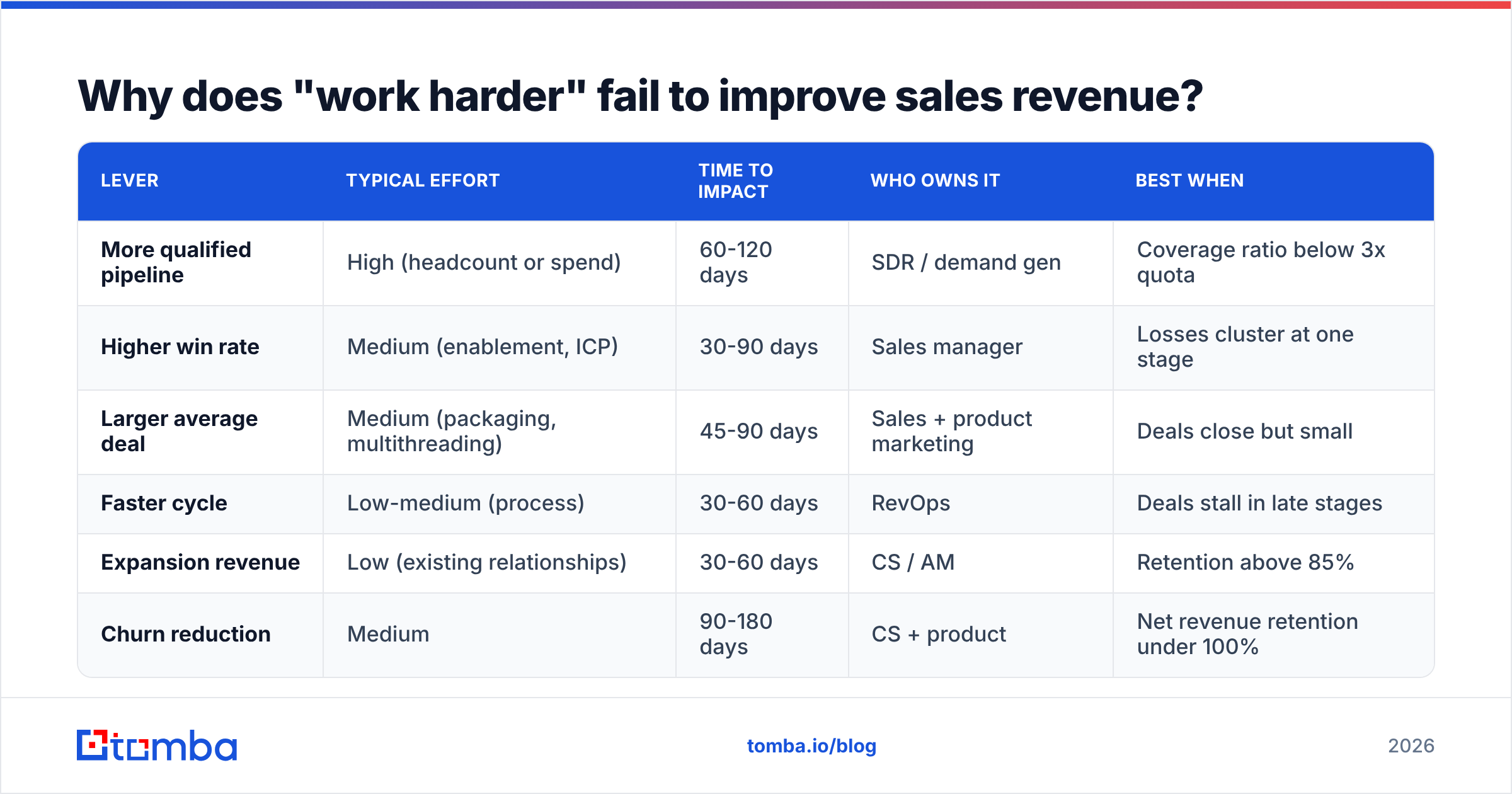
Here's the honest comparison most sales leaders skip:
| Lever | Typical effort | Time to impact | Who owns it | Best when |
|---|---|---|---|---|
| More qualified pipeline | High (headcount or spend) | 60-120 days | SDR / demand gen | Coverage ratio below 3x quota |
| Higher win rate | Medium (enablement, ICP) | 30-90 days | Sales manager | Losses cluster at one stage |
| Larger average deal | Medium (packaging, multithreading) | 45-90 days | Sales + product marketing | Deals close but small |
| Faster cycle | Low-medium (process) | 30-60 days | RevOps | Deals stall in late stages |
| Expansion revenue | Low (existing relationships) | 30-60 days | CS / AM | Retention above 85% |
| Churn reduction | Medium | 90-180 days | CS + product | Net revenue retention under 100% |
If you can only look at one column, look at "Time to impact." Expansion and cycle time pay back inside a quarter. Pipeline expansion rarely does.
Which revenue lever should you pull first?#
Diagnose before you prescribe. Pull your last 100 closed opportunities and answer four questions:
- What's your pipeline coverage ratio? Open pipeline divided by quota for the period. Below 3x, you have a volume problem. Above 5x with a low close rate, you have a qualification problem — you're stuffing the funnel with people who were never going to buy.
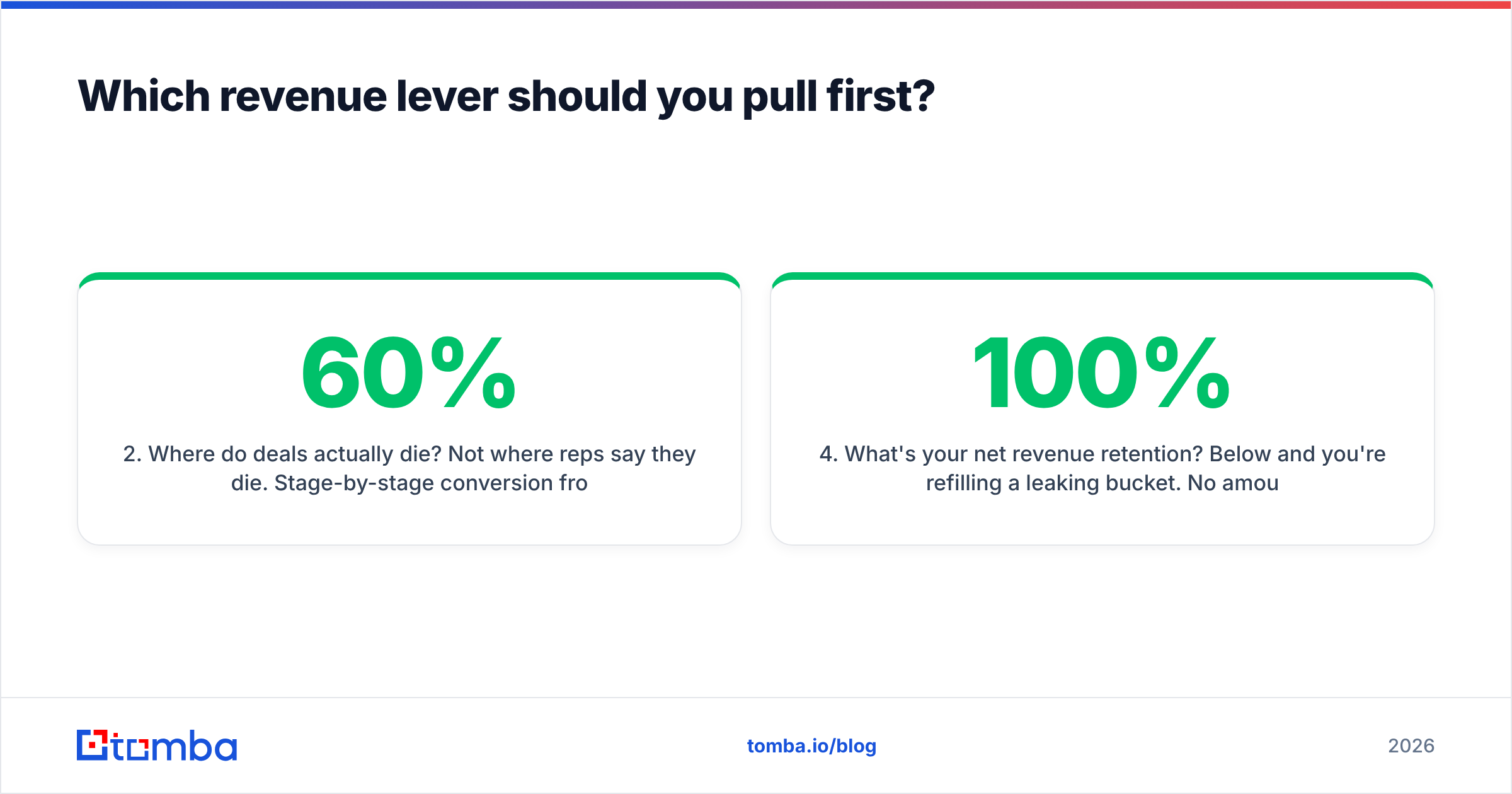
- Where do deals actually die? Not where reps say they die. Stage-by-stage conversion from your CRM. A 60% drop between demo and proposal is a discovery problem. A 60% drop between proposal and close is a pricing or champion problem.
- How long is the median cycle, and what's the tail? If the median is 34 days but the mean is 71, a handful of zombie deals are eating your forecast and your reps' calendars.
- What's your net revenue retention? Below 100% and you're refilling a leaking bucket. No amount of new logo work fixes that permanently.
The answers point at exactly one lever. Resist the urge to fix all four.
How do you increase qualified pipeline without hiring?#
The pipeline problem is almost never "we don't know who to contact." It's that the list you contact is stale, unverified, or aimed at the wrong seniority.
Fix the list before the message. Three concrete moves:
- Tighten the ICP to your top-decile customers. Take your 10 highest-LTV accounts, find the shared firmographic and technographic traits, and rebuild your target list from that intersection. Most teams' "ICP" is a range wide enough to include half the internet.
- Verify every contact before it enters a sequence. Invalid addresses cause hard bounces, and hard bounces above roughly 2% start dragging your domain reputation down. Run lists through an email verifier before send, not after the first bounce report.
- Use pattern-based discovery instead of scraped dumps. When you know the company and the person but not the address, a domain search that returns the company's actual email pattern beats guessing between five permutations and burning four sends.
Then fix the targeting sequence. Multithread from the first touch. Single-threaded deals — one contact, one champion — die when that person changes jobs, which happens to roughly a fifth of B2B buyers each year. Find three contacts per account: the user who feels the pain, the manager who owns the budget line, and the executive who owns the outcome.
And measure the right thing. SDR activity metrics (calls, emails sent) reward volume. Meetings-held-that-reach-stage-two rewards quality. Change the metric and the behavior follows within two weeks.
How do you raise win rate on the pipeline you already have?#
Win rate is the cheapest lever because it costs nothing but process discipline. Four changes with reliable returns:
- Disqualify faster and louder. Give reps explicit permission to close-lost in week one. A deal that dies in seven days costs a fraction of one that dies in seventy. Track "time to disqualify" as a positive metric.
- Mandate a mutual action plan by stage three. A shared document with dates, owners, and the buyer's internal steps. Deals with a written mutual plan close at meaningfully higher rates than those without, largely because they surface hidden approval steps early.
- Run loss reviews, not win reviews. Wins teach you confirmation bias. Interview five lost deals a month — the buyer, not the rep — and you'll find the same two objections repeating.
- Fix discovery, not the demo. Most low win rates are diagnosed as "weak demos" and are actually weak discovery. If a rep can't state the buyer's cost of inaction in dollars, the demo is theater.
For teams selling into technical buyers, add a fifth: give reps a single-page technical FAQ they can send without waiting for a solutions engineer. The two-day lag while they "check with the SE" is where momentum dies.
Can better data actually move the revenue number?#
Yes, and the mechanism is boring: bad data multiplies against every other lever, so fixing it compounds.
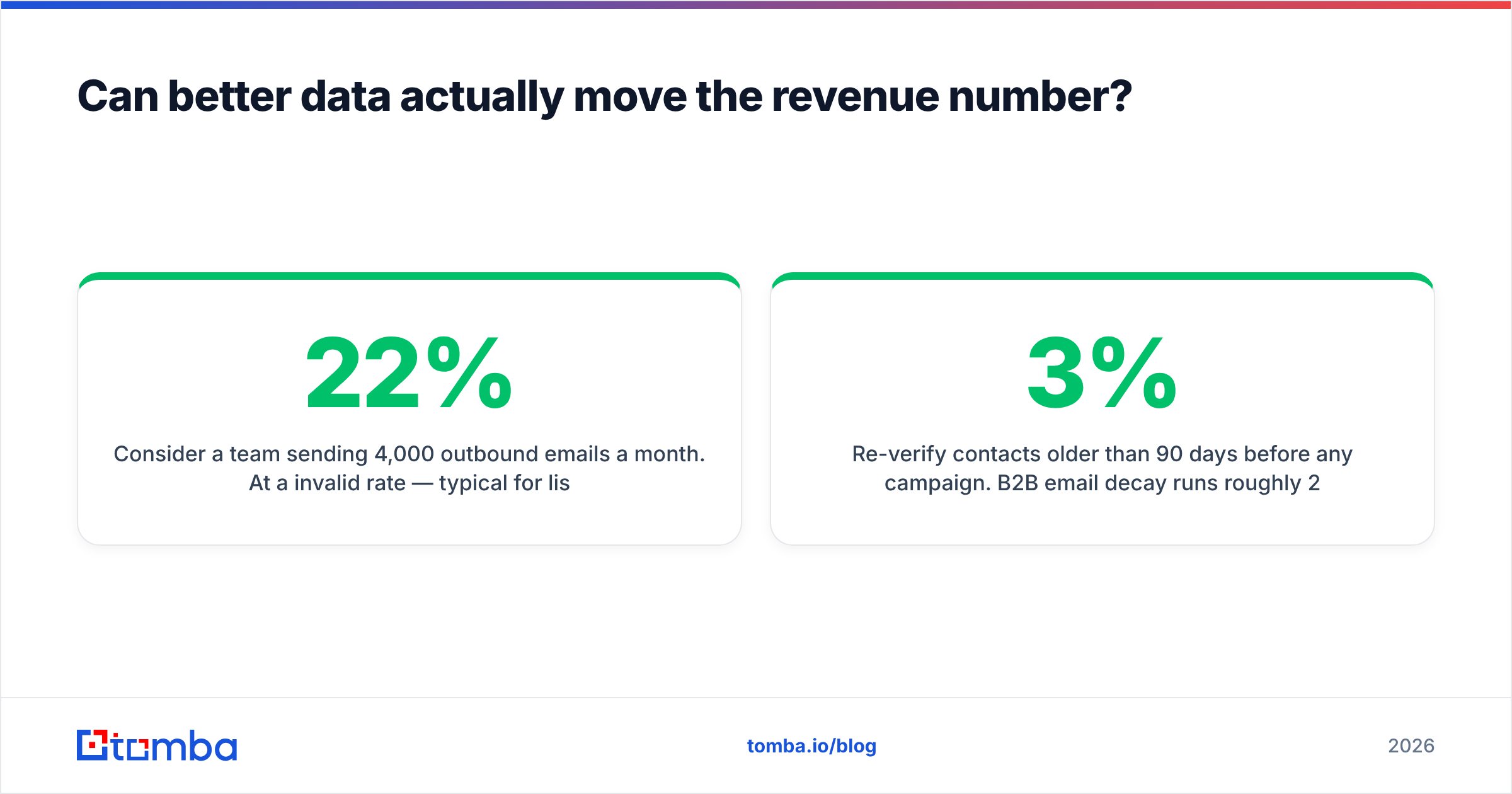
Consider a team sending 4,000 outbound emails a month. At a 22% invalid rate — typical for lists older than six months — 880 sends do nothing except generate bounces. Those bounces suppress inbox placement for the remaining 3,120, so the real cost is far above 22%. Clean the list and you haven't just recovered 880 sends; you've raised the delivery rate on everything else.
The same logic applies inside the CRM. Duplicate accounts split pipeline reporting. Missing phone numbers force a rep to email when a call would have closed. Stale job titles mean your "VP of Engineering" sequence lands on someone who left in 2024.
Concrete data hygiene checklist:
- Re-verify contacts older than 90 days before any campaign. B2B email decay runs roughly 2-3% per month.
- Deduplicate on domain, not company name. "Acme Inc" and "Acme, Inc." are two rows and one account.
- Enrich at point of entry. Inbound forms should ask for email and enrich the rest. Every extra field costs conversion. Push the work to data enrichment instead of to the prospect.
- Add phone as a fallback channel. Email-only outbound caps your reachable audience. A phone finder turns a dead email thread into a live conversation.
- Set a decay policy. Anything untouched for 12 months gets archived, not re-sequenced.
Data work is unglamorous and it is the highest-ROI hour a RevOps person spends. The industry research from Gartner has consistently pointed at data quality as a top constraint on seller productivity — not because the insight is novel, but because almost nobody acts on it.
How do you increase average deal size?#
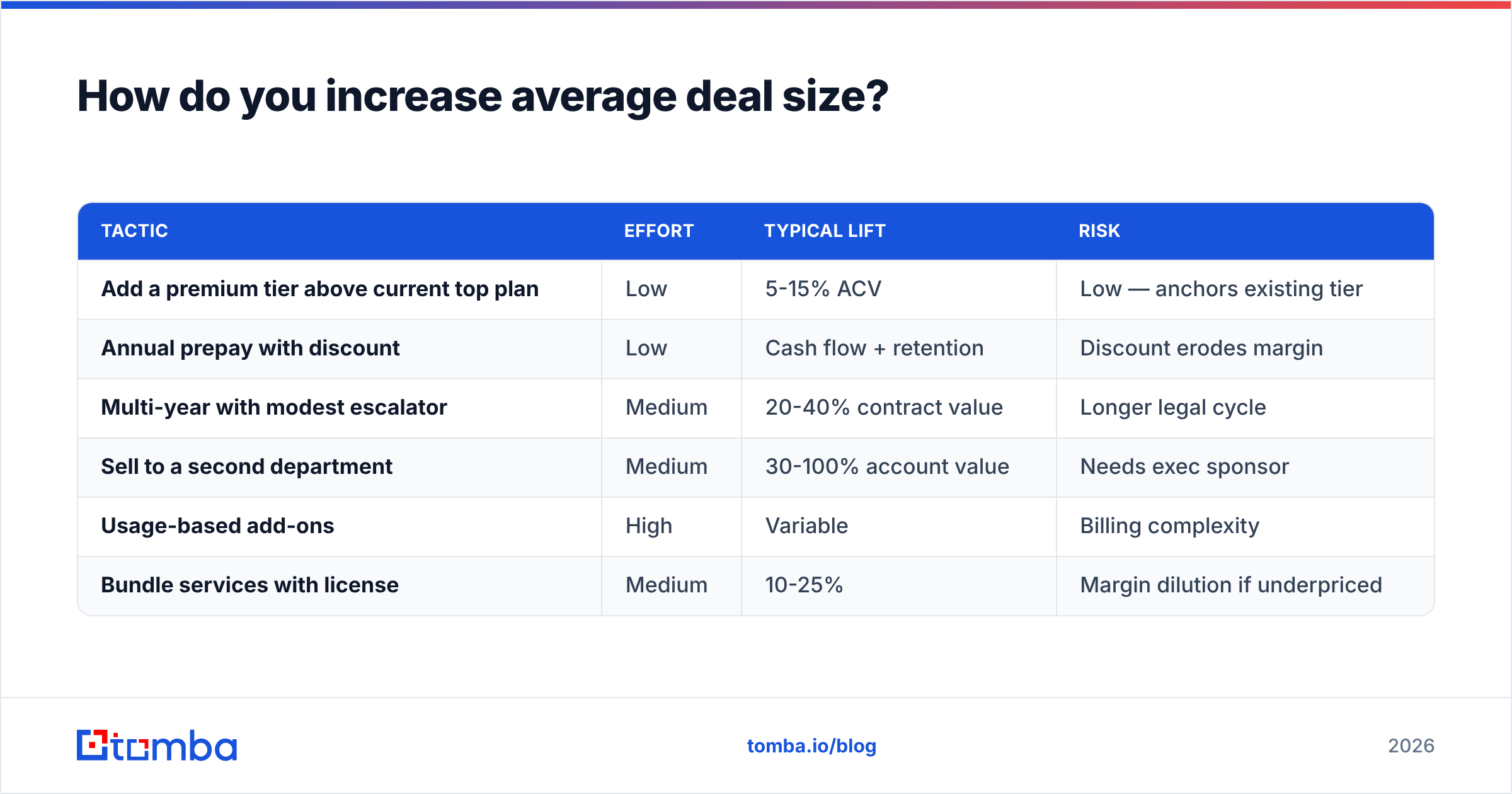
Deal size is the most underused lever because it feels like it requires a product change. It usually doesn't.
| Tactic | Effort | Typical lift | Risk |
|---|---|---|---|
| Add a premium tier above current top plan | Low | 5-15% ACV | Low — anchors existing tier |
| Annual prepay with discount | Low | Cash flow + retention | Discount erodes margin |
| Multi-year with modest escalator | Medium | 20-40% contract value | Longer legal cycle |
| Sell to a second department | Medium | 30-100% account value | Needs exec sponsor |
| Usage-based add-ons | High | Variable | Billing complexity |
| Bundle services with license | Medium | 10-25% | Margin dilution if underpriced |
Two rules make these work. First, never lead with the smallest package. Reps default to the easiest yes. Present three options with the target in the middle. Second, quantify the buyer's cost of inaction in their numbers before you name a price. A $60,000 contract is expensive in the abstract and cheap against $400,000 of wasted spend.
Also worth checking: when did you last raise prices? Many B2B teams have not adjusted list price in three years while their cost base moved. A 7% increase on renewals, applied with 60 days' notice and a clear value narrative, typically loses under 2% of accounts.
How do you shorten the sales cycle?#
Cycle time is a revenue multiplier hiding as an efficiency metric. Cut a 90-day cycle to 70 and the same rep closes roughly 28% more deals per year with no change in win rate.
Where the days actually go:
- Waiting for the next meeting. Book the next step while you're still on the current call. Never end a call with "I'll send some times."
- Security and procurement review. Prepare a standing security packet — SOC 2 letter, DPA template, subprocessor list — and send it at stage two, not when legal asks at stage five.
- Champion building an internal case alone. Give them the deck, the ROI model, and the one-pager for their CFO. Your champion is a part-time salesperson for you with no training.
- Silent stall after proposal. Set an expiration on commercial terms tied to a quarter boundary, and say so at proposal time rather than as a late scramble.
RevOps should instrument stage-entry timestamps so you can see the actual distribution, not the average. The fix is almost always at one stage, not spread evenly.
Where does expansion revenue fit?#
It's the lever most B2B teams leave entirely unowned, and it's usually the cheapest dollar in the business. Selling to an existing account skips discovery, trust-building, and procurement onboarding — the three most expensive phases of a new deal.
Three moves, in order of speed:
- Build a seat-expansion trigger. If an account hits 85% of licensed seats, that's an automatic conversation, not a renewal-time surprise.
- Map the org chart of your top 20 accounts. Who are the three departments adjacent to your current user base? A LinkedIn finder makes mapping those adjacent teams fast enough to actually do.
- Separate renewal from expansion conversations. Bundling them lets the buyer trade one against the other. Renew first, expand thirty days later.
Track net revenue retention as a board-level metric. If it sits above 110%, your existing base grows the business even in a quarter with zero new logos. Companies tracked in public benchmarks — the kind G2 and analyst firms publish annually — consistently show NRR as the strongest predictor of durable growth.
What does a realistic 90-day revenue plan look like?#
Pick one lever. Instrument one metric. Review weekly.
Days 1-14 — Diagnose. Export 100 closed opportunities. Calculate stage conversion, median cycle, ACV distribution, and NRR. Interview five lost deals. Do not change anything yet.
Days 15-30 — Fix the data floor. Regardless of which lever you chose, verify and enrich your active contact base. This is the prerequisite that makes every downstream measurement trustworthy. Use a bulk email finder for the backlog rather than a rep doing it by hand.
Days 31-60 — Run one intervention. One change, communicated once, enforced consistently. If it's win rate: mandatory mutual action plans at stage three. If it's cycle time: next-meeting-booked-on-the-call. If it's deal size: three-tier presentation with target in the middle.
Days 61-90 — Measure and decide. Compare the cohort of deals created after day 31 against the prior quarter's cohort. Same stage, same segment. If the metric moved, systematize it into onboarding and the CRM. If it didn't, kill it and pick the next lever — don't let a failed experiment linger as a half-followed process.
The discipline of one lever per quarter is what separates teams that compound from teams that thrash. Four quarters, four levers, four documented improvements beats twelve simultaneous initiatives that all get abandoned in week six.
What tooling actually supports this?#
You need less than the market wants to sell you. A CRM you enforce, a sequencing tool, and a reliable contact data source cover the majority of the work. Everything else is optional until you have a specific bottleneck it solves.
For the contact data layer, evaluate on three things: match rate on your actual ICP (not the vendor's sample), verification depth including catch-all handling, and cost per verified contact rather than per credit. Run the same 100-row test list through any two providers before committing. Pricing pages are easy to compare; accuracy on your specific segment is the only test that matters — check Tomba pricing against whoever else is on your shortlist, and weigh both against your own sample results.
Start where the leak is. If your outbound is bouncing, your problem isn't strategy — it's the list. Run your next campaign's contacts through the Tomba Email Finder to build a verified, pattern-matched list before you write a single subject line. The free tier gives you 25 searches a month to test match rates on your own ICP; paid plans start at $49/mo when you're ready to scale the volume. Fix the data floor first, then pull your chosen lever — that's the order that actually moves the revenue number.
Related guides#
Ready to find emails that actually work?
Join 150,000+ professionals who stopped guessing and started sending. Free credits on signup — no credit card required.
Get the Tomba newsletter
Practical outbound tactics and product updates — once every two weeks.
About the author