How to Incentivize Sales Reps in 2026: A Practical Guide
Commission alone stopped moving the needle years ago. Here is how to incentivize sales reps with plans that reward the behaviors that actually close revenue — plus what to avoid.
TL;DR
- Incentives work when they reward the two or three behaviors that actually move pipeline — not when they reward everything at once.
- Base/variable splits of 50/50 remain standard for full-cycle AEs; SDRs typically sit at 70/30 with a meetings-held component.
- Non-cash incentives (recognition, time, career access) outperform equivalent cash amounts for mid-performers, who are where most of your recoverable revenue sits.
- Quota attainment below 50% team-wide is a targeting problem, not a motivation problem. Fix the data before you fix the comp plan.
- Cap nothing on the top end. Accelerators above 100% attainment are the single highest-ROI line item in most plans.
What does "incentivize" actually mean in a sales org?#
It means paying for outcomes you want repeated. That is the whole idea, and most comp plans break because they drift away from it.
Think of a comp plan like a thermostat. You set a target, the system reads the room, and it adjusts. If your thermostat is wired to the wrong sensor — say, activity volume instead of closed revenue — it will heat the wrong room enthusiastically and forever. Reps are rational. They optimize for what gets measured and paid.
So before you touch a single percentage, answer this: what specific behavior is under-supplied on your team right now? Not "more revenue." Something concrete — multithreading into second stakeholders, booking discovery calls with VP+ titles, expanding existing accounts, or shortening the gap between demo and proposal. That answer is your incentive design brief.
The mistake most sales leaders make is treating incentive design as a finance exercise. Finance owns the budget envelope. You own the behavioral wiring inside it.
How do you structure base pay versus variable pay?#
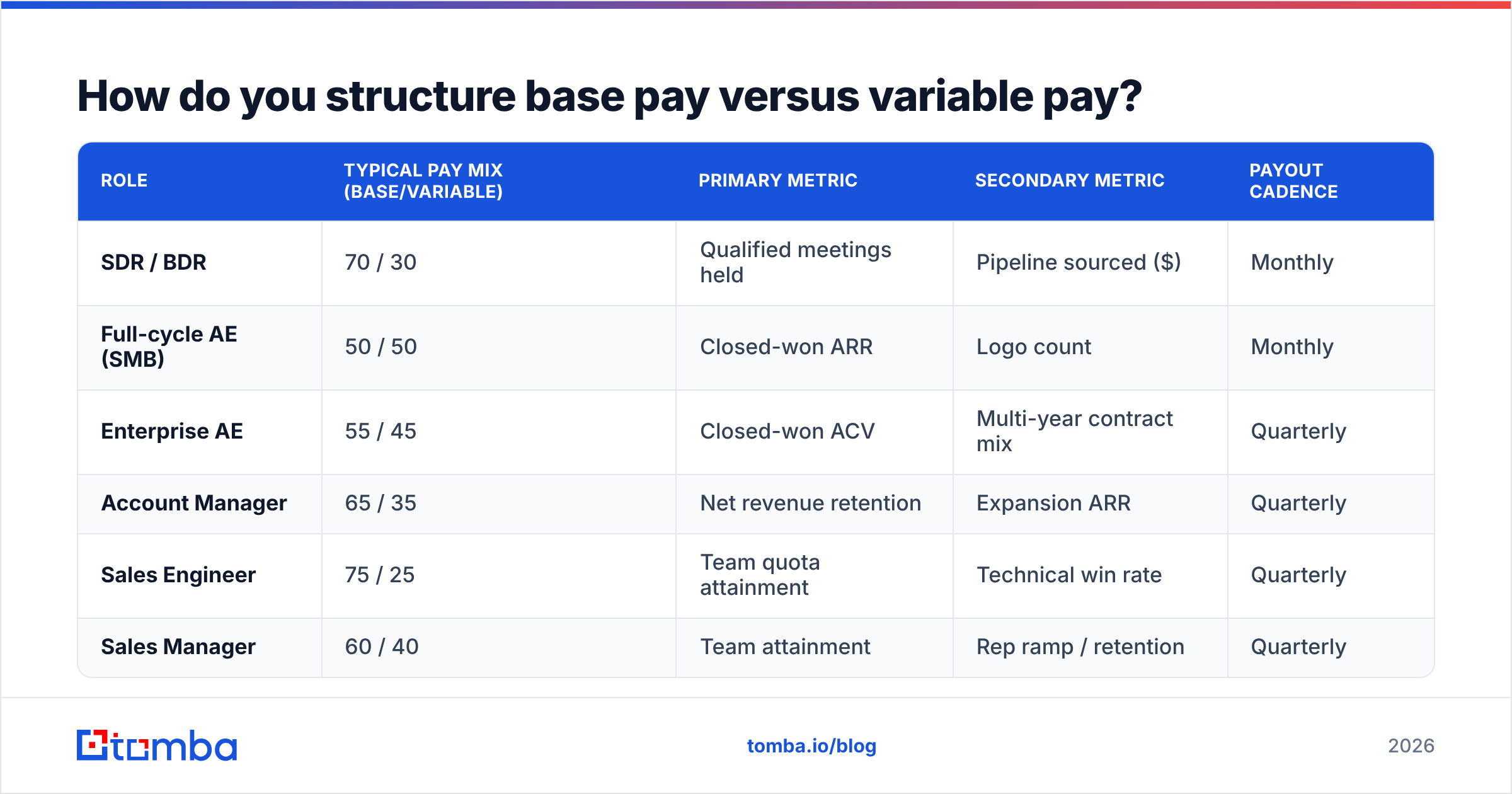
Start with the pay mix, because everything else hangs off it. The rule of thumb: the more control a rep has over the outcome, the more variable their pay should be.
| Role | Typical pay mix (base/variable) | Primary metric | Secondary metric | Payout cadence |
|---|---|---|---|---|
| SDR / BDR | 70 / 30 | Qualified meetings held | Pipeline sourced ($) | Monthly |
| Full-cycle AE (SMB) | 50 / 50 | Closed-won ARR | Logo count | Monthly |
| Enterprise AE | 55 / 45 | Closed-won ACV | Multi-year contract mix | Quarterly |
| Account Manager | 65 / 35 | Net revenue retention | Expansion ARR | Quarterly |
| Sales Engineer | 75 / 25 | Team quota attainment | Technical win rate | Quarterly |
| Sales Manager | 60 / 40 | Team attainment | Rep ramp / retention | Quarterly |
Two things to notice. First, SDRs get paid on meetings held, not meetings booked. Booked-meeting comp is the single most gamed metric in outbound — it manufactures no-shows. Held, and ideally held-and-accepted-by-the-AE, is the honest version.
Second, enterprise roles pay quarterly. Long cycles plus monthly payouts create dead months where a rep's earnings are structurally zero regardless of effort, and dead months are when good reps update their LinkedIn.
What are the seven incentive levers that actually work?#
These are ordered by how reliably they change behavior, based on what most B2B orgs report and what compensation research from firms like Gartner and Forrester consistently finds.
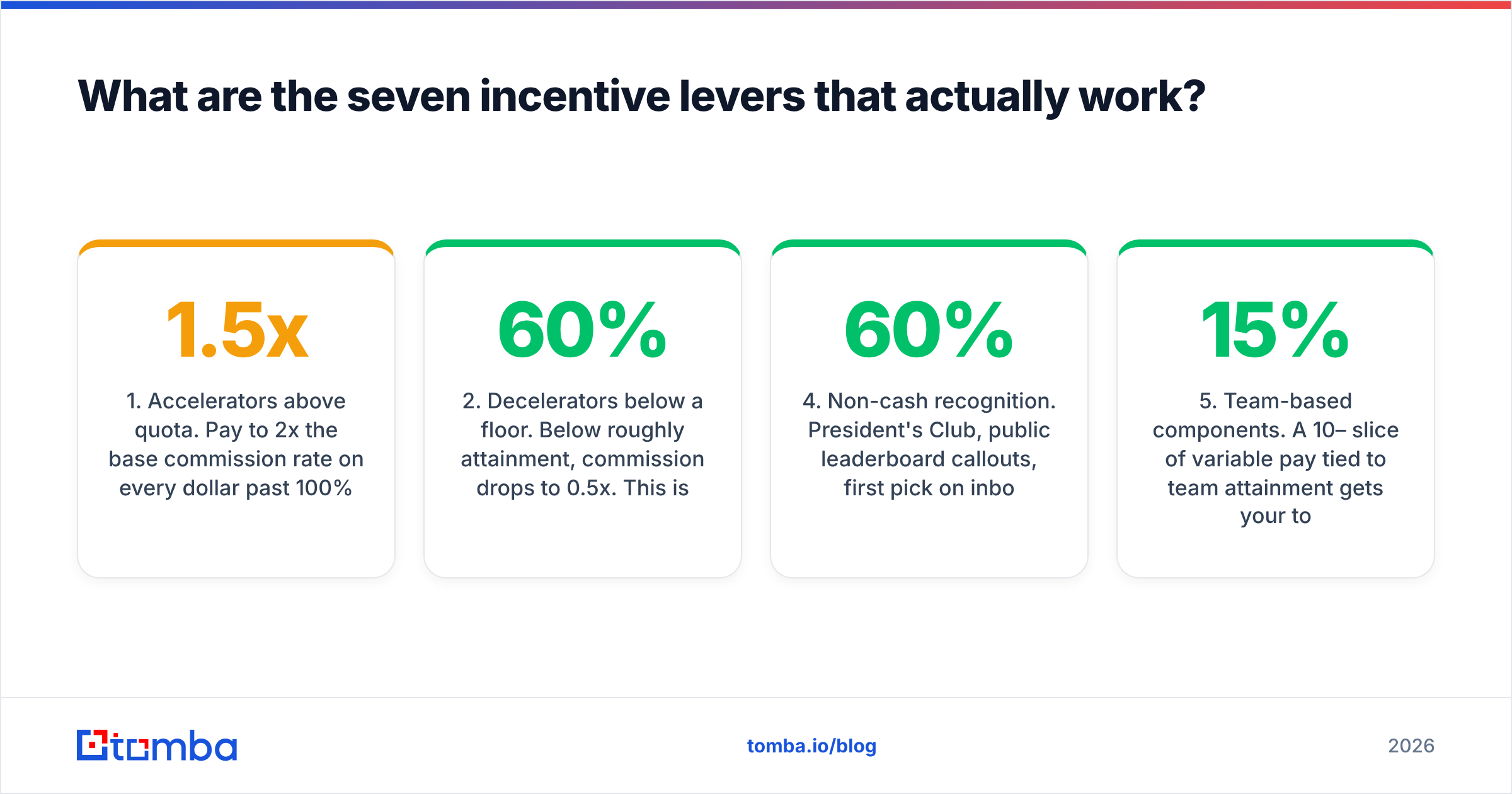
Accelerators above quota. Pay 1.5x to 2x the base commission rate on every dollar past 100% attainment. This is the highest-leverage line in any plan. A rep at 95% attainment with a visible accelerator ahead of them will find two more deals in the last week of the quarter. A rep at 95% with a flat rate will roll them to next period.
Decelerators below a floor. Below roughly 60% attainment, commission drops to 0.5x. This is not punishment — it's a signal that separates a bad quarter from a bad fit, and it protects your budget from funding chronic underperformance.
Behavior-based SPIFFs, run short. A two-week SPIFF on a specific action — booking meetings in a new vertical, running competitive displacement plays, getting three-stakeholder demos — works because it's narrow and time-boxed. SPIFFs that run all quarter become salary.
Non-cash recognition. President's Club, public leaderboard callouts, first pick on inbound leads, a lunch with the CEO. These cost little and disproportionately motivate the middle 60% of your team, which is where the recoverable revenue actually lives.
Team-based components. A 10–15% slice of variable pay tied to team attainment gets your top rep to actually share the objection-handling script instead of hoarding it.
Time and autonomy. Flexible Fridays for quota-hitters, choice of territory in the next planning cycle, remote-work latitude. Senior reps rate these near the top when surveyed — often above an equivalent cash bump.
Career-path clarity. "Hit 100% three quarters running and you are eligible for the enterprise team" is an incentive. It's free, and it's the one most orgs forget to write down.
Is cash always the strongest motivator?#
No — and this is where most plans leave value on the table.
Cash is the strongest motivator for your bottom quartile, who are often solving an immediate financial problem, and for your top 10%, who treat earnings as a scoreboard. For the middle of the distribution, cash bonuses get absorbed into household budgets within about a month and stop being salient. Recognition, status, and access do not get absorbed the same way — a President's Club trip gets talked about for a year.
The practical move is a blended structure: keep commission simple and generous at the top end, then layer non-cash levers on the specific behaviors you want. Do not try to buy every behavior with money. You will run out of money before you run out of behaviors.
One more thing worth saying plainly: no incentive plan fixes a bad list. If your reps are dialing wrong numbers and emailing addresses that bounce, you are paying people to fail faster. Response rates on outbound collapse when data quality slips, and reps read that collapse as "this territory is dead" long before they read it as "this data is stale." Tightening your email verification and data enrichment pipeline usually produces a bigger attainment lift than any comp tweak — and it costs less.
How do you compare incentive plan types side by side?#
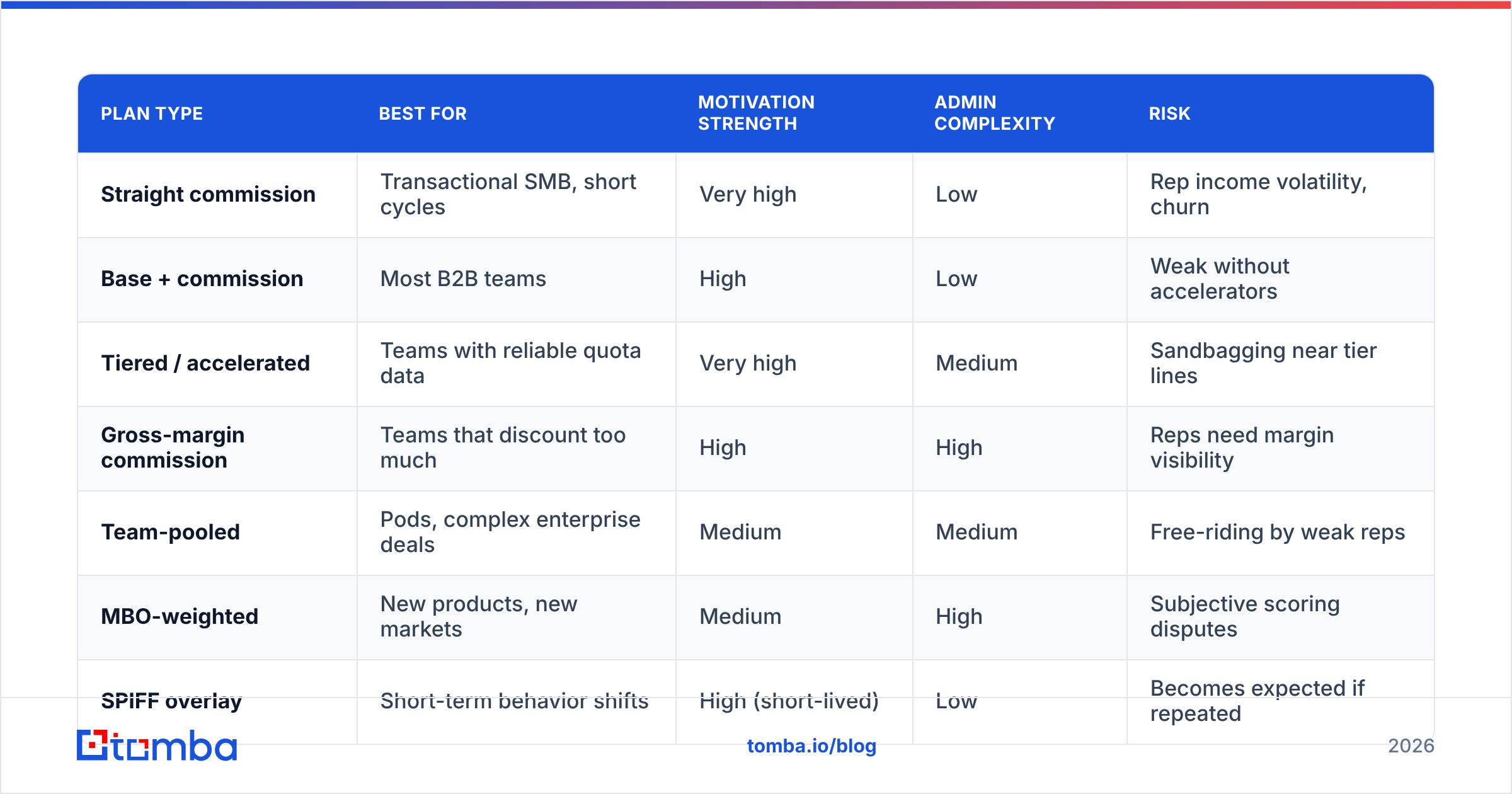
Different plan structures suit different motions. Here is how the common ones stack up.
| Plan type | Best for | Motivation strength | Admin complexity | Risk |
|---|---|---|---|---|
| Straight commission | Transactional SMB, short cycles | Very high | Low | Rep income volatility, churn |
| Base + commission | Most B2B teams | High | Low | Weak without accelerators |
| Tiered / accelerated | Teams with reliable quota data | Very high | Medium | Sandbagging near tier lines |
| Gross-margin commission | Teams that discount too much | High | High | Reps need margin visibility |
| Team-pooled | Pods, complex enterprise deals | Medium | Medium | Free-riding by weak reps |
| MBO-weighted | New products, new markets | Medium | High | Subjective scoring disputes |
| SPIFF overlay | Short-term behavior shifts | High (short-lived) | Low | Becomes expected if repeated |
A note on gross-margin commission: it is the correct answer when reps discount reflexively, and the wrong answer when reps cannot see margin data in the CRM. Do not deploy it until the number is visible on the opportunity record.
How do you set quotas reps actually believe?#
Quota credibility is the invisible half of incentive design. A rep who thinks the number is fictional will not chase the accelerator, no matter how rich it is.
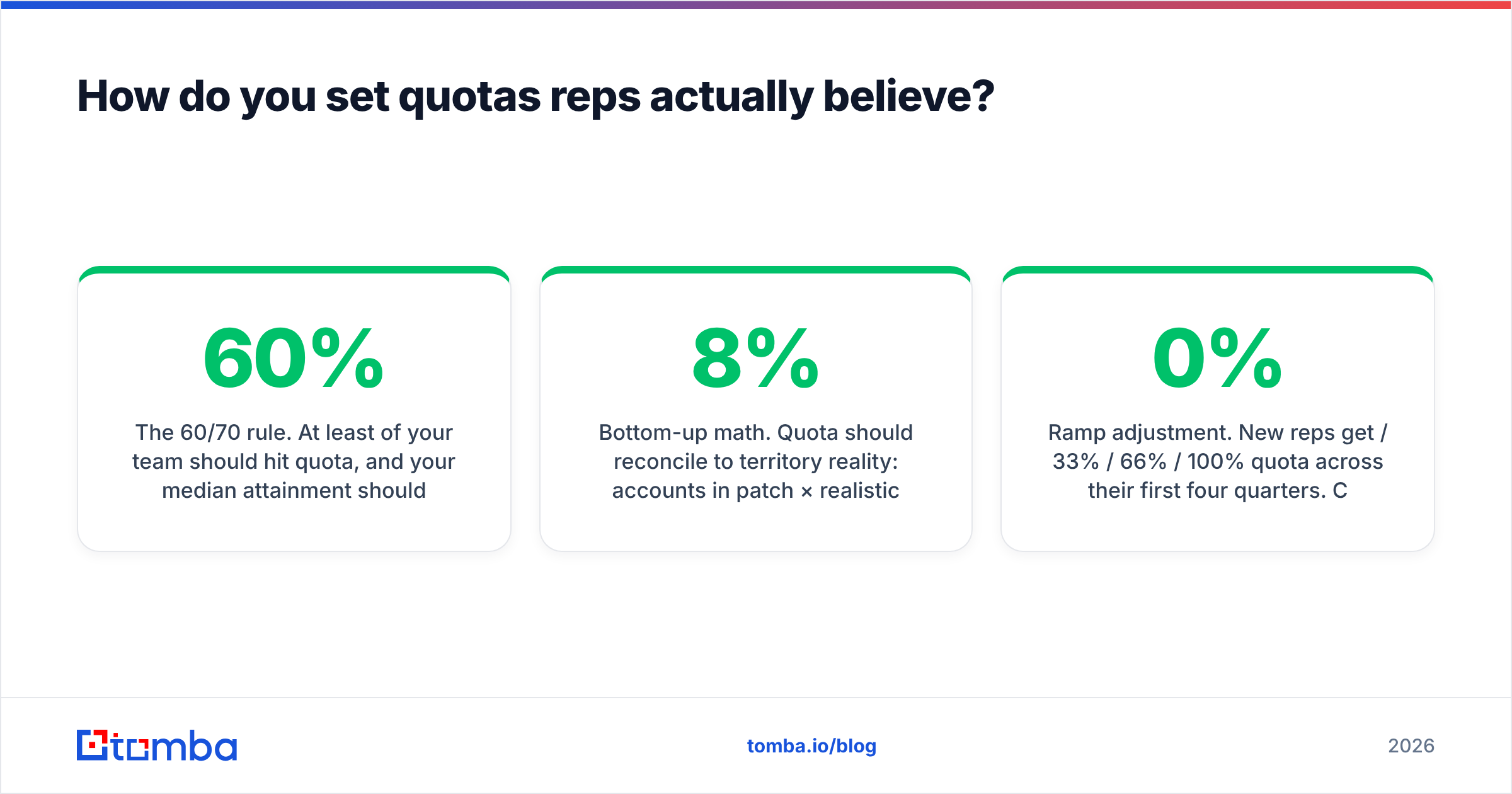
Three tests for a believable quota:
- The 60/70 rule. At least 60% of your team should hit quota, and your median attainment should land near 70–80%. If 20% of the team is hitting, your quota is a wish. If 95% is hitting, you are leaving revenue on the table.
- Bottom-up math. Quota should reconcile to territory reality: accounts in patch × realistic penetration rate × average deal size. If a rep's territory contains 180 accounts and your best-case penetration is 8%, their quota cannot assume 25 new logos.
- Ramp adjustment. New reps get 0% / 33% / 66% / 100% quota across their first four quarters. Charging a full number in month two is how you burn a $30k hire.
The territory-math test is where data quality shows up again. If a rep's assigned patch of 180 accounts contains 40 companies that no longer exist and 60 with no reachable contacts, the quota is mathematically unreachable and no amount of incentive engineering saves it. Running the patch through a domain search before planning season is a two-hour exercise that prevents a full quarter of arguments.
What incentive mistakes should you avoid?#
Capping commission. If a rep triples quota and you cap their payout, you have just taught your entire team the ceiling. They will hit it and stop. Uncapped is a feature, not a risk — you only pay more when you make more.
Changing the plan mid-period. Retroactive plan changes destroy trust faster than any single bad decision a sales leader can make. If the plan is wrong, eat the cost through the period end and fix it at the boundary.
Too many metrics. Three components maximum. A plan with seven weighted components is a plan nobody can compute in their head, and reps only optimize for what they can compute in their head.
Paying on booked, not shipped. Commission on signed contracts that later churn or never invoice creates clawback conflicts. Pay on invoiced or on a delayed schedule tied to first payment.
Ignoring the ramp. New-hire ramp is the most common silent killer of team attainment. Budget for it explicitly.
Confusing recognition with a plan. A leaderboard is a garnish. If your comp plan is weak, no amount of Slack celebration compensates.
How do you measure whether the incentive plan is working?#
Track four things, quarterly:
- Attainment distribution, not average. A team averaging 85% could be everyone at 85%, or half at 140% and half at 30%. Those are different problems.
- Cost of sale as a percentage of revenue. Total comp divided by closed revenue. Creeping upward means your plan is paying for volume that is not converting.
- Voluntary regretted attrition among quota-hitters. If your best reps leave while hitting number, the plan is not paying enough at the top end.
- Behavior shift on the SPIFF'd metric. Did the two-week vertical SPIFF actually produce meetings in that vertical, or just reclassified meetings? Check the CRM, not the report-out.
Salesforce's own research library on sales performance and HubSpot's sales benchmark data are both useful external reference points when you need to argue a plan change to finance — they give you industry anchors instead of internal-only comparisons.
Also worth calibrating: your win rate before and after any plan change. If attainment rose but win rate fell, you incentivized volume and paid for noise.
What does a good 2026 incentive plan look like end to end?#
Here is a workable SMB AE plan you can adapt:
- Pay mix: $70k base / $70k variable, $140k OTE
- Quota: $700k new ARR (5x OTE)
- Commission rate: 10% of ARR to 100% attainment
- Accelerator: 16% on every dollar from 100–150%; 20% above 150%; uncapped
- Decelerator: 5% below 60% attainment
- Team component: 10% of variable tied to pod attainment, paid quarterly
- Non-cash: President's Club at 110%+, first pick of inbound for the top monthly performer, choice of territory at annual planning for three-quarter streaks
- Ramp: 33/66/100% quota over quarters two through four
Three components. Computable in a rep's head. Uncapped upside. That's the whole design.
Fix the data before you fix the plan#
The best comp plan in the world cannot rescue a rep working a list of dead contacts. Before your next planning cycle, pressure-test the raw material: are the accounts real, are the contacts reachable, are the emails deliverable?
Tomba's email finder gives your team verified professional email addresses by domain, name, or company — so the pipeline math behind every quota is built on contacts that actually exist. Start free with 25 searches a month, or check Tomba pricing for the Starter plan at $49/mo when you're ready to run full territories. Get the data right, and your incentives finally have something to reward.
Related guides#
// get started
Find, verify and enrich your first contacts today
Start on the free plan with 25 searches a month, then scale when your team is ready.
Free plan · No credit card required · GDPR & CCPA
// about the author