How to Incentivize Sales Team: 2026 Compensation Playbook
Cash bonuses stop working faster than most sales leaders expect. Here is a concrete framework for building sales incentives that move pipeline, plus the plan types, payout math, and mistakes to avoid.
Working out how to incentivize sales team performance starts with one question: can a normal rep hit the number? Fix the quota first. Then fix the payout.
TL;DR
- Incentives fail more often from bad quota design than from small payouts. Fix the target before you raise the money.
- The strongest 2026 plans blend a base commission with 2-3 accelerators tied to behaviors you can measure weekly (meetings booked, multi-threaded accounts, pipeline created).
- Non-cash rewards (time, autonomy, territory upgrades, career visibility) beat cash for mid-tier reps. That group drives most of your revenue swing.
- Pay fast. A commission that lands 60 days after the close loses most of its pull.
- Give reps clean data before you give them a bigger bonus. Nobody hits a hard quota while hunting contact details by hand.
What does it actually mean to incentivize a sales team?#
Incentivizing a sales team means linking one behavior to one reward. The link has to be tight enough that the rep feels it in the moment they choose what to do next.
That's narrower than "motivation." Motivation is a mood. An incentive is a contract. A rep is deciding between a warm inbound lead and a cold enterprise account. Your comp plan is the only thing in the room arguing for one over the other. If it pays the same for both, you don't have an incentive. You have a payroll formula.
Most weak plans share the same three defects:
- The reward is too far from the behavior. Quarterly bonuses don't influence a Tuesday afternoon.
- The measure is too coarse. Paying only on closed revenue makes top-of-funnel work unpaid labor.
- The math is opaque. If a rep can't work out their commission on a napkin, they'll optimize for what they understand — usually deal count.
Why do cash-only incentive plans stop working?#
Cash works until it becomes expected. Then it turns into a hygiene factor: its absence demotivates, but its presence stops motivating.
Compensation research keeps finding the same pattern. Gartner's sales research and several comp benchmarking studies show that raising variable pay for already well-paid reps changes behavior less and less. The rep on $180K OTE doesn't sprint harder for another $2,000. The rep at $85K might.
There's a second problem. Cash-only plans stack the reward at the top. Your top 10% clear accelerators, take the President's Club trip, and get the best territories. Your middle 60% produce more revenue than your top decile combined. They also watch a race they've already lost by week three of the quarter.
The fix isn't to remove cash. It's to stop treating cash as the whole lever.
What are the main types of sales incentives?#
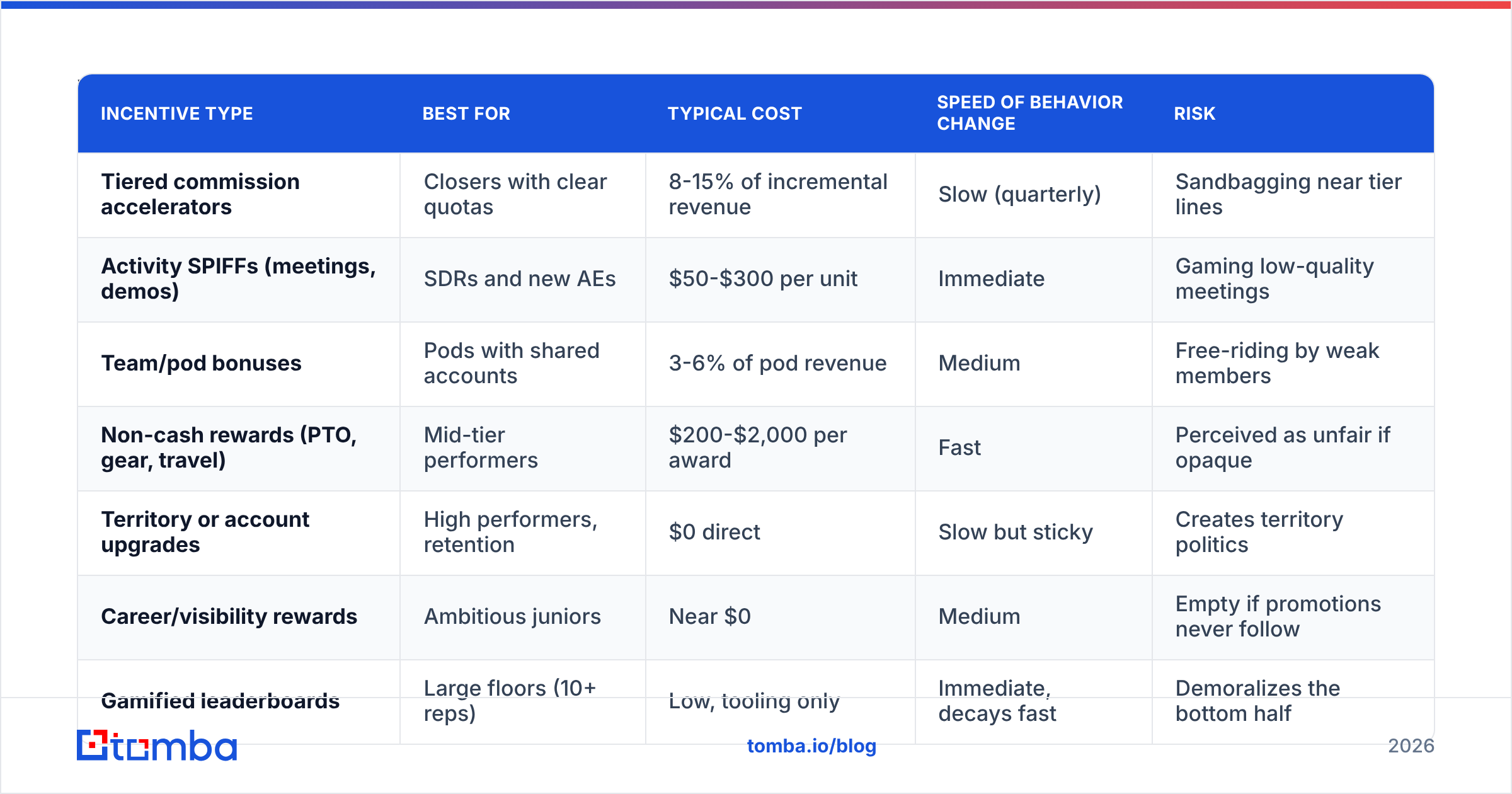
Here's how the seven common plan types compare on cost, speed of effect, and who they actually move.
| Incentive type | Best for | Typical cost | Speed of behavior change | Risk |
|---|---|---|---|---|
| Tiered commission accelerators | Closers with clear quotas | 8-15% of incremental revenue | Slow (quarterly) | Sandbagging near tier lines |
| Activity SPIFFs (meetings, demos) | SDRs and new AEs | $50-$300 per unit | Immediate | Gaming low-quality meetings |
| Team/pod bonuses | Pods with shared accounts | 3-6% of pod revenue | Medium | Free-riding by weak members |
| Non-cash rewards (PTO, gear, travel) | Mid-tier performers | $200-$2,000 per award | Fast | Perceived as unfair if opaque |
| Territory or account upgrades | High performers, retention | $0 direct | Slow but sticky | Creates territory politics |
| Career/visibility rewards | Ambitious juniors | Near $0 | Medium | Empty if promotions never follow |
| Gamified leaderboards | Large floors (10+ reps) | Low, tooling only | Immediate, decays fast | Demoralizes the bottom half |
Two patterns show up in teams that get this right. First, no single mechanism carries the whole plan. The best structures run a base commission plus exactly two secondary levers, not six. Second, those secondary levers rotate every quarter, so they never become expected income.
How to incentivize sales team performance: a 6-step plan#
Work through these six steps in order. Skipping step one is the most common failure.
- Diagnose the real bottleneck first. Pull last quarter's funnel. Say reps create enough pipeline but lose at proposal stage. A meetings SPIFF makes that worse — it floods a funnel that already leaks at the bottom. Pay for the stage that is actually stuck.
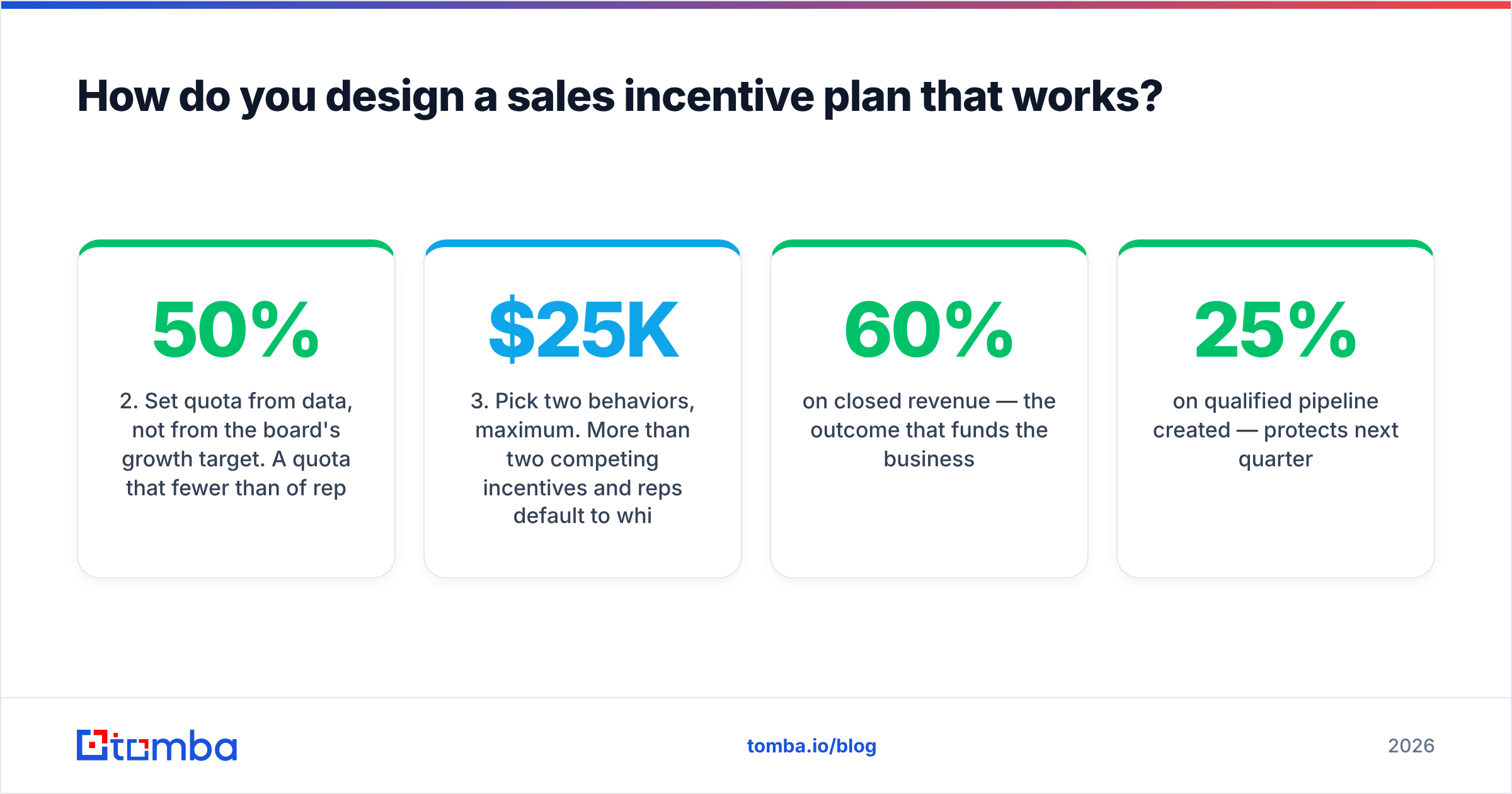
- Set quota from data, not from the board's growth target. A quota that fewer than half your reps hit is a demotivator dressed as ambition. Healthy attainment usually sits in the 60-70% range. If yours is at 30%, the number is the problem.
- Pick two behaviors, maximum. With more than two competing incentives, reps default to whichever pays best. Write each one as a sentence: "We want reps to multi-thread every deal over $25K" beats "improve deal quality."
Steps four to six are about mechanics. They cost nothing, and they decide whether the plan is felt week to week.
- Make the math napkin-simple. A rep should answer "what do I earn if I close this deal?" in under ten seconds. Every extra clause costs you precision.
- Shorten the payout cycle. Monthly beats quarterly. Weekly SPIFF payouts beat monthly. The gap between action and reward is the one variable you fully control.
- Publish the rules before the period starts, then leave them alone. Retroactive changes destroy trust faster than a low payout ever will.
What should you measure?#
Pay on things reps control. Closed revenue is partly luck, market timing, and whether procurement went on vacation. Pipeline created, accounts multi-threaded, and second meetings booked sit almost entirely in a rep's hands. That is exactly why they respond to incentives.
A practical split for a full-cycle AE:
- 60% on closed revenue — the outcome that funds the business
- 25% on qualified pipeline created — protects next quarter
- 15% on a rotating behavior — the thing you're trying to fix this quarter
Is non-cash better than cash for motivating reps?#
For mid-tier performers, usually yes. The catch: the reward has to be something the rep wants and can't easily buy.
A $500 cash bonus disappears into a bank account and gets filed under "salary." A Friday off, a conference ticket, or first pick of next quarter's territory gets remembered and talked about. That visibility does real work. Studies of recognition programs keep finding that public non-cash rewards beat private cash of the same value.
The categories that hold up in practice:
- Time — an extra PTO day, a no-meeting week, early Friday finishes for the quarter's top three
- Autonomy — choice of accounts, freedom to skip a standing meeting, remote-work flexibility
- Tools and territory — a better lead list, a bigger patch, a dedicated SDR for a month
- Status — a public shout-out from the CRO, presenting a win at all-hands, mentoring a new hire
The failure mode is generic swag. A branded water bottle is not an incentive. If you can't name the rep who would be delighted by it, don't offer it.
How do you incentivize an SDR or prospecting team differently?#
SDRs need a different plan. Their output is a leading indicator, not revenue.
Paying SDRs on closed revenue creates a six-week feedback lag. It also ties their pay to AE execution they don't control. The better structure pays on qualified meetings held, with a quality gate: a meeting counts only if the AE accepts it and the prospect shows up. That one clause removes most gaming.
Then remove the friction. An SDR paid to book meetings, but forced to hunt contact data by hand, is being paid to do a job you have made slow. Before you raise the SPIFF, check how many hours a week the team burns on list-building. Give reps a reliable email finder and a working domain search workflow. That often adds more meetings per rep than doubling the payout, and it costs less.
The same logic applies to data hygiene. Bounced emails waste sends. They also damage sender reputation, which quietly lowers everyone's reply rate. Run lists through an email verifier before a campaign to protect the incentive you're paying for.
What are the most common incentive mistakes?#
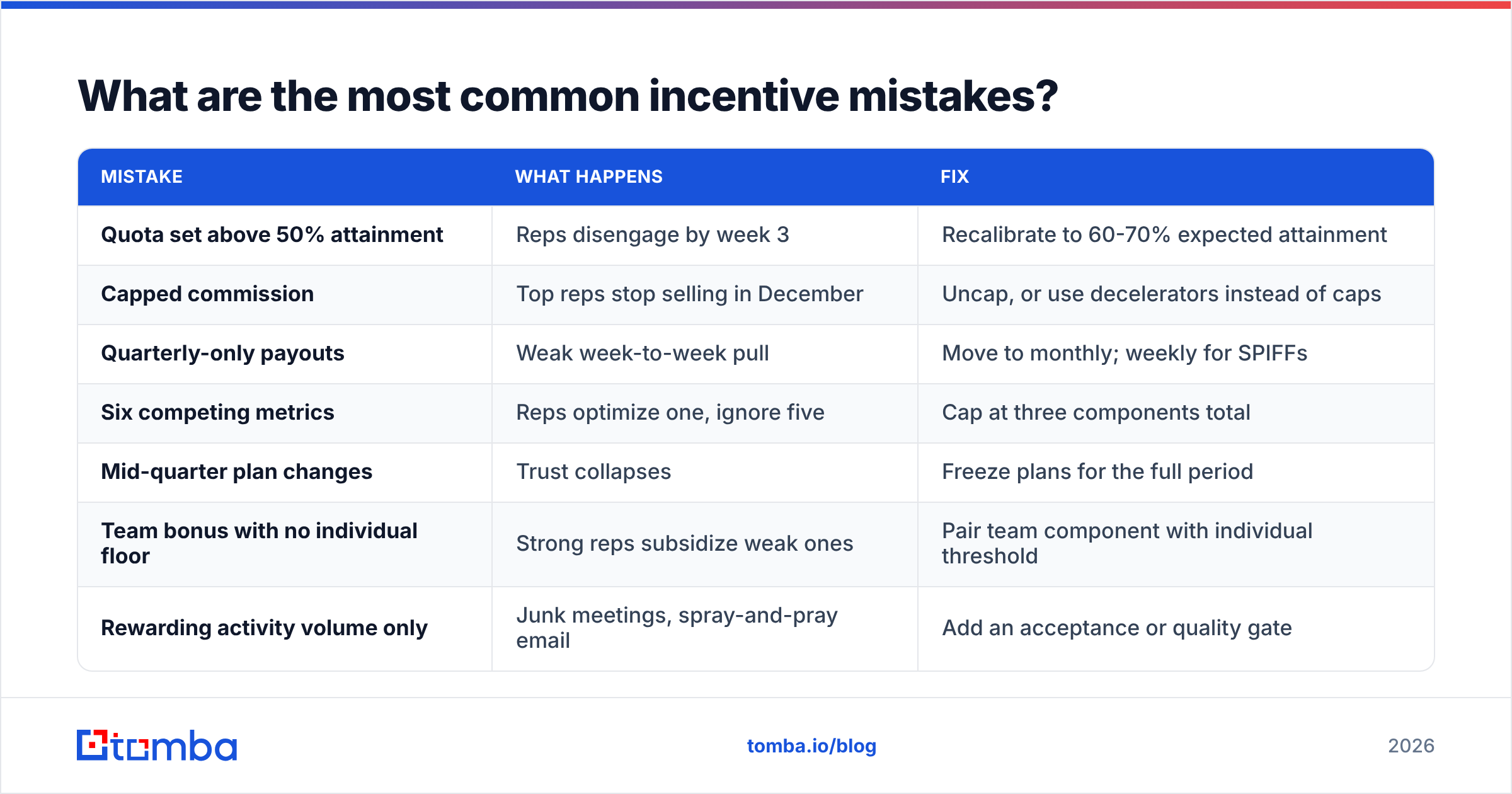
| Mistake | What happens | Fix |
|---|---|---|
| Quota set above 50% attainment | Reps disengage by week 3 | Recalibrate to 60-70% expected attainment |
| Capped commission | Top reps stop selling in December | Uncap, or use decelerators instead of caps |
| Quarterly-only payouts | Weak week-to-week pull | Move to monthly; weekly for SPIFFs |
| Six competing metrics | Reps optimize one, ignore five | Cap at three components total |
| Mid-quarter plan changes | Trust collapses | Freeze plans for the full period |
| Team bonus with no individual floor | Strong reps subsidize weak ones | Pair team component with individual threshold |
| Rewarding activity volume only | Junk meetings, spray-and-pray email | Add an acceptance or quality gate |
The capped-commission mistake deserves extra attention. Caps look prudent on a spreadsheet. In practice they backfire. The moment a rep sees the ceiling, every deal after it becomes a candidate for sandbagging into next quarter. If cost is the worry, use a decelerator instead: the rate drops from 12% to 8% above 150% of quota. The upside signal survives, and your exposure stays capped.
How do you know if the incentive is working?#
Measure the behavior, not just the revenue. Revenue moves for a dozen reasons. The behavior moves because of your plan.
Track four things for eight weeks after launch:
- Behavior rate change — did multi-threading actually go from 30% of deals to 55%?
- Distribution shift — did the middle 60% improve, or did only your top reps earn more?
- Quality drift — did meeting no-show rates or discount depth get worse?
- Rep-reported clarity — ask three reps to explain the plan. If they disagree, it's too complex.
If the behavior didn't move, the payout wasn't the problem. The reward was too small to matter, too slow to feel, or the behavior was blocked by something operational — bad data, a broken handoff, an approval queue.
What tools support a sales incentive program?#
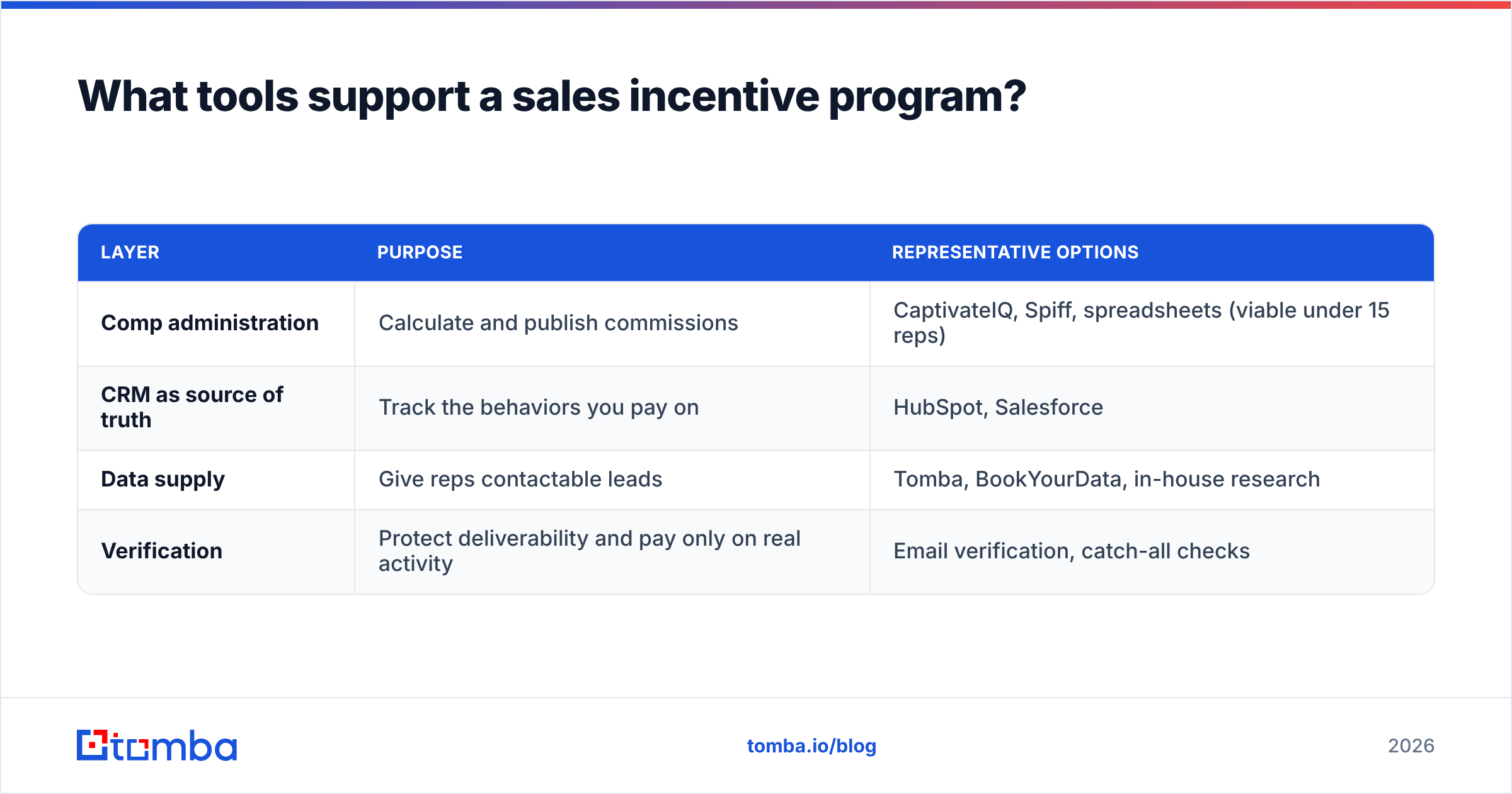
You need three layers. Most teams over-invest in the first and under-invest in the third.
| Layer | Purpose | Representative options |
|---|---|---|
| Comp administration | Calculate and publish commissions | CaptivateIQ, Spiff, spreadsheets (viable under 15 reps) |
| CRM as source of truth | Track the behaviors you pay on | HubSpot, Salesforce |
| Data supply | Give reps contactable leads | Tomba, BookYourData, in-house research |
| Verification | Protect deliverability and pay only on real activity | Email verification, catch-all checks |
Comp software pays off above roughly 15 reps. That is the point where spreadsheet errors cost you more in trust than the software costs in dollars. Below that, a clean shared sheet updated weekly beats a tool nobody opens. Check G2's compensation management category for current buyer reviews first.
The layer teams skip is data supply. Your plan pays for meetings. Your reps spend 40% of the week finding contact details. You are paying a premium for output you have structurally capped. Tools like Tomba and peers like BookYourData exist to remove that constraint. Tomba starts free at 25 searches a month, with Starter at $49/mo and Growth at $99/mo — see Tomba pricing for the full breakdown. BookYourData leans toward pre-built verified lists. Tomba leans toward on-demand lookup and API enrichment. Pick based on whether your motion is list-based or account-based.
What does a good plan look like end to end?#
Here's a worked example of how to incentivize sales team pay on a five-person AE team with a $1.2M quarterly target.
Base structure: $70K base, $70K variable, $140K OTE. Quota $240K per rep per quarter (attainment modeled at 65%).
Component 1 — closed revenue (60% of variable): 10% commission to quota, 14% accelerator from 100-150%, 9% decelerator above 150%. Paid monthly, in the month after cash collection.
Component 2 — qualified pipeline created (25%): $1,500 flat for hitting 3x quota coverage by week 10 of the quarter. Binary, easy to track, protects next quarter.
Component 3 — rotating behavior (15%): This quarter, multi-threading. $400 per closed deal over $25K where three or more contacts at the account were engaged. Rotates next quarter to something else.
Non-cash overlay: Top improver (not top performer) each month gets a Friday off and a shout-out at all-hands. Cost: near zero. Effect on the middle 60%: measurable.
That plan has three components, one page of rules, and a payout cycle a rep can feel. That's the whole formula.
Give your reps something to sell into#
The best comp plan can't fix a rep staring at a list of unverified contacts. Before you redesign your incentives, remove the friction underneath them.
Tomba Email Finder takes your reps from company name to verified contact in seconds — by domain, by name, or in bulk through the API. Start free at 25 searches a month. See whether meeting volume moves before you touch the payout math. Scale to Starter at $49/mo when the team wants more. Fix the input, then fix the incentive.
Related guides#
Ready to find emails that actually work?
Join 150,000+ professionals who stopped guessing and started sending. Free credits on signup — no credit card required.
Get the Tomba newsletter
Practical outbound tactics and product updates — once every two weeks.
About the author