How To Increase Lead Generation: 9 Tactics That Work in 2026
Most lead gen advice stops at 'publish more content.' Here are nine tested tactics — with the data quality work behind them — that actually move qualified pipeline in 2026.
TL;DR
- Lead volume is not the problem for most teams — lead quality is. Doubling raw MQLs while conversion stays flat just moves the cost problem downstream.
- The nine tactics below are ordered by how fast they pay back: fix data hygiene and ICP targeting first, then layer on content, intent signals, and outbound.
- Website visitor identification and reverse-lookup enrichment turn traffic you already have into named accounts — usually the cheapest incremental pipeline available.
- Every channel dies at the same bottleneck: bad contact data. A 40% bounce rate does not just waste sends, it damages the sending domain that all your other channels depend on.
- Measure cost per SQL, not cost per lead. The two numbers frequently point in opposite directions.
Why do most lead generation efforts stall?#
Because they optimize the top of the funnel while the middle leaks.
Here is the pattern that shows up in almost every audit: a team decides it needs more leads, so it adds a channel. More content, more ads, more LinkedIn posts. Volume goes up 60%. Six months later, closed-won revenue is flat, the CRM has 14,000 new records nobody has touched, and the sales team has quietly stopped trusting anything marketing hands over.
The mechanical reason is simple. If 3% of your leads convert to opportunities, adding 1,000 leads adds 30 opportunities. If you instead move conversion from 3% to 5% on your existing 1,000, you add 20 opportunities for roughly zero incremental acquisition spend. The second lever is almost always cheaper, and almost always ignored, because "improve conversion" is not a line item anyone can buy.
So the real answer to how to increase lead generation is a sequencing problem: fix the multiplier before you scale the input.
Sorry — that renders as: 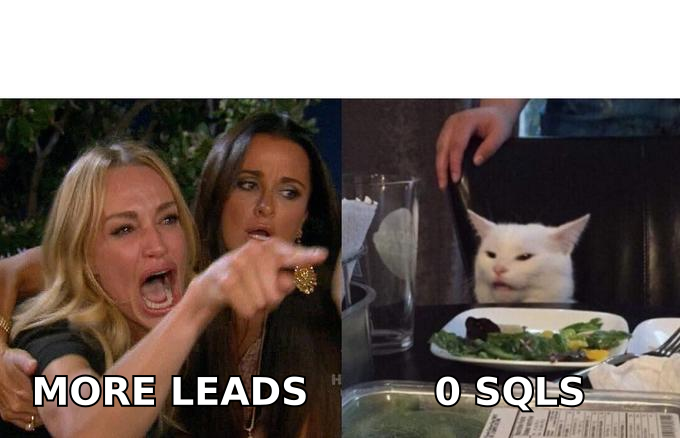
What are the highest-ROI lead generation tactics in 2026?#
These nine are ordered by payback speed, not by how exciting they sound.
- Tighten the ICP before adding channels. Pull your last 40 closed-won deals. Find the two or three attributes they share — headcount band, tech stack, funding stage, department that signed. Anything outside that profile is not a lead, it is a distraction. Teams that do this exercise typically cut their addressable list by half and raise reply rates by more than double.
- Clean and verify the list you already have. Dead records inflate every metric you report and quietly poison your sending domain. Run existing contacts through an email verifier before the next campaign, not after it bounces.
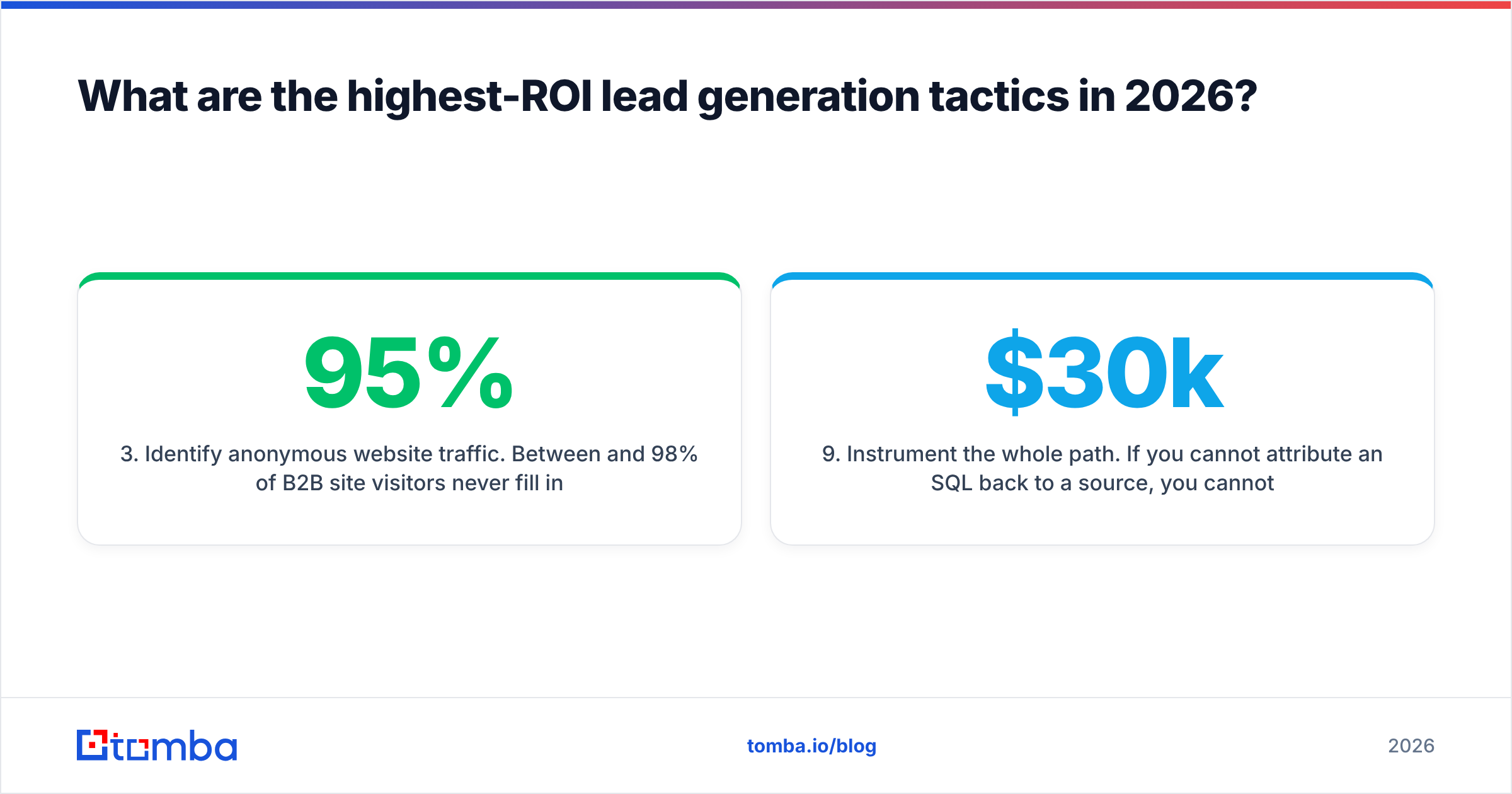
- Identify anonymous website traffic. Between 95% and 98% of B2B site visitors never fill in a form. Reverse-IP and identity resolution tools surface the companies behind that traffic so you can route the ones that match your ICP to sales. This is the single cheapest incremental source most teams have, because you already paid to acquire the visit.
- Build bottom-of-funnel content, not more thought leadership. Comparison pages, pricing explainers, migration guides, and integration docs convert at multiples of a generic blog post because the reader is already in-market. One good "X vs Y" page routinely outperforms twenty trend posts.
- Layer intent signals onto outbound. Job postings mentioning your category, recent funding, new leadership hires, and technology installs are all public and all predictive. Contact the account in the two weeks after the signal, not the two months.
- Run a genuinely useful free tool. Calculators, checkers, and generators earn links, rank for high-intent queries, and capture emails without a gated PDF. The maintenance cost is real but the compounding is better than an ebook.
- Fix speed-to-lead. Response inside five minutes versus thirty minutes changes qualification odds by an order of magnitude in most inbound studies. This costs nothing but routing discipline.
- Add multichannel follow-up. Email plus LinkedIn plus one phone attempt beats email alone on nearly every measured cohort. A single channel means a single point of failure.
- Instrument the whole path. If you cannot attribute an SQL back to a source, you cannot cut the losers. Basic UTM discipline plus a closed-loop CRM field beats a $30k attribution platform you never configure.
Which lead generation channel gives the best cost per SQL?#
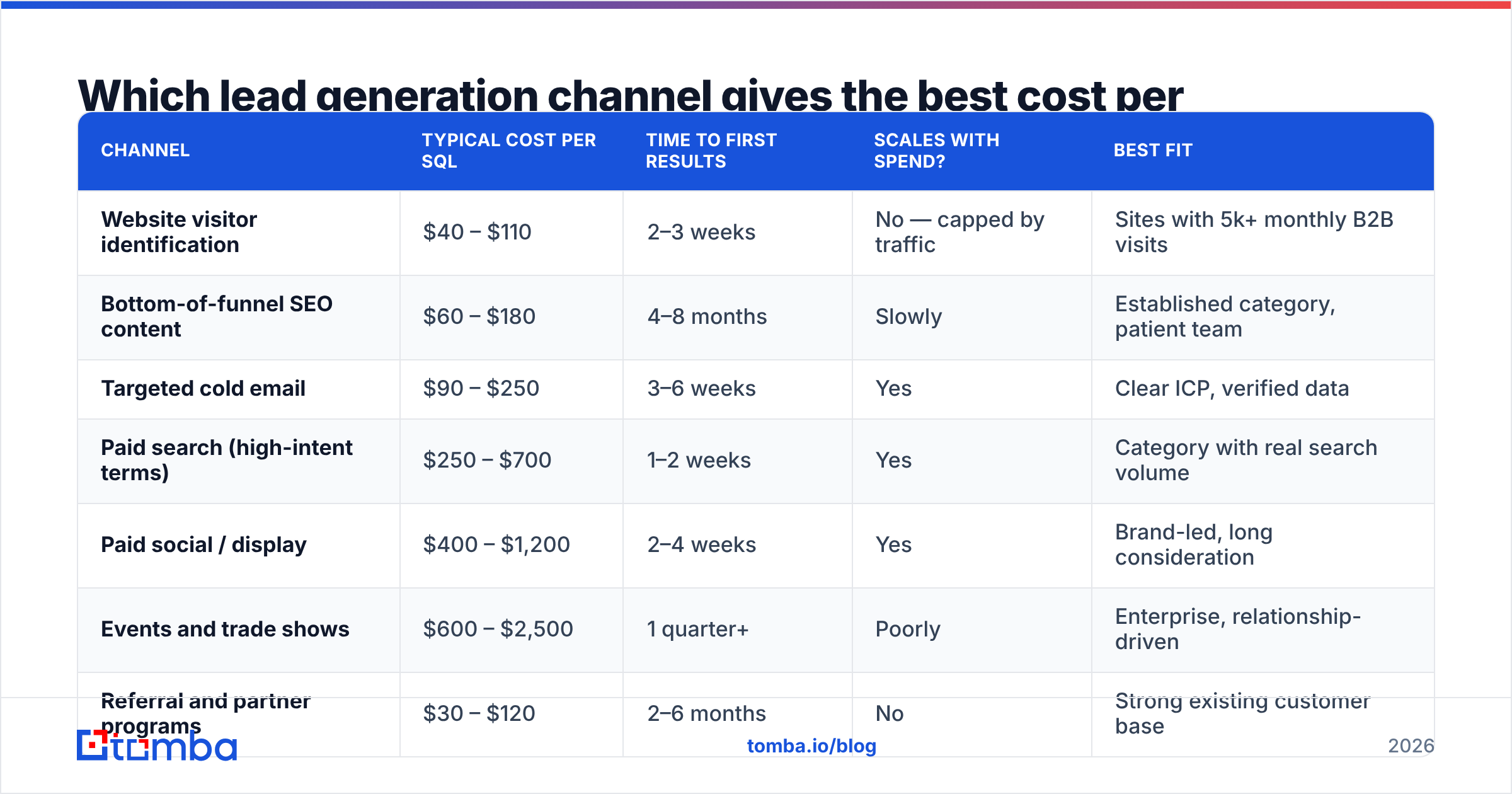
It depends on your motion, but the ranges below reflect what mid-market B2B teams typically report. Treat them as a starting frame, then measure your own.
| Channel | Typical cost per SQL | Time to first results | Scales with spend? | Best fit |
|---|---|---|---|---|
| Website visitor identification | $40 – $110 | 2–3 weeks | No — capped by traffic | Sites with 5k+ monthly B2B visits |
| Bottom-of-funnel SEO content | $60 – $180 | 4–8 months | Slowly | Established category, patient team |
| Targeted cold email | $90 – $250 | 3–6 weeks | Yes | Clear ICP, verified data |
| Paid search (high-intent terms) | $250 – $700 | 1–2 weeks | Yes | Category with real search volume |
| Paid social / display | $400 – $1,200 | 2–4 weeks | Yes | Brand-led, long consideration |
| Events and trade shows | $600 – $2,500 | 1 quarter+ | Poorly | Enterprise, relationship-driven |
| Referral and partner programs | $30 – $120 | 2–6 months | No | Strong existing customer base |
Two things jump out. First, the cheapest channels are the ones that reuse existing assets — your traffic, your customers, your content. Second, the channels that scale linearly with budget are also the most expensive per unit. That is not a coincidence; anything you can buy, your competitors can buy too, and the price gets bid up.
The practical read: build the cheap non-scaling channels to their ceiling first, then buy the scalable expensive ones with the margin that creates.
How does data quality change your lead generation math?#
More than any tactic on the list, and it is not close.
Think of your contact database like a delivery fleet. You can add trucks (more leads) or you can make sure the addresses on the packages are correct. A fleet twice the size delivering to wrong addresses is worse than a small fleet delivering accurately — because now you are burning twice the fuel and the post office has flagged you as a nuisance sender.
That last part is the piece teams miss. Bounce rates above roughly 3–5% start triggering filtering at the mailbox provider level. Google and Yahoo both tightened bulk sender requirements in 2024, and the enforcement has only gotten stricter since. Once your domain reputation drops, your carefully written nurture sequence stops landing in inboxes too. One bad purchased list can damage the deliverability of every other program you run.
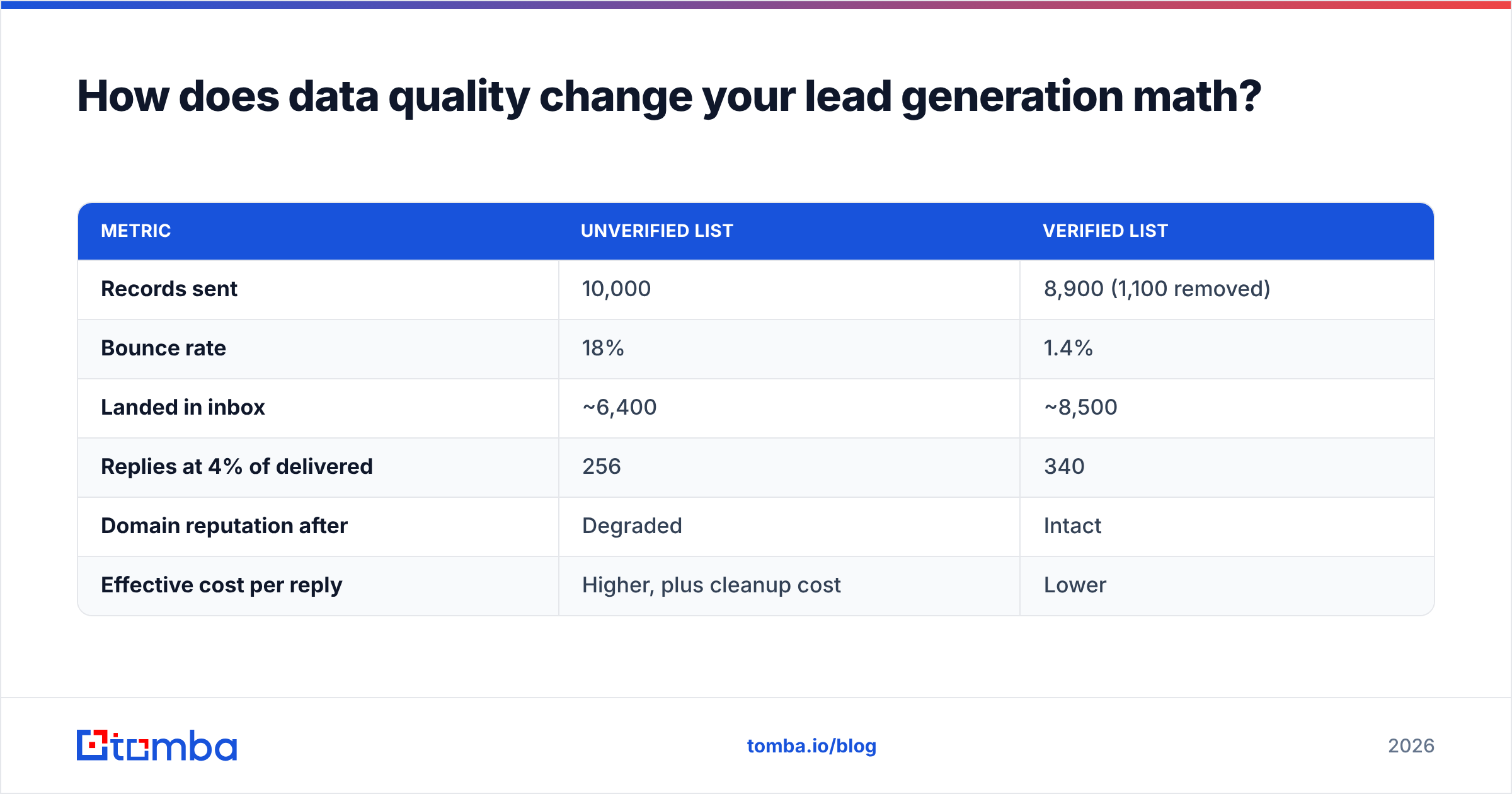
Here is what the same 10,000-record campaign looks like at different data quality levels:
| Metric | Unverified list | Verified list |
|---|---|---|
| Records sent | 10,000 | 8,900 (1,100 removed) |
| Bounce rate | 18% | 1.4% |
| Landed in inbox | ~6,400 | ~8,500 |
| Replies at 4% of delivered | 256 | 340 |
| Domain reputation after | Degraded | Intact |
| Effective cost per reply | Higher, plus cleanup cost | Lower |
Verifying removed 11% of the list and still produced 33% more replies. That is the multiplier effect in one table.
Practical hygiene checklist:
- Verify before every send, not quarterly. B2B contact data decays roughly 2–2.5% per month as people change jobs.
- Handle catch-all domains deliberately. They accept everything at the SMTP layer and tell you nothing. A dedicated catch-all verifier gives you a confidence score instead of a coin flip.
- Suppress role accounts like info@, sales@, and support@ from cold sequences. They complain at higher rates and convert at lower ones.
- Dedupe across sources. The same person acquired from three lists counts as three leads in your dashboard and one annoyed prospect in reality.
- Re-enrich the CRM on a schedule. Data enrichment on stale records recovers contacts you already paid to acquire.

How do you turn anonymous traffic into named leads?#
Three steps, and most teams stop after the first.
Step one: identify the company. Reverse-IP lookup matches visiting IP addresses to organizations. Coverage is imperfect — expect 25–45% match rates on B2B traffic, lower if your audience is heavily remote or mobile — but the matched slice is high-signal, especially if the visitor hit a pricing or comparison page.
Step two: find the right human. Knowing that Acme Corp visited your pricing page three times is useless until you know which VP to contact. This is where a domain search matters: give it the company domain and it returns the people, roles, and email patterns at that organization, so you can pick the buyer rather than emailing a generic mailbox.
Step three: reference the behavior without being creepy. "Saw you were looking at us" is a losing open. "Most teams evaluating this compare us on X — happy to send the honest breakdown" respects the signal without announcing that you are watching. The difference is whether the message is about your tracking or about their problem.
If you want the mechanics of visitor identification specifically, website visitor reveal covers how the matching works and where the coverage limits sit.
What outbound changes actually lift reply rates?#
The tactical answers, in rough order of impact:
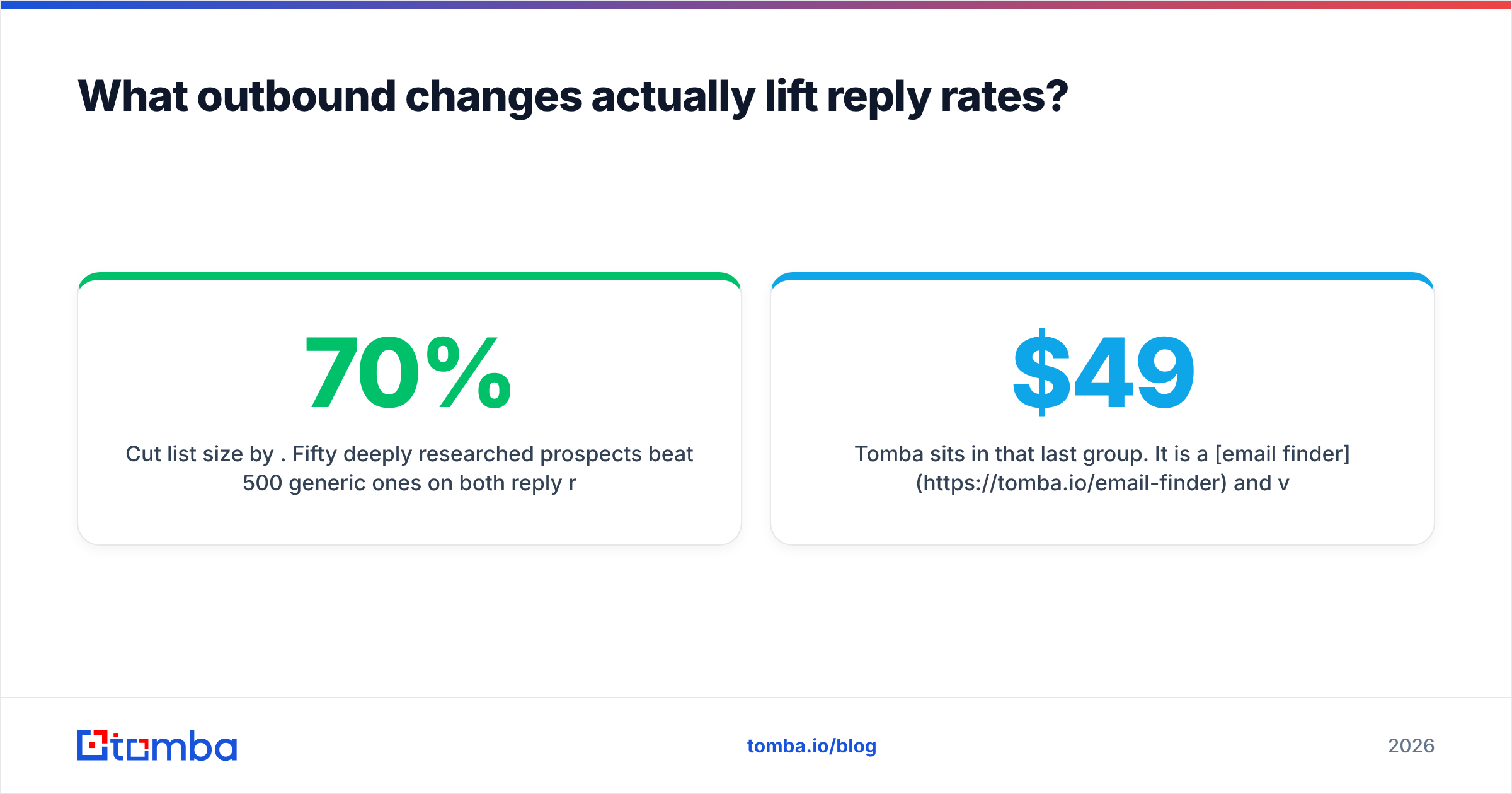
- Cut list size by 70%. Fifty deeply researched prospects beat 500 generic ones on both reply rate and the quality of what replies. This is the highest-leverage change available and it costs nothing but discipline.
- Lead with the trigger, not the pitch. Reference the funding round, the job posting, the tech install. It proves the message was not a broadcast.
- Make the ask small. "Worth a look?" outperforms "15 minutes on Thursday?" because the recipient can answer without opening a calendar.
- Send from a warmed, authenticated domain. SPF, DKIM, and DMARC are table stakes now, not optimizations. Google's own bulk sender guidelines spell out the requirements, and they are enforced, not advisory.
- Follow up three to four times, then stop. Most replies land on touches two through four. Past touch six you are generating complaints, not pipeline.
On the tooling side, this market has consolidated into a few honest categories. Full-suite platforms like Apollo bundle data with sequencing and a CRM layer, which suits teams that want one vendor. Curated B2B database providers like BookYourData sell verified, downloadable lists with strong coverage in specific verticals — a good fit if you want to own the data outright rather than rent seat-based access. Focused data providers do one job well and integrate into whatever stack you already run.
Tomba sits in that last group. It is a email finder and verification layer rather than a sequencer: find the address, confirm it is real, push it into HubSpot, Pipedrive, Sheets, or your own code via the Tomba API. Plans start free at 25 searches per month, then $49/mo for Starter, $99/mo for Growth, and $249/mo for Pro — the full breakdown is on Tomba pricing. Whether that beats a bundled suite depends on whether you want the sequencing bundled or already own it.
Third-party review sites are worth a look before you commit; the G2 lead intelligence category has enough volume of recent reviews to see where each vendor's coverage genuinely holds up by region and company size.
How should you measure lead generation performance?#
Track four numbers and ignore the rest until these are stable.
- Cost per SQL, not cost per lead. A channel producing $12 leads that never qualify is more expensive than one producing $200 leads that close. Cost per lead is the metric that makes bad channels look good.
- Lead-to-opportunity conversion by source. This is the diagnostic that tells you whether a volume problem is actually a targeting problem. Segment it or it tells you nothing.
- Speed to first touch. Measure it in minutes and publish it weekly. It regresses the moment nobody is watching.
- Bounce rate and spam complaint rate. These are leading indicators of a deliverability collapse that will take out your other channels with it. Watch them like uptime metrics, because that is what they are.
A useful cadence: review sources monthly, kill anything with a cost per SQL above 1.5x your blended average after a fair test window, and reinvest that budget in whatever sits below average. Most teams find that two channels do 70% of the work and the remaining five exist because someone set them up in 2023 and nobody turned them off.
Where should you start this quarter?#
If you have thirty days and limited resources, do these in order:
- Week one — run your existing CRM contacts through verification and record the bounce rate you avoided. This produces the fastest visible win and usually funds the rest of the argument internally.
- Week two — rebuild your ICP from closed-won data and cut the target list accordingly.
- Week three — turn on visitor identification and route ICP-matched accounts to sales manually. Do not automate until you have seen fifty of them by hand.
- Week four — launch one tightly targeted outbound sequence to the accounts those first three steps surfaced. Fifty contacts, verified, with a real trigger in the first line.
That sequence works because each step improves the input to the next. Verification makes the outreach land, ICP work makes the targeting sharp, visitor identification supplies warm accounts, and the sequence converts them. Run it in reverse and you get the familiar result: high volume, flat pipeline, an unhappy sales team.
Ready to fix the data layer first?#
Every tactic in this post depends on reaching a real person at a real address. Start with the Tomba Email Finder — search by domain, name, or company, get verified professional addresses with confidence scores and source citations, and push them straight into your CRM or sequencer. The free tier gives you 25 searches a month to test coverage against your own ICP before you pay anything, and Starter is $49/mo when you are ready to scale. Verify the list, then scale the channel. That order matters more than any single tactic on this page.
Related guides#
Ready to find emails that actually work?
Join 150,000+ professionals who stopped guessing and started sending. Free credits on signup — no credit card required.
Get the Tomba newsletter
Practical outbound tactics and product updates — once every two weeks.
About the author