How To Increase Revenue in 2026: 9 Proven Growth Levers
Revenue growth is not one big move — it's five levers pulled in the right order. Here's the math behind each one, plus the pipeline fixes that pay off in a single quarter.
TL;DR
- Revenue is an equation, not a vibe:
Revenue = Accounts × Win Rate × ACV × Purchase Frequency. Every real growth lever moves one of those four terms. - Pricing is the fastest lever (a 5% price increase can lift profit 20-30% with zero new headcount); expansion revenue is the cheapest; net-new logos are the slowest and most expensive.
- Most teams try to fix revenue by adding volume at the top. In practice, the leak is usually mid-funnel — bad contact data, slow follow-up, or a leaky handoff between marketing and sales.
- Retention math beats acquisition math: cutting churn from 3% to 2% monthly changes a customer's lifetime value by roughly 50%.
- Do the cheap diagnostics first: measure your data accuracy, your speed-to-lead, and your win rate by segment before you spend another dollar on ads or headcount.
What actually determines revenue?#
Start with the equation, because everything else is commentary:
Revenue = (# of accounts reached × conversion rate) × average contract value × purchase frequencyThink of it like a factory line. You can widen the intake belt, speed up the machines, make each unit more valuable, or run more shifts. Those are your only four options. Everything sold as a "growth hack" is one of those four wearing a costume.
The useful consequence: when your revenue is flat, you don't need a new strategy — you need to know which of the four terms is broken. A team with 400 monthly conversations and a 4% win rate has a completely different problem from a team with 40 conversations and a 30% win rate. The first has a qualification problem. The second has a volume problem. Prescribing "more leads" to the first team burns cash.
Here's the diagnostic order most operators should follow, cheapest first:
- Fix pricing and packaging. Zero new headcount, zero new leads. Highest margin-per-hour of work of any lever on this list.
- Reduce churn and grow existing accounts. Expansion revenue costs a fraction of net-new acquisition and compounds.
- Raise win rate on pipeline you already have. Better qualification, faster follow-up, tighter discovery.
- Increase deal size. Bundling, multi-year terms, moving upmarket one segment.
- Add net-new pipeline. The most expensive lever, and the one everyone reaches for first.
- Add channels or markets. The slowest to pay back — only justified once 1-5 are running clean.
Why does adding more leads usually fail to increase revenue?#
Because the constraint is rarely at the top. Adding leads to a funnel with a mid-funnel leak is like pouring more water into a bucket with a hole in the side — you get a wetter floor, not a fuller bucket.
Three leaks account for most of the loss:
Leak 1: contact data decay. B2B contact data goes stale at roughly 22-30% per year through job changes alone. If your list is 18 months old, a third of it is wrong. Every bounced email hurts twice — the lost conversation and the damage to your sender reputation, which then suppresses the emails that would have landed.
Leak 2: speed-to-lead. Harvard Business Review's classic study of lead response found firms that responded within an hour were nearly 7x more likely to qualify the lead than those that waited two hours. Most B2B teams still average over a day.
Leak 3: no qualification discipline. Reps spend equal effort on a $4k deal and a $90k deal because nothing in the process forces triage.

Fix those three before you buy another ad. They cost process changes, not budget.
Which revenue lever should you pull first?#
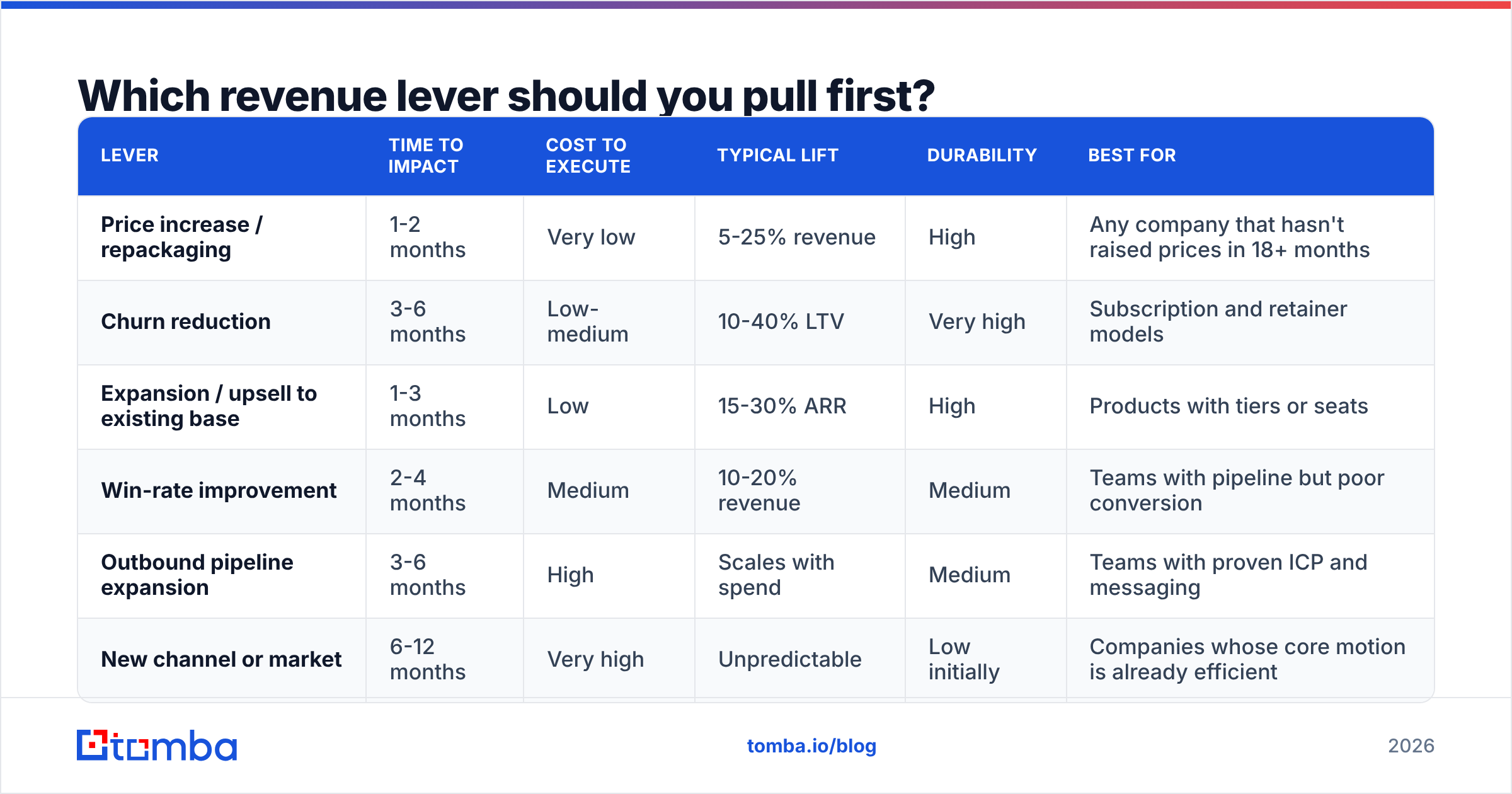
Compare them honestly. Cost, speed, and durability differ enormously:
| Lever | Time to impact | Cost to execute | Typical lift | Durability | Best for |
|---|---|---|---|---|---|
| Price increase / repackaging | 1-2 months | Very low | 5-25% revenue | High | Any company that hasn't raised prices in 18+ months |
| Churn reduction | 3-6 months | Low-medium | 10-40% LTV | Very high | Subscription and retainer models |
| Expansion / upsell to existing base | 1-3 months | Low | 15-30% ARR | High | Products with tiers or seats |
| Win-rate improvement | 2-4 months | Medium | 10-20% revenue | Medium | Teams with pipeline but poor conversion |
| Outbound pipeline expansion | 3-6 months | High | Scales with spend | Medium | Teams with proven ICP and messaging |
| New channel or market | 6-12 months | Very high | Unpredictable | Low initially | Companies whose core motion is already efficient |
The pattern is clear: the levers nobody finds exciting — pricing, retention, expansion — are the ones with the best return per unit of effort. Outbound is worth doing, but it is a scaling lever, not a fixing lever. Scale a broken motion and you get more broken, faster.
How do you increase revenue from customers you already have?#
Three specific plays, in order of how quickly they pay:
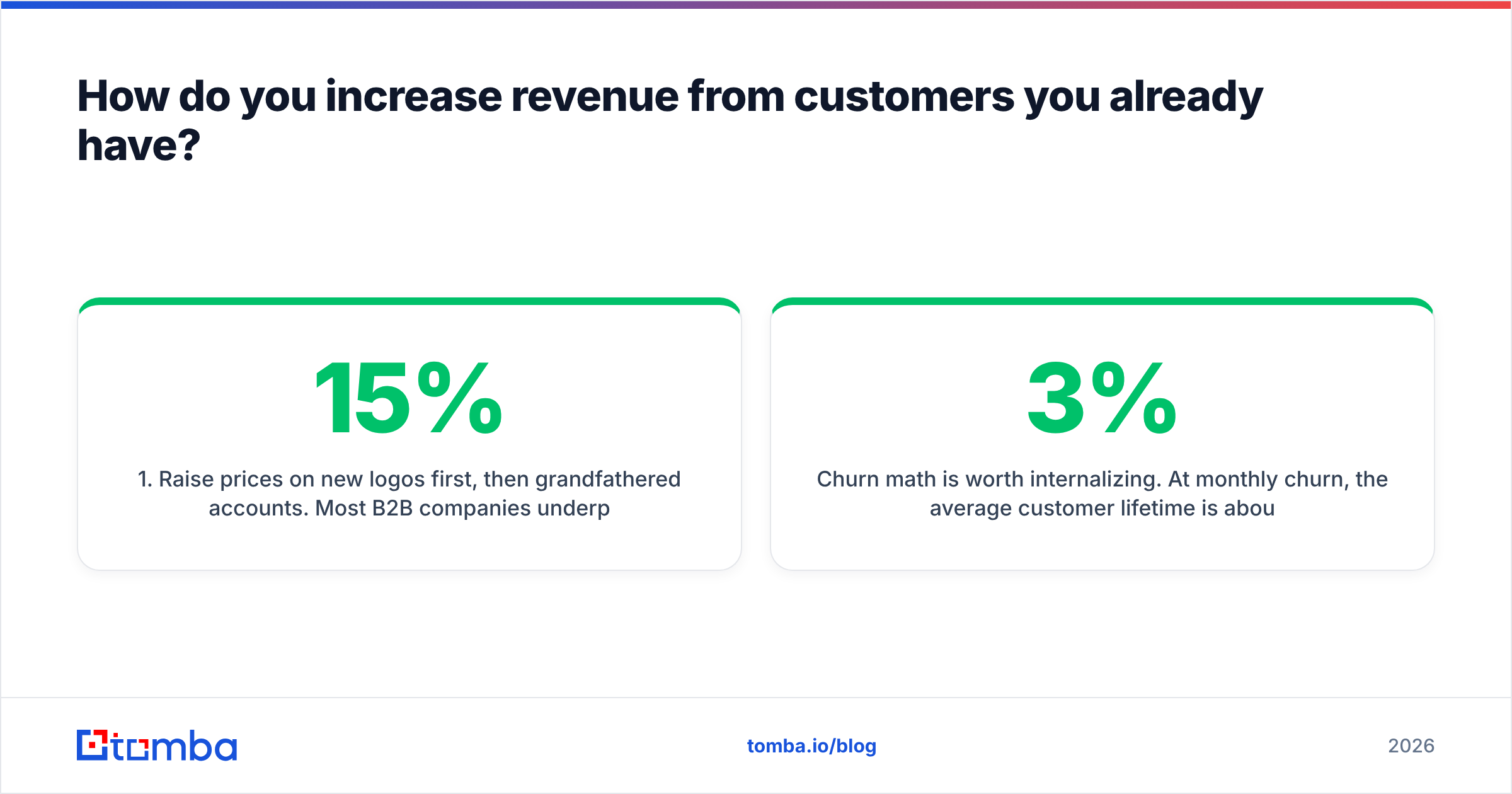
1. Raise prices on new logos first, then grandfathered accounts. Most B2B companies underprice. Test a 10-15% increase on new business only. If win rate doesn't move meaningfully, you left money on the table and now you know. Roll to existing accounts at renewal with a clear value narrative.
2. Build a real expansion motion. Track product usage signals — seats near limit, features requested, support tickets about scale — and trigger an outreach play on each. This is not upselling; it's noticing. According to HubSpot's sales research, companies that formalize expansion plays see materially higher net revenue retention than those relying on renewal conversations alone.
3. Attack churn at the cause, not the symptom. Interview the last twenty churned accounts. You will typically find one or two dominant reasons — bad onboarding, a missing integration, a champion who left. The champion-left case is fixable with data: when your buyer changes jobs, that's both a churn risk and a warm net-new opportunity at their new company. Running your customer list through a reverse email lookup on a quarterly cadence catches these moves before they become surprise cancellations.
Churn math is worth internalizing. At 3% monthly churn, the average customer lifetime is about 33 months. At 2%, it's 50 months. That single point of churn is a ~50% swing in lifetime value — larger than almost any acquisition improvement you could buy for the same money.
How do you build outbound pipeline that actually converts?#
Once the cheap levers are running, outbound is where scale comes from. But outbound has a hard prerequisite most teams skip: contact accuracy.
The sequence that works:
- Define the ICP narrowly enough to be wrong about. "Mid-market SaaS" is not an ICP. "Series B-C vertical SaaS companies, 80-400 employees, with a named RevOps hire and HubSpot in the stack" is. Narrow enough that you can build a finite list.
- Build the account list before the contact list. Accounts first, personas second. Otherwise you end up with a pile of titles and no account strategy.
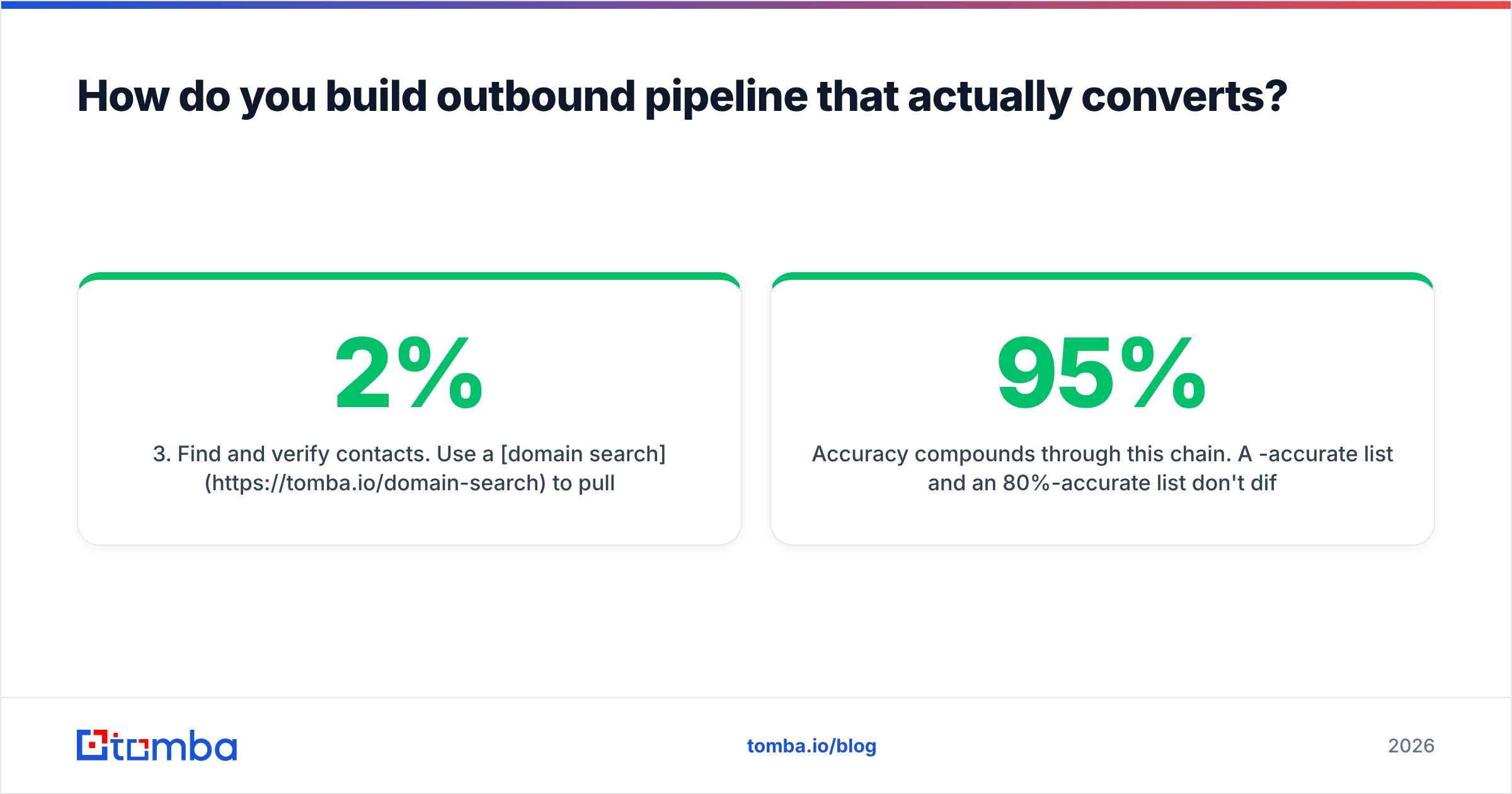
- Find and verify contacts. Use a domain search to pull every reachable address at a target company, then run the list through an email verifier so your bounce rate stays under 2%. Anything above 3-4% starts degrading inbox placement.
- Sequence across channels. Email plus phone plus LinkedIn outperforms any single channel. Add a phone finder step for your top-tier accounts — a connected call converts several times better than an opened email.
- Measure per-step, not per-campaign. Reply rate tells you about your copy. Bounce rate tells you about your data. Meeting-held rate tells you about your targeting. Collapsing them into one "campaign performance" number hides the actual problem.
Accuracy compounds through this chain. A 95%-accurate list and an 80%-accurate list don't differ by 15% in outcome — they differ in deliverability, which affects every subsequent send from that domain. The cheap list is more expensive.
What metrics tell you whether revenue is about to grow?#
Revenue is a lagging indicator. By the time it moves, the decisions that caused it are two quarters old. Track these leading indicators instead:
- Pipeline coverage ratio. Open pipeline ÷ quota for the period. Below 3x for a typical B2B motion means you'll miss, regardless of how good the deals feel.
- Speed-to-lead, measured in minutes. Not "same day." Minutes. This is the single most improvable number on most teams.
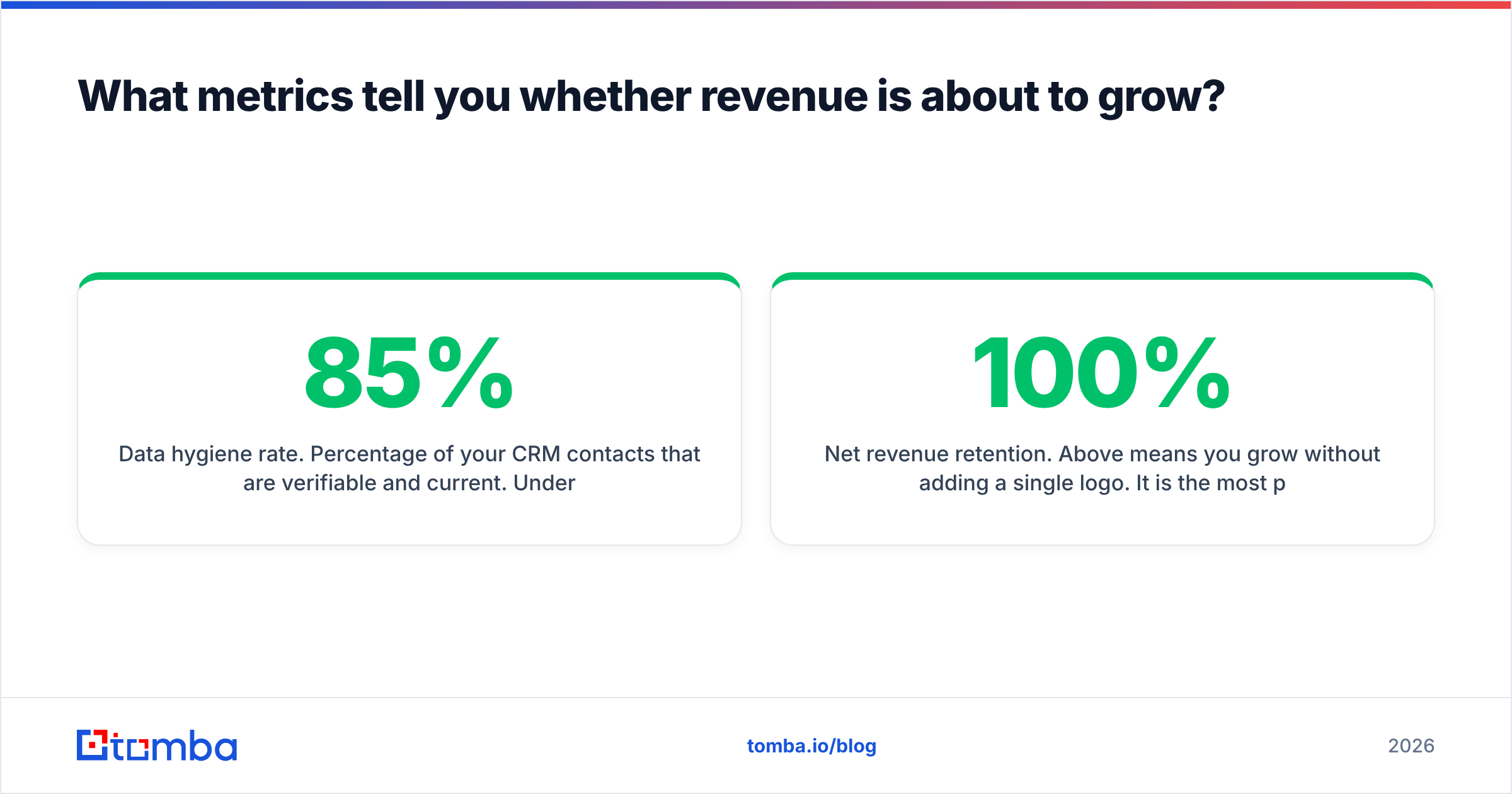
- Data hygiene rate. Percentage of your CRM contacts that are verifiable and current. Under 85% and your forecast is fiction.
- Net revenue retention. Above 100% means you grow without adding a single logo. It is the most predictive number in subscription businesses.
- Win rate by segment. Aggregate win rate hides everything. Split it by company size, source, and competitor — that's where the actionable variance lives.
- Average sales cycle length by stage. A stage that's lengthening is a stage where your process broke.
Gartner's B2B buying research consistently shows that buyers spend a small fraction of their journey with any single vendor's sales team. That means your leading indicators need to cover the parts of the process you can control — response speed, data quality, and coverage — rather than the parts you can't.
How should you sequence a 90-day revenue plan?#
Concrete, in order:
Days 1-15 — Diagnose. Pull win rate by segment, churn by cohort, and bounce rate by campaign. Audit a random sample of 200 CRM contacts for accuracy. Interview the last 20 churned accounts and the last 20 closed-won deals. You are looking for the single largest leak, not a list of twelve.
Days 16-30 — Fix the cheapest thing. Almost always this is pricing, follow-up speed, or data hygiene. Ship one change, not five, so you can attribute the result.
Days 31-60 — Build the expansion motion. Identify accounts using more than 70% of their allotment, accounts with a new executive hire, and accounts whose champion just changed jobs. Run a play against each list. Track response rate per play, not in aggregate.
Days 61-90 — Scale outbound against the clean foundation. Now — and only now — add volume. Build the ICP account list, enrich it, verify it, and sequence it. You are scaling a motion whose conversion math you already trust.
The temptation is to run all four phases simultaneously. Don't. If you change pricing, follow-up speed, targeting, and channel mix in the same quarter, you will have no idea what worked, and you'll be guessing again next quarter.
What's the most common mistake when trying to increase revenue?#
Confusing activity with throughput. A team that doubles emails sent while holding meetings-booked flat has not worked harder; it has worked less efficiently and probably damaged its domain in the process.
The second most common mistake: treating data as a one-time purchase. Contact data is a perishable good. Teams that buy a list once and work it for a year are, by month nine, spending most of their effort mailing people who no longer exist at those companies. The fix is process, not procurement — verify continuously, re-enrich quarterly, and treat bounce rate as a health metric rather than an annoyance.
Third: ignoring the segment analysis. If you sell to both 20-person startups and 2,000-person enterprises, you have two businesses with different win rates, cycle lengths, and churn profiles. Averaging them produces a number that describes neither. Split the analysis and you'll usually find one segment is subsidizing the other — and that's your growth decision right there.
Where does data quality fit into all of this?#
Underneath everything. Every lever above assumes you can reliably reach the right person. Pricing tests need a clean sample. Expansion plays need current contacts at the account. Outbound needs deliverable addresses. Churn prevention needs to know when a champion moved.
That's the practical foundation: keep a verified, current view of who you're selling to. Run new prospect lists through Tomba's Email Finder to get accurate, source-cited contacts before your reps waste a sequence on them, and keep your existing CRM enriched so the pipeline math you're basing decisions on is real. Tomba's free tier gives you 25 searches a month to test accuracy against your own known-good contacts; paid plans start at $49/mo, with Growth at $99/mo — full Tomba pricing is public. Verify your data first, then pull the levers. In that order, the math works.
Related guides#
// get started
Find, verify and enrich your first contacts today
Start on the free plan with 25 searches a month, then scale when your team is ready.
Free plan · No credit card required · GDPR & CCPA
Get the Tomba newsletter
Product and data updates
// about the author