How to Increase Sales in B2B: 9 Tactics That Work in 2026
Most B2B revenue problems are not motivation problems — they are data, targeting, and follow-up problems. Here are nine tactics, with numbers, that actually move pipeline in 2026.
TL;DR
- B2B sales rarely stall because your reps lack hustle. They stall because the list is wrong, the data is stale, or the follow-up dies at touch two.
- The fastest wins come in this order: fix contact data quality, narrow your ICP, then increase touch count per account — not touch count per hour.
- A 20% bounce rate does more damage than a bad subject line. It kills domain reputation and silently caps every campaign you run afterward.
- Multi-threading (3+ contacts per account) lifts win rates more than any single copywriting change.
- Track two metrics weekly: qualified pipeline created and meetings-held-per-1,000-contacts. Everything else is vanity.
Why do most B2B sales plans fail before the first email?#
Because the inputs are broken. You can hire the best SDR on the market, hand them a 12,000-row list scraped in 2023, and they will underperform a mediocre rep working 400 verified, well-targeted contacts.
Here is the arithmetic most teams never run. Say you send 5,000 emails a month. If 22% of those addresses are dead — a normal figure for an unverified purchased list — 1,100 messages bounce. Mailbox providers read that as spam behavior. Your inbox placement drops. The 3,900 valid addresses now land in Promotions or Spam at a much higher rate. So your effective reach is not 3,900. It is closer to 2,400. You paid for 5,000.
Now flip it. Same 5,000 sends, 2% bounce rate, clean sending domain. Effective reach is roughly 4,600. Same rep, same copy, same offer — nearly double the actual conversations. That is the highest-leverage change available to most B2B teams, and it costs less than a single SDR's monthly commission.
The second failure mode is target width. Teams define their ICP as "SaaS companies, 50-500 employees, US." That is not an ICP, that is a filter. A real ICP names the trigger: "Series B SaaS companies that just hired a first RevOps lead." The trigger is what makes the first line of your email non-generic.
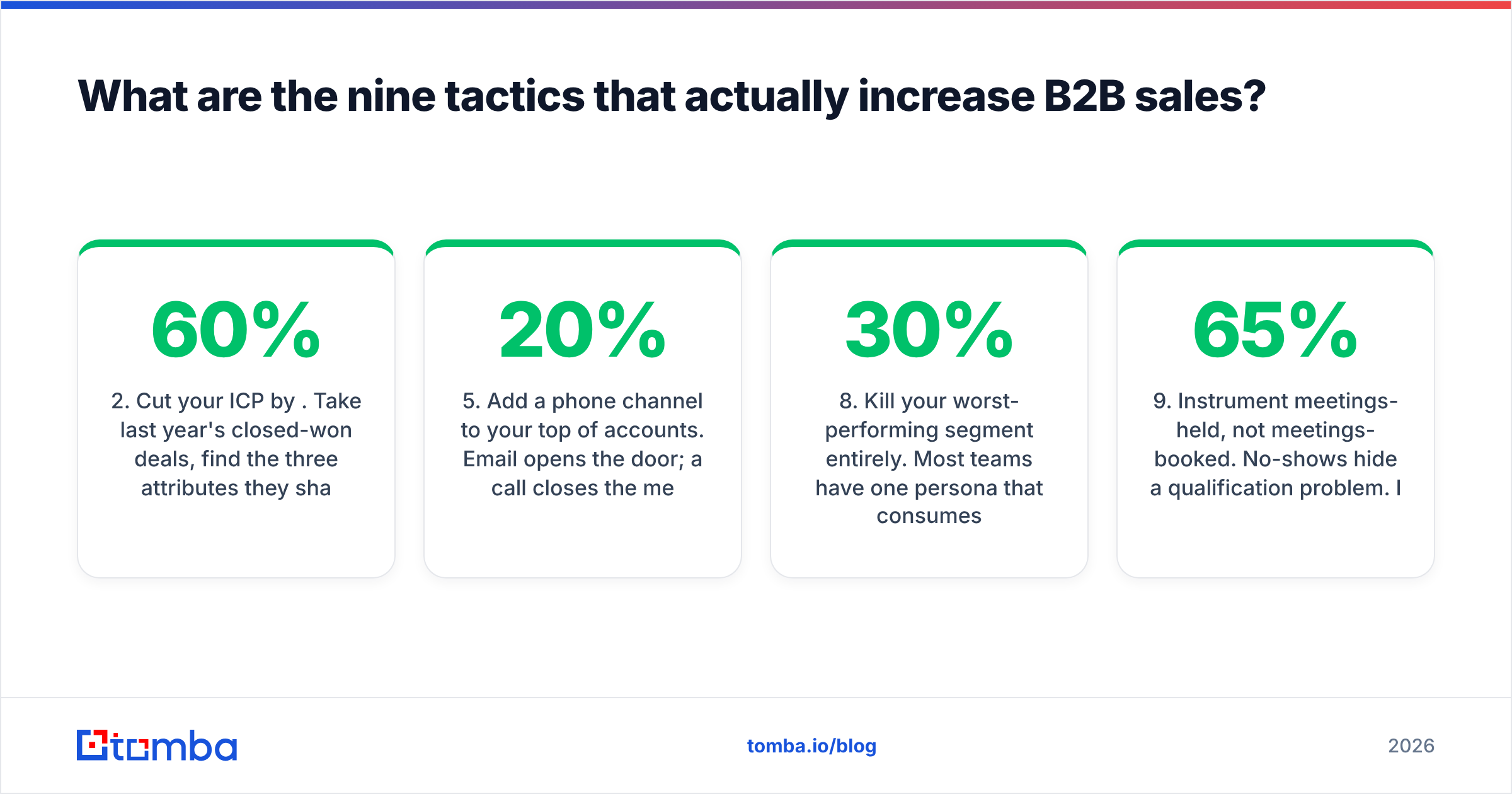
What are the nine tactics that actually increase B2B sales?#
Ranked by payback speed — fastest first.
- Verify every contact before it enters a sequence. Single biggest deliverability lever. Run your list through an email verifier and drop anything that is not
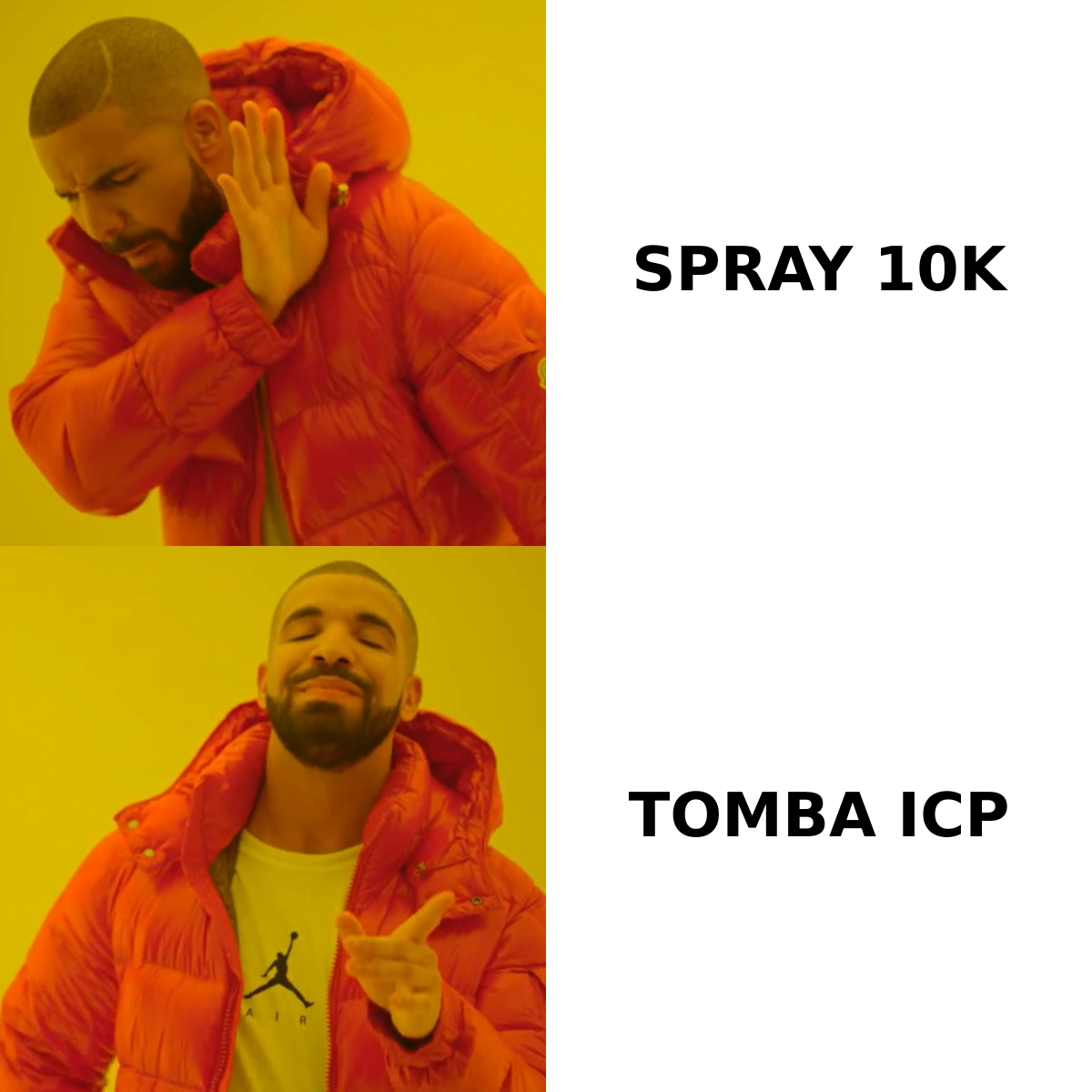
validor a confirmed catch-all you have separately tested. - Cut your ICP by 60%. Take last year's closed-won deals, find the three attributes they share, and prospect only against those. Smaller list, higher reply rate, shorter cycle.
- Multi-thread every target account. Find three to five contacts per company instead of one. Use domain search to pull the full org map from a single domain rather than hunting person by person.
- Extend follow-up from 3 touches to 7. Most replies to cold outbound arrive between touch three and touch six. Teams that stop at three are throwing away the majority of their own pipeline.
- Add a phone channel to your top 20% of accounts. Email opens the door; a call closes the meeting. Pull direct dials with a phone finder rather than dialing switchboards.
- Rewrite openers around a trigger, not a compliment. "Saw you're hiring three AEs in EMEA" outperforms "Love what you're building" by a wide margin.
- Enrich before you route. Firmographic and technographic data at the lead-capture stage means better routing, better scoring, fewer wasted rep hours.
- Kill your worst-performing segment entirely. Most teams have one persona that consumes 30% of effort and produces 4% of revenue. Cut it and reallocate.
- Instrument meetings-held, not meetings-booked. No-shows hide a qualification problem. If held-rate is under 65%, your booking motion is over-promising.
How does data quality compare across the sales funnel?#
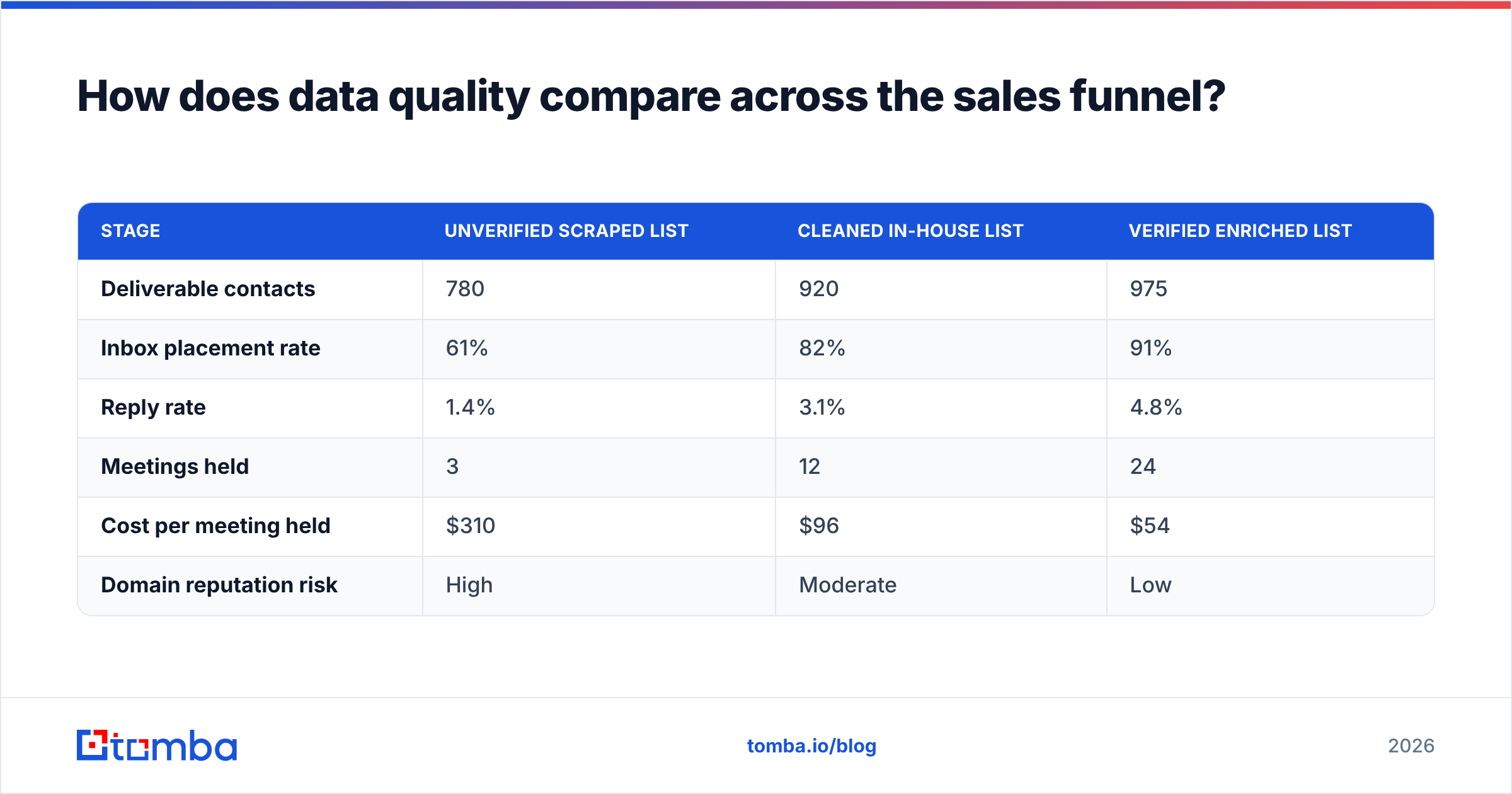
The cost of bad data compounds at every stage. Here is what the same 1,000-contact list produces under three different data-quality regimes, using conservative benchmark rates.
| Stage | Unverified scraped list | Cleaned in-house list | Verified enriched list |
|---|---|---|---|
| Deliverable contacts | 780 | 920 | 975 |
| Inbox placement rate | 61% | 82% | 91% |
| Reply rate | 1.4% | 3.1% | 4.8% |
| Meetings held | 3 | 12 | 24 |
| Cost per meeting held | $310 | $96 | $54 |
| Domain reputation risk | High | Moderate | Low |
The interesting column is the last row of costs. The verified list is not "a bit better" — it is roughly six times cheaper per meeting held, because every downstream conversion works off a larger, healthier base. This is why data spend is usually the wrong place to economize.
Two caveats so you don't over-read the table. First, these are directional benchmarks, not guarantees; your category, offer, and sender history all shift them. Second, verification fixes deliverability, not relevance. A verified email sent to the wrong persona still fails — it just fails without damaging your sender reputation.
Is outbound still worth it in 2026, or should you go all-in on inbound?#
Both, but weighted by deal size. The honest split looks like this.
Inbound wins on cost per lead and loses on control. You cannot decide on Monday that you want twelve conversations with manufacturing CFOs by Friday. Outbound wins on control and targeting precision, and loses on volume economics — every conversation costs rep time.
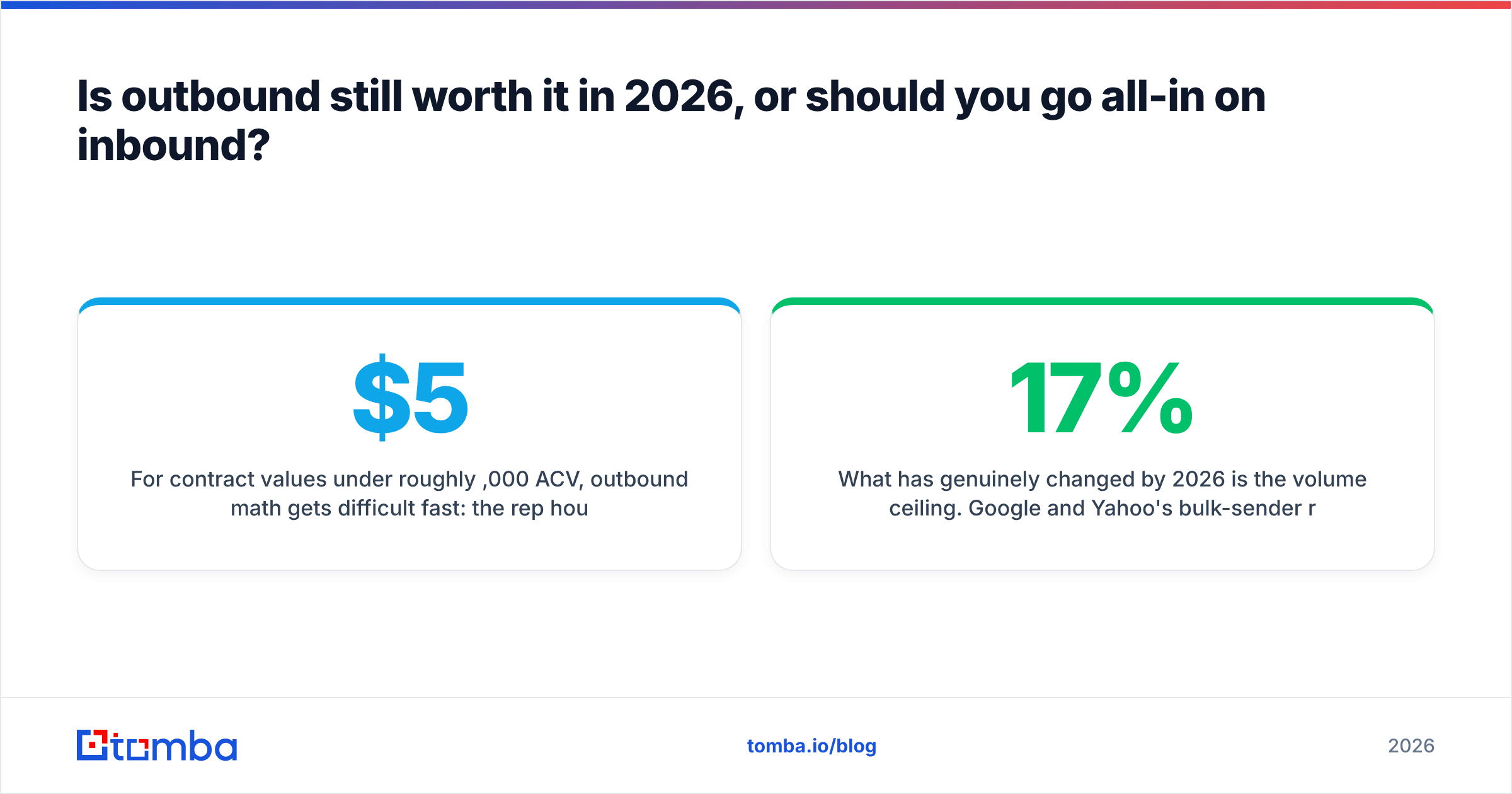
For contract values under roughly $5,000 ACV, outbound math gets difficult fast: the rep hours per closed deal rarely justify the revenue. Above $20,000 ACV, targeted outbound is usually the highest-ROI channel available, because one deal pays for a quarter of prospecting. Between those numbers, run both and let cost-per-closed-won decide.
What has genuinely changed by 2026 is the volume ceiling. Google and Yahoo's bulk-sender requirements, plus Microsoft's tightened thresholds, mean the "send 50,000 a month from ten burner domains" era is over. Google's own sender guidelines now spell out authentication and spam-rate thresholds that make sloppy volume outbound self-defeating. The teams growing outbound today send fewer, better-targeted, better-verified messages. Read the Gartner B2B buying research if you want the buyer-side view: buyers spend only about 17% of their journey with sellers at all, which is exactly why the accounts you pick matter more than the volume you push.
How do you build a repeatable prospecting workflow?#
A workflow beats motivation. Here is one that a two-person team can run without an ops hire.
Step 1 — Define the trigger list weekly. Pick one buying signal (funding round, new exec hire, tech-stack change, job posting) and build that week's account list from it. Fifty accounts is plenty.
Step 2 — Map the org. For each account, find three to five relevant contacts. An email finder that works from domain plus name handles this in bulk; a bulk email finder handles it for the whole list at once.
Step 3 — Verify and segment. Split results into valid, catch-all, and invalid. Send to valid immediately. Route catch-all addresses through a catch-all verifier before deciding — catch-all domains accept everything at SMTP level, so they need a different test. Discard invalid.
Step 4 — Sequence with seven touches across two channels. Days 1, 3, 7, 12, 18, 25, 34. Email on most, a call or LinkedIn touch on days 7 and 18.
Step 5 — Review held meetings every Friday. Not booked. Held. If the number is flat for three weeks, the problem is the account list, not the copy.

What should you look for in a prospecting data provider?#
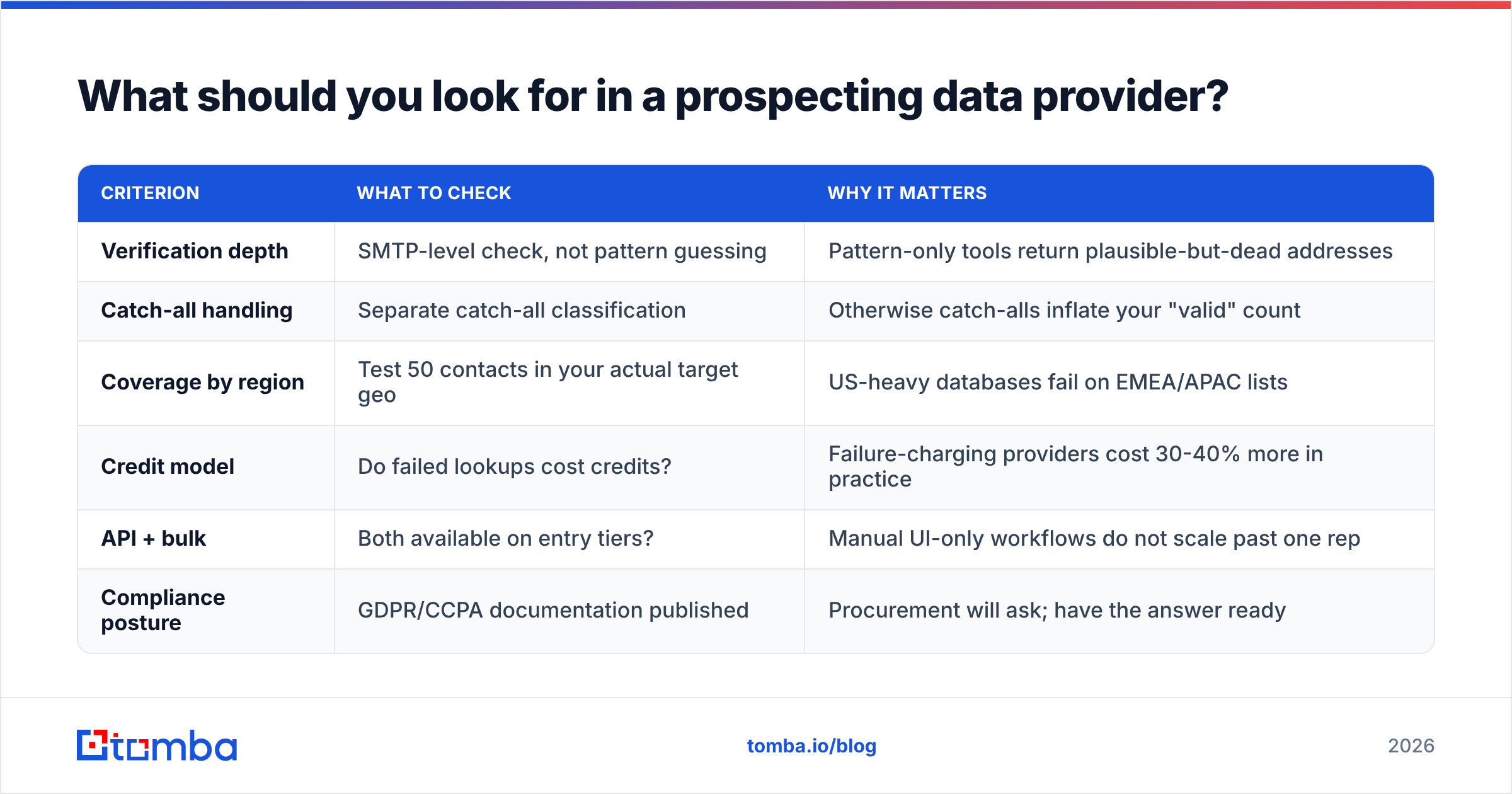
Providers differ more than their marketing pages suggest. Here is a practical evaluation grid.
| Criterion | What to check | Why it matters |
|---|---|---|
| Verification depth | SMTP-level check, not pattern guessing | Pattern-only tools return plausible-but-dead addresses |
| Catch-all handling | Separate catch-all classification | Otherwise catch-alls inflate your "valid" count |
| Coverage by region | Test 50 contacts in your actual target geo | US-heavy databases fail on EMEA/APAC lists |
| Credit model | Do failed lookups cost credits? | Failure-charging providers cost 30-40% more in practice |
| API + bulk | Both available on entry tiers? | Manual UI-only workflows do not scale past one rep |
| Compliance posture | GDPR/CCPA documentation published | Procurement will ask; have the answer ready |
On pricing, the market has settled into a fairly narrow band for small teams. Tomba pricing starts with a free tier at 25 searches per month, then Starter at $49/mo, Growth at $99/mo, and Pro at $249/mo, with Enterprise quoted custom. Providers like BookYourData take a different and equally valid approach — pay-as-you-go credits against a pre-built database, which suits teams that want a one-time list rather than an ongoing search workflow. Match the model to how you actually work: recurring, trigger-based prospecting favors a subscription with API access; a single campaign push favors credit packs.
Whatever you choose, test with your own list before committing. Take 100 contacts you already know are real, run them through a trial, and measure accuracy yourself. Vendor-published accuracy figures are measured on vendor-chosen samples. Yours are the only ones that predict your results. Check how a provider documents its data sources — transparency there correlates strongly with real-world accuracy.
How do you increase deal size, not just deal count?#
Increasing sales has two levers, and most teams only pull one. Volume gets all the attention; average deal size is usually easier to move.
Multi-thread deeper. Deals with four or more stakeholders engaged close larger. More stakeholders means more use cases surfaced, which means a bigger initial scope. This is the same tactic as tactic three above, but the payoff shows up in ACV, not just win rate.
Sell to the budget holder's problem. A manager buys a tool. A VP buys a number. Reframing the same product from "saves your team 6 hours a week" to "removes the need for the second hire you budgeted" changes the price bracket the buyer mentally files you under.
Introduce a tier above the one you expect them to buy. Anchoring is not a trick; it is context. Buyers cannot evaluate whether $99/mo is reasonable without seeing $249/mo next to it.
Time your expansion motion. Day 90 post-close, not day 300. Champions are most engaged in the first quarter, and that is when a second department gets added without a new procurement cycle.
Reduce discounting by increasing qualification. Discounts are usually a symptom of pursuing accounts that were never a strong fit. Fixing the top of the funnel fixes the bottom-of-funnel margin.
For a broader view of how buying committees have grown, HubSpot's sales research is a reasonable neutral reference — the trend toward larger committees is well documented across sources, and it argues for breadth of contact over depth on a single champion.
What metrics should you actually review each week?#
Cut your dashboard to five numbers.
- Qualified pipeline created — dollar value, not count.
- Meetings held per 1,000 contacts touched — your true efficiency ratio.
- Bounce rate — anything above 3% means your verification step is broken.
- Reply-to-meeting conversion — if replies are high but meetings are low, your offer is wrong, not your targeting.
- Average contacts engaged per closed-won account — your multi-threading score.
Notice what is absent: emails sent, calls made, activity counts. Those are inputs you already control. Reviewing them weekly teaches reps to optimize for the counter rather than the outcome. Track them monthly for capacity planning and leave them off the weekly review.
Where should you start if you only have one week?#
Do the data pass. It is the only tactic on this list you can complete in five days and measure in two weeks.
Export your current prospecting list. Verify every address. Delete the invalid ones without sentimentality — a dead address has negative value, not zero value. Then re-run one existing campaign against the cleaned list with no other changes. The delta you see is your data tax, and it is usually larger than anyone on the team expected.
After that, narrow the ICP, extend follow-up to seven touches, and start multi-threading. In that order. Each step compounds on the one before it, and none of them requires new headcount or a new tech stack.
If you want a single starting point, start where the leverage is highest: the contact data itself. The Tomba Email Finder finds verified professional email addresses by domain, name, or company, and the free tier gives you 25 searches a month to test accuracy on your own accounts before you spend anything. Run your next 50 target accounts through it, compare the bounce rate against your current list, and let the numbers decide the rest of your quarter.
Related guides#
// get started
Find, verify and enrich your first contacts today
Start on the free plan with 25 searches a month, then scale when your team is ready.
Free plan · No credit card required · GDPR & CCPA
// about the author