How to Increase Sales in Logistics Business: 2026 Playbook
Freight sales stalls when reps chase shippers who already have a carrier. Here are seven concrete moves — trigger lists, decision-maker mapping, lane-specific pitches — that actually move logistics revenue in 2026.
TL;DR
- Logistics sales fails on targeting, not effort. Most freight reps burn hours on shippers who signed a three-year carrier contract eight months ago.
- The highest-converting signal in freight is a trigger event: a new distribution center, a tariff change, a supply-chain hire, a warehouse lease, a carrier bankruptcy.
- Your buyer is rarely one person. Expect a logistics manager, a VP of supply chain, a CFO, and a plant manager — each with a different objection.
- Lane-specific pitches beat generic "we do freight" outreach by a wide margin. Name the lane, name the cost, name the transit time.
- Build the contact layer first. A trigger list without verified decision-maker emails is a spreadsheet, not a pipeline.
Why is selling logistics services harder than selling software?#
Because you are almost never selling into a vacuum. Every company that ships anything already has a solution — a broker, an asset carrier, a 3PL, or an in-house fleet. There is no "we don't have this yet" segment. You are always displacing an incumbent, and the incumbent has an existing rate agreement, integrated EDI, and a rep the shipper has known for six years.
That changes the entire sales motion. In SaaS you can create demand. In freight you have to catch demand at the exact moment it becomes available: a contract renewal, a service failure, a capacity crunch, a new facility that needs lanes nobody has quoted yet.
Second problem: the value proposition is compressed. Rate, transit time, on-time percentage, claims ratio, and communication quality. That's roughly the whole board. Differentiation has to come from the specificity of what you propose, not from features.
Third problem: margins. A freight brokerage running 13-15% gross margin cannot afford a $2,000 customer acquisition cost on an account that ships four loads a month. Your sales process must be cheap per touch and precise per target.
What actually drives revenue growth in a logistics business?#
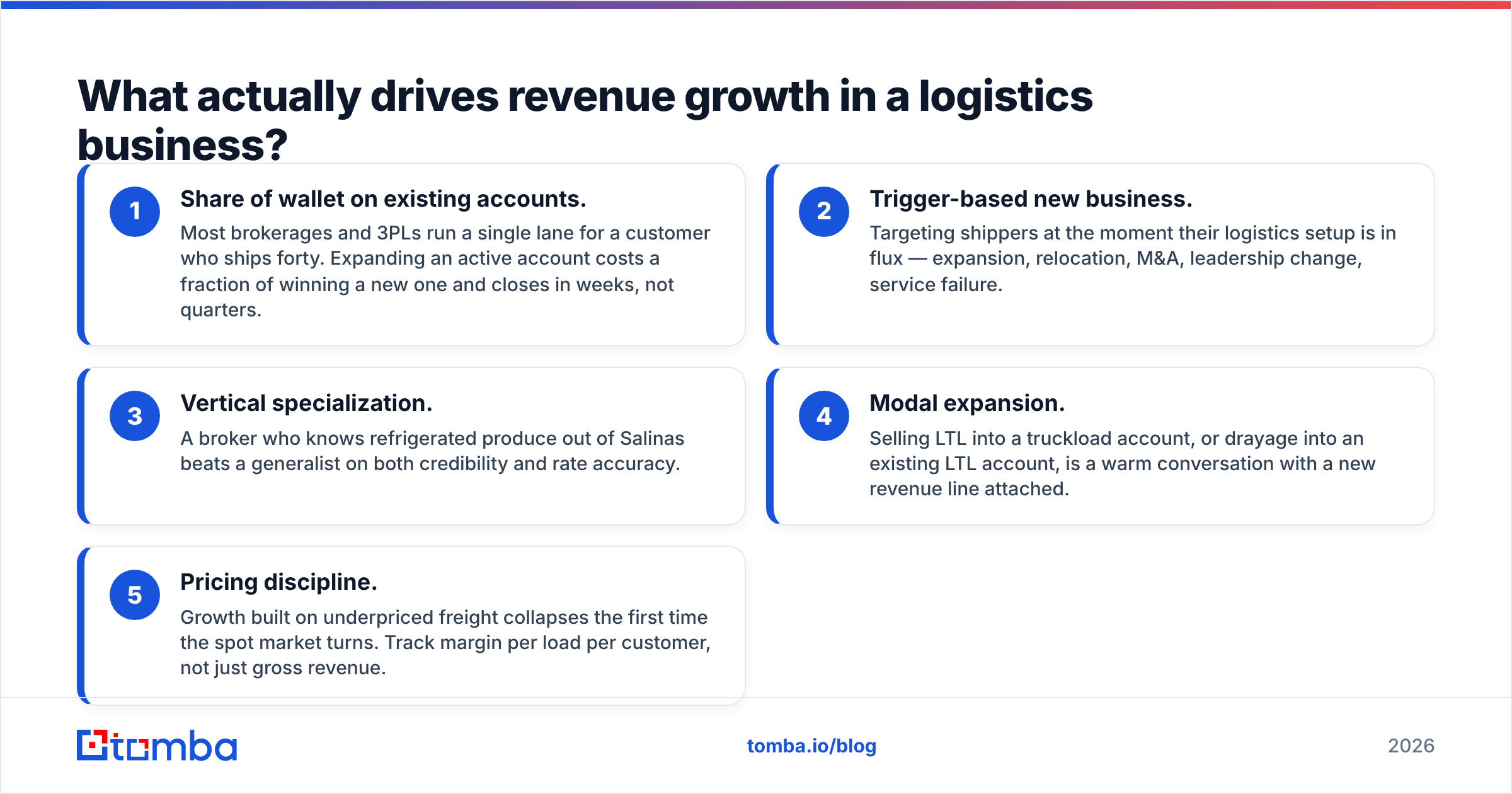
Five levers, ranked by how fast they move the number:
- Share of wallet on existing accounts. Most brokerages and 3PLs run a single lane for a customer who ships forty. Expanding an active account costs a fraction of winning a new one and closes in weeks, not quarters.
- Trigger-based new business. Targeting shippers at the moment their logistics setup is in flux — expansion, relocation, M&A, leadership change, service failure.
- Vertical specialization. A broker who knows refrigerated produce out of Salinas beats a generalist on both credibility and rate accuracy.
- Modal expansion. Selling LTL into a truckload account, or drayage into an existing LTL account, is a warm conversation with a new revenue line attached.
- Pricing discipline. Growth built on underpriced freight collapses the first time the spot market turns. Track margin per load per customer, not just gross revenue.
Notice that three of five levers are about who you talk to and when. That's why data quality sits underneath everything else in this playbook.
Who are you actually selling to inside a shipper?#
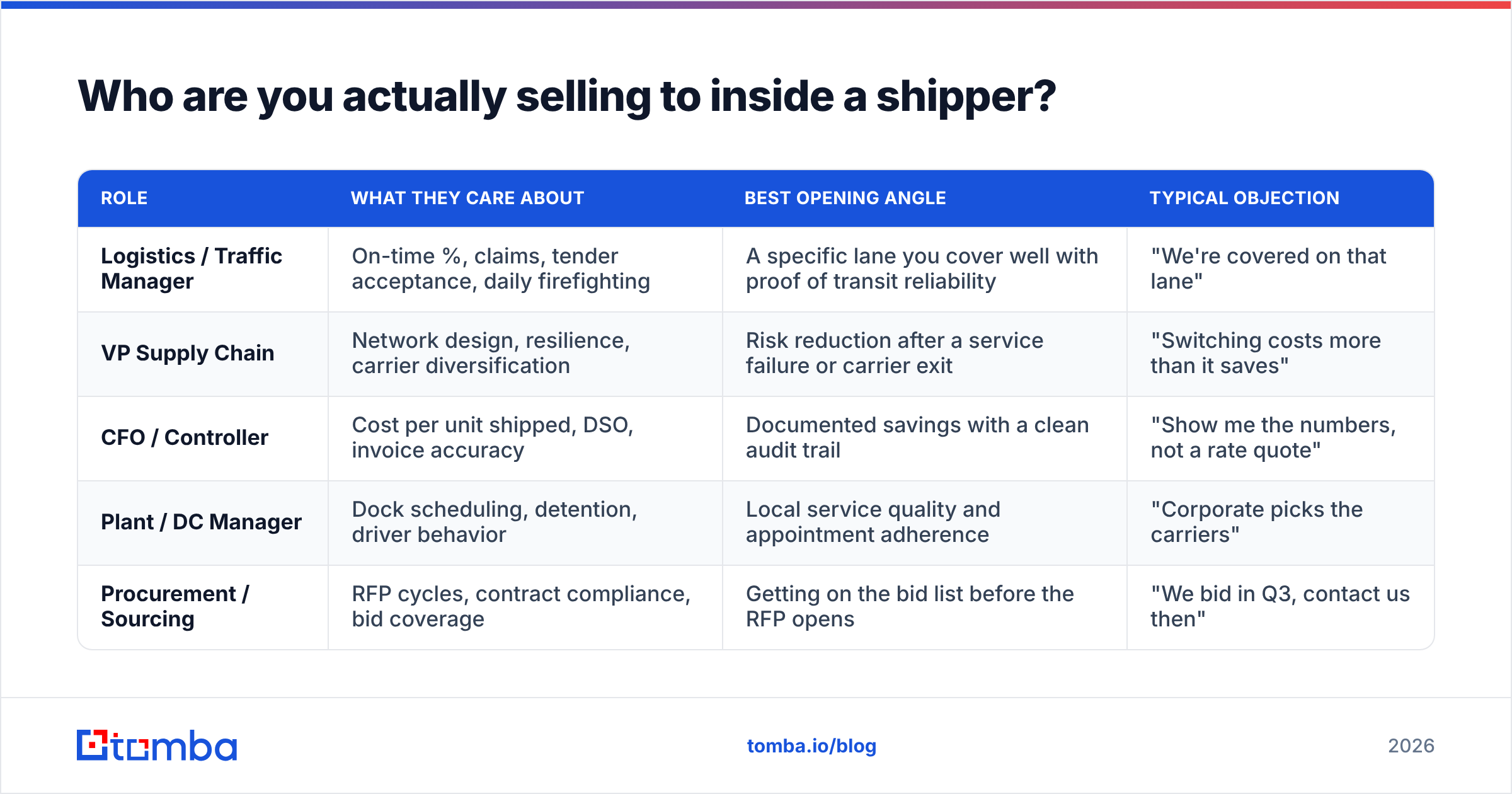
The single most common mistake in logistics outbound is emailing "the logistics manager" and stopping there. Freight decisions in mid-market and enterprise shippers are committee decisions. Here's the map:
| Role | What they care about | Best opening angle | Typical objection |
|---|---|---|---|
| Logistics / Traffic Manager | On-time %, claims, tender acceptance, daily firefighting | A specific lane you cover well with proof of transit reliability | "We're covered on that lane" |
| VP Supply Chain | Network design, resilience, carrier diversification | Risk reduction after a service failure or carrier exit | "Switching costs more than it saves" |
| CFO / Controller | Cost per unit shipped, DSO, invoice accuracy | Documented savings with a clean audit trail | "Show me the numbers, not a rate quote" |
| Plant / DC Manager | Dock scheduling, detention, driver behavior | Local service quality and appointment adherence | "Corporate picks the carriers" |
| Procurement / Sourcing | RFP cycles, contract compliance, bid coverage | Getting on the bid list before the RFP opens | "We bid in Q3, contact us then" |
Two practical consequences. First, your outbound sequence should touch at least two roles per account — usually the operational buyer and the economic buyer. Second, your message has to change per role. The same email sent to the traffic manager and the CFO will fail with both.
Building that multi-threaded contact list is where most teams stall. Manually hunting five contacts per company across 400 target accounts is a full-time job. This is where a bulk email finder earns its keep: upload the company domains and target job titles, get back verified addresses, and skip the LinkedIn scroll entirely. If you already know the person's name and company, a domain search returns the full contact map for the account in one call.
How do you find shippers who are actually ready to switch?#
Stop building lists by SIC code. Start building them by event. Here are the triggers that correlate with an open freight decision, roughly in order of strength:
- New warehouse or DC lease signed. New facility means new lanes nobody has priced. Track commercial real estate announcements and local business journals.
- Supply chain leadership hire. New VPs re-bid. A "VP of Supply Chain" or "Director of Logistics" starting in the last 90 days is the warmest cold lead in freight. Watch LinkedIn job-change announcements.
- Carrier or broker failure. When a regional carrier exits or a broker goes under, every one of their customers is in market that week.
- Tariff, sourcing, or nearshoring shifts. A shipper moving production from Asia to Mexico needs cross-border and drayage capability they don't currently have.
- Funding round or acquisition. Capital events precede volume growth. A Series C manufacturer will ship more in twelve months than it does today.
- Hiring for warehouse or transportation roles at scale. Twenty open forklift roles in one metro means volume is climbing.
- Product launch or seasonal ramp announcements. Retail and CPG shippers telegraph peak needs in earnings calls and press releases.
For each trigger, the play is the same: identify the account, map two to three decision-makers, verify their contact details, and reach out within days — not weeks. Freight windows close fast.
One more source people underuse: your own website traffic. If a shipper's team is reading your lane pages, they're shopping. Website visitor reveal turns anonymous traffic into named companies you can route straight to a rep.
What does a logistics cold email that actually gets replies look like?#
Generic freight outreach — "we're a full-service 3PL with 20 years of experience and a nationwide carrier network" — has a near-zero reply rate because it's indistinguishable from the other eleven emails that shipper got this week.
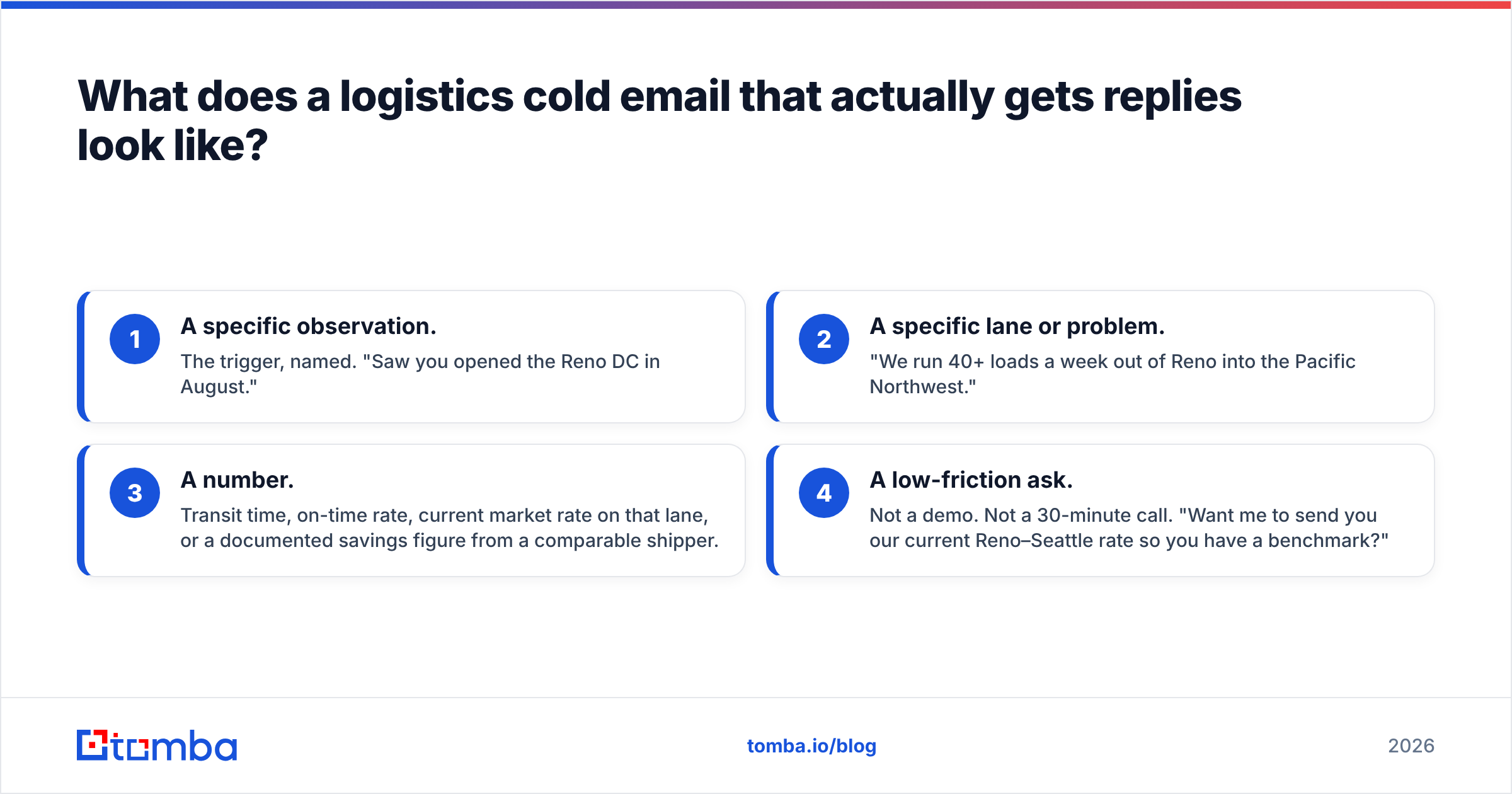
The formula that works has four parts:
- A specific observation. The trigger, named. "Saw you opened the Reno DC in August."
- A specific lane or problem. "We run 40+ loads a week out of Reno into the Pacific Northwest."
- A number. Transit time, on-time rate, current market rate on that lane, or a documented savings figure from a comparable shipper.
- A low-friction ask. Not a demo. Not a 30-minute call. "Want me to send you our current Reno–Seattle rate so you have a benchmark?"
That last part matters more than people think. A rate benchmark is free, useful, and requires zero commitment. It gets replies from people who are not ready to switch — and those replies start the relationship six months before the RFP.
Keep it under 90 words. Freight buyers read on their phone between dock calls. If you want a starting structure, the cold email templates library covers the standard patterns you can adapt to lanes and verticals.
Follow-up cadence for logistics specifically: 4-6 touches over 3 weeks, then a quarterly check-in loop. Freight is a timing game. The rep who is politely present when the incumbent fails is the rep who wins the account. Contacts that go stale between touches are the silent killer here — run the list through an email verifier before each new sequence so bounces don't wreck your sender reputation.
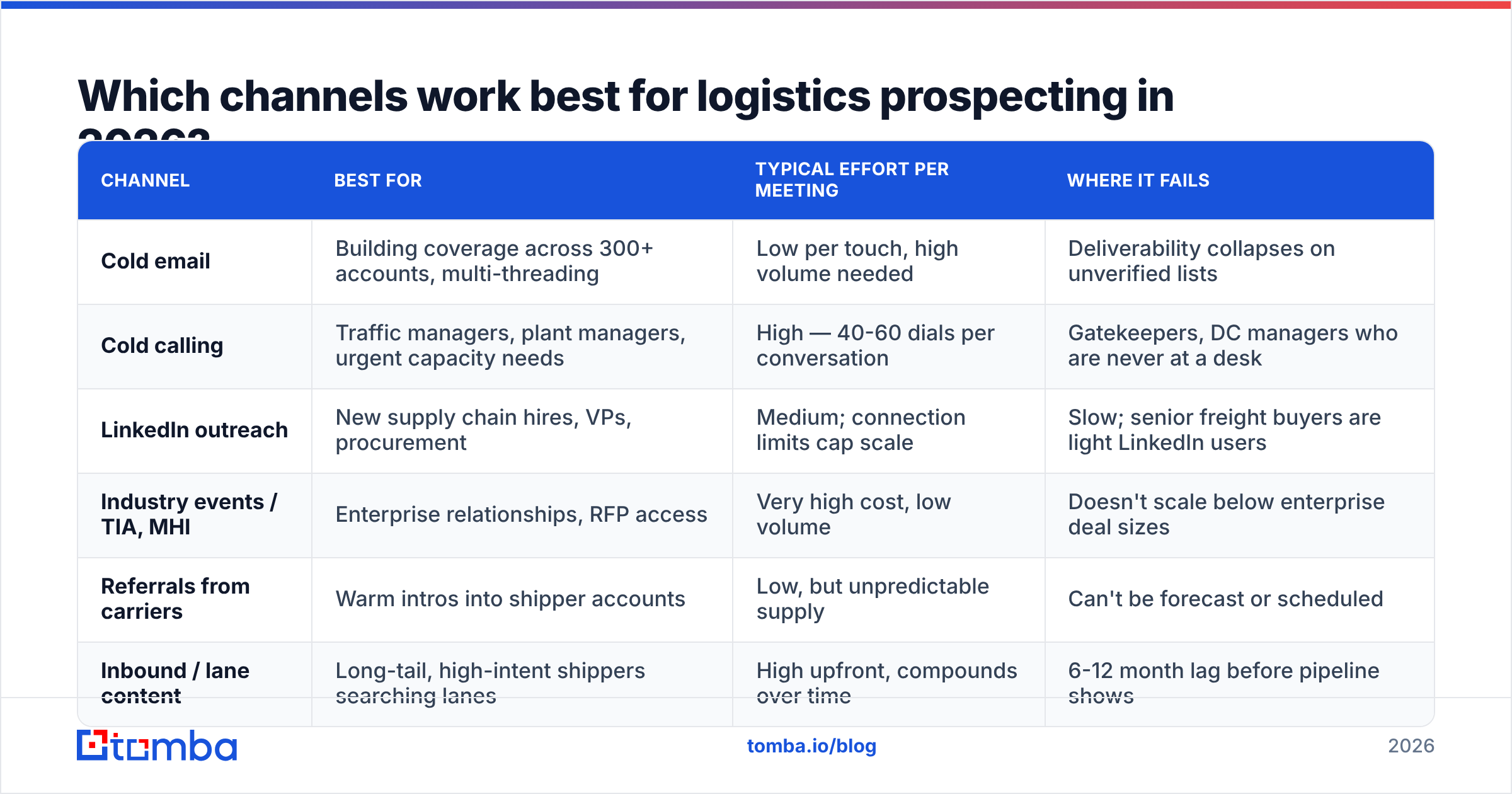
Which channels work best for logistics prospecting in 2026?#
Freight is a phone business that acquired an email layer. Here's how the channels compare in practice:
| Channel | Best for | Typical effort per meeting | Where it fails |
|---|---|---|---|
| Cold email | Building coverage across 300+ accounts, multi-threading | Low per touch, high volume needed | Deliverability collapses on unverified lists |
| Cold calling | Traffic managers, plant managers, urgent capacity needs | High — 40-60 dials per conversation | Gatekeepers, DC managers who are never at a desk |
| LinkedIn outreach | New supply chain hires, VPs, procurement | Medium; connection limits cap scale | Slow; senior freight buyers are light LinkedIn users |
| Industry events / TIA, MHI | Enterprise relationships, RFP access | Very high cost, low volume | Doesn't scale below enterprise deal sizes |
| Referrals from carriers | Warm intros into shipper accounts | Low, but unpredictable supply | Can't be forecast or scheduled |
| Inbound / lane content | Long-tail, high-intent shippers searching lanes | High upfront, compounds over time | 6-12 month lag before pipeline shows |
The combination that outperforms any single channel: email to open the door, phone to book, LinkedIn to warm the name. Multi-channel sequences on a tight target list beat single-channel blast at ten times the volume.
For the phone leg, having direct dials rather than switchboard numbers changes the math entirely. A phone finder that returns mobile or direct-line numbers for the specific traffic manager removes the gatekeeper step that kills most freight dial sessions. Validate before you dial — dead numbers waste the same hour as a bad conversation.
How do you grow revenue from existing logistics accounts?#
The fastest revenue in any logistics business is already sitting in your TMS. Three plays:
- Lane audit. Pull every customer's shipping profile and compare the lanes you run against the lanes they operate. Ask directly: "We handle your Dallas–Atlanta freight. Who covers Dallas–Chicago?" This one question routinely doubles account revenue.
- Modal cross-sell. Truckload customers ship LTL, parcel, and sometimes intermodal. Each is a separate buying decision, often with a separate buyer inside the same company. Map those buyers.
- Quarterly business reviews with real data. Bring on-time percentage, claims ratio, cost per mile trend, and two specific recommendations. QBRs that present data earn expansion conversations. QBRs that are lunch earn nothing.
There is also a defensive angle: churn in freight is quiet. Volume drifts away load by load until a customer is dormant and nobody noticed. Set a rule — any account with a 30% volume drop quarter over quarter triggers a call. Recovering a fading account is far cheaper than replacing it.
Enterprise shippers reorganize constantly. When your champion moves to a new company, that's two opportunities: retain the account under a new contact, and follow the champion to their new employer. Contact enrichment run against your CRM on a schedule catches these moves before your data rots.
What metrics should a logistics sales team actually track?#
Revenue is a lagging indicator. These are the numbers that predict it:
- Meetings booked per 100 verified contacts. Isolates message quality from list quality. If this is below 2, fix the message. If contact bounce rate is above 5%, fix the list first.
- New lanes quoted per week. Quoting is the real leading indicator in freight. No quotes, no loads.
- Quote-to-load conversion. Below 10% usually means you're quoting the wrong lanes or you're being used as a rate check.
- Margin per load by customer. Catches accounts that grow revenue while destroying profit.
- Time from trigger to first touch. Under 7 days is competitive. Over 30 days and the window has closed.
- Accounts with 2+ contacts engaged. Single-threaded accounts churn when the contact leaves.
Track response rate per segment, not in aggregate. Refrigerated shippers, flatbed shippers, and parcel-heavy e-commerce brands behave completely differently, and an aggregate number hides which segment is actually working.
For benchmarking your own operation against the wider market, Gartner's supply chain research and reviews on G2's freight and 3PL categories are useful third-party reference points when you need to justify a change internally.
How should you structure a logistics sales team in 2026?#
Small brokerages typically run a generalist model: every rep prospects, quotes, covers, and manages accounts. That works to about $5M in revenue, then it breaks — the best closers spend their days chasing check calls.
The structural fix is separating hunting from coverage. Sales reps prospect and close. Operations coordinators cover loads and handle daily execution. The moment a rep spends more than 30% of their week on load coverage, new business stops.
Layer a data function on top, even if it's one person part-time: someone who maintains the target account list, enriches contacts, checks trigger feeds, and hands reps a clean list every Monday. A rep with a verified, trigger-scored list of 40 accounts outproduces three reps with a scraped spreadsheet of 2,000.
If you're evaluating where contact data comes from before you buy, vendors publish this — Tomba documents its data sources publicly, and peers like BookYourData take a similar transparency-first approach on B2B contact accuracy. Ask any provider the same question before committing budget.
What's the fastest 30-day plan to increase logistics sales?#
Week 1: Build the target list. 200-300 shippers filtered by vertical, geography, and lane fit — not by revenue size alone.
Week 2: Map contacts. Two to three decision-makers per account, verified. Traffic manager plus one senior stakeholder minimum.
Week 3: Launch multi-channel sequences. Lane-specific emails, direct-dial calls on the accounts that open, LinkedIn touches on the senior contacts.
Week 4: Run the lane audit on existing customers in parallel. This is where the immediate revenue is while outbound compounds.
Then repeat, tightening the list each cycle based on which segments replied. Six cycles in, you'll have a target profile that's specific enough to be genuinely predictive — which is the whole point.
Get the contact layer right first#
Every play in this post depends on reaching a specific human at a specific shipper at a specific moment. That's a data problem before it's a sales problem. Tomba's Email Finder gets you verified work emails for the traffic managers, supply chain VPs, and procurement leads at your target shipper accounts — by name, by company, or by domain in bulk. Start on the free tier at 25 searches a month to test your list quality, then move to Starter at $49/mo or Growth at $99/mo as your outbound scales; full Tomba pricing is public. Build the list right, and the lane pitch does the rest.
Related guides#
// get started
Find, verify and enrich your first contacts today
Start on the free plan with 25 searches a month, then scale when your team is ready.
Free plan · No credit card required · GDPR & CCPA
// about the author