How to Interview Sales Candidates: A 2026 Hiring Playbook
Most sales interviews measure charisma, not quota performance. Here is a structured, evidence-based process for interviewing sales candidates — scorecards, role-play tests, reference scripts, and the questions that actually predict revenue.
TL;DR
- Unstructured sales interviews predict performance barely better than a coin flip. Structured interviews with a fixed scorecard roughly double the signal.
- Run four stages: screen (30 min), structured competency interview (60 min), live role-play or written exercise (60 min), and back-channel references (30 min each).
- Ask for evidence, not opinions. "What was your quota, what did you close, where did you rank?" beats "Tell me about a time you overcame an objection."
- Test the actual job. If the rep will prospect cold, make them find and email a real prospect during the interview — with real tooling, in real time.
- The two highest-signal predictors are verified past attainment and coachability under live feedback. Everything else is noise you can rank lower.
Why do most sales interviews fail to predict performance?#
Because they reward the same skill the job rewards — talking well — and salespeople are professionally trained to interview well. You are letting a candidate demo a product they have rehearsed for years.
The research on this is unambiguous. Decades of meta-analysis on selection methods, summarized well in the Wikipedia overview of structured interviewing, show that unstructured interviews have weak predictive validity, while structured interviews — same questions, same order, fixed rating scale — rank near the top of practical hiring methods. Work-sample tests score higher still.
Three failure patterns show up over and over in B2B sales hiring:
- The mirror hire. The hiring manager rates the candidate highly because the candidate sells the way the manager sells. That works until the manager's style stops matching the market.
- The logo halo. "They were at Salesforce" gets treated as evidence. It is not. It tells you they passed someone's interview, not that they carried a number in a comparable motion.
- The story test. You ask for a story about resilience, get a polished one, and score it. Every candidate has that story. It separates nobody.
Fixing this is less about clever questions and more about process discipline: define the role before you meet anyone, ask every candidate the same things, score independently before you discuss, and make the candidate do the job in front of you.
What should you define before the first interview?#
Write the scorecard first. If you cannot list the five outcomes this rep owns in year one, you are not ready to interview.
A usable sales hiring scorecard has four parts:
- Mission — one sentence. "Own new-logo acquisition in the DACH mid-market segment, self-sourcing 60% of pipeline."
- Outcomes — 3-5 measurable results with dates. "Ramp to full quota of $480K ARR by month five. Book 12 qualified meetings per month by month three."
- Competencies — 5-8 behaviors, each with a definition and a 1-4 anchor scale. Prospecting persistence, discovery depth, multithreading, commercial negotiation, coachability, CRM hygiene.
- Deal-breakers — the non-negotiables. No verified attainment history. Cannot articulate a discovery framework. Blames territory for every miss.
The scorecard becomes the interview guide, the debrief structure, and the onboarding plan. Without it, every interviewer invents their own bar in the room.
One more pre-work item: decide what "good" looks like at your stage. A hunter who thrived at a company with 40 SDRs feeding them is not the same profile as someone who built pipeline from a cold list. Ask about the ratio of self-sourced to inbound pipeline early — it separates people who can generate demand from people who can only work it.
What is the right sales interview process structure?#
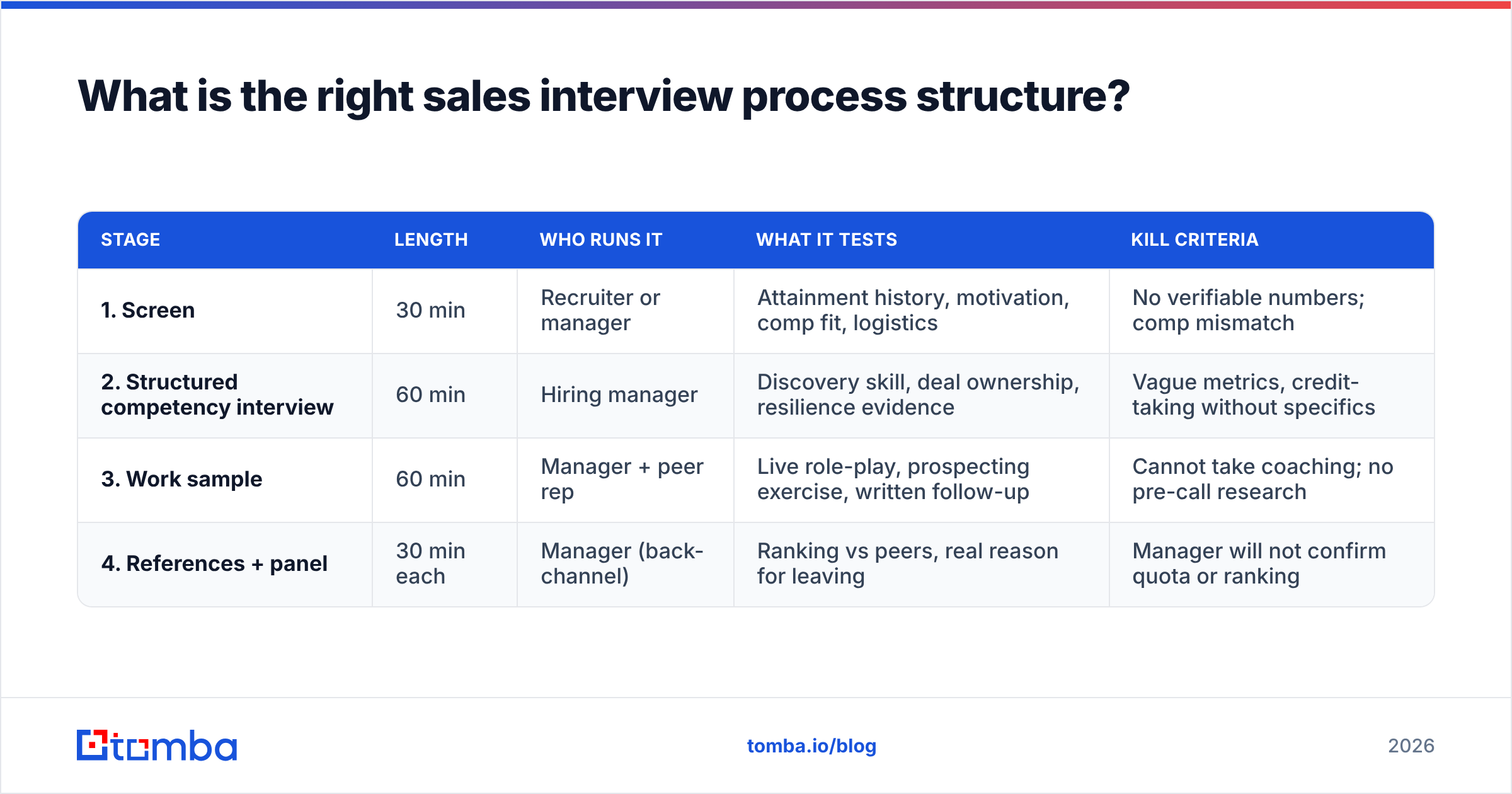
Four stages, roughly three and a half hours of candidate time, spread across no more than 10 business days. Good reps are off the market fast; a 6-week loop is a self-inflicted wound.
| Stage | Length | Who runs it | What it tests | Kill criteria |
|---|---|---|---|---|
| 1. Screen | 30 min | Recruiter or manager | Attainment history, motivation, comp fit, logistics | No verifiable numbers; comp mismatch |
| 2. Structured competency interview | 60 min | Hiring manager | Discovery skill, deal ownership, resilience evidence | Vague metrics, credit-taking without specifics |
| 3. Work sample | 60 min | Manager + peer rep | Live role-play, prospecting exercise, written follow-up | Cannot take coaching; no pre-call research |
| 4. References + panel | 30 min each | Manager (back-channel) | Ranking vs peers, real reason for leaving | Manager will not confirm quota or ranking |
Two rules that matter more than the stages themselves:
- Independent scoring before discussion. Every interviewer submits their scorecard in writing before the debrief. Once someone says "I loved them," the room converges on that. Anchoring is a real and well-documented interview bias.
- Same questions, same order. Deviating breaks comparability. You can go deeper on an answer, but every candidate gets the same core set.
What questions actually predict sales performance?#
Ask for numbers, mechanics, and losses. Avoid hypotheticals — "What would you do if..." tests imagination, not behavior.
Attainment and ranking (the highest-signal block).
- "What was your quota each of the last three years, in dollars, and what did you close?"
- "Where did you rank on your team? Out of how many reps?"
- "What percentage of your pipeline did you self-source?"
- "What was your average deal size and sales cycle length?"
- "Who signed your deals — what title, and how many people were in the buying group?"
A strong candidate answers these in under 90 seconds with specifics. A weak one gives ranges, talks about "team performance," or pivots to a story. Note that pivot; it is data.
Deal mechanics.
- "Walk me through the biggest deal you closed last year, from first touch to signature."
- "Now walk me through the biggest deal you lost. What was the actual reason — not the CRM close reason?"
- "How did you build a business case? Show me a slide or model you used, redacted."
The lost-deal question is the most underrated in sales hiring. Candidates rehearse wins. Losses reveal whether they diagnose or deflect.
Prospecting reality check.
- "Describe your last 30-day prospecting cadence. How many touches, across which channels?"
- "Where did your contact data come from, and what did you do when the email bounced?"
- "What was your reply rate, and how do you know?"
Reps who have genuinely self-sourced pipeline talk fluently about data quality, bounce rates, and list hygiene. They know their email deliverability took a hit the month they bought a bad list. Reps who have only worked inbound cannot fake this depth.
Coachability.
- "Tell me about feedback that changed how you sell. Who gave it, and what specifically did you change?"
- Then, during the role-play, give live feedback and run the segment again. Improvement between takes is the single best coachability signal you will get in an interview.
How do you run a sales role-play that gives real signal?#
Give the brief 24 hours in advance, keep the scenario close to your actual market, and score against a rubric — not against a feeling.
A workable format:
- Send the brief. One paragraph on the fictional prospect: company, industry, title, one trigger event, one stated problem. Give them your public website and nothing else.
- Run 20 minutes of discovery. A peer rep plays the buyer with a written persona sheet — same objections, same reveals, same resistance for every candidate. Consistency is the whole point.
- Stop and coach for five minutes. "You spent 12 minutes pitching and 4 asking. Try the first five minutes again, question-first."
- Re-run five minutes. Score the delta.
- Ask for a written follow-up within two hours. This tests written commercial communication, which is most of modern selling.
Score on four anchors, 1-4 each: pre-call research quality, question depth (did they get past surface pain to business impact?), listening ratio, and next-step control. Publish the rubric internally so interviewers rate the same way.
For prospecting-heavy roles, add a live sourcing exercise. Give the candidate a target account list and 15 minutes to build a contact list with a real tool — for example, running a domain search to pull the right people at a named company, then checking the addresses with an email verifier before writing anything. You are watching for process: do they research the trigger before the message, or do they blast a template? Do they check whether an address is deliverable, or ship a list that will torch your domain in week two?

Should you use assessments, and which ones?#
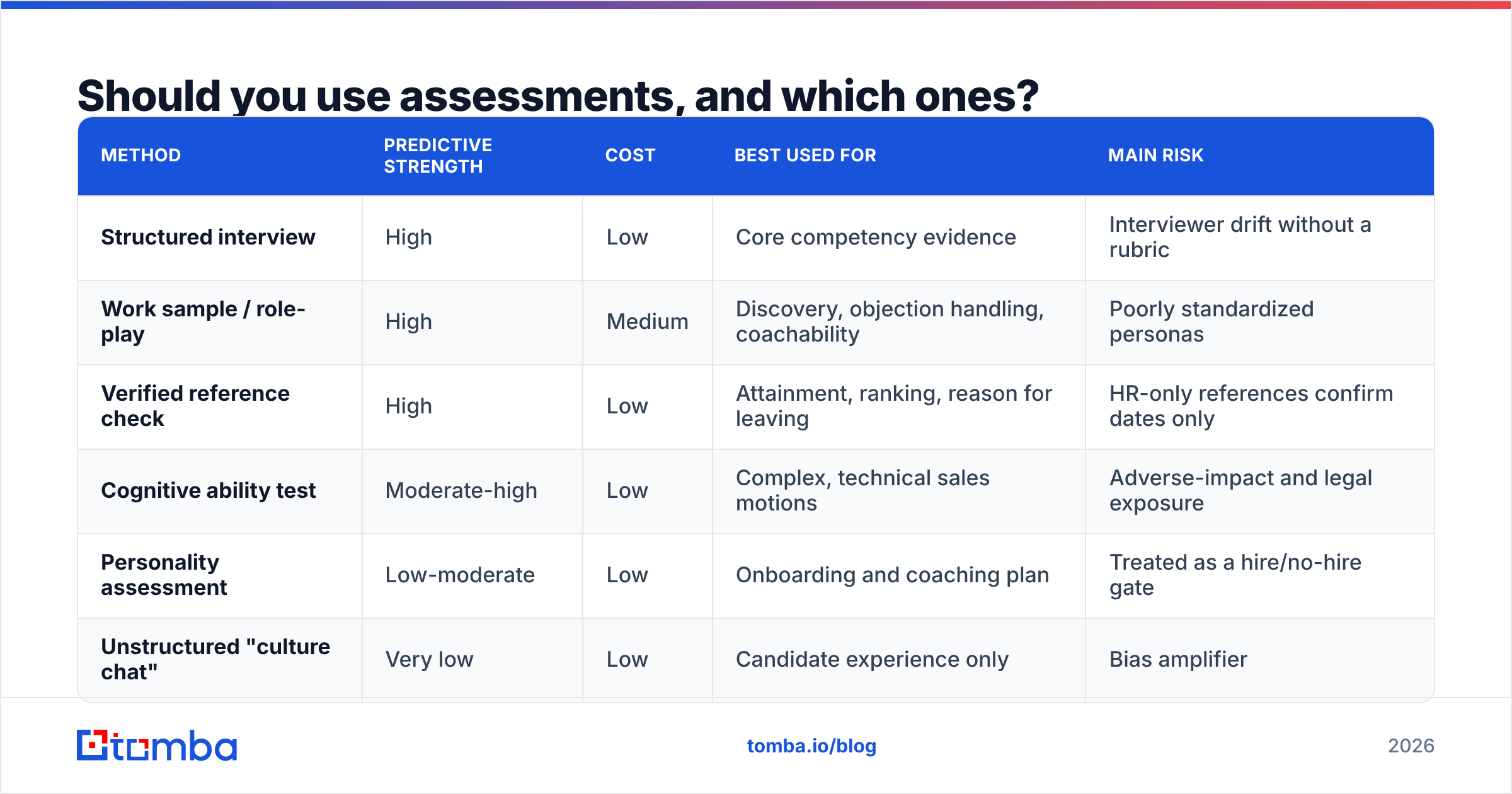
Use them as a tiebreaker and a talking point, never as a gate. Personality assessments have modest predictive validity for sales roles; work samples have much more.
| Method | Predictive strength | Cost | Best used for | Main risk |
|---|---|---|---|---|
| Structured interview | High | Low | Core competency evidence | Interviewer drift without a rubric |
| Work sample / role-play | High | Medium | Discovery, objection handling, coachability | Poorly standardized personas |
| Verified reference check | High | Low | Attainment, ranking, reason for leaving | HR-only references confirm dates only |
| Cognitive ability test | Moderate-high | Low | Complex, technical sales motions | Adverse-impact and legal exposure |
| Personality assessment | Low-moderate | Low | Onboarding and coaching plan | Treated as a hire/no-hire gate |
| Unstructured "culture chat" | Very low | Low | Candidate experience only | Bias amplifier |
If you do buy an assessment, check current, verified reviews on G2 or Capterra rather than the vendor's own case studies, and confirm the vendor can produce validity evidence for sales roles specifically. Many cannot.
How do you check references without getting a useless answer?#
Go around the official list. Formal references are curated, and most HR departments will only confirm employment dates.
The back-channel approach, done ethically:
- Ask the candidate first. "I'd like to speak with your last two direct managers. Can you make an intro?" Refusal without a good reason (current employer doesn't know, sensible) is a flag.
- Find the right people yourself. Former managers and peers from two roles back are usually safe to contact — they have no current stake. A reverse email lookup or a LinkedIn finder gets you a working address when a mutual connection isn't available. Always disclose why you are reaching out.
- Ask ranking questions, not adjective questions. "Where would you rank them among the reps you've managed?" and "Would you hire them again tomorrow, for what role?" produce far more signal than "What are their strengths?"
- Listen for the pause. Hesitation before "Yes, absolutely" is the most reliable negative reference signal in existence.
Two scripted questions worth stealing:
- "On a 1-10 scale, how would you rate their performance?" Then: "What would have made them a 10?" The second question is where the real answer lives.
- "Who else should I speak to about them?" Follow that chain one level.
What are the most common hiring mistakes to avoid?#
- Hiring the closer when you need a hunter. Verify self-sourced pipeline percentage. A rep from a company with a mature inbound engine may never have built a list.
- Ignoring motion fit. Transactional SMB reps and enterprise multithreaders are different jobs. Ask about buying-group size and cycle length, and match it to your motion.
- Skipping the writing test. Most B2B selling is written now. If you never see their prose, you are hiring blind on half the job.
- Confusing energy with skill. High energy is not discovery discipline. The rubric protects you here.
- Over-indexing on industry experience. Domain knowledge is teachable in about a quarter. Coachability and prospecting discipline are not.
- Letting the loop drag. Reference the response rate discipline you would apply to a deal: speed of follow-up wins candidates the same way it wins buyers.
For the scorecard-and-outcomes framework in more depth, HubSpot's sales hiring resources and the topgrading-style interview literature both cover the mechanics well. The core idea is old and still underused: define the job in measurable outcomes, then test for those outcomes directly.
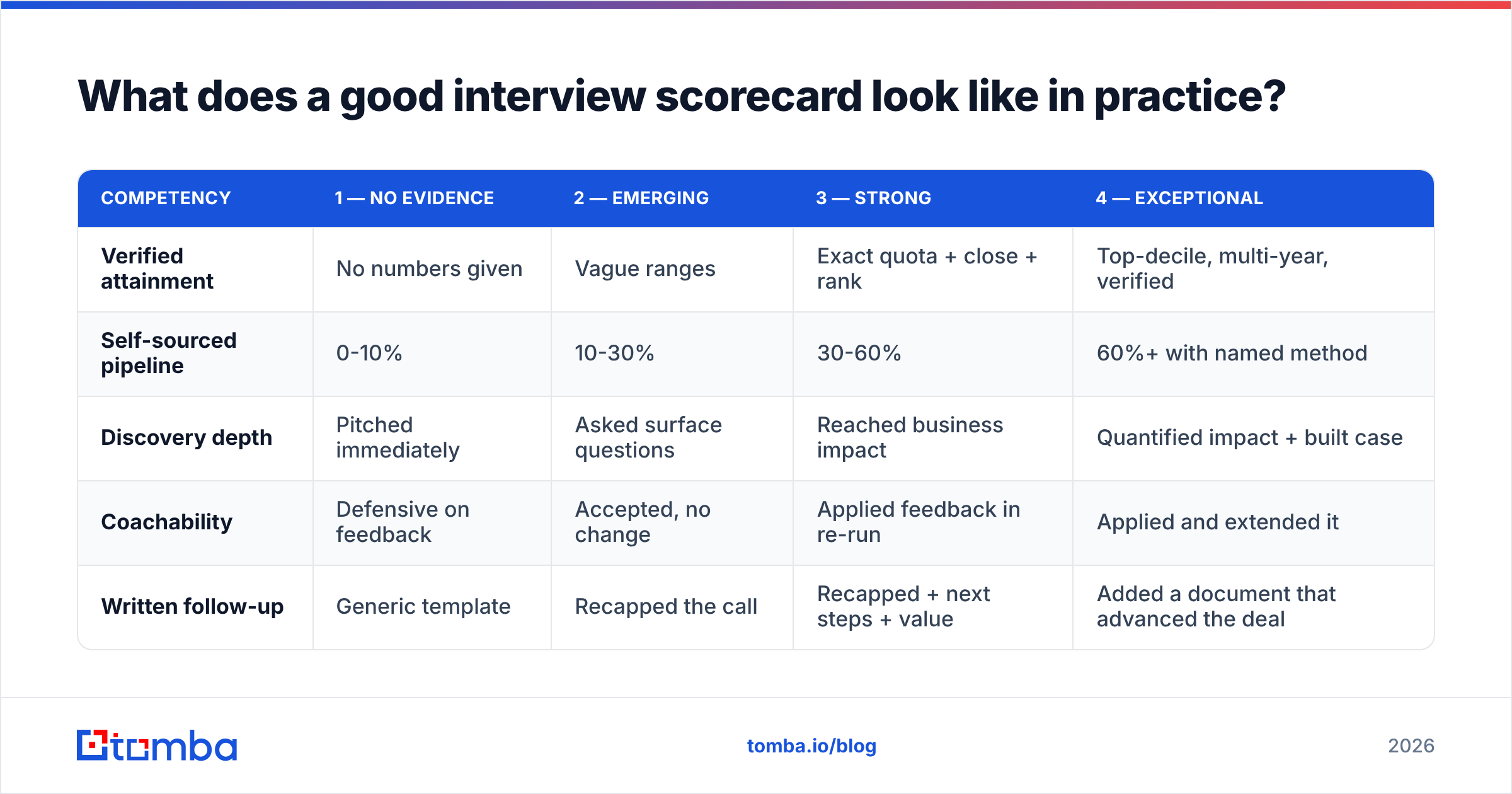
What does a good interview scorecard look like in practice?#
Keep it to one page and force a numeric rating on every line. Free-text-only feedback lets interviewers hedge.
| Competency | 1 — No evidence | 2 — Emerging | 3 — Strong | 4 — Exceptional |
|---|---|---|---|---|
| Verified attainment | No numbers given | Vague ranges | Exact quota + close + rank | Top-decile, multi-year, verified |
| Self-sourced pipeline | 0-10% | 10-30% | 30-60% | 60%+ with named method |
| Discovery depth | Pitched immediately | Asked surface questions | Reached business impact | Quantified impact + built case |
| Coachability | Defensive on feedback | Accepted, no change | Applied feedback in re-run | Applied and extended it |
| Written follow-up | Generic template | Recapped the call | Recapped + next steps + value | Added a document that advanced the deal |
Require every interviewer to submit ratings within two hours of the interview, before the debrief. Then debrief in reverse seniority order so the most junior interviewer speaks first. Both rules cost nothing and remove most of the social pressure that corrupts hiring decisions.
How do you set the new rep up so the hire actually sticks?#
A good interview process is wasted if week one is chaos. Convert the scorecard into a 30/60/90 plan before the offer goes out, and give the rep working infrastructure on day one: a clean territory list, verified contact data, CRM access, and a call library.
The most common ramp killer is dirty data. A new rep who spends their first three weeks bouncing emails builds neither pipeline nor confidence — and a spike in bounces from a new sender damages your domain reputation at exactly the wrong moment. Hand them a pre-verified list instead. Bulk-verifying a territory takes minutes with a bulk email finder, and it removes the single most demoralizing part of a new rep's first month.
Then measure ramp against the outcomes you wrote in the scorecard. If your interview process is working, attainment at month six should correlate with interview scores. If it doesn't correlate after ten hires, your rubric is measuring the wrong things — fix the rubric, not the candidates.
Ready to give your new reps data worth calling?#
The fastest way to prove your hiring process works is to remove every excuse in the first 90 days. Give each new rep a verified, enriched territory list on day one instead of a spreadsheet full of guesses.
Start with the Tomba Email Finder — find verified professional addresses by name, domain, or company, then push them straight into your CRM. The free tier gives you 25 searches a month to test the data quality on your own accounts, and paid plans start at $49/mo on Starter, with Growth at $99/mo and Pro at $249/mo. Check full Tomba pricing to match a plan to your team size, or wire it into your stack directly through the Tomba API.
Hire on evidence. Ramp on clean data. Both are process problems, and both are solvable this quarter.
Related guides#
// get started
Find, verify and enrich your first contacts today
Start on the free plan with 25 searches a month, then scale when your team is ready.
Free plan · No credit card required · GDPR & CCPA
Get the Tomba newsletter
Product and data updates
// about the author