How to Introduce Your Company via Email: Sample Templates
Most company introduction emails get deleted in under three seconds. Here are seven tested templates, a structure that survives a skim, and the sending rules that decide whether anyone reads them.
TL;DR
- A company introduction email works when it leads with the reader's situation, not your founding story. Three sentences of context beats three paragraphs of history.
- The structure that survives a skim: relevant trigger → one-line company description → specific proof → single low-friction ask. Everything else is padding.
- Subject lines under 45 characters and bodies under 120 words consistently out-perform long-form intros in cold contexts. Warm intros can run longer.
- Seven copy-paste samples below cover cold outbound, warm referral, post-event, partnership, vendor pitch, re-introduction after a rebrand, and new-account-manager handover.
- Template quality is only half the job. If the address is stale or unverified, the best copy on earth bounces. Verify before you send.
What is a company introduction email, and when do you actually need one?#
A company introduction email is a short message whose job is to make a stranger understand who you are, why you are relevant to them right now, and what the next step is. That is the whole scope. It is not a brochure, not a case study, and not a pitch deck in prose form.
Think of it like introducing yourself at a conference dinner. You do not open with your company's 2011 founding story and your Series A. You say your name, what you do in one line, and why you are talking to this person. Then you shut up and let them respond. Email works identically — the only difference is that the other person can walk away silently by never opening the message.
You need one in five common situations:
- Cold outbound — no prior relationship, you found them through research or intent data.
- Warm referral — a mutual contact told you to reach out, and their name is your credibility.
- Post-event follow-up — you met at a trade show, webinar, or conference and need to convert a badge scan into a conversation.
- Partnership or vendor outreach — you are proposing a commercial relationship, not selling a seat.
- Account handover or rebrand — the relationship exists but the face or the name has changed.
Each of these needs a different opening line and a different ask. Using one generic template across all five is why most introduction emails read like form letters.
What structure should a company introduction email follow?#
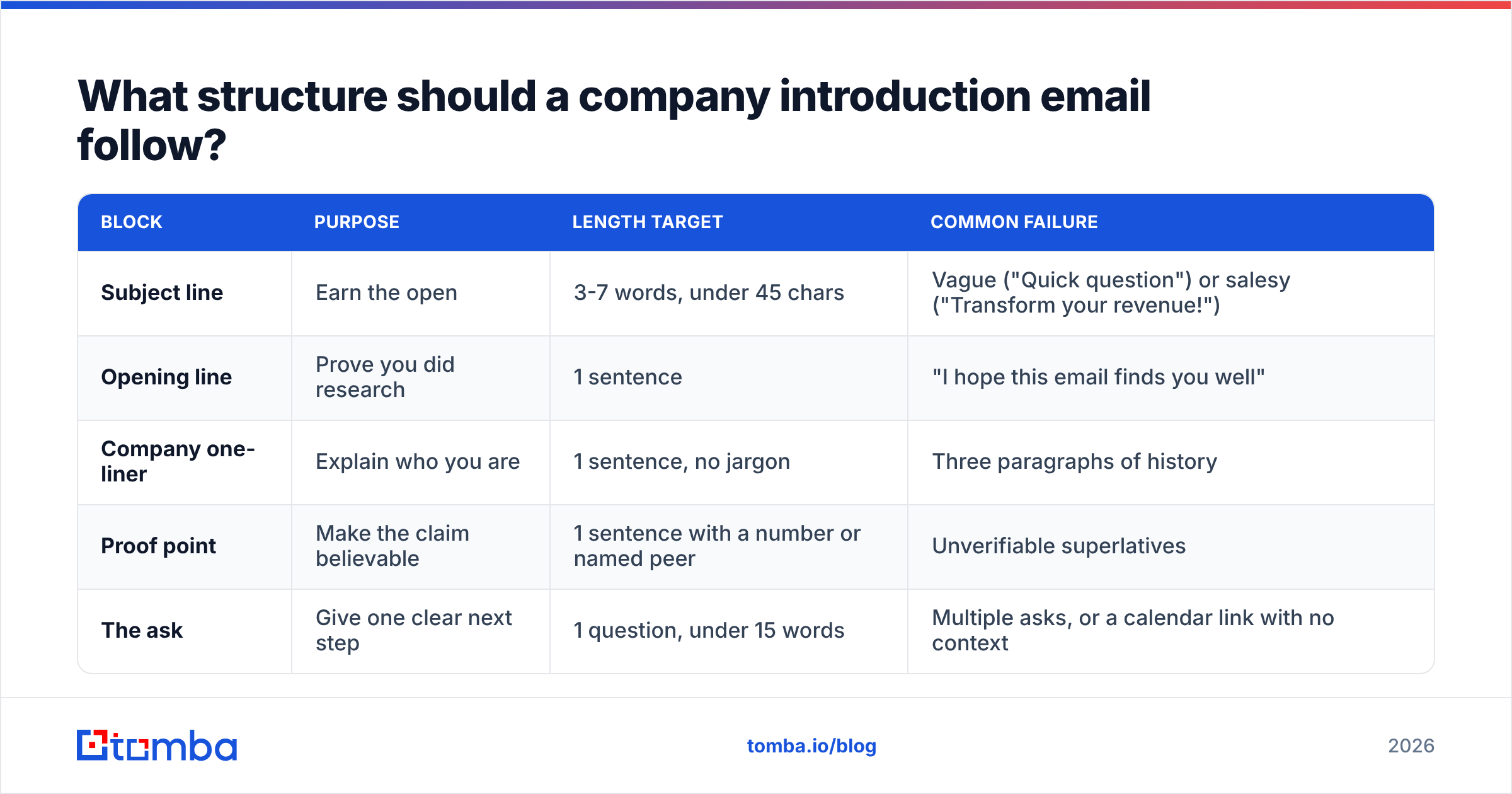
Every high-performing introduction email I have seen breaks into the same five blocks. Miss one and the message either feels like spam or leaves the reader with nothing to act on.
| Block | Purpose | Length target | Common failure |
|---|---|---|---|
| Subject line | Earn the open | 3-7 words, under 45 chars | Vague ("Quick question") or salesy ("Transform your revenue!") |
| Opening line | Prove you did research | 1 sentence | "I hope this email finds you well" |
| Company one-liner | Explain who you are | 1 sentence, no jargon | Three paragraphs of history |
| Proof point | Make the claim believable | 1 sentence with a number or named peer | Unverifiable superlatives |
| The ask | Give one clear next step | 1 question, under 15 words | Multiple asks, or a calendar link with no context |
The ratio matters as much as the blocks. In a cold introduction, roughly 60% of the words should be about the recipient's world and 40% about yours. Most drafts land at 10/90 — which is exactly why they get deleted.

A second structural rule: one idea per email. If you want a meeting and a whitepaper download and a LinkedIn connection, you will get none of them. Pick the smallest commitment that moves the relationship forward. For a cold intro, that is usually a yes/no question — not a 30-minute call.
How do you write the subject line so the email gets opened?#
The subject line is a separate writing problem from the body, and it deserves separate drafting time. Here is what holds up across cold contexts:
- Reference something specific to them. "Your Q3 hiring push" beats "Introducing Acme."
- Stay under 45 characters so it renders fully on mobile, where the majority of B2B email is now first previewed.
- Skip the exclamation marks and the ALL CAPS. Both are spam-filter signals and both read as desperate.
- Do not fake a reply. "RE:" on a thread that never existed burns trust the moment they open it.
- Lowercase can work for founder-to-founder outreach; it reads like a person, not a marketing automation platform.
If you want to pressure-test variants before sending, run them through a subject line tester rather than guessing. Small differences in phrasing move open rates more than most people expect, and a bad subject line means the body you spent an hour on never gets read at all.
What are the best company introduction email samples?#
Seven templates below. Replace the bracketed fields, delete anything that does not apply, and resist the urge to add a paragraph about your company values.
Sample 1 — Cold outbound#
Subject: [Trigger event] at [Company]
Hi [First name],
Saw [Company] just [specific trigger — opened a Berlin office / posted 12 SDR roles / launched the self-serve tier]. That usually means [specific operational problem the trigger creates].
We're [Your company] — we help [customer type] [outcome] without [common trade-off]. [Named peer company] cut [metric] by [number]% in [timeframe] after switching.
Worth a 10-minute look, or is this not a priority this quarter?
[Your name]
Sample 2 — Warm referral#
Subject: [Referrer name] suggested I reach out
Hi [First name],
[Referrer name] mentioned you're rebuilding [team/process] and thought we should talk.
Quick context: [Your company] does [one-line description]. We worked with [Referrer's company] on [specific project], which is why they made the connection.
Are you open to a short call next week? Happy to send over what we did for [Referrer's company] first if that's more useful.
[Your name]
Sample 3 — Post-event follow-up#
Subject: Following up from [Event name]
Hi [First name],
Good talking at [Event] — you mentioned [specific thing they said about their stack or problem]. That stuck with me.
[Your company] helps teams in exactly that spot: [one-line description]. I pulled together [specific resource relevant to their comment] — want me to send it?
[Your name]
Sample 4 — Partnership outreach#
Subject: [Their product] + [Your product] integration?
Hi [First name],
We have [number] mutual customers using [Their product] alongside [Your product], and they keep asking us to connect the two.
[Your company] is [one-line description]. An integration would let shared users [concrete benefit] — we've already scoped it at roughly [effort estimate].
Who on your side owns partnerships?
[Your name]
Sample 5 — Vendor / supplier introduction#
Subject: [Category] supplier for [Company]
Hi [First name],
I understand you handle [category] procurement at [Company]. We supply [specific product] to [named peer 1] and [named peer 2] in your sector.
Our differentiator is [one concrete thing — lead time, certification, unit cost]. Full spec sheet and pricing available on request.
Should I send it over, or is there a formal RFP process I should follow instead?
[Your name]
Sample 6 — Re-introduction after a rebrand#
Subject: [Old name] is now [New name]
Hi [First name],
Short note: [Old company name] is now [New company name]. Same team, same [product], new name and a broader [scope].
Nothing changes on your side — your account, contract, and contacts stay as they are. New invoices will come from [new billing entity].
Anything you want me to walk through? Happy to jump on a call.
[Your name]
Sample 7 — New account manager handover#
Subject: Taking over from [Previous AM]
Hi [First name],
[Previous AM] has moved to [new role/company] and I'm picking up [Company] from here. I've read through your account history — I know you're mid-[project] and that [specific detail] is the open item.
I'd like 20 minutes to make sure nothing drops. Does [day] or [day] work?
[Your name]
How do the main email introduction approaches compare?#
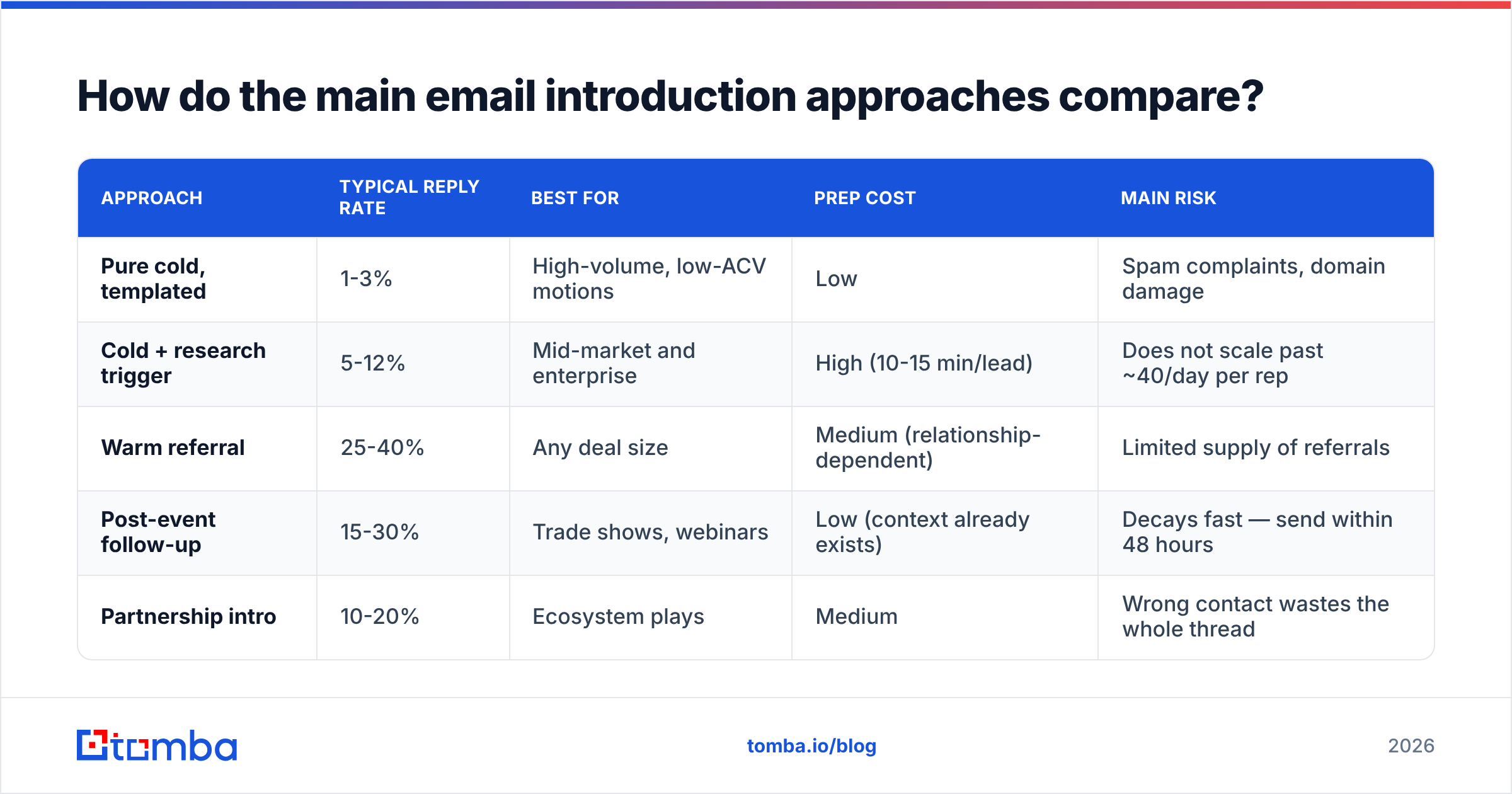
Not every situation calls for the same approach. Here is how the four dominant styles stack up on the metrics that matter:
| Approach | Typical reply rate | Best for | Prep cost | Main risk |
|---|---|---|---|---|
| Pure cold, templated | 1-3% | High-volume, low-ACV motions | Low | Spam complaints, domain damage |
| Cold + research trigger | 5-12% | Mid-market and enterprise | High (10-15 min/lead) | Does not scale past ~40/day per rep |
| Warm referral | 25-40% | Any deal size | Medium (relationship-dependent) | Limited supply of referrals |
| Post-event follow-up | 15-30% | Trade shows, webinars | Low (context already exists) | Decays fast — send within 48 hours |
| Partnership intro | 10-20% | Ecosystem plays | Medium | Wrong contact wastes the whole thread |
The pattern is obvious: the more context you bring, the fewer emails you need to send. A rep sending 30 researched introductions a day will usually beat one sending 300 generic ones, and will not torch the sending domain doing it.
Why do most company introduction emails fail before the copy matters?#
Because they never arrive. This is the part template roundups skip.
Three failure points sit upstream of your copy:
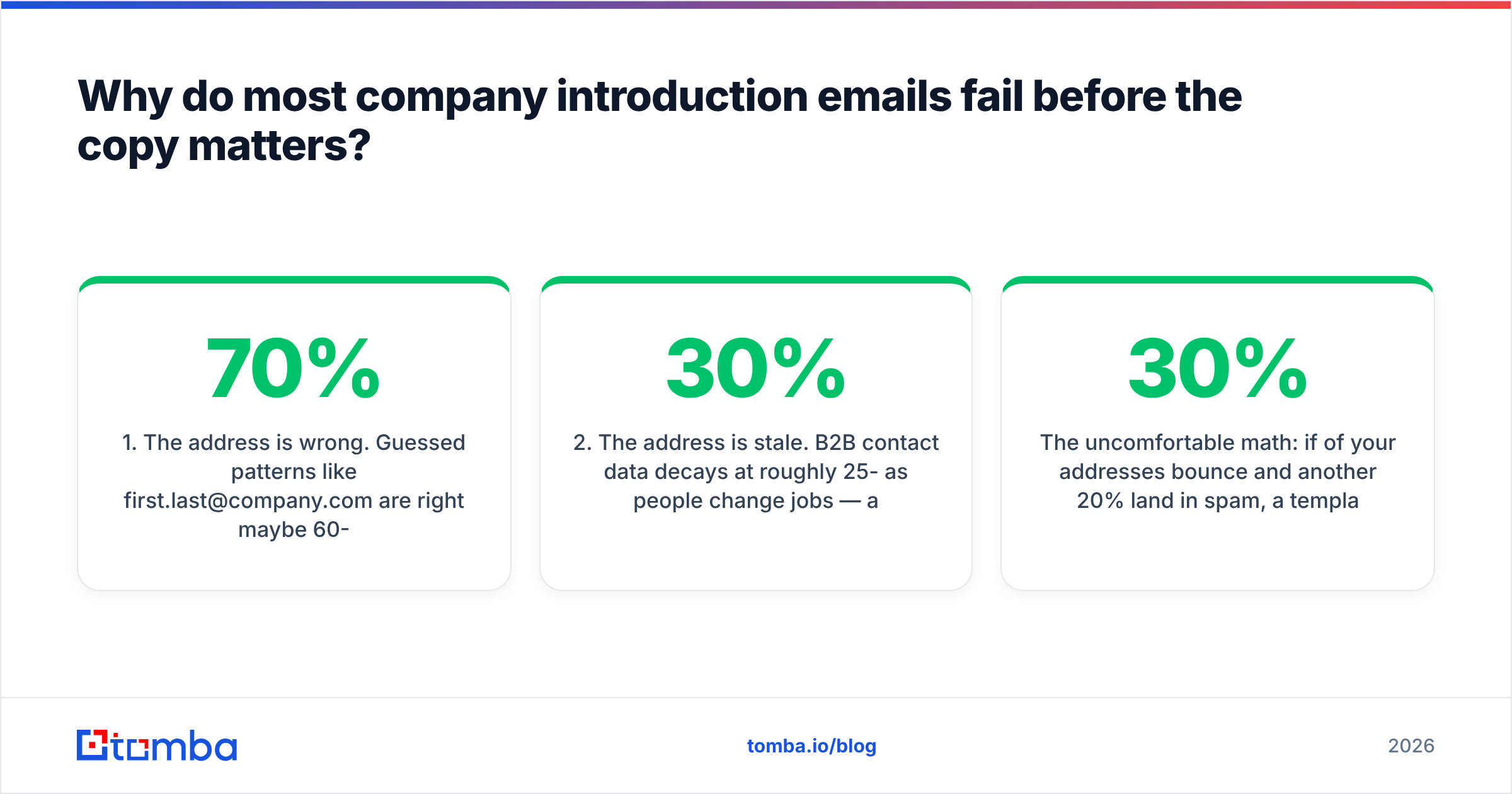
1. The address is wrong. Guessed patterns like first.last@company.com are right maybe 60-70% of the time depending on the sector. Every wrong guess is a hard bounce, and hard bounces above roughly 2% start damaging your sender reputation with the inbox providers. Use an email finder that returns a confidence score and sources rather than permutating and hoping.
2. The address is stale. B2B contact data decays at roughly 25-30% per year as people change jobs — a figure consistently reported across the data-quality literature and echoed in HubSpot's research on database decay. A list you bought or scraped 18 months ago is now closer to half dead. Run it through an email verifier before the campaign, not after the bounces roll in.
3. The domain is not ready. A brand-new sending domain with no SPF, DKIM, or DMARC records, blasting 500 introductions on day one, will land in spam regardless of how good the writing is. Check your SPF record setup and warm the domain gradually before volume outreach.

The uncomfortable math: if 30% of your addresses bounce and another 20% land in spam, a template with a genuinely excellent 12% reply rate produces the same absolute number of conversations as a mediocre one sent to a clean list. Data hygiene is not a side quest — it is a multiplier on everything else you do.
How do you personalise at scale without sounding like a robot?#
Personalisation has a floor and a ceiling. The floor is merge tags — first name, company name — which every recipient now recognises as automation and discounts accordingly. The ceiling is a bespoke paragraph per prospect, which does not scale past a few dozen sends a week.
The workable middle is segment-level personalisation with one variable detail:
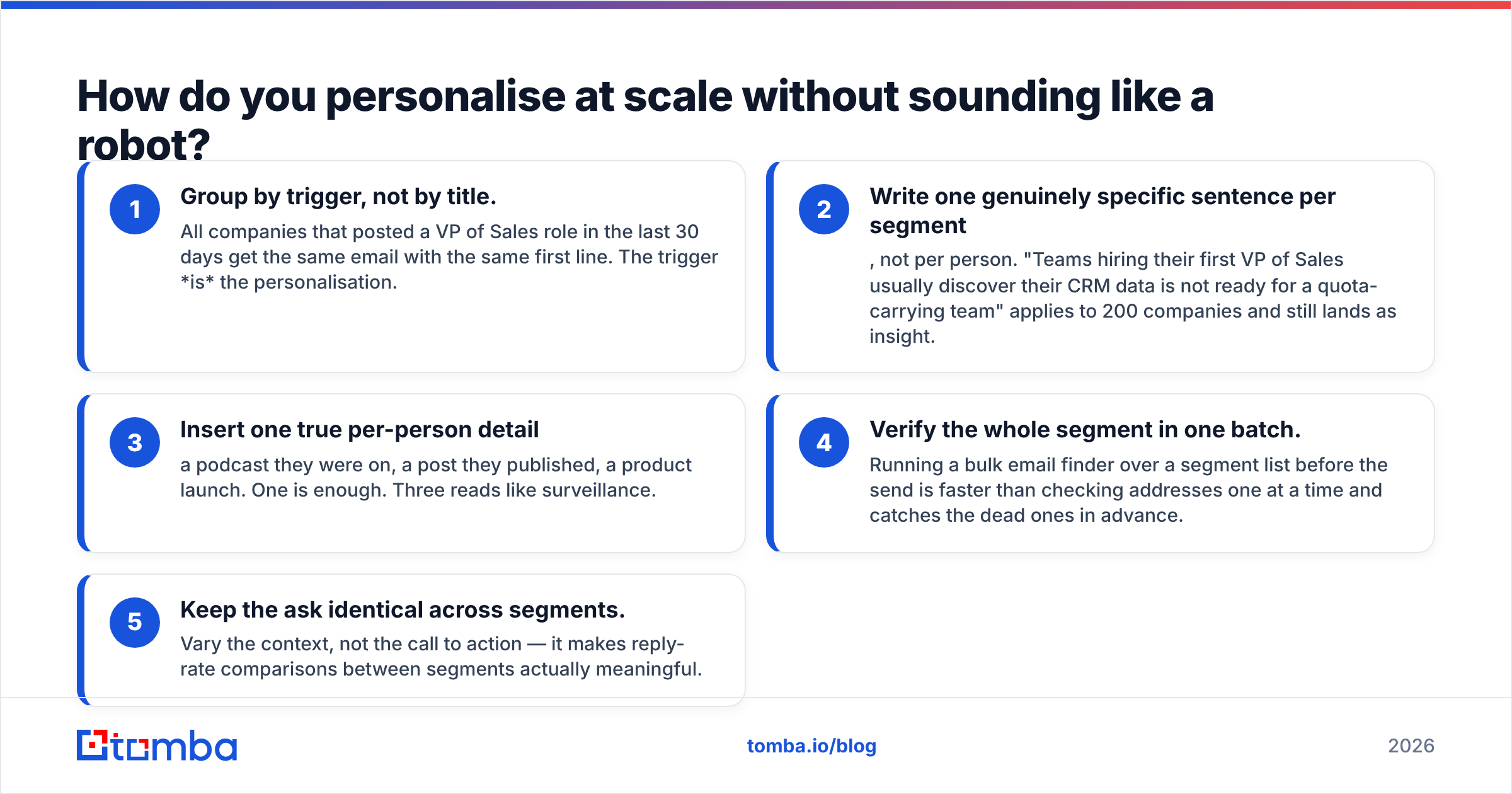
- Group by trigger, not by title. All companies that posted a VP of Sales role in the last 30 days get the same email with the same first line. The trigger is the personalisation.
- Write one genuinely specific sentence per segment, not per person. "Teams hiring their first VP of Sales usually discover their CRM data is not ready for a quota-carrying team" applies to 200 companies and still lands as insight.
- Insert one true per-person detail — a podcast they were on, a post they published, a product launch. One is enough. Three reads like surveillance.
- Verify the whole segment in one batch. Running a bulk email finder over a segment list before the send is faster than checking addresses one at a time and catches the dead ones in advance.
- Keep the ask identical across segments. Vary the context, not the call to action — it makes reply-rate comparisons between segments actually meaningful.
Tools that do this well tend to be judged on data coverage rather than copy features. If you are evaluating options, G2's sales intelligence category is a reasonable neutral starting point — reviews there tend to surface data-accuracy complaints that vendor pages do not.
How do you follow up when the introduction gets no reply?#
Most replies to introduction emails come on the second or third touch, not the first. Silence is not rejection; it is usually a full inbox.
Rules that hold up:
- Two to three follow-ups, then stop. Four or more starts generating complaints, which hurts you more than the deal is worth.
- Space them 3-4 business days apart. Same-day and next-day follow-ups read as anxious.
- Add something each time. A new proof point, a relevant article, a different angle on the problem. Never send "just bumping this to the top of your inbox" — it adds nothing and signals you have nothing to add.
- Change the ask on the last one. If "worth a call?" got silence, try "should I close the file on this?" The permission-to-close email reliably out-converts a fourth pitch, because it is easy to answer.
- Track by thread, not by contact. If they reply on LinkedIn instead of email, the sequence should stop. Nothing kills a warm response faster than an automated follow-up arriving after a human conversation started.
One more thing worth measuring: your response rate per segment, not per campaign. Campaign averages hide the fact that one segment is at 18% and three are at zero — and the fix for a zero segment is almost never the copy.
Which template should you use, and what should you do next?#
Match the template to the relationship, not to your preference:
- No prior contact, high-value target → Sample 1, with 10+ minutes of real research per lead.
- Mutual connection exists → Sample 2. Always. It out-performs everything else.
- Met them in person in the last 48 hours → Sample 3, sent today.
- Commercial partnership → Sample 4, and find the partnerships owner before writing.
- Procurement context → Sample 5, and ask about the RFP process early.
- Existing relationship, changed circumstances → Samples 6 and 7.
Then handle the unglamorous part. Build the target list, find the right contact at each account, confirm the addresses resolve, and only then start writing. In that order — because a perfect template sent to info@ is worth less than a mediocre one sent to the person who actually owns the problem.
If your bottleneck is getting from "I know which 200 companies to contact" to "I have 200 verified addresses for the right person at each," start with the Tomba Email Finder. It searches by domain, name, or company, returns confidence scores and sources so you can see why an address was suggested, and includes verification so you are not guessing at deliverability. The free tier gives you 25 searches a month to test the data quality against accounts you already know; paid plans start at $49/mo on Starter and $99/mo on Growth if the coverage holds up — full Tomba pricing is public, no sales call required.
Write the email second. Get the address right first.
Related guides#
Ready to find emails that actually work?
Join 150,000+ professionals who stopped guessing and started sending. Free credits on signup — no credit card required.
Get the Tomba newsletter
Practical outbound tactics and product updates — once every two weeks.
About the author