How to Launch ABM in 2026: A 90-Day Playbook That Works
Most first ABM programs die in month two, not because the strategy was wrong but because the account list and contact data were. Here is a 90-day launch plan with the tiering, data layers, plays, and metrics that actually hold up.
TL;DR
- Launch with 1:few ABM, not 1:1. Thirty accounts in three clusters gives you enough signal in one quarter; five hand-crafted 1:1 accounts gives you an anecdote.
- The account list is the strategy. If you can't defend why each account is on it, no amount of personalized creative will save the program.
- Contact coverage kills more ABM launches than creative does. You need 6-10 verified contacts per account across the buying committee before you spend a dollar on ads or gifting.
- Budget 40% of program spend on data and list hygiene in quarter one. It feels wrong. It is correct.
- Measure account engagement, meeting rate per tier, and pipeline per account — not impressions, not MQLs.
What is ABM, and why do most launches stall?#
Account-based marketing flips the funnel. Instead of casting a net, collecting leads, and hoping some of them work at companies you want, you pick the companies first and then work backwards to the people inside them.
Think of it like a restaurant deciding to stop serving walk-ins and start catering weddings. Same kitchen, same chefs — but now you need the guest list before you cook anything. Everything downstream depends on that list being right.
That's why launches stall. Teams spend six weeks on messaging frameworks and personalized landing pages, then discover they have three contacts at a 4,000-person enterprise and two of them left in 2024. The account-based marketing category on G2 is full of orchestration platforms that assume you already solved data. You haven't.
A second common stall: ABM gets run as a marketing project. It isn't. It's a revenue operations motion that requires sales to commit named reps to named accounts before anything ships. If sales hasn't signed off on the list, you're running expensive demand gen with extra steps.
Which ABM model should you launch first?#
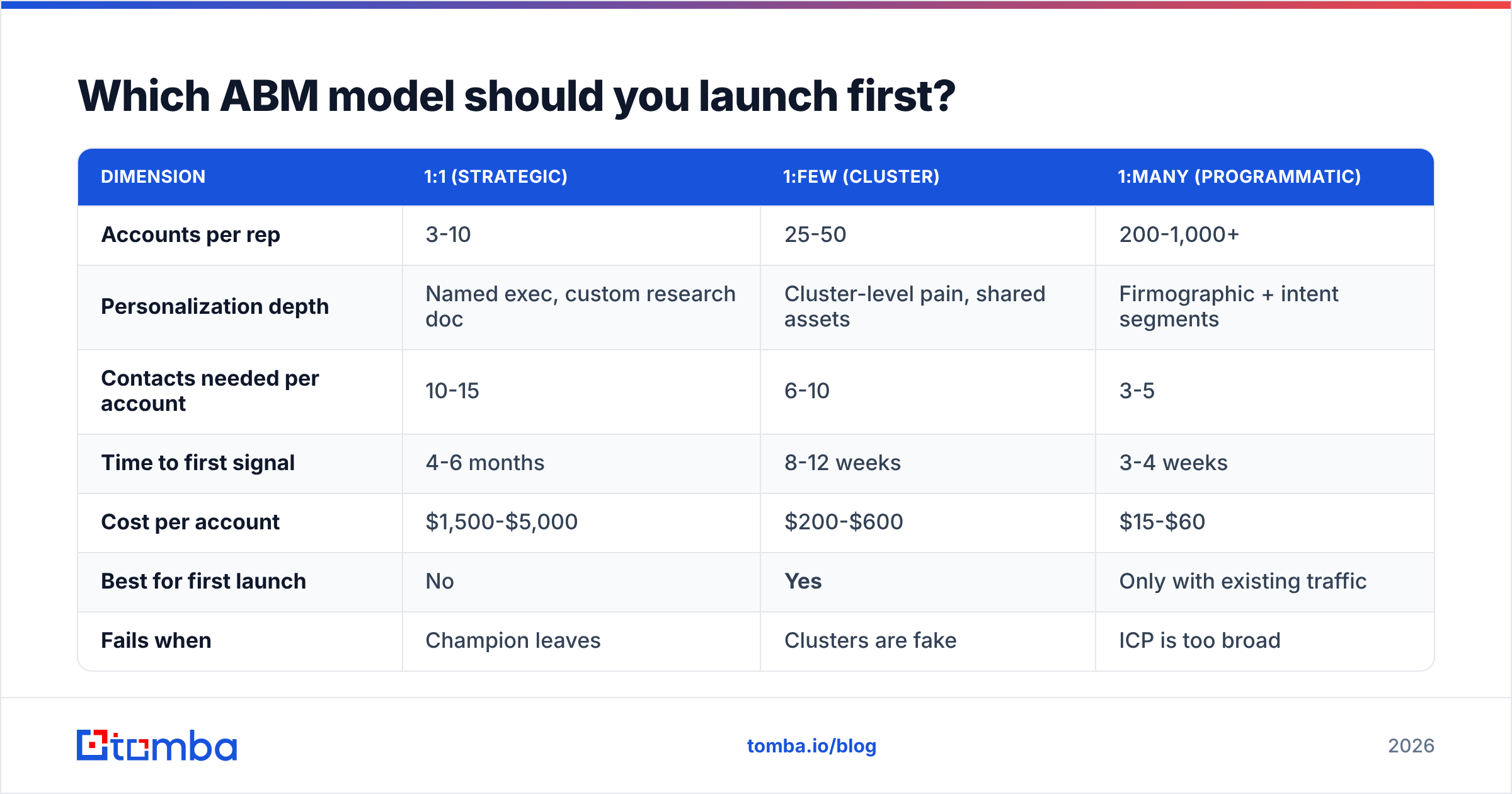
There are three standard flavors, and the mistake is starting with the most glamorous one. LinkedIn's ABM overview frames these well, but here is the practical trade-off for a first program:
| Dimension | 1:1 (Strategic) | 1:Few (Cluster) | 1:Many (Programmatic) |
|---|---|---|---|
| Accounts per rep | 3-10 | 25-50 | 200-1,000+ |
| Personalization depth | Named exec, custom research doc | Cluster-level pain, shared assets | Firmographic + intent segments |
| Contacts needed per account | 10-15 | 6-10 | 3-5 |
| Time to first signal | 4-6 months | 8-12 weeks | 3-4 weeks |
| Cost per account | $1,500-$5,000 | $200-$600 | $15-$60 |
| Best for first launch | No | Yes | Only with existing traffic |
| Fails when | Champion leaves | Clusters are fake | ICP is too broad |
Start with 1:few. You get statistical signal inside a quarter, the assets are reusable across a cluster, and the data burden is manageable. Graduate your top five performers into 1:1 in quarter two, and push the tail into 1:many programmatic retargeting once you know which segments respond.
How do you build the target account list?#
This is 80% of the work. Do it in this order:
- Mine closed-won, not the TAM deck. Pull every deal you closed in the last 18 months. Tag industry, employee count, tech stack, region, and — critically — the job title of the person who first replied. Patterns in your wins beat any analyst's market map.
- Define disqualifiers before qualifiers. It's easier to agree on what's not a fit. No accounts under 50 employees. No accounts with an incumbent renewal more than nine months out. No accounts in regions you can't support. Disqualifiers cut a 5,000-account list to 800 fast.
- Score on fit and timing separately. Fit is static (size, industry, stack). Timing is dynamic (hiring for the role you sell to, funding round, new VP, competitor churn signal). An account needs both to enter tier 1. High fit + no timing goes to the nurture pool.
- Cap the list at what your reps can actually work. Three reps × 30 accounts = 90 accounts. Not 400. A list you can't cover is a list that generates guilt, not pipeline.
- Get written sales sign-off, account by account. Have each rep initial their assigned accounts. This single step is the difference between ABM and marketing sending emails nobody follows up on.
- Set a re-scoring cadence. Monthly. Accounts move tiers. Programs that never re-score end the quarter targeting companies that already bought from a competitor.
What data do you actually need before launching?#
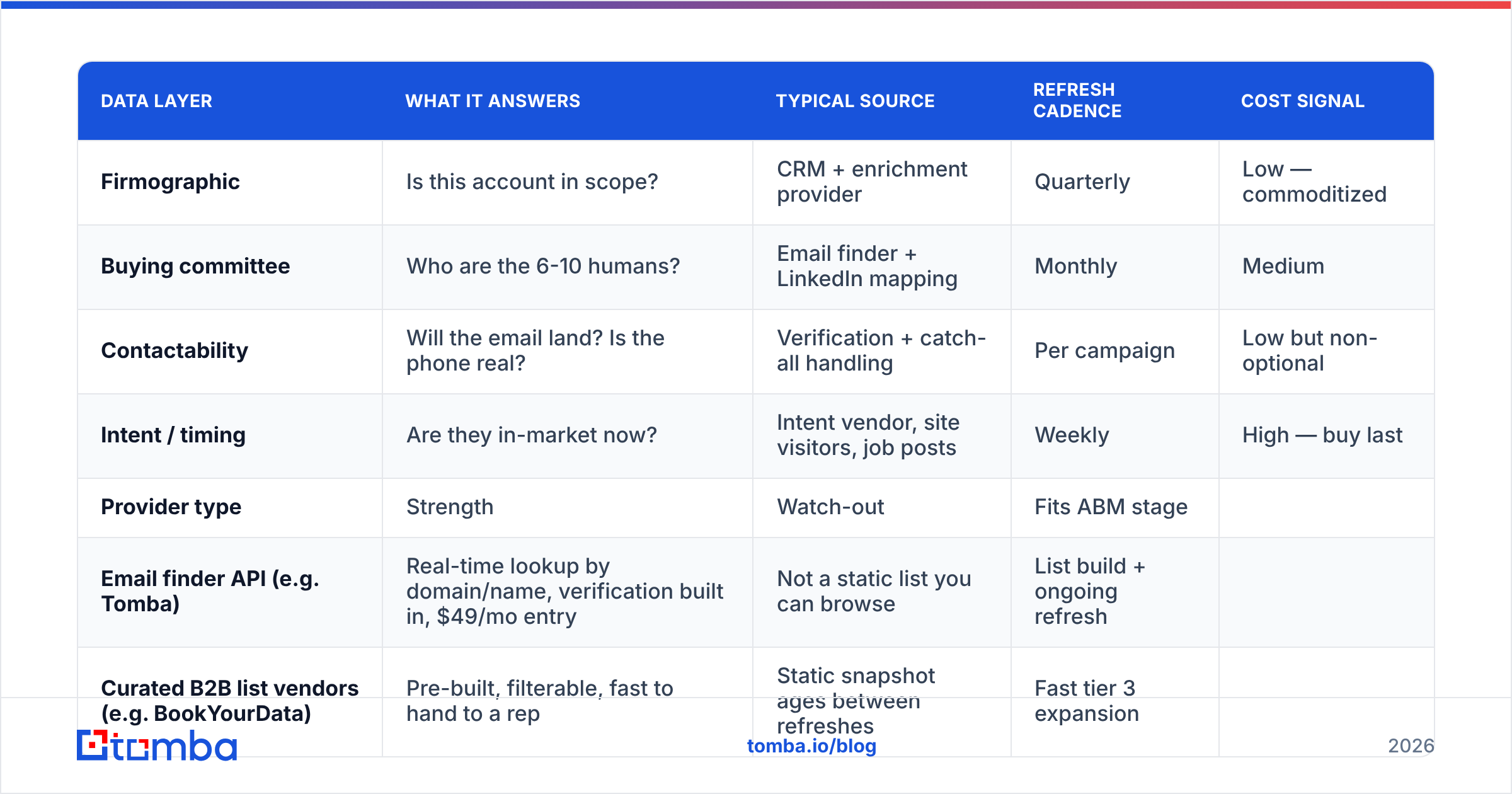
Four layers, and most teams only have one. Here is what a functional ABM data stack looks like and where each layer typically comes from:
| Data layer | What it answers | Typical source | Refresh cadence | Cost signal |
|---|---|---|---|---|
| Firmographic | Is this account in scope? | CRM + enrichment provider | Quarterly | Low — commoditized |
| Buying committee | Who are the 6-10 humans? | Email finder + LinkedIn mapping | Monthly | Medium |
| Contactability | Will the email land? Is the phone real? | Verification + catch-all handling | Per campaign | Low but non-optional |
| Intent / timing | Are they in-market now? | Intent vendor, site visitors, job posts | Weekly | High — buy last |
The order matters. Teams buy intent data first because it's the exciting layer, then discover they can't act on an intent spike because they have one generic info@ address for the account. Intent without contactability is a smoke alarm with no fire exit.
Build the middle two layers first. Use a domain search to map every reachable contact at a target domain, then filter to the titles in your buying committee model. Run everything through an email verifier before it touches a sending tool — a 12% bounce rate on a 30-account program isn't just wasted sends, it's a deliverability problem that follows you into quarter two.
For net-new accounts outside your existing data footprint, provider choice comes down to coverage in your specific segment. Reputable options differ meaningfully by region and company size:
| Provider type | Strength | Watch-out | Fits ABM stage |
|---|---|---|---|
| Email finder API (e.g. Tomba) | Real-time lookup by domain/name, verification built in, $49/mo entry | Not a static list you can browse | List build + ongoing refresh |
| Curated B2B list vendors (e.g. BookYourData) | Pre-built, filterable, fast to hand to a rep | Static snapshot ages between refreshes | Fast tier 3 expansion |
| Full sales-intelligence suites | Intent + contacts + sequencing in one | Seat pricing scales hard past 5 reps | Mature programs with budget |
| Manual research (SDR + LinkedIn) | Highest accuracy on 1:1 accounts | ~15 min per contact | Tier 1 only |
Most 90-day launches end up blending two: an API for continuous enrichment, plus one curated source for breadth. Check Tomba pricing against your account count before you commit — 30 accounts × 8 contacts is 240 lookups, which sits comfortably inside a starter plan.
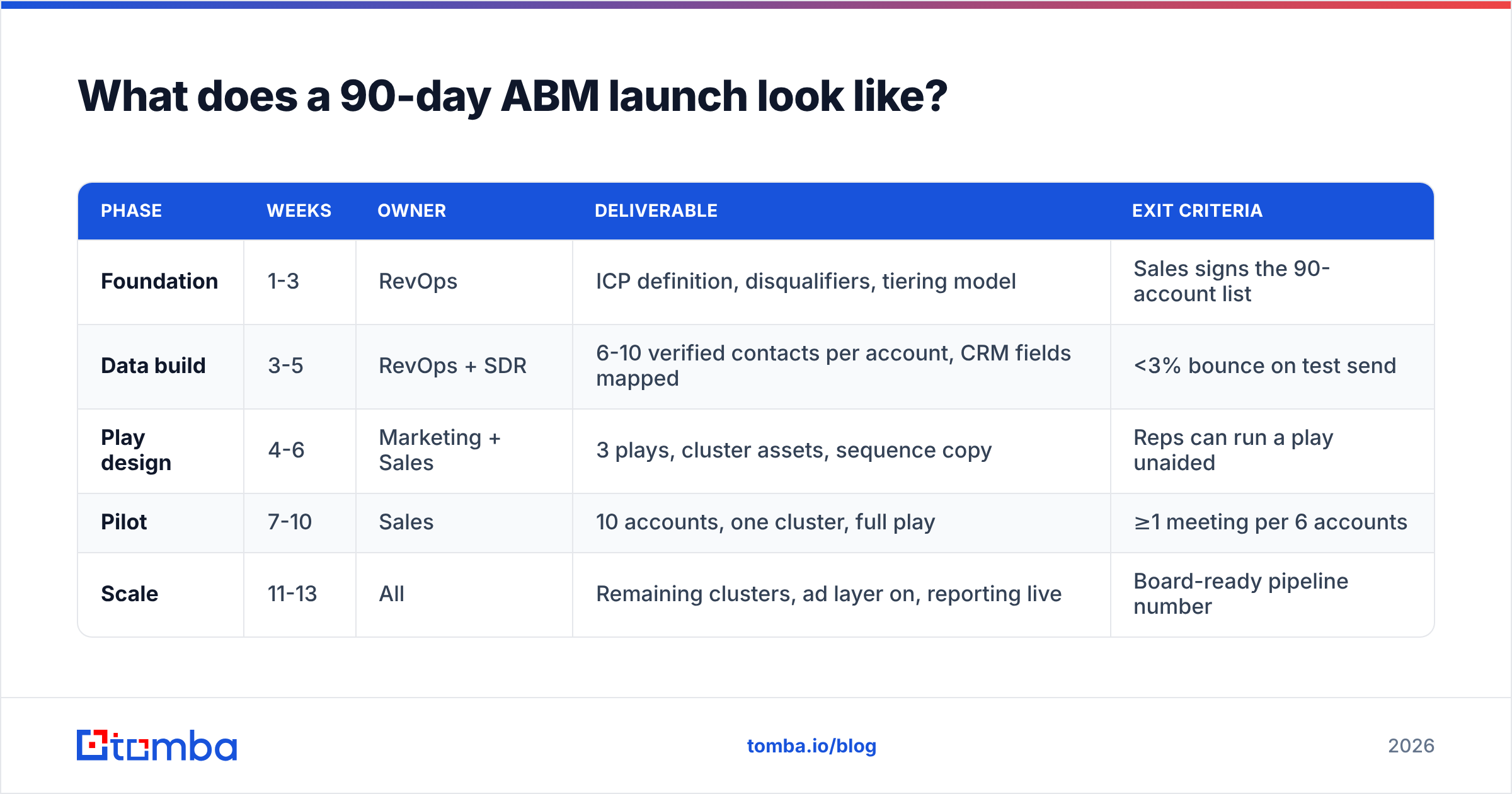
What does a 90-day ABM launch look like?#
| Phase | Weeks | Owner | Deliverable | Exit criteria |
|---|---|---|---|---|
| Foundation | 1-3 | RevOps | ICP definition, disqualifiers, tiering model | Sales signs the 90-account list |
| Data build | 3-5 | RevOps + SDR | 6-10 verified contacts per account, CRM fields mapped | <3% bounce on test send |
| Play design | 4-6 | Marketing + Sales | 3 plays, cluster assets, sequence copy | Reps can run a play unaided |
| Pilot | 7-10 | Sales | 10 accounts, one cluster, full play | ≥1 meeting per 6 accounts |
| Scale | 11-13 | All | Remaining clusters, ad layer on, reporting live | Board-ready pipeline number |
Two notes on this timeline. First, data build overlaps with play design deliberately — the contacts you find shape which plays are viable. If you can only reach practitioners and never directors at your target accounts, a "CFO business case" play is dead on arrival.
Second, the pilot gate is real. If ten accounts and a full play produce zero meetings, do not scale. Diagnose: wrong accounts, wrong contacts, or wrong message. Scaling a broken play across 90 accounts just burns the list faster.
How do you build your first three plays?#
Keep it to three. More than that and reps stop executing any of them well.
Play 1 — The committee wedge. Pick one cluster. Identify three roles that all feel the same pain differently (say, VP Sales, RevOps lead, and a frontline manager). Send three different messages within a 10-day window referencing the same underlying problem. You are not trying to get all three to reply — you are creating internal cross-talk. This is where contact depth pays off; with two contacts per account, the wedge doesn't work.
Play 2 — The trigger response. Define three triggers you'll act on within 48 hours: a relevant job posting, a funding announcement, a new exec in a target function. Route the alert to the owning rep with the contact already enriched. Speed is the entire value here — a five-day-old trigger is just news.
Play 3 — The revival. Every company has closed-lost accounts from 12-24 months ago where the champion has since moved or the blocking reason expired. Re-enrich them, confirm who's still there, and open with what changed on your side. This play has the highest reply rate of the three and the lowest cost, and almost nobody runs it.
Wrap all three in a shared measurement frame so you can tell which one is carrying the program. HubSpot's ABM resources are a decent free reference for play structure if you want templates to adapt rather than start blank.
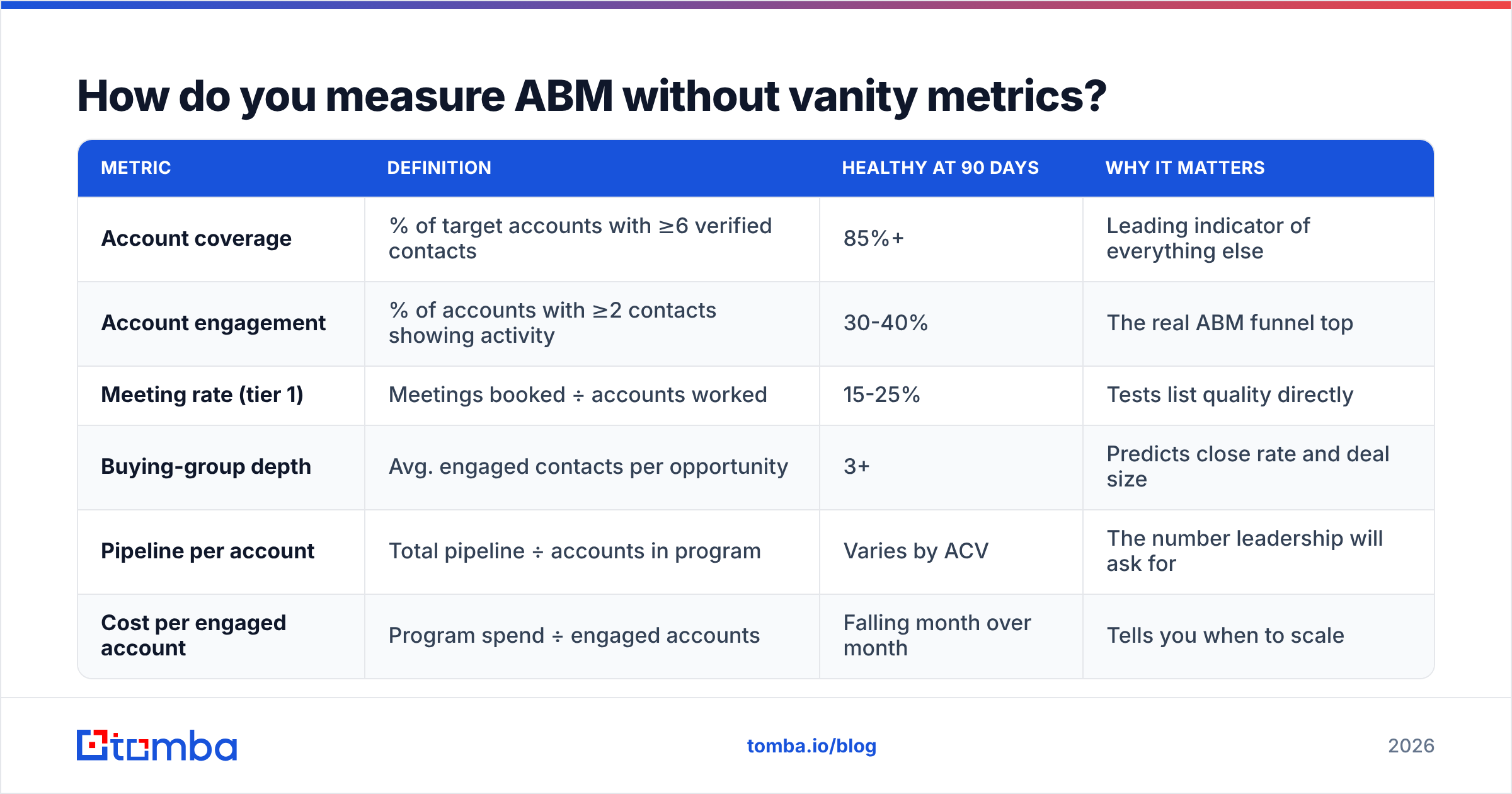
How do you measure ABM without vanity metrics?#
MQLs are the wrong unit. A single MQL from a 12,000-person target account means nothing on its own; four engaged contacts across three departments means a deal is forming.
Track these instead:
| Metric | Definition | Healthy at 90 days | Why it matters |
|---|---|---|---|
| Account coverage | % of target accounts with ≥6 verified contacts | 85%+ | Leading indicator of everything else |
| Account engagement | % of accounts with ≥2 contacts showing activity | 30-40% | The real ABM funnel top |
| Meeting rate (tier 1) | Meetings booked ÷ accounts worked | 15-25% | Tests list quality directly |
| Buying-group depth | Avg. engaged contacts per opportunity | 3+ | Predicts close rate and deal size |
| Pipeline per account | Total pipeline ÷ accounts in program | Varies by ACV | The number leadership will ask for |
| Cost per engaged account | Program spend ÷ engaged accounts | Falling month over month | Tells you when to scale |
Report weekly on coverage and engagement, monthly on pipeline. Do not report on pipeline in week three — you'll be judged on a number that hasn't had time to exist, and the program will get cut before the pilot gate.
What kills first ABM programs?#
The list nobody defends. If the account list came from a spreadsheet marketing built alone, reps will work their own accounts instead. Sign-off is not a formality.
Stale contact data. B2B contact data decays roughly 2-3% per month through job changes alone. A list built in January is meaningfully wrong by June. Continuous data enrichment beats an annual list purchase, and it costs less over a year than one bad quarter of bounced sends.
Personalization theater. Rewriting a first line with the company name isn't personalization; it's mail-merge with extra latency. Cluster-level relevance ("here's what four other Series B fintechs did about SOC 2 evidence collection") outperforms shallow name-dropping and scales to 30 accounts instead of 5.
No sales SLA. Marketing generates an engagement signal, nobody calls for six days, signal is dead. Agree in writing: tier 1 signals get touched within 24 hours, tier 2 within 72.
Scaling before the pilot proves anything. Covered above, and it's still the most common failure. Ten accounts first.
Treating ABM as a campaign. It's a permanent operating model with a quarterly re-scoring rhythm. Programs framed as "our Q1 ABM campaign" end in Q1.
What should you do in week one?#
Concretely: pull your closed-won list, write down five disqualifiers, and count how many verified contacts you currently hold at your top 30 accounts. That last number is usually the wake-up call — most teams find they have fewer than three per account, which means they have a data project before they have an ABM program.
Fix the data layer first. Tomba's Email Finder maps the reachable buying committee at any target domain by name or role, verifies deliverability in the same call, and runs from the API, a spreadsheet, or the browser extension — so your account list stays current as people change jobs instead of decaying quietly in the CRM. Start on the free tier with 25 searches to test coverage against ten of your real target accounts, then scale to Starter at $49/mo once you've confirmed the hit rate in your segment.
Get the contacts right, and the rest of ABM is just discipline.
Related guides#
// get started
Find, verify and enrich your first contacts today
Start on the free plan with 25 searches a month, then scale when your team is ready.
Free plan · No credit card required · GDPR & CCPA
Get the Tomba newsletter
Product and data updates
// about the author